THESIS
THE CORRELATION BETWEEN STUDENTS’ ENGLISH AND ARABIC PRONUNCIATION SKILL IN PONDOK PESANTREN
AL-URWATUL WUTSQAA BENTENG SIDRAP
By
SITI WIRDA LILING Reg. Num. 16.1300.148
ENGLISH EDUCATION PROGRAM TARBIYAH FACULTY
STATE ISLAMIC INSTITUTE (IAIN) PAREPARE
2021
i
THESIS
THE CORRELATION BETWEEN ENGLISH AND ARABIC PRONUNCIATION SKILL IN PONDOK PESANTREN
AL-URWATUL WUTSQAA BENTENG SIDRAP
By
SITI WIRDA LILING Reg. Num. 16.1300.148
Submitted to the English Education Program of Tarbiyah Faculty of State Islamic Institute of Parepare in Partial of Fulfillment of the
Requirements for the Degree of Sarjana Pendidikan (S.Pd)
ENGLISH EDUCATION PROGRAM TARBIYAH FACULTY
STATE ISLAMIC INSTITUTE (IAIN) PAREPARE
2021
ii
THE CORRELATION BETWEEN ENGLISH AND ARABIC PRONUNCIATION SKILL IN PONDOK PESANTREN
AL-URWATUL WUTSQAA BENTENG SIDRAP
Thesis
As Partial Fulfillment of the Requirement for the Degree of Sarjana Pendidikan (S.Pd)
English Education Program
Submitted by
SITI WIRDA LILING Reg. Num.16.1300.148
To
ENGLISH EDUCATION PROGRAM TARBIYAH FACULTY
STATE ISLAMIC INSTITUTE (IAIN) PAREPARE
2021
iii
iv
v
vi
ACKNOWLEDGEMENTS
﷽
In the name of Allah, The Beneficent and The Merciful
First of all, the writer would like to express his gratitude to the lord Allah SWT. Who always and still lends the writer with health, bless, mercy, guide so the writer can finish this thesis. Salawat and salam always are sent to the last prophet Muhammad SAW. Peace be upon him who has guided us from the uneducated person to be the an educated person.
In this occasion, the writer wants to thanks profusely to the all people who have become the biggest supporter in mentally and physically to the writer in finishing her thesis. The writer realizes that a lot of people was care for her and lucky enough to have them. So, in this opportunity, the writer would like to express every special thanks to those special people.
The high appreciation and profusely sincere thanks are due to Dr. Anwar, M.Pd as the first consultant, Dra. Hj. Nanning, M.Pd as the second consultant who has by patiently to guide and given their construction suggestion, motivation and correction to the writer for finishing her thesis.
1. Dr. Ahmad Sultra Rustan, M.Si. as the Rector of IAIN Parepare who was worked hard to manage education at IAIN Parepare.
2. Dr. H. Saepudin, M.Pd. as The Dean of Tarbiyah Faculty IAIN Parepare, who has arranged a positive education for the students, allowed the writer to do the research.
3. Mujahidah, M.Pd. as The Chairman of English Program for the fabulous serving to the all of students.
4. Dr. H. Saepudin, M.Pd. and Drs. Ismail Latif, M.M. as a examiner whom guide the writer by giving suggestion, instruction and motivation as a member of examiner commissions.
vii
5. All the amazing lectures of English Program whom have already taught the writer during her study in IAIN Parepare.
6. The staffs of the Tarbiyah faculty that has worked hard to complete the administration for this research and back then.
7. The writer wants to give her sincerest gratitude to her beloved parents. Liling and Marhaya for the endless support and pray for the writer education until the Degree of Strata-I (S1), and the siblings Sitti Nawira Liling, Muhammad Aswar Liling, Anwar Liling, Muhammad Riswan Liling, Anna Althafunnisa, my cousin whom acquired as my sister Dian Aisyah Abidin whom always teach the writer with her patient. My nieces and all the big family who has given their pray for me.
8. Her writer’s friend from class T306 and Libam’s members whom always care, reply all the question and give a lot of encouragement to finish this thesis.
9. Her mental support’s Kim Cutest Doyoung from NCT and all the members of NCT. The Ijimayoo members as the writer’s biggest mental support system who gave constant support.
10. All the people who have given their help in writing this thesis that the writer could not mention one by one.
11. Last but not least the writer itself whom never give up and have to face it with her patiently and positively. The writer is proud of her.
Finally, the writer realized that this thesis still has much weakness and far from perfection. Therefore, the writer would highly appreciate all constructive suggestion and criticisms.
viii
DECLARATION OF THE RESEARCH AUTHENTICITY
The writer who signed the declaration below:
Name : Siti Wirda Liling
Student Reg. Number : 16.1300.148
Place and Date of birth : Parepare, January 27th1998 Study Program : English Program
Faculty : Tarbiyah
Title of Thesis : The Correlation between Students English and Arabic Pronunciation skill in Pondok Pesantren Al- Urwatul Wutsqaa Benteng Sidrap.
Stated this thesis is her own writing and if it can be proved that it was copied, duplicated or complied by any other people, this thesis and the degree that has been gotten would be postponed.
ix ABSTRACT
Siti Wirda Liling.
The Correlation between English and Arabic Pronunciation Skill in Pondok Pesantren Al-Urwatul Wutsqaa Benteng Sidrap, (Supervised by Anwar and Nanning)In learning English language, the learner might find the difficulties in pronouncing English sound which is not familiar in our mother language.
Furthermore, Indonesia who is more than 80% people who are Muslim had face learning Arabic alphabet as their way to read a holy Quran since in their young age.
Arabic, which is has the same way to produce sound in English pronunciation give the simplicity to the learners to pronounce English words which is not available in Indonesia pronunciation.
In this research, the researcher used quantitative method. The subject of this research is the students of pondok pesantren Al-Urwatul Wutsqaa Benteng Sidrap at in any grade. The data was collected by using recording test to find out the correlation between Arabic and English pronunciation.
The result of English pronunciation skill test showed that 85% of students got very good classification, 15% of students got good classification while no fair or poor classification, the mean score of the test was 86,31. The result of the Arabic test was 100% got very good classification with the mean score was 91,85. The correlation between Arabic and English pronunciation was 0,94 that can be said that there is strong correlation between Arabic and English pronunciation. The skill in pronouncing Arabic words had strong effect in pronouncing English words in pondok pesantren Al-Urwatul Wutsqaa Benteng Sidrap.
Keyword: Pronunciation skill, English, Arabic
x
LIST OF CONTENTS
COVER ... i
COVER OF TITLE ... ii
SUBMISSION PAGE ... iii
ENDORSMENT OF CONSULTANT COMMISIONS ... iv
APPROVED OF CONSULTANT COMMISIONS... v
ENDORSMENT OF EXAMINNER COMMISSIONS ... vi
ACKNOWLEDGMENT ... vii
DECLARATION ON THE AUTHENTICITY OF THE THESIS ... ix
ABSTRACK ... x
LIST OF CONTENTS ... xi
LIST OF TABLES ... xiii
LIST OF PICTURES... xiv
LIST OF APPENDICES ... xv
CHAPTER I INTODUCTION A. Background ... 1
B. Research Question ... 3
C. The Objective of The Research ... 4
D. Significance of The Research ... 4
CHAPTER II REVIEW OF RELATED LITERATURE A. Previous Research Findings ... 6
B. Some Pertinent Ideas ... 9
C. Conceptual Framework ... 20
D. Operational Definition of Variable ... 21
xi CHAPTER III RESEARCH METHOD
A. Research Design and Variables ... 23
B. Location and Duration ... 24
C. Population and Sample ... 24
D. The Instrument of the Research ... 24
E. The Procedure of Collecting Data ... 25
F. The Technique of Data Analysis ... 25
CHAPTER IV FINDINGS AND DISCUSSION A. Findings ... 29
B. Discussion ... 35
CHAPTER V CONCLUSION AND SUGGESTION A. Conclusion ... 42
B. Suggestion ... 42 BIBLIOGRAPHY
APPENDENCES
xii
LIST OF TABLES Table
Number Name of Table Page
2.1 Arabic and English Place of Articulation 19
3.1 The Classification of Students’ Score 26
3.2 The Quality of Correlation Based on The Value of R
Product Moment 27
4.1 The Students’ Score of English Pronunciation Skill 29 4.2 The Classification of Students English Pronunciation
Skill
30
4.3 The Mean Score of Students English Pronunciation Skill
31 4.4 The Students’ Score of Arabic Pronunciation Skill 31 4.5 The Classification of Students Arabic Pronunciation
Skill
32
4.6 The Mean Score of Students Arabic Pronunciation Skill
33
4.7 The Correlation of Arabic and English Toward Students’ English Pronunciation Skill
33
xiii
LIST OF PICTURE Picture
Number Name of Figures Page
2.1 The 5 main points of Articulation 12
2.2 The 3 Parts of the Tongue 13
xiv
LIST OF APPENDICES
Number The Title of Appendices
1 Test
2 Recording Test
3 Statically Correlation
4 Documentations
5 Surat Keterangan Pembimbing (SK)
6 Surat Permohonan Rekomendasi Penelitian 7 Surat Keterangan Selesai Meneliti
1 CHAPTER I INTRODUCTION A. Background
Pronunciation is known as one of the most difficult skill in mastering a new language. This difficulty has nothing to do with intelligence or level of education, or even with knowledge of English grammar and vocabulary. What is generally accepted among psycholinguists and phonologists who specialized in this area, is that the difficulty of learning to pronounce a foreign language is cognitive rather than physical, and that it has something to do with the way ‘raw sound’ is categorized or conceptualized in using speech. Many learners of English as a second language have
“major difficulties” and struggle with correct English pronunciation even after years of learning the language.1
In this case, we found out that pronunciation is how a word a language is spoken or simply the way a particular individual speaks a word or language. A word can be spoken in different ways by various individual or group, depending on many factors; such as duration of the culture, exposure of their childhood, the location of their current residence, speech or voice disorders, their ethnic group, their social class, or their education.2
The language of our mother tongue has a direct effect on our ability to hear and produce a sound in any new language. That might make learners to fail when they found out several sound which not exist in their mother tongue and they are not
1Ahmadi, R M. 2011. “Why is So Difficult to Learn?”
https://erudio.ub.ac.id/index.php/erudio/ article/download/274/208 (accessed on Wednesday 23rd of December 2020 10.34 AM)
2Pronunciation. https;//en.m.wikipedia.org/wiki/ Pronunciation#/media/File%3Aahoa_eztarria _zenbakiekin.png (accessed on 6:56 AM sabtu Januari 19th, 2019)
2
familiar with those words. Pronunciation errors exhibit more in the first language influence that does speaking errors although a substantial number of the first language.3
According to Jarvis & Pavlenko, a person who learns another language would likely do a cross-linguistic transfer. A cross-linguistic transfer itself is a situation in which a person uses his/her knowledge of a certain language to the use of different language. Mostly, a language learner would use his/her mother tongue knowledge when committing a cross-linguistic transfer to another language. Phonological transfer is one of the cross-cultural transfers frequently done by a foreign language learner. A phonological transfer happens when a person‘s knowledge of the phonological system in one language influences his/her phonological perception and production in different language.4
Meanwhile, as said by Lestiono and Gusdian, in spite of the differences among languages in the world, these languages somehow still share quite a few likenesses; one of the resemblances is noticeable in their phonetic aspects in which different languages may share some similar speech sounds.5
The researcher who is learning both of the languages directly found out that there are several sound in English who has a similar place of articulation in Arabic pronunciation. Javed found that English and Arabic—which are completely different languages as they came from distinct roots—surprisingly share some similar
3 Dedy Subandowo. The Language Interference in English Speaking Ability for Efl Learners.
(Muhammadiyah University of Metro 2017). P. 205
4 Scott Jarvis and Aneta Pavlenko. “Cross-linguistic Influence in Language and Cognition”.
New York: Routledge. (2008).
5 Lestiono, Riski and Gusdian, Rosalin Ismayoeng. “Arriving at English Pronunciation by Means of Arabic Consonant Sounds: A Case Study on EFL Students in Indonesian Context”. (7th Kuala Lumpur International Conference on Literature, Humanities, Social Sciences and Education.
2017)
consonants, i.e. /θ/, /ð/, and /∫/. Therefore, these similarities may help Arabic students to learn pronouncing English words, which contain these targeted sounds accurately.6
The similarities between English pronunciation and Arabic pronunciation bring Indonesian students whom are Muslim familiar with those word because it used in Qur’an which is learnt by Muslim since they were young.
Same as that idea above, the Arabic language is difficult as well as the English language. It has many differences from the English language like written from the right and used hijaiyah letter.
On the other hand, it resembles that Arabic pronunciation is very important to learn. In Arabic rules, wrong pronunciation means wrong meaning. And it will bring out the misunderstanding. Therefore, both English and Arabic pronunciation should have more attention. Therefore, such likeliness may facilitate people who speak both languages to pronounce words containing these certain sounds in either English or Arabic.7
This research will focus on the correlation between English pronunciation skills and Arabic pronunciation skills and the impact of being a master in Arabic and the way they pronounce the English word.
B. Research Question
Based on explanation above, there are same problem will be take the problem are:
6 Farheen Javed. ”Arabic and English Phonetics: A Comparative Study”. The Criterion, 2013, p 1-13.
7 Rosalin Ismayoeng Gusdian and Riski Lestiono. “The Use of Arabic Consonant Sounds to Arrive at English Pronunciation: A Case Study on Indonesian Efl students in Tertiary Level”. (Journal of Educational Innovation, English Language Education Department Faculty of Teacher Training and Education Universitas Muhammadiyah Malang, Indonesia, 2018), p. 3
4
1. What is students’ skill in pronouncing English sound in Pondok Pesantren Al- Urwatul Wutsqaa Benteng Sidrap?
2. What is students’ skill in pronouncing Arabic sound in Al-Urwatul Wutsqaa Benteng Sidrap?
3. Is there any correlation between students’ mastering English pronunciation and pronouncing Arabic sounds in Pondok Pesantren Al-Urwatul Wutsqaa Benteng Sidrap?
C. Objective of Research
Based on the problem statement above, the objective of research is :
1. To find out students’ skill in pronouncing English sound in Pondok Pesantren Al- Urwatul Wutsqaa Benteng Sidrap?
2. To find out students’ skill in pronouncing Arabic sound in Al-Urwatul Wutsqaa Benteng Sidrap?
3. To find out the effect of students’ mastering Arabic pronunciation toward pronouncing English sounds in Pondok Pesantren Al-Urwatul Wutsqaa Benteng Sidrap.
D. Significance of the Research 1. The Student
This research is expected to know how good students in pronouncing English sounds when they are good pronunciation in Arabic.
2. Teacher
This research it is also expected to give information to english teachers, especially in pronunciation.
3. Researchers
This research will give experience and knowledge to other researcher about the correlation between mastering Arabic pronunciation toward pronouncing English sound.
6 CHAPTER II
REVIEW OF RELATED LITERATURE
This chapter deals with the review of related literature. It is important to elaborate some theories, which are used in this research in order to have an understanding of certain concepts. There were many related theories as the basis of the research.
A. Previous Research Findings
In this part the researcher presents some research that had conclude to this study in the following:
To begin with, Nurlaila Tussa’adah in her research titled “The Correlation Between Students’ Pronunciation Mastery And Their Speaking Ability At The First Semester Of The Eleventh Grade Of SMA Negeri 1 Abung Pekurun Kotabumi North Lampung In The Academic Year Of 2017/2018” said that the data was calculated by using person product moment correlation to know the Correlation between Students Pronunciation Mastery and Their Speaking Ability at the First Semester of the Eleventh Grade of SMA Negeri 1 Abung Pekurun Kotabumi North Lampung in the Academic Year of 2017/2018, it is concluded that there was a correlation between students’ pronunciation mastery and their speaking ability. The researcher calculated the data and got the result of the data calculation in the previous chapter shows that null hypothesis (Ho) was rejected, and alternative hypothesis (Ha) was accepted. It means that the researcher assumption was true that pronunciation mastery and speaking ability have a correlation. It was supported by the scores that students achieved after the researcher gave the test. The result of Person Product Moment correlation showed that the result 0,954. The result of degree of freedom = 0,361 in
the table are 5% for level significant 0,05. In other sounds, pronunciation mastery has correlation in speaking ability at the eleventh grade of SMA N1 Abung Pekurun Kotabumi North Lampung in the Academic Year of 2017/2018.8
In addition, Amalia Yahya Muliasri Arifin in her research titled “The Influence of Arabic Sound toward English Pronunciation at English Department”
described that the test result of the participants’ in pronouncing the Arabic sound and English fricatives pronunciation. It clearly explain if the participants have a good ability in pronouncing in Arabic sound they can pronounce English fricative pronunciation well. The participants’ ability in producing Arabic sound is good because based on the result of interview that is done by the researcher before testing, they started learning Qur’an since they were 5-6 years old. In addition, their teacher though them about makhraj huruf clearly. They also applied it by reading Qur’an after praying every day especially after magrib prayer and shubuh prayer. The participants admit that their ability in pronouncing Arabic sound can help them in pronouncing English fricative pronunciation. It means there is influence Arabic sound toward English Pronunciation especially in fricative.9
Furthermore, Rosalin Ismayoeng Gusdian & Riski Lestiono said in their research titled “The Use Of Arabic Consonant Sounds To Arrive At English Pronunciation: A Case Study On Indonesian Efl Students In Tertiary Level” This discovery reveals that as the students have become attentive of their knowledge about Hijaiyah letter, they can use this knowledge to help them pronounce the targeted
8 Nurlaila Tussa’adah. “The Correlation Between Students’ Pronunciation Mastery And Their Speaking Ability At The First Semester Of The Eleventh Grade Of Sma N1 Abung Pekurun Kotabumi North Lampung In The Academic Year Of 2017/2018” (Thesis of Tarbiyah And Teacher Training Faculty Raden Intan State Of Islamic University Lampung 2018), p.74
9 Amalia Yahya and Muliasri Arifin, “The Influence of Arabic Sound toward English Pronunciation at English Department” (IAIN PALOPO), p.19
8
English sounds. In other sounds, these Arabic consonants do facilitate students in their learning English pronunciation. It literally supports the previous study by Lestiono and Gusdian, which shows similar result. In addition, this finding also confirms CelceMurcia et al. about the positive cross-linguistic transfer, in which the students positively do a phonological transfer from their knowledge of Arabic to English in order to help them with the pronunciation accuracy. In addition, they add that Arabic sounds are positively helpful for facilitating the Indonesian EFL students to learn English pronunciation. This is highly related to the similarity found in both languages (English and Arabic) especially their consonants. Students‘acquaintance with Hijaiyah letters, especially ذ ,ث and ش can accommodate them in producing the correct pronunciation of /θ/, /ð/, and /∫/ singly. Besides, the techniques that have been applied in this pronunciation teaching (reading a short passage, tongue twister game, the use of phonetic transcription, sound imitation, and also pronunciation drill) are mainly the further implications to be used by more foreign language, to be particular, English teachers.10
By finding some related research, the researcher concludes that English and Arabic place of articulation shared the similarity of the way they produce several sounds yet it also found that several sounds are not exist in English but can be found in Arabic and vice versa. However, the students who learned Arabic by learning Al- Quran and Makhraj Huruf since they were young find it easier to pronounce a sounds in English compare to students who don’t have a basic in learning Arabic.
10 Rosalin Ismayoeng Gusdian & Riski Lestiono, “The Use Of Arabic Consonant Sounds To Arrive At English Pronunciation: A Case Study On Indonesian Efl Students In Tertiary Level” (Erudio Journal English Language Education Department, Faculty of Teacher Training and Education, Universitas Muhammadiyah Malang, Indonesia, 2018), p. 8
B. Some Pertinent Ideas 1. The Concept of Pronunciation
Pronunciation here includes all those aspects of speech which make for an easily intelligible flow of speech, including segmental articulation, rhythm, intonation and phrasing, and more peripherally even gesture, body language and eye contact.
Pronunciation is an essential ingredient of oral.11 These those aspects of speech used for all kind of language across the world to communicate.
Pronunciation means how we say sounds. Most people speak the dialect of Standard language with an accent that belongs to the part of the country they come from or live in. Learners of British English commonly hear RP (Received Pronunciation), which is an accent often used on the BBC and other news media and in some course materials for language learners, but it is also common to hear a variety of regional accents of English from across the world.12 Arabic people also speak with the accent when it turns to speak in second language.
According to Harmer, Pronunciation is how to say a sounds in which it is made up of sounds, stress, and intonation. Sound deals only with sound and can be meaningless, but if we put some sound together in certain order, that will hear a meaning about something.13
2. Place of articulation
In articulatory phonetics, the place of articulation (also point of articulation) of a consonant is the point of contact where an obstruction occurs in the vocal tract
11 Ursula Nowicki, “Teaching Pronunciation: A Handbook for Teacher and Trainers, program manager, English Language and Literacy” (TAFE NSW: Access Division, 2001), p. 6
12Cambridge Dictionary “https://dictionary.cambridge.org/dictionary/english/pronunciation”
(online) (Accessed on: 10th May 2019)
13 Jeremy Harmer. “The Practice of English Language”. (New Edition; London and New York LongMan, 1991), p.33
10
between an articulatory gesture, an active articulator (typically some part of the tongue), and a passive location (typically some part of the roof of the mouth). Along with the manner of articulation and the phonation, it gives the consonant its distinctive sound.14
In phonetics, the basis of articulation, also known as articulatory setting15, is the default position or standard settings of a speaker's organs of articulation when ready to speak. Different languages each have their own basis of articulation, which means that native speakers will share a certain position of tongue, lips, jaw, possibly even uvula or larynx, when preparing to speak. These standard settings enable them to produce the sounds and prosody of their native language more efficiently.16
Different accent and different language might have their own place of articulation. According to Cruttenden, "The articulatory setting of a language or dialect may differ from GB [General British]. So some languages like Spanish may have a tendency to hold the tongue more forward in the mouth, while others like Russian may have a tendency to hold it further back in the mouth. Nasalization may be characteristic of many speakers of American English, while denasal voice ... is frequently said to occur in Liverpool".17
Descriptive phonetic classification relies on the relationships between a number of technical terms that describe the way sounds are made; and one of the
14 Wikipedia. “https://en.wikipedia.org/wiki/Place_of_articulation”. (accessed on Saturday 02rd of January 2021)
15 José Antonio Mompeán González. “Pedagogical tools for teaching articulatory setting”.
2003.
16Celce-Murcia, D. Brinton and J. Goodwin. “Teaching Pronunciation”, (Cambridge University Press 1996), p 27-8
17Alan Cruttenden. Gimson's Pronunciation of English. Routledge. 2014. p. 302.
relevant elements involves that place at which a specific sound is formed and voiced.18
a. Arabic Place of Articulation
Alphabets represent speech sounds. However, a crucial difference between English and Arabic is the sound system.19 The English language contains twenty-six letters while Arabic has twenty-eight letters of the alphabet. In Arabic, place of articulation called makhraj – جَرْخَم. It differs as to the number of these points of articulation. Some believe there are 16, others 14. For our part, we lean towards the grammarian Al Khalil’s opinion and most of the specialists of tajweed, such as Ibn Al Jazari, who consider that there are 17 makhârijs.
The Arabic alphabet has 28 letters, and including the alif- اmakes 29 letters.
The Arabic letters are divided into two parts:
1) Asliya – ةيِلْصَأ (original, main): These are the 29 known letters of the Arabic alphabet.
2) Far’iyya – ةيِع ْرف (auxiliaries, annexes): These are those composed of two letters and whose makhraj oscillates between two points of articulation.20
18Laver, John. (2003). Linguistic Phonetics. (in The Handbook of Linguistics), p. 164
19Vishwanath Bite. “Arabic and English Phonetics: A Comparative Study.” (The Criterion:
An International Journal in English 2013), p 1-13
20 Al-Dirassa. “The points of articulation of Arabic letters | Tajweed rules.” (Accessed on:
October, 2021)
12
Picture 2.1 The 5 main points of Articulation
(Source:https://en.al-dirassa.com/the-points-of-articulation-of-arabic-letters-tajweed-rules/)
From the picture above, the Place of articulation in Arabic or in common way called as makhraj, it groups in five main of articulation. The Mouth - فوَجلا, The throat – قْلَحلا, The tongue - ناسِّ للا, The lips – ِّناتَفَّشلا, The nose – موُشْيَخلا.
1) The Mouth - فوَجلا
Al jawf – فوَجلا: it is the space inside of the mouth. From this space come out the letters of prolongation, which are:
a) The اwhich forms the sound “a”
b) The وwhich forms the sound “oo”
c) The يwhich forms the sound “ee”.
The letters have the point of phonation al jawf (space in the mouth) and are not blocked by anything. The sound stops when the air runs out. The exit point of these letters is estimated but not determined. They are based on breath ability.
They are also called al surah al hawa'iyya – ُفوُرُحلا ةَّيِئا َوَهلا about air. These three
letters (alif ا, wâw و and yâ ي) only come out of the mouth. The nose has no influence in any way.
2) The throat – قْل َحلا
The throat includes 3 exit points: Aqsâ al-halq – قْلَحلا ىَصْقَأ - the back of the throat, Wasat al-halq - قْلَحلا ُطَس َو – the middle of the throat and Adnâ al-halq - قْلَحلا ىَنْدَأ – the entrance to the throat.
a) Aqsâ al-halq – قْلَحلا ىَصْقَأ - the back of the throat.
This place is located at the level of the larynx. The two letters from this point are hamza ء and hâ ه.
b) Wasat al-halq - قْلَحلا ُطَس َو – the middle of the throat.
This place is located at the level of the pharynx, the glottis. The letters
‘ayn عand Hâ ح come out of this place.
c) Adnâ al-halq - قْلَحلا ىَنْدَأ – the entrance to the throat.
This place is the part that closest to the mouth. It is the point of articulation of the letters ghayn غ and khâ خ.
3) The tongue - ناسِّ للا
Picture 2.2 The 3 Parts of the Tongue
The tongue includes 10 different points of articulation. It comes out 18 letters:
a) The back part of the tongue (aqsâ al lisan) at the pharynx level and the upper part of the palate form the point of articulation of the letter qâf ق.
b) The upper part of the tongue slightly below the point of articulation of the qâf ق with the upper part of the palate form the point of
14
articulation of the kâf ك. The letter qâf ق is closer to the throat.
c) The middle of the tongue (wast al lisân) with the upper part of the palate form the articulation point of the djîm ط, shîn ش, and yâ ي (the yâ as a consonant and not as a long vowel). Warning! Pronounce the letter ج well:
“djîm” and not “jîm”.
d) One of the edges (or both) of the tongue resting against the upper premolars and molars form the point of articulation of the dâd ض. The Arabic language is also called “the language of ض because it is a letter specific to the Arabic language and the most difficult to pronounce.
e) One of the edges of the tip of the tongue resting against the palatal mucosa forms the point of articulation of the letter lâm ل.
f) The tip of the tongue slightly above the lâm pressing against the palatal mucosa forms the point of articulation of the letter noûn ن.
g) The tip of the tongue under the point of articulation of the noûn ن pressing against the palatal mucosa and making the back of the tongue vibrate forms the point of articulation of the râ ر.
h) The tip of the tongue resting against the palatal mucosa of the upper central incisors forms the point of articulation of the ta ت, dâ د and Tâ ط.
i) The tip of the tongue with what separates the lower central incisors forms the point of articulation of sâd ص, shîn ش and zey ز.
j) The tip of the tongue resting against the tip of the upper central incisors, taking the precaution of sticking out the tongue slightly between the teeth, forms the point of articulation of the letters Zâ ظ, dhâl ذ and thâ ث.
4) The lips - ناتَفَّشلا
The lips indicate two apart of makhrijs:
a) The inside of the lower lip meets the point of the upper central incisor to form the articulation point of the letter fâ ف .
b) Between the two lips is formed the point of articulation of the letters wâw و (as a consonant and not a long vowel), ba ب and meem م.
5) The nasal cavity – موُشْيَخلا
The nasal cavity. This is called nasal noise (ghunna – ةتُغلا). This happens with the letter noon ن and the meem م when they wear a shedda – ّ. When the noon – ن, the meem – م and the tanween are sakeen, but under certain conditions.
b. English Place of Articulation
Here are the place of articulation in English sound and the resemblance in Arabic sound.
1) Labial
Labial sounds consist of bilabial, labiovelar and labiodental sounds. Bilabial sounds are articulated between the upper and lower lips.21English bilabial consonants are /b/, /p/, /m/ and /w/, whereas Arabic has only /b/ /ب / and /m/ /م / sounds. The sound /p/ does not occur in Arabic but it is for the sound /b/. Although, when using /b/ instead of /p/, the meaning of the sounds changes. All bilabial sounds can occur in three sounds positions; initial, medial and final. Arabic /w/ /و / is considered one of the Labiovelar sounds that are produced when using the upper and lower lips with the soft palate22.
21 Iram Sabir and Nora Alsaeed. “A Brief Description of Consonants in Modern Standard Arabic”, p 187.
22 Iram Sabir and Nora Alsaeed. “A Brief Description of Consonants in Modern Standard Arabic”, p 187.
16
2) Labiodental
Labiodental sounds are produced when the lower lip touches the upper teeth.23 English contains two labio-dental sounds that are /f/ and /v/, whereas Arabic has only /f/ /ف/ but /v/ sound does not exist. Arab speakers can easily pronounce /f/ because it is one of Arabic sounds. However, they struggle in pronouncing /v/ sound. “Arabic doesn’t have a contrastive /v/ sound”24to produce /v/, one should vibrate the sound between lips and teeth.25 Explains that Arabs have to pronounce /v/ as /f/. For example, saying the sentence “It is a fery nice fillage” reflects the fact that Arabic does not present the phoneme /v/.
3) Dental
Dental sounds are articulated with the tip or the blade of the tongue keeps in contact with the upper front teeth26. Dental sounds exist both in English and Arabic sound systems. However, in English, dental consonants include only /ð/ and /θ/, but in Arabic, there are dental and inter-dental consonants. Dentals are represented by the symbols /t/ ت/, ṭ/ ط/, d/ د/, ḍ /ض/, s /س/, ṣ/ص/, z/ز/27and the inter-dental consonants are /θ/ and /ð/. In Arabic, they are represented by the symbols /θ/ث/, /ð/ذ/ and /ð/ ̣ظ/.
23 Iram Sabir and Nora Alsaeed. A Brief Description of Consonants in Modern Standard Arabic, p 187.
24 Peter Avery and Susan Ehrlich. Teaching American English Pronunciation. (Oxford University Press, New York), 1992.
25 Amro Mohamed El Said El Zarka. The Pronunciation Errors of L1 Arabic Learners of L2 English: The Role of Modern Standard Arabic and Vernacular Dialects Transfer. (The British University, Dubai, 2013), p 1-75.
26Iram Sabir and Nora Alsaeed. A Brief Description of Consonants in Modern Standard Arabic, p 187
27Walid M Amer. “An investigation into the Differences between English and Arabic Consonant and Vowel Sounds: A Contrastive Study with Pedagogical Implications”, Associate Professor of Linguistics, The Islamic University of Gaza: Palestine. 2010. p. 4-5.
4) Alveolar
Alveolar sounds are articulated with the tip or blade of the tongue against the alveolar ridge that is located behind the upper teeth.28 English and Arabic alveolar sounds are /d/, /t/, /s/, /z/, /l/, /n/, /r/. Although, Arabic follows by /r/ر/, L/ لand /n/ ن.
5) Alveolo Palatal
Alveolar Palatal sounds are articulated with the blade of the tongue behind the alveolar ridge and the body of the tongue raised toward the hard palate.29 English palatal sounds are /ʃ/, /ӡ/, /tʃ/, /dӡ/, while Arabic has /ʃ/ش/, /j/ي/, and /ʒ/ج.
6) Velar
Velar sounds are produced when the body of the tongue reaches the velum or soft palate.30 English velar sounds are /k/, /ɡ/, and /ŋ/. Even though, /ŋ/ does not exist as an independent consonant in Arabic. They are symbolized by /x/خ, /g/غ/, and /k/ك/.
7) Uvular
Uvular sounds do not occur in English. They are pronounced by using back of the tongue and uvula beside that Arabic has the only one consonant that produces using Uvular31that presented by symbol /q/ق/.
8) Pharyngeal
Pharyngeal sounds are pronounced by using the back of the tongue and pharynx.32 Usually, sounds systems of all languages from all around the world are
28Iram Sabir and Nora Alsaeed. A Brief Description of Consonants in Modern Standard Arabic, p 187
29Iram Sabir and Nora Alsaeed. A Brief Description of Consonants in Modern Standard Arabic, p 189
30Iram Sabir and Nora Alsaeed. A Brief Description of Consonants in Modern Standard Arabic, p 185.
31Iram Sabir and Nora Alsaeed. A Brief Description of Consonants in Modern Standard Arabic, p 185.
32Iram Sabir and Nora Alsaeed. A Brief Description of Consonants in Modern Standard Arabic, p 185.
18
produced from the larynx to the lips. However, the Arabic consonantal system is unique because it differs from any other language system. It consists of a sound class that is pronounced in the area between the larynx and the upper pharynx. Arabic has two pharyngeal consonants that represented by the symbols /ḥ/ح/, and /`/ع/ that both do not exist in English. According to Bite, however, /ḥ/ and /ς/ are categorized as one of the epiglottal sounds in many varieties.33
9) Glottal
Glottal sounds are pronounced in the opening area between the vocal folds, called glottis34. Glottal consonants, /ء/ and /ھ/ exist in both English and Arabic.
Although, /ء/ in English is an alternative pronunciation. /h/ is categorized as a glottal consonant because the opening of the vocal cords becomes narrow when producing it.
The airstream passes the vocal cords and creates turbulence.35
There are many differences regarding their place of articulation between Arabic and English. Moreover, there are several sound of Arabic who don’t exist in nor have equivalents in English. They are /ς/, /đ/, /∂/, /Ṣ/, /ŧ/, /χ/, /ɣ/, /q/, /ḥ/, and /ʡ/.
However, the Arabic sound system lacks certain English consonants, such as /p/, /tʃ/, /dʒ/, /ʃ/, /ŋ/, and /v/. Despite this difference, English and Arabic share fourteen common consonants. They are /d/, /b/, /t/, /j/, /f/, /z/, /ʃ/, /h/, /l/, /m/, /n/, /w/, /r /and /y/.36
33Vishwanath Bite. “Arabic and English Phonetics: A Comparative Study”, (The Criterion:
An International Journal in English 2013), p 1-13.
34Iram Sabir and Nora Alsaeed. A Brief Description of Consonants in Modern Standard Arabic, p 185.
35Iram Sabir and Nora Alsaeed. A Brief Description of Consonants in Modern Standard Arabic, p 185.
36 Iram Sabir and Nora Alsaeed. “A Brief Description of Consonants in Modern Standard Arabic”. (Linguistics and Literature Studies 2014), p 185.
Based from the explanation above, it can be concluded that there are several sounds that have the same place of articulation in both English and Arabic language.
Neither there are several sounds that cannot be found in English but exist in Arabic language, or sounds that found in Arabic but don’t exist in English language.
2.1 Arabic and English Place of Articulation Place of
articulation
English Arabic
Labial
/b/, /p/, /m/, /w/
/ب/ , /م/, /و/
Labiodental /f/, /v/ / ف /
Dental
Dental -
/ت/, / ط/, / د/, /ض/, /س/,
/ص/, /ز/
Interdental /ð/, /θ/ /ث/, /ذ/, /ظ/
Alveolar
Alveolar
/t/, /d/, /z/, /s/, /n/, /l/, /r/
/ر/, /ل/, /ن/
Alveolo Palatal
/ʃ/, /ӡ/, /tʃ/, /dӡ/, /j/
/ش/, /ي/, /ج/
Velar /k/, /ɡ/, /ŋ/ /خ/, /غ/, /ك/
Uvular - /ق/
Pharyngeal - /ح/, /ع/
Glottal /h/ /ء/, /ھ/
After those describes about place of articulation in both languages, clearly found numerous similarity in how we produce several sound of sounds.
20
Gave students reading text
In this research, the researcher was aim to find out the influence of Arabic sound on English pronunciation especially /ð/-/ذ/, /θ/-/ث/, /ʃ/-/ش/ sounds that researcher found to be very much different from our pronunciation in our mother tongue.
C. Conceptual Framework
The conceptual framework of this research would further be explained in the following program:
From the chart above, it can be seen that there were three stages involved in this researcher such as Input, Process, and Output.
In the first stage, the researcher observed students’ English and Arabic pronunciation skill, the researcher also gave the information about the similarity between Arabic and English sound. Pronunciation was selected based on the core of this researcher and previous assumption that there was the correlation between Arabic
Students Arabic skill Students English skill
Assessing student records
pronunciation and English pronunciation. In this stage, the researcher gave the students the test to be record.
Next step, the researcher recorded student’s pronunciation in pronouncing both languages. It was possible that the researcher find a students who good in pronouncing Arabic sounds and good in pronouncing English sounds without learning English deeply. Or the researcher might find the students who had good skill in pronouncing Arabic sound but not good in pronouncing English sound.
In the last stage, after collected all the students recording test, the researcher assessed each students record to find the correct way to pronounce the sound of each word and the correlation between Arabic and English sound of the students.
D. Operational Definition of Variable 1. Research Variable
Variables can be defined as any aspect of a theory that can vary or change as part of the interaction within the theory. In other sounds, variables are anything can affect or change the results of a study. Every study has variables as these are needed in order to understand differences.37 This research have two variables; they are independent variable and dependent variable. Independent variable (X) is a variable which influence to the dependent variable. The independent variable of research is English pronunciation skill. Dependent variable (Y) is variable that is influenced by the independent variable. The dependent variable of this research is Arabic pronunciation skill.
2. Operational Definition
a. Arabic Pronunciation Skill
37 Christopher L and Heffner, “Defining Variable allpsych.com/research methods/defining variables” (accessed on Tuesday, 26 January, 2021).
22
Pronunciation skill in one of the skill that need to be concern about. Arabic is one of the language in the word that has a difficult sound of pronunciation and it is one of the crucial area in Arabic pronunciation because in Arabic language, wrong pronunciation can lead to different meaning.
Indonesia is one of the country that closely related to Arabic because Indonesian used to learn about reading a holy Qur’an since childhood.
b. English Pronunciation Skill
In English Pronunciation is one of the most difficult skills to be mastered. Is about pronouncing and circulating some sounds that have differences between their symbols and sounds. Seeing it used to communicate, pronunciation might send the speaker to misunderstand when someone has not mastered it.
In this study, the researcher focused on students who already had basic skills in pronunciation Arabic sound which was the students of pondok pesantren. As for the sounds that examined there are 3 letters which the researcher found difficulties due to differences in pronunciation with Indonesian because the sounds didn’t exist in Indonesia language. They are /ð/, /θ/ - /ث/, /ذ/ /ʃ/-/ش/ sound.
23 CHAPTER III RESEARCH METHOD
This part covers about the description of the research design, setting of the research, research variable and the operational definition, instrument of the research, procedure of collecting data, and technique of data analysis.
A. Research Design and Variables
Research design is a plan or program make by researcher as the activity target is done38. This research used the correlation research design. There is no manipulation of the variables in either type of research39. According to Fraenkel and Wallen, correlation research is also sometimes referred to as from of descriptive research because it describes an existing relationship between two variables.40
Correlational designs provide an opportunity for the researcher to predict scores and explain the relationship among variables. In correlational research designs, investigators use the correlation statistical test to describe and measure the degree of association (or relationship) between two or more variables or sets of scores. The purpose of correlation research is to clarify our understanding of important phenomena by identifying relationships among variables.
38 Sugiyono, Statistika Untuk Penelitian, (Bandung: Alfabeta, 2012), p. 1
39 Donald Ary, et. Al., Introduction to Research in Education, (8th Edition), (Canada:
Wadsworth, Cengage Learning. 2006), p. 349
40 Jack Fraenkel and Norman Wallen, How to Design and Evaluate Research and Education, (Singapore: McGraw, 2009), p. 328
24
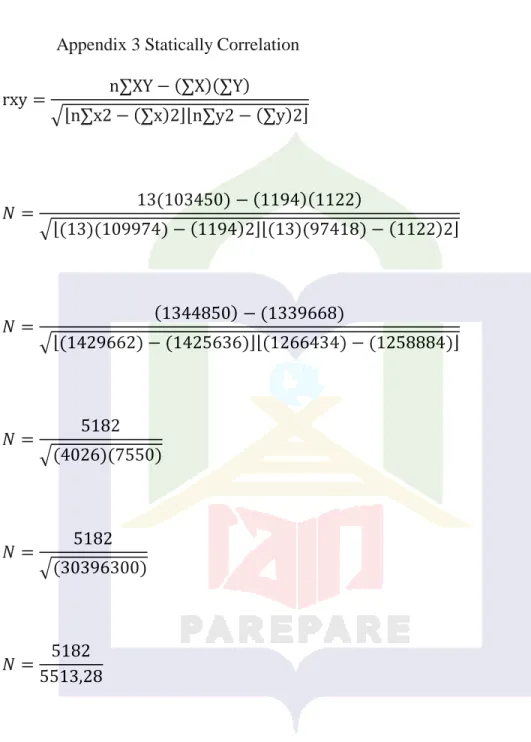
Based on the distinction above, it can be concluded that correlation research is a research that is done to find out whether there is a relationship between two variables to existing data without manipulating the data, variable X and variable Y. In this case, variable X is the students’ Arabic pronunciation skill and variable Y is the students’ English pronunciation skill. The researcher used correlation formula rxy = n∑XY−(∑X)(∑Y)
√⌊n∑x2−(∑x)2⌋⌊n∑y2−(∑y)2⌋to find the correlation between that variables.
B. Location and Duration
The location of this research conducted in Pondok Pesantren Al-Urwatul Wutsqaa Benteng Sidrap meanwhile the duration of the research took about a month.
C. Population and Sample 1. Population
The population of this research was the students of Pondok Pesantren Al- Urwatul Wutsqaa Benteng Sidrap.
2. Sample
The sample that researcher used in this research was the students of Pondok Pesantren Al-Urwatul Wutsqaa Benteng Sidrap especially in academic year of 2019.
D. The Instrument of the Research
The researcher used just one instrument. The instrument was pronunciation text. It used to measure both of languages, their Arabic and English skill. This test was a pronunciation text that used to measure the students’ pronunciation by their ability in Arabic pronunciation toward their English pronunciation test.
E. The Procedure of Collecting Data
In collecting data, it was a reading text where the students read words and sentences which has been provided by the researcher to identify students’
pronunciation itself. The researcher directly asked the students one by one based on the absence to come forward to read the text in front of the researcher to know how far the ability of students during producing in English and Arabic. The researcher used a recorder in getting data of students’ voice.
F. The Technique of Data Analysis 1. Pronunciation text
The data collected through the test analyzed quantitatively in percentage to measure the students’ achievement. This quantitative analysis employed statically calculation to test the hypothesis. The steps are:
a. The researcher gave on focused in the accuracy of the way students spill any words in both Arabic and English pronunciation text.
b. Finding out the score by calculating the percentage of students score:
𝑃 =𝐹
𝑁× 100%
Where:
P = Percentage F = frequency
26
N = total number of sample41
And to calculate the students' test by using the following formula.
Χ =
Σ𝓍n Where:
X = Mean Score
∑X = Total of raw score n = the Number of students
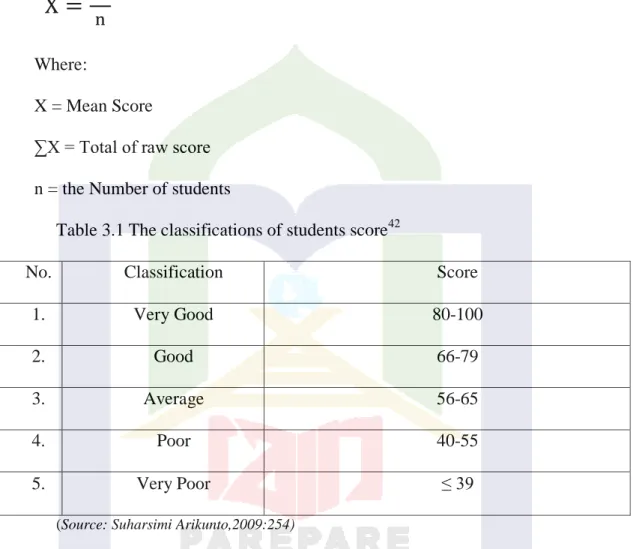
Table 3.1 The classifications of students score42
No. Classification Score
1. Very Good 80-100
2. Good 66-79
3. Average 56-65
4. Poor 40-55
5. Very Poor ≤ 39
(Source: Suharsimi Arikunto,2009:254)
The next step was to find out the correlation between two variables. The correlation between English pronunciation skill and Arabic pronunciation skill. This technique proved statically whether there was any significant correlation between the two variables.
41 L.R. Gay, Educational Research Competencies for Analysis and Application. (Second Edition Colombus, Ohio: Charles E. Meril Publishing),p.225.
42 Suharsimi Arikunto, Dasar-dasar Evaluasi Pendidikan, (Jakarta:Bumi Aksara,2009),p.254
To find the correlation English pronunciation skill and Arabic pronunciation skill, the researcher used the product moment correlation coefficient formula.
The formula is43 rxy = n∑XY − (∑X)(∑Y)
√⌊n∑x2 − (∑x)2⌋⌊n∑y2 − (∑y)2⌋
Where:
𝑟
𝑥𝑦 = Coefficient of correlation product moment∑𝑥=Total distribution score of x
∑𝑦=Total distribution score of y
∑𝑥2 = Sum of Quadrate distribution score x
∑𝑦2 = Sum of Quadrate distribution score y
∑𝑥𝑦 = Total multiplication score of x and y 𝑛 = the number of paired X and Y score
Table 3.2 The quality of correlation based on the value of r product moment44 No. The value of r Product
Moment
Interpretation on Correlation Quality
1. 0,00 –0,199 Very weak correlation
2. 0,20 –0,399 Weak correlation
3. 0,20 –0,399 Middle correlation
43 Syofian Siregar, Metode Penelitian Kualitatif: Dilengkapi Dengan Perbandingan Perhitungan Manual dan SPSS, (Jakarta: Kencana. 2013),p. 252
44Sugiyono, Metode Penelitian Pendidikan, (pendekatan kuantitatif, kulaitatif, dan R&D),cet:2, p.257
28
4. 0, 60 –0,799 Strong correlation
5. 0, 80 –1,000 Very strong correlation
(Source: Sugiyono, Metode Penelitian Pendidikan: 257)
29 CHAPTER IV
FINDINGS AND DISCUSSION
This chapter fulfilled with two sections, the findings of the research and the discussions of the findings. This research objectively tried to find out the students ability in pronouncing English words while they were already have their ability in pronouncing Arabic words in pondok pesantren Al-Urwatul Wutsqaa Benteng Sidrap.
To achieve the objective of this research, the researcher tested the student by recording their pronouncing while they read several words.
A. Findings
The test was hold in pondok pesantren Al-Urwatul Wutsqaa. The researcher gave the paper that contained with the text that should be read by student while the researcher recorded it, there were 26 words and 7 sentences. The researcher was planned to record in video mode but ended up with only voice mode. To find out the student’s score ability in pronouncing by dividing students’ total score with maximum score, after that time with 100. This test would definitely help the researcher in finding and collecting data as the data below:
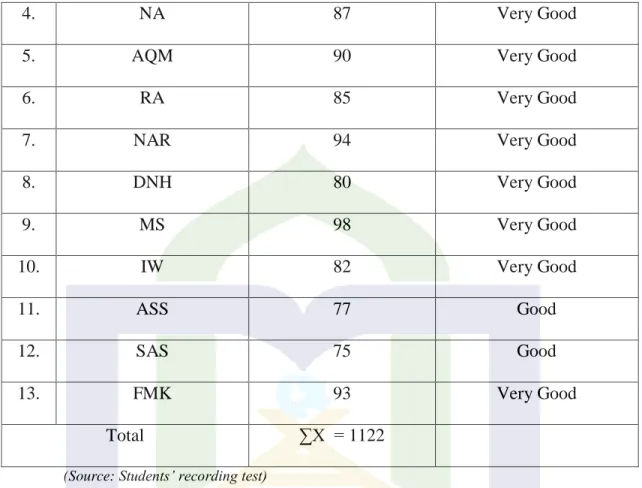
Table 4.1 The students’ score of English pronunciation skill
NO. Name Score Classification
1. SH 87 Very Good
2. A 92 Very Good
3. FAL 82 Very Good
30
(Source: Students’ recording test)
The table 4.1 above showed that there were 13 students that were contributed in the recording test with the classifications that there were totally 11 students had a very good result in pronouncing English words with the highest score is 98. While there were 2 students who had good result with the score 77 and 75.
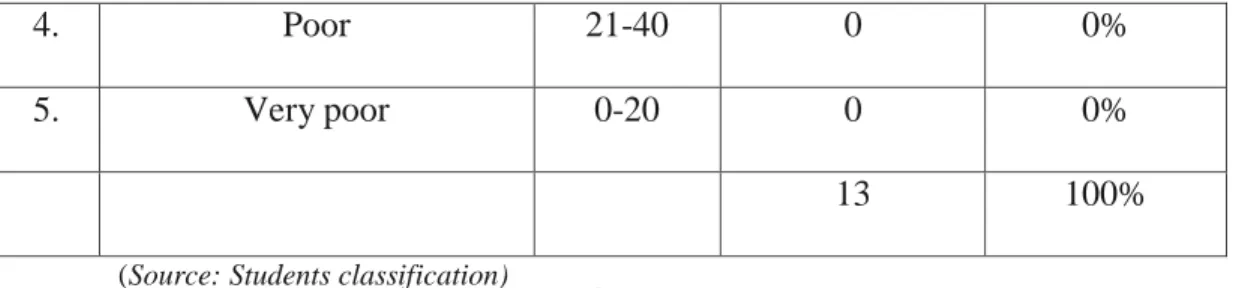
Table 4.2 The classification of students English pronunciation skill
4. NA 87 Very Good
5. AQM 90 Very Good
6. RA 85 Very Good
7. NAR 94 Very Good
8. DNH 80 Very Good
9. MS 98 Very Good
10. IW 82 Very Good
11. ASS 77 Good
12. SAS 75 Good
13. FMK 93 Very Good
Total ∑X = 1122
NO. Classification Score Frequency Percentage
1. Very good 81-100 11 85%
2. Good 61-80 2 15%
3. Fair 41-60 0 0%
(Source: Students classification)
Based on the table 4.2 above, the researcher classified that there were 11 (85%) of students that had very good classification out of 13 students while there were 2 (15 %) students had good classification. Based on that data, the researcher can take the conclusion that most of the students got very good classification in their record test.
Table 4.3 The mean score of students English pronunciation skill
Main score Classify
86,31 Very Good
After got all the result from the test before, the researcher calculate students main score by using formula in the previous pages and come out with the result as can be seen in the table above. The main score that the students got was 86,31 with the classify was very good or in the other way it can be said that out of 13 students in Pondok Pesantren Al-Urwatul Wutsqaa had a very good classify in pronouncing English sound.
Table 4.4 The students’ score of Arabic pronunciation skill.
4. Poor 21-40 0 0%
5. Very poor 0-20 0 0%
13 100%
NO. Name Score Classification
1. SH 92 Very Good
32
The score of students result in pronouncing Arabic words with the total of students who contributed in this research was 13 people showed that the highest score was 99 and the lowest was 85. Although it has different score but it can be said that the classification of all the student was very good with the total of score was 1194.
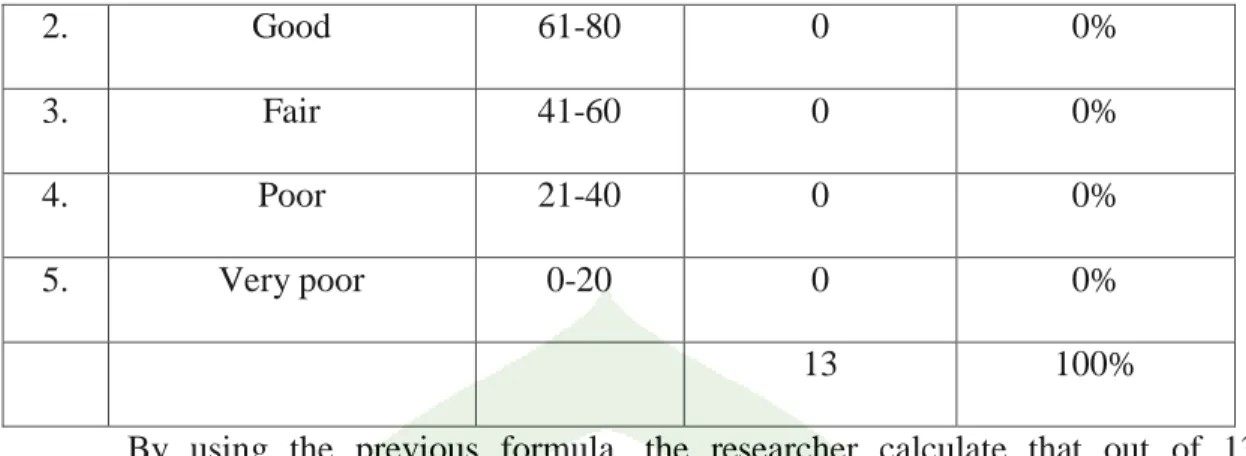
Table 4.5 The classification of students Arabic pronunciation skill.
2. A 97 Very Good
3. FAL 87 Very Good
4. NA 92 Very Good
5 AQM 95 Very Good
6. RA 90 Very Good
7. NAR 99 Very Good
8. DNH 85 Very Good
9. MS 98 Very Good
10. IW 87 Very Good
11. ASS 88 Very Good
12. SAS 86 Very Good
13. FMK 98 Very Good
Total ∑X =1194
(Source: Students’ pronunciation test)
NO. Classification Score Frequency Percentage
1. Very good 81-100 13 100%
By using the previous formula, the researcher calculate that out of 13 contribute students, the classification of the way they pronounce Arabic words was indeed very good. Even total of 13 students had 100% percentage in the way they pronouncing Arabic sounds.
Table 4.6 The mean score of students’ Arabic pronunciation skill
Main score Classify
91,85 Very Good
From the 100% percentage score that the students got in classification of students Arabic pronunciation skill, the next step that the researcher did was to find out the mean score of all the score that the students got. From the table above, it showed that the main score of students’ Arabic pronunciation was 91.85 that can be classify as very good level.
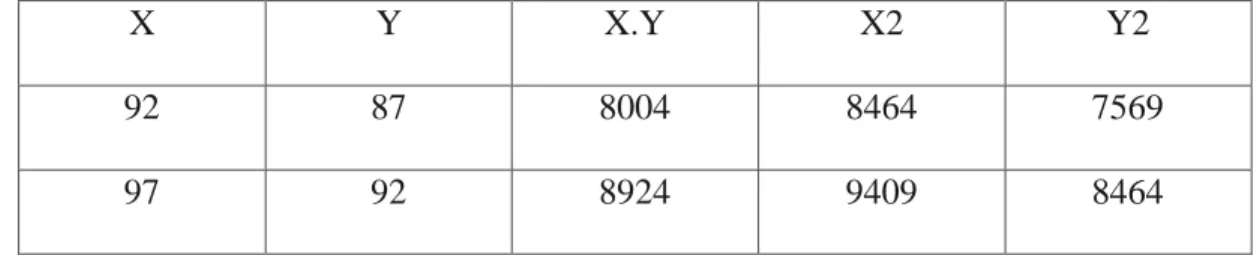
Table 4.7 The correlation of Arabic pronunciation toward students’ English pronunciation skill.
X Y X.Y X2 Y2
92 87 8004 8464 7569
97 92 8924 9409 8464
2. Good 61-80 0 0%
3. Fair 41-60 0 0%
4. Poor 21-40 0 0%
5. Very poor 0-20 0 0%
13 100%
34
87 82 7134 7569 6724
92 87 8004 8464 7569
95 90 8550 9025 8100
90 85 7650 8100 7225
99 94 9306 9801 8836
85 80 6800 7225 6400
98 98 9604 9604 9604
87 82 7134 7569 6724
88 77 6776 7744 5929
86 75 6450 7396 5625
98 93 9114 9604 8649
1194 1122 103450 109974 97418
(Source: All the collected data)
The table above showed the correlation between Arabic and English pronunciation skill. Based on the data that researcher obtained it showed that the students had very good skill in Arabic while good in pronouncing English. It can be concluded that the students whom were good in Arabic would be probably good in pronouncing English word. To get more clarify about the correlation between Arabic and English pronunciation skill, the researcher made an analysis as follow:
rxy = n∑XY − (∑X)(∑Y)
√⌊n∑x2 − (∑x)2⌋⌊n∑y2 − (∑y)2⌋
𝑁 = (1344850) − (1339668)
√⌊(1429662) − (1425636)⌋⌊(1266434) − (1258884)⌋
𝑁 = 0,94
Based on the result of the value from the students recording test was 0,94 its clearly says that there is a very strong correlation between variable X and variable Y or it can be said that Arabic pronunciation skill has strong correlation towards students English pronunciation skill.
B. Discussion
This section explained about the discussion of the findings that been through above. Also this section included in the presentation of the data and the student final result of their recording test.
Before that, the researcher already had to conclude that English and Arabic place of articulation shared the similarity of the way it produced several sounds that this researched focus on as it said in the previous chapter. And as said by Amalia Yahya Muliasri Arifin in her research titled “The Influence of Arabic Sound toward English Pronunciation at English Department” The participants admit that their ability in pronouncing Arabic sound can help them in pronouncing English fricative pronunciation. It means there is influence Arabic sound toward English Pronunciation especially in fricative. The researcher whom shared the same experience as a English and Arabic learner, found it itself that those two languages shared same way to pronounce their sounds. From that experienced, the researcher came out with this research.
36
To validate this research, the researcher used reading text as the instrument to find students skill in pronouncing English and Arabic sound. And to find the significant correlation in the way those languages had spoken, the researcher used the correlation design to describe an exiting relationship between two variables.
According to the research questions in the first chapter, the researcher was going to describe all the phenom that the researcher got on court.
1. The Students Skill in Pronouncing English Sound
The researcher had the first thought that the students might had learn about English as a compulsory subject in school but indeed the experience of learning pronunciation might been only in the cover of the subject. After reached the court, the researcher started to do the analyzed the students skill in English by talking to them with English. Along with that thirteen students, their ability in using English was not sounds alike. There were a students who had very clear yet fluent in English but in the other way, there were a students who still found the difficulties to spill a word in English.
After did some analyzed on, the researcher started to introduce the students into the phonetic symbols in English that would lead the session to the way to pronounce English sound in the right way. Indeed, there were students that already familiar with those symbols while another students just faced the symbols right after the researcher spilled it out. The researcher gave the correct way to pronounce the words and followed by the students obediently. The fluently and the correctly way the students to pronounce those sound was different each other. The students who already