185
JELTII
Journal of English Language Teaching and Islamic Integration Vol. 2, No. 2, July 2019
Designing a Computer Based Test Version of a Vocabulary Test
Rizka Safriyani
UIN Sunan Ampel Surabaya Surabaya, Indonesia [email protected]
Abstract: This research aims to design a Computer Based Test Version of an Academic Vocabulary Test. This study is intended to portray students' capacity in understanding Academic Vocabulary. Also, this research also describes the student's perception of the utilization of the computer-based test. In this study, media and material specialist were involved to confirm the content validity and product quality. Other than that, there are 50 learners participated as the test taker. Surveys and Academic Vocabulary Test was done to resemble the data. Evaluation regarding the program was completed concerning material and the aspects of the media. The suggestion given by the expert were utilized to enhance the utilization of the computer-based test. The validator recommends utilizing four steps; creating interface, coding, publishing, and packaging. Moreover, after the utilization of Computer Based Test, the English Teacher Education Department students' capacity in understanding the meaning of Academic Vocabulary is known in the average level. They have got the average mean score of 53 forthe vocabulary test. On the other hand, the result of non-English Teacher Education Department students' capacity in doing the test is in the low level. They have got the average mean score of 35 forthe vocabulary test. Moreover, the student's opimiom shows that there are 95,5% of the students provide a positive perception to the utilization of A Computer Based Test. They feel positive because of the practicality, and the particular effectiveness of the program to describe students' capacity in understanding Academic Vocabulary.
Keywords: Academic Vocabulary, English as a Foreign Language, perception, Computer Based Test
. First Received:
24 April 2019
Revised:
10 May 2019
Accepted:
25 June 2019
Published:
15 July 2019
186 INTRODUCTION
Vocabulary is one of the essential aspects of learning a foreign language. Anyone will get difficulty in understanding speaking, reading, listening, and writing when they have limited or lack of vocabulary. It might be impossible to learn a foreign language without mastering vocabulary. Students with a high level of vocabulary level may have a good and better performance in using English. As Schmitt (1997: 40) states that vocabulary is one of the most critical skills in a language, it means that vocabulary is one of the keys that must be mastered by the students if they want to have good knowledge in the four skills.
Research written by Afif Fauzi entitled The Correlation between Students Vocabulary Achievement and Speaking Ability shows that there is a significant correlation between students’ vocabulary achievement and speaking ability. This study shows that when a student's vocabulary increases, at the same time students speaking skill are increased. Also, Fatmawati et al. write The Correlation Between Students Vocabulary Achievement and Students Reading Comprehension indicates that there is a significant correlation between students vocabulary achievement and reading ability. A further study written by Fauzi entitled The Correlation between Students Vocabulary Achievement and Students Listening Comprehension shows that when students’
vocabulary increases, at the same time students listening skill are also increased. Those three previous studies indicate that vocabulary plays a vital role in practicing the language.
Teachers usually conduct a vocabulary test in paper and pencil formats. Computer based test seems to give advantages for teachers. It can provide the teacher with instant feedback, and low chance to cheat. The teacher can convey various variants of the exams and assignments without physically monitor which students got which test. All data can be put away on a single server. The teacher needs less time and effort to do the test. Computer based test eliminates human error in grading. Therefore, this study aimed to develop a computer-based test for testing academic vocabulary in English as a foreign language classroom setting. Also, computer based analysis is used to short the time in
187
the test-taking procedures. It was designed in an offline mode. It was expected that the product of this research could be efficiently and precisely classifying test takers into specific sub list. This study would describe the development process of the computer based test, the student's vocabulary mastery and their responses toward the use of computer based test for testing academic vocabulary
LITERATURE REVIEW 1. Vocabulary Test
Vocabulary breadth or size, vocabulary depth, receptive and productive vocabularies are the aspects of vocabulary that should be considered in teaching vocabulary. Vocabulary depth demonstrates how well a person knows the words, including synonymy, polysemy, and collocation of the words, while, vocabulary breadth or size illustrates how many words a person knows and usually only the primary meaning of the words. Next, receptive vocabulary use involves perceiving the form of a word while listening or reading and retrieving its purpose. Furthermore, productive vocabulary consists of wanting to express meaning through speaking or writing and extracting and producing the appropriate spoken or written word form Vocabulary level is one of the central element in language mastery.
Vocabulary test is utilized to gauge vocabulary size. There are two essential methods of estimating vocabulary size; they are dictionary sampling method and corpus.
The dictionary sampling method relates to selecting a lexicon that contains the number or word families that learners are relied upon to know, then testing a selection of words.
The problem with this method is that higher recurrence words will, in general, have longer entries, and are along these lines most likely end up on the test, which may skew the outcomes. Corpus method is utilized to appraise the vocabulary size by choosing word families regarding their recurrence in a corpus. Typically, these word families gathered into the first 1,000 most frequent words, the second 1,000 most frequent words, and so on. This procedure can go as a pointer of the level of a learner's overall vocabulary knowledge based on sample words from recurrence records.
188
There are currently two public vocabulary tests; the Eurocentres Vocabulary Size Test (EVST) and the Vocabulary Levels Test (VLT). The Eurocentres Vocabulary Size Test developed by Paul Meara and his colleagues is a Yes/No Vocabulary Test in a computer application consisting of words and non-words, with examinees having to choose the words they know the meaning. The second test is the Vocabulary Levels Test.
Paul Nation originally designed this test as a diagnostic vocabulary test for use by teachers. The Levels Test derives its name from the fact that separate sections measure learners' knowledge of words from some distinct frequency levels.
There are four versions as the original version from Nation's book, version A, B, C and D. Then, Paul Nation's versions were developed and revised by Norbert Schmitt, Diane Schmitt, and Caroline Clapham. This test consisted of five sections, divided into four levels of vocabulary frequency and one level of academic words from the Academic Word List (AWL). Vocabulary frequency levels were the 2,000 level, the 3,000 level, the 5,000 level, and the 10,000 level. For each vocabulary level, each group contained six words and three definitions.
Paul Nation designs a diagnostic vocabulary test. The Levels Test derives its name from the fact that separate sections measure learners' knowledge of words from some distinct frequency levels. There are four versions as the original version from Nation’s book, version A, B, C and D. Then, Paul Nation's versions were developed and revised by Norbert Schmitt, Diane Schmitt, and Caroline Clapham. This test consisted of five sections, divided into four levels of vocabulary frequency and one level of academic words from the Academic Word List (AWL). Vocabulary frequency levels were the 2,000 level, the 3,000 level, the 5,000 level, and the 10,000. For each vocabulary level, words were classified into ten groups. Each group contained six words and three definitions.
2. Academic Vocabulary
Academic vocabulary refers to words that are used in academic dialogue and text.
These types of words are used to explain the concept and commonly used in classroom
189
lessons, books, assignments, and tests. Therefore, students must become proficient in it to learn effectively in the university. Students need to understand teachers' explanation, discuss what they are learning, read academic texts and write about their learning. To measure students understanding about academic vocabulary, Academic Word List are used and adapted for teaching and testing academic vocabulary. Writers use academic vocabulary in many different subject areas. Learning vocabulary from Academic Word List will help students improve their comprehension of academic texts. It also helps the students to write an assignment in an academic style.
Averil Coxhead created The Academic Word List in New Zealand. Coxhead made a digital collection of over 400 written academic texts taken from a different type of documents; journal articles, university textbook covering 28 different subjects. As a result, the 570 words of The Academic Word List is trimmed out and listed into ten sub lists according to the frequency. Sub list 1 has the most frequent academic words such as area, benefit, define the environment, factor, issue, research and vary. On the other hand, sub list 10 has less frequent words such as adjacent, integrity, forthcoming, levy, panel, persistent, and so-called.
METHODOLOGY
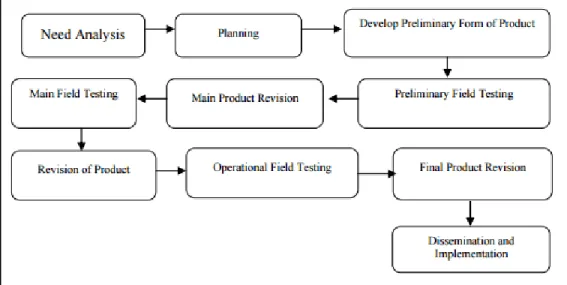
In this research, Borg & Gall's development research model was adapted to produce a more straightforward development model. The first steps are collecting information or need analysis. It includes the review of the literature, classroom observations, and preparation of the report. The second and third steps consist of planning and developing a preliminary form of the product. The plan incorporates defining skills, stating objectives, determining course sequence, and small-scale testing.
Then the fourth stage involves initial field testing. Next, interview, questionnaire data collected and analyzed to conduct main product revision. Main product revision uses quantitative data on subjects' course as evaluation. The seventh step is items correction.
Next, for the eighth and ninth steps involve field testing and final product revision. And the last step or step 10 is the dissemination and implementation.
190
Figure 1. Borg & Gall's development research model
Once the computer-based test product had been validated by the consultant and measured by the grain analysis, the new Academic Vocabulary test was distributed to the class. The number of questions used was 60 items with four alternative answers for each question. Subjects were presented in English and students were given 20 minutes to complete the test in a paper and pencil form. After checking the validity the issue through the item analysis test, then the questions were revised and tested again. The final questions which meet the criteria were inserted into the template based that has been designed first. In the validation stage, there are two specialists involved:
programmer to as the media specialist and linguist as the material specialist. For media specialist, advice on computer-based packaging/design tests was provided and followed up with appropriate changes to input. On the other hand, two lecturers were chosen to do material validation. After the validation was done, then the revised version of the program and the content were ready to be set to the program. The fifth stage was a product revision. Revisions were made on the input regarding product design and test content about Academic Vocabulary. The Final stage was dissemination and implementation of the software to the students
The subject of this research was students of the English Department and Non- English Department in the academic year of 2016/2017. This subject was determined
191
using cluster random sampling technique. Qualitative data and quantitative results were obtained from questionnaire validation expert, reviews of material expert and media expert. The data were from the field trials derived from the comments or responses, questionnaire result, and test results. Survey of validation is for instructional design expert and teacher. To get some suggestions and revisions, the researcher makes a questionnaire of validation. It was created to gather information about the validity of the product. Besides, it can help the researcher know the weakness of the product. The questionnaire was given to the expert reviewer consisting of instructional design expert and teacher. They assessed the prototype and suggested to revise the prototype. The test was undertaken from the questionnaire validation of the test.
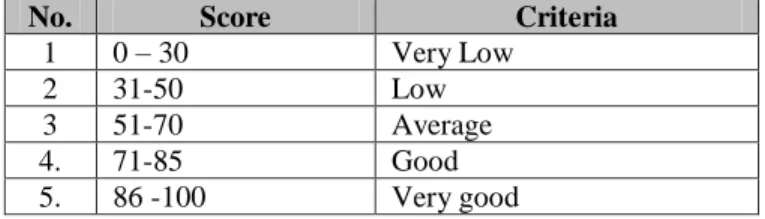
After the test was valid based on the questionnaire validation, the test would be given to the subjects. Data were gathered through Academic Vocabulary test, questionnaire, an interview. To analyze the research data, Alpha Coefficient Formula was used, applied to calculate test instrument reliability level. The data of the test score recap and the results of the interview were arranged and visualized into figures and then interpreted. Triangulation and validation of research results were conducted by consulting the consultant to achieve valid and reliable results. The type of data this study is qualitative data and quantitative data, the data were statistically analyzed descriptively. Qualitative data in the form of comments and suggestions for improvement of the productare used to revise the products. Qualitative data was also derived from the opinions and suggestions of the student. Then the quantitative data obtained from the assessment scores. The guidelines for converting quantitative data to qualitative data with scale 5 are as follows:
No. Score Criteria
1 0 – 30 Very Low
2 31-50 Low
3 51-70 Average
4. 71-85 Good
5. 86 -100 Very good
Table 1. Conversion Guideline quantitative data to qualitative data
192 FINDINGS AND DISCUSSION
Findings
The first field test was conducted to the participants, and they received the questions and answer sheets in a paper-based test. The field test was performed for 20 minutes under the supervision of intensive English instructors as the field assistants.
From the first test results, there were problems with questions items which have a low level of difficulty within the item analysis. Questions number 1, 2, 3, 12, 16 and 26 were too easy. This was predicted to occur because the destructor did not work optimally. The number of correct answers was very dominant, so on the recommendation of the material expert, the revision of the answer choice is taken to answer the issue on the first instrument trial.
Secondly, the second field test was received by the participants through the questions and answer sheets in a paper-based test. The field test was also performed for 20 minutes under the supervision of intensive English instructors as the field assistants.
At this stage, students were informed about the test questions so that they were seriously working on the problem so that the results obtained are objective. There were 60 questions presented in multiple choices form. All of the definitions of the vocabulary were taken from the Cambridge advanced learners 'dictionary or the oxford advanced learners' dictionary and had been revised based on the field test. From the second field test, it was found that in general, all questions have an excellent destructor. Thus, the issues were uploaded into a computer-based test. Before the items were uploaded, the program design was validated.
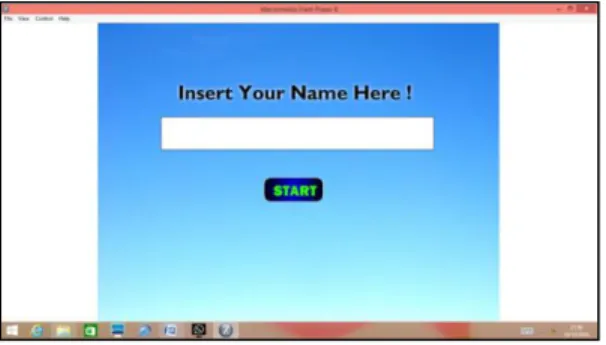
In the development of the multimedia, the stages of the software development were developing the interface, coding, publishing and final packaging. An example of a software-based vocabulary academic test interface design can be seen in the following figure:
193
Figure 2 the Interface of the Computer-Based Test
From the research and development process that had been done, the results obtained at each stage in accordance with research and development procedures described as follows:
1. Media experts validation result
No Aspect Questions Max Score Percentage
1. Interface 60 300 220 73
2. Program 60 300 230 76
Table 2 Media expert validation result
The table shows the average score of both aspects is 75%. Program aspect achieves the highest value with 76% and 73% for the interface. Overall, it can be concluded that the computer-based test program is rated with a good score.
Nevertheless, the evaluator still recommends adding the image on the main view to make it more alive. On the other hand, the color of the letter is also recommended to be modified, and at the end of the test, the name of the test participant should appear on the final sheet to record data.
2. Material experts validation result
No Aspect Questions Max Score Percentage
1. Content 60 300 250 83.33
2. Level of difficulties
60 300 240 80.00
Table 3 Material validation result
194
The table shows the average score obtained from both aspects is 81.5%. The content achieves the highest value with 83.3% and 80% for the level of difficulties.
Overall, it can be concluded that the developed program is rated with a good score.
However, there are also valuator suggestions and comments regarding content compliance and difficulty levels. According to the evaluator, the alternative answers that become deceivers may be able to trick the students to choose the wrong definition, especially for students of non-English education department.
3. User responses
No Aspect Questions Max Score Percentage
1. Content 60 300 210 70
2. Level of difficulties 60 300 210 70
3. Clarity 60 300 280 93
4. Practicality 60 300 290 96
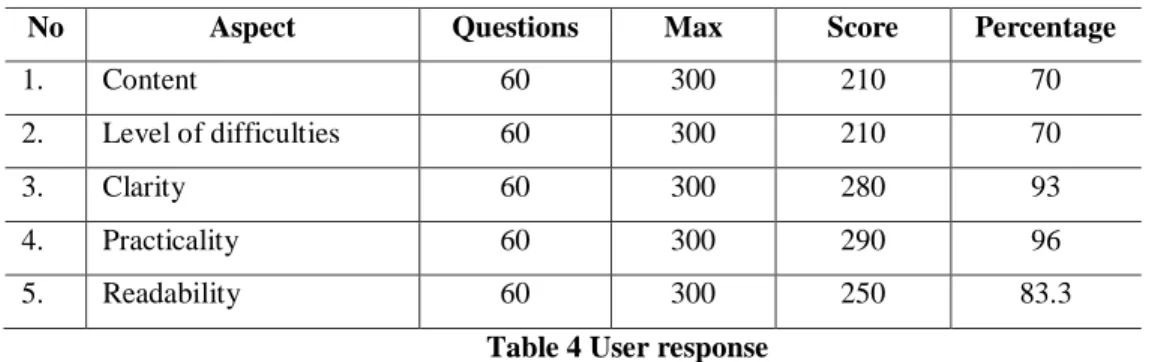
5. Readability 60 300 250 83.3
Table 4 User response
For judgment performed by the users, the average achieved by the five aspects is 82.4%. Overall, it can be concluded that overall the computer-based-test is rated with a good score.
4. Implementation of the a Computer-Based Test for Testing Academic Vocabulary in EFL Class
From 25 students who took the test, the highest result was achieved by C1 students with 65% success rate while the lowest score was 28%. Their mean score was 52%. In the class d which participants are not English education department students, the results showed that the highest achievement was achieved by d1 students with a value of 53% success percentage while the lowest is 11%. Their mean score was 35%.
After the tabulation on the two tables above, it can be concluded that the average/mean value of academic vocabulary mastery for English education department students is 53% while for non-English education program is 35%. Thus, if the percentage is
195
converted to the qualitative table (see table 1), then the level of mastery of academic vocabulary of English education study program is average while the mastery of academic vocabulary of non-English education program is low.
The description of this result is the average accumulation of the correct number of answers for each test participant who at the end is recaptured through simple mathematical calculations. In each test result obtained by the test participants, it appears at what level of their academic vocabulary mastery. One example is the result of class C students. Although students have a high level of academic vocabulary mastery, mistakes at low levels can also occur. The C4 student can score 63.3% for the most errors in level 3. This result shows some factors may affect vocabulary mastery. According to Wu (2013), several factors influence vocabulary strategies for students: motivation, language skills, family background including family involvement and frequency of extracurricular activities involving vocabulary such as watching English TV, listening to English-language radio programs, reading newspapers or English speaking magazines, playing computers in English and learning vocabulary online.
Based on the above factors, the motivation, and frequency of extracurricular activities involving vocabulary such as watching English TV, listening to English- language radio programs, reading newspapers or magazines in English seem to be an essential contributor to making the difference in the results achieved by the students of English education program and non-education students English. The number of times extracurricular activities involving vocabularies such as watching English TV, listening to English-language radio programs, reading newspapers or English magazines must be done more frequently by students of the English teacher education program. The motivation to speak English is also definitely higher because English is a demand so that the mastery of vocabulary is also better from the results of closed questions that have been given to students, 86.4% chose the computer-based vocabulary academic test from the vocabulary-based academic paper test with a variety of reasons such as practical, engaging, efficient and effective.
196
Also, the results of the online questionnaire also showed that 95.5% of students who fill the online survey stated liked the vocabulary-based computer academic test.
This data shows 95.5% percent of students prefer the computer-based academic vocabulary test. This result shows how high the students' positive response about the use of computer-based vocabulary academic test for both English and non-English department students.
Based on the results of program and user valuator input, product revisions were made to make the product better. There were thirteen sections were improved:
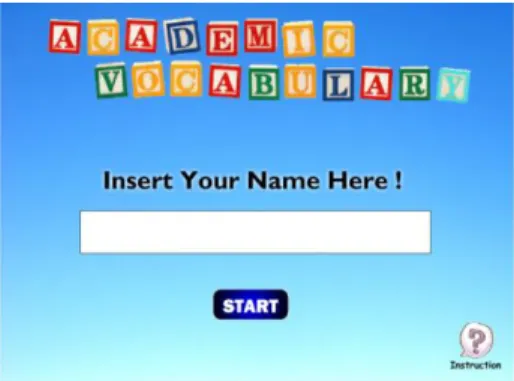
vocabulary academic test page view, instruction page display, level 1, level 2, level 3 to level 10, value-page view and page-vocabulary test computer-based test page. Here are some examples of images from an improved view:
Figure 3 the interface of the a computer-based test for testing academic vocabulary In the picture above, the start page was improved. The instruction feature was added so that the test participants would know what to do to operate this test.
197
Figure 4 instruction guide of a computer-based test for testing academic vocabulary On this page, instructions were made clearly and presented in English because the test was designed with English vocabulary material. There were eight steps to watch out for my test users. In this instruction page, valuable information was delivered especially to accommodate suggestions from evaluators and users to place the menu back to the previous answer if there was a chance to do so. Here, the introduction of green and red button functions becomes very important. To close this page, the test user must click the back button so that the menu would return to the initial view as described earlier. This instruction menu could be accessed before and after the test user fills in the name.
Figure 5 revised page of a computer-based test for testing academic vocabulary The revision of the display slightly changed because the color selection of letters was also a consideration. The font color of the instruction was changed from
198
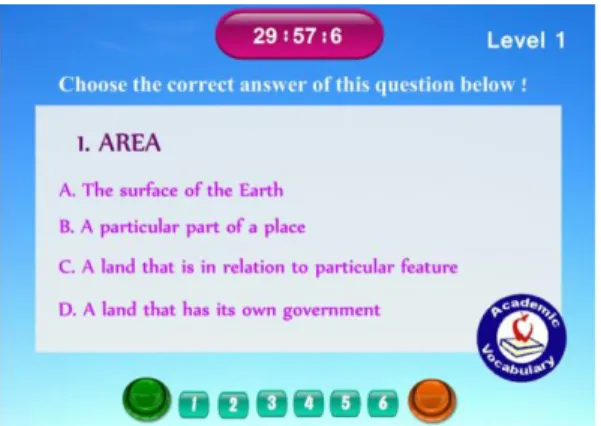
black to white to make it more legible. As explained at the beginning, that there were ten sub-lists of academic vocabulary then this test is also designed with ten levels developed based on the ten sub lists. Also, the timer function was enabled on the first questions. When the test user entered the first page of the test, then the time would run backward until the time ran out. By the instructions on the first page, if until the deadline set, the test user has not completed the test, then the remaining unfinished questions would get a value of 0. This first-page view has also been achieved by the red and green buttons that have their respective functions. The red button served to move to the next level while the green button helped to retreat to the previous level.
Also, between the red and green buttons, there were numbers 1, 2, 3, 4, 5, 6 which refers to the questions that exist at these levels. The number 1 on this page relates to questions 1 to 1 from level 1. The number 2 on this level indicates a second question at level/sub list 1. If the test user wanted to change answer no.1, then the test user just clicked no 1. Automatically the screen display would return to page 1 but time will keep on running. With this menu, then the test user can change the answer if felt necessary.
The final answer chosen will be the basis for calculating the value in the last session.
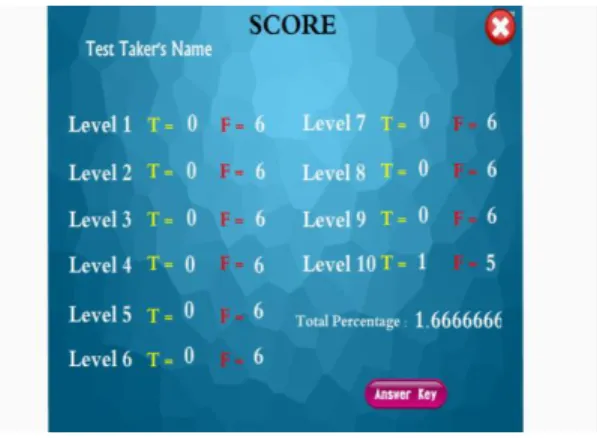
Figure 6 the last page of a computer-based test for testing academic vocabulary On this page, the main view was almost the same as the initial view where the level description using white fonts, the correct answer information using the yellow letter t while the wrong answer information using the red f. If the test user wanted to
199
exit from this menu, the test user could click the cross. On the above page, an additional menu that does not exist on the previous product is a crucial answer feature. Thus, for test takers who want to know the correct answer, can click the answer button.
Figure 7 the last page of a computer-based test for testing academic vocabulary On this page, all the correct answers were listed for each level. This answer was designed on a new background based on a brown-green base and divided into two columns. This key answer feature was not directly connected to the test so that if you want to know the problem at the beginning, then the test participants must follow the retest. To exit from this menu, the user simply pressed the back button. Thus, the test takers would return to the value page
Discussion
The use of the computer-based test is expected to develop the student's ability in problem-solving. According to Smaldino (2012), constructivist learning would improve students' creativity, communication skill and analyzing problems. By the utilization of the computer-based test, the student could use it as a game based learning to solve the problems. It will cultivate the profound learning. A computer test is enjoyable and fun.
Therefore students are willing to spend more time and effort on learning. Fun and enjoyment are important elements in the process of teaching and learning. Students can be more relaxed and motivated to learn. They won't be afraid of taking a computer- based test because it is designed interactively. It is believed that students are more
200
motivated to participate in educational activities if these activities take place in the form of computer-based test. Technology has affected the development of education in general and foreign/second language. Computers have been used for language teaching, and nowadays computer has become widespread in schools and language institutions.
Jamil et al. (2012) on their study found that teachers’ attitudes were positive towards Computer Based test systems, but in some situations, they preferred Paper Based Test as well. Comparatively female, highly ranked, highly qualified, less experienced, teachers who have computer training certificate or degree, and teachers who have Computer Based test examination experiences were more positive towards Computer Based test.
Moreover, computer-based test could pay attention to students’ self-reflection and self- assessment in which students could achieve confidence and motivation as well as awareness of their strengths and weaknesses, progress and achievement.
The pedagogical implication gathered from the research was students were motivated to do a computer-based test. It could inspire the teacher to become a creative teacher in designing/developing a computer-based test to maintain the student's motivation in the classroom. Learning vocabulary and testing vocabulary could be a joyful process for the students with a computer-assisted task. The student could develop self-directed learning outside the school when they would practice their vocabulary.
Some disadvantages may occur such as teacher and students' limited knowledge of operating computer, the readiness of the facilities inside and outside the university and the human error to run the test but the Computer Based Test significantly reduced testing time and developed stronger self-efficacy, intrinsic and human testing motivation in the participants. This idea is in line with Chua (2012) that states the testing mode reduced testing time and increased the motivation of the participants. Another study written by Hosseini (2014) shows that students who chose Computer Based Test to Paper and Pencil Test believed that Computer Based Test is more comfortable, more enjoyable, and time-saving. Students also liked the display of the passages and the questions which was an innovation for them in the test-taking experience compared to the standard testing mode or paper-based test. Vocabulary plays a crucial role in foreign language teaching and learning because it covers all the words students must know to
201
access their background knowledge. It is also important to use vocabulary and express their ideas. Vocabulary could help students to communicate effectively, and learn about new concepts. Widodo (2016) in Yanto (2018) states that vocabulary has a main role in language fluency development and knowledge building. Moreover, there are three critical elements of students’ success in EFL learning which are known as productivity, meaning making, and word quantity. Therefore, vocabulary assessment could give a huge impact to the students fluency and their knowledge development.
CONCLUSION
In the process of planning this computer-based Academic Vocabulary test, the researcher created a framework of program building, design problems, and interface design. While in the development stage, the researcher did a product development. The validation by media expert, material, and the user was done by giving validation questionnaire and product revision. Researchers implemented this computer-based Academic Vocabulary test by way of testing the product and processing data. This trial was conducted at the students of English and Non-English Department. Then, data processing on the students' assessment of the test were displayed. While in the assessment phase, the software feasibility of expert and user validation results, the student's judgment on the software and the deficiencies, advantages, constraints, and software recommendations have been developed.
In this study also, it has been mapped that the level of mastery of Academic Vocabulary students of English Education Study Program was in the average and Non- English Department students is at a low value. Student responses showed 95.5% percent of the students liked the computer-based Academic Vocabulary test for practical reasons, efficient and minimal plagiarism.
This study had the limitations of using discrete tests. In the future, this program will be expected to be able to use contextual questions so that the benefits can be used to measure the mastery of the Academic vocabulary intact. This product would be disseminated to the lecturers and teachers of English partner of Faculty of Tarbiyah and
202
Teacher Training to get more optimal response and feedback for further product development in consortium activities as well as a conference at national and international level.
Further product development would be expected to cover all 570 words of the Academic Vocabulary sub-section with tests that are both discrete and contextual with more efficient software features. In the future, this research was expected to be done continuously to see the effectiveness of this software in mapping the mastery of Academic Vocabulary teachers and English learners in Indonesia.
REFERENCES
Anastasi, A. (1986). Testing Problems in Perspective. Washington DC: American Council on Education
Angele Attard, et al. (2010). Student-Centered Learning: An Insight into Theory and Practice. Bucharest. Education and Culture DG. downloaded from http://www.ehea.info/media.ehea.info/file/T4SCL_forum_Leuven_October_2010 /34/2/2010_T4SCL_Stakeholders_Forum_Leuven_-
_An_Insight_Into_Theory_And_Practice_600342.pdf accessed 10 September 2018
Cennet Altiner. (2011). Integrating a computer-based flashcard program into Academic Vocabulary learning. Thesis. State IOWA University downloaded from http://lib.dr.iastate.edu/etd/10160/
Dawna Duff, J Bruce Tomblin dan Hugh Catts. The Influence of reading on Vocabulary Growth: A Case for a Matthew Effect in Journal of Speech; Vol. 11, No. 6;
2018:1-15.2018 downloaded from
https://www.ncbi.nlm.nih.gov/pmc/articles/PMC4610292/ accessed 11 September 2018
Ebel, BS. (1986). Measuring Educational Achievement. Englewood Cliffs, N.J: Prentice Hall
Gerberich, JR. (1978). Specimen Objective Test Items. London: Longman
Hawes, GR. (1984). Educational Testing for the Millions, New York: McGraw-Hill
203
Hosseini et al. (2014). Comparability of Test Results of Computer-Based Tests (CBT) and Paper and Pencil Tests (PPT) among English Language Learners in Iran in Procedia - Social and Behavioral Sciences 98 (2014) 659 – 667
Jamal Sahara Pour and Ali Akbar Khomeijani Farahani. (2015). The Effect of Vocabulary Knowledge and Background Knowledge on Iranian EFL Learners' L2 Reading Comprehension in Journal of Applied Linguistics and Language Research Volume 2, Issue 2, 2015, pp. 107-121 downloaded from http://www.jallr.com/index.php/JALLR/article/viewFile/36/pdf_34 accessed 11 September 2018
Jamil, Mubashrah et al.(2012). Computer-Based vs Paper-Based Examinations:
Perceptions of University Teachers. In TOJET: The Turkish Online Journal of Educational Technology – October 2012, volume 11 Issue 4,371-381
Jirun Liu and Jianying Zhang. (2018) The Effects of Extensive reading on English Vocabulary Learning: A Meta-Analysis in English Language Teaching; Vol. 11,
No. 6; 2018:1-15.2018 downloaded from
https://files.eric.ed.gov/fulltext/EJ1179114.pdf retrieved 11 September 2018 Kuang Yu Chen. (2011). The Impact of EFL Students' vocabulary Breadth of
Knowledge and Literal Reading Comprehension in Asian EFL Journal Volume 51, 2011: 30-40 downloaded http://asian-EFL-journal.com/PTA/April-2011- kyc.pdf retrieved on 11 September 2018
Nation. I.S.P. (1990). Teaching and Learning Vocabulary. New York: Heinle, and Heinle
Oller, J.W. (1979). Languages Tests at School, A Pragmatic Approach. London:
Longman
Otting, H., & Zwaal, W. (2007). The identification of constructivist pedagogy in different learning environments. In M. K. McCuddy, H. van-den-Bosch, W. B., Martz, A. V. Alexei, & K. O. Morseb (Eds.), The challenges of educating people to lead in a challenging world (pp. 171-196). Netherlands: Springer.
Raja Sekaran. (2018). The Effect of Reading-Based Activities in Enhancing Vocabulary –An Observational Study in MJAL 7:3 Autumn 2015: 262-270.2015 downloaded from http://www.mjal.org/Journal/new/11.pdf retrieved on 11 September 2018.
Romodon, Dion dkk. (2013). Rancang Bangun Model Pembelajaran Bahasa Inggris Interaktif Berbasis Multimedia in Among Makarti Vol.6 No.11, July 2013
204
Schmitt. N. (1999). The Relationship between TOEFL Vocabulary Items and Meaning, Association, Collocation, and Word-Class Knowledge. Language Testing 16:
189-216.
Smaldino S.E, et al. (2012). Instructional Technology and Media for Learning. 11th edition. United State of America: Pearson
Tongqing Gu. (2018). The Effect of Vocabulary Knowledge on Chinese English Learners' Reading Comprehension in International Journal of English Linguistics; Vol. 7, No. 4; 2017: 45-51 retrieved from http://www.ccsenet.org/journal/index.php/ijel/article/view/66512 accessed on 11 September 2018
Vernon, PE. (1976). The Measurement of Abilities. 2nd Edition. London: University of London Press Ltd.
Widodo, H. P. (2016). The ESP vocabulary portfolio as a tool for sustained vocabulary learning. In Yanto, E. S., & Nugraha, S. I. (2018). Video viewing as a mediation of learning content-based vocabulary: Assisting students in understanding disciplinary vocabulary in context. Indonesian Journal of Applied Linguistics, 8, 316-324. doi: 10.17509/ijal.v8i2.13278
Wu, Lin Fang. (2013) A Study of Factors Affecting College Students' Use of ESL Vocabulary Learning in International Journal of Humanities and Social Science
Vol. 3 No. 19 retrieved from
http://www.ijhssnet.com/journals/Vol_3_No_19_November_2013/25.pdf Yanto, E. S., & Nugraha, S. I. (2018). Video viewing as a mediation of learning
content-based vocabulary: Assisting students in understanding disciplinary vocabulary in context. Indonesian Journal of Applied Linguistics, 8, 316-324.
doi: 10.17509/ijal.v8i2.13278
Yesmaya, Violetta dkk. (2014). Aplikasi Pengenalan kosakata Bahasa Inggris "My Picture Dictionary" Untuk Anak Sekolah Dasar berbasis Android in Jurnal Teknik dan Ilmu Komputer Vol.3 No.11, July-September 2014
Yzgul yzonder. (2016) Student EFL Teachers' Receptive Vocabulary Size. in Procedia - Social and Behavioral Sciences 232 ( 2016 ) 444 – 450 retrieved from https://www.sciencedirect.com/science/article/pii/S1877042816312939
accessed on 11 September 2018
Wilkins, D.A. (2015). Linguistics in Language Teaching. Australia in International Journal of English Language and Linguistics Research Vol.3, No.1, pp.1-14, January 2015 retrieved from http://www.eajournals.org/wp-
205
content/uploads/Vocabulary-Input-in-English-Language-Teaching-Assessing- the-Vocabulary-Load-in-Spine-Five.pdf accessed on 10 September 2018