AN UNDERGRADUET THESIS
HEDGING IN WRITINGS BY THE STUDENTS OF GRADE 11 AT THE PUBLIC SENIOR HIGH SCHOOL (SMAN) 1 SEPUTIH RAMAN,
CENTRAL LAMPUNG PROVINCE
By:
ANGGRAINI SILVIA PUTRI STUDENT NUMBER : 1601070065
English Language Education Study Program
TARBIYAH AND TEACHING TRAINING FACULTY STATE INSTITUTE FOR ISLAMIC STUDIES OF METRO
1443 H / 2022 M
ii
AN UNDERGRADUE THESIS
HEDGING IN WRITINGS BY THE STUDENTS OF GRADE 11 AT THE PUBLIC SENIOR HIGH SCHOOL (SMAN) 1 SEPUTIH RAMAN,
CENTRAL LAMPUNG PROVINCE
Presented as a Partial Fulfillment of the Requirements for the Degree of Sarjana Pendidikan (S.Pd.)
in English Education Department
By:
ANGGRAINI SILVIA PUTRI Student Number: 1601070065
Tarbiyah and Teachers Training Faculty English Education Department
Sponsor : Ervan Nurtawab Ph. D.
Co-Sponsor : Trisna Dinillah Harya M.pd
STATE INSTITUTE FOR ISLAMIC STUDIES OF METRO 1443 H / 2022 M
iii
iv
v
vi
vii
HEDGING IN WRITINGS BY THE STUDENTS OF GRADE 11 AT THE PUBLIC SENIOR HIGH SCHOOL (SMAN) 1 SEPUTIH RAMAN,
CENTRAL LAMPUNG PROVINCE ABSTRACT
By:
ANGGRAINI SILVIA PUTRI
The purposes of this research were to know the most dominant type of hedging and to find difficulties in using hedging in writing skill in letter text writing of the eleventh graders at SMA N 1 Seputih Raman Central Lampung.
Therefore, it is expected that this research is beneficial in informing the phenomena of hedging order interference in studying the writing skill.
The method of this research was qualitative research in the form of a case study carried out at SMA Negeri 1 Seputih Raman Central Lampung. The primary source of this research is the eleventh graders students’ at SMA Negeri 1 Seputih Raman Central Lampung that consists of 10 students. The researcher used observation, documentation and interview in collecting the data.
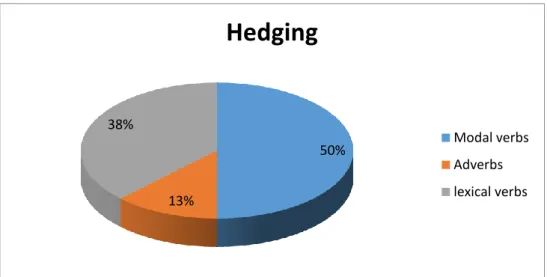
The results of this research proved that the the type of hedging in text writing is modal verbs 50%, lexical verb 37,5%, and adverbs 12,5%. The most dominant type of hedging is Modal verbs because 50%. Furthermore, another research result is about the difficulties of hedging in academic writing of student SMAN 1 Seputih Raman including of lack of ability to understand vocabulary,In writing the student feel have no choice to using hedging word our writing, Less students to do exercises with verbs and tenses, The ability of grammatical strategy is still low.
Key word: purpose, hedging, Writing, dominant
viii
HEDGING PADA TULISAN SISWA KELAS SEBELAS
SMA NEGERI 1 SEPUTIH RAMAN KABUPATEN LAMPUNG TENGAH ABSTRAK
Oleh:
ANGGRAINI SILVIA PUTRI
Tujuan penelitian ini adalah untuk mengetahui interferensi susunan kata bahasa Indonesia dalam menulis text eksposisi dan menemukan solusinya dalam mengatasi interferensi susunan kata bahasa Indonesia dalam menulis teks eksposisi pada siswa kelas sebelas SMA N 1 Seputih Raman Lampung Tengah.
Oleh karena itu, penelitian ini diharapkan bermanfaat dalam menginformasikan fenomena interferensi susunan kata bahasa Indonesia dalam mempelajari keterampilan menulis.
Metode penelitian ini adalah penelitian kualitatif dalam bentuk studi kasus yang dilaksanakan di SMA Negeri 1 Seputih Raman Lampung Tengah. Sumber utama penelitian ini adalah siswa kelas XI SMA Negeri 1 Seputih Raman Lampung Tengah yang berjumlah 10 siswa. Peneliti menggunakan observasi, dokumentasi, dan wawancara dalam mengumpulkan data.
Hasil penelitian ini membuktikan tipe hedging dalam penulisan teks adalah modal verbs 50%, lexical verb 37,5%, dan adverb 12,5%. Jenis urutan kata yang paling dominan digunakan adalah kata kerja Modal karena 50% dari jenis itu mengganggu teks tulisan siswa. Selanjutnya, hasil penelitian lainnya adalah kesulitan hedging dalam penulisan akademik siswa SMAN 1 Seputih Raman diantaranya kurangnya kemampuan dalam memahami kosakata. Dalam menulis siswa merasa tidak punya pilihan untuk menggunakan kata hedging tulisan kita, Siswa kurang melakukan latihan dengan verb dan tenses, Kemampuan strategi tata bahasa masih rendah.
Kata kunci: Interferensi, , Menulis, dominant
ix
STATEMENT OF RESEARCH ORIGINALITY
The Undersigned:
Name : Anggraini Silvia Putri Student Id : 1601070065
Study Program : English Education Department (TBI) Faculty : Tarbiyah and Teacher Training Faculty
States that this undergraduate thesis is originally the result of the researcher’s research, in exception of certain parts which are excerpted from the bibliography mentioned.
Metro, 18 February 2022 The Researcher
Anggraini Silvia Putri 1601070065
x
ORISINALITAS PENELITIAN
Yang bertandatangan dibawah ini : Nama : Anggraini Silvia Putri NPM : 1601070065
Jurusan : Tadris Bahasa Inggris (TBI)
Fakultas : Tarbiyah dan Ilmu Keguruan (FTIK)
Menyatakan bahwa skripsi ini secara keseluruhan adalah hasil penelitian saya kecuali bagian-bagian tertentu yang dirujuk dari sumbernya dan disebutkan dalam daftar pustaka.
Metro, 18 Februari 2022 Yang membuat pernyataan,
Anggraini Silvia Putri 1601070065
xi MOTTO
اًرْسُي ِرْسُعْلٱ َعَم َّنِإَف اًرْسُي ِرْسُعْلٱ َعَم َّنِإ .
For verily after hardship there is ease, verily after hardship there is ease."
(Q.S. Al-Insyirah: 5-6)
xii
DEDICATION PAGE
I highly dedicate this undergraduate thesis to:
1. The first is dedicated of Almighty Allah Subhanahu Wa Ta’alla, thanks God all about the precious gifts that have been given to me.
2. My beloved parents (Mr. Frihartanto and Mrs. Kasmini) who have sincerely done everything for their children. Who always pray and support with endless love. Thank you so much for everything. I love you so much.
3. My beloved brothers (Frengky Asmar Ardiansyah and Muhammad Dwi Anton) . Thanks for your support, love, help, and motivation.
4. My Sponsor (Mr. Ervan Nurtawab Ph.D.) and co-sponsor (Mrs. Trisna Dinillah Harya, M.Pd.), who have guided me patiently to complete this undergraduate thesis. Thank you for guiding.
5. All my beloved friends.
6. My beloved Almamater State Institute for Islamic Studies of Metro.
7. The big family at SMA N 1 Seputih Raman, thanks for help.
xiii
ACKNOWLEDGEMENT
Praise to Allah the Almighty and the most merciful who has given his blessings and guidance so that the writer can complete an undergraduate thesis entitled “Hedging In Writings By The Students Of Grade 11 At The Public Senior High School (Sman) 1 Seputih Raman, Central Lampung Province”.
Considering the limitations of knowledge, got and writing ability of the writer, this undergraduate thesis is inseparable from deficiencies and is not perfect, but the writer hope that this undergraduate thesis can be useful for writer in particular and for all those who wish to use it.
The writer would like to express gratitude to the sponsor, Ervan Nurtawab Ph.D. and the co-sponsor Trisna Dinnilah Harya, M.Pd. who have sincerely guide the writer to accomplish this undergraduate thesis in time.
Thanks to various parties who have helped the process of preparing this undergraduate thesis, who have provided assistance, advice and encouragement, which the writer cannot mention one by one. May the deeds of worship and encouragement and prayer given to the writer sincerely get the Grace of Allah Subhanahu Wa Ta’alla, Aamiin.
Metro, 18 Februari 2022 The researcher,
ANGGRAINI SILVIA PUTRI 1601070065
xiv
TABLE OF CONTENT
COVER ... i
TITLE PAGE ... ii
APPROVAL PAGE ... iii
NOTIFICATION LATTER ... iv
NOTA DINAS ... v
RATIFICATION PAGE ... vi
ABSTRACT ... vii
ABSTRAK ... viii
STATEMENT OF RESEARCH ORIGINALITY ... ix
ORISINALITAS PENELITIAN ... x
MOTTO ... xi
DEDICATION PAGE ... xii
ACKNOWLEDGEMENT ... xiii
TABLE OF CONTENTS ... xiv
LIST OF TABLES ... xvii
LIST OF FIGURE ... xviii
LIST OF APPENDICES ... xix
CHAPTER I INTRODUCTION ... 1
A. Background of The Study ... 1
B. Research Question ... 4
C. Objective of The Study ... 4
D. Benefits of The Study... 4
E. Prior Research ... 5
CHAPTER II REVIEW OF LITERATURE ... 9
A. The Concept of Writing ... 9
1. The Nature of Writing Skill ... 9
2. Type of Writing ... 10
3. Writing assessmen ... 12
xv
B. The concept of hedging ... 14
1. The Nature of hedging ... 14
2. The purpose of hedging ... 16
3. Types of hedging ... 17
CHAPTER III RESEARCH METHOD ... 19
A. The Types and Characteristics of Research ... 19
B. Data Resources ... 20
1. Primary Resources ... 20
2. Secondary Resources ... 20
C. Data Collection Technique ... 21
1. Interview ... 22
2. Documentation ... 22
D. Data Analysis Technique ... 23
E. Research Approach ... 24
CHAPTER IV RESULT AND DISCUSTION ... 26
A. Research Result ... 26
1. Description of Research Setting ... 26
2. The most dominant type of hedging used by the eleventh grade at SMAN 1 Seputih Rama ... 32
3. What are the students’ difficulties in using hedging in writing skill at SMAN 1 Seputih Raman ... 36
A. Discustion ... 38
CHAPTER V CONCLUTION AND SUGGESTION47 A. Conclution ... 41
B. Suggestion ... 41
BIBLIOGRAPHY ... 44 APPENDICES
CURICULUM VITAE
xvi
LIST OF TABLES
Table 2.1 The Measurement Rubric of Writing Score ... 12
Table 4.1 The Condition of Teachers and Official Employers ... 27
Table 4.2 The Total of Classroom ... 29
Table 4.3 The type of Hedging.. ... 36
Table 4.3 The Percentage of Hedging ... 39
xvii
LIST OF FIGURE
Figure 3.1 Components of Data Analysis: Interactive Model ... 24 Figure 4.1 The Students Quantity at SMA Negeri 1 Seputih Raman in
the Academic Year of 2020/2021 ... 29 Figure 4.2 The Location Sketch at SMA Negeri 1 Seputih Raman in the
Academic Year of 2020/2021 ... 31 Figure 4.3 The Percentage of Hedging ... 40
xviii
LIST OF APPENDICES
APPENDICES
1. Blue Print of Writing Test 2. Syllabus
3. Lesson Plan 4. Pre-Test Question 5. Post-Test Question 6. Documentation Sheet 7. Observation Sheet 8. Documentation 9. Surat Izin Survey 10. Surat Balasan Survey 11. Sk Bimbingan Skripsi 12. Surat Tugas
13. Surat Izin Research 14. Surat Balasan Research
15. Surat Keterangan Bebas Kaprodi 16. Surat Keterangan Bebas Pustaka 17. Kartu Konsultasi Bimbingan Skripsi 18. Curriculum Vitae
CHAPTER I INTRODUCTION A. Background of study
English is one of the maximum fascinating, controvercial, and hard issue subject of the school curriculum. Mastery of English provides significant or extraordinary benefits in the communication process both through poetry and oral. The people beings all around the global talk English after they meet one another in every international meeting, workshop, or conference.
Language is a specialized skill which develops in the child spontancously, without conscious effort or formal instruction is advance without awareness of its underlying logic is qualitatively the same in every individual, and is distinct from more general abilities to process information or behave intelligently. 1
Many of technology products use English of their system. That is why, gaining knowledge of English is necessity. Therefore, many nations on this world set an academic curriculum to include English subject, both in Indonesia. English language in Indonesia is a overseas language so english teaching an important role in both formal and informal institutions. Teaching English includes 4 language skills, which include reading,’ writing.listening, and speaking,
Writing is one of the important skills which is taught in the school.
Writing is language skill that be used to communicate and to explicit with
1 H. Douglas Brown, Princip les of Language Learning and Teaching, 4th ed., [8.
Nachdr.] (White Plains, NY: Longman, 2005), P.4.
others in written form. So it is the basic skill that very important for the student. Mastery of writing skills, has exceptional benefits.Writing will add to someone's knowledge and insight. Writing method developing a bridge to communicate with your self and others. Writing conduct will hone and sharpen one's own abilities in written language. However, writing skills are not easy things to master in a short time. There were many problems experienced by students in the process of writing an English text.
Writing problems are caused by the weakening contribution of linguistic and linguistic aspects. Various writing problems caused by the weak support of linguistic aspects include the limitations of English vocabulary, weak grammar mastery, inability to develop writing ideas into good writing and the inability of the concept of writing mechanisms. Whereas, the form of writing process caused by the weak contribution of nonlinguistic aspects, among others, the inaccuracy of learning media selection, the non-conformity of teaching in the teaching environment, the lack of motivation to write in English.
In reference to about problem writing researcher is do pre survey to know about problem writing brazes eleven deep write. The writer successfully conducted pre-survey on 20th of March 2020 at Senior High School 01 Seputih Raman where the result is indicated in the following table.
3
Table 1.1
The result of pra-survey of writing ability No Grade Frequency Percentage Criteria
1 < 70 9 80% Incomplate
2 ≥70 6 20% Complate
Based on the table, we find that the percentage of students whose writing ability is more than MMC is 20%. Whereas abilities less than MMC are 80%. it means that the percentage of students who reach MMC is smaller than the percentage of students who are less than MMC. Therefore, it can be concluded that the class eleven high school students of Senior high school (SMAN) 01 Seputih Raman have limited writing skills.
Related to the writing problems above, it is evident that students or other have difficulty writing English texts because of the limited English vocabulary they have. In addition, the inability to master grammar is also an obstacle. Which affects the quality of student writing. Students 'problems in writing are also caused by students inability in writing mechanism. Students also experience difficulty in developing written ideas. Problems writing students are weak writing motivation and low writing habits.
Based on the problems found above, the researchers consider an attempt to examine the phenomenon of understanding and use of hedging in writing. In this case, researchers will do qualitative research with case study type to analyze the understanding and use of hedging in writing. Therefore, researchers are conduct of a research proposal titled: Hedging in Writings by
The Students of Grade 11 at The Public Senior High School (SMAN) 1 Seputih Raman, Central Lampung Province.
B. Research Question
1. What is the most dominant type of hedging used by the eleventh grade at SMAN 1 Seputih Raman in the academic of 2019/2020?
2. What are the students’ difficulties in using hedging in writing skill at SMAN 1 Seputih Raman in the academic of 2019/2020?
C. Objective of The Study
Based on the research questions, the researcher determines the research question as follows.
a. To analyze the most dominant type of hedging used by the eleventh grade at SMAN 1 Seputih Raman in the academic of 2019/2020.
b. To investigate the students difficulties in using hedging in writing skill at SMAN 1 Seputih Raman in the academic of 2019/2020.
D. Benefits of The Study
It is expected to provide benefits not only for researchers but also for students, teachers and subsequent researchers.
a. For the student
This research is expected to get student benefit with gives information about ability they in utilize hedging. This in writing After knows aught weakness expected by student can forms that necessarily or
5
ideal of hedging's purpose. Besides, the students can also take anticipation and alternative solution divides writing quality step-up them.
b. For The Teacher
Research is expected to provide benefits for teachers in the form of providing a clear picture and evidence of the phenomenon of lack of hedging accuracy in student writing. By knowing this the teacher can emphasize the teaching of hedging in the learning process of writing.
c. For The Next Researcher
This research will be useful for the researcher who will conduct the same ditopik research namely hedging in writing. This research will provide clear information for future researchers regarding hedging analysis procedures in writing. Related to the research objectives, research procedures and data collection methods. Therefore, this research can be a reference for future research.
E. Prior research
This research is conducted based on some previous studies. The first study was conducted by Rida Asfina, A Effendi Kadarisman and Utari Praba Astuti With the title Hedges Used By Indonesian ELT students in written and spoken discourses. The research method used in the first prior research is qualitative research method. the subject of the fisrt prior research is Indonesia ELT student in written and spoken discourses. The result of the first prior
research is to indicate that the discourse mode can be factor that affects the use of hedges.2
This research has similarities and differences with the first prior research. The equation includes the similarity of research topics and research methods. The research topic of these two studies is the equality of using hedging in writing. Another similarity is about the research method because both of these studies use the same research method, namely the qualitative method.
The difference among prior research and this research is located of the research objectives and research samples. The purpose of this study is to determine whether hedging can be used to improve students' writing abilities.
The purpose of the research from the first prior research is to find out whether hedging can improve writing skills. The different sample is because the sample in this study is the students academic writing of Senior High School in Seputih Raman, while the sample from the first prior research is indonesian ELT students in written and spoken discourses.
The second prior research was done by Ika Kartikasari with the title of the comparison of hedging devices in published article by Indonesian and English na tive writer: A corpus based study. The research method used in the second prior research is qualitative research method. the subject of the second prior research is hedging devices in published article and this study aim to
2 Asfina Rida, A. Effendi Kadarisman, dan Utari Praba Astuti, “HEDGES USED BY INDONESIAN ELT STUDENTS IN WRITTEN AND SPOKEN DISCOURSES,” Indonesian Journal of Applied Linguistics 7, no. 3 (31 Januari 2018): 650, https://doi.org/10.17509/ijal.v7i3.9815.
7
compare how Indonesian and English native writer use hedges in their published research article. The result of the second prior research provides the implication that Indonesian scholars need a special instruction especially which focus on hedges proposition.3
This research has similarities and differences with the second prior research. The equation includes the similarity of research topics and research methods. The research topic of these two studies is the equality of using hedging in writing. Another similarity is about the research method namely the qualitative method. The difference between this research and prior research is located in the research objectives and research samples. The purpose of this study is to determine whether hedging can be used to improve students writing skill.
The purpose of the research from the second prior research is to identifying pattern, themes or biases and focus on detailed systematic examination on how Indonesian and English native author used hedges in their published research articles. The different sample is because the sample in this study is the students of Senior High School 01 Seputih Raman while the sample from the second prior research is published research article by Indonesian and English native writer.
The other difference can also be seen from the method used and the focus of the study. The previous studies generally used comparative analysis and focus on the form and the frequency of the hedging. This present study
3 ika kartikasari, “Comparison of Hedging Devices in Published Research Articles by Indonesian and English Narative Writer: A Corpus Based Study,” jurnal pendidikan humaniora 7 (Juni 2019): 38.
focuses on identifying the types or kinds of hedging used by the students the eleventh grade at SMA N 1 Seputih Raman in the academic of 2019/2020 in their research proposals. In addition, all the previous studies did the research only limited to the document, while this present study also elaborate the participant. In this case is the Students, to be interview in order to know their purposes of using hedging.
CHAPTER 2 THEORICAL REVIEW A. Concept of writing skill
1. The nature of writing skill
Writing is the interest of writing, in assessment to reading, speaking etc or a group of particular of writing, especially by particular person or on precise subject. According to Peha, writing is the relate of content for a reason to an audience.4 Writing is a manner of sharing personal connotation and writing guides emphasize the power of the character to construct his or her own perspectives on a topic. Because Writing is an act of coming across meaning, a willingness to interact with students’
assertions is crucial, and response is a central means to provoke and guide ideas.5 It’s means that writing is skill of the author or writer to expose his or her feeling or thought with easy language which optimistically the readers understand about his or her minds.
Another definition about writing is Raimes states that writing is skill in which we express ideas, feelings, and thought which to arrange in words, sentences and paragraph using eyes, brains and hand .6 Writing is the art of performing an sentence perfectly naturaly through the perfectly unnaturaly process of make every phrase and word again, cutting here and
4 Steve Peha, The Writing Teacher’s Strategy Guide, Teaching That Makes Sense, vol.
140, 1995.
5 Ken Hyland, Second Language Writing (Cambridge; New York: Cambridge University Press, 2003), http://hdl.handle.net/2027/heb.31742.
6 Raimes.1983. Techniques in Teaching Writing . New York: Oxford University Press, p.
76
adding there, until clearly.7 Mark A.Runco state that writing is best term as a process rather than a product, and give benefits the writer.8 Writing is process to produce utterance that involve the writer’s brain and feeling.
The writer will explore the idea to written text.
Based on statement above, it infers that during writing a someone can arrange letters, words, sentences, and paragraph through the use of the understanding of structure in written types and hopes the reader understand what the writer means. Writing consists of words and these words are put together in particular formations to make sentences.
Sentences are then organize together into make a paragraphs. However, even at this point things begin to get complex if we think of all writing as being the same. It is quite possible to communicate what we need to add in writing with an incomplete sentence.
2. Types of writing a. Description
Description helps the reader completed her/his imagination to visualize a scene or to understand an emotion. 9 It mea ns that description writing involves visualization of thing or person to be integrated with reader’s interest.
7 Mark Tredinnick.2006.The Little Red Writing Book. Australia: University of New South Wales Press Ltd,p19
8 Scott Barry Kaufman and James C.Kaufman.2009.The Psychology of Creative Writing.New york:Cambrige University Press,p188
9 George E.wishon and Julia M.Burks, Let’s Write English, Van Reinhold Ltd.,Canada,1980,P.128
11
b. Argumentation
The writer takes a strong position on an issue (often a controversial issue) and provides supporting evidence and logic.10 l reasons to defend that positions. It illustrates that argumentation consists of several statements to have the point of view.
c. Narration
Narration is a form of writing used to relate story of acts.
Narration places occurrences in time and tells what happened according to natural time arrangement.11 It means that chronological time is needed to form narration writing based on story of facts or imagination.
d. Exposition
Expository writing is writing that is designed to convey information or explain what is difficult to understand. It illustrates that exposition writing includes informative material and instructional meaning to be interpreted.
10 Vivian M.Rosenberg., Op.Cit. P.79
11 James M.Mc Crimmon, Writing with a Purpose, Houghton Mifflin Company,boston,1984,P.382
3. Writing assessment
Table 2.1
The Measurement Rubric of Writing Score12
Writing Score Criteria Criteria Content
30 – 27
EXCELLENT TO VERY
GOOD
Knowledge able – substantive – etc.
26 – 22 GOOD TO AVERAGE
Some knowledge of subject – adequate range – etc.
21 – 17 FAIR TO POOR
Limited
knowledge of subject - little substance – etc.
16 – 13 VERY POOR
Does not show knoweledge of subject – non- substantive – etc.
Organization 20 – 18 EXCELLENT TO VERY GOOD
Fluent expression – ideas clearly stated – etc.
17 – 14 GOOD TO AVERAGE
Some what choppy
– loosely
organized but main ideas stand out – etc.
13 – 10 FAIR TO POOR
Non-fluent – ideas confused or disconnected – etc.
9 – 7 VERY POOR
Does not
communicate – no organization – etc.
Vocabulary 20 – 18 EXCELLENT TO VERY GOOD
Sophisticated range – effective word/idiom form, choice and usage – etc.
17 – 14 GOOD TO AVERAGE
Adequate range – occasional errors
12 J. B. Heaton, Writing English language tests, New ed, Longman handbooks for language teachers (London ; New York: Longman, 1988).
13
of word/idiom form, choice, usage but meaning not obscured.
13 – 10 FAIR TO POOR
Limited range – frequent errors or word/idiom form, choice, usage – etc.
9 – 7 VERY POOR
Essentially
translation – little knowladge of English
vocabulary.
Language use 25 – 22 EXCELLENT TO VERY GOOD
Effective complex constructions – etc.
21 – 19 GOOD TO AVERAGE
Effective but simple
contructions – etc.
17 – 11 FAIR TO POOR
Major problems in simple/complex contructions – etc.
10 – 5 VERY POOR
Virtually no
mastery of
sentence
construction rules – etc.
Mechanics 5 EXCELLENT TO
VERY GOOD
Demonstrates
mastery of
conventions – etc.
4 GOOD TO
AVERAGE
Occasional errors of spelling, punctuation, capitalization – etc.
3 FAIR TO POOR
No mastery of conventions – dominated by errors of spelling, punctuation, capitalization – etc.
2 VERY POOR
No mastery of conventions – dominated by
errors of spelling, punctuation, capitalization, paragraphing – etc.
B. The Concept of Hedging 1. The Nature of Hedging
Lakoff defines the words whose job is to make things more or less flossy is hedging.13 Similar to Lakoff, Hyland defined the hedging is expression of ambiguity in language use which the function to reduce the strength of statement and claim.14 Swales from his book expressed that hedging is a linguistic device that express modesty, honesty, and appropriate caution in self-repor.15
Hedging is a multi-objective linguistic accessory the learning of which may help a researcher to properly specific his scientific claims.16 In student context, hedging is the one of the features of communication style.17 It means that hedging may result both in writing and speaking. In speaking supporting happens when the speakers lean toward to avoid making a strong explanation in which many people need to make their speaking unclear because articulations may be unseemly to be spoken. In
13 lakoff George, Hedges : A Study in Meaning Creteria and The Logic of Fuzzy Concept, 1973.
14 Ken Hyland, “The author in the text : Hedging seientific writing,” Hong Kong Papers in Linguistics and Language 18 (September 1995): 32.
15 John M. Swales dan Christine B. Feak, Academic writing for graduate students:
essential tasks and skills: a course for nonnative speakers of English, English for specific purposes (Ann Arbor: University of Michigan Press, 1994).
16 Biook Behnam, Amin Naeimi, dan Ali Darvishzade, “A Comparative Genre Analysis of Hedging Expressions in Research Articles: Is Fuzziness Forever Wicked?,” English Language and Literature Studies 2, no. 2 (28 Mei 2012), https://doi.org/10.5539/ells.v2n2p20.
17 Ken Hyland, “Hedging In Academic Writing and EAP Textbooks,” The American University 13 (1994).
15
any case, the use of hedging more frequently disturbed to the writing, especially academic writing. As state by Hinkel that in writing, hedging means to the syntactic of decreasing the responsibility of the writers proportions in claims on the reader.18
The use of hedging in academic writings shows an important role.
Hyland, say that hedging is grammatical strategies which enable categorical commitment, expressing probability rather than certainty. In academic writing hedging is central to effective argument or comunication and the rhetorical means of obtain reader acknowledgment of claims, allowing writers to convey their attitude to the truth of their statements and anticipate possible some objections.19 Hedging by Hyland is used in academic writing because, first hedges allow claims to be made with due modesty, and humility, caution. Second, the popularity of claims is diplomatically negotiated while relating to the work of companion advert competitors.20
In writing, the student often attempt to choose an appropriate language to make what they write acceptable in readers’ view. Hedging can be used to reach that purpose based on what Fraser claimed that hedging is a rhetorical method that includes how can to choose a particular
18 Eli Hinkel, Teaching academic ESL writing: practical techniques in vocabulary and grammar (Mahwah, N.J: L. Erlbaum Associates, 2004).
19 Ken Hyland, “Talking to the academy: forms of hedging in science research articles,”
1996.
20 Hyland, “Hedging In Academic Writing and EAP Textbooks.”
structure or decide a selected form at the pronouncement.21 It is also confirm by Salager-Meyer who extended the definition of hedging into 3 concept dimensional that are hedging is the determined of fuzziness and vagueness, hedging reflects the author’s modesty for their achievements and avoidance of private involvement and hedging is related to the impossibility or unwillingnes of reaching complete accuracy and quantifying all of the phenomena below observation.
Based on the definition of the hedging that is proposed by some experts hedging can be defined as the expression of vagueness which is shown by the use of certain word or phrase which has the function to make the statement soften. The student usually apply hedging in the academic writing to protect their claims and arguments and to avoid their claims and arguments from criticism which may come later.
2. The purposes of hedging
Using of Hedging by some experts have the different thought about the purposes of the writers in using hedging in their writing. Salager- Meyer specified two main purposes for using hedge words as follow :22 a. Increase the precision in the authors claim. Using hedging according to
Salager-Meyer may present the most powerful claim a careful researcher can create. Using hedging in the writing can be a powerful persuasive factor in gaining acceptance for claims. The writer can
21 Bruce Fraser. “Hedged Performatives”. http://www.saber.ula.ve/bitstream/
123456789/27713/1/ hedges.pdf. Accessed on July 24, 2020
22 F. Meyer Salager, “Hedges and Textual Communicative Function in Medical English Written Discourse,” Venezuela, 1994.
17
show that something is not 100% proven, but rather than it is indicated and subsequently assumed.
b. To create the difficulty fuzzy explicit expression of a claim will make it simple for others to criticize the authors‟ claim. By using hedging, the authors will be avoided from the criticism which may come later.
Beside, explicit expression of a claim may reflect his lack of humility and his ignorance of the others in that research area.
While Hyland argues that three main purposes of using hedge.
Using hedge can allow some express of the writer on their arguments with a greater precision. Also, the usage of hedge can anticiipate the potential negative conequences of being tasted that writers arguments or claims are wrong.The last, the employment of hedge might contribute to development between writer and reader relationship.
3. Types of hedging
Hyland stated that the use of modal in reliability hedge is not used passive voice but on active voice and. That consist of :
a. Modal verbs such as, would, will, should, can may might,could Example:It could be that human expansion of the greenhouse effect is the cause of global warming.
b. Modal adjectives such as: Possible,probable,likely,unlikely Example: The study's results are likely due to chance.
c. Adverbs such as: Conceivably, perhaps, possibly, probably, usually Example: We could conceivably finish the design outline by Friday.
d. Nouns such as: Assumption,likelihood, possibility,probability
Example: There is a strong possibility, therefore, that we will have another economic recession within the next five years.
e. Lexical verbs such as: assume ,believe, indicate, interpret ,seem ,suggest.
Example: I suggest that we wait another week.
CHAPTER III RESEARCH METHOD
A. Type and Characteristic of Research
The Researcher will explore phenomena of hedging in writing skill.
Therefore, the researcher decides to choose qualitative method to know the hedging phenomenon used by the eleventh grade at SMAN 1 Seputih Raman in the academic of 2019/2020. Qualitative research is that it allows you to conduct in-depth researh about a wide array of topics, as well as your favorites, in plain and everyday terms.23 It is qualitative research is investigate and understanding some problem of people or social by groups or individual.
Qualitative research means a research that aimed to describe and explain the phenomenon. The understanding of phenomenon can be reached by exploring and describing that narration. It means, that the research procedure that the result of descriptive data written or spoken from the participants or students and the behavior that is observed. It also belongs to descriptive study that proposes to collect current information, to identify problem, to make comparison or evaluation and to learn from others experiences to establish decision.
The characteristic in this research are focuses on the descriptive qualitative research. The researcher will take a survey that it can be used to describe phenomona and summarize. The writer analyzed and described every
23 Robert K. Yin, Qualitative research from start to finish (New York: Guilford Press, 2011).
individual within their life and mind. The writer must be able to describe the phenomenon by clear explanation.
In addition with the explanation above, the purpose of this researcher to know what are the students’ error using of hedging in writing skill of the students eleventh grade of SMAN 01 Seputih Raman .
B. Data Resources
In this case the researcher divides the sources into two items they are primary resource and secondary resource
1. Primary sources
Primary source are naturaly substance on which research is primarly based totally. They are testimony or direct evidence concerning a subject below consideration. They present information in its original form, neither interpreted nor condensed nor evaluated by other writers. The primary source of this research will be the test result writing of the eleventh grade at SMA Negeri 01 Seputih Raman in the academic of 2019/2020. The overall numbers of the students are 15 students.
2. Secondary sources
Secondary source gives interpretation or analysis based on primary sources. They may also give an explant primary sources and often make use of them to guide a specific thesis or argument or to persuade the reader to accept a certain point of view. The secondary source in this research is from documentation, interview, the books, journals, e-books and articles that are related to the research.
21
C. Data Collection Technique
Qualitative research typically follows an inductive process.24 It means that the data collection taken from process analyzing information become concept or interpretations. Creswell stated that “in many qualitative studies, inquiries collect more than one forms of data or information and send a substantial time in the natural setting collecting information”25 The data collection is the accumulation of specific evidence to be able to enable the researcher to properly analyse the results of all activities by his research design and procedures.
The data are needed in a research work to serve the raw material that is used in the production of data. It presents a definite direction and definite answer to a research inquiry. Whatever inquiry has to give a present answer to an investigation. Data are very important for a scientific research. In addition, the data are had to substantiate the various arguments in research findings.26
Qualitative researchers actually have a toolbox of data-collecting techniques, such as indepth interviewing, participant observation, and document analysis.27 The researcher on this research make use of document to collect the data. The researcher takes documents from the result of using hedging on academic writing. In the technique of collecting the data, the
24 Linda Kalof, Amy Dan, dan Thomas Dietz, Essentials of Social Research (Maidenhead; New York: McGraw Hill/Open University Press, 2008), http://site.ebrary.com/id/10274049.
25 John W. Creswell, Research design: qualitative, quantitative, and mixed methods approaches, 3rd ed (Thousand Oaks, Calif: Sage Publications, 2009).
26 Yogesh Kumar Singh, Fundamental of Research Methodology and Statistics (New Delhi: New Age International, 2006), http://site.ebrary.com/id/10323377.
27 Donald Ary dkk., Introduction to research in education, 8th ed (Belmont, CA:
Wadsworth, 2010).
researcher collects the results of writing students to investigate and to identify the using of hedging on academic writing.
In this research the writer uses three techniques in data collection, i.e.
interview, observation and documentation.
1. Interview
Interview occurs when the researchers ask one or more participants general, open-ended questions and record their answers.28 It means that by interviewing the participants can best voice their experiences unconstrained by any perspectives of the researcher or past research findings. Interview provides useful information when the researcher cannot directly observe participants, and the researcher permits participants to describe detailed personal information. Therefore, in this research the researcher will use interview to collect the data from the students.
2. Documentation
Qualitative researchers may use written documents or other artifacts to advantage an know of the phenomenon under study. In this research, the researcher makes use of documents technique to collect the data.
Documents can be a treasured source of data in qualitative research.
Creswell stated that documents represent public and personal documents.
Public documents provide in the form of mins from official memos, meeting, and newspaper. Example of private documents is personal journal
28 John W. Creswell, Educational research: planning, conducting, and evaluating quantitative and qualitative research, 4th ed (Boston: Pearson, 2012).
23
and diaries, letters, and private notes.29 Accordingly, the secondary data wanted are documented as data resource in the form of documentation.
Furthermore, the researcher were given the data form the result of students’
writing test.
D. Data Analysis Technique
The important part in research study is analyzing data, because the result will become a conclusion from all of the research. Analysis of data means studying the tabulated material to be able to determine character facts or meanings. It includes breaking down existing complex factors into simple parts and putting the parts together in new preparations for the reason of interpretation. Qualitative data usually take the form of words (descriptions, observations, recordings, impressions, and the like). The researcher need to prepare and categorize or code the large mass of the data so that they can be described and interpreted. In qualitative research, data analysis consists of two aspects, the aspects consists of text analysis and contain developing a description and themes.
The researcher would apply Miles and Huberman model to analyze the data.30 The componets of this analysis model are pictured by this figure.
29 Creswell, Research design.
30 Matthew B. Miles, A. M. Huberman, dan Johnny Saldaña, Qualitative data analysis: a methods sourcebook, Third edition (Thousand Oaks, Califorinia: SAGE Publications, Inc, 2014).
Figure 3.1. Analysis Components of Miles and Huberman Model
Data analysis by Miles and Huberman model includes of the following steps:31
1. Data collection is the step while the researcher collect all data which can be used to complete the research.
2. The researcher reduces the data he had gotten by summarizing and selecting specific things.
3. To display the data, the researcher usually make use of graphics, figures, or charts. The display should be able to describe the content whole the data.
4. Lastly, the researcher verifies his research by making conclusion of data findings.
E. Research Approach
In this case, the writer use six steps of qualitative approach in the process of research related to the writer related will analysis of hedging in students’ writing document among the eleventh graders of SMA Negeri 01
31 Ibid,
25
Seputih Raman. The following are several steps to conduct this approach in the research :
1. Organize and prepare the data for analysis. This is done by transcribing interviews. optically scanning material, typing up subject notes, or sorting and arranging the information into different types depending at the sources of information.
2. Read through all of the data. A first step is to achieve a general sense of the data and to reflect on its generall meaning. From this steps the researcher got the data or information from the students.
3. Begin detailed analysis with a coding process. Coding is the process to organizing the segments of text before take it a meaning the information.
The writer taking text and labeling those categories with a term, often a term based in the actual language of the students.
4. The writer generates a description of the students as well as categories for analysis. Description 32created detailed rendering of information and categorized the content to analysis.
5. The writer will analyze and interpreter the data from the student. In this case, researcher will analysis of hedging in students’ writing document among the eleventh graders of SMA Negeri 01 Seputih Raman.
6. Making an interpretation or meaning of the data of this final step. The data can be obtained easily, then the writer will interpret and description of category of the word after the procedure is done.
32 Jhon W. Creswell, Research Design, p. 185
CHAPTER IV
RESULT AND DISCUSSION
A. Description of Research Setting
1. Profile at SMA Negeri 1 Seputih Raman
a. The Historical Background at SMA Negeri 1 Seputih Raman
SMA Negeri 1 Seputih Raman is the only public high school in the sub-district of Seputih Raman, regency Central Lampung, Lampung. This school is located in the village of Rama Murti 1, Seputih Raman district. Established since 2001 or rather, it has been around for 20 years. In its history, SMA Negeri 1 Seputih Raman has experienced 5 changes of school principals including:
1) Drs. H. Wibowo, M.Pd. (2001-2008) 2) Drs. H. Suwoko, M.Pd. (2008-2009) 3) Drs. H. Maksum Yusuf (2009-2012) 4) Drs. Stepanus Warsito, M.Pd. (2012-2017) 5) Drs. Nyoman Suarmo, M.M. (2017-now)
b. The Condition of the Teachers and Official Employees at SMA Negeri 1 Seputih Raman
The numbers of the teacher and official employers in SMA Negeri 1 Seputih Raman in the academic year of 2020/2021 can be seen on the table below:
27
Table 4.1
The Condition of Teachers and Official Employers in SMA Negeri 1 Seputih Raman in the Academic Year
of 2020/2021
No Name Bidang Studi
1 Drs. Nyoman Suarmo, M.M. Principal
2 I Wayan Dunia, S.Pd. Indonesian Language 3 Drs. I Nengah Sudarma Indonesian Language 4 Suwardi, S.Pd., M.Pd. Civics
5 Yuliana Setyowati, S.Pd.,M.M. Indonesian Language 6 Umi Zumroh, S.Pd.,M.Pd. Hisrtory
7 Drs. Edi Susanto Hisrtory
8 Drs. Syamsuri Agama Islam
9 Sehnyoadi, S.Pd. Economics
10 Dwi Andariyani, S.Pd. English 11 I Made Sunarjaya, S.Pd. Physics
12 Drs. Katno Physics
13 Drs. Supardi Mathematics
14 Dedy Kurniawan, S.Pd. Indonesian Language
15 Efriyani, S.Pd. English
16 Oriza Kurnia Widarti, S.E. Sosiologi 17 Asfar, S.Ag.,M.Pd.I Agama Islam 18 Ni Ketut Sunarmi, S.Ag. Hisrtory 19 Dra. Sri Susilowati Sociology
20 Drs. Budi Rahmanto Indonesian Language 21 Drs. I Gusti Nyoman Alit Purwa Economics
22 Sri Rahayu Agustina, S.Pd. Pancasila 23 Endang Martilawati, S.Pd. Chemical
24 Heriani, S.Sos Indonesian Language
25 Eli Nurhidayati, S.Pd. Mathematics
26 Suprapti, S.Pd. Hisrtory
27 Susiani, S.Pd. Sports Physical Education And Health
28 Atet Wiyana, S.Pd. Sports Physical Education And Health
29 Fahrudin, S.Pd. Indonesian Language
30 Rohmaneli, S.Pd. Mathematics
31 Sukur, S.Pd. Mathematics
32 Mochamad Muzayin, S.Ag. Pendidikan Pancasila 33 I Wayan Sujaya, S.Pd. Chemical
34 Ning Suropati, S.Pd. Sociology 35 Ni Wayan Sri Kartini, S.Sn. Art
36 Ni Nyoman Marianti, S.Pd. Agama Hindu 37 Yuli Setiowati, S.Pd Mathematics 38 Wiwik Fitri Handayani, S.Pd. Pancasila
39 Dwi Amiyati, S.Pd. Biology
40 Diah Arini, S.Pd. Lampung Language
41 M. Reza Pahlevi, S.Pd.,M.S.Ak Economics 42 Ni Made Lismawati, S.Sos. Sociology
43 Dewiasti, S.Sos. Kesenian
44 Ana Kristinaningsih, S.Pd. Agama Kristen 45 Dedi Setyawan, S.Sn. Art
46 Pipit Patria Ningsih, S.Ag. Art 47 Yunita Ariyanti, S.Pd. Biology 48 Charisma Ganda Mega Sari,
S.Si.,M.Pd.
Kimia 49 Mahfud Sidiq, S.Pd. Agama Islam
50 Kuswanto, S.Pd Mathematics
51 Tumino, S.Pd. Mathematics
52 I Nyoman Widastra, S.Ag. Agama Hindu 53 Kunto Guritno, S.Sn. Art
54 Dani Eka Setyawan, S.Pd. Sports Physical Education And Health
55 Subardi, S.Pd. Sosiology
56 Hariyati,S.Pd.,M.M Hisrtory
57 I Ketut Sujana Staf TU
58 Sutarji Staf TU
59 Ni Wayan Supanti Staf TU
60 Jayus Staf TU
c. Students Quantity at SMA Negeri 1 Seputih Raman
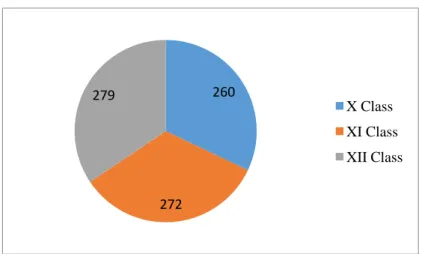
The students quantity at SMA Negeri 1 Seputih Raman in the academic year of 2020/2021 is that can be seen on the figure below:
29
(Source: The Data of Students Quantity Got from the English Teacher at SMA N 1 Seputih Raman Central Lampung)
Figure 4.1 The Students Quantity at SMA Negeri 1 Seputih Raman in the Academic Year of 2020/2021
d. The Condition of Infrastructure Facilities at SMA Negeri 1 Seputih Raman
Overall, the facilities and infrastructure in SMA Negeri 1 Seputih Raman are very adequate, it can be seen from the list of supporting infrastructure for the learning process below:
Electrical power : 6,000 volt Surface area :15,000 M²
Table 4.2
The Total of Classroom at SMA Negeri 1 Seputih Raman
No Classroom
1. X 1 (Theory Class/ Classroom) 2. X 2 (Theory Class/ Classroom) 3. X 3 (Theory Class/ Classroom) 4. X 4 (Theory Class/ Classroom) 5. X 5 (Theory Class/ Classroom)
260
272
279 X Class
XI Class XII Class
6. X 6 (Theory Class/ Classroom) 7. X 7 (Theory Class/ Classroom) 8. X 8 (Theory Class/ Classroom) 9. X 9 (Theory Class/ Classroom) 10. XI A1 (Theory Class/ Classroom) 11. XI A2 (Theory Class/ Classroom) 12. XI A3 (Theory Class/ Classroom) 13. XI A4 (Theory Class/ Classroom) 14. XI A5 (Theory Class/ Classroom) 15. XI A6 (Theory Class/ Classroom) 16. XI S1 (Theory Class/ Classroom) 17. XI S2 (Theory Class/ Classroom) 18. XI S3 (Theory Class/ Classroom) 19. XI S4 (Theory Class/ Classroom) 20. XII A1 (Theory Class/ Classroom) 21. XII A2 (Theory Class/ Classroom) 22. XII A3 (Theory Class/ Classroom) 23. XII A4 (Theory Class/ Classroom) 24. XII A5 (Theory Class/ Classroom) 25. XII S1 (Theory Class/ Classroom) 26. XII S2 (Theory Class/ Classroom) 27. XII S3 (Theory Class/ Classroom) 28. XII S4 (Theory Class/ Classroom) 29. XII S5 (Theory Class/ Classroom)
31
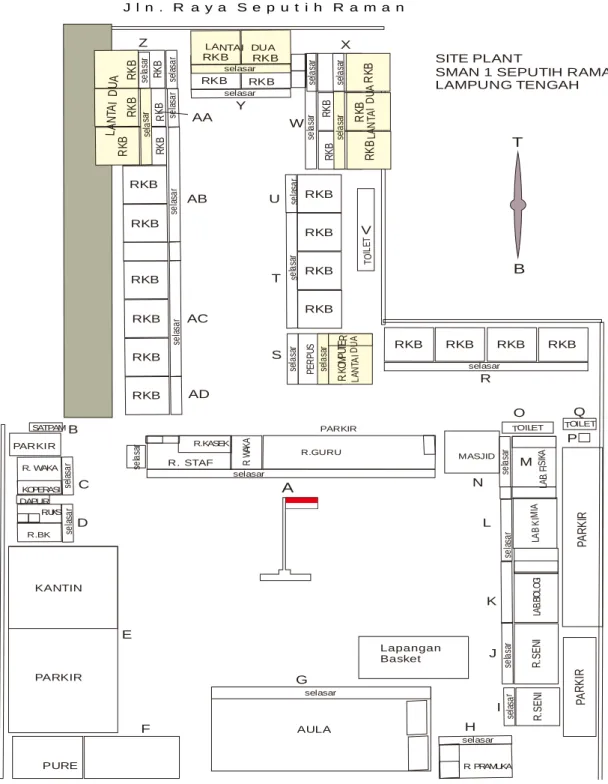
e. Location Sketch at SMA Negeri 1 Seputih Raman
A B
C
D
E
selasar
selasar
selasar
selasar selasarselasar
selasar selasar selasar
selasar
selasarselasar selasar
selasar
selasar
selasar
F
G
H I
selasar
J l n . R a y a S e p u t i h R a m a n
Lapangan Basket selasar
selasar
selasar selasar
T
B SITE PLANT
SMAN 1 SEPUTIH RAMAN LAMPUNG TENGAH
LANTAI DUA
LA
NTAI DUA LANTAI DUA
LANTAI DUA
selasar
M
J K L N
O
P Q R
selasar
S T U
W X
Y Z
AA
AB
AC
V
AD
selasar
selasar selasar
selasar
RKB RKB RKB RKB RKB
RKB RKB RKB RKB RKB
RKB RKB RKB RKB
RKB RKBRKB RKBRKB RKB
RKB RKB RKB RKB
RKBRKBRKB RKBRKB
PERPUS R. KOMPUTER TOILET
TOILET TOILET SATPAM
PARKIR R. WAKA
KOPERASI DAPUR
R. UKS R.BK
KANTIN
PARKIR
PURE
AULA
PARKIRPARKIR
R.KASEK R. STAF
R.GURU
R. WAKA
PARKIR
MASJID
R.SENI LAB. FISIKALAB.BIOLOGILAB KIMIAR.SENI
R. PRAMUKA
(Source: The observation of location sketch Got from the English Teacher at SMA N 1 Seputih Raman Central Lampung)
Figure 4.2 The Location Sketch at SMA Negeri 1 Seputih Raman in the Academic Year of 2020/2021
2. Description of the Research Result
The researcher conducted a qualitative research to answer two research questions. The results of research that answer the research question are as follows:
a. The most dominant type of hedging used by the eleventh grade at SMAN 1 Seputih Raman.
To analyze the most dominant type of hedging used by the student, the researcher used the document of students’ writing letter text assignment. The results of the students’ writing assignment including the following:
1) Chapter I
It was analyzed that in the first data there are no epistemic lexicaland sami auxalary. In addition, there is modal auxilary verb expresing opportunity. consist of one will and two can. The sentences that contains will and would and can.
The sentence are :
a. You’ll learn more about your self,...
b. You will develop soft skill.
c. They can look for abilities and know their abilities.
d. Sudentnts can choose a variety of organization according to abillity.
33
2) Chapter II
It was analyzed that in the second data there are modal verbs.. consist of two can. The sentences that contains can.
The sentence are :
a) Join the organization can develope talent, hobbies, practice, learn to solve problem.
b) Working with the team can be share the talent of they are.
3) Chapter III
It was analyzed that in the Thrid data there is modal verb expresing opportunity. consist of two can and one will. The sentences that contains can and will. The sentence are :
a) Student can hone and develop their talents in jon of organization.
b) You can also get new experience.
c) You’ll be able to use our skill in clas or in our of live.
4) Chapter IV
The type of hedging on the fourth data analized are found type of modal verbs and lexical verb. consist of two can and one will. The sentences that contains two will,should and suggest. The sentence are
a) Student should not only study but they are have many experience.
b) I sugest to learn more than today
c) You will learn our your self.
d) You will develop our soft skill.
5) Chapter V
In addition, there is modal verb and lexical verb consist of two can and will . The sentence are :
a) I suggest to students follow and join a organization.
b) Join a student organozation is a good choice through student orgabization will become know ledgeable individuals.
c) You can learn from the other students to uderstend and the current knowledge.
d) You can find out what you know.
6) Chapter VI
It was analyzed that in the sixth there is modal verb, adverbs. consist of usually can and will.
The sentence are :
a) If the student join organization usually have many time to explore the experiment.
b) Staying with the organization can provide opportuniies for better and easier.
c) Students organization will help become individual on the future carier.
35
7) Chapter VII
It was analyzed that in the seventh data there is modal auxilary verb expresing opportunity. consist of can and will.
The sentence are :
a) You will learn the best way communicate with both individuals and groups.
b) You can found more friends our your comunities.
8) Chapter VIII
It was analyzed that in the eighth data there are no epistemic lexicaland sami auxalary. In addition, there is modal auxilary verb expresing opportunity. consist of two can and suggest.
The sentence are :
a) Students can chose the organization acording to their abilities.
b) The student usually join organization is to get a new friends.
c) The skill can used when in the organization.
9) Chapter IX
It was analyzed that in the ninth data there are modal verbs. consist of can and will.
The sentence are :
a) Join the organization can practice to organization a team an it will train your mentally to be better.
10) Chapter XI
It was analyzed that in the tenth data there is modal auxilary verb expresing opportunity. consist of two will.
The sentence are :
a) Join a student organization is a good chooice because that you will learn resposibility and get more experience.
b) You will develop soft skill.
Tabel 4.3
Type of Hedging by student of Senior High School 1 Seputih Raman
No Name Hedging
Modal verbs Lexical verbs
Adverbs
1 NMNW Will Can - -
2 SY Can - - -
3 NDW Can Will - -
4 DDS should Will Suggest -
5 NMRA Can Will Suggest -
6 MS Can Will - Usually
7 SM Can Will - -
8 NKLU Can - Suggest Usually
9 NGAPR - Will - -
10 DK - Will - -
3. What are the students’ difficulties in using hedging in writing skill at SMAN 1 Seputih Raman in the academic of 2019/2020
To analyze the difficulties in using hedging in writing skill the researcher used interview with English teacher. The result of interview including the following: