Dongchan Jang from the Greer group was very helpful in explaining and instructing me on the mechanical testing of the zeolite films I prepared. I would also like to thank the administrators of the Women's Center, the Women Mentoring Women Program, and the Caltech Animal Team for their support.
Synthesis and Formation of Zeolites
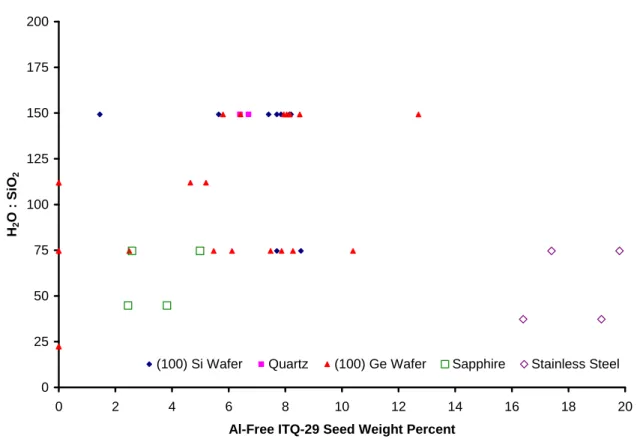
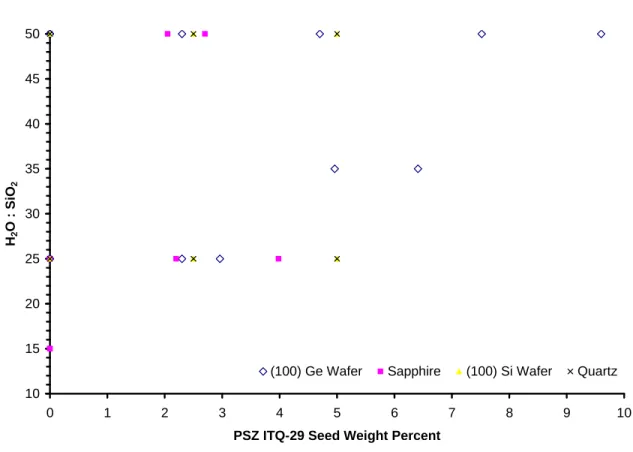
These include reaction time, reaction temperature, presence of seeds, aging of the precursor gel, and static studies against the synthesis of pure silica zeolite known as silicalite (structure code MFI), which is a simple model system, precursor gel which contains only tetraethylorthosilicate,.
Zeolite Applications
Thesis Organization
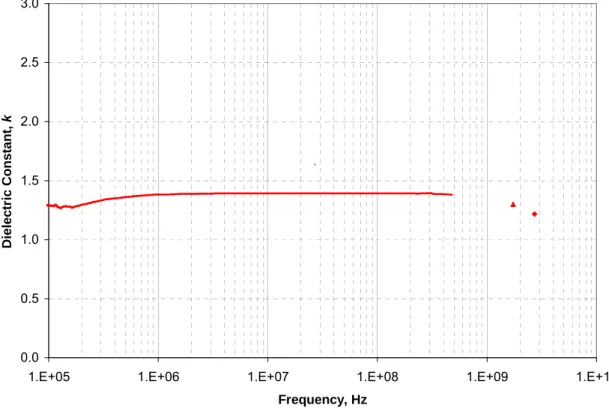
Using these zeolites, as well as the pure silica LTA from Chapter 3, we investigate their applicability to low-k materials using two different techniques for measuring the materials' dielectric constant. It concludes with a discussion of the 2-nitrobenzyl family of photoprotecting groups, which have the potential to be a suitable choice for zeolite syntheses.
A Fluoride-Based Route to Silica Molecular Sieves; strategy for the synthesis of new materials based on close packing of guest-host products. MEL-type pure silica zeolite nanocrystals prepared by a two-step evaporation-assisted synthesis method as ultra-low-k materials.
Introduction to Part I of Thesis
Introduction
While molecular sieve layers are of limited use in applications that require complete entanglement, such as electronic materials, they can be particularly useful in The use of a nonporous support somewhat limits the use of zeolite films; as such, these materials can be used as coatings, whether adsorptive, catalytic, or corrosion-resistant, for applications such as chemical sensors, metal junctions, or low-k dielectrics.2,4,9 Zeolite membranes, from on the other hand, they are used for separation processes.
Zeolite Film and Membrane Synthetic Strategies
In this method, the substrate is immersed directly in the zeolite precursor organ and the zeolite is formed on both sides of the surface. In addition, in situ procedures require immersion of the substrate in presumably a clear solution or a dilute gel.

Development of New Synthetic Techniques
This can also be used to reduce the hydrophilicity of the film, as silanols promote water adsorption. When post-synthetic techniques cannot be used for error correction, error correction becomes an iterative process where only the film preparation method must be adjusted to prevent errors from occurring.
Synthesis and evaluation of pure silica zeolite BEA as a low dielectric constant material for microprocessors. Synthesis and corrosion resistance of high-silica zeolite MTW, BEA and MFI coatings on steel and aluminium.
In situ crystallization of fluoride-mediated, pure-silica zeolite thin films
Results and Discussion
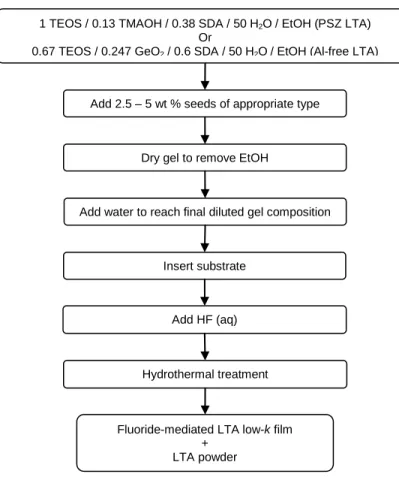
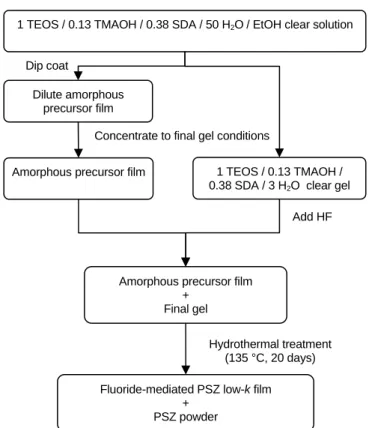
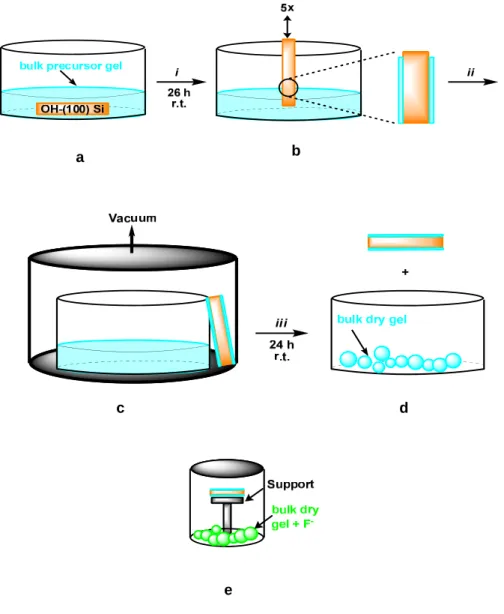
This increases the hydrophilicity of the substrate and improves adhesion between the substrate and the amorphous precursor film. Crystallization of the film and bulk gel proceeds using temperatures reported in the literature from synthesis of powdered samples. Instead, we take advantage of the volatile nature (in the form of HF gas) of the mineralizing agent (F-), and its transport via the vapor phase.
Vapor phase transport of the mineralizing agent prevents etching of substrate surfaces by direct contact with aqueous hydrofluoric acid. The average mechanical properties of ITQ-29 films on low resistivity (100) silicon wafers were evaluated (Figure 3.8).
Conclusions
Experimental
A pure silicate or germanosilicate precursor gel was prepared in a Teflon® jar by hydrolyzing tetraethylorthosilicate (TEOS, 98%, Aldrich) in an aqueous solution of SDA A and either tetramethylammonium hydroxide (TMAOH, 25%, Aldrich) for pure silica. or germanium (IV) oxide (GeO2, Alfa Aesar) for the germanosilicate form. A Teflon® cap with two small drilled holes was screwed onto the jar containing the main precursor gel. The sealed bulk precursor gel was placed in a vacuum desiccator, and the ethanol and excess H2O present in the bulk precursor gel and precursor film were evaporated. germanosilicate form), and the sample was mixed with a Teflon® spatula.
A Teflon® cap with two small holes drilled in it was screwed onto the glass containing the bulk precursor organ. Elastic modulus and hardness measurements for pure-silica zeolite LTA films on (100) Si were obtained via nanoindentation with an Agilent Corp.
Investigation of Dielectric Properties of Fluoride-Mediated, Pure-Silica Zeolite Thin Films
The dielectric properties of the five pure silica materials were investigated to determine their relevance for low-k applications. The k-value of the PSZ LTA film is the lowest obtained for any in situ synthesized polycrystalline PSZ film. Application of the vapor phase transport of fluoride method to the pure silica zeolite systems CHA, ITW, STT and -SVR yielded thin films on surface-modified, (100) Si wafers.
The solution is then filtered and concentrated to a 1 – 1.2 M concentration of the hydroxide form using a rotary evaporator. The solution is then filtered and concentrated to 0.75 M concentration of the hydroxide form using a rotary evaporator.
Introduction to Part II of Thesis 1. Introduction
Photolabile Structure-Directing Agents
A pore-opening technique to remove occluded organics via a combination of reusable structuring agents and a photochemical treatment where the original structuring agent is not completely destroyed could be developed using potential. The photolabile structuring agent method is particularly advantageous for the development of nanostructured planar zeolite materials because, like UV/ozonolysis, it can be used in conjunction with micropatterning techniques. The development of a photolabile structure-directing agent (P-SDA) route for zeolite synthesis requires three elements to demonstrate its feasibility.
First, it is necessary to create an organic molecule capable of acting in the role of directing the structure. These three proof-of-feasibility conditions impose strict requirements on both the type of organic molecule that can be used, as well as the choice of zeolite synthetic chemistry and guide the selection of potential photolabile structure-directing agents.
Photochemical Protecting Groups in Organic Synthesis
However, it is a particularly useful group that can be used to create a variety of photochemical protecting groups. The primary drawback of this photochemical protecting family is the formation of byproducts of the original photochemical protecting group during photolytic removal via N- and C-alkylation. In addition, the use of substituents on the aromatic portion of the photochemical protecting group to enhance photolytic cleavage creates bulky molecules that may be unsuitable for use in zeolite applications.
Like the benzyloxycarbonyl family, the reactivity of this photochemical protecting group can be modified by placing substituents on the aromatic part of the molecule. Finally, the cleavage mechanism of the photochemical protecting group must be appropriate for the specific zeolite in which it becomes entrapped.

Photofunctional Zeolites
Thermal stability of the photochemical protecting group can be evaluated using thermogravimetric analysis; in general, rigid molecules can withstand higher temperatures, and for these purposes all the photochemical protecting groups mentioned here could be useful. In addition, the synthesis of the photochemical protecting group must be reasonable; for example, many of the reactions that generate the oxycarbonyl functionality to create the photochemical protecting group require the use of phosgene gas, which is unsuitable for laboratory-scale use. For example, the polarity of the zeolite cavities can be increased by using lighter charge-balancing atoms, such as Li+ and Na+, which cause interactions between the skeleton and any aromatic parts of the photoactive molecule, leading to some distortion in the symmetry of the molecule. and potentially poor cleavage.
Heavier charge-balancing cations, on the other hand, can enhance the generation of excited triplet states in some molecules, improving the fissibility of the entrapped organic material. The acidity of the surface hydroxyl groups and the basicity of the oxygen in the lattice can also influence the behavior of the photoactive molecule.
Development of a Photolabile Structure-Directing Agent
These factors suggest that even if a photoactive molecule is capable of acting in a structure-directing role, it may be difficult to cleave if it is tightly confined or bound within the zeolite that it helps form. Another molecule was created using the 2-nitrobenzyl group to form the photolabile compound 1-(2-nitrobenzyl)-1H-imidazole (Figure 5.12, P-SDA 2) by protecting the imidazole functionality. The advantages of choosing this family of photochemical protecting groups and small molecule substrates are (a) the chemistry of these molecules follows a well-known pattern (although P-SDA 1 has not yet been synthesized), (b) there are examples in the literature of using substrate molecules themselves or very similar molecules as structure directing agents, (c) the molecules are stable within the thermal range of zeolite synthesis, and (d) each molecule has a different stability at pH ( P-SDA 1 is very stable under basic conditions, while P-SDA 2 is stable in acids up to basic conditions).
The main disadvantage of these molecules is their inability to be completely regenerated after cleavage, as the photoinduced cleavage mechanism of the 2-nitrobenzyl family renders the photochemical protecting group unstable via the reduction of the nitro group to a nitroso group. A choice of a different family of photochemical protecting groups, such as the benzyloxycarbonyl group, could avoid this disadvantage and make the structure directing agent fully recyclable.
Photochemical template removal and spatial patterning of MFI zeolite thin films using UV/ozone treatment. Synthesis of molecular sieves using ketal structural directing agents and their degradation within the pore space. Diquaternary structure directing agents built on charged imidazolium ring centers and their use in the synthesis of one-dimensional porous zeolites.
Photolabile structure-directing agents for zeolite synthesis Abstract
Results and Discussion 1 P-SDA 1 Synthesis
Photodissociation was followed using infrared (IR) spectroscopy and resulted in cleavage of P-SDA 1 present in the zeolite material (Figure 6.8). It is likely that the addition of the nitro group to the molecule negatively affected the zeolite core, possibly due to the slight change in electrostatic interactions caused by the electron-withdrawing nitro group in the aromatic part of the molecule. Although this particular molecule did not demonstrate the feasibility of the photolabile structure-directing agent route to zeolite synthesis, it did demonstrate the ability of 2-.
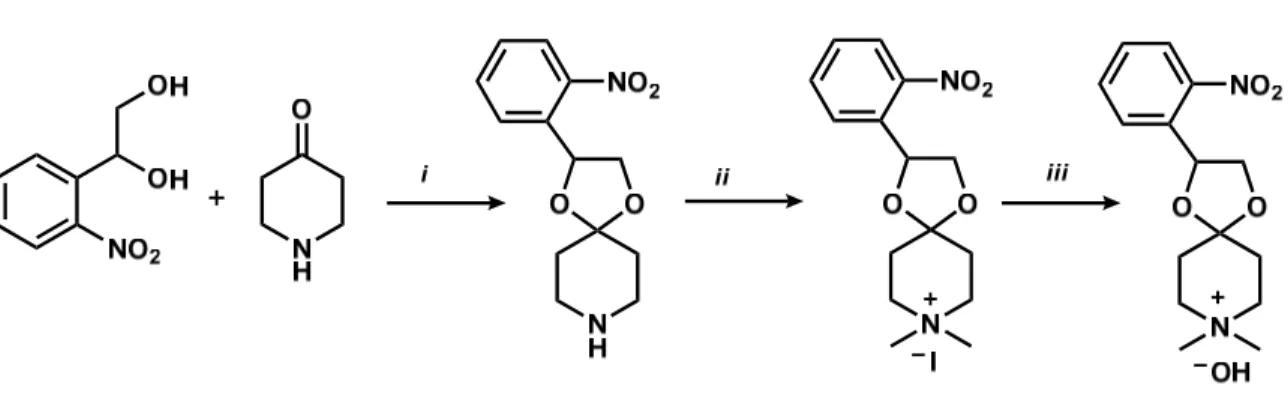
The synthesis of P-SDA 1 proceeds as shown in Figure 6.2, with a ketalization reaction followed by quaternization of the secondary amine. A long-wave UV lamp (UVP Model B 100 AP) was positioned so that the lamp head faced the side of the tube, and the head and area surrounding the sample were enclosed with aluminum foil for safety reasons.
An Imidazole-Based, Photolabile Structure-Directing Agent for the Synthesis of Aluminophosphate Zeolites Synthesis of Aluminophosphate Zeolites
Results and Discussion 1 P-SDA 2 Synthesis
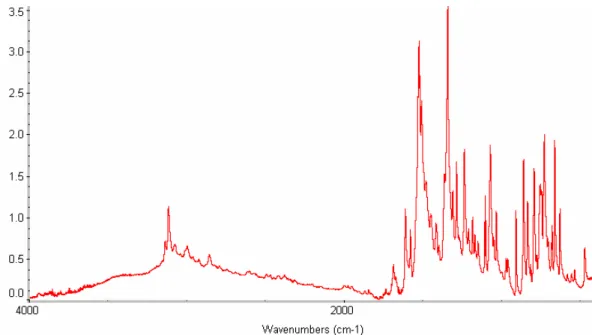
The synthesis of P-SDA 2 was carried out according to literature procedures, with the resulting molecule in approximately 30% overall yield; General literature procedures report yields of P-SDA 2 , which has several characteristic features in its infrared (IR) spectrum (Figure 7.3) and 13C cross-polarization, magic angle spinning, nuclear magnetic resonance (CPMAS NMR) spectrum (Figure 7.4). For example, in the IR spectrum, the absorbances at 1530 and 1375 cm-1 are characteristic of the nitro group and. The XRD patterns of the two phases obtained, AFI and ATS, are shown in Figure 7.6 (their corresponding structures are shown in Figure 7.7); in the XRD patterns, both are mixed with other phases (a dense phase known as tridymite in the case of AFI and an unknown phase for ATS).
Some general trends can be seen in the results of the syntheses. a) Aluminophosphate materials with the zeolite structure ATS are the preferred crystallization product of these syntheses with SDA 2. b) Gels crystallized at 200 °C yielded about 1/3 of the crystalline material as the 175 °C runs, and were more often amorphous. A shift between the production of aluminophosphate materials with the zeolite. structures of ATS and AFI can be seen at 200 °C for larger amounts of magnesium in the synthesis.