ICoSET 2019
Proceedings of the
Second International Conference on Science, Engineering and Technology
Riau - Indonesia
September 5 - 7, 2019
Copyright © 2020 by SCITEPRESS – Science and Technology Publications, Lda.
All rights reserved
Edited by Arbi Haza Nasution, Evizal Abdul Kadir and Luiz Moutinho
Printed in Portugal ISBN: 978-989-758-463-3 Depósito Legal: 473348/20
http://icoset.uir.ac.id
B RIEF C ONTENTS
INVITEDSPEAKERS . . . IV ORGANIZINGCOMMITTEES . . . V PROGRAM COMMITTEE . . . VI FOREWORD . . . VII CONTENTS . . . IX
III
I NVITED S PEAKERS
Prof. EE-Peng Lim Singapore Management University
Singapore
Assoc. Prof. Yuichi Sugai Kyushu University
Japan
Prof. Ir. Dr Sharul Kamal Abdul Rahim Universiti Teknologi Malaysia
Malaysia
Assoc. Prof. Dr. Norma binti Alias Universiti Teknologi Malaysia
Malaysia
IV
O RGANIZING C OMMITTEES
GENERALCHAIR
Dr. Arbi Haza Nasution, M.IT, Universitas Islam Riau, Indonesia
TECHNICALPROGRAMCHAIR
Dr. Evizal Abdul Kadir, ST., M.Eng, Universitas Islam Riau, Indonesia
GENERALCO-CHAIR
Dr. Eng. Muslim, ST., MT, Universitas Islam Riau, Indonesia
EDITORIALCHAIR
Yudhi Arta, S.Kom., M.Kom, Universitas Islam Riau, Indonesia
STEERINGCOMMITTEE
Prof. Josaphat Tetuko Sri Sumantyo, Ph.D, Chiba University, Japan Prof. Ir. Dr. Sharul Kamal Abdul Rahim, Universiti Teknologi Malaysia, Malaysia
Prof. Toru Ishida, Kyoto University, Japan
Prof. Ee-Peng Lim, Singapore Management University, Singapore Prof. Dr. H Syafrinaldi SH, MCL, Universitas Islam Riau, Indonesia
PUBLICATION ANDRELATIONSHIPCHAIR
Dr. Syafriadi, S.H., M.H., Universitas Islam Riau, Indonesia
FINANCIALCHAIR
Ause Labellapansa, ST., M.Cs., M.Kom., Universitas Islam Riau, Indonesia
EDITORIALBOARD
Putra Efri Rahman, S.Kom, Universitas Islam Riau, Indonesia Khairul Umam Syaliman, S.T., M.Kom., Politeknik Caltex Riau, Indonesia
Winda Monika, S.Pd., M.Sc., Universitas Lancang Kuning, Indonesia Panji Rachmat Setiawan, S.Kom., M.M.S.I., Universitas Islam Riau, Indonesia Rizdqi Akbar Ramadhan, S.Kom., M.Kom., Universitas Islam Riau, Indonesia
Anggiat, Universitas Islam Riau, Indonesia Arif Lukman Hakim, Universitas Riau, Indonesia
V
P ROGRAM C OMMITTEE
Prof. Dr. Tengku Dahril, M.Sc, Universitas Islam Riau, Indonesia
Prof. Dr. Hasan Basri Jumin, M.Sc, Universitas Islam Riau, Indonesia
Prof. Dr. Sugeng Wiyono, MMT, Universitas Islam Riau, Indonesia
Prof. Zainal A. Hasibuan, MLS., Ph.D, University of Indonesia, Indonesia
Prof. Josaphat Tetuko Sri Sumantyo, Ph.D, Chiba University, Japan
Prof. Dr. Eko Supriyanto, Universiti Teknologi Malaysia, Malaysia
Prof. Dr. Zailuddin Arifin, Universiti Teknologi MARA, Malaysia
Prof. Jhon Lee, B.Sc, M.Sc., Ph.D, Kyungdong University, Korea
Prof. Ahmed A. Al Absi, Kyungdong University, Korea
Prof. Wisup Bae, Ph.D, Sejong University, Korea Prof. Kyuro Sasaki, Kyushu University, Japan Prof. Adiwijaya, Telkom University, Indonesia Prof. Ir. Asep Kurnia Permadi, M. Sc, Ph.D, Institut Teknologi Bandung, Indonesia
Assoc. Prof. Dr. Azhan Hashim Ismail, Universiti Teknologi MARA, Malaysia
Assoc. Prof. Yuichi Sugai, Kyushu University, Japan
Assoc. Prof. Dr. Sonny Irawan, Universiti Teknologi Petronas, Malaysia
Assoc. Prof. Hussein Hoteit, King Abdullah University of Science and Technology, Saudi Arabia Assoc. Prof. Dr. Anas Puri, ST., MT, Universitas Islam Riau, Indonesia
Kuen-Song Lin, Ph.D, Yuan Ze University, Taiwan
Dr. Shukor Sanim Mohd Fauzi, Universiti Teknologi MARA, Malaysia
Dr. Inkyo Cheong, Inha University, Korea Ahn, Young Mee, Ph.D, Inha University, Korea Hitoshi Irie, Ph.D, Chiba University, Japan Julie Yu-Chih Liu, Ph.D, Yuan Ze University, Taiwan
Liang Chih Yu, Ph.D, Yuan Ze University, Taiwan Chia-Yu Hsu, Ph.D, Yuan Ze University, Taiwan Dr. Amit Pariyar, University Malaysia Sarawak, Malaysia
Dr. Madi Abdullah Naser, Sebha University, Libya
Dr. Nguyen Xuan Huy, Ho Chi Minh City University of Technology, Vietnam
Dr. Chunqiu Li, Beijing Normal University, China Dr. Goh Thian Lai, Universiti Kebangsaan Malaysia, Malaysia
Dr. Syahrir Ridha, Universiti Teknologi Petronas, Malaysia
Dr. Kemas Muslim L., Telkom University, Indonesia
Dr. Moch. Arif Bijaksana, Telkom University, Indonesia
Dr. Satria Mandala, Telkom University, Indonesia Dr. Wahyudi Sutopo, Solo State University, Indonesia
Dr. Zulfatman, University of Muhammadyah Malang, Indonesia
Dr. Suranto AM, UPN Veteran Yogyakarta, Indonesia
Dr. Eng. Husnul Kausarian, B.Sc (Hons)., M.Sc, Universitas Islam Riau, Indonesia
VI
F OREWORD
In the name of Allah, Most Gracious, Most Merciful Assalamu’alaikum Wr. Wb.,
Welcome to the Second International Conference on Science Engineering and Technology (ICoSET 2019).
The advancement of today’s computing technology, science, engineering and industrial revolution 4.0 play a big role in the sustainable development of social, economic, education, and humanity in developing coun- tries. Institute of higher education is one of many parties that need to be involved in the process. Academi- cians and researchers should promote the concept of sustainable development. The Second International Conference on Science, Engineering and Technology (ICoSET 2019) is organized to gather researchers to disseminate their relevant work on science, engineering and technology. The conference is co-located with The Second International Conference on Social, Economy, Education, and Humanity (ICoSEEH 2019) at SKA Co-EX Pekanbaru Riau.
I would like to express my hearty gratitude to all participants for coming, sharing, and presenting your research at this joint conference. There is a total of 84 manuscripts submitted to ICoSET 2019. However only high-quality selected papers are accepted to be presented in this event, with the acceptance rates of ICoSET 2019 is 70%. We are very grateful to all steering committees and both international and local reviewers for their valuable work. I would like to give a compliment to all co-organizers, publisher, and sponsors for their incredible supports.
Organizing such prestigious conferences was very challenging and it would be impossible to be held with- out the hard work of the program committee and organizing committee members. I would like to express my sincere gratitude to all committees and volunteers from Singapore Management University, Kyoto Uni- versity, Kyushu University, University of Tsukuba, Khon Kaen University, Ho Chi Minh City University of Technology, University of Suffolk, Universiti Teknologi Malaysia, Infrastructure University Kuala Lumpur, Universiti Malaya, Universiti Kebangsaan Malaysia, Universiti Utara Malaysia, Universiti Teknologi Mara, and Universiti Pendidikan Indonesia for providing us with so much support, advice, and assistance on all aspects of the conference. We do hope that this event will encourage collaboration among us now and in the future.
We wish you all find the opportunity to get rewarding technical programs, intellectual inspiration, and ex- tended networking.
Pekanbaru, 27th August 2019 Dr. Arbi Haza Nasution, M.IT Chair of ICoSET 2019
VII
C ONTENTS
PAPERS FULLPAPERS
Design of Community-based Ecotourism at Cengkehan and Giriloyo, Wukirsari Village, Imogiri District, Bantul Regency, Special Region of Yogyakarta
Suhartono, Sri Mulyaningsih, Desi Kiswiranti, Sukirman, Nurwidi A. A. T. Heriyadi, Muchlis and Iva Mindhayani
5
Prototype Storage Locker Security System based on Fingerprint and RFID Technology
Apri Siswanto, Hendra Gunawan and Rafiq Sanjaya 11
Feasibility Study of CO2 Flooding under Gross-split Mechanism: Simulation Approach
Muslim Abdurrahman, Wisup Bae, Adi Novriansyah, Dadan Damayandri and Bop Duana Afrireksa 15 Online Classroom Attendance System based on Cloud Computing
Sri Listia Rosa and Evizal Abdul Kadir 20
Analysis of Porosity and Permeability on Channel Deposit Sandstone using Pore-gas Injection and Point Counting in Sarilamak Area, West Sumatra
Bayu Defitra, Tiggi Choanji and Yuniarti Yuskar 26
A Simulation Study of Downhole Water Sink Guidelines Plot Application using Real Field Data
Praditya Nugraha 31
Groundwater Exploration using 2D Electrical Resistivity Imaging (ERI) at Kulim, Kedah, Malaysia Adi Suryadi, Muhammad Habibi, Batara, Dewandra Bagus Eka Putra and Husnul Kausarian 35 Risk Identification in Management System Process Integration Which Have Impact on the Goal of Management System Components
Nastasia Ester Siahaan, Leni Sagita and Yusuf Latief 41
The Performance of 3D Multi-slice Branched Surface Reconstruction on CPU-GPU Platform
Normi Abdul Hadi and Norma Alias 49
Tile-based Game Plugin for Unity Engine
Salhazan Nasution, Arbi Haza Nasution and Arif Lukman Hakim 55
Image Segmentation of Nucleus Breast Cancer using Digital Image Processing
Ana Yulianti, Ause Labellapansa, Evizal Abdul Kadir, Mohana Sundaram and Mahmod Othman 64 An Integrated Framework for Social Contribution of Diabetes Self-care Management Application
Zul Indra, Liza Trisnawati and Luluk Elvitaria 68
Spatiotemporal Analysis of Urban Land Cover: Case Study - Pekanbaru City, Indonesia
Idham Nugraha, Faizan Dalilla, Mira Hafizhah Tanjung, Rizky Ardiansyah and M. Iqbal Hisyam 74 The Effectiveness of Rice Husk Biochar Application to Metsulfuron Methyl Persistence
Subhan Arridho, Saripah Ulpah and Tengku Edy Sabli 80
Digital Forensics: Acquisition and Analysis on CCTV Digital Evidence using Static Forensic Method based on ISO /IEC 27037:2014
Rizdqi Akbar Ramadhan, Desti Mualfah and Dedy Hariyadi 85
IX
Testing the Role of Fish Consumption Intention as Mediator
Junaidi, Desi Ilona, Zaitul and Harfiandri Damanhuri 90
Segmentation of Palm Oil Leaf Disease using Zoning Feature Extraction
Ause Labellapansa, Ana Yulianti and Agus Yuliani 98
Analysis of Economy in the Improvement of Oil Production using Hydraulic Pumping Unit in X Field
Muhammad Ariyon, Novia Rita and Tribowo Setiawan 102
Construction Design and Performance of Dry Leaf Shredder with Vertical Rotation for Compost Fertilizer
Syawaldi 109
The Impact of Additively Coal Fly Ash toward Compressive Strength and Shear Bond Strength in Drilling Cement G Class
Novrianti, Dori Winaldi and Muhammad Ridho Efras 114
Impact of Vibration of Piling Hammer on Soil Deformation: Study Case in Highway Construction Section 5 Pekanbaru-Dumai
Firman Syarif, Husnul Kausarian and Dewandra Bagus Eka Putra 120 Combination Playfair Cipher Algorithm and LSB Steganography for Data Text Protection
Apri Siswanto, Sri Wahyuni and Yudhi Arta 125
Fire Detection System in Peatland Area using LoRa WAN Communication
Evizal Abdul Kadir, Hitoshi Irie and Sri Listia Rosa 130
Forest Fire Monitoring System using WSNs Technology
Evizal Abdul Kadir, Sri Listia Rosa and Mahmod Othman 135
Multi Parameter of WSNs Sensor Node for River Water Pollution Monitoring System (Siak River, Riau-Indonesia)
Evizal Abdul Kadir, Abdul Syukur, Bahruddin Saad and Sri Listia Rosa 140 Analysis for Gerund Entity Anomalies in Data Modeling
Des Suryani, Yudhi Arta and Erdisna 146
The Incidence of Rhinoceros Beetle Outbreak in Public Coconut Plantation in Tanjung Simpang Village, Indragiri Hilir, Riau Province
Saripah Ulpah, Nana Sutrisna, Fahroji, Suhendri Saputra and Sri Swastika 151 Mobile Application of Religious Activities for the Great Mosque Islamic Center Rokan Hulu with Push Notification
Salhazan Nasution, Arbi Haza Nasution and Fitra Yamita 155
An Augmented Reality Machine Translation Agent
Arbi Haza Nasution, Yoze Rizki, Salhazan Nasution and Rafi Muhammad 163 The Community Perception of Traditional Market Services in Pekanbaru City, Riau Province
Puji Astuti, Syaifullah Rosadi, Febby Asteriani, Eka Surya Pratiwi and Thalia Amanda Putri 169 Separation of Crude Oil and Its Derivatives Spilled in Seawater by using Cobalt Ferrite Oxide
Mohammed A, Samba, Ibrahim Ali Amar, Musa Abuadabba, Mohammed A. Alfroji, Zainab M. Salih
and Tomi Erfando 175
X
Study of Open Space Utilization in Pekanbaru City, Riau Province
Mira Hafizhah T., Febby Asteriani, Mardianto and Angelina Rulan S. 182 Application of Augmented Reality as a Multimedia Learning Media: Case Study of Videography
Ahmad Zamsuri, Fadli Suandi and Rizki Novendra 188
Green Building Performance Analysis in the Stimi Campus Building
Dian Febrianti and Samsunan 194
Towing Service Ordering System based on Android: Study Case - Department of Transportation, Pekanbaru
Panji Rachmat Setiawan, Yudhi Arta and Rendi Sutisna 200
Biosurvey of Mercury (Hg), Cadmium (Cd), and Lead (Pb) Contamination in Reclamation Island-Jakarta Bay
Salmita Salman, Achmad Sjarmidi and Salman 205
Expert System to Detect Early Depression in Adolescents using DASS 42
Nesi Syafitri, Yudhi Arta, Apri Siswanto and Sonya Parlina Rizki 211 Geotechnics Analysis: Soil Hardness on Stability of Davit Kecil’s Weir in Ulu Maras, Kepulauan Anambas, Kepulauan Riau
Miftahul Jannah, Dewandra Bagus Eka Putra, Firman Syarif, Joni Tripardi, Nopiyanto and Husnul Kausarian
219
Support for Heritage Tourism Development: The Case of Ombilin Coal Mining Heritage of Sawahlunto, Indonesia
Jonny Wongso, Desi Ilona, Zaitul and Bahrul Anif 229
Aerial Photogrammetry and Object-based Image Analysis for Bridge Mapping: A Case Study on Bintan Bridge, Riau Islands, Indonesia
Husnul Kausarian, Muhammad Zainuddin Lubis, Primawati, Dewandra Bagus Eka Putra, Adi Suryadi and Batara
237
Monitoring Single Site Verification (SSV) System and Optimization BTS Network based on Android
Abdul Syukur, Siti Rahmadhani Sabri and Yudhi Arta 243
Characterization of the Ethnobotany of Riau Province Mascot Flora (Oncosperma tigillarium (Jack) Ridl.)
Desti, Fitmawati, Putri Ade Rahma Yulis and Mayta Novaliza Isda 250 Effect Stocking Density on Growth and Survival rate of Larval Selais Fish (Kryptopterus lais) Cultured in Recirculation System
Agusnimar Muchtar and Rosyadi 254
Development of Safety Plan to Improve OHS (Occupational Health and Safety) Performance for Construction of Dam Supporting Infrastructure based on WBS (Work Breakdown Structure)
Aprilia Dhiya Ulhaq, Yusuf Latief and Rossy Armyn Machfudiyanto 258 Design of Web Login Security System using ElGamal Cryptography
Yudhi Arta, Hendra Pratama, Apri Siswanto, Abdul Syukur and Panji Rachmat Setiawan 268 Standard Operational Procedures Development for Government Building’s Care and Maintenance Work of Outer Spatial and Housekeeping Component to Improve Work Effectiveness and Efficiency using Risk-based Approach
Lasita Khaerani, Yusuf Latief and Rossy Armyn Machfudiyanto
274
XI
A Novel Correlation on MMP Prediction in CO2-LPG Injection System: A Case Study of Field X in Indonesia
Prasandi Abdul Aziz, Hendra Dwimax, Tutuka Ariadji, Steven Chandra, Wijoyo Niti Daton and Ressi Bonti
285
Productivity Analysis of Frac-pack Completion in M Well with Sand Problem Indication and High Permeability Formation
Herianto, Prasandi Abdul Aziz, Wijoyo Niti Daton and Steven Chandra 291 Emulsion Treatment using Local Demulsifier from Palm Oil
Tomi Erfando and Emre Fathan 299
Designing an IoT Framework for High Valued Crops Farming
Domingo Junior P. Ngipol and Thelma D. Palaoag 304
Consideration of the Different Pile Length Due to Soil Stress and Inner Forces of the Nailed-slab Pavement System under Concentric Load
Anas Puri, Roza Mildawati and Muhammad Solihin 311
Utilization of Agricultural Waste to Be Bioethanol Sources as a Solvent on Paraffin Wax Crude Oil Issues
M. K. Afdhol, F. Hidayat, M. Abdurrahman, H. Z. Lubis, R. K. Wijaya and N. P. Sari 315 The Effect of Regeneration Time of Biomass Activated Carbon using Low Temperature to Reduce Filtration Loss in Water-based Drilling Fluid
Nur Hadziqoh, Mursyidah, Arif Rahmadani, Idham Khalid and Hasnah Binti Mohd Zaid 322 Improving the Accuracy of Features Weighted k-Nearest Neighbor using Distance Weight
K. U. Syaliman, Ause Labellapansa and Ana Yulianti 326
Predicting of Oil Water Contact Level using Material Balance Modeling of a Multi-tank Reservoir
Muslim Abdurrahman, Bop Duana Afrireksa, Hyundon Shin and Adi Novriansyah 331 Chip Formation and Shear Plane Angle Analysis on Carbon Steel Drilling using Solid Carbide Tools
Rieza Zulrian Aldio 337
A Solution to Increase Natuna D Alpha’s Resource Utilization by Cryogenic Distillation: Conceptual Design & Sensitivity Study
Wijoyo Niti Daton, Ezra Revolin, Siptian Nugrahawan, Prasandi Abdul Aziz, Tutuka Ariadji, Steven Chandra and J. A. Nainggolan
342
Design of Volcanic Educational-based Natural Tourism at Giriloyo, Wukirsari Village, Imogiri District, Bantul Regency, Yogyakarta-Indonesia
Sri Mulyaningsih 349
Four Types of Moral Holistic Values for Revolutionizing the Big Data Analytics in IoT-based Applications
Norma Alias 357
AUTHOR INDEX 363
XII
P APERS
An Augmented Reality Machine Translation Agent
Arbi Haza Nasution1, Yoze Rizki2, Salhazan Nasution3, Rafi Muhammad1
1Department of Informatics Engineering, Universitas Islam Riau, Pekanbaru, Indonesia
2Department of Informatics Engineering, Universitas Muhammadiyah Riau, Pekanbaru, Indonesia
3Department of Informatics, Universitas Riau, Pekanbaru, Indonesia
Keywords: Machine Translation, Augmented Reality, Chatbot.
Abstract: English is a language used as a universal communication tool. Therefore, without English skills, a person will have a difficulty to communicate properly and correctly in the international scope. This research developed an application of augmented reality-based translating machine that provides the education to students with different media in order to increase students’ interest in learning English. This application used library Vuforia sdk which is able to display 3-dimensional characters with markerless techniques in the form of augmented reality. The final result of this study was an application that can be used on smartphones with Android operating system. Based on the results of the application testing, it is concluded that this application can display 3-dimensional characters in dim light with light intensity of 28 lux at a distance of 10cm-60cm and viewing angle of 10◦-90◦. After reviewing the application, 95% of the correspondents stated that this application is good so it can help students to relearn English outside the school.
1 INTRODUCTION
According to Yamin (2017), the current development of information technology makes all developing countries improve the quality of their human resources as an effort to face global competition.
English is one language that is used as a universal communication tool in the international scope.
Moreover, Galih et al. (2017) states that English iscurrently a foreign language introduced in elementary schools because children aged 6-12 years have a brilliant learning period called the golden age (Saputra and Indonesia, 2014; Pangestika et al., 2017;
Mariani and Ananta, 2017).
The learning facilities at school are still conventional in which teachers deliver the lessons assisted by textbooks as teaching guides in front of the class. As a result, this makes students less interested in the learning process.
This research generates a system in the form of an attractive English learning tool to increase children’s learning interest at the school age. This system translates a text into sound in Indonesian to English and vice versa. A smartphone is needed as a medium to run the application. Characters in 3-dimensional form will translate questions from users, either words or sentences that have been
previously inputted (Dikdok, 2017; Efendi, 2014).
2 LITERATURE REVIEW
There are several prior works being discussed in this section. The first study was an implementation of augmented reality systems conducted by Yoga Aprillion Saputra, (2014), entitled ”The Implementation of Augmented Reality (AR) in Archaeological Fossils at the Bandung Geological Museum”. The second study becoming the reference for the language translation process was conducted by Galih Vidia Pangestika, et al. (2017) entitled
”An Android-Based English Language Learning Application for Elementary School Students”. The next research was conducted by Mariani, et al. (2017) entitled ”The Development of SMS Response and Phone Call Applications Using Android Text To Speech and Proximity Sensors for Drivers” as a reference for the implementation of Text To Speech method (Mariani and Ananta, 2017; Pangestika et al., 2017; Saputra and Indonesia, 2014).
Based on the literature reviews of the previous research, it can be concluded that the creation of an augmented reality-based machine translation that utilizes markerless techniques and Vuforia SDK as a
Nasution, A., Rizki, Y., Nasution, S. and Muhammad, R.
An Augmented Reality Machine Translation Agent.
DOI: 10.5220/0009146301630168
InProceedings of the Second International Conference on Science, Engineering and Technology (ICoSET 2019), pages 163-168 ISBN: 978-989-758-463-3
Copyright c2020 by SCITEPRESS – Science and Technology Publications, Lda. All rights reserved
163
supporting library has never been done.
2.1 Machine Translation
There are three different kind of machine translation.
The rule-based method is a technique that uses standard language rules in the process of transliteration (Rahman et al., 2014; Dewantara et al., 2013). Hansel (2009) states that statistical machine translation utilizes a machine translation paradigm in which the translation results are generated on the basis of statistical models using parameters obtained from the analysis of the collections of parallel two-language texts. The neural machine translation is a new feature of google translate that works by translating all sentences at once, so the translation looks more natural, accurate and not weird when it is read.
In the research of Nasution, et.al (2017), Machine Translation (MT) is very useful in supporting multicultural communication. Existing Statistical Machine Translation (SMT) which requires high quality and quantity of corpora and Rule-Based Machine Translation (RBMT) which requires bilingual dictionaries, morphological, syntax, and semantic analyzer are scarce for low-resource languages. Due to the lack of language resources, it is difficult to create MT from high-resource languages to low-resource languages like Indonesian ethnic languages. Nevertheless, Indonesian ethnic languages’ characteristics motivate us to introduce a Pivot-Based Hybrid Machine Translation (PHMT) by combining SMT and RBMT with Indonesian as a pivot which we further utilize in a multilingual communication support system(Nasution et al., 2017;
Panggabean, 2016).
2.2 Pivot-based Hybrid Machine Translation
In the research of Nasution, et.al (2018), Google Translate service and bilingual dictionary service were combined as a composite service in the language grid. There are more than a hundred high-resource languages available in the Google Translate service.
To this date, two Indonesian ethnic languages, i.e., Javanese and Sundanese, are available in Google Translate service alongside the official language, Indonesian (Nasution et al., 2018; Nugroho, 2005).
It is unlikely that Google Translate can provide the rest of Indonesian ethnic languages in the near future, since the available corpora for Indonesian ethnic languages are still scarce. In order to bridge the gap between high-resource languages and
low-resource languages, in this case between English and Minangkabau, a quicker approach is to create an English-Minangkabau PHMT with Indonesian as the pivot. Since Minangkabau has 61.59%
lexical similarity with Indonesian based on ASJP, the morphology and syntax are similar. Therefore, Indonesian-Minangkabau word-to-word translation is expected to be acceptable.
2.3 Language Grid
Toru Ishida (2018) mentioned that globalization increasingly demands multilingual communication on the Internet, as well as in local communities.
To create customized collaboration tools to support multilingual communities, the Language Grid was established ten years ago. It has been improving web-based services to communities throughout the world by providing highly adaptable infrastructure and access to a wide variety of language resources and services (Ishida et al., 2018; Nasution et al., 2017;
Nasution, 2018).
3 RESEARCH METHOD 3.1 System Overview
Based on the results of the research analysis, it can be concluded that the Augmented reality-based Translating Machine has two criteria. This Augmented reality-based Translating Machine can interact with users by translating text from Indonesian into English and vice versa, and by displaying sound as the result of translation and animated 3D characters. Augmented reality-based Translating Machine is markerless, which means that it does not use printed markers to display 3D animation models.
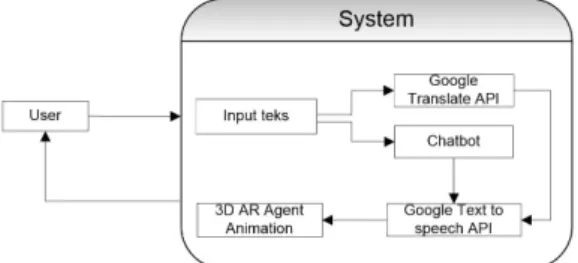
Figure 1 explains the bird view of process from input in the form of text to output in the form of animation object and speech translation results.
Figure 1: Whole System Overview.
ICoSET 2019 - The Second International Conference on Science, Engineering and Technology
164
3.2 Interactive Words
Interactive is a matter related to two-way communication or something that is mutually acting, active and interconnected and has reciprocity between one another (Warsita, 2008). In this system, the word “interactive” is classified into two categories, namely special and general. When a user types a word in the application, the word will be matched to the database. If it is in the database, the 3-dimensional character will say an interactive word consisted in a special interactive word table randomly. Otherwise, if the word typed by the user does not exist in the database, the 3-dimensional character will utter an interactive word consisted in a general interactive word table randomly. In this system, the interactive word consists of two languages, Indonesian and English.
Examples of general and specific interactive words can be seen in the following Table 1.
Table 1: Chatbot Corpus
Category Keywords #Random
Statement Food
fried rice, meatball, fried chicken, fried
potatoes, egg
3 for each keyword Color red, yellow, green,
blue, white
3 for each keyword Animal chicken, goat, cow,
cat, dog
3 for each keyword Transportation plane, car, motorcycle,
bike, train
3 for each keyword Fruit grape, apple, banana,
mango, pineapple
3 for each keyword
General None 5
3.3 Flowchart
In this study, the design of the application used a flowchart in order to show the workflow done by the system as a whole. In general, the flows of the application ofAugmented Reality-Based Translating Machine were as follows:
The flow diagram of the application of augmented reality-based Translating Machine can be seen in Figure 2 and Figure 3.
The flows of the system of an interactive machine based on augmented reality can be explained as follows:
1. The user inputs the text.
2. The text is checked in the database.
Figure 2: System flowchart (Augmented reality part).
Figure 3: System flowchart (Language translation part).
3. If the text is in a special interactive database, the system would produce an interactive word output in a form of a text.
4. If the text does not exist in a special interactive database in the previous stage, the system would access the general interactive database and generated output from general interactive words in form of text randomly.
5. The output of interactive words is sent to the text to speech API to be changed into sound.
6. Character says the word or sentence to the user as output.
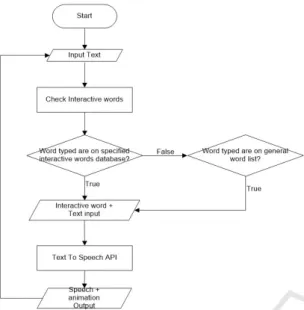
The information about the system flow for
An Augmented Reality Machine Translation Agent
165
the interactive word of Augmented reality-based Translating Machine can be seen in Figure 4.
Figure 4: Interactive Word System Flowchart.
3.4 How the Application Works
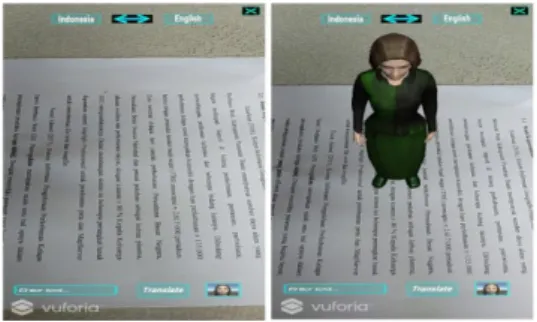
This Augmented reality-based Translating Machine utilizes a markerless technique, which means that a marker used to display 3D characters has not been registered since the application making. The application will search and mark locations in the camera area as markers, and the location is listed as a marker to display the model of 3D characters. An overview of how the application works can be seen in Figure 5.
4 RESULTS AND DISCUSSION
The following is the interface of the application of augmented reality-based machine translation.
Figure 5: Application Interface
Figure 5(a) is a picture before the user presses the
image button and Figure 5(b) is a picture after the user presses the image button.
In this subchapter, we discuss the results of the application testing that has been made. Some of the tests that have been carried out include light intensity testing, viewing angle testing, distance testing, markerless detection location testing, translation testing, and interactive word testing.
4.1 Black Box Testing Scenarios
Black box testing on the application of augmented reality translating machine was conducted to test each function of the interface input in the application, in order to know whether the interface input was in accordance with the expected output. A black box testing result shows that all the system designed match to table 3.1 functionally work as expected.
4.2 Light Intensity Testing
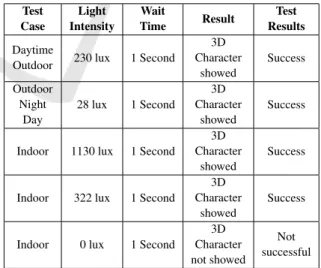
Light intensity testing was conducted inside and outside the room with different light intensities. This test was conducted to find out whether the application of augmented reality translating machine translator could track and display animated models at different light sources.
The conclusion of the test on light intensity can be seen in Table 2.
Table 2: Application test results against light intensity Test
Case
Light Intensity
Wait
Time Result Test
Results Daytime
Outdoor 230 lux 1 Second
3D Character
showed
Success Outdoor
Night Day
28 lux 1 Second
3D Character
showed
Success
Indoor 1130 lux 1 Second
3D Character
showed
Success
Indoor 322 lux 1 Second
3D Character
showed
Success
Indoor 0 lux 1 Second
3D Character not showed
Not successful
Based on the results of the light intensity testing in Table 2, it can be concluded that the application of machine translators cannot mark the location or tracking markerless if the light intensity is 0 lux. In other words, the markerless method in Vuforia did not require light even if there was little tracking on the target.
ICoSET 2019 - The Second International Conference on Science, Engineering and Technology
166
4.3 Distance and Angle Testing
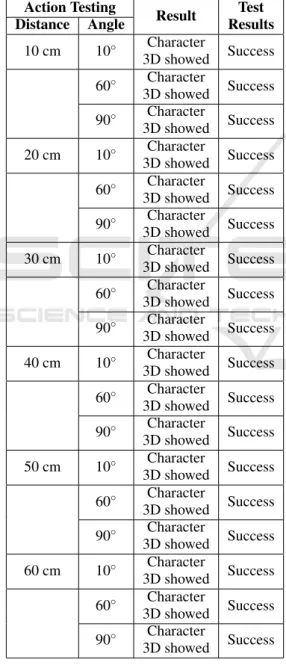
The distance and angle testing was done to find out how far and at what angle the markerless method on Vuforia sdk displayed the 3D characters. This test was carried out with bright light. The test was repeated at a minimum distance of 10cm with an angle of 10◦to the farthest distance of 60cm at an angle of 90◦.
The results of testing distance and angle of the location can be seen in Table 3.
Table 3: Distance and Angle Testing Action Testing
Result Test Results Distance Angle
10 cm 10◦ Character
3D showed Success 60◦ Character
3D showed Success 90◦ Character
3D showed Success 20 cm 10◦ Character
3D showed Success 60◦ Character
3D showed Success 90◦ Character
3D showed Success 30 cm 10◦ Character
3D showed Success 60◦ Character
3D showed Success 90◦ Character
3D showed Success 40 cm 10◦ Character
3D showed Success 60◦ Character
3D showed Success 90◦ Character
3D showed Success 50 cm 10◦ Character
3D showed Success 60◦ Character
3D showed Success 90◦ Character
3D showed Success 60 cm 10◦ Character
3D showed Success 60◦ Character
3D showed Success 90◦ Character
3D showed Success Based on the data of the test results in Table 3, it can be concluded that with a distance of at least 10cm and an angle of 10, the
application of the translating machine is still ableto display 3-dimensional characters well, and the translating machine application is still able to display 3-dimensional characters properly with the furthest distance testing of 60 cm with a taking angle of 60◦and 90◦.
4.4 Types of Tracking Object Testing
Testing the types of tracking object with the markerless method was carried out to find out the best object or place in marking the location by Vuforia sdk using the markerless technique. This test was carried out with 3 types of objects.
The conclusion of the overall results of testing the types of tracking object can be seen in Table 3. Based on the testing conducted on the tracking object, it can be concluded that Vuforia sdk using the markerless method cannot be used on all tracking object fields as listed in Table 3. It is because if the object lacks of image features, the 3D characters will not appear even though the light and color on the object are sufficient.
4.5 Evaluation
The evaluation was performed by giving questionnaires to 20 people, in order to find out the responses from users about the application of augmented reality-based translating machine. The results of the evaluation after giving questionnaires to 20 respondents can be seen in Table 4.
Table 4: Correspondent Percentage Correspondent Percentage
Excellent Very Good Good Not Good
4 15 1 0
Overall, the results of the questionnaire were calculated by using the tabulation formula to get the results of the percentage of each answer to the questionnaire. Each of these percentages is as follows:
1. Excellent : 4/20*100% = 20%
2. Very Good : 15/20*100% = 75%
3. Good : 1/20*100% = 5%
4. Not good : 0/20*100% = 0%
5 CONCLUSIONS
The research and the design of the application of augmented reality-based translating machine have
An Augmented Reality Machine Translation Agent
167
been successfully implemented and a series of tests have been conducted to test the capabilities of the application and the following results are obtained.
The application can be used as a reference in learning word pronunciation and translation from English into Indonesian and Indonesian into English. However, it cannot track well if there is no light. It also cannot display the 3-dimensional characters if there are few details on the marker. The minimum distance to obtain good results in displaying 3-dimensional characters is 10cm from the marked location point.
At a distance of 60cm with taking angles above 10◦to 90◦, the application still can display 3-dimensional characters properly. The application can be used both outdoors and indoors.
REFERENCES
Dewantara, I. M. A. Y., Crisnapati, P. N., Kesiman, M. W. A., and Darmawiguna, I. G. M. (2013).
Augmented reality book pengenalan gerak dasar tari bali.Kumpulan Artikel Mahasiswa Pendidikan Teknik Informatika (KARMAPATI), 2(8):1022–1028.
Dikdok (2017). Naikan kemampuan google translate hadirkan neural machine translation untuk banyak bahasa, jurnal apps.
Efendi, I. (2014). Pengertian augmented reality. Diambil kembali dari it-jurnal: http://www. it-jurnal.
com/2014/05/Pengertian-Augmented-Reality-AR.
html.
Ishida, T., Murakami, Y., Lin, D., Nakaguchi, T., and Otani, M. (2018). Language service infrastructure on the web: the language grid.Computer, 51(6):72–81.
Mariani, H. T. and Ananta, M. T. (2017). Pengembangan aplikasi respons sms dan panggilan telepon menggunakan android text to speech dan proximity sensor bagi pengemudi mobil. Jurnal Pengembangan Teknologi Informasi dan Ilmu Komputer e-ISSN, 2548:964X.
Nasution, A. H. (2018). Pivot-based hybrid machine translation to support multilingual communication for closely related languages. World Transactions on Engineering and Technology Education, 16(2):12–17.
Nasution, A. H., Murakami, Y., and Ishida, T. (2018).
A generalized constraint approach to bilingual dictionary induction for low-resource language families. ACM Transactions on Asian and Low-Resource Language Information Processing (TALLIP), 17(2):9.
Nasution, A. H., Syafitri, N., Setiawan, P. R., and Suryani, D. (2017). Pivot-based hybrid machine translation to support multilingual communication. In 2017 International Conference on Culture and Computing (Culture and Computing), pages 147–148. IEEE.
Nugroho, A. (2005). Analisis dan perancangan sistem informasi dengan metodologi berorientasi objek.
Bandung: Informatika.
Pangestika, G. V., Wikusna, W., and Suryadi, A. H. (2017).
Aplikasi pembelajaran bahasa inggris untuk murid sekolah dasar berbasis android. eProceedings of Applied Science, 3(3).
Panggabean, H. (2016). Urgensi dan posisi bahasa inggris di indonesia. Universitas Methodist Indonesia, Medan.
Rahman, A., Ernawati, and Funny Farady, C. (2014).
Rancang bangun aplikasi informasi universitas bengkulu sebagai panduan pengenalan kampus menggunakan metode markerless augmented reality berbasis android.Jurnal Teknik Informatika, 7(2).
Saputra, Y. A. and Indonesia, T. (2014). Implementasi augmented reality (ar) pada fosil purbakala di museum geologi bandung. Jurnal Ilmiah Komputer dan Informatika (KOMPUTA), 1:1–8.
ICoSET 2019 - The Second International Conference on Science, Engineering and Technology
168