THE INFLUENCE OF CORPORATE SOCIAL RESPOSIBILITY (CSR) AND GOOD CORPORATE GOVERNANCE (GCG) ON COMPANY
PERFORMANCE IN HEALTH INDUSTRY COMPANIES LISTED ON INDONESIA STOCK EXCHANGE IN THE PERIOD OF 2017 TO 2021
A THESIS
Present as Partial fulfillment of the Requirements to Obtain the Bachelor’s Degree in Accounting Department
by:
RATU MADANIA RAHMAT Student Number: 19312021
DEPARMENT OF ACCOUNTING INTERNATIONAL PROGRAM
FACULTY OF BUSINESS AND ECONOMICS ISLAMIC UNIVERSITY OF INDONESIA
YOGYAKARTA 20
i
ii
iii
iv
ACKNOWLEDGEMENTS
Bismillahirrahmanirrahim
All of the worship and praises go to Allah SWT. as the Lord of the World, the only one who can control all of the blessings and success. I also acknowledge the wisdom and teachings of His Messenger, Prophet Muhammad SAW., peace be upon him.
This research entitled The Influence of Corporate Social Responsibility (CSR) and Good Corporate Governance (GCG) on Company Performance in Health Industry Companies Listed on Indonesia Stock Exchange in The Period of 2017 to 2021 has finally come to an end. I would like to express my gratitude and appreciation to everyone who supported me and give encouragement for me in making this process become a beautiful ending. This gratitude would be addressed to:
1. My beloved and lovely parents, Ruhimat and Novia Gardara, as the ones who love me from the first day I was born until the end. They always appreciate every little progress that I have made, no matter how small or big it is, and they supported every step that I took. Their presence alone is the best thing that occurred to me in this life. Without them, I don’t even know how I could stand on my own two feet to face all of the hardship I have been going through. I love you dad, and I love you mom.
2. My big and silly brothers, Agiyar Rahmat and Ridha Rahmat, who always make me feel save and feel grateful to have you guys and make me laugh. I know you guys tried to be approachable on the surface, but I know sometimes you guys hide the part of you that cannot be spoken. Thank you for always hearing my side of the story and being there for me.
3. Mr. Mahmudi, Dr., S.E., M.Si., AK., CMA, CA., as my content advisor guides me from the start until the end of this thesis-making. He showed me what is supposed to be corrected and gave me the best advice that would help me tackle any problem that I could not understand.
v
4. Mrs. Ruli Hapsari, S.Pd., MA, as my language advisor for considering everything, including the language’s structure and the grammar correction that enables me to resolve the small error in my thesis.
5. Mr. Johan Arifin, S.E., M.Si., Ph.D., CFrA, CertIPSAS, as the Dean of the Faculty of Business and Economics, Universitas Islam Indonesia.
6. Mr. Prof Fathul Wahid ST, MSc, PhD., as the Rector of Universitas Islam Indonesia.
7. Mr. Dekar Urumsah, S.E., S.Si., M.Com(IS)., Ph.D., CFrA, as the Head of Department of Accounting.
8. Mr. Rifqi Muhammad, S.E., M.Sc., Ph.D., as the Head of the Accounting Study Program – Undergraduate Program.
9. Mrs. Maulidyati Aisyah, SE., M. Com(Adv)., as the Secretary of Accounting Study Program – International Program.
10. All lecturers and academic staff of the International Program (Mrs. Alfi, Mrs. Putri, Mr. Pasha, and Mr. Tukimin) helped me during these four years of my study at UII and assisted me with the problem that I faced in the administration system.
11. My dear besties. Nabila Afaffilah, Nadia Fitri Syaharani, Najla’ Ghina Salsabila, M. Fahri Alfachrizi. They encourage and give me their best support when I need them the most. It doesn’t matter how small the problem is. They would always listen to every single whining I had. I love you so much. My only wish is that we will still be together until the end of our journey. I don’t know how to say how much thankful I am for your presence in my life. And thank you that you guys had been helped me since the first time we entered to the university until the end of this thesis.
12. Me, myself, and I. For not giving up until the very end. You made all of the hard work and your effort paid off. Not to mention, you give all your best for always appreciating every small thing around you. Thank you for everything you have done for your own sake and for everyone important in every part of your life.
vi
TABLE OF CONTENT
LEGALIZATION PAGE ... Error! Bookmark not defined.
ACKNOWLEDGEMENTS ... iv
TABLE OF CONTENT ... vi
LIST OF TABLE ... ix
ABSTRACT ... x
ABSTRAK ... xi
CHAPTER I INTRODUCTION ... 12
1.1 Background ... 12
1.2 Problem Statement ... 17
1.3 Research Objectives ... 17
1.4 Research Benefits (Research Contribution) ... 17
1.5 Systematics of Thesis Writing ... 18
CHAPTER II LITERATURE REVIEW ... 20
2.1 Stakeholder Theory ... 20
2.2 Signal Theory ... 20
2.3 Agency Theory ... 21
2.4 Company Performance ... 21
2.5 Corporate Social Responsibility (CSR) ... 23
2.5.1 Understanding Corporate Social Responsibility ... 23
2.5.2 CSR Law ... 24
2.5.3 Benefits of Corporate Social Responsibility ... 25
2.6 Good Corporate Governance (GCG) ... 26
2.6.1 Definition of Good Corporate Governance ... 26
2.6.2 Principles of Good Corporate Governance ... 27
2.7 Review of Past Research ... 29
2.8 Hypothesis ... 32
2.8.1 The Effect of CSR on Company Performance ... 32
vii
2.8.2 The Effect of Good Corporate Governance (GCG) on Company
Performance ... 32
2.9 Research Model ... 36
CHAPTER III RESEARCH METHODS ... 37
3.1 Types of research ... 37
3.2 Time and Location of Research ... 37
3.3 Population and Sample ... 37
3.3.1 Population... 37
3.3.2 Sample ... 37
3.4 Operational Definition and Measurement Scale ... 38
3.4.1 Company Performance Variable ... 38
3.4.2 Corporate Social Responsibility (CSR) Variable ... 39
3.4.3 Independent Variable Good Corporate Governance (GCG) ... 40
3.5 Data Collection Techniques ... 42
3.6 Data Analysis Methods ... 43
3.6.1 Financial Ratio Analysis ... 43
3.6.2 Descriptive Statistics ... 43
3.6.3 Classical Assumption Test ... 43
3.6.4 Multiple Regression Test ... 45
3.7 Hypothesis Testing ... 46
3.7.1 Partial Test (Test t) ... 47
3.7.2 Test F ... 47
3.7.3 Coefficient of Determination (R2) ... 48
CHAPTER IV RESULTS AND DISCUSSION ... 49
4.1 Data Collection Result ... 49
4.2 Descriptive Statistics ... 50
4.3 Classical Assumption Test ... 52
4.3.1 Normality Test... 52
4.3.2 Multicollinearity Test ... 53
4.3.3 Heteroscedasticity Test ... 53
4.3.4 Autocorrelation Test ... 54
viii
4.4 Hypothesis Testing ... 55
4.4.1 Partial Test (T Test)... 55
4.4.2 Test F ... 58
4.4.3 Coefficient of Determination ... 59
4.5 Discussion ... 60
4.5.1 The Effect of CSR on Company Performance ... 60
4.5.2 The Effect of Good Corporate Governance (GCG) on Company Performance ... 62
CHAPTER V CONCLUSION ... 66
5.1 Conclusion ... 66
5.2 Research Limitations ... 66
5.3 Suggestions ... 67
REFERENCES ... 68
ATTACHMENT ... 74
ix
LIST OF TABLE
Table 2.1 Previous Research ... 29
Table 3.1 Research Sample ... 38
Table 3. 2 Durbin-Watson Statistical Test ... 45
Table 4. 1 Data Collection Result ... 49
Table 4. 2 Descriptive statistics ... 50
Table 4. 3 Normality Test Results... 52
Table 4. 4 Multicollinearity Test Results ... 53
Table 4. 5 Autocorrelation Test Results ... 55
Table 4. 6 T Test Results... 56
Table 4. 7 F Test Results ... 58
Table 4. 8 Coefficient of Determination ... 59
x ABSTRACT
This study aims to analyze the effect of corporate social responsibility (CSR) and good corporate governance (GCG) on company performance in health industry companies listed on the Indonesia Stock Exchange from 2017 to 2021. This research uses a quantitative method with secondary data obtained from the Exchange website Indonesian Securities. Data analysis techniques were performed using SPSS software. The sample for this study was collected by purposive sampling method from 13 companies. The results showed that corporate social responsibility had no effect on company performance, good corporate governance through audit committees, institutional ownership, and board size had an effect on company performance, while good corporate governance through independent commissioners had no effect on company performance.
Keywords: Good Corporate Governance, Corporate Social Responsibility, Company Performance
xi ABSTRAK
Penelitian ini bertujuan untuk menganalisis pengaruh corporate social responsibility (CSR) dan good corporate governance (GCG) terhadap kinerja perusahaan pada perusahaan industri kesehatan yang terdaftar di Bursa Efek Indonesia tahun 2017 hingga 2021. Penelitian ini menggunakan metode kuantitatif dengan data sekunder yang diperoleh dari website Bursa Efek Indonesia. Teknik analisis data dilakukan dengan sofware SPSS. Sampel untuk penelitian ini dikumpulkan dengan metode purposive sampiling dari 13 perusahaan. Hasil penelitian menunjukkan bahwa corporate social responsibility tidak berpengaruh terhadap kinerja perusahaan, good corporate governance melalui komite audit, kepemilikan institusional, dan ukuran dewan direksi berpengaruh terhadap kinerja perusahaan, sedangkan good corporate governance melalui komisaris independen tidak berpengaruh terhadap kinerja perusahaan.
Kata Kunci: Good Corporate Governance, Corporate Social Responsibility, Kinerja Perusahaan
12 CHAPTER I INTRODUCTION 1.1 Background
Corporate Social Responsibility (CSR) emerged as an important approach and framework to address the role of business in society, setting standards of behavior that companies must work towards to positively and effectively influence society while adhering to values that exclude profit-seeking at any cost. Empirical evidence explains CSR actions lead to progress in company performance (Naek and Tjun Tjun, 2020: 124).
CSR is a company's obligation in solving environmental problems caused by company activities. Currently, CSR is not a voluntary policy for companies in developing their responsibilities to carry out their business activities, but is mandatory for corporations. In carrying out social responsibility, the most important thing is to strengthen the sustainability of the company and make shareholder cooperation in carrying out community improvement programs in the area (Kholida and Susilo, 2019: 81).
A global survey conducted by The Economist Intelligence Unit shows that 85% of senior executives from various organizations make CSR a major consideration in decision making (Dewi and Widagdo, 2013: 82). Many decisions taken by senior executives are more favorable to management and override the interests of stakeholders, especially shareholders. The interest gap between management and shareholders implies information asymmetry. Prasetyo (2022: 46) stated that disclosure is one way to reduce information asymmetry. Information
13
asymmetry can be reduced by social responsibility (CSR) expressed in CSR disclosure or often referred to as Corporate Social Reporting. Companies that have social care can use social responsibility information (CSR activities) as one of the company's competitive advantages (Jaelani, 2021: 63). Stakeholders are interested in social information reported in the annual report, so that company management is not only restricted to the management of the funds provided, but also includes the impacts caused by the company on the natural and social environment (Dianawati and Fuadati, 2016: 2) . The company's linkage with its social environment requires the fulfillment of corporate social responsibility (CSR). Through the implementation of CSR, the company is expected to boost concerns for the environment, workplace conditions, corporate relations, society, corporate social investment, corporate financial performance and access to capital and the company's image in the eyes of the public to be good.
CSR reporting is a corporate communication tool used to convey a transparent impression. It is also a tool available to managers to assess continuous improvement in the non-financial sphere (Hamudiana and Achmad, 2017: 1). In CSR reporting, transparency is the main condition that should be met. Transparency itself is defined as a concept related in general to reporting (Eryadi et al., 2021: 2).
As part of its CSR communication strategy, each company determines the level of transparency required depending on pressure from specific stakeholders within the industry.
CSR in Indonesia is regulated in the Law of the Republic of Indonesia Number 40 of 2007 concerning Limited Liability Companies (PT). Article 66
14
paragraph 2 part c stating that in addition to the annual report it is mandatory to report on the implementation of social and environmental responsibility. Article 74 paragraph 1 states that companies that carry out their business activities in the field and/or related to natural resources must carry out social and environmental responsibilities (Febriansyah et al., 2021: 302).
Most countries in the world, including Indonesia, still categorize CSR reporting as voluntary. CSR reporting is different from financial reporting and mandatory annual reporting in go-public companies. According to data from the National Center for Sustainability Reporting (NCSR), the development of sustainability reporting in Indonesia is quite good. In 2012, there were around 40 companies that published sustainability reports prepared based on sustainability reporting standards set by the Global Reporting Initiative (GRI). The number of companies that publish sustainability reports in Indonesia is the highest in the Southeast Asia region.
Good Corporate Governance (GCG) is one of the factors that affect company performance. It is the principles applied by company to maximize company value, improve company performance and contribution, and maintain long-term company sustainability. The implementation of Good Corporate Governance (GCG) is no longer just an obligation but has become a necessity for every organization. It is believed that the implementation of GCG is another form of enforcement of business ethics and work ethics that has long been the company's commitment, and it is related to improving company performance. Companies that
15
practice GCG will make progress in their performance and make the company long- lived and trustworthy.
According to Laksono et al., (2022: 3), Good Corporate Governance (GCG) is a principle that directs and controls the company in order to achieve a balance between the company's strength and authority in providing accountability to stakeholders. Of course, this is intended to regulate the authority of directors, managers, shareholders and other parties related to the development of the company in a particular environment.
Previous research shows the results that continuous report disclosure has a positive effect on company performance as measured by company profitability and company liquidity (Tarigan and Semuel, 2014: 88). Another study from Setioningsih and Budiarti (2022: 375) based on the test results, found evidence that the breadth of sustainability report disclosure negatively affected company value and company size could moderate the relationship of sustainability report disclosure to company value. Then, it had a positive effect on company performance, which means the implementation of good GCG in the company made the company's performance increase and boosted the company's image. The implication of this study is to provide information to companies to be able to contribute to increasing company value by being much more concerned with disclosing sustainability reports as companies, either large or small, are required to disclose sustainability reports. Savvy investors won't be interested in companies that ignore sustainability reports.
16
During the Covid-19 pandemic, many cases occurred, especially in companies engaged in the health sector. In 2021, the Ministry of state-owned enterprises (SOEs) fired the entire board of Directors of Kimia Farma Diagnostika, as a follow-up to the case of the use of a used antigen rapid test tool that occurred at Kualanamu Airport, North Sumatra. The company is engaged in the manufacture, distribution, and use of pharmaceutical preparation materials and / or medical devices that do not meet the standards and safety requirements (Rizal, 2021). Not only that, PT. Kimia Farma Tbk has experienced cases of financial recording errors that inflated net income in the financial statements in 2001. In the report, Kimia Farma said it managed to make a profit of Rp 132 billion. However, the pharmaceutical company in 2001 actually only netted a profit of Rp 99 billion.
Therefore, this study focuses on 13 pharmaceutical companies and health service providers listed on the Indonesia Stock Exchange in 2017-2021. Previous studies that examined CSR and GCG variables on company performance in this sector did not seem to exist, especially during the pandemic.
The 13 companies are Darya Varia Laboratoria Tbk, Indofarma Tbk, Kimia Farma Tbk, Kalbe Farma Tbk, Merck Indonesia Tbk, PT. Phapros Tbk, Pyridam Farma Tbk, PT. Herbal and Pharmaceutical Industry Sido Muncul Tbk, PT. Soho Global Health Tbk, Tempo Scan Pacific Tbk, PT. Mitra Keluarga Karyasehat Tbk, PT. Prodia Widyahusada Tbk, and PT. Siloam International Hospitals Tbk.
Based on the background description above, the author examines the influence of CSR and Good Corporate Governance (GCG) on the performance of
17
companies in the health industry (pharmaceutical companies and health service providers) listed on the Indonesia Stock Exchange in 2017-2021.
1.2 Problem Statement
Based on the background description, the researcher formulates the problem as follows:
1. Does Corporate Social Responsibility (CSR) affect the company's performance in the health industry (pharmaceutical companies and health service providers) listed on the Indonesia Stock Exchange 2017-2021?
2. Does Good Corporate Governance (GCG) affect the company's performance in the health industry (pharmaceutical companies and health service providers) listed on the Indonesia Stock Exchange 2017-2021?
1.3 Research Objectives
Based on the description of the problem formulation, the purpose of this study is to determine the influence of Corporate Social Responsibility (CSR) and Good Corporate Governance (GCG) on Company Performance in the Health Industry listed on the Indonesia Stock Exchange 2017-2021.
1.4 Research Benefits (Research Contribution)
Research is expected to provide benefits, including:
1. Benefits for academicians and the public (Theoretical Contribution)
The research findings would make a contribution to the area of accounting especially related to CSR, GCG, and company performance. Furthermore, it can be reference for other researchers to conduct further studies.
18
2. Benefits for the company (Practical Contribution)
This research is expected to provide benefits for companies in terms of identifying company performance problems and determining CSR strategies as a form of accountability to the community.
1.5 Systematics of Thesis Writing Chapter I: Introduction
This chapter describes the background of the problem, the formulation of the problem, the objectives and uses of the research, and the systematics of the discussion.
Chapter II: Literature Review
This chapter contains theoretical foundations regarding the theories and variables used in the research, previous research that becomes the basis for the research hypotheses, and frameworks of thought.
Chapter III: Research Methods
This chapter contains the population and research sample, research variables, measuring variables, instrumental submission methods, data processing, analysis techniques, and discussion.
Chapter IV: Data Analysis
This chapter contains descriptions of research objects, characteristics of respondents, validity and reliability tests, descriptive statistical analysis, classical assumption tests, multiple linear regression analysis, hypothesis testing, and discussion.
Chapter V: Conclusion
19
This chapter contains conclusions from the results of the research in the previous chapter, limitations of the study, and suggestions for future similar studies.
20 CHAPTER II LITERATURE REVIEW 2.1 Stakeholder Theory
Stakeholder theory reveals that all stakeholders have the obligation to get information about the company's activities within a predetermined period of time, which can influence decision-making, and the presence of stakeholders in a company is very important. Stakeholders are a group of people who can be influenced by all decisions, rules, and operations of the company. It is related to Corporate Social Responsibility (CSR) that all performance information provided to the company is not only based on financial performance. Corporate Social Responsibility may provide other information about information disclosure of responsibilities carried out by the company, which will influence decision making.
Companies have the responsibility to publish Corporate Social Responsibility reports to stakeholders and report on responsibilities that have been completed (Sindhudiptha and Yasa, 2013: 394).
2.2 Signal Theory
Signaling theory encourages companies to provide information to external parties (outside parties). This impetus is due to the presence information asymmetry between management and external parties. To reduce the occurrence of information asymmetry, the company must disclose the information it has from financial and non-financial aspects. One of them is a report on corporate social responsibility activities. Corporate social responsibility report aims to signal to investors that the company not only provides financial information, but the company also cares about
21
the environment. This theory emphasizes that companies can increase the value of the company through its reports (Sindhudiptha and Yasa, 2013: 393).
2.3 Agency Theory
Agency theory is one of the theories used in explaining the relationship between the principal (the authorizer) and the agent (the recipient of the authority) and this relationship is built to attain the company's goals. The core of the relationship is the separation between ownership (investor/principal) and controller (manager/agent). Ownership is represented by the investor, who delegates power to the agent to manage the investor's wealth. Investors hope that with centralized management, they can benefit from their increased wealth and prosperity. The main principle of the theory states that there is a working relationship between the authorizer (investor) and the recipient (manager). It can be concluded that agency theory is one of the contracts in which one or more people (principal) involve other people (agents) in performing certain services on their behalf, which involves certain decision-making rights on agents (Mustafa and Handayani, 2014: 3).
2.4 Company Performance
Company performance is the main thing and its existence is needed in a company in order to achieve the company's own goals through the cohesiveness of various lines (Nasution et al., 2020: 215). Company performance is something produced by a company in a certain period by referring to the standards established (Devani and Setiawarnan, 2015: 85). For a company, assessing the performance carried out is important so as to obtain information on whether the company is
22
working properly in a certain period (Rani and Mayasari, 2015: 166). So that company performance can be used as an indication in the company's assessment.
The information on company performance is needed to know the extent of the company's current development, so that it can be used as a basis for planning the future. The success or failure of achieving performance depends on how the management assisted by its lower divisions manages the company. Having a good level of company performance is the result of processing company’s functions in various aspects ranging from financial to operational to gain trust from the public, outsiders, and the government (Aprianingsih &; Yushita, 2016: 5).
Return On Asset (ROA) is a ratio used to measure a company's ability to generate profits derived from investment activities. In other words, it is an indicator of a business unit to obtain a return on a number of assets owned by the business unit. This ratio is used to measure management's ability to obtain overall profits.
The greater the ROA, the greater the level of profit achieved by the company and the better the position of the company in terms of asset use.
ROA can help companies that have carried out accounting practices well to be able to measure the efficiency of using capital as a whole, which is sensitive to everything that affects the company's financial situation hence the company's position is known in the industry. This is one step in strategic planning. Profit is the main goal to be achieved in a business. The reasons for achieving banking profits can be in the form of adequacy in fulfilling obligations to shareholders, appraisal of the performance of the leadership, and boosting investors’ interest attractiveness to
23
invest. High profits make banks gain public trust which allows them to raise more capital thus getting more lending opportunities (Wijaya, 2019: 39).
The higher this ratio, the better the productivity of assets in obtaining net profits. This will further increase investors’ interest. The more attractive the company, the greater the rate of return or dividend. This will also have an impact on the share price of the company to rise in the capital market. Thus, ROA affect the company’s stock price. ROA figure can be said to be good if it > 2%. Return On Asset (ROA) is also used to assess the extent to which the investments that has been invested is able to provide a return on profits as expected. The investment is actually the same as the company's assets that are invested or set. The magnitude of ROA value can be calculated by the following formula (Indrawati and Suprihhadi, 2015: 4):
ROA = 𝑃𝑟𝑜𝑓𝑖𝑡 𝑎𝑓𝑡𝑒𝑟 𝑡𝑎𝑥
𝑡𝑜𝑡𝑎𝑙 𝑎𝑠𝑠𝑒𝑡𝑠 X100%
2.5 Corporate Social Responsibility (CSR)
2.5.1 Understanding Corporate Social Responsibility
Corporate Social Responsibility is a concept that can lead companies to carry out their social responsibility to the environment and the community around the company (Fahmi, 2011: 136). In ISO 26000, Corporate Social Responsibility is defined as: "The responsibility of an organization for the impact of its decisions and activities on society and the environment, through transparent and ethical behavior, consistent with sustainable development and community welfare, weighing stakeholders interests, in accordance with applicable law and consistent with
24
international norms, integrated throughout the organization's activities, in this understanding includes both activities, products and services (Rusdianto, 2013: 13).
The concept of CSR is a difficult concept to interpret. It is known that there are different perspectives on CSR resulting in the emergence of various CSR formulations and various elements or programs contained in CSR activities (Ratna and Hasanah, 2019: 15). However, CSR is basically one of the efforts to the community and provides responsibility to the environment and social care by using the capabilities of company resources. Thus CSR has a win-win solution between the company and the social parties.
Companies with CSR will get an advantage in the form of increasing the company's reputation in the community. This will then cause purchase interest among the public because there is already trust in the products of the company.
With the increase in buying interest, it will certainly increase the company's profits, this will also attract investors to invest their capital due to visible profitability.
According to Evans and Kartikaningdyah (2019: 38) CSR has three parts, namely profit, community empowerment (people) and environmental preservation (planet).
2.5.2 CSR Law
It can be said that nowadays the awareness of environmental protection has flourished. This is encouraged by the law No. 40 Article 74 of 2007. The existing laws and regulations regulate that all companies that carry out business activities related to the exploitation of natural resources are legally obliged to perform corporate social responsibility. The annual report is the only document used in CSR disclosures or commonly abbreviated as CSR (Yaparto et al., 2013: 3). the existence
25
of the law requires industries or companies to be able to carry it out, because this obligation is one of the obligations that are not burdensome.
Regulated in the Financial Services Authority Regulation Number 51/PJOK.03/2017 on the implementation of Sustainable Finance for Financial Services Institutions, issuers, and public companies. In the regulation, it contains that to realize sustainable development that is able to maintain economic stability and is inclusive, a national economic system is needed that prioritizes harmony between economic, social, and environmental aspects.
The development of a nation is not only based on the responsibility of government and industry, but everyone must also act to achieve social balance and improve the standard of social life. Companies and industries hold importance in improving economic development well and measuring various factors of the scope of life. The business world at this time not only oversees the company's financial statements but also includes social, financial and life spheres which are often said to be the synergy of three elements (triple bottom line) which has become the concept of sustainable development (Wanda et al., 2018: 21).
2.5.3 Benefits of Corporate Social Responsibility
The benefits obtained by the company if it discloses corporate social responsibility are:
1. As a social investment as well as a source of company long-term competitive advantage.
2. Strengthening company’s profits and financial performance.
26
3. Increasing the sense of responsibility and positive evaluation of investors, creditors, suppliers and the consumer community.
4. increasing commitment, work ethics, efficiency and productivity of employees.
5. Reducing potential social unrest
6. Improving the company's image, goodwill, and long-term value
7. Expanding access to resources for business operations, opening wider market opportunities.
8. Obtaining a license to operate socially, and reducing business risks 2.6 Good Corporate Governance (GCG)
2.6.1 Definition of Good Corporate Governance
The term corporate governance has been widely defined but some of the definitions differ from each other. In the book Good Corporate Governance Review of Ethics in Business Practices, Hamdani (2016: 41) defines corporate governance as a system that directs and controls a company. The Indonesian Institute for Corporate Governance (IICG) defines GCG as the process and structure applied in running a company, with the main objective of increasing shareholder value in the long term while still weighing the interest of other stakeholder in addition to fulfilling the interests of shareholders, GCG is intended to ensure sustainability.
This definition shows that corporate governance can serve to build trust, establish cooperation, and create a common vision between all parties involved in the company so that agency problems can be anticipated.
27
2.6.2 Principles of Good Corporate Governance
As explained in Bank Indonesia regulation No.11/33/PBI/2009, the principles in GCG must apply the principles of transparency, accountability, independency, fairness, and responsibility. This is necessary to achieve the company’s sustainability by weighing stakeholders’ interests. The following is a description of generally applicable GCG principles:
1. Transparency
The basic principle of transparency shows the company's actions to be able to provide information needed by all stakeholders. Transparency contains elements of disclosure and provision of information in a timely, adequate, clear, accurate and comparable manner easily accessible to stakeholders and the public. The principle of openness is useful in the decision-making process and disclosure of material and relevant information about the company.
2. Accountability
The basic principle of accountability requires a company to be able to account for its performance in a transparent and reasonable manner. For this reason, the company should be managed correctly, measurably and in accordance with the interests of the company while taking into account the interests of shareholders and other stakeholders. Accountability is a necessary prerequisite for achieving sustainable performance. It means the accountability ensures the availability of mechanisms, the role of
28
responsibility of professional management for all decisions and policies taken in connection with the company's operational activities.
3. Independence
The basic principle of independence in the implementation of GCG is a company should be managed independently so that each company’s organ does not dominate each other and cannot be intervened by other parties.
4. Fairness
The basic principle of fairness and in carrying out its activities, a company should always take into account the interests of shareholders and other stakeholders based on the principles of fairness and equality. The principle of fairness and equality is a principle that contains elements of justice, which guarantees that every decision and policy taken is in the interest of all interested parties, including customers, suppliers, shareholders, investors and the wider community.
5. Responsibility
Responsibility is defined as the responsibility of the company as a member of society to comply with applicable regulations and meet social needs. The basic principle of responsibility, in principle, is the company must comply with laws and regulations and carry out responsibilities to community and the environment so that business viability can be maintained in the long term and get recognition as a good corporate citizen.
29 2.7 Review of Past Research
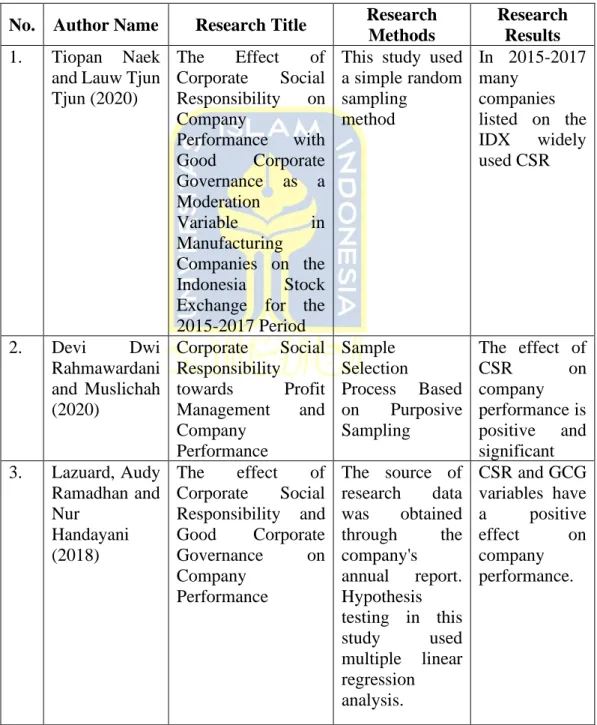
Table 2.1 A few studies on Corporate Social Responsibility (CSR) and Good Corporate Governance (GCG) have been carried out by previous researchers, while the description of previous research can be seen in the Table.
Table 2.1 Previous Research1
No. Author Name Research Title Research Methods
Research Results 1. Tiopan Naek
and Lauw Tjun Tjun (2020)
The Effect of Corporate Social Responsibility on Company
Performance with Good Corporate Governance as a Moderation
Variable in
Manufacturing Companies on the Indonesia Stock Exchange for the 2015-2017 Period
This study used a simple random sampling
method
In 2015-2017 many
companies listed on the IDX widely used CSR
2. Devi Dwi Rahmawardani and Muslichah (2020)
Corporate Social Responsibility towards Profit Management and Company
Performance
Sample Selection
Process Based on Purposive Sampling
The effect of
CSR on
company performance is positive and significant 3. Lazuard, Audy
Ramadhan and Nur
Handayani (2018)
The effect of Corporate Social Responsibility and Good Corporate Governance on Company
Performance
The source of research data was obtained through the company's annual report.
Hypothesis testing in this study used multiple linear regression analysis.
CSR and GCG variables have a positive effect on company performance.
30
No. Author Name Research Title Research Methods
Research Results 4. Ni Putu Sari
Adnyani, I Dewa Made Endiana, and
Putu Edy
Arizona (2020)
The Effect of the Implementation of Good Corporate Governance and Corporate Social Responsibility on Company
Performance
Quantitative research with purposive
sampling. Data used in the period 2016- 2018 with 55 research
samples.
The results showed that CSR had an effect on company performance, but GCG had no influence on company performance.
5. Francisco Allan, Jullie J.
Sondakh, and Hendrik Gamaliel (2020)
The Effect of Intellectual Capital, Corporate Social Responsibility and Good Corporate Governance on Company
Performance (Study on Manufacturing Companies listed on the Indonesia Stock Exchange)
Quantitative research with sampling
technique using purposive
sampling. There are 165 samples
from 33
manufacturing companies listed on the Indonesia Stock Exchange.
Good Corporate Governance affects company performance.
6. Nofita Sari dan Nur Fadjih Asyik (2020)
The Effect of Good Corporate
Governance and Corporate Social Responsibility Disclosure on Company
Performance
This type of research is quantitative. The sample in this
study was
obtained using the purposive sampling
method obtained 66 observations out of 11
state-owned companies listed on the Indonesia Stock Exchange during 2012- 2017.
The results of this study show that corporate social
responsibility disclosure and one of the indicators of
GCG is
ownership institutional
has a
significant positive effect on company performance
which is
reflected in ROE.
7. Hartati (2020) The Effect of the Size of the Board of
The analysis method used is
From the
results of the
31
No. Author Name Research Title Research Methods
Research Results Commissioners,
Audit Committee, and Institutional Ownership on the Company's
Financial Performance
multiple linear regression analysis. There
were 43
companies that met the criteria as research sample.
study, it is known that the size of the
board of
commissioners and audit committee does not affect the company's financial performance, while
institutional ownership affects the company's financial performance.
8. Sukandar &;
Raharja (2014)
The Effect of the Size of the Board of Directors and the
Board of
Commissioners and Company Size on the Company's Financial
Performance
(Empirical Study on Consumer Good Sector
Manufacturing Companies Listed on IDX in 2010- 2012)
The sample consists of 98 companies and submitted financial
statements to Bapepam
consistently in the period 2010- 2012. Data used in this
study was
secondary data and sample selection using purposive
sampling method.
Research results show the board of commissioners and
The size of the company does not have a significant effect on financial performance ,While the
board of
directors has a significant influence on financial performance.
32 2.8 Hypothesis
2.8.1 The Effect of CSR on Company Performance
CSR has emerged as an important approach and framework for addressing the role of business in society, setting standards of behavior that companies must comply with to positively and effectively influence society while adhering to values that exclude profit-seeking.
Wider CSR disclosure will give a positive signal to interested parties to the company (stakeholders) and shareholders of the company (shareholders). In this case, investors prefer choosing a socially responsibe company as it is considered safer. Stakeholders and shareholders will entrust their capital they invest more to such a company, which in turn the capital is used optimally for profit-increasing busines activities. This causes CSR activities carried out by the company will have a positive effect on the company's performance. Research that supports the relationship between CSR and company performance is research conducted by Sari and who revealed that CSR had a positive effect on company performance.
However, research conducted by Wati (2016: 1) which revealed that CSR has no effect on company performance. Therefore, hypothesis 1 is proposed as follows.
H1: CSR affects Company Performance
2.8.2 The Effect of Good Corporate Governance (GCG) on Company Performance
Good Corporate Governance shows corporate governance and corporate control system. Given that GCG is concerned with morality, work ethics, and work principles, GCG is specialized in actions taken by company management so as not
33
to harm stakeholders. The objective of implementing good corporate governance is to create added value for all interested parties. These parties are internal company parties such as the board of directors, board of commissioners, employees, and external company parties which include investors, creditors, government, community, and other interested parties (stakeholders). However, in practice, the implementation of good corporate governance is different in each country because it is related to the economic, legal, ownership structure, social and cultural systems.
Research conducted by Sari and Asyik (2020: 1) and Allan et al., (2020: 44) reveals that Good Corporate Governance affects company performance. Therefore, a hypothesis is proposed as follows
1. Influence of Independent Commissioners on Company Performance
Board of commissioners' supervision of management is generally ineffective due to the less democratic process of selecting the board of commissioners. This is because the candidates for the board of commissioners are often chosen by management so that once they are selected they are powerless to criticize management policies. In order to ensure the creation of good GCG, independent commissioners are required to have good credibility, professionalism and integrity. Independent commissioners bear the responsibility to encourage the principles and practices of good corporate governance proactively so that commissioners in carrying out their duties as supervisors and advisors to the directors can ensure that the company has an effective business strategy, ensures that the company complies with applicable laws and regulations as well as the values set in the company leading to good
34
corporate governance. It can be concluded that the higher the proportion of independent commissioners, the higher the foreign ownership because foreign investors have more confidence in companies with more independent commissioners. Research conducted by Putra (2015: 1) suggests that the high and low levels of independent commissioners affect company performance.
However, research conducted by Setiawan (2016: 1) states that the independent board of Commissioners has no effect on the company's financial performance.
Therefore, hypothesis 2a is proposed as follows.
H2a: The Independent Board of Commissioners influences the Company's Performance
2. The Influence of the Audit Committee on Company Performance
The audit committee is a committee formed by and is responsible to the board of commissioners in order to help carry out the duties and functions of the board of commissioners. The audit committee which is responsible for overseeing financial reports, supervising external audits, and observing internal control systems (including internal audits) can reduce the opportunistic nature of management in managing earnings (earnings management) by supervising financial reports and supervising external audits. The company's performance will be good if the company is able to control the behavior of the company's top executives to protect the interests of company owners (shareholders), one of which is the existence of an audit committee. This is because the audit committee is expected to be able to supervise financial reports, supervise external audits and oversee the internal control system (Makhrus, 2013: 58-60).
35
Research conducted by Muntiah (2014: 1) found that the audit committee had a positive effect on company performance. However, research conducted by Irma (2019: 697) suggests that the audit committee negatively affects the company's financial performance.Therefore hypothesis 2b is proposed as follows.
H2b: The Audit Committee has an effect on Company Performance 3. Effect of Institutional Ownership on Company Performance
Institutional ownership is ownership of company shares owned by institutions such as insurance companies, banks, investment companies and other institutional ownership. Institutional ownership can minimize conflicts of interest between principals and agents. With institutional oversight, it can optimize management performance monitoring to avoid fraudulent behavior by management. Thus, institutions’ involvement in companies can lead to better company performance (Petta, 2017: 629). It is in line with research conducted by Hartati (2020: 175) revealing that institutional ownership affected company performance. However, research conducted by Fadillah (2017: 37) suggests that institutional ownership negatively affects company performance. Therefore, the hypothesis becomes as follows.
H2c: Institutional Ownership affects Company Performance 4. The Effect of Board of Directors Size on Company Performance
The size of the board of directors is a mechanism in corporate governance that is important in determining company performance. The role of the board of directors is to formulate policies for the company's operations so that the decisions taken by the directors are not focused on one party only. The board of
36
directors has a very vital role in a company. With the separation of roles from the board of commissioners, the board of directors has great power in managing all the resources in the company. The board of directors has the task of determining the direction of policies and resource strategies owned by the company, both for the short and long term. In line with research conducted by Sukandar and Rahardja (2014: 1) stating that the size of the board of directors affected company performance. However, research conducted by Wati (2016:
1) suggests that the size of the board of Directors has no effect on the performance of the company. Therefore, the hypothesis becomes as follows.
H2d: The size of the Board of Directors affects Company Performance 2.9 Research Model
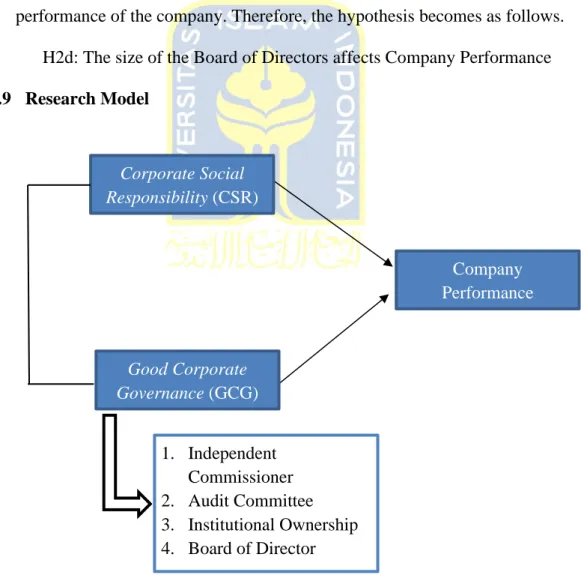
Figure 2. 1 Research Model Corporate Social
Responsibility (CSR)
Company Performance
Good Corporate Governance (GCG)
1. Independent Commissioner 2. Audit Committee 3. Institutional Ownership 4. Board of Director
37
CHAPTER III RESEARCH METHODS
3.1 Types of research
This type of research is quantitative. According to Sugiyono (2015: 15) quantitative methods are research that uses research data in the form of numbers and analysis using statistics. The dependent variable in this study is company performance, while the independent variables are Corporate Social Responsibility and Good Corporate Governance.
3.2 Time and Location of Research
This research was conducted from November 2022 to June 2023. The research location was conducted in pharmaceutical companies and health service providers listed on the IDX in 2017-2021.
3.3 Population and Sample 3.3.1 Population
Population is a generalization area consisting of objects or subjects with certain qualities and characteristics determined by researcher to be studied and then drawn conclusions (Sugiyono, 2015: 15). The total population used in this study is all pharmaceutical companies and health service providers in Indonesia listed on the stock exchange for the period 2017-2021.
3.3.2 Sample
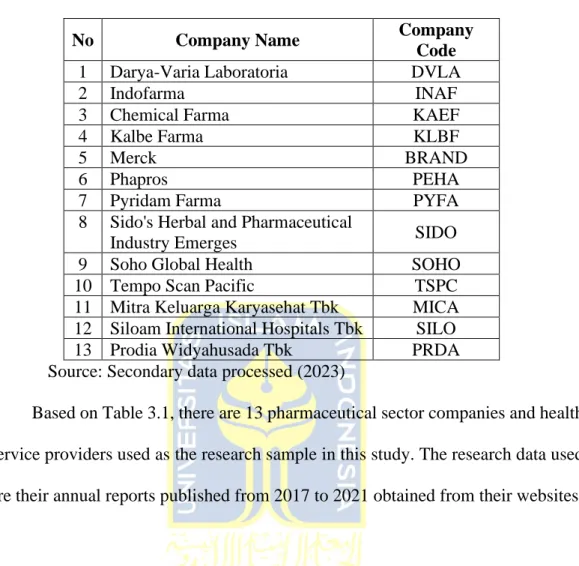
The research sample in this study is selected by using purposive sampling method based on the criteria that have been determined. The sample of the study can be seen in table 3.1.
38
Table 3.1 Research Sample1
No Company Name Company
Code
1 Darya-Varia Laboratoria DVLA
2 Indofarma INAF
3 Chemical Farma KAEF
4 Kalbe Farma KLBF
5 Merck BRAND
6 Phapros PEHA
7 Pyridam Farma PYFA
8 Sido's Herbal and Pharmaceutical
Industry Emerges SIDO
9 Soho Global Health SOHO
10 Tempo Scan Pacific TSPC
11 Mitra Keluarga Karyasehat Tbk MICA 12 Siloam International Hospitals Tbk SILO
13 Prodia Widyahusada Tbk PRDA
Source: Secondary data processed (2023)
Based on Table 3.1, there are 13 pharmaceutical sector companies and health service providers used as the research sample in this study. The research data used are their annual reports published from 2017 to 2021 obtained from their websites.
3.4 Operational Definition and Measurement Scale 3.4.1 Company Performance Variable
The instrument used in this study is Return on Asset ( ROA), one of the financial ratios used to assess the company’s competence in obtaining profits using company assets (Arnel &; Setyani, 2018: 90). ROA can be calculated by the following formula:
ROA = Log.Profit after tax
Total Assets X 100%
39
3.4.2 Corporate Social Responsibility (CSR) Variable
Corporate Social Responsibility (CSR)has emerged as an important approach and framework for addressing the role of business in society, setting standards of conduct that companies must comply with while adhering to values that exclude profit-seeking at any cost. Empirical evidence reveals that CSR actions lead to the advancement of company performance (Naek and Tjun Tjun, 2020: 124). The instruments used in this CSR measurement refers to the implementation of Corporate Social Responsibility (CSR) according to Harisianto and Sutjahyani (2017: 77) in the following categories:
1. Milieu
The environmental section includes scope factors in production procedures, one of which is controlling pollution (contamination) during business operations, preventing and repairing of environmental damage caused by natural resource management.
2. Energy
For activities of the enterprise dealing with the utilization of energy, the activities in this section consist of the use of goods in producing energy and increasing energy efficiency.
3. Occupational Health and Safety
These activities consist of promoting occupational safety, mental, and physical health, establishing an occupational safety committee, disclosing employee safety statistics, and disclosing other employee activities.
40 4. Workforce
Categories in labor activity are recruitment, job training, wages as well as commissions and notifications of other activities.
5. Product
The product section deals with the qualitative aspects of a product consisting of consumer pleasure, advertising, transparency or integrity of the product contents on the packaging.
6. Community Engagement
This section covers community activities related to health, education and arts.
7. Common
This category generally involves the company's obligations to citizens and information related to Corporate Social Responsibility.
The CSR formula can be calculated as follows:
𝐶𝑆𝑅𝑗 = 𝐿𝑜𝑔.∑ 𝑋𝐼𝑗 𝑁𝑗
Information:
𝐶𝑆𝑅𝑗 : Corporate Social Responsibility
∑ 𝑋𝐼𝑗 : The value of the item disclosed 𝑁𝑗 : Item value for companies j, n ≤ 91.
3.4.3 Independent Variable Good Corporate Governance (GCG)
Good Corporate Governance or often abbreviated as GCG is a practice of managing companies in a trustworthy and prudential manner by considering the
41
balance of fulfilling the interests of all stakeholders. With the implementation of GCG implementation, the management of company resources is expected to be efficient, effective, economical and productive by always being oriented toward the company’s goals and taking into account the stakeholder approach. The indicators used to determine Good Corporate Governance are the independent board of commissioners, audit committee, institutional ownership, and the size of the board of directors with the following formula:
1. Independent Commissioner
Independent commissioners are members who are not affiliated with parties, which means those who have business and family relationships with controlling shareholders, members of the board of directors and other committees. Independent board of commissioners use a ratio scale using the following formula:
2. Audit Committee
Audit committee is a group of people elected by the company's board of commissioners who are responsible for assisting auditors to maintain its independence from management. Its task is to assist the board of commissioners in overseeing the financial reporting process. The audit committee is calculated using the following formula:
Com. Independent = Log∑Number of Independent Board of Commissioners
KA = Log∑Number of Audit Committee Members
42 3. Institutional Ownership
Institutional ownership is the ownership of company shares owned by institutions such as insurance companies, banks, investment companies and ownership of other institutions. Institutional ownership is calculated using the following formula:
4. Board of Directors Size
The size of the board of directors is one of the Corporate Governance mechanisms that is very important in determining company performance.
The board of directors has the task of determining the direction of policies and strategies of resources owned by the company, both for the short and long term.
3.5 Data Collection Techniques
The data collection techniques are carried out by taking annual reports of pharmacy companies and health service providers published on the Indonesia Stock Exchange (IDX), especially from 2017 to 2021. This data is obtained from the www.idx.co.id or website of each company.
KI = Log. Number of institutional shares
number of shares outstanding x 100%
DD = ∑Number of Members of the Board of Directors
43 3.6 Data Analysis Methods
3.6.1 Financial Ratio Analysis
The financial ratio used in this study is Return on Equity (ROA). Return on Asset is a financial analysis tool that is useful for determining the company's ability to obtain profits (profits) on the capital used.
3.6.2 Descriptive Statistics
Descriptive statistics are used to analyze data by describing the data that has been collected as it is without making general conclusions and generalizations (Ghozali, 2013: 160). This analysis is used to find out the mean value, maximum value, minimum value and standard deviation of the data.
3.6.3 Classical Assumption Test 1. Normality Test
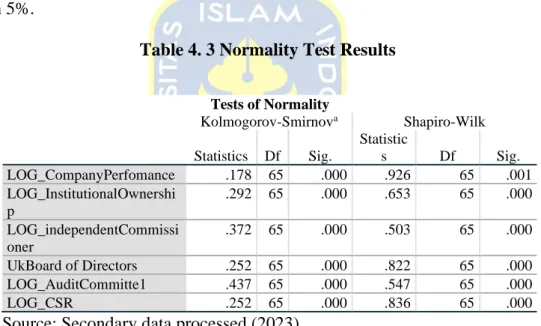
The normality test aims to test whether the sample used has a normal distribution or not. In linear regression models, this assumption is indicated by normally distributed error values. A good regression model is a regression model that has a normal or close to normal distribution, so it is worth testing statistically. Data normality testing using the Kolmogorov-Smirnov Test of Normality in the SPSS program. According to Ghozali (2013: 160), the basis for decision making can be done based on probability (Asymtotic Significance), namely:
If the probability > 0.05 then the distribution of the regression model is normal.
44
If the probability < 0.05 then the distribution of the regression model is abnormal.
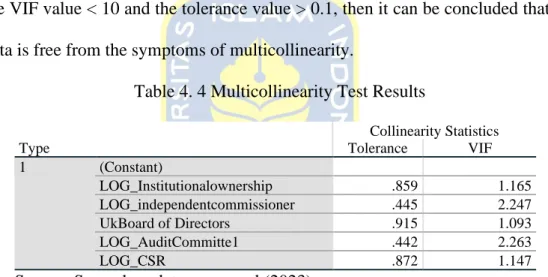
2. Multicollinearity Test
The multicollinearity test is used to test whether in the regression model, there is correlation between independent variables. If there is a correlation, it is called a multicollinearity problem. A good regression model should not occur between independent variables. If it is proven that there is multicollinearity, it is recommended that one of the existing independents be removed from the model, and then the creation of the regression model is repeated. To detect the presence or absence of multicollinearity, it can be seen from the magnitude of Variance Inflation Factor (VIF) and Tolerance. The guideline of a multicollinearity-free regression model is to have a tolerance number close to 1. The VIF limit is 10, if the VIF value is below 10, then there are no symptoms of multicollinearity (Ghozali, 2013: 160).
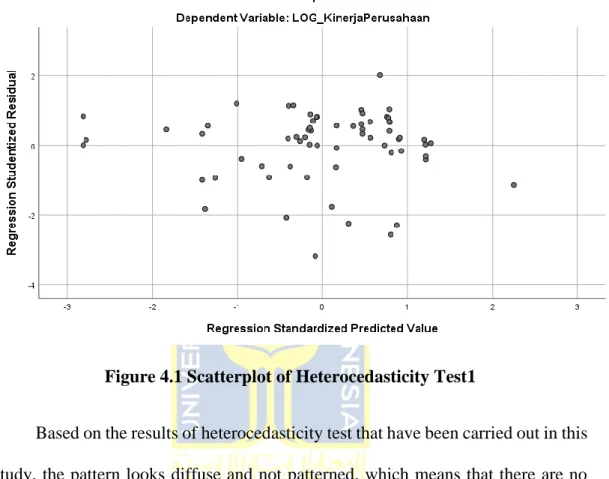
3. Heterocedasticity Test
The heteroscedasticity test is a state in which in a regression model there is a dissimilarity of variance from residual on one observation to another. A good regression model is that heteroscedasticity does not occur.
Heteroscedasticity testing is carried out with the Glejser Test, a hypothesis test to find out whether a regression model has an indication of heterocedasticity by absolute residual regression. The basis for decision making using the glacier test is (Ghozali, 2013: 160):
45
If the significance value > 0.05 then the data does not occur heteroscedasticity.
If the significance value < 0.05 then heteroscedasticity occurs 4. Autocorrelation Test
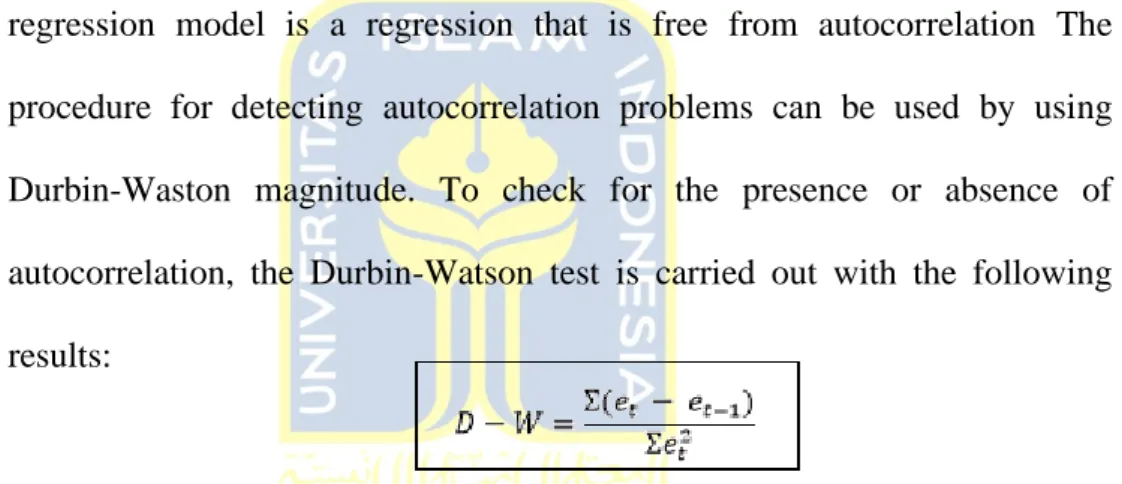
The autocorrelation test conducted in this study aims to find out whether in a linear regression model there is a correlation between the disruptive errors in period t and the errors in t-1 period (previous). If there is a correlation, then there is problem of autocorrelation, of course a good regression model is a regression that is free from autocorrelation The procedure for detecting autocorrelation problems can be used by using Durbin-Waston magnitude. To check for the presence or absence of autocorrelation, the Durbin-Watson test is carried out with the following results:
The test is performed using the Durbin-Watson test, with the formula:
Table 3. 2 Durbin-Watson Statistical Test Statistical value d Result
0 < d < dL Positive Auto Correlation
dL d du Uncertain
du d 4- du No Positive/Negatif Correlation 4- du d 4- dL Uncertain
4- dl d 4 Negative Correlation Source: Ghozali (2013)
3.6.4 Multiple Regression Test
The data analysis method used in this study is a quantitative analysis method with an analysis method, namely Multiple Linear Regression. In regression
46
analysis, in addition to measuring the strength of the relationship between two or more variables, it also shows the direction of the relationship between the dependent variable and the independent variable (Ghozali, 2013: 161). In this study, using the SPSS for windows, the statistical program tool to facilitate the process of processing research data from the program, output will be obtained in the form of processing results from the data, then the output is interpreted to be analyzed. Having analyzed the data, conclusions are drawn as a result of the research. The model of relationship research variables in multiple linear analysis can be arranged in functions or equations as follows:
Y' = a + b1X1+....+ bnXn Where:
Y= predicted value of influence a= constant or price number X = 0 b= regression coefficient
X1= dependent variable value X1 Xn= value of dependent variable Xn
e= Error Term, which is the estimator error rate 3.7 Hypothesis Testing
Hypothesis testing is conducted in order to test the significant level of all coefficients in the regression modeling of research variables by comparing the acquisition of probability values against the level of significance established in hypothesis decision making.
47 3.7.1 Partial Test (Test t)
T testing is performed to identify regression coefficients in each individual of the study variables. Decision- making of the t test is carried out:
1. If the significance level of the probability value of the t-statistic < 0.05, then it is decided that the independent variable has significance.
2. If the significance level of the t-statistic probability value > 0.05, it is decided that the independent variable does not have a significant influence on the dependent variable (Ghozali, 2013: 161).
When a study is based on findings of prior studies, it will be more relevant if it uses a one-way hypothesis test. One-way hypothesis test decision makes use of two bases of comparison, namely by comparing the acquisition of t-calculated values against the acquisition of the values from t-tables or by comparing the acquisition of probability values with the degree of significance.
3.7.2 Test F
The F test is intended to perform hypothesis testing of all regression coefficients simultaneously as well as to ensure that the relation modeling tested has been declared feasible for interpreting the relationship between the independent variable in relation to the dependent variable. The testing is considered very important because when the modeling does not pass the F-test, the results of the t- test are considered unpredictable or irrelevant. Decision making is carried out if:
1. Obtaining the probability value of F-statistics < 0.05 degree of significant, it is decided that the independent variables simulraneouslydo not affect the dependent variable.
48
2. The F-statistical probability > 0.05 degree of significant, it is decided that the independent variable simultaneously does not affect the dependent variable (Ghozali, 2013: 162).
3.7.3 Coefficient of Determination (R2)
The coefficient of determination proxied with R2 indicates the portion or magnitude of variance of the dependent variable which can be explained by the independent variable (Ghozali, 2013: 162). A model is said to be good if the acquisition of the determination value is close to 1 and vice versa if the determination value is close to 0 then the model is declared less good (Ghozali, 2013: 162). Thus, the provisions in deciding the good or bad of a regression modeling is shown from the acquisition of a determination coefficient value lies between 0 to 1.
49
CHAPTER IV
RESULTS AND DISCUSSION 4.1 Data Collection Result
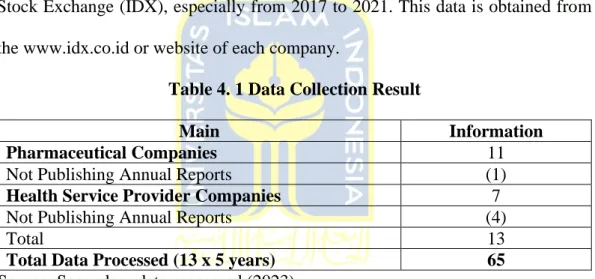
This study aims to analyze the influence of corporate social responsibility and good corporate governance on the performance of pharmaceutical companies and health service providers listed on the Indonesia Stock Exchange in 2017-2021.
Data collection techniques are carried out by taking annual report data of pharmaceutical companies and health service providers published on the Indonesia Stock Exchange (IDX), especially from 2017 to 2021. This data is obtained from the www.idx.co.id or website of each company.
Table 4. 1 Data Collection Result
Main Information
Pharmaceutical Companies 11
Not Publishing Annual Reports (1)
Health Service Provider Companies 7
Not Publishing Annual Reports (4)
Total 13
Total Data Processed (13 x 5 years) 65 Source: Secondary data processed (2023)
Based on Table 4.1 above, it is known that there is 1 pharmaceutical company that does not publish its annual report, namely PT. Organon Pharma Indonesia, and there are 4 health service sector companies that do not publish their annual reports, namely PT. Medikaloka Hermina Tbk, PT. Royal Prima Tbk, PT.
Sarana Meditama Metropolitan Tbk, and PT. Sejahteraraya Anugerahjaya Tbk.
Thus, the number of companies sampled in this study is 13 companies in the 2017- 2021 reporting period. Therefore, the amount of data used in this study is 65 data.
50
The data in this study is transformed in the form of logarithms, this aims to make the research data as normal as possible so that the results of statistical analysis become more valid. In other words, log transformations are used to reduce or eliminate the slant of the original data so that the data can be normalized. This needs to be done in this study, because in reality not all data can always be normally distributed (Tullah, 2017)
4.2 Descriptive Statistics
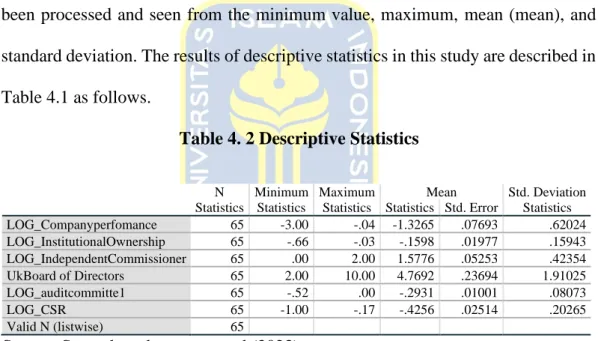
Descriptive statistics explain the data of each variable in this study that has been processed and seen from the minimum value, maximum, mean (mean), and standard deviation. The results of descriptive statistics in this study are described in Table 4.1 as follows.
Table 4. 2 Descriptive Statistics
N Minimum Maximum Mean Std. Deviation
Statistics Statistics Statistics Statistics Std. Error Statistics
LOG_Companyperfomance 65 -3.00 -.04 -1.3265 .07693 .62024
LOG_InstitutionalOwnership 65 -.66 -.03 -.1598 .01977 .15943 LOG_IndependentCommissioner 65 .00 2.00 1.5776 .05253 .42354
UkBoard of Directors 65 2.00 10.00 4.7692 .23694 1.91025
LOG_auditcommitte1 65 -.52 .00 -.2931 .01001 .08073
LOG_CSR 65 -1.00 -.17 -.4256 .02514 .20265
Valid N (listwise) 65
Source: Secondary data processed (2023)
Table 4. 2 shows the dependent variable of pharmaceutical company performance as measured by ROA (Return on Assets). This study makes use of 13 companies consisting of pharmaceutical sector companies and health service provider sectors with a reporting period of 5 years, therefore the number of research is 65 samples. Company performance as measured by company performance variable has a minimum value of -3 owned