Southeast Asia
‘Whose heart hath ne’er within him burn’d, As home his footsteps he hath turn’d, From wandering on a foreign strand!’
The Media and
Political Change in Southeast Asia
Karaoke Culture and the Evolution of Personality Politics
Jonathan Woodier
Edward Elgar
Cheltenham, UK • Northampton, MA, USA
The work is the sole responsibility of the author and does not represent the views of Citi Inc.
All rights reserved. No part of this publication may be reproduced, stored in a retrieval system or transmitted in any form or by any means, electronic, mechanical or photocopying, recording, or otherwise without the prior permission of the publisher.
Published by
Edward Elgar Publishing Limited The Lypiatts
15 Lansdown Road Cheltenham Glos GL50 2JA UK
Edward Elgar Publishing, Inc.
William Pratt House 9 Dewey Court Northampton Massachusetts 01060 USA
A catalogue record for this book is available from the British Library
Library of Congress Control Number: 2008937110
ISBN 978 1 84844 178 1
Printed and bound in Great Britain by MPG Books Ltd, Bodmin, Cornwall
List of tables vi
Acknowledgements vii
1 Introduction: disruptive technologies – change, conflict and
breakdown 1
2 The growth of the media and entertainment industry: the
move to centre stage 27
3 The Southeast Asian context 55
4 Please do not adjust your set: international information flows,
the media and security in Malaysia 87
5 From propaganda to pop culture: the Philippines and the rise
of the Southeast Asia media stars 115
6 Perning in the gyre: Indonesia, the globalized media and the
‘war on terror’ 140
7 The rise and fall of the media dictator: Thailand and the
continued influence of the military in Southeast Asia 175 8 The Singapore grip: putting the squeeze on a globalized
media post 9/11 217
9 Managing perceptions – from shooting the messenger to
dodging the questions: the role of PR in Southeast Asia 242 10 Subverting the media: piracy, surveillance and the battle for
control in Southeast Asia 271
11 Conclusion 297
References 304
Index 351
v
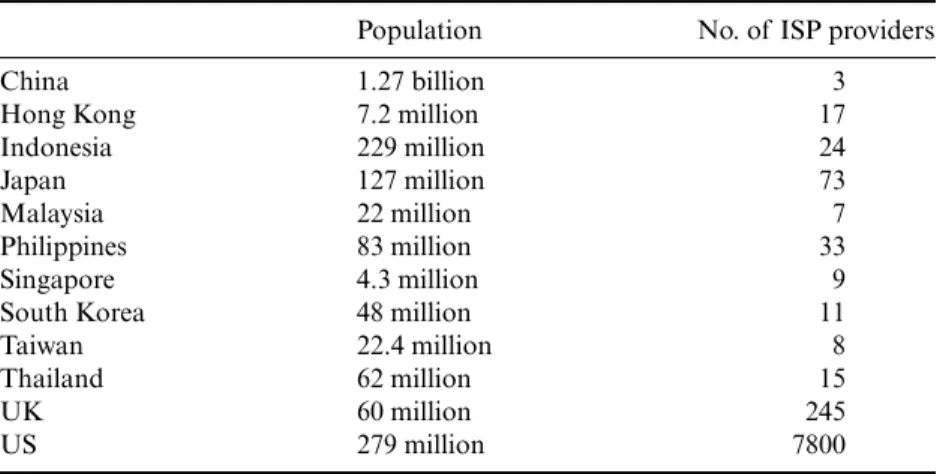
2.1 Asia – number of Internet service providers per country (2000) 53 2.2 Asia – computer penetration and Internet use (2003) 53 3.1 Cable in Asia – comparative costs (2004) 69 3.2 Asia Pacific broadband Internet penetration of total
households (%) 70
3.3 Asia Pacific multichannel pay-TV penetration of TV
homes (%) 72
3.4 Asia Pacific cable TV penetration of TV homes (%) 73 3.5 Asia Pacific digital DTH satellite penetration of TV
homes (%) 74
3.6 Asia Pacific IPTV penetration of TV homes (%) 75 3.7 Asia pay-TV, broadband and telecoms data (latest
subscriber data) 76
3.8 Asia – country IT investment (US$ per inhabitant) 78
vi
This work would not have been possible without the patience of my family, my wife Dina and son Ben, the support of my employer Citi, the input from academics, journalists, fellow travellers and the people I met during the 20 years I lived in the Asia Pacific region. Finally, many thanks for the invalu- able advice, editing and friendship of Dr David Martin Jones.
vii
technologies – change, con fl ict and breakdown
In Beijing, on 22 October 2001, Gerald Levin, the chief executive of AOL Time Warner, toasted China’s media regulator and director of the Propaganda Department of the Chinese Communist Party, Xu Guangchun.
The toast recognized the fact that the American giant had become the first western media company licensed to broadcast directly to the Chinese people (The Economist 27 October 2001, p. 66). Elsewhere, in South Asia, the Taliban ambassador to Pakistan was beginning his afternoon briefing to the gathered international media corps in Islamabad, detailing the regime’s latest take on the American bombing of Afghanistan. Meanwhile, in Southeast Asia, as the old century faded, families in Banda Aceh, Sumatra, watched coverage of the English FA Cup final on Malaysian television, beamed via satellite to their homes in the Indonesian province. The increas- ing ease with which the global news and entertainment products crossed national borders, the embrace of the media by one of the most archaic regimes in the region and AOL’s move into the China market, represented only the latest in a long line of events underlining the growing importance and impact of the mass communication media in Asia.
By the end of the twentieth century, governments across Southeast Asia, their legitimacy undermined by the Asian Financial Crisis, were being chal- lenged by emerging opposition voices given full range by this new, aggres- sive and robust media. In the Philippines, The Center for Investigative Journalism, established in 1989 by Sheila Coronel, challenged corruption and cronyism in that country, and threatened to play a major role in unseat- ing the country’s President (Coronel 1999a). In Thailand, as elections approached in November 2000, a constitutionally mandated new National Broadcasting Commission threatened to unpick the Thai military’s tight grip on the country’s broadcasting industry (Crispin 2000), as traditional political elites witnessed their monopolistic hold on power threatened in a new global economy. In Indonesia, new media outlets flourished as the 32-year reign of President Suharto came to an end, and the coherence of the state was threatened by internecine violence and separatist movements
1
seeking independence from the post-colonial arrangement. In Malaysia, intra-elite disputes saw a growth of support for the Islamic PAS party, and even the longevity of the Singapore government seemed to face new voices of opposition, enabled and emboldened by the changes that modernity and new technology brought to the region.
It was a very different situation from that just ten years earlier, when the Asian economic miracle was being lauded for its extraordinary growth enabled by ‘selective intervention’ and a market cultivated by an Asian model of governance (World Bank 1993, p. vi). Indeed, it looked as if Southeast Asia would be the latest region swept by a new wave of democ- ratization (Huntington 1991), encouraged by globalization and the emer- gence of a vocal middle class demanding their interests be met. These interests, moreover, would be fed by the growing international media network. But, whilst classical liberal theory suggests the globalized media would help democratize societies, this has proved incorrect in Southeast Asia. If anything, ten years after the Asian Financial Crisis, local political elites have proved remarkably adept at dealing with these challenges and have been reconstructing elite control.
This book, then, considers what impact the media has upon the democ- ratizing process in Southeast Asia. Has the media had a liberalizing effect or become subject to elite control in Southeast Asia and, if so, why? What role does the global media play in this process, particularly given its con- glomerization and commoditization? Ironically, the international media has become an important regional player, given the Southeast Asian state elites seeming inability to agree on cross-border mergers and acquisitions which might allow the creation of regional champions to compete with the global players. Yet, examination of a number of case studies of media and political change in Southeast Asia between 1996 and 2006 will show that the media in Southeast Asia has not become globalized, nor has it or the local political elites proved defenceless in the face of the powerful interna- tional players. Rather they have manufactured ways to continue their control policies, with interesting political repercussions both domestically, and for our understanding of the role of the globalized and local media in the politics of the developing world.
THEORIZING THE MEDIA IN SOUTHEAST ASIA
Technological developments and the current round of global economic integration have ensured that the mass communication media and its connected apparatus have become increasingly central to daily life in Asia.
And yet, despite the growing importance of the communication media in
Southeast Asia, the industry’s role in political change is an area that remains misunderstood. The literature on the media in the region, while growing, tends to be both country-specific and dominated by distinct polit- ical agendas. From early studies which looked at the media and its devel- opmental role in Asia (Lerner and Schramm, 1967), through the descriptive and proscriptive (Goonasekera and Lee 2001; Gunaratne 2000; Hueval and Dennis 1993; Mehra 1989), to more critical studies which see the media as a tool of capital (Rodan 1997, 1998), they tend to obscure a more useful narrative revolving around the different interest groups competing for access to the media space.
By examining the communications media and its relationship to political change in Southeast Asia, this study will endeavour both to provide a regional comparative analysis and offer a more nuanced and balanced interpretation of the mass communication media and its relationship to political institutions in Southeast Asia post 9/11.
Southeast Asian states are trying to make sense of the impact of global- ization on their political and economic shape. This blend of modernity and speed forces its societies to grapple with issues of governance, the shape of institutions like the media, and the possible ramifications of some of glob- alization’s general trappings that are seen to be western. Particularly, they face a confusing clamour of voices calling for an array of options that range from democratic liberalization to accommodate growing opposition, to tighter control in the face of violent, radical neo-fundamentalist and sepa- ratist challenges.
Giddens has argued that globalization, along with the technological developments that have given the process life and reach, has led to ‘the intensification of world-wide social relations which link distant localities in such a way that local happenings are shaped by events occurring many miles away and vice versa’ (Giddens 1990, p. 64). From satellite television and financial data to the ‘emoticons’ beloved of the oyayubizoku, the thumb tribes of Japan, the communications media is globalization incarnate, showing little respect for national boundaries or any ideological hegemony.
Carried by telecommunications technology, there has been an explosion of news and entertainment products, bursting across porous national borders with political and economic implications for governments in the region. As Atkins (2002) argues, where once control of the media and the dissemination of information served as an integral part of political control, the unfettered flow of global media products is now perceived as posing a challenge to established elites in the region. Commentators describe local political elites as ‘losing control’ (Williams and Rich 2000), although growing local audiences seemed to have an increasingly voracious appetite for the latest entertainment products served up as normal fare by the global
giants just as they do for similar products produced by the newly- enfranchised local media.
Strategies of commoditization and celebrification of the media, however, have the political effect in the Southeast Asian context of reducing the threat to illiberal governments through a diet of gossip and conspicuous consumption. Further exacerbating the concerns of Southeast Asia’s polit- ical elites was the fact that the more ubiquitous media organizations were controlled by global corporations. Moreover, interests that straddled national borders raised questions of intended or unintended influence, often leaving the nation state looking like a weak competitor in the global information power play (Williams 1995).
Media magnate Rupert Murdoch’s $US60-billion empire includes Fox Entertainment group (45 per cent of US homes), and DirectTV (a provider of digital television services and multi-channel video programming distrib- ution to 15.4 million Americans), in the US, as well as Star TV (300 million viewers across 53 countries from Australia to the UK), and Phoenix Satellite Television (42 million households or 140 million viewers in China), in Asia (Shah 2004, p. 2). MTV, owned by Fox competitor, Viacom, proudly claims to be available in 481.5m households in 179 countries (Gibson 2006a).
Indeed, the pace and depth of the change being unleashed by this process, and its impact on the media industry, has had major implications for national sovereignty and political change, with particular resonance for Southeast Asia as it worked to recover from the financial crisis of the late 1990s.
Governments in the region opened up their economies at the behest of international financial institutions, keen to reap some of the financial benefits of being part of the global information economy. Regional econ - omies from Indonesia to Korea enjoyed growth rates of between 8 per cent and 12 per cent in the late 1980s and early 1990s, but they exposed themselves to forces of change that had serious social and political ramifications. These have been brought into heightened relief. Further, in the wake of the attack on the World Trade Center in New York on 11 September, 2001, these forces have intensified.
As the character of financial capital has changed it has created remark- able wealth, with the ratio of global financial assets to annual world output soaring from 109 per cent in 1980, to 316 per cent in 2005. In 2005, the global stock of core financial assets reached $US140 trillion. This new capitalism is ever more global. The sum of the international financial assets and liabil- ities owned (and owed), by residents of high-income countries jumped from 50 per cent of aggregate gross domestic product (GDP) in 1970, to 100 per cent in the mid-1980s, and about 330 per cent in 2004. Further, these new concentrations of wealth and income have created new elites, providing a challenge to the traditional rulers, such that this ‘modern mutation of
capitalism has loyal friends and fierce foes. But both can agree that its emer- gence is among the most significant events of our time’ (Wolf 2007).
What, however, is the role of the mass communication media in this fast changing environment? Is it still a watchdog, scrutinizing the excesses of the powerful through ‘public deliberation’ (Page 1996, p. 5), or a propaganda tool ensuring their ideological domination? Or is it something else, pro- moting image and celebrification? Is it a market place in which citizens can find the information they need to guide their democratic decisions, or a hegemonic weapon of imperial cultures? Perhaps, in a world of instant information and access, is it an audacious disintermediator; a modern-day Robin Hood, supposed enemy of monopolistic dictatorships and friend to the ordinary consumer, encouraging social change as a forum for grass roots expression and technology of opposition.
As this work will show, the mass communications media provides a public space to which powerful actors in society can secure access by complex negotiation. From here they can attempt to inform, influence and persuade. Indeed, one area of particular focus for this thesis is the growing use of public relations (PR) consultants in Southeast Asia by the tradi- tional elites in this process, and representing an area of study that is both relatively new and on which there currently is a dearth of research, partic- ularly where Southeast Asia is concerned. Thus, where the media and its role in political change is concerned, the differing weight and influence of those using the media impacts the competition for access, reflecting the rel- evant power relations, political economy, commercial imperatives and knowledge of the medium. As a result, the interplay between the commu- nication media and political change is complex and often confusing.
It is no surprise, then, that the extent of the communication media’s influence continues to be debated at length (BBC 29 March 2002). This reveals an obsession which, itself, implies we suspect the communications media for its reach and its impact. Even though the research on the impact remains undecided and the available evidence seems to imply its effects are ambiguous and inconclusive, from the earliest days of its analysis, the media has been perceived as powerful (Curran et al. 1995). Let us first examine, then, theorizing about the role of the media as it has evolved over the twentieth century.
THEORIZING THE MEDIA AND ITS POLITICAL ROLE
The centrality of the mass media in modern society has long been recog- nized, even if not completely explained. In 1828, British politician Lord
Macaulay coined the term, ‘the fourth estate’, in recognition of the sig - nificance the mass media played both as a social institution and a political forum for debate. Today, a market-oriented media culture entwined with technological innovation has put the media industry centre stage in any consideration of political change.
This work will draw on the understandings of the media developed by Kellner (1990) in his hegemony model, the structural theories of Thompson (1995) and his work on the central role of the media and how it is part of the political process, and Giddens (1991) view of its social role, as well as the political theories of Di Palma (1990), and Friedman (1994) which look at elite paction, thus creating a lens through which it is possible to present media development in Southeast Asia. It will also test these the- oretical understandings in the context of Southeast Asia allowing, finally, for their review and an assessment of their strengths and weaknesses and modification to fit into a Southeast Asian context.
In order to do this, these ideas, themselves, need to be put into a theo- retical context, examining the communications media, what it does, how it does it and how it is changing, by reviewing the classic interpretations of the media and its role in society, as well as providing an analysis of its links to political change and democratization. This chapter will thus provide the theoretical framework against which the behaviour of devel- oping Southeast Asian states will be explored. It will also examine the various theoretical attempts to understand the media. It will consider the development of thinking about the media, and examine the interplay between the communications media and its audience in the light of the use of the media as a political resource. In doing so it will suggest that the development of the relationship between the media and political change in Southeast Asia is unique. This chapter will provide a theoretical frame- work for evaluating the influences informing the media’s impact on society and its role in democratization and political change, and offer an assessment of the potential evolution of the media on post-industrial society.
The chapter will subsequently examine how the media is structured, owned and controlled, and who has access to the space that the media creates. It will demonstrate that competing interests within media organi- zations means political influence is mixed at best and that, while the strongest voices revolve around profit-oriented ownership, this has not stopped other groups gaining access to the media, nor deterred political elites from using the media to seek to influence audiences. Indeed, as McLuhan (1964) first demonstrated, the media is a technology and, as such, is neutral. Technologies, however, become politicized by the messages they communicate and the influence they seek to effect. To that end, politics
has adapted to the media, with industry trends dictating the form and fashion of political message delivery.
For Thompson, the mass communications media involves the institution- alized production and mechanized diffusion of symbolic goods (Thompson 1997, 2001). It necessarily involves a technology of production and an audi- ence and, as Golding and Murdoch (1996, p. 11) observe, is increasingly
‘integrated into the industrial structure’.
The battle for influence within and around the media organizations is, therefore, key to the understanding of media production. The input of the different actors must be considered. In this context, those who work in the industry like journalists, editors and managers, can have a different focus and agenda than that of the transnational companies that own the means of news production. And, at a global level, the role of shareholders – the de facto owners of many of these companies listed on global stock exchanges – cannot be ignored. Even those dependent on private finance and more cen- tralized control without the influence of public ownership, understand the vital consideration of commercial revenue from advertising. And the tech- nology, itself, steps into the theoretical interplay, as an important player.
This still leaves the ongoing relationship between those who create the media products and the audience that receives them. Therefore, it is important to position this argument against the intellectual arguments about the mass communications media and political change, and to understand where the arguments in this work are situated.
THE MASS COMMUNICATIONS MEDIA:
A THEORETICAL HISTORY
The role and impact of the communication media has been a source of dis- agreement since the early nineteenth century, when both John Stuart Mill and his father James Mill, first described the media as a critical government watchdog. By contrast, the Marxist and radical alternative explanations, synthesized by the Frankfurt School and others in the 1920s and 1930s, and carried on through the 1960s into the current day, saw the media as a culture industry rendering individuals ‘less capable of autonomous judgement and more dependant on social processes over which they have little control’
(Thompson 2001, p. 176).
Indeed, since the 1980s and the emergence of critical media studies, the media, and news production in particular, has been subject to ongoing aca- demic scrutiny. While there has been little agreement on the industry and its effects, it is generally agreed that it plays a pivotal role in organizing the images and discourses through which people make sense of the world
(Golding and Murdoch 1996, p. 11). That is where the agreement ends and two theoretical camps have emerged. These two, competing understandings reflect the epistemic difference between a liberal view of the media and its radical counterpart, the Marxist or neo Marxist interpretation of the role of communications.
Both theoretical traditions see the media as central to modern politics.
The liberal sees it as providing a market place for the open debate of ideas over which the consumer exercises power of choice. By contrast, the Marxist or neo-Marxist critical perspective focuses on the procedures and relation- ships underpinning the media and its development, explaining the media as ideological agencies that play a role in maintaining class or elite domination.
The many strands of these approaches go some way in tracing the fabric of media control, production and reception, providing separate elements of a complex picture of the ways in which media messages are produced and shaped, and some insight into the different influences that inform this process (Curran et al. 1982).
The idea that the media is a conduit for information about the world forms an important thread in classical liberalism and the ‘heroic fight of the individual against political power’ (Keane 1991, p. 37). The positive rela- tionship between media freedom and democratic practice was subsequently developed by modernization theorists after the Second World War. For these theorists, trying to understand the nature of political power and eco- nomic development as the end of liberalism, and contemplating both the rebuilding of Europe and the construction of new post-colonial identities in Europe’s old empires, modernity was seen as a cybernetic order with social communication as central to the structural organization of politics and society (Deutsch 1953).
The relationship between the news media and democracy has been central to this area of communication research. In this context, the func- tion of the news media is seen as providing citizens with reliable informa- tion on which they can make political choices, vital to a healthy democracy (Gans 2003; Kovach and Rosenstiel 2001; Schudson 1995). This is an important consideration given that ‘modern political practices are made possible through mediated political communication in most democratic societies’ (Kim and Johnson 2006, p. 4). There have, of course, been detrac- tors who suggest the media performs poorly in this role and that election coverage is superficial and overdramatized. This, alongside negative cam- paign advertising, they suggest is responsible for falling voter turnouts (McChesney 1999).
Yet the link between the media and politics is unshakeable. Voters in modern societies find political information from the media (Graber 2004;
Zaller 2003), and the news media have a direct impact on political activity
and participation, being closely connected to political knowledge (McLeod and MacDonald 1985; Miller and Reese 1982). Indeed, power is played out in the media, as all modern politics is media politics. It ‘has to exist in the media space, and has to adopt the language of the media . . . the existence in the media is the pre-condition for political projects or images to reach people’s minds, and thus citizen’s votes’ (Castells 2004, p. 8). Political power becomes dependent on the control of, or the influence on, the apparatus of communication and persuasion – primarily the information and communi- cations technology that is central to what we call the media and, thus, the materials they convey. This is because culture is ‘by and large embedded in the process of communication . . . with the media and Internet at its core’
(ibid. p. 15).
The second strand of analysis, therefore, is concerned with the environ- ment in which the production takes place and the power relations involved, particularly on an economic basis. It recognizes the importance of the loci of power within the institutions processing and producing news and enter- tainment products: ‘who uses it, who controls it, what it is used for, how it fits into the power structure, how widely it is distributed’ (Finnegan 1988, p. 41).
From a somewhat different and more critical perspective, Theodor Adorno, Max Horkheimer, Jurgen Habermas (Dialectic of the Enlightenment, 1947) and the Frankfurt School offer a modified Marxist analysis that had previ- ously dismissed the media as merely a tool of bourgeois propaganda and false awareness. For the Frankfurt School, the mass media had become an instru- ment of domination, impeding the development of social consciousness among the proletariat, and facilitating, even hastening, a decline into the bar- barism of totalitarianism. For Habermas, rather than contributing to the increase of pluralism and democracy, the market has constrained the public space which once was home to civic debate, deliberation, agreement and action (Habermas 1989).
The approach of the Frankfurt school has been influential, and has led to the analysis of the nature of media organisations and their internal prac- tices, hierarchies and roles. As the British sociologist Stuart Hall argued
‘the media reproduce the structure of domination/subordination which characterises the [social] system as a whole’.1
The emphasis on the importance of the loci of power in media organi- zations has included ‘gatekeeper’ studies, which examined the flow of news material through stages of the selection and editing process, the examina- tion of formal and peer control in media organizations, and considerations of the professional ideologies and work practices of journalists who have a professional ethos or ideology which defines the beliefs and values of their profession, and lays down guidelines for accepted and proper behaviour.
This approach questions journalists’ declaration of professional auton- omy, placing the control of the production process by media professionals elsewhere within the dominant culture, so that the journalists are hot-wired with views by their class and education. For, while journalists argue pro- fessional autonomy derived from democratic tenets of freedom of expres- sion and the ‘public’s right to know’, as well as a commitment to values such as objectivity, impartiality and fairness, these claims are often questioned for being at best limited and societal, masking the journalists subservience to the dominant liberal ideology.
This suggests the control of the production process by media profes- sionals is confined to the production of messages, the meaning of which is primarily determined elsewhere. Thus, journalists might believe they remain objective, even as they ‘faithfully echo the established political vocabularies and the prevailing politico-economic orthodoxy. Since they do not cross any forbidden lines, they are not reigned in. So they are likely to have no awareness they are on an ideological leash’.2
To this end, consideration of the political economy of media institutions has provided a useful analysis of the structures of ownership and control, as well as scrutiny of where journalists get their information, and which sources and commentators they favour. Although this approach has come in for criticism for its economic determinism, there have been useful efforts to incorporate an element of flexibility in the argument. Of particular note in considering Southeast Asia, Kellner, in his use of the work of Italian Marxist theorist Antonio Gramsci, suggests the media is not a monolithic tool of capitalist ideology, but ‘a synthesis of capitalist and democratic structures and imperatives and is therefore full of structural conflicts and tensions’ (Kellner 1990, p. 15). The media, in other words, is highly ambigu- ous, particularly in the generation of its messages and their impact.
Interestingly, Tester’s study of the way political elites work to assert their control over new technologies that new groups have also claimed for their own forms of expression provides a useful contribution to the discussion on the role of ICT in political change. The cooption of modern culture expressed through communication technologies reflects, at the very least, the compelling nature of capital. It also reveals a recognition of the per- ceptions of the political and economic elites that the mass media is an important instrument of communication for influence and persuasion which can be dominated by various social groups as part of a struggle to influence public thinking (Tester 1994).
Political economists, therefore, have played an important role in charting developments such as the growth of the media, the extension of corporate control, and convergence within the industry. They have also made a useful contribution to understanding the process of commodification of the
media. This includes the reduction in the overall diversity of programming as these companies converge and follow commercial strategies built around synergies between their media and other interests, and the changing rela- tionship between the media, the government and the state (Golding and Murdoch 1996, p. 16).
For many of these observers, the media and entertainment industry are at the centre of ‘new modes of image production and cultural hegemony, the political struggles of various groups and the restructuring of capitalist society’ (Kellner 1990, p. 129). In analysing the Southeast Asian context, and the political developments around the region, this study will attempt to show that control of the media is a crucial resource in local power strug- gles, both for the political elites and those who challenge them.
While both the liberal democratic and critical studies perspectives have a useful contribution to make, they have, however, traditionally ignored the media audience and the technology itself although, it would seem, analysing the way that ‘meaning is made and remade through the concrete activities of producers and consumers is . . . essential’ (Golding and Murdoch 1996, p. 15). Those who are being influenced and persuaded are not without voice, and the audience has made an appearance centre stage, pushed into the lime- light by thinkers in areas such as cultural studies. This theoretical approach is ‘centrally concerned with the construction of meaning – how it is produced in and through particular expressive forms and how it is continu- ally negotiated and deconstructed through the practices of everyday life’
(Murdock 1989, p. 436). Here, the audience is not passive, and life experi- ences shape media consumption (Fiske 1992).
Indeed, audiences receive and use media content in different ways. And, as we shall show subsequently, the latest developments of Information Communications Technology (ICT), are enabling a far more active role for the media audiences. This ‘collective celebration’ (Sorlin 1994, p. 81), when we watch a particular programme or read a particular magazine helps to mark other communities. These become increasingly fragmented and less geographically defined as the media moves to create differentiation: no more just a Straits Timesor a South China Morning Postaudience, but a Computer Times, Angling Newsor Mother’s World.
Thus newly-imagined groups are challenging nations. In this way, the com- munications media is playing an important social role: a useful institution that satisfies our desire to observe others and allows us to maintain links on a small scale with a local newspaper or radio station, while providing infor- mation as a frame of reference on a large scale, helping us to make sense of the world while helping to define our relations to others (Sorlin 1994, p. 80).
While nation states and their political elites are economically and politi- cally powerful with their ‘mass media image-makers’ to help them attempt
to manage reality, people ‘creatively and ambitiously negotiate their cul- tural (including symbolic) worlds’ (Lull 1995, p. 114). Indeed, given that social organizations like the mass media are human constructs, the social construction of reality then, ‘must be understood as a process which applies as much to the nature of institutions as it does to the dynamics of daily life’
(ibid., p. 122).
The work of analysts like Fiske and de Certeau in L’Invention du Quotidian (1998), decodes media texts in ways which are related to their social and cultural circumstances. As a consequence, a New Audience Research approach, based on in-depth interviews rather than questionnaire techniques, and focusing on the audience’s ‘situatedness’ within a particu- lar socio-historical context, has evolved from a combination of traditional qualitative research strategies in sociology with some of the ideas of reader response theory in literary criticism.
But, while the audience does play an important role as ‘situated inter- preters’ (Keane 1991, p. 38), it is equally important to understand that the persuaders are becoming increasingly sophisticated (The Economist, 2 May 2002). The communication media embodies a bias in terms of the organization and control of information, pre-structuring the reception of opinion. Due to this unique ability to influence the daily construction of reality and the assumptions that underpin it, those who might profit from its economic, political and cultural influence will seek to control it (Innis 1951). In order to clarify the context in which the media operates in Southeast Asian development, we shall additionally evaluate the struc- tural and functional accounts of the media in modernity as developed ini- tially by Innis and consolidated by Thompson (1991) and Giddens (1995).
Innis’s thoughts on the social history of the communication media in his work The Bias of Communication(1951), in particular, influenced a number of theoretical approaches that pull the technology of the mass communi- cations media into the conceptual foreground. Innis believed that the key to social change is found in the development of communication media, and he claimed that each medium embodied a bias in terms of the organization and control of information. Innis saw the communication media as being used to create political control, but he also believed that change came from the margins of society, since people on the margins invariably developed their own media.
From Innis’s work, Marshall McLuhan developed a technological deter- minist view that the medium is the message, and maintained a ‘technology- led theory of social change . . . where communication technologies such as television, radio, printing and writing profoundly transformed society and
“the human psyche” ’.
McLuhan’s global village is a virtual extension of the human nervous system expressed as an electronic web. An ‘electric implosion’ has linked up the world and created an Age of Anxiety as lives are interlinked through knowledge and awareness. Yet, for McLuhan, it is a technology the effects of which ‘do not occur at the level of opinions or concepts, but alter sense ratios or patterns of perception steadily and without any resistance’
(McLuhan 1964, p. 19).
At the other end of the spectrum is the lighter touch of the cultivation theory of Professor George Gerbner, Dean of the Annenberg School of Communications at the University of Pennsylvania, which argues that television has long-term, but gradual and indirect behavioural influence (Chandler 1995).
For those who reject the more determinist view, the idea of the media as influencer has been at the centre of the debate. One of the most powerful effects models of communications is agenda-setting theory. Agenda setting was a term coined by McCombs and Shaw who, in a 1972 study of the US presidential campaigns (McCombs and Shaw 1972), showed a correspon- dence between the order of importance given in the media to issues and the order of significance attached to the same issues by the public and politi- cians (McQuail 1994, p. 256).
This theory suggests that through repeated news coverage, the media are able to set the importance of certain issues in the public’s mind, and that while the media might not directly affect how the public thinks about polit- ical matters, it does affect what subjects people think about, thereby estab- lishing what political issues people consider important (Severin and Tankard 1997, p. 252). This, then, has raised the question that if the media shape the public agenda, what or who shapes the media’s agenda?
McCombs and others suggest that only about one-third of the stories in the mass media are clearly of an objective importance to the public. These include natural disasters or other public catastrophes. The remaining edi- torial content exists because they fit the conventions of journalism: they fill the need for drama, controversy, or human interest; they come from established and ‘reliable’ sources; or they have been deemed worthy of cov- erage by leading news organizations. Equally important, the conventions of journalism – the choice of experts, the search for drama, ‘balance’, or con- troversy – shape the way an issue is framed in the public mind. The mass media tell us not only what to think about, McCombs observes, but also how to think about it.
This critical strand questions the market liberal approach with its ideas of a ‘Free Press’. It, notably, underlines market failures where cost of entry and cost of production make access uneven, creating both information- poor and information-rich societies (Garnham 1990, pp. 20–55). This
notwithstanding, the links drawn by modernization theorists between cap- italist market development, the free flow of information and the develop- ment of liberal institutions received further prominence as a ‘third wave’ of democratization swept the world, beginning in Portugal in 1974, and cul- minating in the end of the Soviet Empire in 1989 (Huntington 1991). As capitalism reigned supreme from the cash registers to the ballot boxes, a plural media became one of the central tenets of a ‘ruling social science par- adigm of an inexorable liberal-democratic end of history [where] economic progress inevitably presaged eventual liberalization and democratization’
(Jones and Smith 2001, p. 855).
However, as we will see from the analysis of the role of the globalized media in Southeast Asia, the liberal thesis is inadequate to explain the role of the media in political change. A more sophisticated approach is needed;
an approach that recognizes the importance of the media in modern society, bringing in understandings borrowed from McCombs and others from the media as influencer school, and applied to the Southeast Asia context. In this way, a more nuanced explanation of the complex interplay between the media and its audience is possible. It must also take into account the media as both a business and a technology that enables effective communication and persuasion and is, therefore, an important political resource fought over by competing elites.
In this context, Giddens and Thompson have attempted a synthesis of the arguments that counters more liberal market views. Giddens develops the theory that the media help us make sense of our lives (Giddens 1991).
The media scares us while providing the balm to soothe our fears, from expert advice to stories of how others tackle their reality.
Research continues to be done that reinforces this position. The British government, considering why Britain had become a risk-averse nation that
‘over-protects, over-regulates and needs to rediscover self-reliance and a spirit of adventure’,3was told by Professor George Gaskell, a risk expert from the London School of Economics, that:
The mass media could be largely to blame. Virtually everything we eat, for example, has at some point been associated [in the media] with carcinogens. But people seem to want to read about new dangers. Maybe we just have a collective interest in finding things to be anxious about. (Brindle and Lewis 2006) Further, Giddens (1979) provides something of a theoretical compromise between liberal and critical views of the media via his Structuration Theory, suggesting that we act into a system and that system biases the type of inter- action but, as we work within a system, we change the system. Giddens also assumes that there are always unintended consequences of technologies and their use and redesign.
For Thompson, as the media has become central to modern life and pol- itics, so media consumption has become ‘a routine, practical activity which individuals carry out as an integral part of their everyday lives’ (Thompson 1995, p. 38). The outcome of this process is that the mass media now serves as both a producer and mirror of our ‘self-fashioning’ (ibid., p. 43).
For each of these authors, the mass media have become both a cause and outcome of modern society, and this thesis will draw on their ideas in its analysis.
Thus, the various organizations that make up this institution have become a source of information that people use to make sense of their lives, as well as a tool for those in power to control their constituents. The media are polysemous (for example, Gamson et al. 1992), and life experiences shape media consumption as much as the media shapes our life experiences (for example, Fiske 1992).
The various technologies which have facilitated the development of the communication media, the printing press, the computer and the television must be seen as having an important role in framing the social construction of reality. McLuhan’s (1964) contribution is valuable because he underlined the fact that these are not simply machines which convey information.
Their influence goes much deeper as they become:
metaphors through which we conceptualise reality in one way or another.
They . . . classify the world for us, sequence it, frame it, enlarge it, reduce it, and argue a case for what it is like. Through these media metaphors, we do not see the world as it is. We see it as our coding systems are. Such is the power of the form of information. (Postman 1979, p. 39)
The interplay between society and its technology is clearly a complex and subtle one. Technology and, in particular, technological change scores society deeply, as it does the human psyche, becoming intricately embed- ded in our neuroses and anxieties, particularly so when technological change is rapid and, therefore, turbulent and disruptive. These scars are reflected in many of our most celebrated literary texts. Joyce Cary’s road slices throughMister Johnson’s traditional African society, dismembering the fabric of village life abruptly and violently. Similarly, the development of the railway left its indelible mark on the nineteenth century and fatally on itsfictional heroes and heroines, with a number of them, including Anna Karenina, dying under its wheels. Even more disruptively, televi- sion impacted life at the end of the twentieth century just as the Information Superhighway and information and communication tech- nology (ICT) look set to do the same in the twenty-first. Their influence has been given cultural reference in works from Poltergeist to William Gibson’sIdoru.
Thus, the mass communication industry is intricately interwoven with the technology which gives it form. From the printing press to the digital electronic signal, its influence on us is subtle but often profound. However, the social context in which these technologies are used, and the competi- tion to control access to what is rightly perceived to be an influential medium, is crucial. And while technological determinism is to be avoided, it offers some useful insights for our study into the impact of the mass com- munications media on politics and political change, particularly the influence of television on politics.
So, as with his counterparts from across the Atlantic, Kellner (1990) puts an extra polish on the lens through which to view the developments in Southeast Asia. Kellner allows us, the audience, to be more than just instru- ments, mute, pliant, able to be pushed hither and thither. Rather, we inter- pret the media’s messages in ways which suit us. Dismissing the more popular theories of instrumentality (including structural Marxism), and post-modern imagery as inadequate, Kellner, with his Hegemonic or Gramscian perspective, has the advantage of embracing both the social institutions and the human interaction within this world view, such that the conflict and contestation are natural modes of interacting. Kellner also rec- ognizes the importance of the technology, producing a theory that properly situates television amongst all the important social institutions, while inter- weaving the influence of dominant ideologies: expressions of elite interests rooted in the economic system. The ubiquitous nature of television, with its use of satellite technology to flood signals around the world, puts it in the theoretical spotlight, illuminating its particular limitations.
Kellner’s hegemony model is particularly useful when considering the political developments in Southeast Asia and the role of the media. As we will see, while the media furthers the perceived interests of the ruling elite, it does not do so in a monolithic way. There is conflict and contestation, particularly in the face of the growing challenges of modernity and glob- alization. Of particular note for any consideration of developments in Southeast Asia, Kellner maintains that local elites, however, have been able to reassert their control strategies by being flexible enough to forge new alliances among ‘transnational corporations, the capitalist state, and com- munications technologies in the era of technocapitalism’ (Kellner 1990, p. 90).
In this way, Kellner, combined with the structural understanding of the growing role of the media in modern society provided by Thompson and Giddens, will form the theoretical basis of this consideration of the role of the media in political change in Southeast Asia. This work, then, will test these theoretical understandings in the context of Southeast Asia, thus facilitating, in the conclusion, a review and assessment of the strengths and
weaknesses of these theories, and modifications necessary to address the Southeast Asian context, ultimately demonstrating that while the global media is not liberalizing, nor has the media in Southeast Asia, as some like Rodan assert, become a simple tool of capital.
Kellner, like Thompson and Giddens, places the media, and television in particular, at the centre of society. Southeast Asia is no exception, and this analysis will offer a summary of the latest developments in the mass com- munication media industry, as well as situating the historical position of the media in the evolution of post-colonial communities in Asia, illustrating that the media is no longer merely a tool of national government, but is now increasingly accessible to the ordinary citizen, with dramatic consequences for the political and social fabric of Southeast Asia. It will also provide a survey of the existing literature on the communications media and its effects, and consider the implications of the impact of the information age and its attendant communications technology on Southeast Asia, drawing, in particular, on the work of media theorists Kellner and Thompson.
METHODOLOGY
This book will analyse media development in Southeast Asia via a case study methodology. These case studies will elaborate the distinctively different media approaches developing in Southeast Asia, as well as the occasional emergence of alternative voices, and the varying place and impact of the international media within these systems, critically examin- ing Rupert Murdoch’s 1993 declaration to a London audience after News Corporation’s purchase of Star TV, that satellite television constituted an ‘unambiguous threat to totalitarian regimes everywhere’.4 Murdoch reflected the hopes of those who wished to see the spread of democratic pluralism, but did little to enamour those regimes to his group of compa- nies (at least initially), nor to the new global media of which he boasted.
The results of this ongoing and evolving competition for control of the flow of information within and across the states of the region that comprise the case studies, provides useful insights into the development and impact of the communications media, and how it is perceived in Southeast Asia.
In order to develop the case study model, we must first examine the emer- gence of the global media from the 1990s. Chapter 2 considers how the media has become central to the modern condition, underlining the latest developments in the media industry, the growing importance of television and the development of Information Communications Technology (ICT).
It examines the growth of the global media giants, as part of a number of important trends impacting the industry: globalization, conglomeration
and commodification. This includes an examination of how the media is structured, owned and controlled, and the competition for the media spaces. It considers how the media is developing and changing, including the rapid globalization of the decades since the 1980s, and the introduction of technologies that have enhanced and deepened the changes, as well as the growth of the global entertainment giants. It looks at the creation of the mediated world and the ‘entertainment economy’ (Wolf 1999), with the increasing commercialization of the media and entertainment industry.
Chapter 2 also examines two developments contiguous to the growth of the media industry: the emergence of the perception industries and the role of celebrity in modern society.
The history of the communications media in Asia is unique, and uniquely different as the case studies will demonstrate, so an exposition is necessary on the development of the communications media in Asia, its control and ownership, and the influx of the international media and their impact, if any, on the local players. Chapter 3 examines how these devel- opments play out in the major developed states of Southeast Asia, namely Singapore, Malaysia, Thailand, The Philippines and Indonesia, and the battle to control the globalized media in the face of technological change.
It throws some light on how international industry trends are playing out in the region, the impact of new technology and developments like the Internet, as well as assessing the growing importance of the media in Southeast Asia, and the local competition for media space. While there is not a monolinear connection between democracy and the media, it does raise a set of issues that, as the local political elites deal with them, have implications for both media development and democracy.
Southeast Asia’s elites have perceived the media to be linked with regime change and, as they attempt to ensure their own legitimacy through national development, they have been subject to security dilemmas, both from the impact of the influx of international media and other global influences, and a growing insecurity connected to this and to the rise of the Internet and new,
‘disruptive’ communications technologies. Chapter 2 further examines the question of whether the local political elites are helpless in the face of moder- nity, and shows how historical expertise linked with modern techniques and understanding is allowing Southeast Asia’s political elites to maintain their strategy of control, ensuring that the media remains a resource in elite paction. It also discusses the role of the mass communication media in the ongoing political crafting within these relatively new states, drawing on the work of Friedman (1994), and Di Palma (1990), and the use of the mass com- munication media by the different political actors as they create alliances and negotiate political development. It also examines how the celebrification of the media plays into the hands of both the illiberal state and actors.
Chapter 3 explores the development of the media in Asia as a vehicle for persuasion rather than one of control as it was in the newly-independent states, the role of the western media in Asian political and social develop- ment and the failure of international liberal media to provide a lead. It includes a look at the massive growth in cross-border information flow and the extent of US cultural hegemony (for example, the dominance of Dow Jones Inc. in the area of quality, business-orientated English language product – AWSJ, Wire, CNBC, The Far Eastern Economic Review), and dis- cusses the way globalization has been particularly exacerbated in Southeast Asia, where it was generally assumed by Asian elites (and liberal democra- tic theorists) that a globalizing media meant both Westernization and democratization. This is proving not to be the case, as our case studies will demonstrate, because Western media adapts both to popular culture and the needs of political elites in order to protect their distribution.
The role of the media and its impact on politics in Southeast Asia is examined by means of a series of case studies, looking at the main states in the Association of Southeast Asian Nations (ASEAN) and the role the media has played in the development of the nation, how it has developed, the influence of the international media, and the strategies used by local political elites to maintain control. All the case studies show the importance of the Asian Financial Crisis in undermining the legitimacy of the devel- opmental state model embraced by the Southeast Asian political elites, and how coalitions are being remade with the US ‘war on terror’ and the use of professional image makers helping restore their grip on power.
By using a variety of research methods, including interviews, personal experience and observation to provide primary data, as well as secondary sources including news reports, official statistics and other documentary evidence, the case studies provide ‘illuminating insights into cultural prac- tices and social meanings’ (McNeill and Chapman 1985, p. 159). To this end, the five countries that have been chosen for these case studies are also ones which can provide useful insights into the role of the media in politi- cal change, in particular the role of the global media companies.
Indonesia, Malaysia, Singapore, Thailand and The Philippines are not only the major economies of Southeast Asia, but they are the countries in the region which have also opened themselves up, as this book will show, to the global economy, allowing the interplay with the global media indus- try which is at the centre of the book. All five are also regarded as sitting beside internationally strategic shipping lanes, and are also seen by the inter- national community as important in the global security power play, partic- ularly around the US ‘war on terror’. In total, this means that the countries are seen as having an important role in the flow of global trade and finance and are, therefore, players on the stage of international relations.
The first case study, in Chapter 4, examines the control model of Malaysia, and how the government’s hold on power and over the means of communication was threatened as it sought to link to the global economy in order to encourage economic growth – key to continued regime legitimacy.
It examines how the ruling party has tried to meet the challenges of inter- elite tensions resulting from the Asian Financial Crisis and the rise of an Islamist party appealing to the many Malaysians who had not benefited from the global economy. This is contrasted with the case of The Philippines in Chapter 5, where a media free-for-all after the fall of the authoritarian Marcos regime, combined with Asia’s general obsession with celebrity, has resulted in the ultimate in personality politics, but no meaningful democra- tic pluralism, as elites seek to suppress dissent expressed through the media helped by its celebrification.
In between these extremes lie Thailand and Indonesia, where the role of the military in the political system, the ongoing search for political solu- tions and the influence of business interests makes for a more fluid media industry, flirting with pluralism while subject to commercial and political strictures. In Chapter 6, the Indonesian case study shows how one of the few examples of a Muslim state with a nascent democratic political system is struggling to create a democratic political culture after the introduction of a democratic political system. All the while, traditional elites regroup and coalesce to form a revived and refined political unit, keen to restore their control strategy with the tacit, if not deliberate, support of western democratic governments looking to establish alliances with Muslim elites in a strategically important region. Likewise, in Chapter 7, Thailand pro- vides a useful example of how any suggestion that there is a natural pro- gression to liberal democracy looks ill-considered, as politics oscillates between a democratic electoral system, single party dominance and endur- ing influence of the military and royal autocracy, and how the media rather than encouraging liberalism can, in the hands of a business elite, provide support to an illiberal government backed by a military–royal coalition with the support of an urban middle class which imagines that an author- itarian coalition is more likely to represent its interests than a popularly- elected government.
The book then examines the case of the Singapore model of control and how it developed, followed by an analysis of its latest evolution as a case study in how local political elites have embraced spin in their attempt to control the messages in an increasingly complex media environment. In Chapter 8, we show how the People’s Action Party (PAP) and its leader, Lee Kuan Yew, established a control model that both its neighbours and others in the Asian region attempt to mirror, and how even they have been shaken by the emerging opposition voices enabled by the developments in ICT. It
then examines how, with a unique combination of legalism and ownership, the PAP maintained its gatekeeper status.
Chapter 9 subsequently reviews, from the consideration of these case studies, the rise of the perception industries and the art of persuasion in the Asian media. This involves a consideration of the spin doctors behind the scenes and their roles in a Southeast Asian context, and whether or not they are having an impact in terms of changing the engagement between media and politics. It also considers how the new communications technology is shaping politics in Southeast Asia, and how parties, governments and other groups use the new technologies, thereby attempting an assessment of the political role of the communications media. Using Singapore as a case study, the book examines the latest manifestation of a regionally attractive, illiberal control strategy. This is a sophisticated approach to securing access to the media space whilst minimizing liberal controversy and in support of its own efforts to become a regional media hub such that, where traditional influence alone is not enough, by the use of the perception industries the Singapore government has successfully maintained a technocratically enforced ‘Fortress Singapore’.
In Chapter 10, we examine the most recent developments in the media industry and what they mean for Southeast Asia’s political elites. We chart the efforts of alternative voices to be heard in the new media space, sub- verting the communications technology to the ends of pluralism, terror or just commercial gain, offering a new challenge to the illiberal regimes of Southeast Asia, forcing a countervailing reaction from the likes of Singapore’s surveillance state, and the projection of control into virtual spaces.
In conclusion, in Chapter 11, the book examines the nature of a Southeast Asian model of media development in the close embrace of local elites who feel keenly the threat, perceived or real, of a media that is growing in importance in information-sensitive, young states. In this model, the media is an institution rooted in the development of the state: the voice of nationalism, independence and development.
The turn of the century marked a clampdown on the media across the Southeast Asian region (Freedom House 2005). When considering the countries included in this thesis, Freedom House put the Philippines as the freest of the countries in Southeast Asia, with a measure of 75 (partly free), down from 77 in 2004. Then comes Thailand 95 (partly free), down from 88, Indonesia 119 (partly free), down from 117, Singapore 139 (not free), down from 135 and, finally, Malaysia 152 (not free), down from 154.5While it is important to question the relative position of countries in this study – for example, is Malaysia less free than Singapore – the importance of the Freedom House illustration is to outline that of the countries examined in
this book, all were downgraded in the 2005 study from that of the previous year.
The influence of the media has not been lost on the ruling elites of Asia.
Information has traditionally been their jealously protected ward and the mass communication media a central figure in nation building. Yet the depth and pace of the changes swept in by the cultural firestorm linked to the flow of global news and entertainment products has had many of the ruling elites in damage limitation mode. The wider governments in the region opened the doors to their economies in an attempt to reap some of the financial benefits of being part of the global information economy, the more they seemed to fan the flames of modernity licking at the social and political foundations of their societies.
Southeast Asia, in particular, is an information-sensitive region. It comprises relatively young and porous states, lacking in autonomy and obsessed with internal security due to the fissures that slice through their societies. Be they ethnic, religious, or economic, these fissures often coin- cide, further deepening division and resulting in low regime legitimacy.
These states are increasingly subject to the dramatic social changes wrought by globalization, and the ruling regimes, therefore, are particularly sensitive to outside influences. Where once they seemed to control the communica- tions media (halcyon days in a real or imagined past), their hegemony was threatened. Cross-border information flows increased as disruptive tech- nology from satellites to mobile phones dissolved the sanctity of national boundaries, and the pursuit of economic development was seen to have dis- sipated the once centralized ownership and control of the communications media, sometimes even to foreign interests. As a result, the ruling elites were forced to compete with other groups, as well as amongst themselves, for access to the media and its audiences.
Certainly, any attempt to analyse the communications media and its effects, political or otherwise, raises a number of questions and many con- tradictions, both on the side of the producers and the receivers. Any argu- ment for consolidation of the mass communications market as the dominant business trend takes place against a background of the devel- opment of the Internet and associated technology which has not only increased the amount of media space but also reduced the cost of entry, thus easing mass communications from out of governmental or corporate control.
Any suggestions by Barnett (1998) and others of a general increase in sensationalism and a ‘dumbing-down’ of media products must reflect the fact there is more news and more journalists digging around than ever before. Indeed, in Asia, some suggest that there exists a more critical media as niche channels and the use of communications technology has created
an audience which is forcing mainstream media to provide better coverage (Coronel 1999b).
Likewise, if there is an increasingly sophisticated audience, why is there a seemingly pallid demand for quality? Perhaps this can be put down to the breakneck pace at which we live our lives, and the amount of information which flows into it – as a result of which we tend to choose to consume our news and politics like our food, fast, insubstantial and heavy handed on the sugar.
Cultural imperialism and the growing dominance of the trans - national media corporations is another trend which is often countered in the global versus the local debate. The Chinese community in London and Manchester can now watch Hong Kong-produced Cantonese-language content piped to them at home by TVB, or fans of the BBC’s award- winning Top Gearmotoring programme can watch their English filmed hot-rods in Delhi, Beijing and Manila. Besides, although local elites rail against the impact of the ‘Western media’, hegemony in their own national culture and communications system might falter, but it is questionable whether the loss of national cohesion and identity need result (Collins 1995, p. 181).
Yet the strong local reactions to the cross-border flow of content would suggest that consolidation not only remains the major factor in the busi- ness, but that this process is dominated by what are perceived to be Western and, predominantly, American-controlled organizations (Chadhu and Kaviori 2000). While it is clear that global entertainment companies have understood the importance of providing local flavours alongside their global blockbusters, whether it be local-language music shows or locally- produced soaps or the local versions of their big hits like Who Wants To Be A Millionaire?, these media giants own content that has the widest reach:
Disney’s Lion Kingand AOL’s Harry Pottertapped into the pockets of children from Beijing to Jakarta.
Even the mass access Internet may well look like a mere blip in the devel- opment of the technology as companies and governments move to regain control of its space. Perhaps this is why other strategies of opposition have developed in the periphery, amongst the dispossessed and the displaced, from piracy to fundamentalist-inspired violence.
So, while Southeast Asia’s ruling elites no longer have the control over the media they might once have enjoyed, this thesis will show that there is a growing awareness of the globalization of infotainment and an under- standing that politicians can use, or ‘spin’ the media in Asia to maintain and even extend elite control. This has strong links back to the influences of the developmental, nation-building media of the early days of independence, and possibly to the media’s roots in Western colonial rule. So, whilst it
reflects a developing western phenomenon, it has taken on distinctive char- acteristics in Southeast Asia. This work will address the developments above and attempt to shed a distinctive Asian light on the mediatization of politics.
The model developed in Southeast Asia, as this book shall further show, also includes a popular response, where the communications media and associated technology is being used to challenge elites locally, whether through new channels like the Internet or use of video technology or text messaging, and globally through a growing response to US/Western hege- mony. The latter includes a noticeable increase in the contempt amongst some of the Asian media for most aspects of the West apart from its tech- nology – this is a worldview that interestingly coincides with some Asian autocrats, even NGOs. Thus, the media is more ambivalent than much of the literature assumes and can itself be used by ‘media-savvy’ politicians in a way that secures the continuing nation-building agendas of elite driven politics. In addition, with the rise of media stars, popular obsession with celebrity allows name recognition to be turned into votes, allowing for the success of celebrity rather than the embrace of issues.
In conclusion, then, this study will suggest that, as media and entertain- ment products flood across porous national borders around the region, wary local elites are also finding support from formerly critical western liberals keen to pursue the US-led ‘war on terror’. As this work attempts to place the mass communications media and its relationship to liberal democracy in the current era of global commercial operations and how this plays out in Southeast Asia with distinctive regional characteristics, it will also conclude that the ‘war against terror’ gives authoritarian governments in the region the renewed hope that they can successfully have economic growth without loosening their control. This is disconcerting given the development needs of Southeast Asia: ‘Tyranny, corruption and suppres- sion of the media go hand in hand in far too many countries. Indeed, the chronic misgovernment which is creating a growing list of “failed states”
world wide can only really flourish when it is free from detection and expo- sure by a free press and broadcast media’ (Tait 2002). And, while Tait’s assertion may be seen as simplistic, empirically observable political phe- nomena in countries such as Burma and North Korea would suggest he has a point. Likewise, as we shall see in this book, Southeast Asian states like Indonesia and the Philippines, which are fraying at the edges, also display similar characteristics in areas where the central state no longer holds sway, and local military and business interests often violently silence any opposi- tion, including that expressed through the media.
But it also has worrying implications given the importance of the region which not only includes the world’s most populous Muslim nation, but
borders the Malacca Straits (a piece of water that carries about 40 per cent of the world’s trade, more than 50 000 merchant ships every year, including 80 per cent of the energy supplies of Japan and China) – a choke point where global trade and geopolitics meet in a lawless sea that, in 2005, Lloyds of London described as a ‘war risk zone’ (removed from the list of vulnerable areas in 2006, following an improvement in security).6