i METRO
By :
MIRNAWATI DEWI St. Number : 1501070275
Tarbiyah and teachers training faculty English Education Department
STATE INSTITUTE FOR ISLAMIC STUDIES OF METRO 1441 H/2020 M
ii
AN UNDERGRADUATE THESIS
IMPROVING READING COMPREHENSION
BY USING WRAP UP STRATEGY AT MA MUHAMMADIYAH METRO
Presented as a Partial Fulfillment of the Requirement For The Degree of Sarjana Pendidikan (S.Pd)
In English Education Program
By:
MIRNAWATI DEWI St. Number : 1501070275
Tarbiyah and teachers training faculty English Education Department
1stSponsor : Drs. Kuryani, M.Pd 2ndCo-sponsor : Andianto,M.Pd
STATE INSTITUTE FOR ISLAMIC STUDIES OF METRO 1441 H / 2020 M
iii
IMPROVING READING COMPREHENSION
BY USING WRAP UP STRATEGY AT MA MUHAMMADIYAH METRO
ABSTRACT BY:
MIRNAWATI DEWI
The purpose of this research is to improve the students’ reading comprehension and learning activity in MA Muhammadiyah Metro. The researcher considers that wrap up strategy helps the students in learning process and be one of the strategies to improve the students’ reading comprehension.
In this research, the researcher conducted Classroom Action Research (CAR) which was done in two cycles. Each cycle consists of planning, acting, observing and reflecting. The subjects of this research was 20 students in tenth graders of MA Muhammadiyah Metro. In collecting data, the researcher used test (pre test, post test I and post test II), observation and documentation. The research was conducted collaboratively with the English teacher at MA Muhammadiyah Metro.
The result of this research showed that wrap up strategy can improve the students’ reading comprehension and their learning activity of the tenth graders at MA Muhammadiyah Metro. It can be known by the students’ average score from the pre test to post test. The average score in pre test was 45.45, post test I was 59.4 and post test II was 74.15. It means that the wrap up strategy can improve the students’ reading comprehension and their learning activity.
Keyword : Improving, Reading Comprehension, Wrap Up Strategy, Classroom Action Research.
iv
MENINGKATKAN PEMAHAMAN MEMBACA DENGAN MENGGUNAKAN STRATEGI WRAP UP
DI MA MUHAMMADIYAH METRO
ABSTRAK OLEH:
MIRNAWATI DEWI
Tujuan dari penelitian ini adalah untuk meningkatkan pemahaman membaca dan kegitan pembelajaran siswa di MA Muhammadiyah. Peneliti menilai bahwa strategi wrap up membantu siswa dalam proses pembelajaran dan menjadi salah satu strategi untuk meningkatkan pemahaman membaca siswa.
Dalam penelitian ini, peneliti melakukan Penelitian Tindakan Kelas (PTK) yang dilakukan dalam dua siklus. Setiap siklus terdiri dari perencanaan, tindakan, pengamatan dan refleksi. Subjek penelitian ini adalah 20 siswa kelas sepuluh MA Muhammadiyah. Dalam mengumpulkan data, peneliti menggunakan tes (pre-test, post test I dan post test II), observasi dan dokumentasi. Penelitian ini dilakukan secara kolaboratif dengan guru bahasa Inggris MA Muhammadiyah.
Hasil penelitian ini menunjukkan bahwa strategi wrap updapat meningkatkan pemahaman membaca dan kegiatan pembelajaran siswa kelas sepuluh MA Muhammadiyah Metro. Hal ini dapat dibuktikan dengan skor rata- rata siswa dari pre test hingga post test. Skor rata-rata pada pre test adalah 45.45, post test I adalah 59.4 dan menjadi 74.15 pada post test II. Ini berarti bahwa Strategi wrap up dapat meningkatkan pemahaman membaca dan kegiatan pembelajaran siswa.
Kata kunci :pemahaman, pemahaman membaca, strategi Wrap Up, PenelitianTindakan Kelas.
v
vi
vii
viii
ix
x
xi MOTTO
”And only to God should you hope"
(QS Al Insyirah ayat ke- 8)
“Nothing is Easy but nothing is Impossible Because Allah is Always with Me”
(Writer)
xii
DEDICATION PAGE
“I highly dedicate this undergraduate thesis to my beloved parents and all whom I love.
Furthermore, to my almamater, State Institute for Islamic Studies of Metro”
xiii
ACKNOWLEDGEMENT
As human being who constantly have faith to Allah the Almighty, let us continuously offered our praise to Him for all abundant blessing, especially the precious health to the writer that he can accomplish this Undergraduate Thesis.
Sholawat and Salam are upon our prophet Muhammad SAW, the great leader of moral awakening in the world.
In this occasion, the researcher would like to express her greatest appreciation, honor and gratitude to his beloved parents (Mr.Arsad and Mrs.Aroh), for all their valuable supports and moral encouragement in motivating the researcher to finish his research.
The researcher also would like to express his deepest gratitude to his sponsor and co-sponsor, Drs. Kuryani M.Pd and Andianto M.Pd for their advice, guidance, correction, and suggestion in finishing this undergraduate thesis. Her gratitude also goes to:
1. Prof. Dr. Enizar, M.Ag, the Rector of State Institute for Islamic Studies of Metro (IAIN Metro).
2. Dr. Akla, M.Pd, the Dean of Tarbiyah and Teacher Training Faculty.
3. Ahmad Subhan Roza, M.Pd, the Head of English Education Department.
4. Drs. Kuryani, M.Pd as the first advisor and Andianto, M.Pd as the second advisor, thank you so much or kindness and valuable knowledge and for your support in finishing this undergraduate thesis.
5. All lecturers of English Education Department who have taught and educated the researcher during his study at IAIN Metro.
xiv
xv
TABLE OF CONTENT
COVER ... i
TITLE PAGE ... ii
ABSTRACT ... iii
ABSTAK ... iv
RATIFICATION PAGE ... v
NOTIFICATION LETTER ... vi
NOTA DINAS ... vii
APROVAL PAGE ... viii
STATEMENT OF RESEARCH ORIGINALITY ... ix
ORISINALITAS PENELITIAN ... xi
MOTO ... xii
DEDICATION PAGE ... xiii
ACKNOWLEDGMENT ... xiv
TABLE OF CONTENT ... xv
LIST OF TABLES ... xvii
LIST OF FIGURE... xix
LIST OF APPENDICES... xx
CHAPTER I INTRODUCTION ... 1
A.Background of the study ... 1
B.Identification of the Problem ... 4
C.Problem limitation ... 4
D.Formulation of the Problem ... 5
E.Objective and benefits of the study percentage ... 5
F. Prior research ... 6
CHAPTER II THEORITICAL REVIEW ... 10
A.Reading Comprehension ... 10
B.The Concept of Wrap Up Strategy... 20
C.Action Hypothesis ... 21
CHAPTER III RESEARCH METHODOLOGY ... 25
xvi
A.Variable and Operational Definition of Variable... 25
B.Research Location ... 26
C.Subject of the Research ... 27
D.Action Plan... 27
E.Data Collecting Technique ... 36
F. Instrument of the Research ... 39
G.Data Analysis ... 40
H.Indicators of Success... 41
CHAPTER IV RESULT OF THE RESEARCH AND DISCUSSION ... 42
A.Research Result ... 42
B.Discussion ... 72
CHAPTER V CONCLUSION AND SUGGESTION ... 78
A.Conclusion ... 78
B.Suggestion ... 79 BIBLIOGRAPHY
APPENDICES
CURRICULUM VITAE
xvii
LIST OF TABLES
Table .. 1.1 The categorization of pre-survey result reading comprehension
among the tenth grade at MA Muhammadiyah Metro ... 2
Table 3.1 The Table of Specification of Reading Test ... 39
Table 4.1 The Data of Teacher of MA Muhamadiyah Metro ... 47
Table 4.2 The Students Quantity of MA Muhammadiyah Metro ... 49
Table 4.3 The Data of Students Pre Test Score ... 52
Table 4.4 The frequency distribution based on reading grade interval pre- test ... 53
Table 4.5 Frequency of students’ score in Pre-test ... 53
Table 4.6 The Data of Students Post Test I Score ... 58
Table 4.7 The frequency distribution based on reading grade interval Post test 1 ... 60
Table 4.8 The Frequency of Students’ Score in Post-test I ... 61
Table 4.9 The Frequency Students’ Activities in Cycle I ... 61
Table 4.10 The Comparison of students’ Pre-test and Post-test I in Cycle I 62 Table 4.11 The Data of Students Post Test II Score ... 67
Table 4.12 The frequency distribution based on reading gradeinterval Post test II ... 68
Table 4.13 The Frequency of students’ Grade in Post-test II ... 69
Table 4.14 The Frequency Students’ Activity in Cycle II ... 69
Table 4.15 The Comparison of Students’ Score in Post-test I and Post-Test II ... 70
Table 4.16 The Comparison of Students’ Pre-Test, Post-Test I in Cycle I and Post Test II in Cycle II ... 74
Table 4.17 The Percentage of Students Activities in Cycle I and Cycle II... 75
xviii
LIST OF FIGURE
Figure 3.1 Cycles in Acton Research ... 29
Figure 4.1 structure organization of MA Muhammadiyah Metro ... 50
Figure 4.2 Location Sketch of MA Muhammadiyah Metro ... 51
Figure 4.3 The percentage of the student’s grade in Pre-test ... 54
Figure 4.4 The Precentage of the Students’ Grade in Posttest I ... 59
Figure 4.5 The Graph of Students Activities in Cycle I ... 61
Figure 4.6 The Comparison Graph of the Students’ Completness Score in Pre test and post-test I ... 62
Figure 4.7 The Graph of the Students’ Completness Score in Post-test II ... 67
Figure 4.8 The Graph of Students’ Activities in Cycle II ... 70
Figure 4.9 The Comparison of the Students’ Completness grade on Post- test I andpost-test II ... 71
Figure 4.10 The Comparison grade of Students reading comprehension in Pre-Test, Post-Test I in Cycle I, and Post-Test II in Cycle II ... 75
Figure 4.11 The Graph of Learning Activity in Cycle I and Cycle II ... 76
xviii
LIST OF APPENDICES APPENDICES I
1. Syllabus 2. Lesson Plan
3. List of Presence Pre-test 4. List of Presence Post-test 1 5. List of Presence Post-test 2 6. Instrument Pre-test
7. Instrument of Post-test 1 8. Instrument of Post-test 2
9. Observation Sheet of Students’ Activities in Cycle 1 10. Observation Sheet of Students’ Activities in Cycle 2 11. Observation Sheet of Researchers’ Activities in Cycle 1 12. Observation Sheet of Researchers’ Activities in Cycle 2 13.File Note Table
14.Documentation Pictures APPENDICES II
1. Surat Izin Survey 2. Surat Balasan Survey 3. SK Bimbingan Skripsi 4. Surat Tugas
5. Surat Izin Research 6. Surat Balasan Research
7. Surat Keterangan Bebas Jurusan 8. Surat Keterangan Bebas Pustaka 9. Kartu Konsultasi Bimbingan Skripsi 10.Curriculum Vitae
1 CHAPTER I INTRODUCTION
A. Background of the Study
English is an international language that used to communicate in everyday life. By mastering English, people can meet communication needs in various fields such as education, economics, culture, politics, and defense or security. In Indonesia, English is a foreign language since Indonesian people get learning English from the process of learning English in formal institutions and non-formal institutions. English has many benefits, which are used as the official communication media of many countries and is widely understood and used.
As one of the language skills, reading is one of the important skills in English besides writing, speaking, and listening. Reading is the most important one that should be mastered by students if they want to understand the text. Some students consider that reading is very difficult because many aspects must be learnt. Briefly, the students should understand how to read well and comprehend what is being read.
In addition, reading is very important because people can get information and add their knowledge from the text. There are many different purposes for reading. Sometimes the people read a text to learn material.
Sometimes they read for pure pleasure, and need to follow a set of directions.
Nevertheless, reading is not an easy language skill. There are many problems got by the students in the process of reading an English text. Most students have limited English vocabulary so they are not able to understand the contents of the text properly. In addition, students also have limited grammar mastery. Problems in reading are also caused by the in ability of students to determine the main ideas and supporting ideas for a reading, besides the lack of motivation and interest in reading also causes low reading ability of students.
In line with the reading the above, the researcher had investigated the problem of reading from the results of the pre-survey conducted on the tenth grade at MA Muhammadiyah Metro that had been carried out on May 8th 2019. While, the pre-survey results are illustrated in the following table:
Table 1.1
The categorization of pre-survey result students reading comprehension among the tenth grade at MA Muhammadiyah
Metro
No Grade Frequency Percentage Criteria
1. >68 2 students 10% Complete
2. <68 18 students 90% Incomplete
Total 20 students 100%
Based on the results of the pre-survey above, it is known that the percentage of students whose reading comprehension is not able to achieve MMC is 90%. While the percentage of students whose comprehension reading is able to achieve MMC is 10%. This means that the percentage of students who are unable to achieve MMC is greater than the percentage of students who are able to achieve MMC. Therefore, it can be concluded that
3
the students‟ reading comprehension of tenth graders of MA Muhammadiyah Metro is less satisfactory.
Moreover, it is known that the main cause of the low reading comprehension of the tenth grade students of MA Muhammadiyah Metro is because of their low vocabulary in English. In addition, the tenth grade students of MA Muhammadiyah Metro also have problems in mastering English grammar. The problems of reading got by the tenth graders of MA Muhammadiyah Metro are also caused by their in ability to determine the main ideas and supporting ideas. In addition, students also have problems in the form of low motivation and interest in reading.
In relation with the results of pre-survey, the researcher knows that most of the problems reading students are caused by the low mastery of English vocabulary. In addition, the problem of reading is also caused by a lack of mastery of English grammar. Reading problems are also caused by low motivation, low reading rate, and lack of interest in reading.
Moreover, reading problems got by the tenth grade students of MA Muhammadiyah Metro need to be dealt with intensively by implementing an effective teaching strategy. Wrap up is one of the strategies in reading where students are asked to summarize the entire contents of the reading in their own words to find out how far their understanding of the content they read.
Students discuss the texts they have read to find problems by expressing them through a text. The use of wrap up strategy is very useful in improving reading comprehension, which is to be able to find key ideas and support by
evaluating the texts that have been read and can also provide conclusions from the text.
Based on the whole description above, the researcher considered the need to improving the students‟ reading comprehension of tenth graders at MA Muhammadiyah Metro by using wrap up strategy in this case researchers was conduct classroom action research to improve students‟ reading comprehension by implementing wrap up strategy. Because of that, the researcher constructs a research proposal entitled "Improving Students‟
Reading Comprehension by Using Wrap Up Strategy at MA Muhammadiyah Metro".
B. Identification of the Problem
Based on the results of the pre-survey that had been stated in the background of study, the researcher identified several research problems including the following:
1. The students have insufficient reading comprehension.
2. The students have lack of vocabulary.
3. The students have low reading habit.
4. The students do not have high motivation in reading.
5. The students have low reading interest.
6. The students have weak reading comprehension.
5
C. Problem limitation
Based on the problems that have been identified, the researcher limits the problem of this research only to the students‟ weak reading comprehension of tenth grade students of MA Muhammadiyah Metro then the discussion of this problem is supported by the plan to implement wrap up strategy.
D. Formulation of the Problem
Based on the problem limitation, the researcher formulated the research problem as follows: “Can the use of wrap up strategy improve students‟ reading comprehension and their learning activity among the graders at MA Muhammadiyah Metro in the academic year of 2019/2020 ?”
E. Objective and Benefits of the Study Percentage 1. Objective of the Study
The purpose of this study is to improve students reading comprehension and their learning activity by using wrap up strategy among the tenth grade at MA Muhammadiyah Metro in the academic year of 2019/2020.
2. Benefit of Study
This research is expected to provide significant benefits not only to researcher but also to students, teachers and subsequent researchers.
a. For the Students
As the contribution to the students especially in the form of improving students reading comprehension through the application of strategy wrap up in this study. This is because the
implementations of strategy wrap up helps the tenth grade students of MA Muhammadiyah Metro. In addition, the implementation of strategy wrap up is expected to improve student motivation in learning English.
b. For the English Teacher
As an inspiration for the English teacher to give a significant positive effect on their students at MA Muhammadiyah Metro, in the form of providing information on alternative strategies for teaching reading.
The implementation of strategy wrap up is expected to help teachers create a conductive English learning environment. In addition, the implementation of strategy wrap up can help teachers achieve effective learning goals.
c. For the Next Researcher
As guidance for the next researcher who was examine in the realm of increasing reading comprehension. This is because this research can be one of the alternative research guidelines or references. This study can provide information to the next researcher regarding the effective steps that was be used in teaching reading by using strategy wrap up.
F. Prior research
This research was be carried out by considering some prior research.
The first prior research is conducted by Riani with the research title
"collaborative strategic reading implementation to improve students' reading
7
comprehension"1. The prior research method of the firs is classroom action research. Prior sample research is a high grade student. The results of prior research show that the collaborative strategic reading (CSR) Preview, Click and Clunk, Get Gist and Wrap Up can improve reading.
This research and the first prior research have similarities and differences. The equation between this research and prior research is in the form of a similarity strategy used in the effort to teach reading. Prior research and research have similarities in their research methods, namely classroom action research. Whereas the difference between this research and the prior research firs lies in the differences between the sample and the research method. This research sample is students of 10th grade at MA Muhammadiyah Metro, while prior research is the highest grade of the senior high school Majalengka.
Furthermore, the second prior research was conducted by Rahman with the title of the research “the implementation of collaborative strategy reading (CSR) and its effects on students‟ reading comprehension”.2This second prior research investigated for strategies for teaching strategies of CSR. One of them is wrap up strategy. English language skills examined by the second prior research are reading. The research method used by the second research is qualitative. The second prior research MAN 1 Makassar whereas the results of research from the second prior research prove that the
1Desy Olivia Riani, ”Collaborative Strategy Reading Implementation to Improve Students‟ Reading Comprehension” vol.1, Issue 2, June 2013.
2 Indah FadhilahRahman, “The Implementation of Collaborative Strategy Reading (CSR) and its Effects on Students‟ Reading Comprehension”Vol 1, Number 01, June 2015.
Preview, Clink and Clunk, Get The Gist and Wrap Up strategy can improve reading.
In addition, the second prior research has similarities and differences with this study. The similarity between the second prior research and this study lies in the equation of language skills studied, sample and the teaching strategies used. Language skill examined by the second prior research and this research is reading, while the teaching strategy used in this study is a wrap up strategy. The difference between this study and the second prior research lies in the research method. This research is classroom action research. While, in the second prior research is qualitative.
Moreover, the third prior research conducted by Febtisari and Fitrawati with the title of the research “improving student‟s reading comprehension of descriptive text by using collaborative strategic reading (CSR) to eight grade students at junior high school”.3One of the teaching strategies that were used by second prior research is Wrap Up strategy. The students have read the low interest, low vocabulary and low critical thinking skill. Finally, students are lazy to read and reading strategies that are less good. Other factors are teachers‟ less creative in selecting strategies for teaching. Collaborative Strategic Reading is a technique that teaches students to work cooperatively on a reading assignment to improve better comprehension, so it can be concluded that this strategy is very useful for
3 Mira Febtisari and Fitrawati, “Improving Students‟ Reading Comprehension of Descriptive Text by using Collaborative Strategic Reading (CSR) to Eight Grade Students at Junior High School” Vol 6, No 1, 2017.
9
students to know that there are tough words in the text and be able to understand the meaning of the words is difficult.
The third prior research has similarities and differences with this study. The equation between the second prior research and this study lies in the equation of language skills studied and the teaching strategies used. The language skill examined by the third prior research and this research is reading, while the teaching strategy used in this study is a wrap up strategy.
The difference between this study and the third prior research lies in the research sample. This research was involve the Tenth Grade at MA Muhammadiyah Metro as a research sample. While, the third prior research involved the Eight Grade Students at Junior High School.
Base on differences and similarities of the variable previous with this research in which the researcher was do this time, researcher is optimistic to improving students‟ reading comprehension by using wrap up strategy at MA Muhammadiyah in the academic year of 2019/2020 is definitely succeed.
10 A. Reading Comprehension
1. The Concept of Reading a. The Definition of Reading
According to Daniel R. Schwarz, reading is dialogue between reader and writer; readers bring their imaginations, memories, thinking processes, moral and social values, historical knowledge, and prior experiences to every text.1It means that reading is a process that is carried and used by readers who want to get the message delivered by the author through the medium of words or written language. In other words, reader must focus with the text to be understood.
Meanwhile, Alan kennedy, Ralph Radach, Dieter Heller, Joel Pynte state that reading is a spatial activity, with the eyes moving from one fixation location to the next to pick up spatially distributed information. Despite this fact, our current understanding and modeling of reading tends to ignore the relevance of spatial cognition in reading.2 It means that reading is eyes activity to get information base on the text.
1Daniel R. Schwarz, In Defense of Reading Teaching Literature in the Twenty- First Century (India: Pondicherry,2008), p.7.
2 Alan kennedy, Reading as a Perceptual Process (London: Kidlington,2000), p.89.
11
Judi Moreillon explains that reading is making meaning from print and from visual information. But reading is not simple.
Reading is an active process that requires a great deal of practice and skill.3 In other words, in reading we must have skills.
Reading is a complex conscious and unconscious mental process in which reader uses a variety of strategies to reconstruct the meaning that the author is assumed to have intended, based on data from the text and from the reader‟s prior knowledge.
In reading, the students should be thought to use what they know what they know to understand unknown elements, whether these are ideas or simple words. Reading is a functional process; it is used to accomplish “acts” in the world.
b. The Purpose of Reading
There are many purposes in reading activity. The purpose for reading was help the readers focus on information, consequently such purpose are most effective when establish by the reader. Afterward, the stated purpose can be used as basic for discussion to determine whether the reader the reader has achieved his goal. As McDonough and Shaw quoted from William that usefully classified reading into:
1) “getting general information from the text 2) Getting specific information from a text, and
3 Judi Moreillon, Collaborative Strategies for Teaching Reading Comprehension (united states of America,2007), p.10.
3) For pleasure or interest”.4
From the statement above it can be concluded there are two kinds purpose of reading activity. Reading for information usually used in reading task, it is probably seen an as a type of reading comprehension. Readers read because they have to read.
In addition, Rivers and Temperedly list the following examples of some of the reasons L2 student may need or want read:5 1) To obtain information for some purpose or because we are
curious about some topic
2) To obtain instruction how to perform some task for our work or daily life (e.g. knowing how appliance works)
3) To keep in touch with friends by correspondence or to understand business letters
4) To know when or where something was take place or what is available
5) To know what happening or has happened (as reported in newspaper to magazines, reporters).
According to William Grabe and Fredricka,6 when we start to reading, we actually have a number of initial decisions to make, and we usually make these decisions very quickly almost unnoticed in most cases. In other settings, usually academic or professional ones,
4 Jo McDonough and Christopher Shaw, Material and Method in ELT:
Teachers’ Guide (Massachusetts: Blackwell PublishingLtd, 1993), p.102.
5 Ibid, p.102-103.
6William Grabe and Fredricka L. Stoller, Teaching and Researching Reading (New York: Third Avenue, 2002), P. 11-14.
13
we sometimes synthesize information from various reading sources, from different parts of a long and complex text, or from a prose text and the diagrams or charts that accompany it. Such reading is quite different from searching, skimming, or reading for general comprehension.
c. Models of Reading
In the reading comprehension, there are three important model which should be paid more attention such as:7
1) The Bottom-Up Model
Bottom-up model where the reader begins with the printed word, recognises grapic stimuli, decoded them to sound, recognises word and decodes meaning.
2) Top-Down Model
Top-down model emphasise the importance of these schemata, and the reader‟s contribution, over the income text.
Top-down model intends the students to build the meaning through their previous knowlege and assumption.
3) Interactive Model
Interactive model is a combination among bottom-up and top-down models and emphasizes the interaction between a reader and the text.
7 J. Charles Alderson, Assessing reading (New York: Cambridge University press, 200), P.16-18.
2. The Concept of Reading Comprehension a. The Definition of Reading Comprehension
Reading is not separated from comprehension because the purpose or the result of reading activity is to comprehend what has been read. Reading without understanding what has been read is useless. In reading comprehension as one of integrated skill attracts many experts to highlight their opinion about the definition of reading comprehension.
According to Karen R. Harris and Steven Graham, reading comprehension is a multi-component, highly complex process that involves many interactions between readers and what they bring to the text (previous knowledge, strategy use) as well as variables related to the text itself (interest in text, understanding of text types).
Reading comprehension provide only a basic indication of how well a student understands text and offer little information about how the student uses cognitive and metacognitive processes. In short, they do not explain why a student maybe struggling. Nor do they help us detect and diagnose specific comprehension problems.8 In other words, reader is required to be more active in the learning process.
Furthermore, M.F. Petel and Praveen M. Jain state that reading comprehension involves understanding the meaning of context, vocabulary, grammatical structure and concepts. Reading
8Janette K. Klingner, Sharon Vaughn, and Alison Boardman, teaching Reading Comprehension to Students with Learning Difficulties (New York: Spring Street, 2007), p.8 and 15.
15
reinforces the vocabulary.9 It means that reading comprehension purpose is to efficiency of reading.
Moreover, Danielle S. McNamara defines reading comprehension is a complex task that draws on a range of skills and processes.10 It means that readers need reading to take meaning contained or conclusion in the text. In other words, reading is not a simple process because it needs many steps that should be done.
William Grabe and Fredricka L. Stoller explain that reading comprehension is composed of a combination of word recognition abilities and general comprehension abilities (typically measured by listening comprehension). 11 It means that reading comprehension are two abilities combined to make it easier to understand the text.
Based on the definition of the experts above, it can be concluded that reading comprehension is process in looking and know the word to get information suggested from the text or written language. Therefore, the readers understand all of the reading text selection.
9Dr. M.F. Petel and Praveen M. Jain, English Language Teaching (Jaipur:
Vaishali Nagar, 2008) p.133.
10 Danielle S. McNamara, reading comprehension strategy (New Jersey:
Marwah, 2007), p.63.
11William Grabe and Fredricka L. Stoller, Teaching and Researching Reading,
… p.28.
b. Strategy for Reading Comprehension
There are some strategies in reading comprehension that can be use to help the readers comprehend the text. Those strategies can be explained, as follows:12
1) Indentifying the Purpose in Reading
Efficient reading consists of clearly identifying the purpose in reading something. By doing so, the readers know what they‟re looking for and can weed out potential distracting information. It means that to find out what information would be taken of the text, the reader should determine their purpose in reading.
2) Skimming The Text For Main Ideas
Skimming consist of quickly running one‟s eyes across a whole text (such as an essay, article, or chapter) for its gist.
Skimming gives reader the advantage of being able to predict the purpose of the passage.13 In other word, skimming is reading the whole text quickly to get the main point of the text. Furthermore, by skimming the reader can predict the content of the text.
3) Scanning The Text For Specific Information
Scanning is quickly searching for some particular piece or pieces of information in a text. The purpose of scanning is to extract specific information without reading through the whole
12 H. Douglas Brown, Teaching by Principles: An Interactive Approach to Language Pedagogy second edition, … p.306.
13Ibid, p.308.
17
text.14 It means, scanning is reading the text quickly to find specific information without reading every word in the text.
4) Guessing When The Readers Aren‟t Certain
Teachers can help learners to become accurate guessers by encouraging them to use effective compensation strategies in which they fill gaps in their competence by intelligent attempts to use whether clues are available to them.15 Therefore, when the students are doubt with their guessing, the teachers are able to help the students by providing clues that are suitable based on the passage.
5) Analyzing Vocabulary
One way for learners to make guessing pay off when they don‟t immediately recognize word is to analyze it in terms of what they know about it.
a) Look for prefixes (co-, inter-, etc.) that may give clues.
b) Look for suffixes (-tion, -ally, etc.) that may indicate what part of speech it is.
c) Look for roots that are familiar.
d) Look for grammatical contexts that may signal information.
e) Look at the topic for clues. In other word, to understanding unknown words, the reader or the learner can use alternative
14Ibid.,
15Ibid.
way such as: analyze prefixes, suffixes, root words, grammatical context, and the topic of the text.
c. Indicator of Reading Comprehension
There are some criteria commonly use in indicating students‟ reading comprehension, there are:16
1) Main idea (topic).
2) Expression/idiom/phrases in context.
3) Inference (implied detail).
4) Reference
5) Grammatical features.
6) Detail (scanning for a specifically stated detail).
7) Excluding facts not written (unstated detail).
8) Supporting ideas.
9) Vocabulary in context.
Based on the indicator above, the preparation process of reading comprehension test must consider the completeness of the indicators of reading comprehension.
16 H. Douglas brown, language assessment: principle and classroom practice, (San Fransisco, California, 2003), 206.
19
d. The Assessment of Reading Comprehension
There are several reasons for assessing reading and the skills and knowledge that are involved in reading. They include assessing to encourage learning, assessing to monitor progress and provide feedback, assessing to diagnose problems, and assessing to measure proficiency. The same form of assessment may be used for a variety of goals.17Types of comprehension question forms are used as the major means of focusing on comprehension of the text. There is variety of question types that can be used such case:
1) Pronominal Questions, Imperatives 2) Alternative Questions (Yes/ No Question) 3) True/ False sentences
4) Multiple-choice sentences 5) Information Transfer
Meanwhile, in this research researcher was use multiple- choice sentence in testing student reading comprehension. Multiple- choice sentences is the questions are easy to mark. If the questions are not well made, often the students‟ chance are higher. Good multiple-choise are not easy to make and often they are more difficult than they should be. This is because the wrong choices must
17I. S. P. Nation, Teaching ESL/EFL: Reading and Writing (New York:
Routledge, 2009), P.75.
seem possible and not stupid. If they are possible then they might be partly correct.
Text comprehension is usually assessed through questions.
Questions should focus on main ideas and viewpoints, not minor details. These are called higher order questions. Methods of assessment vary with the types of responses students make to the questions. The students‟ responses can be spoken or written. Written responses can be in the form of a multiple-choice response, short answers or extended pieces of writing.18
This typically can be done by asking students to read and answers the question about what they have read. Formats include multiple-choice, short answer, and cloze or fil in the blank questions.
B. The Concept of Wrap Up Strategy 1. The Definition of Wrap Up Strategy
Wrap up strategy can support a reader in reading and it can be applied to all reader including students. Wrap up is strategy that can help students understand certain words or sentences. When using this strategy, the teacher must provide a broader explanation.
According to Janette K. Klingner, Sharon Vaughn, and Alison Boardman, wrap up is formulating questions and answers about what
18Elizabeth S. Pang et al., teaching reading,IAE (Switzerland: Palais Des Academies, 2003), P.18.
21
they have learned and by reviewing key ideas.19 It means that wrap up strategy is one of the strategies that can help students in review key main ideas. In other words, with formulating questions the reader is required to read the text.
Meanwhile, William Grabe and Fredricka L. Stoller state that wrap up is summarize what has been learned.20It means that a student make summarize to help them review important information. In other words, summarizing activities are not always used in writing learning.
In addition, Stephanie Macceca explains that when students
“wrap up” the reading, they summarize what has been learned from the reading and generate possible teacher-generated questions.21 It means that when students don't understand the main idea of text students can make a summary to produce questions, because this helped them review important information.
Based on the definition of the experts above, it can be concluded that wrap up is formulate questions to help them review important information by increasing their understanding and memory so that they find the main idea of a text.
19Janette K. Klingner, Sharon Vaughn, and Alison Boardman, Teaching Comprehension to Students with Learning Difficulties, … P.145.
20William Grabe and Fredricka L. Stoller, Teaching and Researching Reading,
… P.157.
21 Stephanie Macceca, Reading Strategies for Science (Huntington Beach:
Oceanus Drive, 2014), P.236.
2. The Advantages and Disadvantages of Wrap Up Strategy a. The Advantages of Wrap Up Strategy
The advantage of wrap up is to increase students' knowledge, understanding, and memory about what they have read. Students generate questions about important information in the passage.22
Stephanie Macecca emphasizes that wrap up can help students improve their comprehension of the content and their recall of the information.23
Vaughn, Sharon, Klingner, and Janette Kettman states that WrapUp useful to give students the opportunity to review what they have read to help understand and remember what they have learned.
Also, when students are reading expository text, Wrap-Up canserve as a study strategy.24
Based on the statement above, it can be concluded that wrap up strategy has advantages to find a lot of information through embracing and formulating questions.
b. Disadvantages of Wrap-Up Strategy
According to Diane M. Browder and Fred Spooner, wrap-up strategy is not appropriate with one that is inherent in any cooperative
22Janette K. Klingner, Sharon Vaughn, and Alison Boardman, Teaching Comprehension to Students with Learning Difficulties, …p.145.
23Stephanie Macceca, Reading Strategies for Science, … p.236.
24Vaughn, Sharon, Klingner, and Janette Kettman, “Teaching Reading Comprehension though Collaborative Strategic Reading”(ttp.: tnp., 2005), p.7.
23
learning technique.25 Therefore, the teacher has to establish and consistently reinforce rules for the students to work as a team.
3. The Implementation of Wrap Up Strategy in Reading Instruction Wrap up strategy is one included in the self-montoring, because this strategy involves students directly and can be beneficial for students.
In the use of wrap up strategy, how teaching or application of this strategy, that are:
Chaty Chollins block explains the steps of wrap up, as follows:26 a. Students are asked to read the text.
b. After reading, students summarize what has been learned c. Students formulate questions based on the text.
Stephanie Macceca emphasizes three steps to implementation the wrap up strategy.27
a. Students are asked to summarize what has been learned from the reading and produce the possibilities generated by the teacher's questions.
b. They also answered the questions they had formulated because this helped them review important information. Thus, students enhance their understanding of content and remember information.
25Diane M. Browder and Fred Spooner,Teaching Students with Moderate and Severe Disabilities, (New York: Spring Street, 2011), P.162.
26Chaty Chollins Block, Adolescent Literacy Research and Practice (New York:
Spring Street, 2004), p.200.
27Stephanie macceca, Reading Strategies for Science, … p.236.
c. The teacher can instruct students to use the question bar to help them form literal thinking questions and high levels on index cards.
Based on the explanation above, the researcher was implementing The steps of wrap up strategy in teaching reading comprehension, as follows:
1) Students read the text.
2) After reading, students summarize what has been read.
3) Students formulate questions based on the text.
d. Students also answer the questions they had formulated because this helped them review important information. Thus, students enhance their understanding of content and remember information.
e. The teacher can instruct students to use the question bar to help them form literal thinking questions and high levels on index cards.
The step stated by the experts above all says that students must make a summary after reading and try to formulate questions then ask directly to the teacher to ask for an explanation.
C. Action Hypothesis
The action hypothesis of this research is stated, as follows:
“By using wrap up strategy it can improve students' reading comprehension and learning activity at MA Muhammadiyah Metro”.
25 CHAPTER III
RESEARCH METHODOLOGY
A. Variable and Operational Definition of Variable 1. Variable of The Research
Variable is the condition or characteristics when experiment can manipulation, control or observation.
The operational defines as follows:
a. Independent Variable
Independent variable (X) is variable that causes, influences, or affect outcomes. It also called treatment, manipulated, antecedent or predictor variable. Independent variable of this research used Wrap Up strategy as variable (X). This variable emphasizes on improving student‟s scores in reading comprehension base of general knowledge.
Moreover, to know student‟s participant in this strategy there are some indicators as follow:
1) The students are able to understand this strategy in the classroom and able to improve their knowledge when use their opinion.
2) The students are able to comprehend the text.
b. Dependent Variable
Dependent variable (Y) is the variable which is observed and measured to determine the effect of independent variable. Dependent variable of this research is reading comprehension. It is can be defined as knowledge of students in identification the text such as: main idea,
topic, and others. In this research variable was be conducted in pre- test and post-test in different level in multiple choice from that consist of 20 items and was give 1 score for each items and calculated gotten score with formulating total of true answers divided number of the exercise and multiplied to 100, so the lowest score is 0 and the highest score is 100. And to know the student‟s mastery in reading comprehension, the writer decides some indicators in this variable; as follows:
1) The students are able to understand the main idea, topic of the passage and answering the question well.
2) The students should identify the communicative purpose of the text.
3) The students are able to predict and prove their prediction with their own word.
4) The students should be gotten included in the text.
B. Research Location
Classroom action research was be conducted at MA Muhammadiyah Metro. The setting of the research is Jl. KH. A. Dahlan No.1 Imopuro Metro Pusat Kota Metro, 34111.
27
C. Subject of the Research
The subjects of this research are the students of the tenth grade of MA MuhammadiyahMetro. The total of students is 20 students. While, the object of this research is the students‟ narrative text reading comprehension at class X MIA/IPA of MA Muhammadiyah Metro. This classroom action research is collaborative study. The collaborator of this research is the English teacher of the tenth grade that M. Faisal Fazri S. Pd. Class X IPS consists of 4 males and 16 females, so the total students is 20 students.
D. Action Plan
1. Classroom Action Research
The research uses the classroom action research. According to Car and Kemmis by Annu Burns, action research is simply a form of self- reflective inquiry undertaken by participants in social situations, teachers in order to improve the rationality and justice of their own practices.31 It means that through self-reflection the teacher conduct that study in own class.
In addition, Jean Mcniff and Jack Whitehead state that action research is about practitioners who create new ideas about how to improve practice, and put forward those ideas as theories of their personal practice.32 It means the focus of the use of action research is in education.
31Anne Burns,Doing Action Research in English Language Teaching, (New York: Madison Ave, 2010), p.5.
32Jean Mcniff& Jack Whitehead, All you need to know about Action Research (California: Thousand Oaks, 2006), p.5.
Meanwhile, Zina O‟Leary states that action Research: is a study that pursues integrated actions and knowledge through participatory cycles and processes. In research actions, processes, results, and applications are closely related.33 It means that action research is reflection to use to review the previous action and plan the next one.
From several theories or explanations above, it can be inferred that the classroom action research is a dynamic process that has our aspects, action, observing, and reflecting in every cycles, it is do the class to improve quality of learning practice.
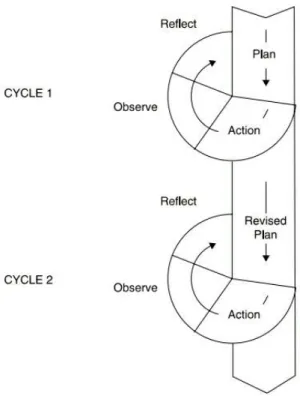
Classroom action research (CAR) has various models but in this research the researcher uses Kemmis and Mc Taggart research design.
According to Kemmis and MC Taggart as cited by Anne Burns action research is dynamic and complementary process which consists of four essential phases such as planning, action, observation, and reflection in spiral system.34These phases can be seen by following figured:
33Zina O‟Leary, The essential guide to doing Research (California: Thousand Oaks, 2004), p.139.
34Anne Burns, Doing Action Reasearch in English Language Teaching, … p.7.
29
Figure 3.1.Cycles in Action Research, Kemmis and Mc Taggart Model35
This figure describes the sequence of the research which is proceeding by planning, following by action, observation, and reflection that implement in each cycle in spiral system. The assumption is if the determine out came in the first cycle cannot be achieve or there may be found new problem, so it was probably be continue and receive in the next cycle that have same phase on the first cycle.
In this case, the researcher was conduct classroom action research in class of the tenth grade of MA Muhammadiyah Metro. The reason of why the researcher was conduct classroom action research is because the
35Ibid, p.9.
researcher was improve the students reading comprehension of the tenth grade of MA Muhammadiyah Metro by using wrap up strategy.
2. The Steps in The Research
They are four steps in cycle. They are planning, action, observation, and reflection, if the first has failed and the cycle must be review again in the second cycle and so on. That can be illustrated by like this procedure as follows:
a. Cycle 1 1) Planning
In this first phase, after analyzing the finding of the preliminary study such as identifying and diagnosing student‟s problem in Reading comprehension that occur in the classroom and concluding the finding in preliminary study. Then the researcher was preparing some plans to conduct the classroom.
They are the following:
a) The researcher prepares the lesson plan including learning procedure, media, and relevant material to be applying in acting phase.
b) The researcher prepares learning resource for students.
The researcher determines the method to be applying in acting phase. In this case, the researcher uses wrap up strategy to improve reading comprehension.
31
c) The researcher prepares observation format and also evaluating format to evaluate the student‟s activity after learning process.
d) The researcher designs the criteria of success.
2) Acting
In the second phase, the researcher collaborates to implement the action that has been arranged in planning phase. This activity is implemented on the following step:
a) Pre Teaching Activity
(1) The researcher starts the lesson by greeting to the students.
(2) The researcher and students pray together.
(3) The researcher checks students‟ attendance.
(4) The researcher informs to the students about the competence, the indicator and the objectives that should be achieve.
b) While Teaching Activity
(1) The researcher divides the students into some group.
(2) The researcher explains the wrap up to the students about how to apply sequences of wrap up strategy in Reading narrative text.
(3) The researcher gives the material and facilities in the form of narrative text.
(4) The researcher affirms student‟s Reading comprehension by checking their understanding.
(5) After the students become more proficient in using this strategy, gradually the researcher transfer the responsibilities to the students to lead the discussion by applying this strategy.
c) Post Teaching Activity
(1) The researcher gives positive feedback to the students.
(2) The researcher and the students conclude the learning topic that has been discussed.
(3) The researcher greets the students in end of the meeting.
3) Observing
In the third phase, the observer observes the student‟
activity, their participations, class situation during learning process, and researcher performance by using structure observation form and made note the overall activities.
Furthermore, the researcher also collects the data from the post test and result of student‟s activity. The researcher observes the overall activities to find out the effectiveness of learning process which have be occurs and the result is concluding and discussing in reflecting phase.
33
4) Reflecting
In the fourth phase, the researcher tries to see and think again something that researcher has done. It also to know whether there is influence to the students‟ learning process. By reflecting, the researcher can get information the strength and the weakness from the action that the researcher has been done.
If the researcher still find the problems, the researcher was conduct the next cycle and use the collected data in cycle one as the reference by repairing all the problems or weaknesses in previous cycle.
b. Cycle 2
1) Re-Planning
In the first phase, when the researcher finds the problem in the first cycle, the researcher was repair the problem in the next cycle. It is explained as a follow:
a) The researcher analyses the reflection result to obtain the solving problem.
b) The researcher revises and prepare the lesson plan based on the problem appear in the previous cycle including learning procedure, media, and relevant material to be apply in acting phase.
c) The researcher rearranges observation format and also reform the evaluation format to improve the plan indicators that have not been achieved yet in the previous cycle.
2) Acting
In the second phase of cycle two, the researcher applies the same steps in previous cycle, but the writer apply the revise plan such as lesson plan, material, and instrument for evaluation. The activities they are:
a) Pre Teaching Activity
(1) The researcher starts the lesson by greeting to the students.
(2) The researcher and students prays together.
(3) The researcher checks student‟s attendance.
(4) The researcher informs to the students about the competence, the indicators and objectives that was be achieved.
b) While Teaching Activity
(1) The researcher divides the students into some group.
(2) The researcher reminds how to apply wrap up strategy.
(3) The researcher gives the material and facilitates the students during the discussion by applying wrap up.
35
(4) The researcher affirms student‟s Reading comprehension by checking their understanding.
(5) After the students become more proficient in using this strategy, gradually the researcher transfers the responsibilities to the students to lead the discussion by applying this strategy.
(6) The researcher gives the evaluation to the students.
c) Post Teaching Activity
(1) The researcher gives positive feedback or reinforcement to the students.
(2) The researcher and students conclude the learning topic that has been discussed.
(3) The researcher greets the students in the end of the meeting.
3) Observing
In the third phase, the observer observes the student‟s activity, their participations, class situation during learning process, and researcher performance by using structure observation form and made note the overall activities.
Furthermore, the researcher also collects the data from the post test and the result of student‟s activity.
4) Reflecting
In the fourth phase, the researcher discusses and analyses about the data that have been collected from all the activities from the acting phase until observing phase to find out whether the implementation of wrap up run successful or unsuccessful in the second cycle and also compare the student‟s improvement from cycle one until cycle to find out the student‟s achievement. If there is find good improvement based on the criteria of success that have determine before, the researcher was not continue the action in next cycle.
E. Data Collecting Technique
The data collecting techniques this research consist of as follows:
1. Test
Tests are valuable measuring instruments for education research. A test is a set of stimuli presented to an individual in order to elicit responses on the basis, which a numeral score can be assigned. The researcher was do the test in order to know the students‟ Reading comprehension of the tenth graders of MA Muhammadiyah Metro.
The test is divided into two parts, as follows:
a. Pre-Test
The pre-test of this research was being done before implementing the strategy of wrap up. The pre-test in the form of
37
reading comprehension test by asking the students to answer the multiple choice question. The total of the question of the pre-test is thirty questions.
b. Post-Test
The post-test was being done after the treatments. After the treatment, the student was having a post-test. The form and procedure of the post-test are the same as pre-test. In this case, the researcher was done the test in order to know the Students‟ Reading Comprehension of the tenth graders of MA Muhammadiyah Metro.
2. Observation
Observation according to John W. Creswell is the process of gathering open-ended, firsthand information by observing people and places at a research site. As a form of data collecting. Advantages include the opportunity to record information as it occurs in a setting, to study actual behavior, and to study individuals who have difficulty verbalizing their ideas.36It means that observation is a data collection strategy in which the activities of subjects are visually examine.
3. Documentation
Documentation may refer to particular individuals, as with school records and reports about pupils, or may concern more „macro‟ issues, as with one of her Majesty‟s Inspectorate reports on the physical state of
36John W. Creswell, Education Research, Planning, Conducting, and Evaluating Quantitative and Qualitative Research, (Boston: Boylston Street, 2012), p.213-214.
schools. It can have a number of features.37 For the example, they may be made up exclusively of written words, or they may include statistics, as in a survey research report. It means that documentation is note of information in the form of documentation.
The documentation was being done to document the following the items:
a. The history of the school
b. Organization structure of the school c. Location of the school
d. The distribution of the teacher in each subject e. The quantity of the students in each class f. The learning facility of the school.
4. Field Note
Field note is the notes you make as you note actions. You can write them into a special notebook, or on the back of your hand, in which case you would write them up later. You can write in straight notes, or try mind maps, spider diagrams and pictures.38 In this research, the researcher was use field note to record the student‟s activity during the learning process.
In this research, the researcher was conduct the field note in order to get the complete data from the tenth graders of MA Muhammadiyah Metro
37Roger Sapsford, Victor Jupp, Data Collection and Analysis Second Edition, (California: Thousand Oaks, 2006), p. 273.
38Jean Mcniff& Jack Whitehead, All you need to know about Action Research,
… p.139
39
about the student activities, events in each learning steps, learning purposes, leaning time, and feelings of the students in the learning process.
F. Instrument of the Research
In instrument research the writer was use the following.39 1. Reading Test Question
To measure students‟narrative text reading comprehension of the tenth grade of MA Muhammadiyah Metro, the researcher was apply some reading tests that consist of pre-test and pos-test. Both of the tests are in form of asking the students to write narrative text based on the pictures that are related on the topics of narrative text.
Table 3.1
The Table of Specification of Reading Test:
Outcomes to Assess Item Types (with item number) Content Standard Objectives Multiple-choice Total Points 1.1. Identify the
meanings in narrative text on the simple written texts.
The students are able to identify the meanings in narrative text on the simple written texts.
Read the text and answer the following
question.
0-100
Source: Silabus Bahasa Inggris X Kurikulum 2013
2. Observation Sheet
In order to observe the learning activity and each cycle, the researcher was use observation sheet. It deals with learning activity such as:
39H Brown Douglas, Language Assessment Principles and Classroom Practices, (California: San Francisco, 2003), p. 267,268.