Monitoring and evaluating the service
12
12.1 Customer satisfaction evaluation
What does ‘satisfaction’ mean? The concept itself is an abstract one. The achievement of satisfaction can be a complex and precarious process. The roles played in the service encounter by service personnel and consumers contribute to this. In the same way that totally satisfied customers are hard to find, the totally dissatisfied customer is also an
Introduction
The greater part of this book has been devoted to the various elements needed for the creation of a quality service. If all these components are in place, then the service provider will be hoping that trialists of the service will become loyalists.
In other words, the organization will be looking to attract customers who will engage with it over some time. In the previous chapter on relationship marketing, we explored strategies that an organization might employ to boost retention and generate loyalty.
Whether a relationship marketing approach is being followed or not, one of the key ways in which an organization will continue to succeed is by monitor- ing and evaluating the service that it currently provides.
On the premise that the service has been designed to satisfy those who consume it, a useful starting point in service evaluation is to monitor customer satisfaction.
Customer complaints are also a useful source of information. The primary aim in understanding complaints is of course to recover the customer. But the information should also be fed back into the service evaluation system to be used strategically to improve future service delivery.
elusive creature. While one should understand the extent of customer satisfaction (i.e. how much customers are satisfied), it is perhaps more important to understand the underlying cause of the satisfaction/dissatisfaction.
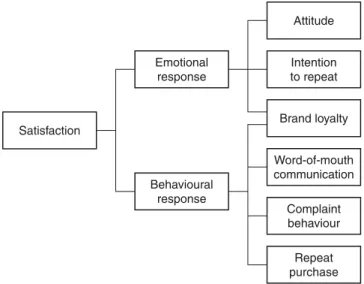
In general, the response to a satisfactory experience will contain both emotional and behavioural elements (Figure 12.1). So customer satisfaction will result in posi- tive emotional states. These, in turn, mediate the response between customer satis- faction and behavioural responses – positive word of mouth, no complaint behaviour and repeat purchase.
12.1.1 What is satisfaction?
The model used to explain the occurrence of satisfaction is known as the expectancy- disconfirmation model (Figure 12.2). It was first proposed by Oliver in 19771and has subsequently been tested in a variety of different industries.
The model suggests that satisfaction is dependent on customers’ expectations, and their perceptions of performance in relation to those expectations. One implication of this model is that to secure satisfaction, management need not (and indeed should not) focus exclusively on improving its performance. Resources should also be devoted to
Word-of-mouth communication Brand loyalty
Intention to repeat Emotional
response
Satisfaction
Behavioural response
Attitude
Complaint behaviour Repeat purchase Figure 12.1 Behavioural and emotional responses to satisfaction
Disconfirmation Expectations
Performance
Satisfaction
Figure 12.2 Expectancy-disconfirmation model of consumer satisfaction
managing customer expectations. As Peters and Austin state: ‘Managing expectations is all about under-promising and over-delivering.’2
12.1.2 Customer expectations
There are five key factors that influence a customer’s expectations: previous experi- ence; personal recommendation; personal needs; marketing communications; and the level of involvement in the purchase (Figure 12.3). Research suggests that the most important of these factors in shaping expectations are the consumer’s past experience of the service and what other people say about it.
Customers tend to complain less about services than products even though they are more likely to be dissatisfied with services. One reason why they do not complain as much comes from the active part that they play in specifying the service. If a trip to the hairdresser results in a bad haircut, who is to say that it is because of the hairdresser’s incompetence? It may be that the client did not communicate clearly enough what he or she wanted.
Prior to using a service, consumers may have in mind four different scenarios of the service that they might experience:
● The ideal
● The anticipated
● The deserved
● The minimum tolerable.
The consumer can expect any of these (Figure 12.4). As we have seen, expectations shape satisfaction. If the ‘minimum tolerable’ is expected then this or anything bet- ter may lead to satisfaction. Equally, anyone expecting the ‘ideal’ will be dissatisfied with anything less.
Past experience
Word of mouth
Personal needs
Involvement Marketing communications
Own brand
Competitor brands
Expectation of performance
Figure 12.3 Antecedents of expectations
Sometimes customers have a view about what they ‘deserve’, even if these are set at a low level. For instance, patients may believe that at the very least they ‘deserve’
to return from surgery alive. (This may also be the minimum tolerable.) If a customer has a strong idea of what he or she deserves, perhaps formed from a guarantee, or previous usage, then expectations will be set at that level. Expectations will be more firmly held and will probably result in greater levels of dissatisfaction if the service fails to deliver.
The ‘deserved’ outcome can also modify expectations downwards, e.g. if a builder is instructed to build a house that must be finished in two months, then the level of workmanship that the customer receives is likely to suffer from corner-cutting as the builder struggles to meet the deadline. If the customer realizes the constraints that they have forced the builder to work to, then their ‘deserved’ outcome should be set at a low level.
What the customer believes he or she deserves may, however, still be lower than his or her ‘anticipated’ or expected outcome. If this arises then the customer will be dissatisfied. He or she may have chosen not to believe what the builder told him or her at the outset about the most likely consequences of the tight schedule, choosing instead to expect the outcome to be better than the picture painted.
Parasuraman, Zeithaml and Berry3define a narrower band for expectations. They describe a ‘zone of tolerance’ between adequate service provision and the desired service provision (Figure 12.5). This zone expands and contracts. It can also remain
As ‘expected shifts’
g reater likelihood of satisf
action
Diminishing lik
elihood of satisf action
Ideal Minimum
tolerable Expected
Deserved
1. The closer ‘expected’ expectations are to the ‘minimum tolerable’ the greater the likelihood of satisfaction.
2. Satisfied customers can appear anywhere on the spectrum. What determines their position is the position of ‘expected’ outcome.
Figure 12.4 Impact of expectations on satisfaction
Adequate Desired
Zone of tolerance
Ideal Minimum
tolerable
Low High
Figure 12.5 Levels of expectations Source:Based on Parasuraman et al. (1990)3
12.1.4 Service fairness
Recently the concept of service ‘fairness’ has been proposed as a determinant of cus- tomer satisfaction.8Fairness can be broken down into three components – outcome fairness, which is the quality of the core service offering; procedural fairness, which is concerned with service delivery, i.e. whether it was timely; and interactionalfair- ness, which is concerned with the customer’s relationships with the service deliv- erer. Each of these has been found to contribute independently to satisfaction. But it is outcome fairness that is the most critical in understanding a customer’s satisfac- tion response, whereas it is in the areas of process and procedural fairness that the service provider can more easily exceed customers’ expectations.9
12.1.5 Measuring satisfaction
A variety of research mechanisms can be deployed to measure customer satisfaction.
One valuable piece of research would be a study that segmented service attributes into satisfiers, dissatisfiers and criticals.10In measuring this, the service provider would gain a clearer understanding of how to allocate operational resources to deliver satisfaction.
Table 12.1 Factors needed for satisfied employees, listed in order of importance Supervisor support
Team support
Other departments support Effectiveness of the technology Organizational commitment Source: Sergeant (2000)7
unchanged in magnitude, while moving up or down the spectrum. It varies according to the service and to the individual customer. More recently, it has been shown that expectations and the zone of tolerance can fluctuate during service consumption.4,5 Further, satisfaction with individual encounters will affect satisfaction with the over- all experience.6Consequently, operations managers have an important role in man- aging expectations during service delivery. It is particularly important to manage this satisfactorily at early stages in the process since these encounters have been shown to influence customers’ thresholds of tolerance at a later stage in service delivery.
12.1.3 Employee satisfaction
Of course in many service organizations employees play a customer-facing role and their behaviour is a key determinant of customer satisfaction. These employees in turn need to be satisfied. Research has highlighted the variables that are important in determining employee satisfaction7(see Table 12.1).
Satisfiers are those elements of service delivery which, when performed beyond what the consumer considers adequate, have a positive impact on perceptions. Yet when they are neither in evidence nor well performed, they do not depress percep- tions of service quality. These are often elements of service delivery that the cus- tomer does not expect. For example, regular users of a particular car hire company may consider performance beyond the adequate if the next time they ring to book a car the receptionist remembers their individual preference for car model, collection and delivery details, etc. However, if none of this happens, it will not result in customers having lower perceptions of service quality.
Dissatisfiers are those elements of service delivery which when performed at a level below that which the consumer believes to be adequate will result in dissatis- faction. But any performance above that level that the consumer considers to be adequate, will have little impact on perceptions of service quality. So, to continue with our example of car hire, if the customer has arranged for the car to be at his or her office at 5 pm, and the car is delivered at 7 pm, then this is likely to result in dis- satisfaction. If, on the other hand, the car is delivered at 3 pm, this is not likely to raise perceptions of service quality if the customer is in no position to use the car before 5 pm.
Criticals are those factors that can act as both satisfiers and dissatisfiers. Good per- formance on these factors can improve perceptions of service quality, and con- versely, poor performance can detract from it. So, for example, if empathy is a critical factor, then polite service may raise perceptions of service quality and impolite service may depress them.
A common technique used to measure satisfaction is a quantitative satisfaction survey based on multi-attribute attitude analyses.
12.1.6 Satisfaction survey
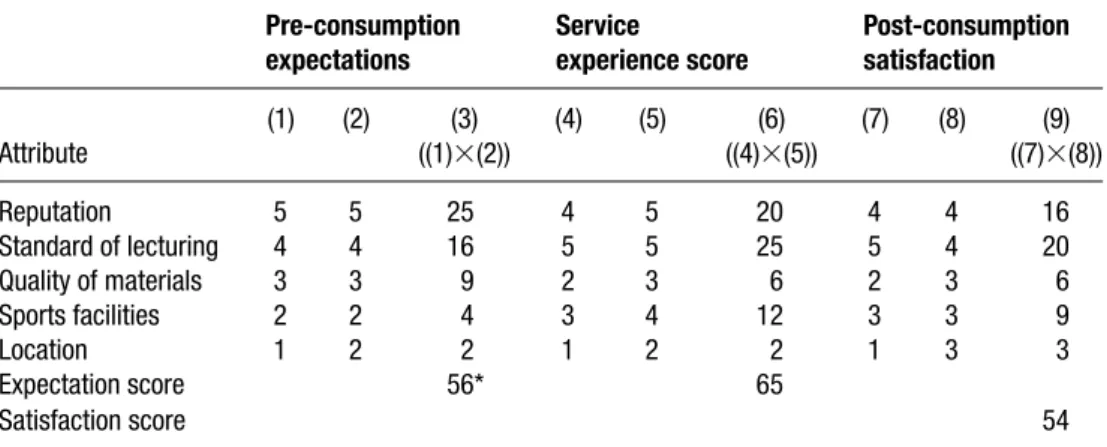
Suppose that MBA students as they join a Masters course are asked to describe the factors that influenced their choice of educational establishment. Their list would probably contain the dimensions in the left-hand column of Table 12.2.
Table 12.2 A multi-attribute expectation/satisfaction matrix
Pre-consumption Service Post-consumption
expectations experience score satisfaction
(1) (2) (3) (4) (5) (6) (7) (8) (9)
Attribute ((1)⫻(2)) ((4)⫻(5)) ((7)⫻(8))
Reputation 5 5 25 4 5 20 4 4 16
Standard of lecturing 4 4 16 5 5 25 5 4 20
Quality of materials 3 3 9 2 3 6 2 3 6
Sports facilities 2 2 4 3 4 12 3 3 9
Location 1 2 2 1 2 2 1 3 3
Expectation score 56* 65
Satisfaction score 54
* Maximum possible score ⫽75 (where the individual gives each attribute in column 2 a score of 5)
They are then asked to rank the list of attributes:
Most important⫽5 Least important⫽1
This is shown for a hypothetical student in column 1, Table 12.2. (Note that if the list had contained eight attributes and not five, then the scale would have been: Most important⫽8, Least important⫽1 and so on.)
Finally, they are asked to state the degree of importance that each holds for them.
Using, for example, the following scale:
Very important 5
Fairly important 4
Neither important or unimportant 3
Fairly unimportant 2
Very unimportant 1
These scores are in column 2 in Table 12.2.
The validity of using an importance scale has been called into question because of the ambiguity and somewhat imprecise meaning of the word. Wilkie and Pessemier11 and Oliver12suggest instead that each attribute should be measured on the semantic differential that suits the word best, e.g. good–bad, attractive–unattractive. This may be true for academic works; however, if different attributes have different scales the questionnaire becomes more complex and difficult to administer. The choice between the two methods should be based on the depth of diagnostic information required from the survey.
In this case the student had an Expectation score of 56 out of a possible score of 75.
This maximum would occur where the student had given an importance rating of 5 to each of the variables.
The same two questions are asked at the end of the MBA course to give a Revised expectation score or a Service experience score (columns 4 and 5). In situations where the service takes some time to consume, this revised score must be calculated since experience of the service will often change what it takes to make the customer satis- fied. In this case the student took up sport during the course and so its importance increased and its ranked position rose. Notice that his expectations have now been revised upwards to 65.
Finally, to compute a satisfaction score, the following two questions are asked of the same list of attributes:
Q1 A ranking of the attributes (column 7, Table 12.2):
Most important⫽5 Least important⫽1
Q2 How did the service perform against expectations (column 8, Table 12.2)?
A lot better than expected 5 A little better than expected 4
Just as expected 3
A little worse than expected 2 A lot worse than expected 1
Models have been developed where the respondents have instead been asked to dis- cuss their degree of satisfaction. As in the following scale:
Q3 The degree of satisfaction.
Very satisfied 5
Fairly satisfied 4
Neither satisfied nor dissatisfied 3
Fairly dissatisfied 2
Very dissatisfied 1
Many writers prefer the earlier scale. This is because, on the one hand, this scale has been shown to be independent of the level of expectations, and at the same time to be highly correlated with satisfaction.13However, in many senses it is more import- ant that the service results in satisfaction than that it lives up to expectations. Indeed the earlier scale tends to ignore the possibility of expectations being revised during the service process.
The satisfaction score for this student is 54. He is therefore dissatisfied. To achieve satisfaction the score has to be equal to, or greater than, the expectation score.
However, the validity of this somewhat blunt approach to the measurement of satisfaction has recently been questioned. We have previously discussed the relevance of measuring expectations in the context of services. Furthermore, concentrating solely on outcome satisfaction and failing to measure satisfaction during the process of con- sumption may result in inaccurate readings of customers’ attitudes.14This is particu- larly true if you believe that after consumption cognitive dissonance will be evident.
Finally, the usefulness of the information provided by these satisfaction studies has also been questioned. What is the meaning of any recorded difference between Expectations and Performance? What is the difference between 80% of your cus- tomers being ‘very satisfied’ and 70% of them being ‘very satisfied’? These surveys cannot say, for example, how much more likely a ‘satisfied’ customer is to switch than a ‘very satisfied’ customer. So in quantitative studies companies are simultan- eously recording high satisfaction ratings and declining loyalty15and high switching behaviour among satisfied customers.16
In an attempt to provide more powerful satisfaction data, it has been suggested that emotional responses to the service performance and the quality of the satisfac- tion should also be captured.17,18
12.2 Customer complaints
12.2.1 Dissatisfied customers: what do they do?
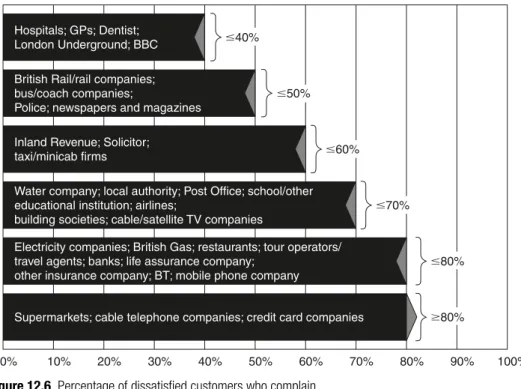
Until fairly recently there was a general perception that customers unhappy with a service were less likely to complain than when they were unhappy with a product.19 But recent research suggests that whereas for FMCG products complaints are made by only 4% of those who are unhappy with the product, this rises to 50% with con- sumer services and an astonishing 75% in business-to-business services.20Within the services sector, dissatisfied consumers complain in varying proportions. The cost of
However, dissatisfied customers are not likely to keep the bad news to them- selves. At the same time as deciding not to buy the service again they are probably spreading the bad news.
Customer complaints are actually helpful to the organization for several reasons.
First, they give the organization a chance to recover its original customer. Indeed, there is some evidence to suggest that customers whose complaints lead to a suc- cessful recovery of the service experience end up more satisfied than those cus- tomers who found the initial service encounter satisfactory. It also diminishes the risk of bad publicity, either from personal word-of-mouth communication or in more damaging leaks through the press to the general public, and it provides infor- mation that should be useful for development of the service.
Historically, companies have shied away from the whole issue of customer com- plaints, preferring instead to devote resources to generating business. Retaining business through service recovery is still not widespread. However, while we would suggest that the handling of complaints should be resourced, it has been shown that even those customers who had their complaints satisfactorily resolved were more likely to switch service provider than those who had not been dissatisfied in the first place.23Perhaps this is because it is estimated that more than 50% of those who do com- plain feel worse about their services delivery experience after they have complained.24
0% 10% 20% 30% 40% 50% 60% 70% 80% 90% 100%
Hospitals; GPs; Dentist;
London Underground; BBC British Rail/rail companies;
bus/coach companies;
Police; newspapers and magazines Inland Revenue; Solicitor;
taxi/minicab firms
Water company; local authority; Post Office; school/other educational institution; airlines;
building societies; cable/satellite TV companies
Electricity companies; British Gas; restaurants; tour operators/
travel agents; banks; life assurance company;
other insurance company; BT; mobile phone company
Supermarkets; cable telephone companies; credit card companies ⱕ40%
ⱕ50%
ⱕ60%
ⱕ70%
ⱕ80%
ⱖ80%
Figure 12.6 Percentage of dissatisfied customers who complain Source:Consumers’ Association (1998)22
the service and the extent of the social involvement have been shown to be posi- tively correlated with complaining behaviour.21Over 80% of dissatisfied consumers complain to supermarkets, credit card and cable companies, whereas, just over 30%
complain to their GP or dentist (Figure 12.6).
12.2.2 Who complains?
Research has shown that those consumers who do complain about the service they receive tend to be the loyal users of the service. In terms of numbers, they represent only a tiny fraction of the total number of dissatisfied customers. Bell and Zemke25 estimate that only 4% complain, and Dube and Maute26estimate that between 5 and 10% of dissatisfied customers complain.
A great deal of research has been carried out to establish the characteristics of those who complain. Zemke and Bell27and Warland, Hermann and Willits28found them to be predominantly young women, who were intellectually, socially and eco- nomically upmarket. Perhaps they complain more because they are less daunted by confrontation. Perhaps it is because their expectations are higher than for many other groups of consumers. There is certainly evidence to support this latter view.
Studies have found that these consumers are the ones most likely to be unhappy about the performance of the services that they purchase.29,30
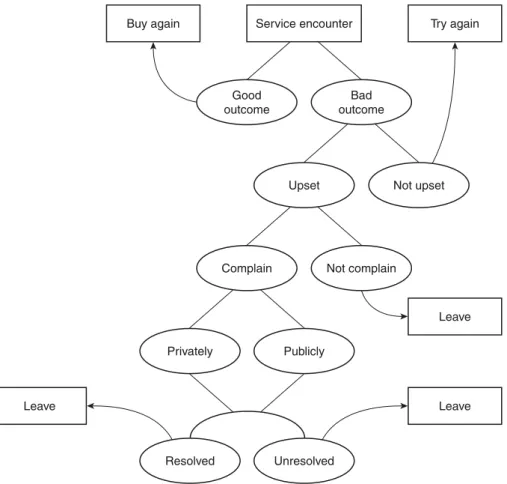
Of the three possible outcomes of poor service delivery (illustrated in Figure 12.7) – not upset, upset/complain and upset/no complaint – it has been found that the two groups that were furthest apart demographically were the upset/complain and the
Leave Leave Try again Service encounter
Buy again
Leave
Upset
Complain
Privately Publicly
Not complain Not upset Good
outcome
Bad outcome
Resolved Unresolved
Figure 12.7 Means by which the dissatisfied customer can tackle the issue
upset/no complaint. Those that were not upset tended to be the older, more conserva- tive members of society.31
12.2.3 To whom do they complain?
Complain to the service provider
There are a number of options open to the customer who decides to complain (Table 12.3). He or she can go back to the company and complain to them. This is, in fact, the most likely first course of action. Best and Andreasen,32found that, on the whole, sellers have a virtual monopoly on complaints handling. The company imposes its own standards, sets the resolutions and decides on any level of compensation.
The unhappy customer can complain in private, e.g. by writing a letter of com- plaint, or in public, e.g. by creating a scene on the premises.33The public complaint is most feared by those companies that do not provide a good service in the first place, or do not have a good complaints handling procedure. Customers sometimes choose to air their grievances publicly in the belief that they are more likely to have them satisfactorily resolved by behaving in this manner in front of other customers.
Successful resolution of complaints by the company also reduces the risk of attract- ing the attention of the legislature or even the voluntary consumer watchdog. The vociferously negative comments of the London Evening Standard’s commuter watch- dog no doubt played a part in the establishment of the Passenger’s Charter. Had there been no cause for complaint there would have been no watchdog. Had there been no watchdog there would have been less incentive to change.
Complain to a consumer watchdog
So instead of approaching the offending company, the consumer can take a complaint to an organization that has been set up to protect or promote consumers’ interests.
Some of these organizations deal with all kinds of problems and enquiries, e.g. the Citizens Advice Bureau, which receives public funding, and the Consumers’
Association, which has no grants or subsidies from government or industry. There are also industry-specific bodies, e.g. OFGAS for the gas industry, OFFER for the electri- city industry, or Greenpeace for the environment. The first two were set up when these industries were privatized. They were given statutory powers to protect consumers’
interests. The smaller ones rely on voluntary help and fund-raising for their existence.
If these organizations cannot resolve the complaint by conciliation then, in some cases, the aggrieved customer can seek redress through arbitration.
Table 12.3 What the dissatisfied customer can do Complain to seller
Write or phone manufacturer Write or phone the head office Write or phone trade association Contact Trading Standards Officer Consult Citizens Advice Bureau Consult a solicitor
Write or phone Office of Fair Trading
Take legal action
If dissatisfied consumers find no joy through any of the above channels they must then resort to the final method of redress and take legal action.
In England, Wales and Northern Ireland, theSupply of Goods and Services Act 1982requires a supplier of a service acting in the course of business to carry out that service:
● with reasonable care and skill
● in a reasonable time (if there is no specific time agreed) and
● for a reasonable charge (if no fixed price was set in advance).
Any goods or parts fitted as part of the contract must be:
● of satisfactory quality
● fit for their purpose and
● as described.
These terms apply unless they have been excluded or varied in the contract govern- ing the supply of services, in which case there are strict limits on the circumstances in which, and the extent to which, an exclusion or variation will be effective (the Unfair Contract Terms Act 1977 [the Consumers’ Association believes that it was as a result of their campaigning that this act was passed]34and the Unfair Terms in Consumer Contracts Regulations 1999).
Whilst the 1982 Act is not applicable in Scotland, Scots common law imposes simi- lar standards of care.
In addition to this basic premise, there are a number of (predominantly consumer- focused) rules, regulations and watchdogs ready to champion the consumer’s cause.
For example, financial services (theFinancial Services and Markets Act 2000), banking (theMortgage Code and others) and law (Professional Ethics and The Law Society) are all tightly regulated.
Remedies
Cancellation:If a supplier of a service materially breaches the conditions of a con- tract (for example by completely failing to carry out the work ordered) the consumer is likely to have a choice either to affirm the contract (i.e., treat it as still in existence) and claim compensation from the trader for failure to carry out what was agreed or rescind (i.e., cancel) the contract. However, unlike buying goods, it is not as easy for a consumer to reject the whole job and ask for all their money back unless they can show that the workmanship was so poor they got no benefit from it at all.
Work not done on time: When work is not completed on time or within a reasonable time, the consumer may write to the trader to make time ‘of the essence of the con- tract’. This means that the consumer has set a specific date for the work to be fin- ished, after which he or she will consider the trader to be in breach of contract and will be free to get other estimates, have the work completed by another trader, and hold the original company responsible for the costs. The consumer may have to go to court as a last resort to recover these costs. The consumer may also be entitled to compensation for the delay if it has caused him or her a lot of inconvenience, for example in taking extended periods off work to wait in for contractors.
Work not satisfactory: It is usually considered reasonable to give the trader a chance to put things right, and it is worth bearing in mind that the amount of compensation the consumer can claim for shoddy work could be affected if he or she unreasonably refuses to allow the trader an opportunity to make amends. Accordingly, the consumer should (i) inform the trader what he or she is not happy with straight away, and con- firm it in writing with a list of the specific problems to be sorted out, and (ii) set a deadline for this work to be done, and give notice that after this time he or she will have no alternative but to get quotes from another contractor and consider suing in County Court for the remedial costs.
Unauthorized work: If the consumer has agreed certain work and the trader goes ahead with additional work without authorization, the consumer does not have to pay for the extra work. However, more practical solutions may be to:
● Accept the need for extra work and pay if it seems reasonable
● Ask the trader to undo the work
● Negotiate a price for the work taking into account the fact it was unauthorized
● In some circumstances, if the trader refuses to release the goods – e.g. the car he or she has done repairs to – the consumer may have to pay under protest and take legal action for compensation.
Withholding payment:If the consumer is not happy with work, he or she may want to consider withholding some of the payment until the work has been completed to his or her satisfaction. In these circumstances the consumer must tell the trader what he or she is doing and why. In the absence of any contractual right to withhold pay- ment the trader may consider this to be a breach of contract by the consumer.
Ultimately it will be for the courts to decide whether or not a breach of contract has occurred and the redress, in the form of damages (compensation) or otherwise, to which a consumer might be entitled.
A claim can generally be pursued though the courts for up to six years after the services have been rendered, providing it can be shown that the problem was due to the work not being carried out properly or the goods or materials used not being of satisfactory quality.
12.2.4 Why do they complain?
Consumers complain because they are dissatisfied. They are dissatisfied because their expectations are not met, and obviously the higher their prepurchase expect- ations, the more likely they are to be dissatisfied. This is why a key role for commu- nications in service marketing is the management of expectations. To understand more fully why they complain, we have to examine the reasons why their expect- ations may be unfulfilled.
Miscommunication on a customer’s part is only one reason why expectations may not be fulfilled (Figure 12.8). Some of these factors are within the control of the service provider, some are not. It is certainly up to the provider to reduce the likelihood of mis- communication or misinterpretation by making the service clearly understood. It is also the responsibility of the company to ensure both that it clearly understands a client’s instructions, and that the client clearly understands what will be delivered.
Service providers should take the lead in designing initiatives to reduce these problems.
However, it is not only prepurchase expectations that condition whether or not a complaint is made. It is also the expectation of the likely outcome from complaining.
If consumers expect to achieve something by complaining then they are much more likely to complain. Some psychologists would go even further, by suggesting that even if there is no possibility of rectifying the situation, it is still best to express anger, in order to accept the dissatisfaction.35Indeed, recent research has suggested that anger is the dominant emotional response to poor service and that this (as opposed to dissatisfaction) is the major determining factor in terms of a consumer’s propen- sity to complain/repurchase.36
The average consumer would probably not take this advice too seriously, no mat- ter how beneficial it may be to them psychologically. They are much more likely to weigh up all the costs and benefits associated with complaining. Their emotional well-being will be only one factor. If they perceive the benefits to outweigh the costs then they will complain. Table 12.4 lists the factors that help fashion the costs and benefits of complaining.
Miscommunication of service provision by competitors Customer
miscommunicates service required
Expectations unfulfilled Customer
misinterprets signals (price, positioning, etc.)
Word-of-mouth miscommunication
Poor staff performance
Figure 12.8 Major causes of unfulfilled expectations
Table 12.4 The costs and benefits of complaining
Costs Inconvenience Special trip to complain Form-filling, letter writing
Forgo service during complaint process Uncertainty Difficulty finding correct complaint procedure
No indication of the action that will be taken Unpleasant Treated rudely, have to hassle
Feel guilty, embarrassed
Benefits Emotional Chance to assert rights, chance to vent anger, receive an apology Functional Refund, replacement, repair
Altruistic Other customers prevented from experiencing dissatisfaction Would feel guilty about not complaining
Product improvement Organization would improve its offering Source: Based on Richins (1990)36
12.2.5 What do they complain about?
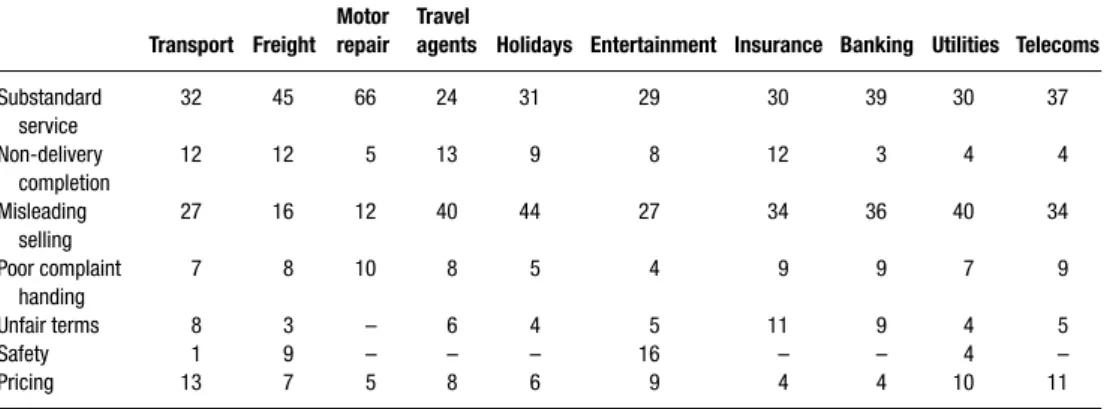
Customers complain about different problems in different industries (Table 12.5). In banking, account errors are the biggest source of complaints, whereas in air travel, can- cellations and flight delays generate the most complaints. Even within an industry, there will be varying weaknesses from different service companies. Each operator should have an understanding of its own weaknesses, and those of their main competitors.
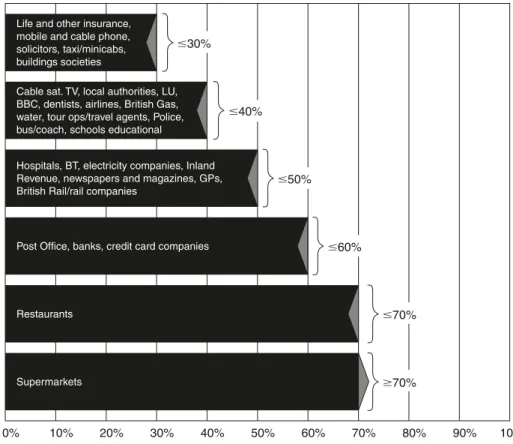
Once again, some service sectors appear to be better than others at handling cus- tomer complaints. So although supermarkets received the highest proportion of complaints, they were also the best at satisfactorily resolving them. However, the picture for life and other insurance companies is not as positive, with less than 30%
of complainants being satisfied with how their complaint was handled (Figure 12.9).
One of the main reasons for this is that nearly all problems that occur with products can be openly demonstrated and discussed. If a car does not start, it does not start. If a vacuum cleaner fails to clean carpets then this too can be demonstrated. Whereas, who is actually to blame for problems that arise in the consumption of services, where what constitutes satisfactory is often open to judgement and debate. Even where the com- plaint is justified, service providers may still feel that their own position is also quite defensible. This often relates to verbal and non-verbal signals from the consumer that the service provider attempts to interpret. Communication is a transactional process.
Imagine a company rings a courier in a panic. It desperately needs to get a docu- ment to Paris the following day. The courier goes to extraordinary lengths to see that it gets there, and this results in some extra costs. When the company receives the invoice it is outraged by the price. The service provider misinterpreted the signals about urgency from the company.
A large party in a restaurant spends a long time deciding what they want to eat, apparently preferring to chat with fellow diners. They do not appear to be in any hurry, or to want an attentive waiting staff. When the bill arrives they leave no tip, say- ing that they were disappointed with the time that they spent waiting for their food.
These are two examples of service scenarios where the service provider would feel that the complaint was unjustified. However, the customer would feel that the service provider was to blame for having misjudged the customers’ requirements.
Table 12.5 Major sources of complaining
Motor Travel
Transport Freight repair agents Holidays Entertainment Insurance Banking Utilities Telecoms
Substandard 32 45 66 24 31 29 30 39 30 37
service
Non-delivery 12 12 5 13 9 8 12 3 4 4
completion
Misleading 27 16 12 40 44 27 34 36 40 34
selling
Poor complaint 7 8 10 8 5 4 9 9 7 9
handing
Unfair terms 8 3 – 6 4 5 11 9 4 5
Safety 1 9 – – – 16 – – 4 –
Pricing 13 7 5 8 6 9 4 4 10 11
Source: Biswell (2004)37
12.3 Service recovery
Successful complaints handling is one strategy for what has come to be known today as service recovery.38 This is where the organization treats dissatisfied customers in such a way that they leave the service experience feeling positively disposed towards the service provider and willing to engage with the organization in future transactions. Service recovery can take place where the service provider operates a comprehensive guarantee. It also occurs where the organization that is not working to any specified guarantee meets or exceeds the expectations of the complaining cus- tomer in the way in which it handles a complaint.
The distinguishing characteristics of services mean that it is often more difficult to recover an unsatisfactory experience. Simultaneity of production and consumption means that it is not always possible to undo or re-do the service. Consider a poor concert performance, or a disappointing swimming lesson. The heterogeneous nature of many services means that some failure is inevitable. However, the high level of customer involvement, whilst sometimes contributing to service mistakes, can also present good opportunities for service recovery. The findings of research have sug- gested that employee behaviour (as opposed to problems caused by faulty systems or policies) is one of the most difficult types of failure to recover from.39
0% 10% 20% 30% 40% 50% 60% 70% 80% 90% 100%
Life and other insurance, mobile and cable phone, solicitors, taxi/minicabs, buildings societies
Cable sat. TV, local authorities, LU, BBC, dentists, airlines, British Gas, water, tour ops/travel agents, Police, bus/coach, schools educational
Hospitals, BT, electricity companies, Inland Revenue, newspapers and magazines, GPs, British Rail/rail companies
Post Office, banks, credit card companies
Restaurants
Supermarkets
ⱕ30%
ⱕ40%
ⱕ50%
ⱕ60%
ⱕ70%
ⱖ70%
Figure 12.9 Percentage of complaints satisfactorily resolved Source: Consumers’ Association22
In addition to recovering specific service failures, a strategic recovery system should be built into the service process because:40
● Failure in one area can often precipitate service breakdown in other areas
● Unattended failures tend to recur
● Failures tend to decrease customer confidence
● Recovery tends to have a positive halo effect.
There are two basic parts to any such service recovery system. The first is the trans- actional element that relates to the recovery of the specific experience. The second is the way in which information from this complaint is used by the organization (see later section in this chapter on effective complaint handling).
Note, however, that efforts to recover potential defectors should not be treated uni- formly. Organizations should base their offers on the potential profitability of individual customers (see discussion on customer segmentation and profitability in Chapter 11).41
The severity of the service failure conditions both the strength of the negative reaction and the customer’s expectation for service recovery.42Dissatisfaction with the service can also become more intense if the complainant does not feel that the complaint is being handled appropriately. This individual is already in an irritable frame of mind and therefore staff need to be trained to handle the situation sensi- tively. Ideally, these employees should be empowered to take decisions about the best course of action. However, many companies find this an uncomfortable sug- gestion believing that the employee will always err on the side of the customer, and perhaps be over-generous with any compensation. Other companies take a more progressive view, as Jan Carlzon CEO of SAS said:
What’s the danger of giving away too much? Are you worried about an over- satisfied customer? That’s not much of a worry. You can forget about an over- satisfied customer, but an unsatisfied customer is one of the most expensive problems you can have ... the danger is not that employees will give away too much. It’s that they won’t give away anything because they don’t dare.43
If the empowerment of front-line employees is not possible, then senior management themselves must be prepared to play an active part in the resolution of complaints.
Top management involvement usually goes down well with customers, because customers like to deal with those who have the power and confidence to act on their behalf. They should be called in at the slightest hint that the customer might be dissatisfied with the way a complaint is being handled.
A recent empirical study suggests that from the complainant’s viewpoint the most important aspect of service recovery is for the organization to accept responsibility for the problem (even if in approximately one-third of complaints, the customer is in fact responsible). The empowerment of front-line staff to resolve complaints was the next most important factor. Receiving an apology was the least impressive recovery strategy. A personal apology either face to face or by telephone was preferred to that of a written one.44
The same study also found evidence to suggest that the way an organization recovers is situation-specific. So, however well it has performed in the past, and consequently has satisfied the customer, none of this will have any bearing on a customer’s satisfaction with service recovery procedures.
12.4 Effective complaint-handling procedures
Companies that take a pragmatic view will accept that they can make mistakes.
They will recognize that customers will occasionally have a better idea of the way that the service should be delivered. Indeed a dearth of complaints is more often a danger signal than a cause for celebration. It is to the organization’s advantage to encourage customers to air their views, and it should set up a complaint-handling procedure that does just that. As the President of world-wide quality at American Express says, ‘the formula that I use is: better complaint handling equals higher customer satisfaction, equals higher brand loyalty, equals higher profitability’.45
When designing a complaint-handling system, it can often be difficult to strike the right balance between making the system easily accessible, and making it too access- ible. The organization wants to encourage users to make justifiable complaints, but it is counterproductive to set up a complaints procedure that creates the impression that the organization is expecting lots of complaints. This usually means that the service provider does not believe that it is offering a good service. Customers will very quickly pick this up, and begin to start looking for problems. It would be much more productive to provide a better service in the first place.
Historically, dealing with customer complaints was considered a second-rate occu- pation for marketing professionals. It was much more stimulating and glamorous to be developing new products and advertising campaigns. Customer complaint- handling was regarded as a maintenance function and a cost centre to the business.
Fortunately nowadays, many companies take a more enlightened view. They incorporate complaints handling into their strategic mix, and call it Customer Ser- vice or Customer Care. Until the late 1990s it was common practice in those com- panies to staff these operations with marketing personnel, thereby allowing them to experience first-hand the voices of consumers. There is an old management saying,
‘If you’re going to be a general, you have to remember what its like to be a private.’
The organization benefits in several ways by staffing customer service with these employees. It raises the profile of the department in the company. It makes a state- ment to all employees about the importance that the company attaches to the reso- lution of complaints. In doing so, it communicates the significance of providing a quality service, and finally, it generally also leads to improvements in the way that complaints are handled. Employees charged with complaint-handling will often make suggestions about the powers they need to do the job well, and ways in which the department could be run more effectively. However, more recently there has been a trend towards outsourcing this function to call centres.
12.4.1 The benefits of effective complaint-handling
Companies that devote resources to an effective complaints procedure benefit in many ways:
● They are given a second chance to make good their relationship with a dissatisfied customer.
● Adverse word-of-mouth publicity is avoided.
● They will understand what would improve their current service.
● They will know where their operations problems lie.
● Employees may be motivated to provide a better-quality service.
To make the best use of a customer service department it is not enough to deal expe- diently with each complaint as it is received. Naturally, this is all that the aggrieved customer is interested in. Initially, it should also be what interests the company most.
There are many examples of companies who have gone to extraordinary lengths to try to please a dissatisfied customer: most of them are American. As a nation, the United States seems to be more clued up to the benefits of dealing with complaints effectively. Americans can be less reticent about going ‘over the top’ in an overt attempt to keep a customer.
However, in addition to dealing with complaints, the company should also attempt to learn from its mistakes. It does this by putting in place management infor- mation systems that enable customer service staff to record every complaint that is made and then to report these complaints (Figure 12.10). Management must be able to identify the cause of complaints if it is to aid the development of the service. For example, it has been estimated that British banks spend more than twice what they
Compile
Strategic analysis of complaints
Management information systems
Inform complainant
Complete Complaint record, nature of complaint, action taken, etc.
Circulate to management, unions,
quality circles, etc.
Develop ways of incorporating
complaints data
Pass
to appropriate department, organization
Check that remedy is provided
Solve Order remedial action
Investigate Acknowledge Explain how it will be dealt with
Complaint
Unable to solve
Policy making process Figure 12.10 Effective complaints-handling process
ought to in order to operate their service. This is because their procedures are so error-prone that they continually lose documents and waste precious time and money tracking them down, or regenerating them. This problem came to light because customer complaints were monitored. Knowing the source of the problem, all they need to do is deal with it. As Einstein said, ‘The formulation of a problem is far more essential than a solution’.46
The success of a complaint management process can also be examined by checking complaining data against satisfaction and retention. This is illustrated in Figure 12.11 using data adapted from a survey of hotel guests.47The first diagram shows an orga- nization’s complaint resolution performance. In this case, 25% of customers have a problem with the service. Only half of those report the problem, and of those that do, 30% remain unresolved.
No problem
(75%)
Report problem
(50%)
Don’t report (50%) Have problem
(25%) All guests (100%)
Problem resolved (70%)
Not resolved
(30%) (a)
No problem (95% A⫹B)
Report problem
Don’t report (75% A⫹B) Have problem All guests
Problem resolved (90% A⫹B)
Not resolved (50% A⫹B) (b)
No problem (95%
repurchase intention)
Report problem
Don’t report (80%
repurchase intention) Have problem All guests
Problem resolved (90% repurchase
intention)
Not resolved (60% repurchase
intention) (c)
Note: Where A and B represent the top two boxes on a 5-point customer satisfaction scale, the data shows, for example, that 95% of
‘no problem’ guests say they are ‘very satisfied’
or ‘satisfied’ & 50% of the ‘problem not resolved’
guests say they are ‘very satisfied’.
Figure 12.11 Problem impact tree Source:Rust et al. (1995)47
The Problem Impact Tree shown in Figure 12.11(b) displays satisfaction data from the same customers. The letters A and B represent the top two points on a five-point satisfaction rating scale. Among customers with a problem, satisfaction falls from 90% for those whose problem is resolved to 50% for those whose problem remains unresolved. In this case, satisfaction in the ‘problem resolved’ category is almost as high as for those in the ‘no problem’ category.
Customers who do not report a problem also end up with relatively low levels of satisfaction (75%). But they are not as low as those whose complaints remain unresolved (50%).
Complaint management also affects customer retention. Once again, Figure 12.11 illustrates the serious implications of not resolving complaints satisfactorily. If retention data is not available, then ‘intention to repeat’ survey data can be used.
Combining satisfaction and retention data with complaint management information enables management to calculate the value of guiding the customer down different branches of the Problem Impact Tree. This will help the organization maximize its resources to greatest effect.
12.5 Guarantees
12.5.1 The provision of guarantees
The function of the guarantee is that it reduces risk to consumers both before and after purchase. It also conveys a powerful marketing message and helps to shape cus- tomers’ expectations of a quality service. In reducing risk, the guarantee often dimin- ishes much of the ambiguity often associated with service provision. However, ambiguity often arises from the intangible nature of the service, and the more intan- gible the service, the more difficult it is to provide guarantees (Figure 12.12).
For example, it is easy for a cobbler to guarantee to repair shoes in 24 hours or to provide the service free of charge. The smart cobbler should rarely find himself working for nothing. If he expects to turn round all shoes in a 24-hour period, then once he has taken on all that he can manage in this time, he can just refuse to accept any more under the conditions of the guarantee.
The more tangible the service
The less ambiguous the service provision
Easier to set performance indicators
Easier to provide guarantees
Figure 12.12 Tangibility and the provision of guarantees
It is more difficult for a tutor to guarantee the results of her students. There are many intangible aspects of such a service, and not all of these are under the control of the tutor. This is not to say that those responsible for providing services with some intan- gibility should not provide guarantees. Indeed, guarantees have been developed for services as intangible as education, and driving instruction.48In both cases, free add- itional instruction was offered to those who did not successfully complete their course.
However, too often those who provide the more intangible services shelter behind the shield of difficulty when it comes to the provision of guarantees. Note that offering guarantees against service failure is not nearly as powerful as guaranteeing customer satisfaction.49
Many companies operating in competitive markets use guarantees as a positioning tool. They use it as a means of differentiating themselves from the competition, e.g.
when Thomson Holidays first offered ‘No surcharges guaranteed’ it was the first tour operator to do this. However, the uniqueness of this benefit was short-lived. Like so many service developments, it was easily copied. Note also that this particular guaran- tee only applied to one aspect of the service.
Sometimes companies adopt a more all-embracing approach. Instead of providing a specific guarantee, they guarantee total customer satisfaction. We can probably all think of services that provide ‘satisfaction guaranteed’. Whether or not we believe them is another matter. Many such companies attach no meaning to these state- ments, using them merely as a form of words intended to convey a quality service.
But if they do, then as we have already stated this type of guarantee is more power- ful than one guarding more specifically against service failure.
12.5.2 Designing a guarantee
Guarantees can be either explicit or implicit. The latter are earned by the service provider and are not created overnight. Such guarantees are often held by up-market hotels and restaurants.
There are several factors/questions that an organization should consider when deciding whether or not to offer a guarantee:50
● Can the company afford to offer one? This in turn is related to …
● The company’s quality and performance standards: if these are relatively low, there may be significant costs associated with offering a guarantee.
● What are the risk perceptions associated with offering one?
● Do competitors offer one? If so is it against what kind of factor?
● Should it be unconditional, or against a specific aspect of the service?
● Will it be a monetary or non-monetary response?
● What is the hassle-free process by which customer can invoke the guarantee?
The all-embracing guarantee of the sort described earlier is in fact not the best type of guarantee that a company can offer. The best guarantees meet the criteria sum- marized in Table 12.6.
Easy to understand
The guarantee should be as short and simple as possible. It should be written in clear, plain English to help prevent any ambiguity from creeping in. The ideal is to
think of an advertising endline; normally only one sentence in length, and with the intention of being highly memorable.
Easy to invoke
Companies are often fearful of making guarantees easy to invoke because they are frightened of the potential cost. They can see the benefits of offering guarantees to con- sumers, but cannot see what benefits are to be gained by making them easy to invoke.
Unconditional
For the same reasons that it is important to make it easy for dissatisfied customers to complain, it is best to make the guarantee as unconditional as possible. This type of guarantee communicates to staff and customers that the service provider believes in the quality of their offering. Naturally, it is only sensible to offer such a guarantee if the service is a quality one.
Credible
To provide a guarantee that customers regard as incredible casts doubt on everything that the company does. Driving schools that guarantee learner drivers will pass first time are making unbelievable promises. The learner will know that there are many factors affecting whether or not they pass the driving test that are outside the control of the instructor, e.g. the nerves of the learner, or the mood of the test examiner. A table of pass rates relative to other driving schools would probably prove more cred- ible, and would serve the main purpose of providing a guaranteed risk reduction.
Focused on customer needs
A guarantee should be guaranteeing aspects of service that are important to cus- tomers. It should not be focusing on what the company regards as important, or on what the company thinks customers regard as important.
Enlightened service providers should have identified those aspects of their service that are critically important to customers, not only to aid the design of a guarantee, but also to enable them to design a quality service.
Meaningful (with significant penalties or payouts)
The guarantee is not meaningful if the penalties that accrue to the provider, or the levels of compensation paid to the customer, are insignificant. In both these cases
Table 12.6 Qualities of the ideal guarantee Easy to understand
Easy to invoke Unconditional Credible
Focused on customer needs
Meaningful (significant penalty of payout) Provide clear performance standards
there is little incentive for the company to improve its service offering. Most dissatisfied customers will not take the trouble to complain. Even if they did, the company would not suffer high payout costs and so is less likely to work on service improvements.
Provide clear performance standards
Employees should know the targets they are trying to meet. The achievement of these standards generally denotes the provision of a good service. So, the pizza com- pany that guarantees to deliver within a given time, states what the company regards as the maximum time that a customer should have to wait for a pizza. This guarantee gives kitchen and waiting staff clear performance standards.
12.6 Customer defections
We have previously suggested that organizations should attempt to minimize cus- tomer defections. However, it has been suggested that the best management processes do not attempt to eliminate all defections.51Some customers will defect regardless of what a company does to tempt them to stay. Furthermore, attempting a zero defec- tions strategy is likely to represent an inefficient use of resources.
A good defections management programme will attempt to identify those who have or are about to leave. However, it is not always easy to identify those customers who are about to defect. It is easier in those services where a contractual agreement is in place. In such industries, customers may begin to complain, or suggest that a competitor is offering a lower price, as the original contract approaches its renewal.
In consumer services, building a database that records purchase frequencies and values will help pinpoint potential defectors. Such a database is relatively easy to establish in services where reservations or appointments are necessary. Another means of capturing the information is to design a loyalty card or frequent purchase programme where customers are rewarded for their loyalty. The service operator can then spot customers whose purchase frequency has declined. Or those who buy with the same frequency but purchase less at each occasion. Both are indicators that the customer may be about to defect.
Summary
In this chapter we have discussed a number of ways in which the organization can attempt to understand and learn from its customers’ experiences. We have looked at gathering information on customer satisfaction and from customer complaints. We have also considered that an information feedback loop should also be present in any guarantee process. Invocation of guarantees and increased complaining behav- iour can be potential predictors of customer defections. But where possible it is prob- ably more reliable to try to anticipate potential defections through database modelling of consumer purchasing patterns.
The benefit of building such management information systems into the service process is that the service provider can continue to learn and develop the service offering in ways that are likely to result in continuing to satisfy customers.
References
1 Oliver, R (1977) ‘Effect of expectation and disconfirmation on postexposure product evalu- ation: an alternative interpretation’, Journal of Applied Psychology, 62, August, 480–486.
2 Peters, T and Austin, N (1985) A Passion for Excellence. New York: Random House.
3 Parasuraman, A, Zeithaml, V A and Berry, L L (1990) Delivering Quality Service. New York:
Free Press.
4 Johnson, R (1995) ‘The zone of tolerance exploring the relationship between service trans- actions and satisfaction with the overall service’, International Journal of Service Management, 6(2), 46–61.
5 Cottam, A (1998) The Experiential Nature of Service Consumption: An Investigation of the Formation of Customer Satisfaction. Unpublished PhD thesis, University of Manchester Institute of Science and Technology.
6 Johnson, R, op. cit.
7 Sergeant, A (2000) ‘When do customer contact employees satisfy customers?’, Journal of Service Research, 3(1), 18–34.
8 Clemmer, E C and Schneider, B (1996) ‘Fair service’, in Advances in Services Marketing and Management, 5, 109–126.
9 Winsted, K F (2000) Service behaviours that lead to satisfied customers’, European Journal of Marketing, 34(3), 399–417.
10 Johnson, R and Lyth, D (1988) ‘Service quality: integrating customer expectations and operational capability’, Proceedings of the QUIS Symposium, University of Karlstad, Sweden, August.
11 Wilkie, W L and Pessemier, E A (1973) ‘Issues in marketing’s use of multiattribute attitude models’, Journal of the Market Research Society, x, 428–441.
12 Oliver R L (1980) ‘Product dissatisfaction as a function of prior expectation and subsequent disconfirmation: new evidence’, in Day R L and Hunt, H K (eds), New Dimensions of Consumer Satisfaction and Complaining Behaviour.Bloomington, IN: Indiana University Press.
13 Warland, R H, Hermann, R O and Willits, J (1975) ‘Dissatisfied customers: who gets upset and who takes action’, Journal of Consumer Affairs, 9.
14 Miller, J (1977) ‘Studying satisfaction: modifying models, eliciting expectations, posing problems and making meaningful measurement’, in Hunt, K (ed.), Conceptualization and Measurement of Customer Satisfaction and Dissatisfaction. Cambridge, MA: Marketing Science Institute.
15 Griel, H (1993) ‘Zufriendene Kunden als Markenwelchsler’, Absatzwirtschaft,36(2), 90–94.
16 Riecheld, F F and Aspinall, K (1994) ‘Building high-loyalty business systems’, Journal of Retail Banking, 15, 421–429.
17 Casado Diaz, A N and Mas Ruiz, F J (2002) ‘The consumer’s reaction to delays in service’, International Journal of Service Industry Management, 13(2), 118–140.
18 Cottam, op. cit.
19 Consumers’ Association (1998) Consumer Complaints Survey.
20 Goodman, J. (1999) ‘Basic facts on customer complaint behaviour and the impact of service on the bottom line’, in speech to 7th Annual Quality Service Conference, St Pete Beach, USA.
21 McCole, P (2004) ‘Dealing with complaints in services’, International Journal of Contemporary Hospitality Management, 16(6), 345–354.
22 Consumers’ Association (1998) Handled with Care? Consumer Complaints 1991–1997. Policy Report, London: Consumers’ Association.
23 Bolton, R N and Bronkhurst, T M (1995) ‘The relationship between customer complaints and subsequent exit behaviour’, in Kardes, F and Sujan, M (eds), Advances in Consumer Behaviour22. Boston, MA: Association for Consumer Research.
24 Naylor, G (2003) ‘The complaining customer: a service provider’s best friend’, Journal of Consumer Satisfaction, Dissatisfaction and Complaining Behaviour, 16, 241–248.