STUDENTS’ ABSTRACT OF UNDERGRADUATE THESIS IN STATE ISLAMIC INSTITUTE OF METRO
IN ACADEMIC YEAR OF 2016/2017 By:
ISTIKOMAH Student Number.13107517
Tarbiyah and Teacher Training Faculty English Education Departement
STATE ISLAMIC INSTITUTE OF METRO 1439H /2017 M
ii
IN ACADEMIC YEAR 2016/2017
Presented as a Partial Fulfillment of the Requirements for the Degree of Sarjana Pendidikan (S.Pd)
in English Education Departement
By:
ISTIKOMAH Student Number: 13107517
Tarbiyah and Teacher Training Faculty English Education Departement
Sponsor : Dr. Widhiya Ninsiana, M.Hum Co-Sponsor : Trisna Dinillah Harya , M.Pd
STATE ISLAMIC INSTITUTE OF METRO 1439H /2017 M
iii
iv
v
vi
vii ABSTRACT
BY:
ISTIKOMAH
The main purpose of this research was to figure out the grammatical cohesion errors which appeared in the abstract of students’ undergraduate thesis of English Education Departement of State Islamic Institute Metro in the year of 2016/2017.
The characteristic of this research was descriptive qualitative. The primary data of this research were taken from twenty abstracts of students’
undergraduate thesis of English Education Departement in State Islamic Institute of Metro in the year of 2016/2017. The data were collected by documentation, and interview. Moreover, they were categorized, decoded, analyzed deeply and represented by qualitative descriptive. In addition, Creswell model was used to analyze the data which had been collected.
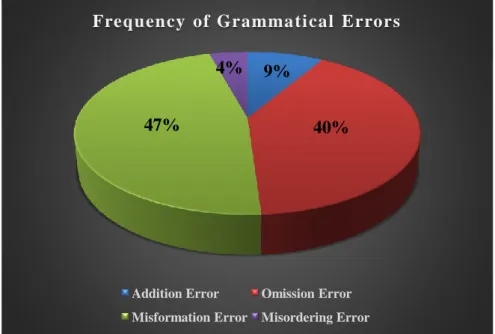
The result of this research data shown that grammatical cohesion was used in the abstract. After analyzing this phenomenon, there were 4 items (9%) of addition errors, 19 items (40%) of omission errors, 22 items (47%) of misformation errors, and 2 items (4%) of misordering errors in the abstract of students’ undergraduate thesis. In addition, the result of interview shows that they knowledge well about abstract but they are difficult to put suitable gramatical cohesion in the sentence. It is confirmed that they rarely use grammatical cohesion in their scientificn writing. The conclusion of this research is the students’ knowledge of grammatical cohesion aspects was still needed to be improved in their scientific writing.
Because, there are still many grammatical cohesion errors appearing in the abstracts, in which the errors of misformation are the most errors made by the students.
Keywords:Scientific writing, abstract, grammatical cohesion errors.
viii ABSTRAK
By:
ISTIKOMAH
Tujuan utama dari penelitian ini adalah untuk menemukan kesalahan-kesalahan gramatikal kohesi yang terdapat dalam dari skripsi mahasiswa Program Jurusan Inggris IAIN Metro tahun 2016/2017.
Penelitian ini adalah penelitian kualitatif deskriptif. Data utama dari penilitian ini merupakan dua puluh abstrak yang diambil dari skripsi mahasiswa Program Studi Bahasa Inggris IAIN Metro tahun 2016/2017.
Data tersebut dikumpulkan melalui dokumentasi, dan interview; serta dikategorikan, diuraikan, dianalisis secara mendalam, dan disajikan menggunakan kualitatif deskriptif. metode analisis yang dikemukakan oleh Creswell untuk menganalisa data yang telah diperoleh.
Hasil data penelitian ini menunjukan bahwa gramatikal kohesi digunakan di abstract. Setelah menganalisis fenomena tersebut, terdapat beberapa kesalahan, yakni: 4 (9%) kesalahan addition, 19 (40%) kesalahan omission, 22 (47%) kesalahan misformation, 2 (4%) kesalahan misordering.
Selain itu, hasil dari interview menunjukan bahwa mahasiswa memahami abstrak dengan baik teteapi mereka sulit untuk meletakan gramatikal kohesi di kalimat. Hal ini dibuktikan dengan hasil interview bahwa mahasiswa jarang menggunakan gramatikal kohesi dalam tulisan mereka. Kesimpulan dari penelitian ini adalah pengetahuan mahasiswa tentang gramatikal kohesi masih perlu dikembangkan dalam tulisan mereka. Karena, masih banyak kesalahan gramatikal kohesi yang terdapat dalam abstrak. Selain itu, kesalahan misformation merupakan kesalahan yang paling sering muncul dalam abstrak mahasiswa.
Keywords:Karyailmiah, abstrak, kesalahan gramatikal kohes
ix
x
xi
“And that there is not for man except that (good) for which he strives”
(An-Najm (The Star) verse 39)
“Who Patiently will be lucky”
xii
“I highly dedicate this undergraduate thesis to my beloved family, my beloved friends and all of the lectures at IAIN Metro”.
“ May Allah SWT bless us ’’
xiii
xiv
NOTA DINAS ... iii
APPROVAL PAGE ... v
RATIFICATION PAGE ... vi
ABSTRACT ... vii
STATEMENT OF RESEARCH ORIGINALITY ... ix
MOTTO ... xi
DEDICATION PAGE ... xii
ACKNOWLEDGEMENTS ... xiii
TABLE OF CONTENTS ... xiv
LIST OF TABLES ... xvii
LIST OF FIGURE ... xviii
CHAPTER I INTRODUCTION ... 1
A. Background of The Research ... 1
B. Focus of Research ... 5
1. Problem Limitation ... 5
2. Problem Formulation ... 6
C. Objective and Benefits of the Research ... 6
1. Objective of the Research ... 6
2. Benefits of the Research ... 7
D. Prior Research ... 7
CHAPTER II THEORETICAL REVIEW ... 9
A. The Concept of Writing ... 9
1. Definition of Writing... 9
2. Process of Writing ... 11
3. Characteristic of Good Writing ... 14
B. The Concept of Scientific writing ... 16
xv
2. The typical Structure of Abstract ... 21
D. The Concept of Grammatical Cohesion ... 22
1. Definition of Cohesion ... 22
2. Types of Grammatical Cohesion ... 24
E. The Concept of Errors Analysis ... 33
1. Definition of Error Analysis ... 33
2. Classification of Error ... 35
CHAPTER III RESEARCH METHODOLOGY ... 39
A. The Characteristic and Type of The Research ... 39
B. Data Source ... 40
C. Data Collection Technique ... 41
1. Documentation ... 41
2. Interview... 42
D. Data Analysis Tecnique ... 42
E. Approach ... 44
CHAPTER IV RESULT AND DISCUSSION ... 46
A. Description of Research Setting ... 46
1. Profile of IAIN of Metro ... 46
a. The Historical Background of IAIN Metro ... 46
b. Organization Structure of IAIN Metro ... 49
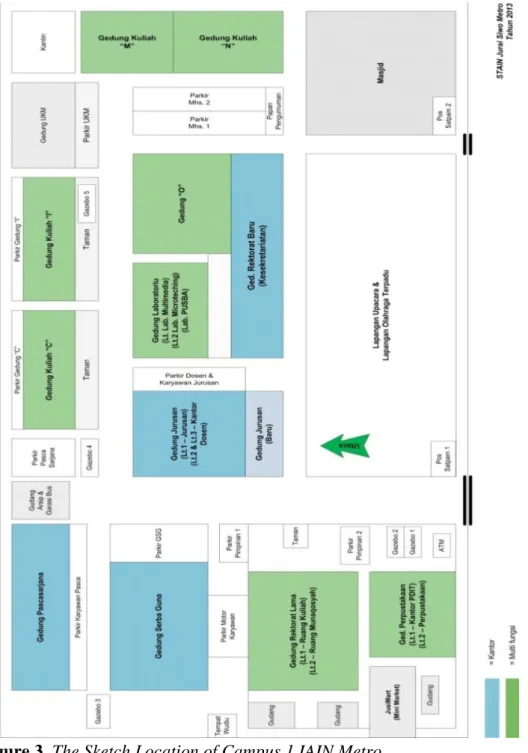
c. The Location Sketch of Campus 1 IAIN Metro ... 50
d. The Location Sketch of Campus 2 IAIN Metro ... 51
e. Facilities at STAIN Jurai Siwo Metro ... 52
f. The Condition of Lecture and Official Employees ... 53
g. Students at IAIN Metro ... 54
h. The Profile of English Education Study Program ... 54
xvi
CHAPTER V CONCLUSION AND SUGGESTION ... 78 A. Conclusion ... 78 B. Suggestion ... 79
BIBLIOGRAPHY APPENDIXES
CURRICULLUM VITAE
CHAPTER I INTRODUCTION A. Background of the Research
Writing is one of four skills in English. They are listening, speaking, reading, and writing. Writing is commonly categorized as the most complex skill in learning English. The writing skill becomes a crucial aspect in educations field because writing completely needs many aspects such as grammar, unity, coherence, organization, punctuation, and so on. By writing, students can explore information and ideas in the written text. They can discover and express what they really think and feel about people, ideas, issues, and events only in a process of writing. In addition, writing is a way in order students to accomplish their ideas on the paper.
Meanwhile, writing as a process of expressing ideas should be done in our leisure. Everyone has a same occasion to express everything in his or her mind on the paper. Writing can be an enjoyable activity as long as we have ideas and knowledge to actualize it.
Therefore, many students retell their life experience in writing. But, in fact, writing is not an easy activity event we have many ideas especially in composing a scientific writing.
Writing a scientific writing is more than picking up a pen and scratching words on a paper. It requires a well-done thinking and good planning to be understood the reader. One of part in the scientific
writing. Abstarct is a summary of the scientific writing written after the researcher has been conducted. It informs the readers of what can be found in the whole of every scientific writings. Furthermore, a good scientific writing cannot be created without noticing good grammatical aspects although the writers have prepared their ideas. Consequently, many students are difficult to compose their scientific writing.
Furthermore, not all students can do it well in organizing scientific writing.
Moreover, Grammatical Cohesion refers to a combination item between sentences that from grammatical aspect. Then, it consists reference is the use word which do not have meanings of their own, substitution is the replacement of one item by another wording, ellipsis is something omitte, and conjunction is the word that has function or connecting clausa or sentence. Furthermore, if one word with another word is not connected each other, some sentences or texts will be difficult to understand.
Based on the explanation above, it can be concoulded that writing is one of the most difficult aspects English. Moreover, if it is a scientific writing which has a complex format and style, it will need alertness in several aspects to make it well. Among those aspects that must be noticed is grammatical structure. Therefore, grammatical cohesion is essentially needed in order to make good scientific writing,
especially for foreign learners in Indonesia. It is pointed out that the grammatical cohesion influences the level of the written product.
Meanwhile, to make a good scientific writing, students have to master in making scientific writing because it need a good understanding of scientific writing aspects. Before starting to write, a writer needs to read some scientific papers that have been written in a good format so that the writer can comprehend it. In scientific writing, the ideas and resources must be applied and presented in a right format and good style.
Writing the scientific writing in State Islamic Institute of Metro, chiefly in the students of English Education Departement (EED), is a necessity in acquiring writing skill. In order to create a precious-writing product, the competences of writing aspects are required. One of them is grammatical structure. Most writing products should be presented in a good grammatical structure in order to make the readers understand what the writer writes.
In this case, the researcher conducted a pra survey on March 30th, 2017. The researcher had analyzed there were several errors in writing of the abstracts which consisted of some error on using grammatical cohesion. Here is an example:
AN ANALYSIS OF SUBJECT-VERB AGREEMENT ERROR ON THE STUDENTS’ DESCRIPTIVE TEXT WRITING AT
THE THIRD SEMESTER OF ENGLISH NEDUCATION DEPARTMENT OF STAIN JURAI SIWO METRO
ABSTRACT By:
YA
Writing is one of the language capabilities that has important role. In writing, the students are asked to be able develop their ideas and opinions in a written. To be able create the good written, the students also have to master about mechanical aspects in writing such as grammatical usage, spelling, punctuation, and coherence. In this research, the writer only focused on the mechanical aspect is subject verb agreement as the main topic of the research. Because using subject-verb agreement become phenomena in writing process, as the students’ writing result of STAIN Jurai Siwo Metro that still many errors in using subject-verb agreement.
Therefore, in this research the writer chose to use qualitative method with the case study approach. Observation and documentation were used to collect the data. The writer conducted the research toward ten students of the third semester of English Education Department by asking them to write the descriptive text with the correct of using subject-verb agreement.
From the students’ writing result, the writer found many usage of subject-verb agreement errors such as disagreement:
singular subject-plural verb 22 items (63%), disagreement:
plural subject-singular verb 8 items (23%), and singular or plural verb-incorrect modal-verb agreement 5 items (14%). As a result, the writer concluded that disagreement: singular subject- plural verb has the biggest errors on the students’ writing are 63%.These phenomena happened because the students felt difficult in writing activity, the students are lack of knowledge about subject-verb agreement, and the students still confused in the differentiating which subjects are singular or plural. To solve this problem, the students should study and know more about the mechanical aspects especially in using of subject-verb agreement. Many resources that can be reference in understanding the rules of subject-verb agreement, and so this research does.
Based on the abstract written by YA, the researcher found two categories of grammatical cohesion error, namely conjunction and
reference. The bold words are conjunction, and the underline words are references. While, there is no any ellipsis and substitution error.
In writing an abstract, YA had a mistake in using conjunction in the first paragraph. There is no conjunction to separate between two sentences: “In this research, the writer only focused on the mechanical aspect is subject-verb agreement as the main topic of the research”. It should be “In this research, the writer only focused on the mechanical aspect that is subject-verb agreement as the main topic of the research”.
In the last paragraph, YA also had a mistake in using conjunction in “students’ writing are 63%”. There is no conjunction in this sentence. It should be “students’ writing which are 63%”. Besides that, she had a mistake in using “reference” in the last paragraph:“these”. Reference these should be changed to be “this”.
In this case after analyzing pre-survey data, the conclusion which was covered the students in English Education Departement (EED), ignore the important of grammatical cohesion to convey their abstracts in scientific writing. It should be highlighted that abstract is a crucial part of scientific writing so that the students should decrease the common grammatical errors. Based on, the researcher briefly proposed to analyze the grammatical cohesion errors in the abstract of the students’ undergraduate thesis.
Furthermore, in abstract the researcher should be written cohesively. It can be understood that good writing needs cohesion aspect to make a good writing in order readers will understand of the writer purpose easly. In this research, the researcher focuses an error analysis of grammatical cohesion on students’ abstract of undergraduate thesis.
Based on the case above, the researcher was interested to analyze the error of grammatical cohesion on students’ abstract of undergraduate thesis in State Islamic Institute of Metro in Academic Year 2016/2017.
B. Focus of Research 1. Problem Limitation
According to the background above, the researcher would focus an error analyze the use of grammatical cohesion devices on students’
abstract of undergraduate thesis in State Islamic Institute of Metro in Academic Year 2016/2017.
2. Problem Formulation
Concerning the background of the research, the researcher formulates the problem of the research as follows:
1. What are the types of grammatical cohesion error on students’ abstract of undergraduate thesis in State Islamic Studies of Metro in Academic Year 2016/2017?”
2. Why is the students’ Grammatical Cohesion error appearing in their abstract of undergraduate thesis in State Islamic Studies of Metro in Academic Year 2016/2017?
C. Objective and Benefits of the Research 1. Objective of the Research
Based on the formulation of problem above the objective of this research are:
1. To know the type of grammatical cohesion on students’ abstract of undergraduate thesis in State Islamic Studies of Metro in Academic Year 2017/2018.
2. To know why the students’ Grammatical Cohesion error in their abstract of undergraduate thesis in State Islamic Studies of Metro in Academic Year 2017/2018.
2. Benefits of the Research a. For the students
The researcher hopes the students as additional knowledge that makes the students realize the important of using grammtical cohesion in their abstract of undergraduate thesis.
b. For the English teacher
The researcher hopes it can be the resource of teaching for the students. However, it would aware them about their students’
difficulties in their abstract of undergraduate thesis of grammatical cohesion to reduce the difficulty.
D. Prior Research
In this undergraduate, the researcher discussed about the prior researches as comparison. The first is an error analysis that had been researched by Nur Hafis Abdurahman, which is entitled “Grammatical Cohesion Analysis of Students’ Thesis Writing”. In this thesis the researcher find out types of grammatical cohesive devices students mostly used in their thesis writing and how these devices create cohesive discourse. Researcher applied descriptive case study as from of research. Furthermore, the result revealed that students could produce various types of grammatical cohesive.
The majority of devices used by the students were referential cohesive devise and conjunctive cohesive device. Other type’s substitution and ellipsis. In many cases, students tended to misuse singular pronoun while referencing plural objects or vice versa. From the total 1273 grammatical cohesive devices used, there are some students how adequately master using grammatical cohesive device by only using inappropriately 74 (5.81%) of them.1
The second prior research is conducted by Zuhroul lailatul Rohmah, which is and entitled “An Analysis of Grammatical Cohesion in Analytical Exposition Text’’. In this thesis the researcher finding research shows the error on the use of reference on grammatical cohesion types is the highest error found in the students’ text than other types. Likewise, the frequency of reference, substitution, ellipsis and the last conjunction. In conclusion, the
1 Nur Hafiz Abdurahman, Grammatical Cohesion Analysis of Students’ Thesis Writing, (The University of Pontianak: 2013).
students often used grammatical cohesion in writing. It caused that they did not know to use grammatical cohesion correctly. They only knew the kinds of grammatical cohesion but they did not know how to use in writing, especially in writing analytical exposition text.2
Based on the research above, it indicates that phenomena of grammatical cohesion are crucial in writing process. The first research is analysis grammatical cohesion of Students’ thesis writing and the second prior research about an analysis of grammatical cohesion in analytical exposition text. Then, the researcher would conduct different variabel. The researcher would analysis grammatical cohesion on students’ abstract of undergraduate thesis, because both of the prior research above that it did not analyze about abstract of undergraduate thesis. So, the researcher interested to analysis grammatical cohesion on students’ abstract of undergraduate thesis.
2 Zuhroul lailtul Rohmah, An Error of Grammatical Cohesion in Analytical Exposition Text, (Metro:2
015).
CHAPTER II
THEORETICAL REVIEW A. The Concept of Writing
1. Definition of Writing
Terminologicaly, writing is the activity by using a pen or pencil to make a letter or number on the surface. Moreover, it is an activity which in contrast to reading, speaking, and listening.3 Writing is the written productive language skill. It is an skill to convey information to a reader or a group of readers. It is realized by writer’s ability to apply the rules of the language she or he is writing to transfer the information she or he has in her or his mind.4 Therefore, writing is one of communication forms by making a letter to deliver the information from the writer to the reader.
Writing, as one of the four language skills, has conventionally occupied a place in most English syllabuses. Nowadays, in a higher education, writing is the most dedicated although it is considered as problematic skill for all the writers. This skill entails exploring students’
ideas presented in well written products. These written products are often the result of thinking, drafting, and revising procedures that require specialized skills which every writer doesn’t develop naturally.5
There are several aspects that have to be considered to get a good written result. One of the basic aspects is organizational competence. This
3 As Hornby, Oxford Advanced Learners’ Dictionary,(New York: Oxford University Press, 2000), Sixth Edition, p.1499
4 Sanggam Siahaan.2008.The English Paragraph, (Yogyakarta: Graha Ilmu),p.2
5 H. Douglas Brown, Teaching by Principles: An Interactive Approach to Language Pedadogy,(San Fransisco:Longman,2000),Second Edition,p.335.
part is often use in writing, because it consists of grammatical structure and discourse. In this case, grammar is the important role in every writing activity by which pure language is structured. Without the organizational aspects, our language espeially in written language will be messed up. As a consequence, if the someonce want to write, she or he must use grammatical structure correctly. If she or he makes some mistakes, it can be easily seen event though a small mistake.
In addition, writing is the most important skill encountered by the students because the students will be challenged in searching and exploring an idea by their style of writing. Furthmore, every language and culture brings their own style of writing. Therefore, every writer has different type and style in their written product even they have similar topic.
Meanwhile, writing is a progressive activity. It means that when someone wants to write something, she or he must already know about what and how she or he is going to say it. After that she or he is finished writing, she or he must read their written result and than make changes and corrections. This activity is very important if she or he wants to get a good written result.6
Based on the statement above, the researcher can infer that writing is basically the processing ideas and thoughts by using knowledge of structure and vocabulary to combine a our ideas a means communiction.
6 Alice Oshima & Ann Hogue, Introduction to Academic Writing, (New York: Longman, 1997), Second Edition, p. 2.
2. Process of Writing
Writing is not a one-step action, but it is a process that has several steps. It start from beginning of what the topic is going to write until the publication of writing. There are at least three steps of writing process, they are:
a. Prewriting (Planning)
Prewriting is the first step in writing process.7 Before we start to compose a writing, some ideas should be thought as a topic of product writing. In this step, writers are challenged to think about the topic that will be decided. In deciding the subject of writing, the writers should consider who will be the reader of the writing.
Many writers usually read appropriate references as their warming up to get an appropriate topic. Unfortunately, the information which is invented from reading is imperfectly remembered. Therefore, it makes sense to make note-taking from what we have read. This sentence will be literal ideas of possible topics to be composed.8
In addition, reading commonplace book and journal can make the writer get easy to find idea for their wrriting.
Commonplace book gives new perception and more quotations
7 Ibid,p.16
8 Alastair Fowler, How to Write,(New York: Oxford University Press, 2006),p.12
which will make writing product become strong and more alive.9 The other reference to enrich the subject of writing is journal.
Many outstanding writers use journal to create an interesting writing because it contains of good perceptions, ideas, emotions, and actions.10
b. Drafting
Before the writer start to write and to get writing product well, they should make a format of the writing and put the word down on paper.11 This step is often drafting. According to Kristine argued “the drafting is the step that the writers really start to write. In this step, when the writers to write, she or he put their words into the paper without worrying about spelling, grammar punctuation, or the best wording.12
Drafting is tentative and imperfect writing. Drafting product can be refined to develop by putting down all the term related to the topic in the margin to make the writer easily to check an appropriate word in eleborating the topic. Besides, in drafting phase, reading and correcting are required to improve product of writing.13
9 Thomas.S.Kane, The Oxford Essential Guide to Writing,(New York: Oxford University Press,1998),p.20
10 Ibid,p.21
11 Beverly Ann Chin, How to Write Great Research Paper,(USA: John Wiley &
Sons,Inc,2014),p.57
12 Kristine Brown and Susan Hood, Writing Matters,(New York: Cambridge University Press, 1989),p.14
13 Thomas.S.Kane, The Oxford Essential Guide to Writing,p.35-36
In addition, drafting can be referred to first version of writing because the sentence of this process is often done on the assumption which will be changed later. A number of drafts may be produced on the way to the revising.14
As a result, the earlier steps to create perfect product writing are elaborating the topic using the appropriate term which have been listed and correcting to make perfection. In this part the writers compose their writing in a good process and structure.
c. Revising
The writer needs to read the draft which they produced.
Perhaps the order of the information is not clear probably the ambiguous and confused text has been written. Eventually, the writer has asked the reader to comment and suggest and reflecting and revising. So, the writer revises his writing to make appropriate revisions.
Revising is a prosedure for improving or correcting a work in progress. As the third and final in writing process, revising is a series of strategies design to re-examine and re- evaluate the choices that have created of piece of writing.In revising, the writer tries to make certain that readers can
14 Jeremy Harmer, How to Teach Writing, (England: Longman 2004),p.5
understand the messages. The writer should check whether the logic of ideas is presented smoothy or not.
Revision is a thinking process that occurs any time you are working on a writing project.It means looking at your writing with a “fresh eye”—that is, reseeing your writing in ways that will enable you to make more effective choices through out your essay. Revision often entails rethinking what you have written and asking yourself questions about its effectiveness; it involves discovery as well as change.15
d. Final Version
Once writers have edited their draft, making the changes they consider to be necessary, they produce their final version.
This may look considerably different from both the original plan and the first draft, because things have changed in the editing process, but the writer is now ready to send the written text to its intended audience.
Furtheremore, as indicated above, shows that the writers move back and forth between the stages of the process. This means the writers plan, darft, and edit but often re-plan, re-draft, re-edit till the final version really is the final version has the process reached its culmination.16
15 Jean Wyrick, Steps To Writing Well With Additional Readings 8th Edition, (USA:
WadsworthCengage Learning, 2004), p. 95.
16 Jeremy Harmer, How to Teach Writing, (England: Longman 2004),p.5
3. Characteristic of Good Writing
It has been widely known that writing should be well-written.
A good academic paper should have several aspects to give a better sense of writing product. There are three characteristics of good writing:
a. Coherence
A paragraph should consist of coherent sentences that are ordered according to principle. The sentences are made readers understand the paragraph easily. The sentence is put in order so that the reader can understand the writers’ idea easily.17
In addition, in order to make coherence in writing, the sentences must hold together. It means that the movements of a sentence to another should be logical and smooth. To make writing more coherence, Oshima and Hogue declared that there are four ways: repeating key nouns, using pronoun, and using transition signals.18
b. Cohesion
Cohesion is another characteristic of the good paragraph.
The supporting sentences connect to each other in their support of the topic sentence. Cohesive device is the method to connect sentence which has four important devices in order to make
17 Cynthia A Bordman, Writing to Communicate, (London: Longman,2008),p.18
18 Alice Oshima & Ann Hogue, Introduction to Academic Writing, (New York: Longman, 1999), Third Edition, p.37-79
writing more coherent. They are connectors, definite articles, personal pronouns, demonstrative pronouns.19
c. Unity
The last characteristic of a well-written paragraph is unity.
Every good writing product should have unity which means that only a main idea is discussed in every supporting sentence.
The writers must consider thay they should not put other information which doesn’t directly have relation with the topic sentence. In addition, the writer may write other information which is contrast with the topic sentence as long as it supports the topic sentece. However, if the writers write too many contrast sentences, their writing will not have unity.20
B. The Concept of Scientific Writing 1. Definition of Scientific Writing
English is no longer as a tool of international communication but English becomes a need. Most writers in the world use English to make good relationships one another. As an international language, English plays an extremely significant role in communication and has many interrelationships with various aspects owned by human being. It is also used in many fields based on the purpose of the writers. One of them is a scientific writing.
19 Cynthia A Bordman, Writing to Communicate, p.23
20 Ibid,p.25
Scientific writing is a piece of writing that provides information about the topic which the writer has researched.21 Furthermore, scientific writing can be defined as experts communicating through the written word with other expert. Then, scientific writing is an activity of exploring and investigating knowledge or information of open problems in scientific field.22
In line with the explanation above, it can be concluded that a scientific paper or scientific writing is used to investigate and explore a particular topic broadly and deeply. It provides the information about a topic to the readers. In writing, there are several kinds of scientific writing such as:
scientific articles, research reports, scientific essay, and so forth.
It will be better if scientific writing is clarified as a technique than a creative art. It will make the writing product be effectively scientific.
There are at least three basic aspects in elaborating scientific knowledge to be an effective scientific writing, namely:
1) Thought is a difficulty of having some meaningful results and ideas to publish. In this case the writer must be able to interpret them correctly.
2) Structure is simply a matter of getting the right things in the right places.
21 Beverly Ann Chin, How to Write Great Research Paper, (USA: John Wiley & Sons, Inc., 2014), p.1
22 A Yavuz Oruc, Handbook of Scientific Proposal Writing, (New York: CRC Press, 2012), p.
7.
3) Style is a difficulty of indicating the fewest and most appropriate words and using the rules of good grammar.23
In line with, a good scientific writing should be based on the ideas that the readers can easily understand. Moreover, the writers should be capable in composing the scientific writing in the right format and guidance.
2. Element of Scientific Writing
As clearly defined above, a good scientific writing should be written in a good format. Then, it should totally include the elements which bring the writing more understandable and meaningful. The elements are: title, summary or abstract, introduction, methodology, result (including tables and figures), discussion, citation, acknowledgement, and bibliography.24
1) Title
The title is the primary point of the scientific writing which has to be read. Title defines the content of the paper. It will attract the readers to read the writers’ paper and provide the greatest information for the readers to find the point of our writing.
23 Jennifer Peat, Scientific Writing Easy When You Know How, (London: BMJ Books, 2002), p. 8-9.
24 David Lindsay, Scientific Writing: Thinking in Words, (Australia: CSIRO Publishing, 2011), p. 16
2) Abstract
Abstract is kind of simple paper that encloses the writers’ full paper into a fraction of its original space. It gives the readers a preview of what the writers’ write.
3) Introduction
This part consist the demonstration of the issue reasonably and logically which convinces the reader that the writing has been well thought out. It gives the readers summaries the relevant literature so that they will comprehend why the writers interest in composing their research.
4) Method
It is the way used by the writers in conducting their scientific writing in order to make the research exists in good procedure.
The methods include collecting data, validating ways, analyzing and interpreting data, and so on.
5) Result
Result reports outcomes of the research after it is conducted.
Generally result is presented in a table or a figure. In this part, the writers should present result clearly and clinically.
6) Discussion
This element includes elaboration of the issues which are researched. It contains a wide elaboration of the study.
Discussion highlights a significant result and doesn’t carry out
repetition of result data or findings that has been presented in result section. In this part, writer should give clearly interpretation of the data.
7) Citation
This part includes theories or opinions of some experts that writers cite to empower the truth of the research.
8) Bibliography
This is the essential support for logical scientific writing and reporting. In this way, the writer should present every reference used in conducting the research. In addition, bibliography will help the readers in finding their reference related to what the writer research.
C. The Concept of Abstract
It is generally believed that abstract is a crucial part of scientific writing, such as journal, scientific article, thesis, and so forth. Abstract is a short piece of writing or short brief summary of the scientific writing which gives the information about what the researcher writes.
Because abstract takes an essential role of scientific writing, it should be written in a good structure. The brief explanation of abstract will be elaborated below.
1. Definition of Abstract
An abstract is a quite crucial part of scientific writing, such as scientific article, thesis, journal, and so forth. Terminologically,
abstract is a short piece of writing which contains the main idea in a document.25
Moreover, abstract is the key content of every scientific writings containing the main idea that has been discussed. In addition, abstract is a summary of the scientific writing written after the research has been conducted. It informs the readers of what can be found in the whole of every scientific writings.26 Briefly, the readers can know and understand about what the writers write on their scientific writing by comprehending the abstract.
In addition, abstract are what most writers who interest in your title will read next to reach more information. Meanwhile, not all writers read the whole of the scientific writing but they only read the abstract. So, it must not only be concise, but it also must be complete and clear. Moreover, because abstract is brief summary, it should be composed in limited length. Most journal editors limit the length of abstract by setting the number of words, usually between 150 and 250 words.27
In other words, abstract, the brief summary of entire paper, should elaborate the question of why, how, and what which are contained in the paper. Those questions should be described clearly
25 A S Hornby, Oxford Dictionary. P, 5.
26 Brian Paltridge, Thesis and Disertation Writing, (USA: Routledge, 2007),p. 155
27 David Lindsay, Scientific Writing: Thinking in Words,p. 49.
in the body of abstract using good format. Abstract should contain of objectives, materials and methods, results, and conclusions which provide maximum information with minimum words.28
In conclusion, a good abstract should be written in a good structure containing aim, method, result, and conclusion of the research. Then, abstract is also written in a brief and specific elaboration which presents the maximum information for the readers.
2. The Typical Structure of Abstract
It is widely known that abstract is an important part in scientific writing which carries out the information of the whole writing. Consequently, abstract should be written in good structure not only in sentence structure (grammar), but also in typical structure. There are several typical structures of abstract, namely.29 1) Overview of the study
This part describes the general purpose of the research conducted by the researcher.
2) Reason for the Study
Every scientific research should have reason why the research is conducted. In this site, a researcher must elaborate the reason of his/her research.
28 Jen Tsi Yang, An Outline of Scientific Writing, (Singapore: World Scientific Publishing, 1995), P. 53
29 Brian Paltridge, Thesis and Disertation, p. 155
3) Methodology of the Study
In this part, a researcher also must explore the methods used in conducting the research.
4) Result
Every scientific research must have the result or finding. Because of it, a researcher should write down the result of the research in the abstract.
D. The Concept of Grammatical Cohesion 1. Definition of Cohesion
According to Holliday in Deborah cohesion can be defined as the set of resources for constructing relations in discourse which transcend grammatical structure.30 It also stated that cohesion is in the level of semantic which refers to relations of meaning that exist within text, and that define it as a text.31 Like other semantic relations, cohesion expresses through the strata organization of language that can be explained as a multiple coding system comprising three levels of coding or strata, such as, the semantic (meaning), the loxicogrammatical (form), and the phonological (expression). Therefore, in everyday terminology, meaning is put into wording, and wording into sound or writing. Here is the schema of strata (meaning-sound writing):
30 Deborah Schiffrin at all, The Handbook of Discourse Analysis,(Hongkong: Blackwel, 2001),p.35
31 M. A. K. Halliday and Hasan Ruqaiya, Cohesion in English, (London: Longman, 1976),p.4
Meaning (the semantic system)
Wording (the loxicogrammatical system, grammar, and vocabulary)
Sounding/writing (the phonological and orthographic system) In this schema, the guiding principle in language is that the more general meanings are expressed through the grammar and the more specific meanings through the vocabulary. Furthermore, cohesion is expressed partly through the grammar and vocabulary. Therefore, it refers to grammatical cohesion and lexical cohesion.32
The term of cohesive is commonly defined as an over feature of the text, providing surface evidence for the text’s unity that are connected each other. Moreover, cohesion is realized linguistically by devices and ties that are used to form a larger text (spoken or written) as the elements or units of language. It relates to the reader’s linguistic competence since cohesion trust strongly on grammatical and lexical devices.33 In other word, cohesion becomes a special feature that has some devices in producing some text.
Generally, halliday and Hasan device cohesive ties into five kinds, namely reference, substitution, ellipsis, conjunction, and lexical cohesion.34 Meanwhile, Cohesion is created through grammatical and
32 Ibid,p.5
33 Marianne Celce-Murcia and Elite Olshtain, Discourse and Context in Language Teaching (USA: Cambridge University, 2000),p.126
34 M. A. K. Halliday and Hasan Ruqaiya, Cohesion in English,p.4
lexical forms. Grammatical cohesion includes reference, substitution, ellipsis and conjunction while lexical cohesion includes reiteration and collocation. These two kinds of cohesion help create texture or the property of being a text.35 Furthermore, it is commonly known as grammatical cohesion and lexical cohesion. Reference, substitution, ellipsis, and conjunction are grammatical device and lexical has two devices that are reiteration and collocation.
The writer concludes, the concept of cohesion in producing a writing text is very extremely needed besides coherent aspect. It is the way how the meaning of the text can relate each other both grammatically (grammar) and lexical (vocabulary). Without relations between ties of those ones, the whole text cannot be clear and readable. Therefore, the existence of cohesion in writing is that the meaning of the text can be understood by the teacher.
2. Types of Grammatical Cohesion a. Substitution
There are some special words in English which contribute to cohesion by substituting for words that have already been used. The most important of these special words are one, do (or one of the other forms of do, namely does, did, done and doing) and so.36 In line of the statement above, Halliday and Hasan state that substitution is the
35 Josephine B. Alarcon and Katrina Ninfa S. Morales, “Grammatical Cohesion in Students’ Argumentative Essay in English and Literature”(Philippines: University of Santo Tomas),Vol.2 No.5/February 20011,p.1
36 Raphael Salkie, Text and Discourse Analysis, (New York: Taylor & Francis e-library, 2001),p.35
replacement of one item by another.37Substitution, on the other hand, is a relation within text. A substitution is short of counter which is used in place of the repetition of a particular item. It indicates that function of substitution is to substitute something in a text. For instance:
My axe is too blunt. I must get a sharper one.
You think Andre already knows? - I think everybody does.
One and does are both substitution. One substitution for axe, and does substitutes for knows. The example would be entirely possible to
‘replace’ one by axe and does by knows. One and axe are both head in the nominal group, does and knows are both verbal group.
Then, according to Nunan there are three types of substitution- nominal, verbal, and causal.38 There are three types of substitution, such as: verbal, nominal and clausal. The following is a list of items that occurs as substitutes, the list is brief explanation of the three categories.
1) Nominal Substitution
Nominal substitution is a substitution of nominal item, it expresses by one/ones and same. The substitution one/ones always function as head of a nominal group, and can substitute only for an item which is it head for a nominal group. For instance:
a. Would you like some sandwiches?
Please pass the ones with cucumber in.
37 M.A.K, Halliday, Cohesion in English, p. 89.
38 David Nunan, Introducing Discourse Analysis,(England: Penguin Books, 1993),p.24
b. I am having chicken and rice.
I’ll have the same.
c. Te children will carry the small boxes, the adults will carry the large ones.
2) Verbal Substitution
The verbal substitution in English is do. This operates as Head of a verbal group, in the place that is occupied by the lexical verb, and its position is always final in the group. Here are two examples from Alice in Halliday and Hasan’s book of Cohesion in English.
For instance:
a. The words did not come the same as they used to do
b. I don’t know the meaning of half those long words, and what’s more, I don’t believe you do either!
The word do in (a), substitute for come that in (b) substitute for know the meaning of half those long words.
3) Clausal Substitution
There is one further type of substitution in which what is presupposed is not an element within the clause but an entire clause. The words used in clausal substitution are so and not.
There are three environments in which clausal substitution take place: report, condition and modality. In each of these environments it may take either of two form, positive and
negative, the positive is expressed by so, the negative by not. For example:39
a. Is it going to rain? I think so.
b. Has everyone gone home? I hope not
In the example above the word so describe the clause going to rain. And not in (b) presupposes everyone gone home.
In conclusion, the researcher concludes that substitution is aimed at avoiding the similar words to be repeated exactly at the nest sentence or clauses.
b. Ellipsis
Ellipsis is omitting part of sentences on the assumption that an earlier sentence or the context will make the meaning clear.40In other hand, ellipsis occurs when some essential structural element is omitted from a sentence or clause and only be recovered by referring to an element in the preceding text.41 Halliday and Hasan also assert that ellipsis is the omission of one or more items from a construction.
Essentially between substitution and ellipsis are the same process, ellipsis can be interpreted as that form of substitution in which the item is replaced by nothing. In other hand, ellipsis is simply ‘substitution by
39 M.A.K.Halliday and Ruqaiya Hasan, Cohesion in English,(London:
Longman,1976),p.90-141
40 Guy Cook, Discourse,(New York: Oxford University Press, 1989),p.20
41 Ibid,p.25
zero’. As with substitution, there are three types of ellipsis, nominal, verbal and clausal.42
1) Nominal Ellipsis
It means ellipsis within the nominal group. Nominal ellipsis therefore involves the upgrading of a word functioning as Modifier to the status of Head. For example:
- Which last longer, the curved rods or the straight rods? The straight are less likely to break.
The word straight in the question is functioning as modifier but as head in the response. Thus the straight is elliptical nominal group.
2) Verbal Ellipsis
Verbal ellipsis is verbal group. A verbal group whose structure fully represents its entire systemic feature is not elliptical. There is only one lexical element, and that is the verb itself. For instance:
- Have you been swimming? - Yes, I have.
3) Clausal Ellipsis
It means within clause. For example:
- I haven’t finished my assignment yet.
- Why
42 M.A.K.Halliday and Ruqaiya Hasan, Cohesion in English,(London:
Longman,1976),p.142-146
Why means ‘why haven’t you finished your assignment yet? In ellipsis is no implication that unsaid is not understood, on the contrary, unsaid but understood.
Based on the explanation above, the researcher concludes ellipsis is the omission of one or more words and it is not repeated but it can be understood from the linguistics context.
c. Reference
Reference is one in which the relationship of reference is taken to hold expressions in a text and entities in the world, and that of reference between expression in different parts of text.43 It also relation between in element of text and something else by reference to which it is interpreted in the given instance. Reference is a potentially cohesive relation because the thing that serves as the source of the interpretation may itself be an element of text. Then, Halliday and Hasan said that there are three types of reference, namely: personal, demonstrative and comparative reference.44
1) Personal Reference
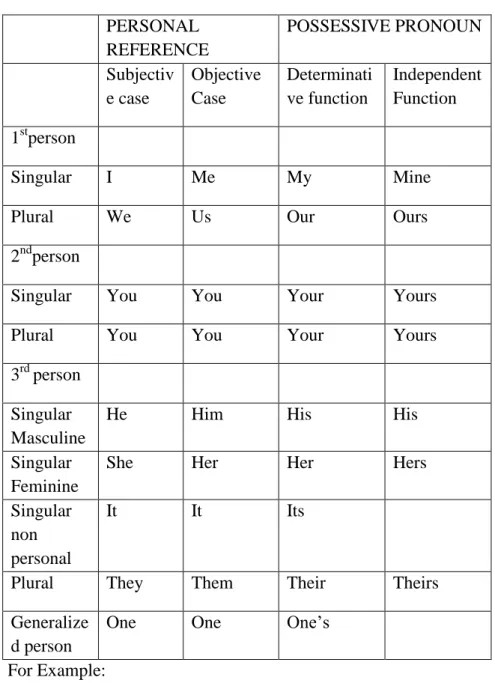
It is a reference by means of function in the speech situation, through the categories of person.45 The category of personal includes the three classes of personal pronouns, possessive
43 Gillian Brown and George Yule, Discourse Analysis,(Melbourne: Cambridge University Press,1983),p.204
44 M.A.K.Halliday and Ruqaiya Hasan, Cohesion in English,(London:
Longman,1976),p.308-309
45 Ibid,p. 37-38
determiners (usually called ‘possessive adjective’), and possessive pronouns. It can be seen in the below:
Table 1: Personal Reference PERSONAL REFERENCE
POSSESSIVE PRONOUN Subjectiv
e case
Objective Case
Determinati ve function
Independent Function 1stperson
Singular I Me My Mine
Plural We Us Our Ours
2ndperson
Singular You You Your Yours
Plural You You Your Yours
3rd person Singular Masculine
He Him His His
Singular Feminine
She Her Her Hers
Singular non personal
It It Its
Plural They Them Their Theirs
Generalize d person
One One One’s
For Example:
- Ana did not buy the novel because it was so expensive. (It as a subject personal pronoun refers to the novel)
- Anna will visit her grandmother’s home soon. (Her as a possessive adjective refers to the subject anna).
2) Demonstrative Reference
Demonstrative reference is reference by means of location.
Demonstrative reference is expressed through determiner and adverbs.
a. Demonstrative determiner includes this, these, that, those.
They refer to the location of something, typically some entity person or object that is participating in the process, they therefore occur as elements within the nominal group.
b. Demonstrative adverbial includes here, there, now and then.
They refer to the location of a process in space or time, and they normally do so directly, not through the location of some person or object that is participating in the process, moreover they typically function as the clause, not as elements within the nominal group. For instance:
- Take that book, please!
- These students are diligent.
3) Comparative Reference
Comparative reference is indirect reference by means of identify or similarity. 46Comparative reference divided into two: general comparison that expresses likeness between things: then, particular comparison that expresses
46 Ibid,p.58-59
comparability between thing in respect of a particular property.47 For instance:
- She loves reading more than I do d. Conjunction
Conjunction is words that join clauses into sentence.48 Therefore, the fourth type of cohesive relation in the grammatical cohesion is conjunction. Conjunction differs from reference, substitution and ellipsis that it is not a device for reminding the reader of previously mentioned entities, actions and state of affairs. However, it is a cohesion device because it signals relationships that can only be fully understood through reference to other parts of the text. Conjunction has four types, namely:
1) Additive
Additive conjunction can be function as additional information without changing the information in clause and sentence previous. The item of the additive conjunction include and, and also, or, besides, nor, furthermore and in addition. For example:
From a marketing viewpoint, the popular tabloid encourages the reader to read the whole page instead of choosing stories. And isn’t that what any publisher wants?
47 Ibid,p. 76
48 Michael Swan, Practical English Usage,(Hongkong: Oxford University Press,1995),Second Edition,p.142
From example above, word and as signal the presentation of additional information.
2) Adversative
Adversative conjunction is the connector of two contras sentences. The basic meaning of the adversative relation is contrary and similarities to expectation.
For example :
Ahmad stated that there are many students get good score. In other hand, Nana also stated that there are many students get A grade.
3) Causal
Causal conjuntion relations include of result, reason and purpose. The example as follow;
Chinese tea is becoming increasingly popular in restaurant, and even in coffee shop. This is beacuse of the growing belief that it has several health giving properties.
4) Temporal Sequence Conjuntion
Temporal relation connect clauses depending on whether the actions they take place at the same time or one after the other. For instance :
Brick tea is a blend that has been comperesed into a cake. It is taken mainly by the minority groups in China. First, is ground to a dust. Then, it is usually cocked in milk.
Based on the categories of grammatical cohesion above, the writer tended to accomplish all of the categories. The requirements involves some aspect in grammatical cohesion, namely: refernce, ellipsis, substitution, and conjuction.
E. The Concept of Errors Analysis 1. Definition of Error Analysis
As the researcher mentioned above, the students who learn English make error. Therefore it because a good input and will be useful for the writer who will be an English teacher to keep on trying to analyze the problem would be face by the students in using structure. Error analysis is study of identifying, describing, classifying the students errors.
According to Brown, the fact that learnes do make error, it can be observed, analyzed, classified to several something of the system operating within the learners led to a surge of study of learners errors are called Error Analysis.49 Moreover, error analysis is significant. It provides into strategies employ in second languge acquisition.50 So the researcher can analyze in grammatical errors.
The activities that have to be as the procedures of error analysis are describing what error about and then classifying what kind of errors are, after that evaluating the errors to be correct.
49 H. Douglas Brown, Priciple of Language and Teaching, ( longman: San Francisco State University, Fourth Editision, 2000), p. 217
50 Jacek Fisiak, Contrastive Linguistics and the Languge Teacher, (New York: Oxford University Press, 1967), p.208
Because the errors cannot lost from the process of language learning, it is surely needed treatment to help to reduce and avoid the errors are usually happened in using language. To prepare the most appropriate treatment to be applied, firstly knowing specially about the errors is absolutely important. In this case, a carefuly and deep study on it should be conduct. Moreover, the way used to study errors is commonly called as error analysis.
By doing error analysis to the students, the teacher can help them to improve their sill. It is said by Brown that is interesting that tittle research evidence shows that overt grammaticl correction by teacher in the classroom is of an consequence in improving learners language.51 Error analysis not only can help the teacher to increase their motivation and their skill but also can help the teacher to increase teaching learning process to get the maximally result of study.
Concerning to the error the linguistic and other language have the same opinion that errors can distrub the achievement of lernings goal. Therefore, error can be mimed and correct. From the expanation above the researcher infers that analyisi of errors is astudy of identifying, describing, and classifying, the noticeable from adult grammar of native speaker the las purpose of error
51 H. Douglas Brown, Priciple of Language and Teaching,p. 217
analysis is find to the feedback, use as reference in language to minimize the error may be made by the students.
In this research, the researcher would an error analyze of grammatical cohesion on students’ abstract of State Islamic Institute of Metro. The researcher would analyze the common mistakes found in grammatical cohesion on students’ abstract.
2. Classification of Error
It is widely highlighted that error analysis is divided into four big parts, such as: linguistic category taxonomy, surface strategy taxonomy, comparative taxonomy, and communicative effect taxonomy.52 Moreover, they are elaborated below:
a. Linguistic Category Taxonomy
This is to classify the errors according to both the language component and the particular constituent which influence the errors. Language components include phonology (pronunciation), syntax and morphology (grammar), semantics and lexicon (meaning and vocabulary), and discourse (style).
Particular linguistic constituents include the elements that consist of every language component. For example in syntax, we may regard whether the error is in the main clause which constituents are affected, such as: noun phrase, preposition, auxiliary, adjective, adverb, and so on.
52Heidi Dulay et al. Language Two,New York: Oxford University Press p. 146.
b. Surface Strategy Taxonomy
This part highlights the ways that surface structures are altered. The elements of surface strategy are often altered in specific and systematic ways. Some of the altered structures are omitting necessary items and adding unnecessary ones in a sentence. Among the common errors are:
1) Omission Errors
Omission errors are illustrated by the absence of a component that has to appear in a well-formed sentence.
Most language learners, not all, often omit the grammatical morpheme much more frequently than content morphemes.
For Example: Early childhood education is very important for children their brains are active in that priod.
The sentence above should be:
Early childhood education is very important for children because their brains are active in that priod.
2) Addition Errors
These errors are the opposite of omission errors. Those errors are illustrated by the presence of an element which must not appear in a well-performed sentence.
For Example: even though the boy is naught but he is smart The sentence above should be:
The boy is naught but he is smart
3) Misformation Errors
Misformation errors can be characterized by the use of the wrong form of the word or structure. While in omission errors the element isn’t delivered, in misinformation the learners deliver something although it is incorrect.
For example: they will be easier to understand and remember what he learnt.
The sentence above should be:
They will be easier to understand and remember what they learnt.
4) Misordering Errors
This part is illustrated by the incorrect placement of a word or group of words in a sentence.
For example: so, I can not go out, the weather is bad The sentence above should be:
The weather is bad, so I can not go out c. Comparative Taxonomy
The comparative taxonomy classifies the errors on the basis of comparing the structure of second language errors to other types of construction.
For example: Yohana is beautiful than her sister.
The sentence above should be:
Yohana is more beautiful than her sister.