1 A. Background of the Study
In junior high school, English taught as foreign language. It consists of four skills namely listening, speaking, reading, and writing. But the researcher focused on writing skill. Writing is a process of exploration that offers benefits students and content teacher alike. As students write to make their ideas clear and comprehensible, they experience the fun of discovery, and so do their teacher.1 According to the statement above, it can be concluded that in exploring and measuring students‟ ideas, teachers assesed them through writing.
Based on PPLK 2 at SMP N 1 Balong, writing also taught in every chapter of handbook PR Bahasa Inggris untuk SMP/MTS (Kelas VII Semester 1) by. Bachtiar Bima M. and Cicik Kurniawati. Researcher known students‟
development in every learning. But not all of students constantly have good development. So, it can be concluded that every student have differences in writing skill.
Based on the observation during real teaching at SMP N 1 Balong, researcher found the variation of students‟ writing skill. There are high, and low writing skill level.2 Mostly, students who have low writing skill level, they have problem in vocabularies. Although, the researcher allowed the
1 Vicky Urquhart and Monette Mclver, Teaching Writing in the Content Areas, (Alexandria: Association for Supervision and Curriculum Development, 2005), 3.
2 See on Page 44
students to look up dictionary while they were writing. Various grammar, vocabulary, and spelling recommendations can be found in good dictionary.3
In fact, according to the observation, not only have problem in vocabulary but also they have problem in grammatical, diction, and punctuation. Other, speech sound, and meaning of sentences giving problem to students too although already taugh in the classroom every meeting.
In the context of teaching writing skill, there are some aspects that correlated with linguistic intelligence. Which includes Semantic, Phonology, Syntax, and Praxis. In junior high school, there are several simple writing skill lesson, such introducing My self, describing someone and so forth, to measure students‟ writing skill that correlated with linguistic intelligences.
Linguistic intelligence can be defined as the capacity in using words effectively, whether orally (e.g., as a storyteller, orator, or politician) or in writing (e.g., as a poet, playwright, editor, or journalist). That intelligence includes the ability to manipulate the syntax or structure of language, the phonology or sounds of language, the semantics or meanings of language, and the pragmatic dimensions or practical uses of language. Some of these uses include rhetoric (using language to convince others to take a specific course of action), mnemonic (using language to remember information), explanation (using language to inform), and metalanguage (using language to talk about itself).4 So, every learners have linguistic intelligence, but they are
3 Sydney L. Langosch, Writing American Style an ESL/EFL Handbook, (New York:
Barron‟s Educational Series,1999), 3.
4 Thomas Armstrong, Multiple Intelligence in the Classroom (Third Edition), (Virginia:
ASCD,2009), 6.
not conscious if they have it, so the researcher wants to measure and correlate the linguistic intelligence of learners and their writing skill. Based on statement above, this study is entitled “The Correlation Between Students’
Linguistic Intelligences and Their English Writing Skill of Seventh Grade Students at SMP N 1 Balong in Academic Year 2015/2016.”
B. Limitation of the Study
Based on the background of study above, this study is focused on subject and object research. The subject of research is Student Lingusitic Intelligence.
That include semantics, phonology, syntax, and praxis. While the object of research is focused on students‟ writing skill of SMP N 1 Balong. According to the statement above this study is focused on the correlation between students‟ linguistic intelligences and their english writing skill of seventh grade students at SMP N 1 Balong in academic year 2015/2016.
C. Statement of the Problem
To Make the problem clearly and avoid far-ranging discussion, this study identified as follow:
Is there any correlation between students‟ English linguistic intelligences and their English writing skill of seventh grade student at SMP N 1 Balong in academic year 2015/2016?
D. Objective of the Study
The objective of the study as below:
To Identify whether there is any correlation between students‟ English linguistic intelligences and their English writing skill of seventh grade students at SMP N 1 Balong in academic year 2015/2016.
E. Significances of the Study 1. Theoretical Significance
The result of this research is expected to add reference. How to know the students‟ ability in writing skill and students linguistic intelligence development. It can be contribute to determine the appropriate method in developing English lesson especially ability in writing.
2. Emperical significances
The result of this research is expected to be benefical for:
a. Teacher
For the teachers, the research can help them to determine the appropriate method in English writing section. Furthermore, they can help student linguistic intelligence grow better.
b. Student
The result of this research is expected to help student to know the quality of their linguistic intelligence. So, can motivate student to develop their writing skill.
c. Writer
The result of this research is expected to add the writer‟s knowledge and experiences about influences of linguistic intelligences in student writing skill.
F. Organization of the Thesis
Chapter 1 is Introduction. This chapter serves to describe background of the study, limitation of the problem, statement of the problem, objective of the study, significances of study, and organization of the thesis.
Chapter 2 is review of related literature. This chapter convers some parts consist of theoretical background, previous research finding, theoretical framework, hypothesis. Theoretical background, some material are discussed.
Chapter 3 is research metodology. This chapter is general explanations of research design, population, sample, data collection instrument, technique of data collection, technique of data analysis.
Chapter 4 of this study is research result and discussions. This chapter convers some parts consist of research location of SMP N 1 Balong Ponorogo, data description about linguistic intelligence and writing skill of seventh grade students, analysis of the data, and discussion of the result of the study.
Chapter 5 is closing. This chapter is conclusion and recommendation about result of research.
CHAPTER II
REVIEW OF RELATED LITERATURE
A. Theoretical Background
Theoretical background is important component in thesis. Theoretical background discussed about the theory of variables that will search by researcher. In this chapter discussed about intelligences, kinds of intelligences, linguistic intelligence, and English writing skill.
1. Intelligence
a. Definition of Intelligence
Intelligence is a very general mental capability that, among other things, involves the ability to reason, plan, solve problems, think abstractly, comprehend complex ideas, learn quickly and learn from experience. It is not merely book learning, a narrow academic skill, or test taking-smarts.5 From the statement above intelligence is important for learner, because ideas, plan, and the other is lacked by learner to take action. But, each student have differences in ability of intelligence. So, rapidity in thinking and learning also different.
The differences in intelligence are possessed by each student.
So, It influence in learners ability. Intelligence differenciate will make learners variaty too. Because, not all student can master all the
5 Linda S. Gottfredson, Mainstream Science on Intelligence: An Editorial with 52 Signatories, history, and bibliography (Editorial), (Ablex Publishing Corporation,1997), 13.
6
intelligence. With different intelligence on each student, especially in linguistic intelligence, learners have different difficulties in their ability in writing primarily in English. Writing something that must be mastered by every learners. Especially, in learning process in the classroom or public society.
b. Kinds of Intelligence
According to Howard Gardner there are seven types of differences that everyone seems to possess to a greater or lesser degree. As the theory evolved, he added an eight intelligence to the list. These eight intelligences are:
1) Linguistic intelligence 2) Body-kinesthetic intelligence 3) Spatial intelligence
4) Musical intelligence
5) Logical-mathematical intelligence 6) Intrapersonal intelligence
7) Interpersonal intelligence 8) Naturalist intelligence6 c. Linguistic Intelligence
Linguistic Intelligence is the understanding of the phonology, syntax, and semantics of language, and its pragmatic uses to convince other of a course of action, help one to remember information, explain
6 Thomas Armstrong, The Multiple Intelligences of Reading and Writing Making The Word Come Alive, (Virginia: Association for Supervision and Curriculum Development,2003), 13-14.
or communication knowledge, or reflect upon language it self.
Examples include the storyteller, orator, poet, editor, and novelist.7 Lingustic intelligence also called word smart, because involves sensitivity to spoken and written language, the ability to learn languages, and the capacity to use language to accomplish certain goals.8 It means Learners have linguistic intelligence and will develop step by step. In childhood, children use it as media to learn in speaking, writing, and learning language. In adult linguistic intelligence use as profession like writer, poet, editor, novelist and accomplish certain goal. This intelligence includes the ability to effectively use language oneself rhetorically or poetically especially in writing.
Every people have different ability in lingusitic. So, not all people have sign to use as profession, but just as simple writer.
Language intelligence is intelligence in the language acquisition, there are many kinds of language intelligences:
1) Semantics
Semantics is the Study “toolkit” for meaning: knowledge encode in the vocabulary of the language and in its patterns for building more elaborate meanings, up to the levels of meaning.9
7 Ibid, 13.
8 Leila Vakili Samiyan, The Relationship Between Linguistic Intelligence and L2 Learning Strategis among EFL Learners with Intermediate Level of Proficiency (Int. Journal of Literature, Language, and Linguistics,1,2013),89.
9 Patrick Griffith, An Introduction to English Semantics and Pragmatics, (Edinburgh:
Edinburgh University Press, 2006),1.
So every meaning have pattern for elaborate vocabulary in sentence, and make meaning of sentence clearly.
In semantic, there are some aspects to learn. These are:
a) Conceptual and associative meaning b) Semantic features
c) Semantic role d) Agent and theme
e) Instrument and experience f) Location, source, and goal g) Lexical relation
h) Synonymy i) Antonymy j) Hyponymy k) Prototypes
l) Homophones and homonyms m) Polysemy
n) Word play o) Metonymy p) Collocation10 2) Phonology
Phonology is essentially the description of the system and pattern of speech sounds in a language. Phonology is concerned
10 George Yule, The Study of Language 3rd edition, (New York: Cambridge University Press,
2006), 100-109.
with the abstract or mental aspect of sounds in language rather than with actual physical articulation of speech sounds.11 So, when we study about phonology we can know how to speech a sound of word correctly.
In phonology, there are some aspects to learn. These are:
a) Phonemes
b) Phones and allophones c) Minimal pairs and sets d) Phonotactics
e) Syllables and clusters f) Co-articulation g) Assimilation h) Elision
i) Normal pairs.12 3) Syntax
Syntax is a central component of human language.
Language has often been characterized as a systematic correlation between certain types of gestures and meaning, as represented simplistically. 13 So, syntax concentrate on the structure and
11 George Yule, The Study of Language 3rd edition, (New York: Cambridge University Press, 2006), 43.
12 George Yule, The Study of Language 3rd edition, (New York: Cambridge University Press,
2006), 44-49.
13 Robert D. Van Valin Jr., An Introduction to Syntax, (New York: Cambridge University Press, 2004),1.
ordering of components within a sentence. We can know the sentence structure correctly.
In syntax, there are some aspects to learn. These are:
a) Generative grammar b) Syntactic structures
c) Deep and surface structure d) Structural ambiguity e) Recursion
f) Symbols used in syntactic description g) Tree diagrams
h) Phrase structure rules i) Lexical rules
j) Complement phrase k) Transformational rules14 4) Praxis
According ETS Praxis study companion matter we can know in this test is discussed about language art. So, praxis can help learners in language art development, especially in language acquisition and vocabulary development.15
And kinds of language intelligence focused on the using instrument measurement.
14 George Yule, The Study of Language 3rd edition, (New York: Cambridge University Press,
2006), 86-98.
15 The Praxis Study Companion:Middle School English Language Art (www.ets.org/praxis), accessed february 12th, 2016.
2. English Writing Skill a. Writing
Without a doubt, the most important invention in human history is writing. It provides a relatively permanent record of information, opinions, beliefs, feelings, arguments, explanations, theories, etc. Writing allows us to share our communication not only with our contemporaries, but also with future generations. It permits people from the near and far distant past to speak to us.16 From the statement above, writing have important meaning in life, every information we can get everytime and everywhere.
Writing is a recursive process. Students should learn strategies for invention and discovery. Audience, purpose, and occasion define all types of writing. Effective writing fulfills the writer‟s intention and meets the audience needs. All teachers can use writing to improve content learning.17 So, student must learn recursive to be good writer, and capable to convey self intention when meets the audience needs.
According to J. B. Heaton, writing skill is complex and sometimes difficult to teach, requiring mastery not only of grammatical and rhetorical devices but also of conceptual and judgemental elements. The following analysis attempts to group the
16 Robbert Todd Carrol, Student Success Guide: Writing Skill (1990),1.
www.skepdic.com/refuge/studyskills.pdf accessed december 24th, 2015
17 Vicky Urquhart, Monette Mclver, Teaching Writing in the Content Areas, (Virginia:
Association for Supervision and Curriculum Development, 2005) 1.
many and varied skills necessary and varied skill necessary for writing good prose into five general components or main areas.
1) Language use: the ability to write correct and appropriate sentences;
2) Mechanical skills: the ability to use correctly those convensions peculiar to the writen language – eg. Punctuation, spelling;
3) Treatment of content: the ability to think creatively and develop thoughts, excluding all irrelevant information;
4) S tylistic skills: the ability to manipulate sentences and paragraphs, and use language effectively;
5) Judgement skills: the ability to write in an appropriate manner for a particular purpose with a particular audience in mind, together with an ability to select, organise and order relevant information.18
All verified that writing is complex. It possess component and element what makes writing varied. Because, every student have different ability in writing. So, five general component or main areas make student have many variation in ability. And variation or differences in linguistic intelligence.
B.
Previous Research FindingBefore the researcher holds this research, the researcher studied previous research as follow :
18 J. B. Heaton, Writing English Language test (New York: Longman Inc, 1989), 135.
Narges Moheb and Mohammad S. Bagheri research entitled Relationship Between Multiple Intelligences and Writing Strategies of Iran Language Institude19and Leila Vakili Samiyan research entitled The Relationship Between Linguistic Intelligence and L2 Learning Strategies among EFL Learners with Intermediate Level of Proficiency. Research.
Journal of literature, Languages, and and Linguistics.20
In Narges Moheb, and Mohammad S. Bagheri research serves the problem statement about the relationship, result change levels, sex of the participant, types of intelligence which impact on writing strategies using by learners. Then according to previous research above, they concluded that Multiple Intelligence of the students have relationship with Strategy with General and Before Writing Strategies used by learners. None of the intelligences are correlated with During or After Writing Strategies. Others, Multiple Intelligence in advanced students have more significant relationship with Writing Strategies than among high levels. On the other hands, There are relationship between some of intelligences and some Writing Strategies used by females Interestingly, none of the intelligences are correlated with any of Writing Strategies among males. Although, the combination of intelligences can slightly predict general writing strategies none of the intelligences can separately predict any of Writing Strategies.
19 Nagres Moheb, Mohamad S. Bagheri, Relationship Between Multiple and Writing Strategies, (Finland: Academy Publisher, 2013) (Journal),777.
20 Leila Vakili Samiyan, The Relationship Between Linguistic Intelligence and L2 Learning Strategies among EFL Learners with Intermediate Level of Proficiency, (Mashhad: School of human science, foreign language department, international University of Imam Reza,2013) (Journal), 89.
Then the researcher also took Leila Vakili Samiyan as previous of study. She concerned on the relationship between Linguistic intelligence and L2 learning strategies and different categories of learning strategy. She concluded that study were conducted to investigate two variables ( LI and L2 Learning Strategies), and intended to examine their correlation in foreign language learning context. The research attempted to explore whether or not there was a significant relationship between above mentioned variables.
Based on the findings of the current research, the relationship between Linguistic Intelligence, Compensation, Metacognitive and Affective strategies was found to be significant, while there was not any correlation between Linguistic Intelligence and the other three strategies. The second research question tried to find that which strategies were used more frequently among Intermediate EFL students.
According to the previous research above, the researcher argues that, this research does not conduct yet by another researcher. More, the researcher focused on linguistic intelligence and correlated it with writing skill.
C. Theoretical Framework
Phenomenon:
There are differences or variation in students‟writing skill
Assumption
Linguistic Intelligence Writing Skill
Hypothesis: There is any correlation between students‟ English lingusitic intelligences and their English writing skill of seventh the grade students at
SMP N 1 Balong in academic year 2015/2016
Title : The Correlation Between Students’ Linguistic Intelligences and Their English Writing Skill of Seventh Grade Students at SMP N 1 Balong in Academic Year 2015/2016
Input Analysis Theoretical Background:
Linguistic intelligence theory, Writing skill theory
Process Analysis:
Quantitative Analysis Method:
Use to find the correlation between students‟ English linguistic intelligences as dependent variable students‟
English writing skill as independent variable. According to this statement hypothesis measurement and testing do.
Output Analysis
Conclusion: There is any correlation between two Variables with number of validity, reliability, and score of test
Outcome Analysis
Recommendation:
recommendation to teacher student, and researcher
According to the chart above, those can be described, that the researcher looks at a phenomenon, there are differences or variations in writing skill. Then writing skill are trying to correlate with linguistic intelligence. After that, researcher serves a title and current hypothesis related the theory. Next, researcher serves analyzing process, in analyzing process researcher serves quantitative analysis to find the correlation between students‟ English linguistic intelligences as dependent variable students‟ and English writing skill as independent variable by using validity measurement, reliability measurement, and test. After test and measurement do, researcher found the correlation between students‟ linguistic intelligence and students‟
writing skill as output analysis. Finally, close with conclusion and recommendation as outcome analysis.
D. Hypothesis
There is significant correlation between students‟ English lingusitic intelligences and their English writing skill of seventh grade student at SMP N 1 Balong in academic year 2015/2016
CHAPTER III
RESEARCH METHODOLOGY
This chapter serves the research methodology that used in this study. The existence of the research methodology has a good of guiding in the research in order to work systematically. The research methodology covers a set of research activities concluded by researcher. It involves research design, population and sample, data collection instrument, technique of data collection, technique of data analysis.
A. Research Design
Research is simply the process of arriving as dependable solution to a problem through the planned and systematic collection, analysis and interpretation of data. Research design is mapping strategy it is a essentially a statement of the object of the enquiry and the strategis for collecting the evidence, analyzing the evidence and reporting the finding.21
This research applied a correlative research. Correlation research methods are used to assess relationships and pattern of relationship among variables in a single group of subject.22 Correlative research use for expressing the degree of relationship quantitatively to sets of measures of variables, we usually take the score of an index that is known as coefficient of correlation. It is kind of ratio which expresses the extent to which changes in one variable
21 Yogesh Kumar Signh, Fundamental of research Methodology and statistic, (New Delhi:
New Age International, 2006), 77.
22 Donald Ary et. Al., Introduction to Research in Education, 8th ed. (Canada: Wadsworth Cengage Learning, 2010), 351.
18
one are accompanied with changes in the order variable.23 The research has goal for finding whether there is correlation between Students‟ Lingustic Intelligence and their English writing skill or not.
B. Population and Sample 1. Population
A population is defined as all members of any well-difined class of people, events, or objects.24 From the definition of population, the researcher can say that population is whole subject of the research.
Population is a large group of individual who have general characteristic.
The population of this research was all students at the seventh grade of SMP N 1 balong in academic year 2015/2016. The total population was 224 Students.
2. Sample
Sample is the small group that is observed.25 Sample unit should be suitable with criteria of the research.
According to Andhita Dessy Wulansari, researcher used cochran sampling formulation to formulate sample. The formulation is as follow:
n = �0
1+ �0−1
�
Notes:
n0 = �2
�2
23 Yogesh Kumar Signh, Fundamental of research Methodology and statistic, (New Delhi:
New Age International, 2006), 304.
24 Donald Ary et. Al., Introduction to Research in Education, 8th ed. (Canada: Wadsworth Cengage Learning, 2010), 148
25 Ibid., 148
t = score of Z/2 in table normal stadart
(if = 0,05 then t = 1,96; if = 0,01 then t= 2,57) p = H0 percentage that found in opportunity as big as 0,5
q = H1 percentage that found in opportunity as big as 1-0,5 = 0,5 d = degree of carefullnes that desirable ()
N = number of population n = number of sample26
For determining sample of 224 students, researcher took with the formulation below:
n0 = 1,96
2.0,5 .0,5
0,05 2 = 384,16 n = 384,16
1+ 384 ,16−1 224
= 384,16
2,7105
n = 141,7 → 142 students
According to that formula above, the total sample in this research is 142 students. On the other hand, every class have 28 students. It means that the researcher showed take different formula to determine the total sample of research:
nt = n �1
�
= 142 28
224
nt = 17,75→ 18 students
26 Andhita Dessy Wulansari, Penelitian Pendidikan: Suatu Pendekatan Praktik dengan
Menggunakan SPSS.( STAIN PO PRESS, 2012), 48.
The calculation of total sample above, shows that in this research, the researcher took 18 students as respondent each class.
C. Data Collection Instrument
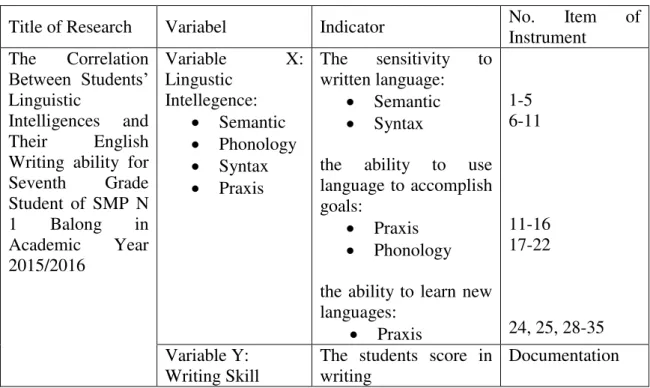
Instrument is used to get data. In this research researcher uses a test essay writing to test writing language intelligence ability, on the other hand the researcher use questionnaire. Questionnaires rely on written information supplied directly by people in response to questions asked by the researcher.27 Then, the researcher also used documentation method to get some data about student‟s writing skill. In this research, data collection instrument is shown in this table as below.
Table 3.1 Instrument of Data Collection
Title of Research Variabel Indicator No. Item of
Instrument The Correlation
Between Students‟
Linguistic
Intelligences and Their English Writing ability for Seventh Grade Student of SMP N 1 Balong in Academic Year 2015/2016
Variable X:
Lingustic Intellegence:
Semantic
Phonology
Syntax
Praxis
The sensitivity to written language:
Semantic
Syntax
the ability to use language to accomplish goals:
Praxis
Phonology the ability to learn new languages:
Praxis
1-5 6-11
11-16 17-22
24, 25, 28-35 Variable Y:
Writing Skill
The students score in writing
Documentation
27 Martyn Denscombe, The Good Research Guide 2nd edition. (New York: Mc Graw Hill, 2003), 145.
D. Technique of Data Collection
In this research, the researcher used questionnaire, data documentation to collect data.
1. Questionnaire
Questionnaire is the idea of formulating precise written question, for those whose opinions or experience you are interested in, seems an obvious strategy for finding the answers to the issues that interest you.28
In this research, two instrument were used to find out score about students‟ Lingustic intelligence in SMP N 1 Balong in Academic year 2015/2016.
a. Multiple intelligence inventory by Walter McKanzie
This questionnaire has 90 items and consists of 9 sections, each measuring one type of intelligences with 10 items. The researcher focused in section 7 that indicates Linguistic intelligence strength.
b. A Likert type of Linguistic Intelligence questionnaire derived from Gardner‟s MI Models and a questionaire devised by Chislett MSc and Chapman.
It consists of 32 related questions, for each of which 4 options are considered. In each question that count as follow:
1) Mostly Agree = 4 points 2) Slightly Agree = 3 points 3) Slightly Disagree = 2 points
28 Loraine Blaxter at al., How to Research; 3rd Ed., (New York: Open University Press, 2006), 201.
4) Mostly Disagree = 1 point 2. Documentation
The documentary sources identified below are written sources.
There are alternative types of documents for research, which take the form of visual sources (pictures, artefacts etc.) and even sounds (music). These also constitute some form of „document‟ which has a value for research but, because they are used relatively rarely within the social sciences, the initial comments are restricted to written forms of documents..29
In this research, documentation was used to get some data about students‟ writing skill in VII grade of SMP N 1 Balong Ponorogo in academic year 2015/2016. The data were gotten from the result of linguistic intelligence questionnaries and students‟ score in writing skill.
E. Technique of Data Analysis
The data that have been collected by using research instrument to be analyzed. Dealing research construction, it correlates between two variables and two data that were obtained are interval. This, to know whether or not there is significant correlation between students‟ linguistic intelligence and their English writing ability for seventh grade students of SMP N 1 Balong in academic year 2015/2016. In this research, there were some quality that used to measure a compatibilty, efficiency, and consistency.30
29 Martyn Denscombe, The Good Research Guide (2nd Edition), (Philadelpia: Open University Press,2003),212.
30 Ngalim Purwanto, Prinsip-Prinsip dan Teknik: Evaluasi Pengajaran, (Bandung, Remaja Rosdakarya, 2009), 137.
1. Validity
Validity is an important key to effective research. Instrument measurement variable is valid in empiric if researcher spread instrument to respondent who not real respondent approximately 20-30 respondents.31So, the researcher checked the validity of instrument in SMP N 1 Balong and the total respondent were 18 students of seventh grade who selected randomly. In this form, resercher using validity technique of correlation product moment by Karl Pearson.32 The formulation is as follow:
Rxy= � ( )−( )( )
(�( 2)−( )2)(� 2−( )2)
Notes:
rxy = The correlation coefficient between X variable and Y variable.
∑x = the total Number of score multiplication of X variable (students‟
Linguistic intelligence) and Y variable (English Writing ability).
∑y = the total number of scores of Y variable.
∑x2 = the total number of square score X variable.
∑y2 = the total number of square score Y variable.
The steps of the data analysis applied in this research are:
a. Determining ∑x, ∑y, ∑xy, ∑x2, ∑y2.
b. Computing by applying the formula of product moment correlation.
c. Determining of significant standart 5% and 1%.
31 Andhita Dessy Wulansari, Penelitian Pendidikan: Suatu Pendekatan Praktik dengan
Menggunakan SPSS.( STAIN PO PRESS, 2012), 82.
32 Retno Widyaningrum, Statistik: Edisi Revisi, (Yogyakarta: Pustaka Felicha, 2013), 105.
d. Determining the correlation criteria by appliying the indexes of corellation as follow:33
Scale Interpretation
0,800 – 1,000 High correlation 0,600 – 0,800 Sufficient correlation 0,400 – 0,600 Fair Correlation 0,200 – 0,400 Low correlation 0,000 – 0,200 Very low correlation
e. Making conclusion by comparing the second, third, and fourth steps.
According to the formulation above, the researcher checked questionaire from 18 students and found that rtable was 0,444. It means that rt > 0,444 and it can be said that the data is valid.
Table 3. 2
The Result of Validity Test
Item Number “r” Calculate “r” critical Criterion
1 0,456 0,444 VALID
2 0.498 0,444 VALID
3 0,682 0,444 VALID
4 1,737 0,444 VALID
5 0,448 0,444 VALID
6 0,959 0,444 VALID
7 0, 929 0,444 VALID
8 0,711 0,444 VALID
9 0,639 0,444 VALID
10 0,737 0,444 VALID
11 0,588 0,444 VALID
12 0,832 0,444 VALID
13 0,510 0,444 VALID
14 0,732 0,444 VALID
15 0,853 0,444 VALID
16 0,468 0,444 VALID
17 0,960 0,444 VALID
18 0,929 0,444 VALID
19 0,816 0,444 VALID
33 Suharsimi Arikunto, Prosedur Penelitian Suatu Pendekatan Praktik, (Yogyakarta:
Rineka Cipta, 2002), 276.
20 0,713 0,444 VALID
21 0,449 0,444 VALID
22 0,729 0,444 VALID
23 0,436 0,444 INVALID
24 0,576 0,444 VALID
25 0,449 0,444 VALID
26 0,381 0,444 INVALID
27 0,421 0,444 INVALID
28 0,475 0,444 VALID
29 0,706 0,444 VALID
30 0,542 0,444 VALID
31 0,469 0,444 VALID
32 0,616 0,444 VALID
33 0,499 0,444 VALID
34 0,575 0,444 VALID
35 0,981 0,444 VALID
According to the table above, they were 35 items of questionaire.
But there were 3 invalid items, it means that they were 32 valid questionaires which take to students.
2. Reliability
Reliability is constancy or carefulness of instrument evaluation. In quantitative research, reliability is an essentially a synonym for dependability, consistency, and replicability over time, over instruments, and over groups of respondent.34 Instrument measurement variable is reliable if researcher spread instrument to respondent who not real respondent approximately 20-30 respondents.35To measure reliability used Alpha Cronbach formulation. The step are below:
34 Louis Cohen et al., Research Method in Education, (New York: Madison Avenue, 2007), 146.
35 Andhita Dessy Wulansari, Penelitian Pendidikan: Suatu Pendekatan Praktik dengan
Menggunakan SPSS.( STAIN PO PRESS, 2012), 86.
a) Find varians �2 every item.
b) Find �2
c) Find Total Varians ��2 d) Find Reliability
The formula as below:
Varians (� 2):
�2=
2
� − � 2
Note:
x2 = quadrate of x variables x = x variables
n = number of respondent Alpha Cronbach formulation:
r11 = �
�−1 1−Ʃσσ2
t2
Notes :
k = Number of Item36
36 Andhita Dessy Wulansari, Penelitian Pendidikan: Suatu Pendekatan Praktik dengan
Menggunakan SPSS.( STAIN PO PRESS, 2012), 90.
Table 3.3 Table of Varians
Item Number Varians
1 0,694
2 0,666
3 0,584
4 0,534
5 0,766
6 0,877
7 0,666
8 0,839
9 0,444
10 0,645
11 0,444
12 0,638
13 0,472
14 0,608
15 0,432
16 0,444
17 0,645
18 0,361
19 0,361
20 0,321
21 0,432
22 0,321
23 0,331
24 2,024
25 0,583
26 0,311
27 0,098
28 0,237
29 0,432
30 0,250
31 0,432
32 0,432
33 0,385
34 0,250
35 0,250
Total 18,198
Formulating Reliability (Alpha Cronbach):
= �
�−1 1− �� 2
�2
= 35
34 1−18,19819,694
= 1, 294 0, 595
= 0.769
From the formulation above, the researcher found reliability. If r11 > r table
so, the instrument is reliable. And if r11 < r table so the instrument is not reliable.
The result of linguistic intelligence is 0,769. It can be conclude 0,769 > 0,444 so the research instrument are reliable.
CHAPTER IV RESEARCH RESULT
In previous chapter, the researcher has already checked validity and reliability that used to determine how much item that can be used to test. In this chapter researcher serves the research result. It involves research location (see appendix 4), general research, and specific research. In general research described teaching writing in SMP N 1 Balong, in specific research serves data description, data analysis, discussion and intepretation.
A. General Description
According to PPLK 2 or teaching practice at SMP N 1 Balong, the researcher observed teaching writing in seventh grade students. Writing section did not teach everyday or every meeting. But, writing section was certainly tought every unit. That was divided into eight times meeting, but one section could spend two times meeting every week. But writing section usually spent one time meeting in teaching writing class. One chapter were tought in four sections. That were listening, speaking, reading, and writing.
For instance, in teaching writing, especially descriptive text material, the time allotment was 2 X 45 minutes. For the reason, teacher needed to observe that there was linguistic intelligence to evolve students‟ ability.
Related to students linguistic intelligence, its intelligence involves sensitivities to spoken and written language, the ability of learning languages,
28
and the capacity for using language to accomplish certain goals.37 So, especially in seventh grade, indirectly, students were asked to evolve themselves about linguistic intelligence. But the researcher focused on written language. In this case, teacher gave problem or material to students (e.g descriptive text) and required them to solve that problem, that was about language features and generic structure of descriptive text. According to the material was given to students, they learned how to solve problems such language features and generic structure of descriptive text then the goals of descriptive text were students developed main idea and used their sensitivity in written. In this case, teacher in assessing students‟ linguistic intelligence capacity easily. Student linguistic intelligence, there were four categories.
That were semantics, phonology, syntactics, and praxis. In SMP N 1 balong, students were taught writing in part of english lesson, but indirectly students were learned about semantics, phonology, syntactics, and praxis but not all at once. Writing was taught two times every chapter. Related linguistic intelligence students were taught step by step each part. According to George Yule, there is semantics, semantics is study meaning, phrases, and sentences.38 In this section, students summarized a descriptive text. In summarizing, students should be able to hold all in diction, punctuation, grammatical, and meaningful. About diction, students ought to use appropriate words in making sentence. In punctuation, students must
37 Leila Vakili Samiyan, The Relationship Between Linguistic Intelligence and L2 Learning
Strategis among EFL Learners with Intermediate Level of Proficiency (Int. Journal of Literature, Language, and Linguistics,1,2013),89
38 George Yule, The Study of Language 3rd edition, (New York: Cambridge University
Press, 2006), 100.
compose descriptive text with correct punctuation, such commas, dots, etc.
Furthermore, students must use correct grammatical, and the paragraph is meaningful. So, the readers easily read that text. Then, Students must comprehend sentence pattern to build more relevant like in grammar section.
In this section, students were given material about simple present tense. This grammar was used to compose description text in the next part. Others, teacher offered new vocabularies to students in comprehending meaning, next teacher gave exercises like sentence gaps. Then phonology, it is the study about articulation of speech sound.39 In phonology, students imitated teacher said like listen and repeat. In this section students were asked for hear and repeat how teacher said the words or sentences by drilling the articultion of word and sentences clearly. Next, students practiced them in front of the class.
There is syntactics, syntactics is about sentence structure.40 In syntactics students can make sentence correctly either grammatically or semantically.
After students known the meaning, students learned about the structure, like generic structure in descriptive text, etc. In this part, students were asked to write a descriptive text with appropriate diction, correct grammatically, meaningful, and structuralized. The last is praxis, praxis is about language art.41 Students must know the culture or character of foreign language, students must know, memorize, and develop new vocabularies. In this part, varies examples of descriptive text were given in simple composity.
39 George Yule, The Study of Language 3rd edition, (New York: Cambridge University
Press, 2006), 43.
40 Ibid.
41 The Praxis Study Companion:Middle School English Language Art (www.ets.org/praxis),
accessed february 12th, 2016.
B. Specific Description 1. Data Description
The population of this research was the students of seventh grade at SMP N 1 Balong. The Sample was taken by Cochran sampling formulation. As explained above, the total sample was 142 students from 18 students each class. The list of sample is shown as follow.
a. The Data of Linguistic Intelligence
In this research, to get the score of students‟ linguistic, the researcher used A Likert type of linguistic intelligence questionaire derived from Gardner‟s MI Models and a questionaire devised by Chislett MSc and Chapman. It consists of 32 related questions, for each of which 4 options are considered (Mostly Agree = 4 points, Slightly Agree = 3 points, Slightly Disagree = 2 points, Mostly Disagree = 1 point).
Based on the questionaire, the researcher of the students‟
linguistic intelligence score as follow:
Table 4.1
The Students‟ Linguistic Intelligence Score 7A Class
No. Name Score
1 Bayu Roh'azi 86
2 Pingky Nur Widia 82
3 Ardi Muhamad 82
4 Vanesa Kusuma 90
5 Fatkhurrozi 91
6 Lia Agustin 93
7 Jesica Shelcillya 84
8 Silvi Eka Pertiwi 85
9 Elly Elviana 91
10 Hesti Putri Ken Ristri 93
11 Lia Purwaningsih 88
12 Firda Katrina 89
13 Febri Anwar 90
14 Anisa Lulu 85
15 Dwi Ayu Avita Sari 88
16 Tedi Dwi Pradika 89
17 Dika Alvira 92
18 Anggraeni Nur K 87
7B Class
No Name Score
1 Andika Vernando P 89
2 Mukhlis Nur Al Aiyini 91
3 Anisa Salsabila 76
4 Erin Yuliana Putri 73
5 Endang Tri Utami 77
6 Noor Diana Anindya A.R 86
7 Didik Hariyadi 82
8 Muhammad Andri Dwi S 95
9 Riska Priyanti 81
10 Masayu Putri M 95
11 Ahmad Rifki Fauzi 81
12 Muhammad Nasrul P 84
13 Nofa Rohma Dulmanab 85
14 Imron Krisnatul M.F 89
15 Tantowi Yahya 88
16 Ananda Azizul Hakim 87 17 Rahmat Dhiki Nurhuda 87
18 Ihsan Faturrohman F 95
7C Class
No. Name Score
1 Ayu Agustyas Ningrum 98
2 Devy Anindya Shaharani 72
3 Diego Pria Pratama 80
4 Putri Kurnia Zahra 82
5 Alvi Amalia Aswinda P. 80
6 Ani Imelia Maulida 93
7 Nurul Rapita Sari 80
8 Kharisma Wahyu Pratiwi 100
9 Bayu Ramdani 81
10 Andrean Alfarizqi 80
11 Elfrida Bayu Muhtadi 82 12 Putra Azizs Prasetya 97 13 Nanda Kristina Nabila R 93 14 Ananda Yoga Prasetya 82
15 David Rohmad Wijaya 89
16 Fina Lailatul Maghfiroh 93
17 Mega Lestari 81
18 Bayu Ramdani 85
7D Class
No. Name Score
1 Alfina Fia Narbila 86
2 Desita Maya Anggraini 82
3 Dwi Bagus Ramadan 87
4 Fauziah Ardyningtyas 76
5 Febi Sugianto 83
6 Coryo Albert Conan A 80
7 Agus Wahyudi 96
8 Sri Wahyuni Wulandari 82
9 Dea Fitri Cahyanti 100
10 Sindy Ayu Zahwarani 101
11 Robby Kurniawan R 84
12 Ariya Shyahrul Aljannah 84 13 Ristya Silvy Reza Qirana 89
14 Lady Janice 84
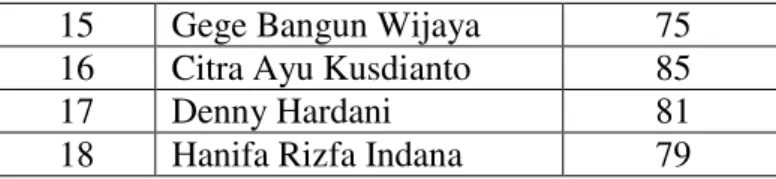
15 Gege Bangun Wijaya 75
16 Citra Ayu Kusdianto 85
17 Denny Hardani 81
18 Hanifa Rizfa Indana 79
7E Class
No. Name Class
1 Bagas Khoiri Mustofa 108
2 Siti Umaroh 103
3 Dedy Saputra A.H 79
4 Andhika Yoga Pangestu 83 5 Intan Wahyu Setyo Rini 82
6 Zafhira Ramadani 89
7 Amanda Nadylla Kustina 75
8 Abby Yusna Mahendra 77
9 Aditya Dwi Nur M 76
10 Nindy Putri Nurmalitasri 101
11 Diki Andri Saputra 79
12 Fitri Dwi Murtanti 96
13 Gonggo Budi Wijaya 82
14 Sri Rahayu 84
15 Pramudya 84
16 Amelia Shabrina C 82
17 Nur Fadilah Syamsa H 83
18 Azwan Fazliyudin 78
7F Class
No. Name Score
1 Putra Aditya Pangestu 79
2 Angga Febriyantoro 78
3 Bagus Renaldi 75
4 Prastiyan Dwi Hilmawan 73
5 Ngainul Faldiana 85
6 Nadia Octavia Nooriyant 77
7 Nurani Intan Muji R 98
8 Reni Sri Widya Ningrum 98
9 Akbar Abdul Fukhroni 76
10 Rena Sri Widya Angraini 98 11 Aprilia Krisna Mukti 93 12 Wahida Aprilia Putri 94
13 Salsa Kurniasih 97
14 Nadya Pricilia 99
15 Natasya Sal Sabila 89
16 Andy Hardianto 71
17 Agus Dwi Giono 70
18 Nanda Risma Ariyani 89
7G Class
No. Name Score
1 Agnes Arianti Putri 82
2 Nita Selviana Maharani P 82
3 Artika Wardani 87
4 Hernita Lucky W 85
5 Kiki Andriansyah 85
6 Nanda Aulia 94
7 Anisa Dwi Ratnasari 93
8 Dadang Setiyo Bawono 75
9 Alfina Febrianti 90
10 Rijul Alex Candra S 81
11 Onky Lavio Ridha F 86
12 Feri Nur Syamsudin 75
13 Ahmaddy 76
14 Bagus Defri Saputra 80
15 Dandi Sukoco 79
16 Fatkur Prasetyo 83
17 Ricki Ahmad Prayoga 85
18 Yuans Yudhistira 75
7H Class
No. Name Score
1 Arif Fadhilah 85
2 Noval Septian Rifani 86
3 Surizky Eka Annisa Putri 81
4 Niken Suryani 75
5 Vikko Isnaini 80
6 Tantri Putri Nurhidayah 80
7 Siti Nurhandayani 85
8 Dila Asfa Sajidah 79
9 Astin Vitasari 83
10 Devi Tri Ratna W 84
11 Dino Setyadi Nugroho 77 12 Elma Dwi Kurnia Sari 80
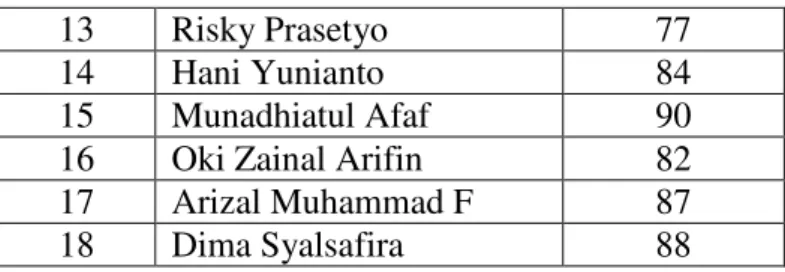
13 Risky Prasetyo 77
14 Hani Yunianto 84
15 Munadhiatul Afaf 90
16 Oki Zainal Arifin 82
17 Arizal Muhammad F 87
18 Dima Syalsafira 88
b. The Data of Students’ English Writing Skill
The data of students‟ writing skill gotten from teacher documentation of writing assesment in the last meeting before Final Test. The data got to measure students‟ writing skill level. From the level, the researcher known students who get high, intermediate, and low writing skill level. The categories that shown the analysis of students‟ writing skill score were explained in the next detail.
Table 4.2 The Students‟ English Writing Skill Score 7A Class
No. Name Score
1 Bayu Roh'azi 82
2 Pingky Nur Widia 85
3 Ardi Muhamad 84
4 Vanesa Kusuma 85
5 Fatkhurrozi 84
6 Lia Agustin 81
7 Jesica Shelcillya 83
8 Silvi Eka Pertiwi 85
9 Elly Elviana 85
10 Hesti Putri Ken Ristri 83
11 Lia Purwaningsih 81
12 Firda Katrina 84
13 Febri Anwar 85
14 Anisa Lulu 83
15 Dwi Ayu Avita Sari 85
16 Tedi Dwi Pradika 84
17 Dika Alvira 85
18 Anggraeni Nur K 83
7B Class
No Name Score
1 Andika Vernando P 80
2 Mukhlis Nur Al Aiyini 78
3 Anisa Salsabila 84
4 Erin Yuliana Putri 82
5 Endang Tri Utami 81
6 Noor Diana Anindya A.R 80
7 Didik Hariyadi 80
8 Muhammad Andri Dwi S 78
9 Riska Priyanti 82
10 Masayu Putri M 80
11 Ahmad Rifki Fauzi 80
12 Muhammad Nasrul P 78
13 Nofa Rohma Dulmanab 78
14 Imron Krisnatul M.F 77
15 Tantowi Yahya 77
16 Ananda Azizul Hakim 80
17 Rahmat Dhiki Nurhuda 80
18 Ihsan Faturrohman F 78
7C Class
No. Name Score
1 Ayu Agustyas Ningrum 82
2 Devy Anindya Shaharani 82
3 Diego Pria Pratama 78
4 Putri Kurnia Zahra 85
5 Alvi Amalia Aswinda P. 82
6 Ani Imelia Maulida 83
7 Nurul Rapita Sari 85
8 Kharisma Wahyu Pratiwi 85
9 Bayu Ramdani 78
10 Andrean Alfarizqi 84
11 Elfrida Bayu Muhtadi 80 12 Putra Azizs Prasetya 77 13 Nanda Kristina Nabila R 85 14 Ananda Yoga Prasetya 82
15 David Rohmad Wijaya 84
16 Fina Lailatul Maghfiroh 85
17 Mega Lestari 84
18 Bayu Ramdani 78
7D Class
No. Name Score
1 Alfina Fia Narbila 83
2 Desita Maya Anggraini 80
3 Dwi Bagus Ramadan 76
4 Fauziah Ardyningtyas 78
5 Febi Sugianto 75
6 Coryo Albert Conan A 75
7 Agus Wahyudi 67
8 Sri Wahyuni Wulandari 79
9 Dea Fitri Cahyanti 80
10 Sindy Ayu Zahwarani 80
11 Robby Kurniawan R 75
12 Ariya Shyahrul Aljannah 76 13 Ristya Silvy Reza Qirana 80
14 Lady Janice 79
15 Gege Bangun Wijaya 75
16 Citra Ayu Kusdianto 80
17 Denny Hardani 78
18 Hanifah Rizfa Indana 78
7E Class
No. Name Class
1 Bagas Khoiri Mustofa 77
2 Siti Umaroh 76
3 Dedy Saputra A.H 78
4 Andhika Yoga Pangestu 75 5 Intan Wahyu Setyo Rini 74
6 Zafhira Ramadani 79
7 Amanda Nadylla Kustina 78
8 Abby Yusna Mahendra 75
9 Aditya Dwi Nur M 75
10 Nindy Putri Nurmalitasri 80
11 Diki Andri Saputra 78
12 Fitri Dwi Murtanti 79
13 Gonggo Budi Wijaya 74
14 Sri Rahayu 79
15 Pramudya 74
16 Amelia Shabrina C 78
17 Nur Fadilah Syamsa H 80
18 Azwan Fazliyudin 75
7F Class
No. Name Score
1 Putra Aditya Pangestu 77
2 Angga Febriyantoro 74
3 Bagus Renaldi 76
4 Prastiyan Dwi Hilmawan 78
5 Ngainul Faldiana 78
6 Nadia Octavia Nooriyant 84
7 Nurani Intan Muji R 79
8 Reni Sri Widya Ningrum 85
9 Akbar Abdul Fukhroni 75
10 Rena Sri Widya Angraini 85 11 Aprilia Krisna Mukti 80 12 Wahida Aprilia Putri 76
13 Salsa Kurniasih 79
14 Nadya Pricilia 85
15 Natasya Sal Sabila 79
16 Andy Hardianto 76
17 Agus Dwi Giono 75
18 Nanda Risma Ariyani 80
7G Class
No. Name Score
1 Agnes Arianti Putri 78
2 Nita Selviana Maharani P 70
3 Artika Wardani 80
4 Hernita Lucky W 80
5 Kiki Andriansyah 85
6 Nanda Aulia 85
7 Anisa Dwi Ratnasari 80
8 Dadang Setiyo Bawono 78
9 Alfina Febrianti 70
10 Rijul Alex Candra S 80
11 Onky Lavio Ridha F 65
12 Feri Nur Syamsudin 70
13 Ahmaddy 78
14 Bagus Defri Saputra 78
15 Dandi Sukoco 60
16 Fatkur Prasetyo 75
17 Ricki Ahmad Prayoga 78
18 Yuans Yudhistira 75
7H Class
No. Name Score
1 Arif Fadhilah 70
2 Noval Septian Rifani 75
3 Surizky Eka Annisa Putri 75
4 Niken Suryani 78
5 Vikko Isnaini 83
6 Tantri Putri Nurhidayah 65
7 Siti Nurhandayani 70
8 Dila Asfa Sajidah 80
9 Astin Vitasari 78
10 Devi Tri Ratna W 78
11 Dino Setyadi Nugroho 80 12 Elma Dwi Kurnia Sari 80
13 Risky Prasetyo 70
14 Hani Yunianto 75
15 Munadhiatul Afaf 78
16 Oki Zainal Arifin 70
17 Arizal Muhammad F 75
18 Dima Syalsafira 80
2. Data Analysis
In this research, the researcher took 142 students as research samples. Those samples were the seventh grade students of SMP N 1 Balong in academic year 2015/2016.
a. Analysis Linguistic Intelligence to the Seventh Grade Students at SMP N 1 Balong in Academic Year 2015/2016
The analysis was conducted to determine the linguistic intelligence of seventh grade students at SMP N 1 Balong in academic year 2015/2016. The linguistic intelligence could be determined from the score of linguistic intelligence which made into score interval. The steps were explain:
1) To determine MX
2) To determine SDx
3) To determine top up of linguistic intelligence 4) To determine bottom of linguistic intelligence
5) To make an analysis of students‟ linguistic intelligence Table 4.3 Analysis Data of Linguistic Intelligence
X F Fx x=(X-Mx) x2 f.x2
108 1 108 23 529 529
103 1 103 18 324 324
101 2 202 16 256 512
100 2 200 15 225 450
99 1 99 14 196 196
98 4 392 13 169 676
97 2 194 12 144 288
96 2 192 11 121 242
95 3 285 10 100 300
94 2 188 9 81 162
93 7 651 8 64 448
92 1 92 7 49 49
91 3 273 6 36 108
90 4 360 5 25 100
89 9 801 4 16 144
88 4 352 3 9 36
87 6 522 2 4 24
86 5 430 1 1 5
85 11 935 0 0 0
84 9 756 -1 1 9
83 5 415 -2 4 20
82 14 1148 -3 9 126
81 7 567 -4 16 112
80 9 720 -5 25 225
79 6 474 -6 36 216
78 2 156 -7 49 98
77 5 385 -8 64 320
76 5 380 -9 81 405
Mx = fx
n
= 12264
144
= 85,167 ≈ 85
After determining MX , then the researcher determined SDX . It was conducted to know how much the standart of deviation of linguistic intelligence score. The formula was explain:
SDx = fx
2 N
= 7702
144
= 87,76
144 = 0,609 ≈ 1
After determining MX and SDX , then the researcher determines top up and bottom of linguistic intelligence score. It is conducted to know the limitation of standart category from linguistic intelligence score.
Top up of linguistic intelligence score = Mx + 1.SDx = 85 + 1.1
75 7 525 -10 100 700
73 2 146 -12 144 288
72 1 72 -13 169 169
71 1 71 -14 196 196
70 1 70 -15 225 225
∑ 12264 7702
= 85 + 1
= 86
Bottom of linguistic intelligence score = Mx - 1.SDx
= 85 - 1.1
= 85 - 1
= 84
The linguistic Intelligence of seventh grade students at SMP N 1 Balong can be determined by accumutating data above. The analysis can be seen clearly as the table below:
Table 4.4 The Analysis of Linguistic Intelligence Interval F Category Percentage
86 – 108 59 High 40,97%
85 11 Fair 7,63%
70 – 84 74 Low 51,38%
From the calculation above, it was known that the students‟
linguistic was very variaties. There were 40,97% or 59 students included high category and score were between 86-108. Then 7,63%
or 11 students were fair category then score was 85, and 51,38% or 74 students included low category by in line the score were between 70- 84. So, the researcher concluded that the students‟ linguistic intelligence, in this case, was low.
b. Analysis English Writing Skill to the Seventh Grade Students of SMP N 1 Balong in Academic Year 2015/2016
The analysis was conducted to determine the English writing skill of seventh grade students at SMP N 1 Balong in academic year 2015/2016. The English writing skill could be determined from its score which made into score interval.
The steps were explain:
1) To determine My
2) To determine SDy
3) To determine top up of the English writing skill score 4) To determine bottom of the English writing skill score 5) To make an analysis of students‟ English writing score Table 4.5 Analysis Data of Students‟ English Writing Skill
Y F Fy y=(Y-My) y2 f.y2
85 17 1445 6 36 612
84 9 756 5 25 225
83 7 581 4 16 112
82 7 574 3 9 63
81 3 243 2 4 12
80 25 2000 1 1 25
79 8 632 0 0 0
78 26 2028 -1 1 26
77 5 385 -2 4 20
76 6 456 -3 9 54
75 16 1200 -4 16 256
74 4 296 -5 25 100
70 7 490 -9 81 567
67 1 67 -12 144 144
65 2 130 -14 196 392
60 1 60 -19 361 361
∑ 11343 2969
My = fy
n
= 11343
144
= 78,770 ≈ 79
After determining My , then the researcher determined SDy . It was conducted to know how much the standart of deviation of students English speaking ability score. The formula was as follows:
SDy = fy
2 N = 2969
144
= 54,48
144
= 0,378 ≈ 0
After that, researcher did not determine top up and bottom of students‟ English writing skill because SDy = 0. The analysis of students‟ English writing score was in the table below:
Table 4.6 The Analysis of Students‟ English writing score Interval F Category Percentage
79 – 85 76 High 52,77%
60 – 78 68 Low 47,22%
From the calculation above, it was known that the students‟
English writing skill were placed in two categories. There were 52,77% or 76 students include high category and the score were between 79-85, and 47,22% or 68 students included low category by scoring between 60-78. So, the researcher concluded that the students‟
English writing skill, in this case, was high.
c. The Correlation between Students’ Linguistic Intelligence and Their English Writing Skill of Seventh Grade Students at SMP N 1 Balong
This research is conducted to find out whether there is correlation between students‟ linguistic intelligence and writing skill or not. There are two variables, independent variable and dependent variable. Independent variable is linguistic intelligence, while dependent variable is students‟ English writing skill.
To know the correlation between those variables, the researcher takes some steps. The steps were explain:
1) Preparing the correlation map, the upper side was X variable with the lowest interval in the left side.
Variable X has H=108 and L=70
R = H - L + 1 k =
�
= 108 – 70 + 1= 39 = 39
5 = 7,8 ≈ 8
It means the lowest interval is 70–74 and the highest is 105- 109.
Variable Y has H=85 and L=60 R = H – L + 1 k =
�
= 85 – 60 + 1 = 26
3
= 26 = 8,66 ≈ 9
It means the lowest interval is 60-62 and the highest 84-86. See table. 4.7