About this chapter
The last chapter finished by showing you how to prepare a trial balance. The trial bal- ance has two main purposes: (i) to confirm that all transactions have been entered correctly in the double-entry system; and (ii) to provide the information necessary to prepare an entity’s basic financial statements. Such statements usually include a trading account, a profit and loss account, and a balance sheet.
In this chapter we show you how to prepare such statements for a trading entity. A trading entity is a fairly simple organization so it enables us to demonstrate the basic procedures without too many complications. The knowledge and experience that you gain from working your way through this chapter will then give you the foundation nec- essary for studying more complex organizations.
Another tale of woe
Chapter
4 Sole trader accounts
Cattles suspends executives and issues new alert
By Jane Croft and Maggie Urry Shares in Cattles plummeted 40 per cent on Tuesday after the subprime lender suspended three senior exec- utives in Welcome Financial Services, its main operating com- pany, and warned 2008 profits were likely to be ‘substantially lower’
than market expectations.
Cattles had previously warned profits would be ‘substantially lower’ just 11 days ago and said it expected it would be required to enter into talks with its banks and bondholders, which raised concerns among analysts that it might breach its lending covenants. Cattles shares, which peaked at more than 400p in early 2007, yesterday fell 2.1p to close at 3.lp.
The lender has asked Deloitte to review its bad debt impairment
provisions and said it believed that there had been a breakdown in internal controls that had resulted in its impairment policies having being applied incorrectly.
Analysts raised concerns that Cattles, which has delayed its 2008 results, could breach its banking covenants, which would trigger all
£2.6bn of its group debt to fall due.
Analysts had predicted Cattles would report profits of £170m in 2008 before its previous two profit warnings, but banking covenants would be breached if interest cover slipped below 1.75 times.
James Hamilton, analyst at Numia, said he believed interest cover would fall below that level if bad debt impairments were 15–16 per cent above his forecast.
‘Cattles dramatically expanded its loan book at the top of the eco- nomic cycle and used accounting policies that would allow the group to have loans 240 days in arrears before any impairment was taken to the profit and loss,’ he said.
Cattles is due to refinance a
£500m debt facility with a syndicate of 22 banks led by Royal Bank of Scotland later this summer, plus a further £135m facility that falls due to Royal Bank of Scotland in December. It has stopped lending to new customers.
It is feared that some of the banks may not roll over their loans and Cattles is conserving cash so it can repay some or all of that debt if necessary.
www.ft.com, 3 March 2009.
Questions relating to this news story can be found on page 93
²
FT
Source: Reproduced with permission from The Financial Times.
By the end of this chapter you should be able to:
G prepare a simple set of financial statements for a trading entity;
G make adjustments in sets of financial statements for stock, depreciation, accruals and prepayments, and bad and doubtful debts;
G list the main defects of historical cost accounting;
G explain why accounting profit is not the same as an increase in cash.
Learning objectives
Why this chapter is important
This chapter is important for non-accountants for the following reasons.
1 To distinguish between capital and revenue items. This is often a matter of judgement and it is not one that is always easy to make. You should not leave the decision entirely to your accountants because it has a major impact on the profit that your entity makes. Make sure that you get involved in the decision!
2 To be aware that subjective judgements are involved. Subjective judgements are involved in preparing annual (or periodic) accounts. The main adjustments are for stock, depreciation, accruals and prepayments, and bad and doubtful debts. The decisions that are taken can have significant effect on how much profit you make. So once again, don’t leave it to your accountants to decide what to do.
3 To understand that cash is not the same as profit. It is vital that you understand the dif- ference between cashand profit. If you don’t your entity is likely to go bankrupt. Just because you have made a profit doesn’t necessarily mean that you’ve got the same amount of money in the bank. All sorts of adjustments are made to the cash position before accountants arrive at what is called ‘profit’. Profit is not, repeat NOT, there- fore, simply the difference between cash received less cash paid.
In this section we are going to explain how to prepare a basic set of financial statements.
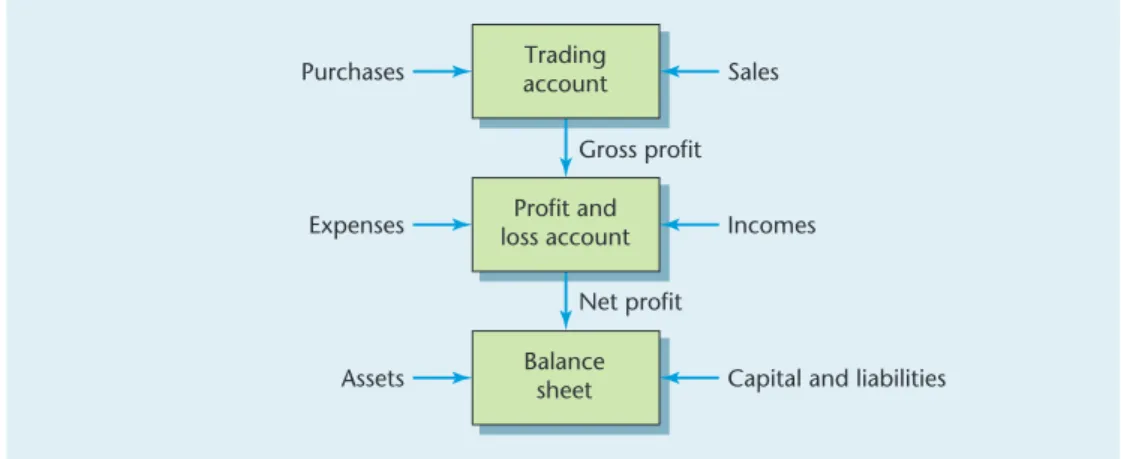
Such a set is usually made up of a trading account a profit and loss account, and a bal- ance sheet. You can see how they relate to each other in Figure 4.1. If an entity is not trading in goods but in services (say), a trading account will not, of course, be necessary.
Preparing basic financial statements
!
A profitable change
A change in accounting rules has meant that Deutsche Bank has made a profit instead of a loss. The bank was able to reclassify €25bn as ‘loans’ instead of
‘assets’. Price movements on loans do not have to be charged to the profit and loss account.
News clip
Source: Adapted from www.accountancyage.com/articles, 31 October 2008.
In order to keep our explanation simple we are going to assume for the time being that once the trial balance has been prepared no further adjustments are required. Then later on in the chapter we deal with a number of adjustments that usually have to be made at the period end (it’s usually a year). In practice the trial balance would normally be pre- pared before any adjustments are allowed for. They would then be entered in the books of accounts once everything has been agreed for that year.
We suggest that you adopt the following approach if you become involved in the year end procedures.
1 Double-check that your trial balance (TB) balances.
2 Go through the TB line by line, inserting against each balance ‘C’ (for a capital item) and ‘R’ (for a revenue item). Capital expenditure is expenditure that is likely to pro- vide a benefit to the entity for more than one accounting period. Revenue expenditure is expenditure that is likely to provide a benefit for just one period. Capital income (a term not normally used) includes the finance provided by the owners and long-term loans. Revenue income includes income from sales, dividends and rents. It is not always easy to make a distinction between capital and revenue items and some diffi- cult decisions may have to be taken.
3 Insert the ‘R’ balances either in the trading account or in the profit and loss account.
The recommended layout (or format) is shown in Example 4.1.
4 Transfer the ‘C’ balances to the balance sheet. See Example 4.1 for the format.
5 Calculate the gross profit (or loss) in the trading account, i.e. by deducting the cost of purchases from the trading income. Balance the account. Transfer the balance (i.e. the gross profit) to the profit and loss account.
6 Calculate the net profit (or net loss) by deducting the expenses from the gross profit plus any non-trading income. The balance is the net profit for the year (it could be a net loss). Balance the account. Transfer the balance to the balance sheet.
7 Separate all the capital income balances (including the net profit for the year) from all the capital expenditure items and classify them as shown in Example 4.1. Balance the balance sheet.
Trading account
Gross profit Sales Purchases
Incomes Expenses
Capital and liabilities Assets
Net profit Profit and loss account
Balance sheet
Figure 4.1 A trading entity’s basic accounts
!
(a) Accounting profit = cash received less cash paid True/false (b) Capital expenditure is normally the difference between cash receivedand cash paid. True/false
(c) Capital expenditure only provides a short-term benefit. True/false
Activity 4.1
Preparation of basic financial statements
The following trial balance has been extracted from Bush’s books of account as at 30 June 2012.
Name of account Dr Cr
£ £
Bank (1) (C) 5 000
Capital (at 1 July 2011) (2) (C) 11 000
Cash (3) (C) 1 000
Drawings (4) (C) 8 000
Motor vehicle at cost (5) (C) 6 000 Motor vehicle expenses (6) (R) 2 000
Office expenses (7) (R) 3 000
Purchases (8) (R) 30 000
Trade creditors (9) (C) 4 000
Trade debtors (10) (C) 10 000
Sales (11) (R) 50 000
––––––– –––––––
65 000 65 000 ––––––– –––––––
––––––– –––––––
Notes:
There were no opening or closing stocks.
R = Revenue items; C = Capital balances.
Required:
Prepare Bush’s trading and profit and loss account for the year to 30 June 2012 and a balance sheet as at that date.
Example 4.1
Bush
Trading and profit and loss account for the year to 30 June 2012
£ £
Sales (11) 50 000
Less: cost of goods sold:
Purchases (8) 30 000
–––––––
Gross profit 20 000
Less: expenses
Motor vehicle expenses (6) 2 000
Office expenses (7) 3 000 5 000
––––– –––––––
Net profit for the year 15 000
–––––––
–––––––
Answer to Example 4.1
²
Bush
Balance sheet at 30 June 2012
£ £
Fixed assets
Motor vehicles at cost (5) 6 000
Current assets
Trade debtors (10) 10 000
Bank (1) 5 000
Cash (3) 1 000
–––––––
16 000 Current liabilities
Trade creditors (9) 4 000 12 000
–––––– –––––––
18 000 –––––––
–––––––
Capital
Balance at 1 July 2011 (2) 11 000
Add: Net profit for the year* 15 000
Less: Drawings (4) 8 000 7 000
–––––– –––––––
18 000 –––––––
–––––––
* Obtained from the profit and loss account.
The bracketed number after each narration refers to the account number of each balance extracted from the trial balance.
1 Both the trading account and the profit and loss account cover a period of time. In this example it is for the yearto(or, alternatively, ending) 30 June 2012. The balance sheet is prepared at a particular moment in time. It depicts the balances as they were at a specific date. In this example they are shown as at 30 June 2012.
2 The trading account, the profit and loss account, and the balance sheet are presented in what is called the verticalformat, i.e. on a line-by-line basis starting at the top of the page and working downwards. This is in contrast to the horizontalformat. This format lists expenditure balances in the trading and profit and loss account and liability bal- ances in the balance sheet on the left-hand side of the page, while income and asset balances are shown on the right-hand side. The horizontal format is now out-of-date and is rarely used. Using the vertical format, the gross profitof £20,000 is not only the last line in the trading account but also the first line of the profit and loss account.
3 Both the trading account and the profit and loss accounts are accounts in their own right and they form part of the double-entry system. The balance sheet is merely a list of balances left in the accounting system after the profit and loss account has been prepared. The last line of the profit and loss account shows a net profit of £15,000.
This balance remains within the accounting system and so it will be carried forward to the next accounting period. It must, therefore, be included in the balance sheet, otherwise the balance sheet would not balance. You will find the £15,000 towards the bottom of the balance sheet.
4 The balance sheet is divided into two main sections. The first section shows that Bush owned net assetsworth £18,000 at 30 June 2012. It is split between fixed assetsof
£6000, i.e. those assets that are intended for long-term use in the business, and cur- rent assets, i.e. those assets that are constantly being turned over and replaced such as stock, debtors and cash. However, current liabilitiesof £4000 have been deducted from the current assets of £16,000 to show that there was £12,000 of net current assets. Current liabilities are amounts owing to various parties that will be due for payment within the next 12 months.
Tutorial notes
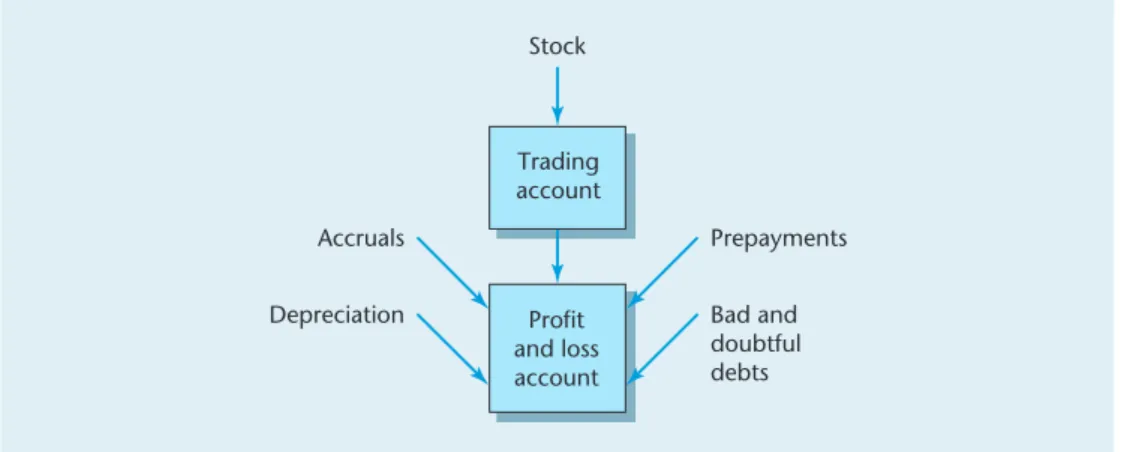
We can now move on to deal with a number of year end adjustments. These are events that are normally only made at the end of the year when the financial statements are being prepared. We are going to deal with four of them. They involve allowing for open- ing and closing stock, writing off some capital expenditure, dealing with outstanding debtors and creditors, and making an allowance for likely bad and doubtful debts (see Figure 4.2).
We begin with stock.
Year end adjustments
5 The second section shows how the £18,000 of net assets has been financed, i.e.
where the money has come from. There were two sources: £11,000 contributed by the owner as capital; and profit left in the business of £7000 – the £15,000 profit made for the year less £8000 taken out (in the form of cash or goods) by Bush during the year, presumably in anticipation that the entity would make a profit. Note that it is not customary to include proprietor’s drawings in the profit and loss account.
6 In a more detailed example the expense section in the profit and loss account, and the fixed assets, current assets, current liabilities and capital section in the balance sheet would include many more balances. The profit and loss account balances would be grouped in sections, e.g. administration expenses, distribution costs, selling expenses. In the balance sheet, both fixed asset and current asset balances would be shown in the order of the least liquid (or realizable) assets balances being placed first, e.g. property before machinery, stocks before debtors. Similarly, current liabilities would be listed in the order of those that are going to be paid lastbeing placed first, e.g. short-term loans would come before creditors. If there are a number of capital balances they too would be placed on ‘a last should be first’ basis, i.e. capital would come before retained profits.
In what order should the following balances be shown in a balance sheet?
(a) furniture and fittings; land; plant and machinery; property.
(b) cash; bank; insurance paid in advance; other debtors; trade debtors; stocks.
(c) bank overdraft; electricity owing; other creditors; trade creditors.
Activity 4.2
Answer to Example 4.1 continued
Stock
Prepayments Bad and doubtful debts Accruals
Depreciation
Trading account
Profit and loss account
Figure 4.2 Main adjustments
It is most unlikely that all the purchases that have been made during the year will have been sold by the end of it and so there will almost certainly be some goods still left in the stores. In accounting terminology, purchases still on hand at the period end are referred to as stock(the Americans use the term inventory).
When calculating the gross profit for the year, therefore, it is necessary to make some allowance for closingstock, since we want to match the sales revenue earned for the period with the cost of goods sold and not the cost of all of those goods actually pur- chased during the year. This means that we have to check the quantity of stock we have on hand at the end of the year and then put some value on it. In practice, this is an extremely difficult exercise. We shall be returning to it in a little more detail in Chapter 13. But we have another problem in dealing with stock. Closing stock at the end of one period becomes the opening stock at the beginning of the next period so we have to allow for openingstock as well. This means that the cost of goods sold is made up of three elements: opening stock, purchases and closing stock. Expressed as a formula:
By making an adjustment for opening and closing stock, the trading account should now appear as in Example 4.2.
We now move on to the second of our year end adjustments: depreciation.
Cost of goods sold= (opening stock+ purchases) –closing stock
Stock
Example of a trading account with stock adjustments
£ £
Sales 4 000
Less: Cost of goods sold
Opening stock 1 000
Purchases 2 000
––––––
3 000
Less: Closing stock 1 500 1 500
–––––– ––––––
Gross profit 2 500
––––––
––––––
Example 4.2
Assume that Company A has a sales revenue of £10 000 for the year. The opening stock had a value of £2000 and during year the company made purchases of £6000.
What would be the gross profit if the closing stock was valued at:
(a) £1500 (b) £2000 (c) £2500?
Activity 4.3
Expenditure that covers more than one accounting period is known as capital expendi- ture. Capital expenditure is not normally included in either the trading account or the profit and loss account but it would be misleading to exclude it altogether from the cal- culation of profit.
Expenditure on fixed assets (such as plant and machinery, motor vehicles and furniture) is necessary in order to help provide a general service to the business. The benefit received from the purchase of fixed assets must (by definition) extend beyond at least one account- ing period. So the cost of the benefit provided by fixed assets ought to be charged to those accounting periods that benefit from such expenditure. The problem is in determining what charge to make. In accounting terminology, such a charge is known as depreciation.
There is also another reason why fixed assets should be depreciated. By notcharging each accounting period with some of the cost of fixed assets, the level of profit will be correspondingly higher and the owner would then be able to withdraw more profit from the business. If this happens, insufficient cash may be left in the business and the owner may then find it difficult to buy new fixed assets.
It is not easy to measure the benefit provided to each accounting period by some groups of fixed assets and most depreciation methods tend to be somewhat simplistic. The method most commonly adopted is known as straight-line depreciation. This method charges an equal amount of depreciation to each accounting period that benefits from the purchase of a fixed asset. The annual depreciation charge is calculated as follows:
Another method that you might come across (although it is far less common than straight-line depreciation) is reducing balance. A percentage depreciation rate is applied to the original cost of the asset afterdeducting any depreciation charged in previous periods. Example 4.3 shows how it works.
The reducing balance method of calculating depreciation results in a much higher charge in the early life of the asset than does straight depreciation. So it is much more suitable for fixed assets such as vehicles because they tend to depreciate very quickly in the first two or three years.
You can see that in order to calculate the annual depreciation charge using either the straight-line method or the reducing balance method it is necessary to work out (a) how long the asset is likely to last; (b) what it can be sold for, and (c) its useful life.
It is customary to include fixed assets at their historic (i.e. original) cost in the balance sheet but some fixed assets (such as property) may be revalued at regular intervals. If this is the case, the depreciation charge will be based on the revalued amount and not on the his- toric cost. It should also be noted that even if the asset is depreciated on the basis of its revalued amount there is still no guarantee that it can be replaced at that amount. A combi- nation of inflation and obsolescence may mean that the eventual replacement cost is far in excess of either the historic cost or the revalued amount. It follows that when the fixed asset eventually comes to be replaced, the entity may not have sufficient cash available to replace it.
Depreciation
original cost of the asset – estimated residual value –––––––––––––––––––––––––––––––––––––––––––––
estimated life of the asset
The depreciation charge for the year is charged to the profit and loss account as an expense. The balance sheet would include the following details for each group of fixed assets:
1 the historic cost (or revalued amount), i.e. the gross book value (GBV);
2 the accumulated depreciation;
3 the net book value (NBV).
In other words, line 1 minus line 2 = line 3.
These balance sheet requirements are illustrated in Example 4.4.
Reducing balance method of depreciating fixed assets
A fixed asset costs £1000. Assume that the depreciation rate to be applied is 50%. The depreciation rate per year would then be as follows.
Year £
1. 01.01 Original cost 1000
31.12.01 Depreciation charge for the year (50%) 500 ––––––
Reduced balance 500
31.12.02 Depreciation charge for the year (50%) 250 ––––––
Reduced balance 250
31.12.03 Depreciation charge for the year (50%) 125 ––––––
Reduced balance 125
––––––
––––––
1 Depreciation would be charged each year until eventually the original cost of the asset is written off completely.
2 We have used a depreciation rate of 50% in this example in order to make it easier to follow. In practice the depreciation rate would be calculated by using the formula:
n R r =1 –
√
–––C
where r = the depreciation rate to be applied; n = the estimated life of the asset; R = the residual (scrap) value; and C = its historic cost.
Example 4.3
Tutorial notes
The cost of a company’s plant was £50,000. It was estimated that the plant would have a life of 20 years and that it could then be sold for £5000.
Using the straight-line method of depreciation, how much depreciation would you charge to the profit and loss account in Year 1?
Activity 4.4
The third of our last minute adjustments relates to accruals and prepayments.
We will deal with each of these adjustments separately.
Accruals
An accrual is an amount owing for a service provided during a particular accounting period but still unpaid for at the end of it. For example, the entity may have paid the last
Accruals and prepayments
Balance sheet disclosure of fixed assets
Net book
Fixed assets Cost Depreciation value
£ £ £
Buildings 100 000 30 000 70 000
Equipment 40 000 25 000 15 000
Furniture 10 000 7 000 3 000
–––––––– ––––––– ––––––––
150 000 62 000 88 000
–––––––– –––––––
–––––––– –––––––
Current assets
Stocks 10 000
Debtors 8 000
Cash 2 000
–––––––
20 000 ––––––––
108 000 ––––––––
––––––––
Example 4.4
What depreciation policy would you recommend? (a) straight-line for all assets; (b) reducing balance for all assets; (c) reducing balance for certain types of fixed assets and straight-line for all other assets; (d) other methods (state what).
Your answer:
Why?
Activity 4.5
Accrual mistake
Ex-executives of the USA company Krispy Kreme Doughnuts have settled a claim that the company allegedly under-accrued or reversed previously accrued incentive com-
pensation expenses with the intention of apparently inflating the company’s earn- ings. The personnel involved agreed to give up money allegedly made illegally.
News clip
Source: Adapted from www.cfo.com/article, 6 March 2009.
quarter’s electricity bill one week before the year end. In its accounts for that year, there- fore, it needs to allow for (or accrue) the amount that it will owe for the electricity consumed during the last week of the year. The amount due will normally be settled in cash a few days after the year end.
The accrual will be based on an estimate of the likely cost of one week’s supply of electricity, or as a proportion of the amount payable (if it has already received the invoice).
The accrual will be included in the amount charged to the profit and loss account for the period as part of the cost of the service provided. The formula is:
The closing accruals will be shown on the balance sheet as part of the current liabilities.
Prepayments
A prepayment is an amount paid in cash during an accounting period for a service that will be provided in a subsequent period. For example, assume a company’s year end is 31 December. It buys a van halfway through 2011 and licences it for 12 months, so half of the fee paid will relate to 2011 and half to 2012. It is necessary, therefore, to adjust 2011’s accounts so that only half of the fee is charged in that year. The other half will eventually be charged to 2012’s accounts.
Prepayments made during the year will be deducted from the amount charged to the profit and loss account. The formula is:
The closing prepayments will be shown in the balance sheet as part of the current assets.
(amounts paid during the year + closing accruals) – opening accruals
(amount paid during the year + opening prepayments) – closing prepayments You owed £500 to the telephone company at 31 December 2010. During the year to 31 December 2011 you paid the company £4000. At 31 December 2011 you owed the company £1000.
What amount for telephone charges would you debit to the profit and loss account for the year to 31 December 2011?
Activity 4.6
Jill had paid £3000 in advance for insurance at 31 December 2010. During the year to 31 December 2011 she paid the insurance company £10,000. At 31 December 2011 she estimated that she had paid £2000 for insurance cover that related to the following year.
What amount for insurance charges should Jill debit to her profit and loss account for the year to 31 December 2011?
Activity 4.7
The fourth main adjustment made in finalizing the annual accounts involves making adjustments for bad debts, and provisions for bad and doubtful debts.
The realization rule allows us to claim profit for any goods that have been sold, even if the cash for them is not received until a later accounting period. This means that we are taking a risk in claiming the profit on those goods in the earlier period, even if the legal title has been passed to the customer. If the goods are not eventually paid for, we will have overestimated the profit for that earlier period. Fortunately, there is a technique whereby we can build in an allowance for any possible bad debts,as they are called. This is quite a tricky operation and so we will need to explain it in two stages: first, how to account for bad debts; and, second, how to allow for the possibility that some debts may be doubtful.
Bad debts
Once it is clear that a debt is bad (i.e. it is highly unlikely it will ever be paid), then it must be written off to the profit and loss account immediately as an expense. This means that we have to charge it to the current year’s profit and loss account even though it may relate to an earlier period. This is because it is usually impractical to change accounts once they have been finalized because the owner may have already taken his profit out of the business in cash. On the balance sheet we then show trade debtors afterdeducting any bad debts that have been written off.
Bad and doubtful debts
Exemplar España
The Bank of Spain’s policy of forcing banks to provide for bad loans suggests that Spain can now be considered to be at ‘the cutting edge of accounting innovation’. Its regulators were determined that its banks
would not get involved in cookie-jar accounting ‘where executives excessively pad out provisions in good times and then quietly let the excess flow out in the tough times to disguise poor performance’.
News clip
Source: Adapted from www.ft.com/cms/s, 9 March 2009.
Gibson’s trade debtors at 31 December 2010 amount to £75,000. One of the trade debtors has owed Gibson £5000 since 2004. Gibson thinks that the debtor now lives abroad in exile.
Should Gibson write off the £5000 as a bad debt to the profit and loss account for the year to 31 December 2010? If so, which account should be debited and which account should be credited? And what amount for trade debtors should be shown in Gibson’s balance sheet at 31 December 2010?
Activity 4.8
Provisions for bad and doubtful debts
The profit in future accounting periods would be severely distorted if the entity suffered a whole series of bad debts. So it seems prudent to allow for the possibility that some debts may become bad. We can do this by setting up a provisionfor bad and doubtful debts (a provision is simply an amount set aside for something that is highly likely to happen), and debiting an annual charge to a special account. In order to calculate the charge, it is necessary to estimate the likely level of bad debts. The estimate will normally be based on the experience that the entity has had in dealing with specific bad debts. In simple book-keeping exercises, the provision is usually expressed as a percentage of the outstanding trade debtors.
The procedure is illustrated in Example 4.5.
Accounting for bad and doubtful debts
You are presented with the following information for the year to 31 March 2011:
£
Trade debtors at 1 April 2010 20 000
Trade debtors at 31 March 2011 (including £3000 of specific bad debts) 33 000 Provision for bad and doubtful debts at 1 April 2010 1 000 Note: A provision for bad and doubtful debts is maintained equivalent to 5 per cent of the trade debtors as at the end of the year.
Required:
(a) Calculate the increase required in the bad and doubtful debts provision account for the year to 31 March 2011.
(b) Show how both the trade debtors and the provision for bad and doubtful debts account would be featured in the balance sheet at 31 March 2011.
Example 4.5
£
Trade debtors as at 31 March 2011 33 000
Less: Specific bad debts to be written off to the profit
and loss account for the year to 31 March 2011 3 000 –––––––
30 000 –––––––
–––––––
Provision required: 5% thereof 1 500
Less: Provision at 1 April 2010 1 000
–––––––
Increase in the bad and doubtful debts provision account* 500 –––––––
–––––––
* This amount will be charged to the profit and loss account for the year to 31 March 2011 The balance on the provision for bad and doubtful debts account will be higher at 31 March 2011 than it was at 1 April 2010. This is because the level of trade debtors is higher at the end of 2011 than it was at the end of 2010. The required increase in the provision of £500 will be debitedto the profit and loss account. If it had been possible to reduce the provision (because of a lower level of trade debtors at the end of 2011 com- pared with 2010) the decrease would have been creditedto the profit and loss account.
Answer to Example 4.5(a)
Tutorial notes
²
As a non-accountant it is important for you to grasp just two essential points about the treatment of bad debts and doubtful debts.
G A debt should never be written off until it is absolutely certain that it is bad, because once it is written off, it is highly likely that no further attempt will ever be made to recover it.
G It is prudent to allow for the possibility of some doubtful debts. Nevertheless, it is perhaps rather a questionable decision to reduce profit by an arbitrary amount, e.g. by guessing whether it should be 3 per cent or 5 per cent of outstanding debtors.
Obviously, the level that you choose can have a big effect on the profit for the period in question.
In this section, we bring together the material covered in this chapter in a comprehensive example.
In previous sections of the book, we have emphasized that the calculation of accounting profit calls for a great deal of subjective judgement. Accounting involves much more than merely being very good at mastering some complicated arithmetical examples. So we think that it would be helpful (indeed essential) if we summarized the major defects inherent in the traditional method of calculating accounting profit. (Continues on page 89).
Accounting defects
A comprehensive example
Balance sheet extract at 31 March 2011
£ £ Current assets
Trade debtors 30 000
Less: Provision for bad and doubtful debts 1 500 –––––––
28 500 –––––––
–––––––
Watson keeps a provision for bad and doubtful debts account. It is maintained at a level of 3% of his total outstanding trade debtors as at the end of the year. The balance on the provision account at 1 January 2011 was £9000. His trade debtors at 31 December 2011 amounted to £250,000.
What balance on his provision for bad and doubtful debts does he need to carry for- ward as at 31 December 2011? What amount does he need to write off to the profit and loss account for that year? And will it increase or decrease his profit?
Activity 4.9
Answer to Example 4.5(b) continued
Example of basic accounting procedures
Wayne has been in business for many years. His accountant has extracted the following trial balance from his books of account as at 31 March 2011:
£ £
Bank 1 200
Capital 33 000
Cash 300
Drawings 6 000
Insurance 2 000
Office expenses 15 000
Office furniture at cost 5 000
Office furniture: accumulated depreciation at 1 April 2010 2 000 Provision for bad and doubtful debts at 1 April 2010 500
Purchases 55 000
Salaries 25 000
Sales 100 000
Stock at 1 April 2010 10 000
Trade creditors 4 000
Trade debtors 20 000
–––––––– ––––––––
139 500 139 500 –––––––– ––––––––
–––––––– ––––––––
Notes: The following additional information is to be taken into account.
1 Stock at 31 March 2011 was valued at £15,000.
2 The insurance included £500 worth of cover which related to the year to 31 March 2012.
3 Depreciation is charged on office furniture at 10 per cent per annum of its original cost (it is assumed not to have any residual value).
4 A bad debt of £1000 included in the trade debtors balance of £20,000 is to be writ- ten off.
5 The provision for bad and doubtful debts is to be maintained at a level of 5 per cent of outstanding trade debtors as at 31 March 2011, i.e. after excluding the bad debt referred to in note 4 above.
6 At 31 March 2011, there was an amount owing for salaries of £1000.
Required:
(a) Prepare Wayne’s trading and profit and loss account for the year to 31 March 2011.
(b) Prepare a balance sheet as at that date.
Example 4.6
(a) Wayne
Trading and profit and loss account for the year to 31 March 2011 (Source
£ £ of entry)
Sales 100 000 (TB)
Less: Cost of goods sold:
Opening stock 10 000 (TB)
Purchases 55 000 (TB)
–––––––
65 000
Less: Closing stock 15 000 (QN 1)
–––––––
50 000 –––––––
Answer to Example 4.6
²
(Source
£ £ £ of entry)
Gross profit 50 000
Less: Expenses:
Insurance (2000 – 500) 1 500 (Wkg 1)
Office expenses 15 000 (TB)
Depreciation: office furniture (10% ×5000) 500 (Wkg 2)
Bad debt 1 000 (QN 4)
Increase in provision for bad and doubtful debts 450 (Wkg 3)
Salaries (25 000 + 1000) 26 000 (Wkg 4)
–––––––
44 450 –––––––
Net profit for the year 5 550
–––––––
–––––––
(b) Wayne
Balance sheet at 31 March 2011
(Source
£ £ £ of entry)
Fixed assets Cost Accumulated Net book
depreciation value
Office furniture c/f 5 000 2 500 2 500 (TB and Wkg 5)
––––––– ––––––– –––––––
b/f 5 000 2 500 2 500
––––––– –––––––
––––––– –––––––
Current assets
Stock 15 000 (QN 1)
Trade debtors
(20 000 – 1000) 19 000 (Wkg 3)
Less: Provision for bad and
doubtful debts 950 18 050 (Wkg 3)
–––––––
Prepayment 500 (QN 2)
Cash at bank 1 200 (TB)
Cash in hand 300 (TB)
–––––––
35 050 Less: Current liabilities
Trade creditors 4 000 (TB)
Accrual 1 000 (QN 6)
––––––
5 000 30 050
–––––– –––––––
32 550 –––––––
–––––––
Financed by:
Capital
Balance at 1 April 2010 33 000 (TB)
Add: Net profit for the year 5 550 (P&L a/c)
Less: Drawings 6 000 (450)
–––––– –––––––
32 550 –––––––
–––––––
Key:
TB = from trial balance;
QN = extracted straight from the question and related notes;
Wkg = workings (see below);
P&L a/c = balance obtained from the profit and loss account. Answer to
Example 4.6 continued
As a non-accountant, it is most important that you appreciate one vital fact: the method that we have outlined for calculating the profit for a period results in an estimateof what the accountant thinks the profit should be. You must not place too much reliance on the absolute level of accounting profit. It can only be as accurate and as reliable as the assumptions upon which it is based. If you accept the assumptions, then you can be fairly confident that the profit figure is reliable. You will then not go too far wrong in using the information for decision-making purposes. But you must know what the assumptions are and you must support them. So we recommend that you always ques- tion accounting information before accepting it.
The main reasons why you should not place too much reliance on the actuallevel of accounting profit (especially if you are unsure about the assumptions upon which it is based) are summarized below.
G Goods are treated as being sold when the legal title to them changes hands and not when the customer has paid for them. In some cases, the cash for some sales may never be received.
G Goods are regarded as having been purchased when the legal title to them is trans- ferred to the purchaser, although there are occasions when they may not be received, e.g. if a supplier goes into receivership.
G Goods that have not been sold at the period end have to be quantified and valued.
Counting stock can be a complex operation and valuing it involves a considerable amount of subjective judgement.
Workings
1 Insurance: £
As per the trial balance 2 000
Less: Prepayment (QN 2) 500
–––––––
Charge to the profit and loss account 1 500
–––––––
–––––––
2 Depreciation:
Office furniture at cost 5 000
–––––––
–––––––
Depreciation: 10% of the original cost 500
–––––––
–––––––
3 Increase in provision for bad and doubtful debts:
Trade debtors at 31 March 2011 20 000
Less: Bad debt (QN 4) 1 000
–––––––
19 000 –––––––
–––––––
Provision required: 5% thereof 950
Less: Provision at 1 April 2010 500
–––––––
Increase in provision: charge to profit and loss 450 –––––––
–––––––
4 Salaries:
As per the question 25 000
Add: Accrual (QN 6) 1 000
–––––––
26 000 –––––––
–––––––
5 Accumulated depreciation:
Balance at 1 April 2010 (as per TB) 2 000
Add: Depreciation for the year (Wkg 2) 500
–––––––
Accumulated depreciation at 31 March 2011 2 500
–––––––
–––––––
G There is no clear distinction between capital and revenue transactions.
G Estimates have to be made to allow for accruals and prepayments.
G The cost of fixed assets is apportioned between different accounting periods using methods that are fairly simplistic and highly questionable.
G Arbitrary reductions in profit are made to allow for bad and doubtful debts.
G Historic cost accounting makes no allowance for inflation. So the value of £100 (say) at 1 January 2011 is not the same as £100 at 31 December 2011. As a result profit tends to be overstated largely because of low closing stock values and low depreciation charges.
The defects of historic cost accounting as listed are serious but no one as yet has been able to suggest a better method of accounting. For the time being, therefore, all we can do is to take comfort in the old adage that ‘it is better to be vaguely right than precisely wrong’.
We would like to emphasize one point before we leave this chapter. Many students are mystified when they begin their study of accounting why ‘profit’ is not the same as an increase in cash. Now that you have worked your way through this chapter you should be clear why this is not the case. So remember that:
Why? Most of the reasons are contained within the above list of accounting defects. We have also demonstrated the distinction pictorially in Figure 4.3. Basically, some cash items are excluded from the profit and loss account (e.g. capital expenditure) while some non-cash items are included in it such as a provision for bad and doubtful debts. You can perhaps compile your own list of reasons by having a go at answering Activity 4.10.
Accounting profit is not the same as an increase in cash.
Net cash flow Cash
received
Cash paid In
Out
+ –
+ –
+ –
+ – Capital
transactions
Opening and closing debtors
and creditors
Non-cash items Accounting profit
Figure 4.3 Cash vs accounting profit
List as many examples as you can of (a) cash transactions that are not normally included in a trading or profit and loss account; and (b) non-cash items that are usually included in such financial statements.
Activity 4.10
We began this chapter by showing you how to prepare a basic set of financial statements working from a trial balance and where there were no year end adjustments. We then went on to deal with four important adjustments that an entity usually has to make at the year end once the trial balance has been balanced. These four adjustments relate to opening and closing stocks, an allowance for depreciation on capital assets, adjusting for accruals and prepayments, and making allowances for bad and doubtful debts.
These four types of adjustment lead to many inherent deficiencies in the way that accounting profit is conventionally calculated. In concluding the chapter we summarized such deficiencies while at the same time reminding you that an increase in profit does not necessarily lead to an increase in cash.
Conclusion
Questions you should ask
It is important that as a non-accountant you should grasp the significance of this chapter. The decisions that your accountants will have taken in making a series of year end adjustments to the financial accounts (particularly for stocks, deprecia- tion, accruals and prepayment, and bad and doubtful debts) will have a considerable effect on the amount of profit that the entity reports for the year.
We suggest that you ask the following questions.
G What criteria have been used for distinguishing between capital and revenue items?
G Which items included in the financial statements may or may not be capital (or revenue)?
G What is the definition that you have used to determine revenue?
G Was a physical stock check done at the year end?
G What method was used to value the closing stock?
G What depreciation method has been used?
G Has historic cost been used to depreciate the fixed assets?
G If not, how has the cost of fixed assets been determined?
G How has the expected life of the assets been assessed?
G How do such lives compare with those used by our competitors?
G How have any residual values for the fixed assets been estimated?
G How have estimated values been determined for any accruals and prepay- ments?
G Have any bad debts been written off?
G How can we be certain that they are indeed bad?
G What basis is used to determine an appropriate level of provision for bad and doubtful debts?
!
The answers to these questions can be found within the text.
1 Name two important functions of a trial balance.
2 What are the three financial statements that make up a set of basic accounts?
3 What are the two broad groups into which all transactions may be classified?
4 Name the two stages involved in preparing the basic accounts.
5 What term is given to the difference between sales revenue and the cost of goods sold?
6 What term is given to the difference between the total of all revenue incomes and the total of all revenue expenditures?
7 What two formats may be used for the presentation of financial statements?
8 Which format is the one now commonly used?
9 What is meant by ‘stock’?
10 What is the American term for stock?
11 What is meant by ‘opening stock’ and ‘closing stock’?
12 What three items make up the closing stock?
13 To which account are opening and closing stock transferred?
Check your learning
Key points
1 A trial balance provides the basic data for the preparation of the financial accounts.2 The basic financial statements of a trading entity normally include a trading account, a profit and loss account, and a balance sheet.
3 Revenue balances are transferred to either the trading account or the profit and loss account, and capital balances to the balance sheet.
4 The trading account and the profit and loss account form part of the double- entry system. The balance sheet is merely a listing of the balances that remain in the ledger system once the trading and profit and loss accounts have been prepared.
5 The basic financial accounts are nowadays normally presented in a vertical format.
6 Following the completion of the trial balance, some year end adjustments have usually to be made to the financial statements. The main adjustments are stock, depreciation, accruals and prepayments, and bad and doubtful debts.
7 Accounting profit is merely an estimate. The method used to calculate it is highly questionable and it is subject to very many criticisms. Undue reliance should not be placed on the actual level of profit shown in the accounts. The assumptions upon which profit is based should be carefully examined and it should be viewed merely as a guide to decision making.
8 Accounting profit is not the same as an increase in cash.
14 Is opening stock shown on the balance sheet at the end of an accounting period?
15 Is closing stock shown on the balance sheet at the end of an accounting period?
16 What is depreciation?
17 Name two methods of depreciating fixed assets.
18 How are each of those methods calculated?
19 What is meant by the terms ‘gross book value’ and ‘net book value’?
20 What amount for depreciation is shown on the balance sheet?
21 What is (a) an accrual, and (b) a prepayment?
22 Where are they normally disclosed in the profit and loss account?
23 Where are they to be found in the balance sheet?
24 What is (a) a bad debt, and (b) a doubtful debt?
25 What is a provision for bad and doubtful debts?
26 On what might the provision be based?
27 List eight reasons why the calculation of accounting profit is an arbitrary exercise.
Remember the news story at the beginning of this chapter? Go back to that story and reread it before answering the following questions.
Yet again another alleged ‘accounting irregularity’ involving an inadequate provision for bad debts.
Questions
1 How could ‘a breakdown in internal controls’ affect a decision to set aside a specific provi- sion for bad debts?
2 Why might the company break its banking covenants if all the £2.6bn group debt fell due?
3 What is meant by the explanation ‘before any impairment was taken to the profit and loss account’?
4 Do you think that 240 days is an exceptionally long period of time for loans to be in arrears?
The answers to questions marked with an asterisk can be found in Appendix 4.
4.1 Explain why an increase in cash during a particular accounting period does not neces- sarily mean that an entity has made a profit.
4.2 ‘The differentiation between so-called capital and revenue expenditure is quite arbi- trary and unnecessary.’ Discuss.
Tutorial questions
News story quiz
4.3 How far does a balance sheet tell users how much an entity is worth?
4.4 ‘Depreciation methods and rates should be prescribed by law.’ Discuss.
4.5 Explain why it is quite easy to manipulate the level of gross profit when preparing a trading account.
4.6 How far is it possible for an entity to build up hidden amounts of profit (known as secret reserves) by making some adjustments in the profit and loss account for bad and doubtful debts?
4.7* The following trial balance has been extracted from Ethel’s books of accounts as at 31 January 2010:
Dr Cr
£ £
Capital 10 000
Cash 3 000
Creditors 3 000
Debtors 6 000
Office expenses 11 000
Premises 8 000
Purchases 20 000
Sales 35 000
–––––– ––––––
48 000 48 000
–––––– ––––––
–––––– ––––––
Required:
Prepare Ethel’s trading and profit and loss account for the year to 31 January 2010 and a balance sheet as at that date.
4.8* Marion has been in business for some years. The following trial balance has been extracted from her books of account as at 28 February 2011:
Dr Cr
£000 £000
Bank 4
Buildings 50
Capital 50
Cash 2
Creditors 24
Debtors 30
Drawings 55
Heat and light 10
Miscellaneous expenses 25
Purchases 200
Sales 400
Wages and salaries 98
––– –––
474 474
––– –––
––– –––
Required:
Prepare Marion’s trading and profit and loss account for the year to 28 February 2011 and a balance sheet as at that date.
4.9 The following trial balance has been extracted from Jody’s books of account as at 30 April 2012:
Dr Cr
£000 £000
Capital (as at 1 May 2011) 30
Cash 1
Electricity 2
Maintenance 4
Miscellaneous expenses 7
Purchases 40
Rent and rates 6
Sales 85
Vehicle (at cost) 30
Wages 25
––– –––
115 115
––– –––
––– –––
Required:
Prepare Jody’s trading and profit and loss account for the year to 30 April 2012 and a balance sheet as at that date.
4.10The following trial balance has been extracted from the books of Garswood as at 31 March 2010:
Dr Cr
£ £
Advertising 2 300
Bank 300
Capital 55 700
Cash 100
Discounts allowed 100
Discounts received 600
Drawings 17 000
Electricity 1 300
Investments 4 000
Investment income received 400
Office equipment 10 000
Other creditors 800
Other debtors 1 500
Machinery 20 000
Purchases 21 400
Purchases returns 1 400
Sales 63 000
Sales returns 3 000
Stationery 900
Trade creditors 5 200
Trade debtors 6 500
Wages 38 700
–––––– ––––––
127 100 127 100
–––––– ––––––
–––––– ––––––
Required:
Prepare Garswood’s trading and profit and loss account for the year to 31 March 2010 and a balance sheet as at that date.
4.11Pete has extracted the following trial balance from his books of account as at 31 May 2011:
Dr Cr
£000 £000
Bank 15
Building society account 100
Capital (as at 1 June 2010) 200
Cash 2
Heat, light and fuel 18
Insurances 10
Interest received 1
Land and property (at cost) 200
Long-term loan 50
Long-term loan interest paid 8
Motor vehicles (at cost) 90
Motor vehicle expenses 12
Plant and equipment (at cost) 100
Property maintenance 7
Purchases 300
Repairs to machinery 4
Rent and rates 65
Sales 900
Wages and salaries 250
–––– ––––
1166 1166
–––– ––––
–––– ––––
Required:
Prepare Pete’s trading and profit and loss account for the year to 31 May 2011 and a balance sheet as at that date.
4.12*The following information has been extracted from Lathom’s books of account for the year to 30 April 2010:
£
Purchases 45 000
Sales 60 000
Stock (at 1 May 2009) 3 000
Stock (at 30 April 2010) 4 000
Required:
(a) Prepare Lathom’s trading account for the year to 30 April 2010.
(b) State where the stock at 30 April 2010 would be shown on the balance sheet as at that date.
4.13Rufford presents you with the following information for the year to 31 March 2011:
£
Purchases 48 000
Purchases returns 3 000
Sales 82 000
Sales returns 4 000
Stock at 1 April 2010 4 000
He is not sure how to value the stock as at 31 March 2011. Three methods have been suggested. They all result in different closing stock values, namely:
£
Method 1 8 000
Method 2 16 000
Method 3 4 000
Required:
(a) Calculate the effect on gross profit for the year to 31 March 2011 by using each of the three methods of stock valuation.
(b) State the effect on gross profit for the year to 31 March 2012 if Method 1 is used instead of Method 2.
4.14*Standish has been trading for some years. The following trial balance has been extracted from his books of account as at 31 May 2012:
Dr Cr
£ £
Capital 22 400
Cash 1 200
Creditors 4 300
Debtors 6 000
Drawings 5 500
Furniture and fittings 8 000 Heating and lighting 1 500 Miscellaneous expenses 6 700
Purchases 52 000
Sales 79 000
Stock (at 1 June 2011) 7 000
Wages and salaries 17 800
––––––– –––––––
105 700 105 700 ––––––– –––––––
––––––– –––––––
Note: Stock at 31 May 2012: £12 000.
Required:
Prepare Standish’s trading and profit and loss account for the year to 31 May 2012 and a balance sheet as at that date.
4.15Witton commenced business on 1 July 2009. The following trial balance was extracted from his books of account as at 30 June 2010:
Dr Cr
£ £
Capital 3 000
Cash 500
Drawings 4 000
Creditors 1 500
Debtors 3 000
Motor car at cost 5 000
Office expenses 8 000
Purchases 14 000
Sales 30 000
–––––– ––––––
34 500 34 500 –––––– ––––––
–––––– ––––––
Additional information:
1 Stock at 30 June 2010: £2000.
2 The motor car is to be depreciated at a rate of 20 per cent per annum on cost; it was purchased on 1 July 2009.
Required:
Prepare Witton’s trading and profit and loss account for the year to 30 June 2010 and a balance sheet as at that date.
4.16The following is an extract from Barrow’s balance sheet at 31 August 2011:
Fixed assets Cost Accumulated Net book
depreciation value
£ £ £
Land 200 000 – 200 000
Buildings 150 000 60 000 90 000
Plant 55 000 37 500 17 500
Vehicles 45 000 28 800 16 200
Furniture 20 000 12 600 7 400
––––––– ––––––– –––––––
470 000 138 900 331 100
––––––– ––––––– –––––––
––––––– ––––––– –––––––
Barrow’s depreciation policy is as follows:
1 A full year’s depreciation is charged in the year of acquisition, but none in the year of disposal.
2 No depreciation is charged on land.
3 Buildings are depreciated at an annual rate of 2 per cent on cost.
4 Plant is depreciated at an annual rate of 5 per cent on cost after allowing for an esti- mated residual value of £5000.
5 Vehicles are depreciated on a reduced balance basis at an annual rate of 40 per cent on the reduced balance, i.e. on the net book value as at the end of the previous year.
6 Furniture is depreciated on a straight-line basis at an annual rate of 10 per cent on cost after allowing for an estimated residual value of £2000.
Additional information:
1 During the year to 31 August 2012 new furniture was purchased for the office. It cost £3000 and it is to be depreciated on the same basis as the old furniture. Its esti- mated residual value is £300.
2 There were no additions to, or disposals of, any other fixed assets during the year to 31 August 2012.
Required:
(a) Calculate the depreciation charge for each of the fixed asset groupings for the year to 31 August 2012.
(b) Show how the fixed assets would appear in Barrow’s balance sheet as at 31 August 2012.
4.17*Pine started business on 1 October 2011. The following is his trial balance at 30 September 2012:
£ £
Capital 6 000
Cash 400
Creditors 5 900
Debtors 5 000
Furniture at cost 8 000
General expenses 14 000
Insurance 2 000
Purchases 21 000
Sales 40 000
Telephone 1 500
–––––– ––––––
51 900 51 900 –––––– ––––––
–––––– ––––––
The following information was obtained after the trial balance had been prepared:
1 Stock at 30 September 2012: £3000.
2 Furniture is to be depreciated at a rate of 15 per cent on cost.
3 At 30 September 2012, Pine owed £500 for telephone expen