(A Pre-Experimental Research at the Second Year Students of SMA Negeri 7 Pinrang)
BY
NIARMI HARIYANTI Reg. Number 13.1300.027
ENGLISH DEPARTEMENT TARBIYAH AND ADAB FACULTY
STATE ISLAMIC INSTITUTE (IAIN) PAREPARE
2019
i
By
NIARMI HARIYANTI Reg. Num: 13.1300.027
Submitted to the EnglishProgram of TarbiyahFaculty of State Islamic Institute of Parepare in Partial FullFilment of the Requirements for the Degree ofSarjana
Pendidikan (S. Pd)
ENGLISH PROGRAM TARBIYAHFACULTY
STATE ISLAMIC INSTITUTE (IAIN) PAREPARE
2019
ii
Skripsi
As Partial Fulfillment of the Requirements for the Degree of Sarjana Pendidikan (S.Pd)
English Program
Submitted by
NIARMI HARIYANTI Reg Num.13.1300.027
to
ENGLISH PROGRAM TARBIYAH FACULTY
STATE ISLAMIC INSTITUTE (IAIN) PAREPARE
2019
iii
iv
ENDORSEMENT OF EXAMINER COMMISSIONS
v
vi
Alhamdulillāh Rabbil Al-„ālamῑn. There is no beautiful sentence to say except prayer and thanks into our God Allah swt. for His blessing, mercies, and enjoyment so that the writer could finish this skripsi completely, as partial fulfillments for degree of Sarjana Pendidikan Bahasa Inggris (S.Pd.) of State Islamic Institute (IAIN) of Parepare. May shalawat and salam always be given to our prophet Muhammad saw.
as the big leader in this world, who has guided us from the stupidity to cleverness.
The writer would like to presentacknowledgmentof her deepest appreciation and admiration from her heartstrings specially to herbeloved parents (H. Teddy Haryanto and Hj. Hasnawati)who always I remember their suggestions and motivationin her life until finish her skripsi and endless love. The writers get the ease in completing academic assignments on time.
The writerwish to extend her deepest appreciation and unlimited thanks fullnesstoDrs. SyarifuddinTjali, M.Ag. as her first consultant andDrs. Amzah, M.
Pd..,.asher second consultant who have giventheir valuable guidance, suggestions, motivation and correction of this skripsi.
The writers also would like to express her deepest and most thanks to:
1. The rector of State Islamic Institute (IAIN) Parepare, Dr. Ahmad SultraRustan, M.Si. and his staff.
2. Dr. H. Saepudin, M.Pd.as the chairman of Tarbiyah and AdabDepartment and also Mujahidah, M.Pd. as the chairman of English Program for their kind and supple management.
vii
Hariyanto, Hj. Hasnawati, Tri HariyantiS.Pd,.who has given her motivation and suggestion to finish this research. And always took a prayer to our God Allah SWT for the writer.
5. Her friends Hasmawati, Citra Salam and NurAzisah who always give courage as well as their helping for finishing this research.
6. Her friends in English Department 2013. Thanks for givingsupport and sharing their time and being good friends.
7. Mahasiswa Islam PecintaAlam(MISPALA) and Angkatan 14 :Laron, Biribiri, Cancorang, Jaguar, Lubi, Siamang,Belibis, and Uwauwa, as well as Rubah.
Thanks for giving support.
8. Her sweetest appreciation goes to her husband SUHARTONO in herwonderful life. For all support, help time, a beautiful moment that makes this script is fun to finish. And all the friends whose named cannot be written to all their support and helps.
Finally, the writer realized that this skripsi still has many weaknesses and far from perfection. Therefore, the writer would highly appreciate all constructive suggestions and criticisms.
May the Almighty Allah swt. always blesses us now and forever, Aamiin.
Parepare, 5 December 2018 The Researcher,
NIARMI HARIYANTI Reg. Number: 13.1300.027
viii
Nama : NiarmiHariyanti
Student‟s Reg. Number : 13.1300.027
Place, Date of Birth : Bulu, March 25ᵗʰ 1995
Study Program : English Departement
Faculty : Tarbiyah
Title of Skripsi: Improving Students Speaking Skill by Using English Drama (A Pre- Experimental Research at The Second Grade of SMA Negeri 7 Pinrang).
State that this skripsi is her own writing and if it can be proved that it was copied, duplicated or complied by any other people, this skripsi and the degree that has been got would be postponed.
Parepare, 5 December 2018 The Researcher,
NIARMI HARIYANTI Reg. Number: 13.1300.027
ix (Supervised by Syarifuddin Tjali and Amzah).
This research was carried out at SMAN 7 Pinrang at the second year students.
This research purposed to improve students‟ speaking skill.
This research used pre-experiment where the procedures of pre-experiment are pre-test and post-test. In the pre-test, the students were given test. It is oral test before gave treatment. The post-test, the students‟ were given test, like in pre-test, it is test to know the result of the treatment that had been given by the teacher. In treatment, the students got the material about English drama.
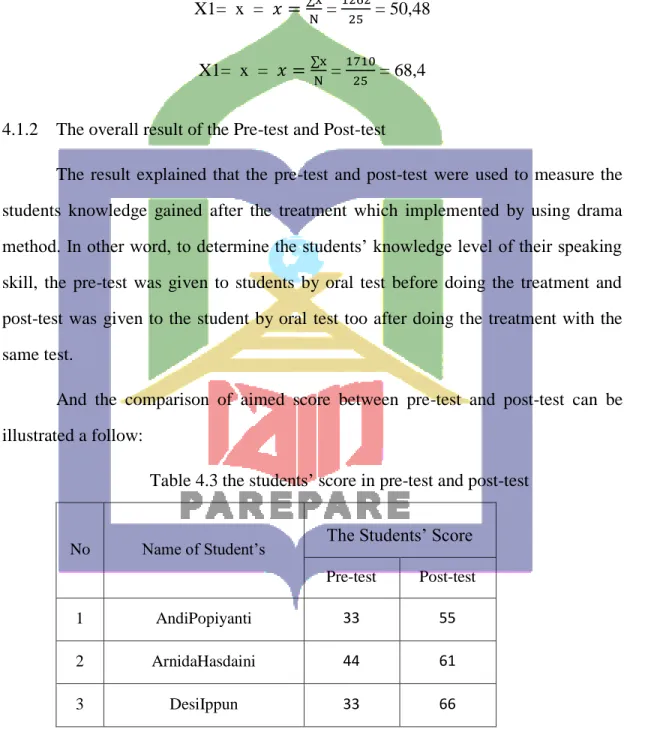
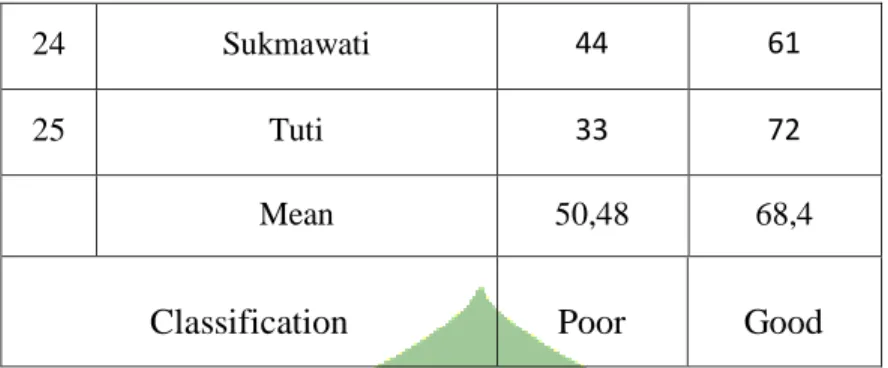
This subject of the research is XI.IPS.3 the second year students of SMAN 7 Pinrang which consists of 25 students. Improving students speaking skill by using English drama effect can be seen on the score of the post-test after giving treatment. After giving treatment, students‟ score (post-test) was better than students‟
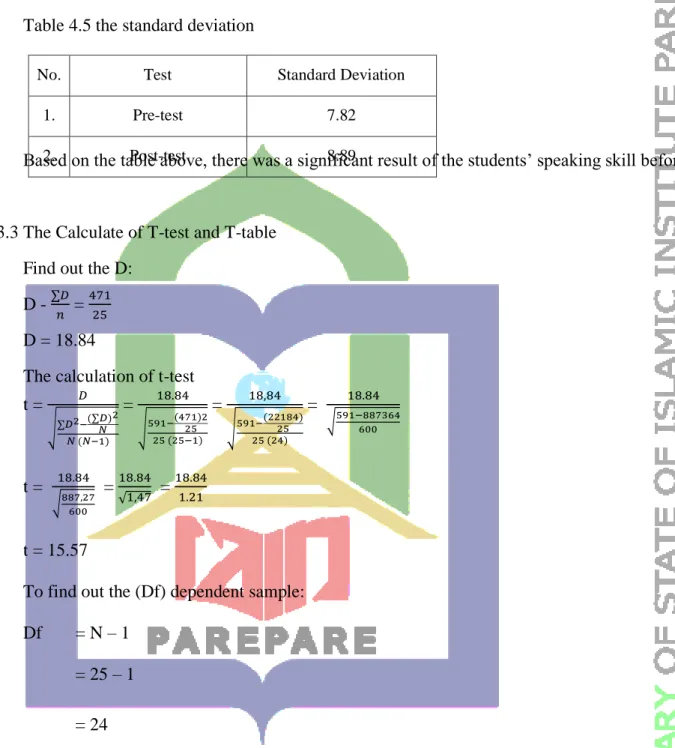
score (pre-test) before giving treatment. Were the mean score students‟ pre-test was 7.82 which classified as poor classification. And the mean score students‟ post-test was 8.89 which is classified as very good classification.The degree freedom significance 5% was 1.711. it was higher than the result of the significance difference of the post-test that was 15.57>1.711. It means that applying teaching speaking skill by using English drama help the student in improving students‟ speaking skill.Thus, it can be concluded that improving students‟ speaking skill is significantly better after getting treatment.So, the null hypothesis is rejected and the alternative hypothesis is accepted.Therefore, it is proven that English drama in teaching speaking can improve students' speaking skill
Keywords:English Drama, Contextual Teaching, Speaking Skill.
x
PAGE OF TITLE ... i
SUBMITTED PAGE ... ii
ENDORSEMENT OF CONSULTANT COMMISSIONS ...iii
ENDORSEMENT OF CONSULTANT COMMISSIONS ... v
ACKNOWLEDGEMENT ... vi
DECLARATION OF THE AUTHENTICITY OF THE SKRIPSI ...viii
ABSTRACT ... ix
TABLE OF CONTENTS ... x
LIST OF TABLES ... xii
LIST OF FIGURES...xiii
LIST OF APPENDICES ... xiv
CHAPTER I INTRODUCTION 1.1 Background ... 1
1.2 Problem Statement ... 5
1.3 Objective of Study ... 5
1.4 Significance of the Research ... 5
CHAPTER IIREVIEW OF RELATED LITERATURE 2.1 Some Pertinent Ideas ... 6
2.2 Previous Related Research Finding ... 22
2.3 The Conceptual Framework ... 23
2.4 Hypothesis ... 24
xi
3.3 Population and Sample ... 27
3.4 Instrument of the Research ... 27
3.5 Procedure of Collecting Data ... 27
3.6 Technique of data Analysis ... 31
CHAPTER IVFINDINGS AND DISCUSSION 4.1 Findings ... 37
4.2 Discussions ... 44
CHAPTER VCONCLUSION AND SUGGESTION 5.1 Conclusion ... 51
5.2 Suggestion ... 52
BIBLIOGRAPHY ... 53
APPENDICES ... 55 CURRICULUM VITAE
xii Tables
4.1 4.2 4.3 4.4
4.5
The Result of Students‟ Pre-Test The Result of Students‟ Post-test The Students‟ Score in Pre-test and Post-test
The worksheet of calculating score of pre- test and post-testThe Percentage of Post-test
the standard deviation
37 39 40 41
43
xiii Figures
2.1 3.1
The Conceptual Framwork of the Research The Formula of the Research Design
23 25
xiv 1.
2.
3.
4.
5.
Instrument of the Pre-test Lesson Plan
Instrument of the Post-test Documentations Drama Script
55 56 68 59
1 1.1 Background
English is an international language in the world. So, it is important for people to learn it. By learning English, the students are expected to absorb and keep up with the development of science, technology and art. In Indonesia, English is a one of foreign language. It is the most famous foreign language which is taught from kindergarten up to university school level. In communication, there is spoken and written language. In spoken language, the communication will be held orally. The most people, mastering the art of speaking is a single most important aspect of learning a second of foreign language, and the success is measured in terms of the ability to carry out a conversation in the language1.
The teaching of English in senior high school is intended to develop the student‟s communicative competence which emphasized four skill covering listening, writing, reading, and speaking. Speaking is the most important skill, because it is one of the abilities to carry out conversation. Speaking is an interactive process of constructing meaning that involves producing, receiving, and processing information.
The students should have the ability to speak English well because people identify the
1Fauziati,Teaching of English as a Foreign Language (Surakarta, Muhammadiyah University Press, 2002), p.121
English mastery with their English speaking and in other that they can communicate with others.
Language is not only taught and learned, but is used as a habit. Therefore learning speaking is difficult because it must be practice as a habit to master it.
Speaking skill is emphasized to make student speak the components of speaking such as grammar, vocabulary, pronunciation, fluency, and comprehension. Those components should be produce well when speaking English to avoid different meaning from the speaker to the listener. The way of teaching speaking is intended to give basic competence about the language itself and to give opportunity for the students to express their idea in speaking class. But teaching speaking is not an easy job for several reasons. First, it related to the condition of students who lack of the vocabulary mastery. Second, they like to use their native language more than English language in teaching learning process. Third, they rarely practice to use English to communicative. Fourth, most of the students are not confident to speak English in speaking class, especially in front of the class. The other problem related to the student is they are not interested in the method given to them. To make students able to speak, teacher must be creative enough to manage the class so that the students are actively involved in the interaction.
There are many problems appear in the teaching learning process, as found by researcher when doing an observation at SMANegeri 7 Pinrang. The first, the students are shy and not confident in speaking English especially in front of the class.
The second, the students are bored and unmotivated to learn since they have limited opportunity to express their idea. The third, they rarely practice to use English to communicate. And the last, the students are not interested in English learning process. They become passive in English learning and they are not able to speak.
Therefore, the English teaching process is not effective.
Based on the problem faced in SMANegeri 7 Pinrang above, the researcher found many causes which relate to students. It is because the teacher has difficulties to manage and to make the students interested in the material and the method. The limited capability in the component of speaking makes them shy and not confident to speak English. In addition, giving motivation is the limited because commonly the teacher just given full attention to the material and neglects the students attraction. In that situation, teaching learning process does not run well and make students bored.
Beside that, it is a hard work for getting the students attention. Lack of control also occurs when they teach in the large class. Therefore, it is difficult to implement the individual control for each student. During the teaching hours, the teacher still uses traditional technique and only gives one skill in each meeting. The teacher usually gives less chance to students to expressing their idea and lets the students only memorize the vocabulary, asks the students to open the exercise book, read the task, and then does the exercise. Then the teacher asks the students to write the words without asking the students to use it in the communication. Hence some students do not know the function of this language exercise.
To solve the problem, many methods can be used. One of them is drama.
Drama is a method for learning speaking. In teaching speaking there are some principles. The first is helping students overcome their initial reluctance to speak, encourage, provide opportunity, and starting from something simple. The second is asking students to talk about what they want to talk about. The third is asking student to talk about what they are able to talk about. The fourth is providing appropriate feedback. The fifth is combining speaking with listening and reading. The last is incorporating the teaching of speech acts in teaching speaking.2
Based on the principle above drama has criteria as a method to teach speaking. It encourages thinking and creativity, lets students develop and practice new language and behavioral skill in a relatively nonthreatening setting and can create the motivation and involvement necessary for learning. Drama encourages the students to actively participate in teaching learning process because this method provides a way of creating a rich communicative environment where students actively become a part of some real world system and function according to predetermined roles as members of that group. Drama can increase self-confidence of hesitant students, because in drama activities, the students will have a different role and reasonability. So, it is appropriate to use drama in improving the student‟s speaking skill.
2Fink, Learning How to Learn, (L.Dee,2003) p.481
Based on the phenomena above, the researcher try to find the effective solution to increase the speaking mastery of second year student of SMANegeri 7 Pinrang by employing drama as a method of teaching speaking.
1.1. Problem Statements
Based on the background of study mentioned above, the researcher states the problem of study in this researcher as follow:
Is using drama able to improve students‟ speaking skill at the second year of SMA Negeri 7 Pinrang ?
1.2. The Objective of Study
Based on problem statement, the general objective of study is to improve students‟ speaking skill. The specific objectives of the study are:
To determine whether English drama able to improve students‟ speaking skill.
1.3. Significance of the Research
Significance of this research is expected to be useful contributions to:
1.4.1 Students
They know about each component of speaking when practicing drama, students more confident in front of the class, they are able to improve their speaking skill and they can explore their creativity and expression in speaking English.
1.4.2 English Teacher
English teacher able to make the lesson fun and easy to understand, they are able to improve the students‟ speaking skill, and the result can improve the teacher professionalism quality as an educator.
1.4.3 The Researcher
To add knowledge and give contribute to other researchers who wish to conduct research using drama in different aspects.
7 2.1 Some Pertinent Ideas
2.1.1 Speaking
To most people mastering the art of speaking the single most important of learning a foreign or second language and success in measured in terms of the ability to carry out a conversation in the language.
Speaking is making use words in an ordinary voice, uttering words, knowing, and being able to use language, expressing oneself in words; making speech. While skill is the ability to do something well. Therefore, the researcher can infer that speaking is the ability to make use of words or language to express oneself in an ordinary voice. In short, the speaking skill is the ability to perform the linguistic knowledge in actual communication.
2.1.1.1 Definition of Speaking
Speaking consists of producing systematic verbal utterances to convey meaning. (Utterance is simply thing people say). Flores said, “Speakingis an interactive process of constructing meaning that involves producing and receiving and processing information”3. Speaking in language especially difficult for foreign
3Kathlen M. Bailey. Nunan, Practical English Language Teaching : Speaking. (New York, TheMcGraw Hill Companies, 2005). p.2
language learners, because effective oral communication requires the ability to use language appropriately in social interactions. Diversity in interaction involved not only verbal communication, but also paralinguistic elements of speech such as pitch, stress, and intonation4
“Richards, specifically makes effort to describe speaking from the functions of speaking point of view. According to him, in humans‟ daily lives, people use speaking to employ three major functions i.e. speaking as interaction, speaking as transaction, as well as speaking as performance.”5
Speaking as performance is recognized as the third type of speaking which refers to public speaking, that is, a speaking type that transmits information in front of an audience, such as classroom presentation, public announcement as well as drama.
According to Nunan, interactional speech is more fluid and unpredictable than transactional speech. Speaking activities inside the classroom need to embody both interactional and transactional purpose, since language learners will have to speak the target language in both transactional and interactional speaking6.
Brown and Yule said, in transactional situation, where information transference in the primary reason for the speaker choosing to speak, the language tends to be clearer, more specific, than in primarily interactional situation. So
4Richard and Renandya, Methodology in Language Teaching : An Anthology of Curret Practice, (New York: Cambridge University Press, 2002) p.204
5Richard.J.C. Teaching Listening and Speaking From Theory to Practice. (New York USA:Cambridge University Press, 2008) p.25
6Nunan David, Practical English Language Teaching, ( New York, The McGraw Hill Companies, 2003), p.56
theyassume that normal speaker of language achieve an ability to express their need, to communicate information7.
Speaking is also one of the language arts that is most frequently used by people all over the world. The art of speaking is very complex. It requires the simultaneous use of the number of abilities which often develop at different rates generally; there are at least four components of speaking skill concerned with comprehension, grammar, vocabulary, pronunciation and fluency.
2.1.1.1.1 Comprehension
For oral communication certainly requires a subject to respond to speech as well as to initiate it.
2.1.1.1.2 Grammar
It is needed for students to arrange a correct sentence in conversation.
Students‟ ability to manipulate structure and to distinguish appropriate grammatical form in appropriate ones. The utility of grammar is also to learn the correct way to gain expertise in a language in oral and written form.
2.1.1.1.3 Vocabulary
One cannot communication effectively or express their ideas both oral and write form if they do not have sufficient vocabulary. So, vocabulary means the appropriate diction which is used in communication.
7Brown and Yule, Teaching The Spoken Language, (New York, Cambridge University Press 1999) p.14
2.1.1.1.4 Pronunciation
Pronunciation is the way for students‟ to produce clearer language when they speak. It deals with the phonological process that refers to the component of a grammar made up of the elements and principles that determine how sounds vary and pattern in language.
2.1.1.1.5 Fluency
Fluency can be defined as the ability to speak fluency and accurately. Fluency in speaking is the aim of many language learners. Signs of fluency include a reasonable fast speed of speaking and only a small number of pauses and “ums” or
“es”. These signs indicate that the speaker does not have spent a lot of time searching for the language items needed to express the message.
2.1.1.2 Teaching Speaking
Teaching speaking is the way for students to express their emotion, communicative needs, interact to other person in any situation, and influence the others. For this reason, in teaching speaking skill it is necessary to have clear understanding involved in speech.
Harmer Jeremy suggested on his book, there are some many classroom- speaking activities that are currently in use in communicative class8.
8Harmer Jeremy, The Practice of English Language Teaching, (New England, Longman) p.
271-273
2.1.1.2.1 Acting from Script
The teacher can ask the students to act out scenes from plats and or their course books, sometimes filming the result. Students will often act out dialogues they have written themselves. This frequently involves them in coming out to the front of the class.
2.1.1.2.2 Communication Games
Games which are design to provoke communication between students frequently depend on an information gap, so that one students have to talk to a partner in order to solve a puzzle, draw a picture (describe and draw), put things in the right order (describe and arrange), or find similarities and differences between pictures.
2.1.1.2.3 Discussion
One of the reason that discussion fail, when they do is that students are reluctant to give an opinion in front of the whole class, particularly if they cannot think of anything to say and are not, anyway, confident of the language they might use to say it. Many students feel extremely exposed in discussion situation.
2.1.1.2.4 Prepared Talks
A popular kind of activity is the prepared talk where students make presentation on a topic of their own choice. Such talks are not designed for informal spontaneous conversation; because they are prepared, they are more writing-like than his. However, if possible, students should speak from notes that from a script.
2.1.1.2.5 Simulation and Role Play
Many students derive great benefit from simulation and role play. Students simulate a real life encounter (such as business meeting, an encounter in an aero plane cabin, or an interview) as if they doing so in the real world, either as themselves in that meeting or aero plane, or taking on the role of character different from themselves or with thoughts and feeling they do not necessarily share. Simulation and role-play can be used to encourage general oral fluency.
2.1.2 Definition of Drama
“Drama is the specific mode of fiction represented in performance. [1] the term comes from a Greek word meaning “action” (classical Greek:drama), which is derived from to do (Classical Greek: drao). The enactment of drama in theatre, performed by actors on stage before an audience, presupposes collaborative modes of production and a collective form of perception. The structure of dramatic texts, unlike other forms of literature, is directly influenced by this collaborative production and collective reception. [2] The early modern tragedy Hamlet by Shakespeare and the classical Athenian tragedy Oedipus the King (c.4229 BCE) by Sophocles are among the supreme masterpieces of the art of drama.”9
Francis Fergusson writes that “a drama, as distinguished from a lyric, is no primarily a composition in the verbal medium; the words result, as one might put it, from the underlying structure of incident and character. As Aristotle remarks, „the poet, or “maker” should be maker of plots rather than of verses; since he is a poet because be imitates, and what he imitates are actions”.10
Helen Nicholson from her book, drama is combine thought, language and feeling in range of energetic and creative ways, although there are recognizable
9“Drama,”Wikipedia,12 November 2016. http://en.wikipedia.org/wiki/Drama.
10“Drama,”Wikipedia,12 November 2016. http://en.wikipedia.org/wiki/Drama.
practice in drama which students might acquire, reaching new understanding emplies a creative and personal involvement with the word.11Drama education, at its most inclusive, invites students not only to engage with the dramatic narrative of others, but also to find ways to communicate their own ideas. In drama, intellectual and emotional involvement with the narratives of others is integral to the learning, wherein moral, political and cultural values are open, temporarily and contingently, to renegotiation and interpretation. Inthis context, making drama, as all drama teachers are well aware, involves a rather messy process of discussion, questioning, speculation, experimentation and reflection; it requires students both to explore their own ideas and values and to interpret those with which they are less familiar. From this point of view, drama education is a living art form in which students might
„understand something new‟ about both their own lives and those of others.
Drama in education becomes functional role-play. Functional role-play is frequently assumed to be of a lower artistic order than „drama as an art from‟ it may indeed often be so, if the purpose of the functional role-play goes no further than simple interaction for short-term pedagogic ends. However, study of these particular functional dramas is revealing; several use quite complex and elegant artistic structure.
Additionally, drama is also as a spesific action to make the learning procces more active, enjoyable, communicative, and contextual. As Cheng stated that
11Nicholson Helen, Teaching Drama, 11-18 (New York, Continuum 2000), p.1
Interactive drama are a language learning activity in which each student in the class takes a distinct role with spesific goals and then interacts with other students in the class takes to build alliances and complete common goals.12Futhermore, Maley, DuffandWessels have pointed to the values and uses of drama: “Drama can help the teacher to archive „reality‟ in several ways. It can overcome the students‟ resistance to learning the new language. Drama can increasself confidence of hesitant students, because in drama activities, the students will have different role and responsibility.13 So, it is appropriate to use drama in teaching speaking skill.
I am strongly recommending teachers embrace drama approach more completely by staging a play with their learners for the following reason:
2.1.2.1 Drama is a whole-person approach to language teaching which requires us to look at communication holistically. Creating a character and acting in a play can be a visceral, intellectual and emotional experience which makes the learning process more meaningful and memorable and more transferable to the real world.
2.1.2.2 Acting helps build confidence, because apart from aspect of performance and the rapturous applause that usually accompanies it, it is totally collaborative and mutually supportive. We rely on each other to succeed in producing something of value and quality.
12 Cheng, Y., E. K. Horwiz, & D. L. Schallert. 1999. Language Anxiety: Differentiating Writing and Speaking Components. Cambridge: Cambridge University Press. P.1
13 Maley, A. And Duff, A. 2001 Drama Techniques in Language Learning: a resource book for communication activities for language teacher: Cambridge: Cambridge University Press.
P.61
2.1.2.3 The group shares the same objective and putting on a play provides a tangible and achievable target to work towards.
2.1.2.4 Working within the framework of a play contextualizes all the related language work.
2.1.2.5 The process of building characters can make us aware of the needs and character traits of people we come into contact with in our daily lives, which is important in real-life communication and interaction. In mixed-nationality classes, cultural difference is spontaneously revealed, which helps us to understand each other better.
2.1.2.6 Putting on a play together as a group trains students in problem solving as constantly throughout the rehearsal period we are faced with decision that have to be made or hurdles that have to be overcome. These could be of a technical nature (lightning/sound/props etcetera) or related to the acting. It is invaluable language practice for students to do this kind of collaborating and problem-solving in English.
2.1.2.7 Producing a play allow us to explore and develop characters whose lives we only see a small part of on stage. This provides enormous scope for improvising scenes not in the play and generates discussion of the characters‟ thoughts, words and actions.
2.1.2.8 Using authentic scrip lends itself well to exploring features such us connected speech, expressing attitude with the voice, intonation patterns and sentence stress.
Contemporary plays have a wealth of idiomatic language and samples of speech
which reflect how English in use in the real world. Such plays also allow us to study communicative strategies such as hesitation devices, false starts and circumlocution.
2.1.2.9 Well-written plays by and large consist of short utterances, again reflecting authentic language use and these are useful in the internalization and memorization of vocabulary and functional chunks of language. On several occasions, students have commented that they have used „chunks‟ from the play in their everyday lives.
2.1.2.10 The only teaching materials required when producing a play are the scripts.
2.1.2.11 Being a part of this kind of group activity is enormous fun and highly rewarding.
With such high priority now being placed on building our learners‟
confidence, improving their spontaneity, developing their fluency and generally strengthening their ability to communicate in realistic situations, we need to provide them with „rehearsals for life‟. Drama attempts to bridge the gap between the carefully controlled language work that is often done in the classroom and the complexity of unpredictable language and behavior we are confronted with in the outside world by physically and emotionally engaging our students in safe and occasionally unsafe situations. It is a whole-person approach in that it does not deal exclusively with spoken language but rather requires our learners to react and respond with their intellects, emotions and natural instincts.
Drama examines and practices these broader aspects of communication:14 2.1.2.1 Gesture and gesticulation
2.1.2.2 Facial expression;
2.1.2.3 Eye contact and eye movement;
2.1.2.4 Posture and movement;
2.1.2.5 Proxemics;
2.1.2.6 Prosody (pitch, tone, volume, tempo) 2.1.3 Technique of Teaching Drama
As is the case with many basic skills, one of the important periods to improve speaking skill is, incontrovertibly, during primary education. Speaking skill acquired and developed during primary education are significant with regard to both acquisition and permanence. Therefore, it is essential that sufficient and effective teaching methods are employed in order to improve speaking skills during primary education. In our view, a favorable technique in aiding primary school students to acquire and develop oral communication skills is the use of creative and educational drama activities. No matter where this technique is applied, creative drama may be considered a method of learning-a tool for self-expression, as well as art. The scope of creative drama may be briefly explained through six learning principles.
2.1.3.1 A student learns meaningful content better than other content.
2.1.3.2 Learning occurs because of a student‟s interaction with his environment.
14Mark Almond. Teaching English with Drama. Pavilion Publishing (Brighton) Ltd.
2005.p.9
2.1.3.3 The more sensory organs a student uses while learning, the greater the retention of the lessons.
2.1.3.4 A student learns best by doing and experiencing.
2.1.3.5 Effective participation is important in learning emotional conduct.
2.1.3.6 Learning becomes easier and more permanent in educational environments where there is more than one stimulus.15
Drama is a particularly effective tool for pronunciation teaching because various components of communicative competence (discourse intonation, pragmatic awareness, and nonverbal communication) can practice in an integrated way.
Talking or speaking being central to the development of the brain, must be a priority for teachers. Alexander promotes dialogic teaching as the most powerful form of talk in the classroom. He identifies its key elements as:
Collective: teachers and pupils address learning tasks together, as a group or as a class;
2.1.3.1 Reciprocal: teachers and pupils listen to each other, share ideas and consider alternative viewpoints;
2.1.3.2 Supportive: pupils articulate their ideas freely, without fear of embarrassment over „wrong‟ answer, and they help each other to reach common understanding.
15Abdulhak Halim Ula, effects of Creative, Educational Drama Activities on Developing Oral Skill in Primary School Children, American Journal of Aplied Sciences 5 (7):876-880, 2008
2.1.3.3 Cumulative: teachers and pupils build on their own and each other‟s ideas and chain them into coherent lines of thinking and inquiry;
2.1.3.4 Purposeful: teachers plan and steer classroom talk with specific educational goals.16
Drama shares the elements listed above, and it promotes pupils‟ thinking because of the quality, dynamics, and content of talk that can develop.
Prendivile and Toye said in their book, that they would maintain that drama is more effective in developing pupils‟ ways of thinking, ways of understanding, than ordinary classroom discussion because the language of drama, as the language of all artistic creation, is a heightened version of the language of everyday talk17. The reason for this is that drama utilities a new context, a fictional world which is periled to reality, but in which the uses of language can be as a rich and varied as we want.
Its usefulness to speaking and listening, and thus language development, is that we create together a shared experience which frames the language and makes us, the pupils and the teacher, communicate more effectively than more discussion ever can.
Meanwhile, drama techniques utilized in a language class have generally been divided into seven types, including games, mine, or pantomime, role playing improvisation, simulation, storytelling, and dramatization.
16Prendivile andToye, Speaking and Listening Thought Drama 7-11, (London, Paul Chapman Publishing,2007) .p.54
17Prendivile andToye, Speaking and Listening Thought Drama 7-11, (London, Paul Chapman Publishing,2007) .p.55
The teaching steps were divided into four steps consisting of (1) working on a drama script, (2) drama rehearsal, (3) drama production, and (4) drama evaluation, each of which is detailed is follows:
2.1.3.1 Working on a drama script
The first step involved the establishment of background knowledge allow a play which students were required to engage in. in order to make the interaction more meaningful to student and to facilitate their acquisition of a language, they needed to know who they were in that particular context, who they interacting with, and why they were interacting with those people. Students‟ background knowledge of the play was established by means of class discussion of the play‟s characters, their natures, their relationship with other characters, or their problems. The questioning techniques were employed to encourage students‟ participation and interaction. Example of question is as follows. “What kind of person is this character?‟” “How does s/he feel about the person her/him taking to?‟” and “What is the relation between the character and the person her/him is talking to?”
Through the establishment of background knowledge about the play, students could be made aware of other crucial elements of communication in addition to linguistic forms. Also, students had opportunities to practice expressing their thoughts opinion, and feelings.
2.1.3.2 Drama rehearsal
Drama rehearsal was designed to elicit students‟ physical and emotional engagement. In this step, students were divided into groups or pairs, and they were assigned to play each character‟s role. The background knowledge established in the previous step enabled them to understand their role and the context where the communication took place. Here while the play‟s dialogue that they were required to deliver provided them with language input, the context of the play facilitated their learning of how the forms were applied in that particular context. Close monitoring and interruptions by the teacher were required in this step in order to correct students‟
pronunciation, to enhance their understanding of their role, and to ensure that students were delivering a dialogue from their understanding rather than being engaged in more rote recitation. Questions were posed to strengthen students‟ understanding and to guide ho they should express the play‟s meaning.
2.1.3.3 Drama production
This step created opportunities for students to engage in a performance to experience lifelike communication situations without any interruption from the teacher. Through a performance, in addition to delivering a dialogue, students could exploit facial expression, intonations, and gestures to convey intended meaning of each character. This helped them internalize both linguistic and non-linguistic components of speaking ability. To make sure that it was manageable within that class time, a performance of an extracted scene was provided for students to practice
their speaking ability. A full-scale stage performance of the whole play was kept for the final project pr end of class activity. Students‟ performance was videotaped for subsequent evaluation.
2.1.3.4 Drama evaluation
Drama evaluation involved the evaluation of the performance. The videotaped was played after the performance to allow students to practice expressing their opinions towards their own performance as well as their peers‟ performances. That students were able to observe themselves enabled them to improve their performance and learn from their mistakes.
2.1.4 Theoretical Framework
With respect to the methodological principles, drama techniques are based on the Communicative Approach. As Larsen-Freeman remarks, the principles goals of such approach is not focused on the linguistic accuracy, but rather on making the students communicate in the target language fluently. The language produced in the classroom is employed within a social context and it is appropriate to the specific participant, setting and topic. As a consequence, the communication has a purpose and is meaningful, as it is “sociolinguistical appropriate” (Larsen-Freeman).18 students are involved and pair and group activities, where they have the opportunity to dedicate more time to speaking interaction with their peers and negotiate meaning in order to be understood. The groups are constantly exchanged so that the pupils
18Larsen-Freeman, D. Language Teaching Methods: Communicative Approach Video, retrieved on April 19th, 2015 from https://www.youtube.com/watch?v=3kRT-rsKxn4
have the chance to know each other better and increase their confidence. The teacher does not direct the activities, but he or she act as a facilitator of the learning process, since the students is the true protagonist and the lesson is learner-centered. Also, according to this approach, students will give the opportunity to express their feeling and opinions. Finally, grammar mistakeis tolerated, since communication and fluency willgive a main role. The teacher can correct the students‟ errors afterwards, trying not to interrupt the normal flow of a conversation.
2.2 The Previous Related Research Findings
There are some previous researchers that are used by researcher, they are:
Aqlisty Nia Chandra in her research “Improving Students‟ English Speaking Skill by Using Drama”had found that there is an improvement of the students‟
speaking skill. The students‟ test score are much better than before.19
Tri Hariyanti in her research “Teaching Interactional Speaking by Using Role Play for the 10th Grade Students Of Senior High School Negeri 7 Pinrang in the academic year 2015-2016” had found that the students‟ speaking skill improved through the use of role play. They were more confidence to speak English. They easily learn the material with group. They actively participated during the teaching and learning process.20
19Aqlisty Nia Chandra, “Improving Student’ Speaking Skill by Using Drama”
UnyversitasMuhammadiyah Surakarta. 2011
20Tri Hariyanti. “Improving Interactional Speaking Skill by Using Role Play for the 10th Grade of Senior High School 7 Pinrang” (UnpublishSkripsi, Parepare;STAINParepare, 2016.
Liu and Dong “Use Role Play method to See How The Students Performed In Groups” when they were given a familiar situation to role play in their also observed their language potency and hoe the errors can be correct as well as how to give feedback to the learners for further improvement. Their observation was that is the teacher gave the familiar situation, than the result would be positive and rather giving instant feedback they should be shown the video tapes with oral feedback for self or peer correction”21
SittiAminah in her research “Improving Speaking Performance By Using Oral Presentation for the fifth semester students of English Education Program State Islamic College of Parepare” had found that the students‟ speaking performance improved by using oral presentation method. They had more chances to speak and they actively participated during the teaching and learning process.22
21Liu an Ding (2009) Use Role Play in English Language, Teaching Asian Social Science vol 5, no 10.p.36
22SittiAminah, “Improving Students‟ Speaking Performance ByUsing Oral Presentation for the fifth semester of English Departement of State Islamic College of parepare” (UnpublishSkripsi, Parepare;STAINParepare, 2016.
2.3 Conceptual Framework
The researcher focused the research on speaking skill through drama. The conceptual framework of this research is present the following diagram:
2.3.1 Input
Input is refer to the students‟ prior knowledge of drama which the students‟
knowledge about drama before giving treatment by using English drama. To know the students‟ prior knowledge, the researcher gives the students pre-test.
2.3.2 Process
Process is refer to the students will be learning about speaking throughEnglish drama. In this process, the researcher teaches the students with the three meeting.
INPUT
• Students' Speaking
PROCESS
• Teaching speaking by using English drama technique
OUTPUT
• The students' improvement in speaking skill
2.3.3 Output
Output is referring to result of process. The result will show that there is students‟ speaking skill improve after learning English drama. To know the students‟
speaking skill, the researcher gives the students post-test.
2.4 Hypothesis
Based on the previous related literature and the problem statement above, the writer puts forward hypothesis as follow:
2.6.1 Null Hypothesis (H0)
There is not an influence to improve the students‟ speaking skill by using English Drama at the second grade of SMAN 7 Pinrang
2.6.2 Alternative Hypothesis (H1)
There is an influence to improve the students‟ speaking skill by using English Drama at the second grade of SMAN 7 Pinrang
2.5 Variable of Research and Definition of Variable
There are two variables involve this research namely, dependent and independent variable, independent variable is the drama method. Drama method is a game, activities and exercises are often used to introduce students to drama. These activities tend to be less intrusive and are highly participatory. Dependent variable is students‟ speaking skill. Speaking is one of four basic competences that the students should gain well.
27
In this part the researcher explained the research design, location and duration, population and sample, instrument of the research, procedures of collecting data, and method of data analysis.
3.1 Research Design
The researcher employed pre-experimental design that applies one group pre- test and post-test design. The design also presented as follow:
E=O1 X O2 Where:
E = Experimental group O1 = Pre-test
X = Treatment O2 = Post-test23 3.2 Location and Duration
In this part the researcher explained about the location and duration to do research 3.2.1 Location
23L.R. Gay, Educational Research, Competencies for Analysis and Application, (Colombus, Ohio:Charles E, Meril Publishing, 1981).p.225
The location of the research took place in AMAN 7 Pinrang. This high school locates in south Sulawesi province, Pinrang city.
3.2.2 Duration
The duration of the research is a month, where three meetings for the treatment two meeting for pre-test and post-test.
3.3 Population and Sample 3.3.1 Population
The population of this research is the second grade students of SMAN 7 Pinrang
3.3.2 Sample
Based on the population above, so the researcher used purposive sampling method that one class of the second year students of SMAN 7 Pinrang took a research sample and got valid data. Because selection of a sample is a very important step in conduct a research study. The researcher used purposive sampling because the good sample is one that is representative of the population from which it is selected.
3.4 The Instrument of the Research
The instrument that the researcher used in this research is speaking skill test.
This instrument was applied in pre-test and post-test.
3.5 Procedures of Collecting Data
The researcher was conducted test in collect data. Test conducted twice, pre- test and post-test. The pre-test gave to find out the previous skill before conduct the
materials (English drama). The data collecting presented in chronological order as below:
3.5.1 Pre-test
Pre-test used to know the student skill or knowledge about speaking.
The following is the procedure of pre-test:
1. The researcher explained what the students are going to do.
2. The researcher distributed the instrument sheet of pre-test to the students.
3. The researcher gave the topic to the students
4. The researcher gave time to the students for 3 minutes and 5 minutes at most to make their argument
5. After the students make their argument the researcher gave time to the students to present their argument.
3.5.2 Treatment 3.5.2.1 First meeting
The researcher said greeting to the students and introduce herself, and then the researcher introduced that drama and explained it. The researcher divided the students on to the groups, and then the researcher gave drama script to the students. After that the researcher explained what the students are going to do. Then the researcher readied the script with repeat by the students together. Then the students repeated the pronunciation. After that the researcher gave the changes to the students to ask about the correct pronunciation.
Before closing the class, firstly the researcher asked the students difficulties during the teaching process. If it might there some question concerning with the material, the researcher explained and given the answer, some advice that give to students to motivate them to always practice their English. The researcher called the students name to ensure that they attend the class and say thank to the students‟
attention and closing the class by say salam.
3.5.2.2 Second meeting
In this meeting the researcher explained about the intonation and expressing of the drama script. Firstly, the researcher started the class by say salam and while asked the students about their pronunciation about the drama script. The researcher introduced the topic that intonation and expressing and explained it, then the researcher gave the example to make the students understand. Then the researcher gave time for the students to make sure their intonation and expression by their own script while the researcher gave attention and correction by surround the class. If the time is up, the researcher asked the student by disordered to read their script using intonation and expression.
Before closing the class, firstly the researcher asked the students difficulties during the teaching process. If it might there some question concerning with the material, the researcher explained and given the answer, some advices that given to students to motivate them to always practice their English. The researcher called the
students name to ensure that they attend the class and say thank to the students‟
attention and closing the class by say salam.
3.5.2.3 Third meeting
The researcher started the class by say salam and was asked the students condition, the researcher introduced what are the students going to do. The researcher told the student to seat with their group and after that the researcher explained about the act. After that the researcher gave the students a drama video to make the students interest and motivate. After the video end the researcher told the student to do the act with their group by their own scrip. The researcher gave the time to the student act by their own creation while the researcher gives attention to them.
Before closing the class, firstly the researcher asked the students difficulties during the teaching process. If it might there some question concerning with the material, the researcher explained and given the answer, some advices was given to students to motivate them to always practice their English. The researcher called the students name to ensure that they attend the class and say thank to the students‟
attention and closing the class by say salam.
3.5.2.4 Forth meeting
The researcher started the class by say salam and was asked the students condition, the researcher introduced what are the students going to do. The researcher told the student to seat with their group and after that the researcher explained about the act. After that the researcher gave the students a drama video to make the students
interest and motivate. After the video end the researcher told the student to do the act with their group by their own scrip. The researcher gave the time to the student act by their own creation while the researcher gives attention to them.
Before closing the class, firstly the researcher asked the students difficulties during the teaching process. If it might there some question concerning with the material, the researcher explained and given the answer, some advices was given to students to motivate them to always practice their English. The researcher called the students name to ensure that they attend the class and say thank to the students‟
attention and closing the class by say salam.
3.5.3 Post-test
The researcher gave a post-test to measure the students about the speaking skill after joining treatment. The test was same as the pre-test.
3.6 Technique of Data Analysis
The data of the research is quantitative data. The researcher used the standard of peaking score criteria proposed by Heaton to analyze the data which are gotten from the speaking pre-test and post-test. The analyze was only gives score on three aspects include accuracy, fluency in speaking and comprehensibility (the listeners are understood), as follow:
3.6.1 The Scale Criteria of Speaking
The Students‟ speaking skill scored by utilizing a set of a rating scale criteria proposed by Heaton in the following table:
ACCURACY FLUENCY COMPREHENSIBILITY 6 Pronunciation is only
very slightly influenced by the mother tongue. Two or three minor grammatical and lexical errors.
6 Speaks without too great and effort with a fairly wide range of expression. Searches
for words
occasionally but only one or two unnatural pauses.
6 Easy for the listener to understand the speakers‟ intention and general meaning.
Very few interruption or clarification required.
5 Pronunciation is slightly in influenced by the mother tongue.
A few minor
grammatical errors but most utterances are correct.
5 Ha to make an effort at times to search for words. Nevertheless, smooth delivery on the whole and only a few unnatural pauses.
5 The speakers‟
intention and general meaning and fairly
clear. A few
interruptions by the
listener for
clarifications are necessary.
4 Pronunciation is still moderately
4 Although he/she has to make an effort and
4 Most of what the speaker says is easy to
influenced by the mother-tongue but no serious phonological errors. A few grammatical and lexical errors but only one or two major errors causing confusion.
search for words, three are not too many unnatural pauses.
Fairly smooth
delivery mostly.
Occasionally
fragmentary but succeeds in conveying the general meaning.
Fair range of expression.
follow. His/her to help him/her to convey the meaning or to seek clarification.
3 Pronunciation is influenced by the mother-tongue but only a few serious phonological errors.
Several grammatical and lexical errors, some of which cause confusion.
3 Has to make an effort for much of the time.
Often has to search for the desired meaning. Rather halting delivery and fragmentary. Range of expression often limited.
3 The listener can understand a lot of what is said. But he/she must constantly seek clarification.
Cannot understand many of the speaker‟s more complex or longer sentences.
2 Pronunciation
seriously influenced by the mother-tongue with errors causing a
breakdown in
communication.
Many basic and grammatical errors.
2 Long pauses while he/she searches for the desired meaning.
Frequently
fragmentary and halting delivery.
Almost give up making the effort at times. Limited of expression.
2 Only small bits (usually short sentences and phrases) can be understood and then with considerable effort by someone who is used to listening to the speaker.
1 Serious pronunciation errors as well as
many basic
grammatical and lexical errors. Ne evidence of having.
1 Full of long unnatural pauses. Very halting and fragmentary delivery. At times gives up making the effort. Very limited.
1 Hardly anything of what is said can be understood. Even when the listener makes a great effort of interrups.24
24 Heaton, Writing English Language Test, (New York:United State of America: Longman inc, 2001),P.100.
3.6.2 Scoring and Classifying the students‟ score
Scoring the students‟ speaking skill in pre-test and post-test used this formula:
Score =
The score of the test result would be classifying in to the following criteria:
SCORE CLASSIFICATION
80-100 Very Good
66-79 Good
56-65 Fair
40-55 Poor
<39 Very Poor25
3.6.3 Calculating the mean score and standard deviation
3.6.3.1 To calculating the mean score, the researcher applied the formula as follow:
Where : ẍ : the mean or arithmetic average of the score
∑x : The um of all the score
25 Suharsimi Arikunto, Dasar-Dasar Evaluasi Pendidikan, Edisi Revisi; (Jakarta: Bumi Aksara.2009),p.245
ẍ =
N : The total number of the subjects26
3.6.3.2 To calculate the standard deviation the researcher applied the formula:
SD = √ Where SS = ∑ - Where :
SD = Standard mean deviation SS = Standard score
N = The total number of students I = Constant number
∑x = The um of the score
(∑ = The sum square of the sum of square27 3.6.4 The Test of Significant
To finding the significant difference between the mean score of pre-test and post-test, it was needed to calculate the t-test value using the following formula:
t - √
Where:
T = test of significance
= the mean score of difference
26 Gay, L. R, Educational Research Competencies For Analysis and Application, ( Ed),United State, Earsonmerril Prenfile Hall, p. 298
27 Ibid
∑D = the sum total of total score of difference
∑D2 = the square of the sum score of difference N = the total number of the sample
DF = N-1
t = test of significant28
28 Gay, L. R, Educational Research Competencies For Analysis and Application, ( Ed),United State, Earsonmerril Prenfile Hall, p. 331
39
This chapter consisted of two sections; they are findings of the research and discussions of the findings. The writers analyzed the data that is obtained through the result of pre-test and the result of post-test.
4.1 Research Findings 4.1.1 Data Description
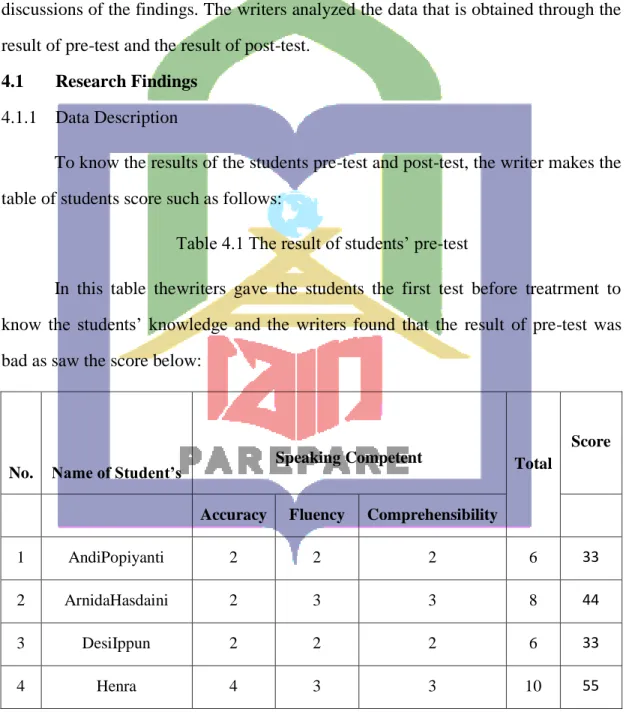
To know the results of the students pre-test and post-test, the writer makes the table of students score such as follows:
Table 4.1 The result of students‟ pre-test
In this table thewriters gave the students the first test before treatrment to know the students‟ knowledge and the writers found that the result of pre-test was bad as saw the score below:
No. Name of Student’s Speaking Competent Total
Score
Accuracy Fluency Comprehensibility
1 AndiPopiyanti 2 2 2 6 33
2 ArnidaHasdaini 2 3 3 8 44
3 DesiIppun 2 2 2 6 33
4 Henra 4 3 3 10 55
5 M. Farhan Fahreza 3 3 3 9 50
6 Masni 5 4 4 13 72
7 Mohd. Irwanzah 3 2 5 10 55
8 Muh. Akbar 4 5 4 13 72
9 Muh Akbar Sah 2 3 3 8 44
10 Muh. Faizal 2 2 1 5 27
11 Muh. FatulR 3 2 5 10 55
12 Muh.Tri Putra 4 2 2 8 44
13 Mustari 3 3 3 9 50
14 Mutmainna 2 3 2 7 38
15 Noval Abdul Asis 4 4 2 10 55
16 NunurRamadhani 3 4 5 12 66
17 NurAdiraS 4 4 3 11 61
18 NurAisyah 5 2 4 11 61
19 Nurjannah 2 3 3 8 44
20 Nurwahyuni 3 2 2 7 38
21 Reni Andriani 5 5 3 13 72
22 Ruslan 4 3 3 10 55
23 ST. Ramlah 3 4 4 11 61
24 Sukmawati 2 3 3 8 44