By
KIKI REZKI ANANDA Reg. Num.14.1300.010
ENGLISH PROGRAM TARBIYAH FACULTY
STATE ISLAMIC INSTITUTE (IAIN) PAREPARE
2019
ii
SKRIPSI
DEVELOPING ENGLISH PROFICIENCY TEST MEDIA IN JUNIOR HIGH SCHOOL
By
KIKI REZKI ANANDA Reg. Num.14.1300.010
Submitted to the English Program of Tarbiyah Faculty of State Islamic Institute of Parepare in Partial Fullfilment of the Requirements for the
Degree of Sarjana Pendidikan (S.Pd.)
ENGLISH PROGRAM TARBIYAH FACULTY
STATE ISLAMIC INSTITUTE (IAIN) PAREPARE
2019
iii
DEVELOPING ENGLISH PROFICIENCY TEST MEDIA IN JUNIOR HIGH SCHOOL
Skripsi
As Partial Fulfilment Requirements for the Degree of Sarjana Pendidikan (S.Pd.)
English Program
Submitted by
KIKI REZKI ANANDA Reg. Num. 14.1300.010
To
ENGLISH PROGRAM TARBIYAH FACULTY
STATE ISLAMIC INSTITUTE (IAIN) PAREPARE
2019
iv
v
vi
vii
ACKNOWLEDGEMENT
In the name of Allah, The Beneficent and The Merciful
First thing first, let us express our best regard to our God Allah swt, the lord of this world, the Master of Judgment day, and the Creator of this universe who has been giving us beautiful life, long life, so the writer can finish this skripsi.
Secondly, may salawat and salam to our prophet Muhammad saw as the King of the Great Kingdom, namely Islam then brought us from uneducated person to be educated person.
The writer would like to present acknowledgement of her deepest appreciation and admiration to many people especially to her beloved parents and big family, who have giving endless love, advice, financial support, and sincere prayers for her safety, healthy and successful all time.
Her deepest gratitude is due to the Consultant DR. H. Saepuddin, S.Ag., M.Pd., and co-consultant Hj. Nurhamdah, S.Ag., M.Pd., who have patiently guided and given their construction suggestion, useful correction, valuable guidance and overall support in making this skripsi. And also to Muhhammad Ahsan, S.Si, M.Si., Dr. Zulfah, M.Pd., Amilah Ilyas, M.Pd., Hasnawati, S.Pd.I., who have validate her research, and patiently guided and given their guidance.
The writer also would like to express her deepest and great thanks to:
viii
1. The Rector of State Islamic Institute (IAIN) Parepare, DR. Ahmad Sultra Rustan, M.Si. and his staffs.
2. Dr. H. Saepuddin, M.Pd. as the Dean of Tarbiyah Faculty and also Mujahidah, M.Pd. as the Chairman of English Eductional Program for their kind supple management.
3. All lecturers and staffs of State Islamic Institute (IAIN) Parepare for their guidance during the years of his study.
4. The Headmaster of SMPN 2 Pinrang and all the teachers especially Mam Amilah Ilyas, Mam Hasnawati, Mam Sumiati, Mr. Zubair, who have given his permission, guided, and support her during she did the research.
5. Rahmat Amiruddin, S.Pd.I., Alim Akkas, S.Pd.I., Satriadi, S.Pd., Nurfadillah Nurcholis, S.Pd.I, M.Pd., and all the seniors who has helped and given many suggestions during her study especially in her research.
6. Her beloved brothers and sisters of Lintasan Imajinasi Bahasa Mahasiswa (LIBAM) State Islamic Institute (IAIN) Parepare, English Department 2014, Rumah Baca dan Kreasi Qalam, ACE- English Training Center who have coloured, inspired, motivated, supported her.
7. Coffee-mates and all the coffeeshop who have given so much inspiration, support, and free wifi.
8. All people who have given their help in writing skripsi that the writer could not mention it one by one.
Finally, the writer realized that this skripsi still has any weakness and still far from being perfect. Therefore, the writer would highly appreciate all constructive suggestions and criticism.
ix
May the Almighty Allah SWT always make us be the blessed one now and on. Amiin
Parepare, 11th January 2019 The Writer,-
Kiki Rezki Ananda 14.1300.010
x
DECLARATION OF THE AUTHENTICITY OF THE SKRIPSI
The researcher who signed the declaration below:
Name of the Student : Kiki Rezki Ananda Student Reg. Number : 14.1300.010
Faculty : Tarbiyah
Study Program : English
The Title of Skripsi : Developing English Proficiency Test Media in Junior High School
State that this skripsi is her own writing and if can be proved that it was copied, duplicated or complied by any other people, this skripsi and the degree that has been gotten would be postponed.
Parepare, 11th January 2019 The Research,-
Kiki Rezki Ananda 14.1300.010
xi
ABSTRACT
Kiki Rezki Ananda. Developing English Proficiency Test Media in Junior High School, English Program of Tarbiyah Department, State Islamic Institute (IAIN) Parepare (Supervised by H. Saepuddin and Hj. Nurhamdah).
This research aim to know the valid profile, teacher valuation, and students’
responses toward English proficiency test media that has been developed. The result of this research is expected to give valuable contribution to both teacher and students for encountering the rapid development of information and communication technology to increase the quality of the evaluation.
The method of this research is development research that consist of four main stages i.e. 1) Define, 2) Design, 3) Development, 4) Dissemination. Each stages passed gradually and systematically to the next stages. Every stages passed a process of structured activities. The implementation of the stage can be adjusted to the conditions and situations that facilitate the process. Furthermore, subject of this research was the first grade students of SMPN 2 Pinrang. The instrument of research are English proficiency test, and questionnaire.
Research result show that in this study: 1) the product considered very good or very interesting and feasible to implement. Material validation done by Dr. Zulfah, M.Pd result 88,57%. Media validation done by Muhammad Ahsan, S.Si, M.Si. results 87,14%. The average score was 87,85% based on table of interpretation it meant the product was very good. 2) Practitioners assessment showed that the product considered very good or very interesting by average score 93%. 3) Percentage of students’ responses toward English proficiency test media was 91%. It can be concluded that English proficiency test media was feasible to use.
Keywords: English Proficiency test, Development, and Media
xii
TABLE OF CONTENTS
PAGE OF TITTLE ... ii
SUBMITTED PAGE. ... iii
ENDORSEMENT OF CONSULTANT COMMISIONS. ... iv
ENDORSEMENT OF EXAMINER COMMISSIONS ... vi
ACKNOWLEDGEMENTS. ... vii
DECLARATION OF THE AUTHENTICITY OF SKRIPSI ... x
ABSTRACT. ... xi
TABLE OF CONTENTS. ... xii
LIST OF TABLES. ... xiv
LIST OF FIGURES. ... xv
LIST OF APPENDICES. ... xvi
CHAPTER I: INTRODUCTION 1.1 Background... 1
1.2 Research Question. ... 3
1.3 Objective of the Research. ... 3
1.4 Significance of the Research. ... 3
CHAPTER II: REVIEW OF RELATED LITERATURE 2.1 Preview Related Research Findings. ... 5
2.2 Some Pertinent Ideas. ... 6
2.2.1 Introducing to Assessment ... 6
2.2.2 Language testing ... 14
2.2.3 Testing the Language Skill and Language areas ... 19
2.2.4 Introducing to Computer Based Test ... 20
xiii
2.2.5 Introducing to Multimedia Authoring Tool ... 21
2.3 Conceptual Framework. ... 28
CHAPTER III:
METHOD OF THE RESEARCH
3.1Research Design. ... 303.2 Place and Time of the Research. ... 34
3.3 Subject of the Research. ... 34
3.4 Instrument of the Research. ... 34
3.5 Procedure of Collecting Data. ... 35
3.6 Technique of Analysis Data ... 36
CHAPTER IV: RESEARCH FINDINGS AND DISCUSSION 4.1 Design of Product (Prototyping) ... 37
4.2 Validation. ... 48
4.2.1 Validation by Material Expert ... 39
4.2.2 Validation by Media Expert ... 41
4.2.3 Practitioner English Teacher I ... 44
4.2.4 Practitioner English Teacher II ... 46
4.3 Product Revision ... 48
4.4 Testing or Trial ... 57
4.5 Product Discussion ... 61
CHAPTER V: CONCLUSION AND SUGGESTION 5.1 Conclusions. ... 68
5.2 Suggestion. ... 69
BIBLIOGRAPHY. ... 71
APPENDICES. ... 74
xiv
LIST OF TABLES
Number
of Tables Tittle of Tables Pages
3.1 4.1 4.2 4.3 4.4 4.5 4.6 4.7 4.8
Attitude Interpretation Guidelines adopted form Sugiono (2016) Material Expert Assessment
Media Expert Assessment
Practitioner English Teacher Assessment I Practitioner English Teacher Assessment II Item Difficulty Index of Each Question Item Discrimination of Each Question The Result Validity Statistic
Student Assessment
36 39 42 44 46 50 53 55 58
xv
LIST OF FIGURES
Number of Figures
Tittle of Figures Pages
2.1 2.2 2.3 2.4 2.5 3.1 4.1 4.2 4.3 4.4 4.5 4.6 4.7 4.8 4.9 4.10
Assessment, Measurement, and testing adopted from Lynch Introduction Page
Question Page Quiz Result Page
Conceptual Framework of the Research 4D Model
Icon
Loading Screen Instruction Page Warning Page
Question Page Listening Question Page Reading Quiz Result Page
Review Quiz Page (correct) Review Quiz Page (incorrect) End Page
10 26 27 27 28 32 61 62 63 63 64 65 65 66 66 67
xvi
LIST OF APPENDICES
Number of
Appendices Tittle of Appendices Pages
1 2 3 4 5 6 7 8 9
Flow Chart Story Board List of Question Questionnaire Item Discrimination Item Difficulty Item Validity Reliability Documentation
73 74 78 88 96 98 101 104 105
1
English is used as a second or third language and for some people the first language. With the spread and development of English around the world, it has become an important means of communication among the people of different cultures and languages. The government of Indonesia has put English as an essential subject to be learned from elementary school up to university school.
Technology isn’t something that students need to be separated from; rather it’s something that students need to embrace.1 The development of technology already effects most of the human activity nowadays. The development is very fundamental and has brought many significant changes in velocity and innovation of education world.2
Today, the use and variety of computer and internet technologies in educational settings to support teaching has become increasingly popular.3 Lately, the utilization of computers in measurement or testing is trending. Whittington, Bull &
Danson defined Computer-Based Testing are the form of assessment in which the computer is an integral part of question papers' delivery, response storage, marking of
1Min Pun, " The Use of Multimedia Technology in English Language Teaching: A Global Perspective" (Crossing the Border: International Journal Interdisciplinary Studies, vol.1, no.1, December 2013), p.29.
2Muchamad Suradji, “Pengembangan Teknologi Informasi Dan Komunikasi Di Bidang Kesiswaan, Kepegawaian Dan Keuangan Di SMA Muhammadiyah 1 Gresik” (Master thesis; Program Magister Pendidikan Agama Islam UIN Sunan Ampel: Surabaya, 2012), p. 2.
3Ahmet Basal, “Authoring Tools For Developing The Content In Language Education”
(International Journal on New Trends in Education and Their Implications, vol.8, no.4, October 2012), p. 164.
response or reporting of results from a test or exercise. It allows teachers or instructors to organize, schedule, execute tests, send data and reports easily. One of the examples of the utilization of computers in measurement was in Candidate Civil Servants (CPNS) recruitment. The program that used in that recruitment is called Computer Assisted Test (CAT). Almost all institutions in Indonesia had used it in their candidate civil servant recruitment. This method is considered to be more practical, effective and efficient.4 Since 2016 the government had decided to apply Computer Based Test in the final examination. It aimed to ensure the implementation of keeping cost down and honest, net, and flexible and also to increase the quality, flexibility, and reliability of the final examination.
Dealing with researcher observation in the preliminary study found that SMPN 2 Pinrang was one of the schools that suitable for developing English proficiency test media. It has an available computer laboratory which could be used to conduct examination by using computer-based test. In addition, using a computer in learning activity is a usual thing for students and teachers.
Based on the explanation above, the researcher is interesting to do the research in developing English proficiency test media by using Multimedia Authoring tool software at first grade students in SMPN 2 Pinrang. It was expected that it could help both students and teacher for encountering the development of information and technology and to increase the quality of the evaluation.
4Situs Informasi Pendaftaran CPNS dan Loker 2014,"Pengenalan Sistem dan Software Cat CPNS Tahun 2014", Official Website Situs Informasi Pendaftaran CPNS dan Loker 2014.
http://pendaftaran-cpns.blogspot.com/2013/08/pengenalan-sistem-computer-assisted.html (May 5th, 2018)
1.2 Research Question
Based on the background of the research, the problems of the research are formulated as follows:
1. How is the valid profile of english proficiency test media that has been developed at first grade students of Junior high school?
2. How is the teachers valuation toward english proficiency test media that has been developed at first grade students of Junior high school?
3. How is the students response toward english proficiency test media that has been developed at first grade students of Junior high school?
1.3 Objective of the Research
The following are objectives of the research:
1. To know the valid profile of english proficiency test media that has been developed at first grade students in of Junior high school.
2. To know the teachers valuation toward english proficiency test media that has been developed at first grade students in of Junior high school.
3. To know the students response toward english proficiency test media that has been developed at first grade students in Junior high school.
1.4 Significance of the Research
The result of this research is generally to develop English test and particularly this research is expected to give a valuable contribution to both the teachers and the students. For the teachers, it will help in creating and taking a test for their evaluation.
Whereas for the students, it can train them to do the test by using a computer, so they get accustomed to using it. For the government, it can be used as an example and
motivation to develop more product to be used in the school. And also for the researcher, it can be used as an alternative source and references to other researchers to study English proficiency test media development.
5 conceptual framework
2.1 Preview Related Research Findings
Some researcher had conducted a few studies and found related results of the research. First Wahyu Hidayat in his research entitles Development of Based Computer Test Subjects in Methodology of Research Subject found that a test can be done using a computer. The use of the computer as a replacement test using paper and pencil is more efficient and effective.1
Next, Rahmat Amiruddin in his research concludes that English test could be developed by using a software as a replacement for English test using paper and pencil is more effective and efficient. In addition, using Computer Based Test in examination would not distract participants or reduce the participant's concentration and even could make participants enthusiastic in answering the question. Then using CBT in the examination could reduce expenditures in preparing to face test either time or money and the students could use CBT easily.2
And the last Simhachalam Thamarana in his paper entitle Role of Multimedia Resources in Teaching and Learning of English Language conclude that Multimedia Offers teacher enermous opportunities for making learning and teaching
1Wahyu Hidayat, "Development of Based Computer Test in Methodology of Research Subject” (Laporan Hasil Penelitian Pusat Penelitian dan Pengabdian pada Masyarakat STAIN Parepare; Parepare, 2013), p. 1.
2Rahmat Amiruddin, "The Use of Various Softwares in English Test Development at Second Grade Students in SMAN 1 Pituriawa (A development Research)" (Unpublished scrips; English Program of Tarbiyah Department STAIN Parepare; Parepare, 2015), p. 126.
environments meaningful and effective. The one of the ultimate goals of multimedia language teaching is to promote students’ motivation and learning interest, which can be a practical wayto get them involved in the language learning.3
2.2 Some Pertinent Ideas 2.2.1 Introducing to Assesment 2.2.1.1 Definition of Assesment
Generally, Assesment is the act of judging or deciding the amount, value, quality, or importance of something, or the judgment or decision that is made.4 There are four overlapping domain of assessment:
1. Educational assessment includes academic tests that measure academic achievement or performance, like math or English language literacy test and cognitive ability tests that measure intellectual skills or diagnose neuropsychological issues as learning disabilities.
2. Vocational assessments measure career interest, job aptitudes and skills, and work capacities; occupation-specific skill certification is also included.
3. Psychological assessments measure neuropsychological, behavioral, social, and emotional skill and abilities, mental health screening and chemical dependency tests are also included in this category.
4. Medical assessment measures physical and functional capabilities such as vision or speech, and may also include drug testing.5
3Simhachalam Tamarana, “Role of Multimedia Resources in Teaching and Learning of English Language”. Teaching English Language and Literature Challanges and Solution, p. 171.
(Accessed on May 5th).
4“Assessment” Cambridge Online Dictionary.
https://dictionary.cambridge.org/dictionary/english/assessment (Accessed on may 5th 2018).
Assessment really is the bridge between teaching and learning.6 No matter how carefully the instructional design and implement, what students learn cannot be predicted with any certainty. It is only through the assessment that teacher can discover whether the instructional activities in which teacher engaged their students resulted in the intended learning. Then according to Imran Hameed “Educational assessment is the process of documenting, usually in measurable terms, knowledge, skills, attitudes, and beliefs". Furthermore, Maria Arias Cordova says that Assessment is generally used to refer to all activities teachers use to help students learn and to gauge student progress. 7
Whereas according to Harlen, Gipps, Broadfoot, Nuttal Assessment in education is the process of gathering, interpreting, recording, and using information about pupils’ responses to an educational task.8 Then, Mohammed Najib Abdul Gafur, Adibah Latif, and Cristal Joan Peter defined that Assessment is the process of making judgment or producing values involves assessment (gathering evidence) and evaluation (analysis and reflections) based on data gathered (measurement) through any instrument (test).9
5Federation for Children with Special Needs, “Assessment”, Federation for Children with Special Needs, Website.http://www.ncwd-youth.info ( Accessed on May 4th).
6Dylan William, “Assessment: The Bridge between Teaching and Learning” (Voices from the Middle, 21 no. 2, December 2013) p. 15.
7In Arburim Iseni, "Assessment, Testing and Correcting Students' Errors and Mistakes"
Language Testing in Asia Vol. 1, Issue 3 (October 2011), p. 61.
8Harlen, Gipps, et al., Linguistics and language learning. Modern Linguistics (New York:
St.Martin's Press 1993), p. 219.
9Mohammed Najib Abdul Gafur, Adibah Latif, and Cristal Joan Peter. “Assessment in Language Teaching” (Naskah presentasi yang disajikan pada International Seminar di UNISMUH Makassar: Makassar, November 30th, 2013), p. 2.
Based on the definitions above, the researcher concluded that assessment, especially in education, is systematic process of collecting data or information (about students' knowledge, skill, attitude, beliefs and also the effectiveness of teaching and learning process) for analyzing, interpreting, and making judgment or producing values by using any instruments. The purpose of assessment is to determine teaching and learning effectiveness, the level of success on the aims and objectives and help individuals for future actions, remediation, and advancement.
2.2.1.2 Difference between Assessment, Evaluation, Measurement, and Testing Some people frequently had confused to distinguish between assessment, evaluation, measurement, and testing. Most of them ended up thinking that it is just the same. But actually, the case is different. Assessment, evaluation, measurement, and testing are different.
According to Herman and Knuth, assessment is used to determine what a student knows or can do, while evaluation is used to determine the worth or value of a course or program. Assessment data effects student advancement, placement, and grades, as well as decisions about instructional strategies and curriculum.10
Whereas Dr. Bob Kizlik said that Measurement refers to the process by which the attributes or dimensions of some physical object are determined. One exception seems to be in the use of the word measure in determining the IQ of a person, while the assessment is a process by which information is obtained relative to some known objective or goal. Assessment is a broad term that includes testing. A test is a special form of assessment. Tests are assessments made under contrived circumstances especially so that they may be administered. In other words, all tests are assessments,
10Connoley, R., Criterion-Referenced Assessment. (Australia: Deakin University,2004), p. 62.
but not all assessments are tests. Then, Evaluation is perhaps the most complex and least understood of the terms. Inherent in the idea of evaluation is "value." When we evaluate, what we are doing is engaging in some process that is designed to provide information that will help us make a judgment about a given situation.11
Then, Terry Overton made the definition for each are:
1. Test: A method to determine a student's ability to complete certain tasks or demonstrate mastery of a skill or knowledge of content. Some types would be multiple choice tests or a weekly spelling test. While it is commonly used interchangeably with the assessment or even evaluation, it can be distinguished by the fact that a test is one form of an assessment.
2. Assessment: The process of gathering information to monitor progress and make educational decisions if necessary. As noted in my definition of the test, an assessment may include a test, but also includes methods such as observations, interviews, behavior monitoring, etc.
3. Evaluation: Procedures used to determine whether the subject (i.e. student) meets preset criteria, such as qualifying for special education services. This uses assessment (remember that an assessment may be a test) to make a determination of qualification in accordance with a predetermined criterion.
4. Measurement, beyond its general definition, refers to the set of procedures and the principles for how to use the procedures in educational tests and assessments. Some of the basic principles of measurement in educational
11Bob Kizlik, “Measurement, Assessment, and Evaluation in Education".
http://www.adprima.com/measurement.htm (May 5th, 2018), p. 2-3.
evaluations would be raw scores, percentile ranks, derived scores, standard scores, etc.12
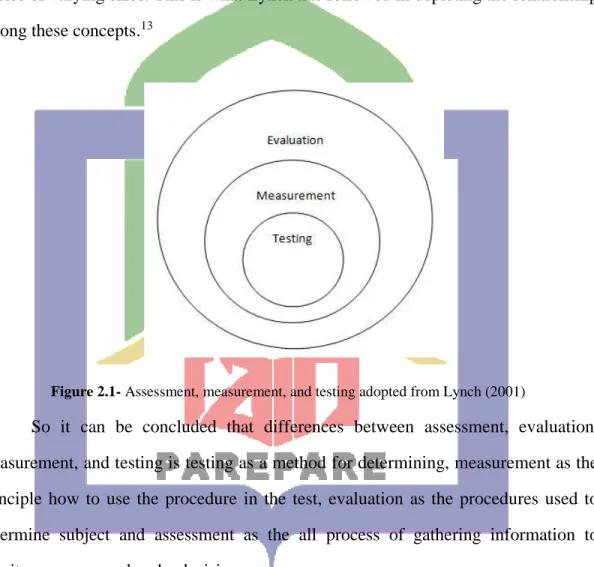
For the purpose of schematic representation, the three concepts of evaluation, measurement, and testing have traditionally been demonstrated in three concentric circles of varying sizes. This is what Lynch has followed in depicting the relationship among these concepts.13
Figure 2.1- Assessment, measurement, and testing adopted from Lynch (2001)
So it can be concluded that differences between assessment, evaluation, measurement, and testing is testing as a method for determining, measurement as the principle how to use the procedure in the test, evaluation as the procedures used to determine subject and assessment as the all process of gathering information to monitor progress and make decisions.
12Terry Overton. Assessing Learners with Special Needs An Applied Approach, Seventh Edition. (New York: Pearson Longman.Inc,) p. 43.
13Lynch, Bryan. K. “Rethinking assessment from a critical perspective”, Language Testing Vol. 18 No. 4 (October 2001), p.351.http://www.scribd.com/doc/217859598/Rethinking-Assessment- From-a-Critical-Perspective (Accessed on May 4th, 2018).
2.2.1.3 Types of Assessment
Numerous terms are used to describe different types of learner assessment.
Although somewhat arbitrary, it is useful to these various terms as representing dichotomous poles.14
Formative <---> Summative Informal <---> Formal Continuous <---> Final Process <---> Product Divergent <---> Convergent
1. Formative vs. Summative Assessment
Formative assessment is designed to assist the learning process by providing feedback to the learner, which can be used to identify strengths and weakness and hence improve future performance. Formative assessment is most appropriate where the results are to be used internally by those involved in the learning process (students, teachers, curriculum developers).
Summative assessment is used primarily to make decisions for grading or determine readiness for progression. Typically summative assessment occurs at the end of an educational activity and is designed to judge the learner’s overall performance. In addition to providing the basis for grade assignment, summative assessment is used to communicate students’ abilities to external stakeholders, e.g., administrators and employers.
14Mhairi Mc Alpine, Principles of Assessment. (Glasgow: University of Glasgow, Robert
Clark Center for Technological Education, 2002), p.4-10
http://www.caacentre.ac.uk/dldocs/Bluepaper1.pdf (Accessed on May 5th, 2018).
2. Informal vs. Formal Assessment
With informal assessment, the judgments are integrated with other tasks, e.g., lecturer feedback on the answer to a question or preceptor feedback provided while performing a bedside procedure. Informal assessment is most often used to provide formative feedback. As such, it tends to be less threatening and thus less stressful for the student. However, informal feedback is prone to high subjectivity or bias.
Formal assessment occurs when students are aware that the task that they are doing is for assessment purposes, e.g., a written examination or OSCE. Most formal assessments also are summative in nature and thus tend to have greater motivation impact and are associated with increased stress. Given their role in decision-making, formal assessments should be held to higher standards of reliability and validity than informal assessments.
3. Continuous vs. Final Assessment
Continuous assessment occurs throughout a learning experience (intermittent is probably a more realistic term). Continuous assessment is most appropriate when student and/or instructor knowledge of progress or achievement is needed to determine the subsequent progression or sequence of activities. Continuous assessment provides both students and teachers with the information needed to improve teaching and learning in the process. Obviously, continuous assessment involves increased effort for both teacher and student.
Final (or terminal) assessment is that which takes place only at the end of a learning activity. It is most appropriate when learning can only be assessed as a complete whole rather than as constituent parts. Typically, the final assessment is
used for summative decision-making. Obviously, due to its timing, final assessment cannot be used for formative purposes.
4. Process vs. Product Assessment
Process assessment focuses on the steps or procedures underlying a particular ability or task, i.e., the cognitive steps in performing a mathematical operation or the procedure involved in analyzing a blood sample. Because it provides more detailed information, process assessment is most useful when a student is learning a new skill and for providing formative feedback to assist in improving performance.
Product assessment focuses on evaluating the result or outcome of a process.
Using the above examples, we would focus on the answer to the math computation or the accuracy of the blood test results. Product assessment is most appropriate for documenting proficiency or competency in a given skill, i.e., for summative purposes.
In general, product assessments are easier to create than product assessments, requiring only a specification of the attributes of the final product.
5. Divergent vs. Convergent Assessment
Divergent assessments are those for which a range of answers or solutions might be considered correct. Examples include essay tests and solutions to the typical types of indeterminate problems posed in PBL. Divergent assessments tend to be more authentic and most appropriate in evaluating higher cognitive skills. However, these types of assessment are often time-consuming to evaluate and the resulting judgments often exhibit poor reliability.
A convergent assessment has only one correct response (per item). Objective test items are the best example and demonstrate the value of this approach in assessing knowledge. Obviously, convergent assessments are easier to evaluate or
score than divergent assessments. Unfortunately, this “ease of use” often leads to their widespread application of this approach even when contrary to good assessment practices. Specifically, the familiarity and ease with which convergent assessment tools can be applied lead to two common evaluation fallacies: the Fallacy of False Quantification (the tendency to focus on what’s easiest to measure) and the Law of the Instrument Fallacy (molding the evaluation problem to fit the tool).
2.2.2 Language Testing
According to Priscilla Allen, University of Washington, Language Testing is the practice and study of evaluating the proficiency of an individual in using a particular language effectively.15 Then, Alan Davies, University of Edinburgh, Said that "The activity of developing and using language tests. As a psychometric activity, language testing traditionally was more concerned with the production, development, and analysis of tests. Recent critical and ethical approaches to language testing have placed more emphasis on the uses of language tests. The purpose of a language test is to determine a person's knowledge and/or ability in the language and to discriminate that person's ability from that of others. Such ability may be of different kinds, achievement, proficiency or aptitude. Tests, unlike scales, consist of specified tasks through which language abilities are elicited. The term language assessment is used in free variation with language testing although it is also used somewhat more widely to include for example classroom testing for learning and institutional examinations."16.
15Priscilla Allen, “Definition of Language Testing”, http://languagetesting.info/whatis/lt.html.
(Accessed on May 5th, 2018).
16Alan Davies, “Definition of Language Testing”, http://languagetesting.info/whatis/lt.html.
(Accessed on May 5th, 2018).
Whereas Carol Chapelle and Geoff Brindley, Universities of Iowa State and Macquarie told that “In the context of language teaching and learning, Language testing refers to the act of collecting information and making judgments about a language learners’ knowledge of a language and ability to use it." And in Wikipedia, this is its current definition of Language testing: "Language Assessment or Language Testing is a field of study under the umbrella of applied linguistics. Its main focus is the assessment of first, second or another language in the school, college, or university context; assessment of language use in the workplace; and assessment of language in the immigration, citizenship, and asylum contexts."17
So, language testing is the activity of collecting data and determining a person’s knowledge and/or ability in the language and to discriminate that person’s ability from that of others.
Actually, there are many types of test. It can be divided based on the way of scoring and based on the aim to do test.18
2.2.2.1 Types of Test Based on The Way of Scoring: Objective and Subjective Test Subjective and objective are terms used to refer to the scoring of tests. All test items, no matter how they are devised, require candidates to exercise a subjective judgment. Furthermore, all tests are constructed subjectively by the tester, who decides which areas of language to test, how to test those particular areas, and what kind of items to use for this purpose. Thus, it is only the scoring of a test that can be
17Language Testing and Assessment”, Encyclopedia of Language and Education, vol. 7,.
(Accessed on May 05th, 2018).
18Heaton, J.B. Writing English Language Test: New Edition. (New York: Longman Inc, 1998) p. 171.
described as objective. This means that a testee will score the same mark no matter which examiner marks the test.
Since objective test usually has only one correct answer, they can be scored mechanically. The fact that objective tests can be marked by computer is one important reason for their evident popularity among examining bodies responsible for testing a large number of candidates.
On the whole, objective tests require far more careful preparation than subjective tests. Examiners tend to spend a relatively short time on setting the question but considerable time on marking. In an objective test, the tester spends a great deal of time constructing each test item as carefully possible, attempting to anticipate the various reaction of the test at each stage. The effort is rewarded, however, in the case of the marking.
2.2.2.2 Types of Test Based on the Aim to Do Test
Types of test based on the aim to do test can be divided into:
1. Achievement/Attainment Test
This group can be further subdivided into class progress tests and achievement tests.
1. Class Progress Tests
Most teachers are, at some time or other, required to construct such tests. Each progress test situation is unique and can only be evaluated fully by the class teacher in the light of his or her knowledge of the students, the program which they have been following, and the class teacher’s own particular aims and goals.
The progress test is designed to measure the extent to watch the students have mastered the material taught in the classroom. It is based on the language program
which the class has been following and is just as important as an assessment of the teacher’s work as the student’s own learning. A good progress test should encourage the students to perform well in the target language and to gain additional confidence.
Its aim is to stimulate learning and to reinforce what has been taught.
2. Achievement Tests
Achievement or attainment tests, though similar in a number of ways to progress test, are far more formal tests and are intended to measure achievement on a large scale. Achievement test frequently takes the form of secondary school entrance tests and school certificate examinations.
Several achievement tests are standardized; they are pre-tested, each item is analyzed and revised where necessary, norms are established and comparisons made between performances of different students and different schools. A good achievement test should reflect the particular approach to learning and teaching that has previously been adopted.
2. Proficiency Test
Whereas an achievement test looks back on what should have been learned, the proficiency test looks forward, defining a student's language proficiency with reference to a particular task which he or she will be required to perform. Proficiency test is in no way related to any syllabus or teaching program; indeed, many and even language backgrounds. The proficiency test is concerned simply with measuring a student's control of the language in the light of what he or she will be expected to do within the future performance of the particular task.
The proficiency test is concerned with measuring not general attainment but specific skills in the light of the language demands made later on the student by a future course of study or job.
3. Aptitude Test
A language aptitude test or prognostic test is designed to measure the student's probable performance in a foreign language which he or she has not started to learn; it assesses aptitude for learning a language. Language learning aptitude is a complex matter, consisting of such factors as intelligence, age, motivation, memory, phonological sensitivity and sensitivity to grammatical patterning.
Aptitude test generally seeks to predict the student’s probable strength and weakness in learning a foreign language by measuring performance in an artificial language.
4. Diagnostic Test
Although the term diagnostic test is widely used, few tests are constructed solely as diagnostic tests. Achievement and proficiency test, however, is frequently used for diagnostic purposes: areas of difficulty are diagnostic in such tests so that appropriate remedial action can be taken later. Since diagnostic strengths and weakness is such an important feature of progress tests and of teaching, the teacher should always be alert to every face of achievement revealed in a class progress tests.
Note that diagnostic testing is frequently carried out for a group of students rather than for individuals.
2.2.3 Testing the Language Skills and Language Areas19
Four major skills in communicating through language are often broadly defined as listening, listening and speaking, reading and writing. In many situations where English is taught for general purposes, these skills should be carefully integrated and used to perform as many genuinely communicative tasks as possible.
Where this is the case, it is important for the test writer to concentrate on those types of test items which appear directly relevant to the ability to use language for real-life communication.
Ways of assessing performance in the four major skills may take the form of test of:
2.2.3.1 Listening comprehension, in which short utterances, dialogues, talks, and lectures are given to the testees;
2.2.3.2 Speaking ability, usually in the form of an interview, a picture description, role play and a problem-solving task involving pair work or group work;
2.2.3.3 Reading comprehension, in which question are set to test the students' ability to understand the gist of a text and to extract key information on a specific point in the text;
2.2.3.4 Writing ability, usually in the form of letters, reports, memos, messages, instructions, and accounts of past events, etc.
It is the test constructor’s task to assess the relative importance of these skills at the various levels and to devise an accurate means of measuring the student’s success in developing these skills. Several test writers still consider that their purpose can best be achieved if each separate skill can be measured on its own. But it is
19Heaton, J.B. Writing English Language Test: New Edition. p. 8-9
usually extremely difficult to separate one skill from another, for the very division of the four skills is an artificial one and the concept itself constitutes a vast oversimplification of the issue involved in communication.
Whereas in an attempt to isolate the language areas learned, a considerable number of tests include sections on:
1. Test of grammar and usage: the tests that measure students’ ability to recognize appropriate grammatical forms and to manipulate structures.
2. Test of vocabulary: a test that measures student's knowledge of the meaning of certain words as well as the patterns and collocations in which they occur.
3. Test of phonology: a test that designed might attempt to assess the following sub-skills; ability to recognize and pronounce the significant sound contrast of a language, ability to recognize and use then stress patterns of a language, and ability to hear and produce the melody or patterns of the tunes of a language.
2.2.4 Introducing to Computer Based Test
The test is usually associated with the measurement of the mastery of certain materials. The results one of them is used to make decisions on the institution or from the teacher to the students. The result of the test is considered as valid evidence of the individual, which can be used for example for a class rise, promotion, and graduation.
Before the advent of the computer-based test, the test is usually done in writing the paper (paper-based test), but along with the development of information technology begins to shift the written test was replaced with a computer-based test even internet- based test. Computer-based test (CBT) is a method of presenting the test so that the
test taker's response to these tests can be stored and analyzed electronically. In other words, the computer-based test carried out with the help of computer software.20
The use of computer technology in the assessment has various advantages. In addition, the assessment also has problems, for example, the technical limitations, variations in the level of computer skills, the lack of guarantee of authenticity and security, there is a feeling of anxiety may have difficulty technology, the high cost of access, and others.21
There are many advantages of the test by using computer, including allowing perform tests at the right time for the participants, reducing the time for job assessment tests and make a written report, eliminating the logistical work such as distributing, storing and using the test paper, test participants can immediately know the result of the test . While the loss is that, the dependence of the equipment such as computers, requires adequate computer lab (in hardware and software as well as the amount) if the system of Computer-Based Test has problematic the implementation of computer-based tests will be delayed, requiring knowledge and computer skills to the test participants.
2.2.5 Introducing to Multimedia Authoring Tool
Multimedia Authoring tool is also known as Authorware, a program that helps to write hypertext or multimedia applications. Authoring tools usually enable you to create a final application merely by linking together objects, such as a paragraph of text, an illustration, or a song. By defining the objects' relationship to each other, and
20“Computer-based Testing”, Wikipedia the Free Encyclopedia.
http://en.wikipedia.org/wiki/Computer-basedTesting, (Accessed on May 5th, 2018).
21In Sapriati, Amalia dan Minrohayati, "Ujian Berbasis Komputer (UBK)”.Jurnal Pendidikan Terbuka dan Jarak Jauh, vol. 10, no. 2 (September 2009), p. 63-72.
by sequencing them in an appropriate order, authors (those who use authoring tools) can produce attractive and useful graphics applications. Most authoring systems also support a scripting language for more sophisticated applications.
The distinction between authoring tools and programming tools is not clear- cut. Typically, though, authoring tools require less technical knowledge to master and are used exclusively for applications that present a mixture of textual, graphical, and audio data.
Authoring can be described as creating a highly interactive application in which the information can flow in both the direction i.e., from application to user and from user to application. Multimedia authoring tools have helped in creating higher- quality audio and video application with very little expertise.
Authoring does not require a team of programmers, instructors, corporate communications, and content specialist with no previous programming experience should be able to learn and use the authoring environment. At large, authoring programs could be grouped into the following two distinct types i.e., those that relied entirely on point and click and those that required simple scripting.
Multimedia authoring tools can be evaluated by performing certain tests, which include the creation of non-interactive multimedia, computer-based training (CBT) application, catalog creation and even authoring for the World Wide Web.22
22"Multimedia and It's Application,”
http://egyankosh.ac.in/bitstream/123456789/12331/1/Unit-3.pdf (Accessed on May 5th, 2018).
2.2.5.1 Features of Authoring Tools 1. Editing Features
The elements of multimedia – image, animation, text, digital audio and MIDI music and video clips – need to be created, edited, and converted to standard file formats and the specialized applications provide these capabilities. Editing tools for these elements, particularly text and still images are often included in your authoring system.
2. Organizing Features
Some authoring tools provide a visual flowcharting system or overview facility for illustrating your project’s structure at a macro level. Storyboards or navigation diagram too can help organize a project. Because designing the interactivity and navigation flow of you project often requires a great deal of planning and programming effort, your story board should describe not just graphics of each screen but the interactive elements as well. Features that help organize your material, such as those provided by Super Edit, Authorware, IconAuthor and other authoring System
3. Programming Features
Authoring tools that offer a very high level language or interpreted scripting environment for navigation control and for enabling user inputs – such as Macromedia Director, Macromedia Flash, HyperCard, MetaCard and ToolBook are more powerful. The more commands and function provided in the scripting language, the more powerful the authoring system. Script can perform computational tasks;
sense and respond to user input; create character, icon and motion animation; launch other application; and control external multimedia devices.
4. Interactive Fetaures
Interactivity empowers the end users of your project by letting them control the content and flow information. Authoring tools should provide one or more levels of interactivity: simple branching, which offers the ability to go to another section of the multimedia production; conditional branching, which supports a go-to based on the result of IF-THEN decision or events. A structured language that supports complex programming logic, such as nested IF-THENs, subroutines, event tracking and message passing among object and elements.
5. Performance Tuning Features
Complex multimedia projects require extra synchronization of events.
Accomplishing synchronization is difficult because performance varies widely among the different computers used for multimedai development and delivery. Some authoring tools allow to lock a production’s playback speed to specified computer platform, but other provides no ability what so ever to control performance on various systems.
6. Playback Features
When developing multimedia project, it will continually assembling elements and testing to see how the assembly looks and performs. The authoring system should let to build a segement or part of the project and then quickly test it as if the user were actually using it.
7. Delivery Features
Delivering project may require building a run-time version of the project using the multimedia authoring software. A run-time version allows your project to play back with out requiring the full authoring software and all its tools and editors.
Many times the run time version does not allow user to access or change the content, structure and programming of the project. If the project is going to distribute widely, it should distribute it in the run-time version.
8. Cross-Platform Features
It is also increasingly important to use tools that make transfer across platforms easy. For many developers, the Macintosh remains the multimedia authoring platform of hoice, but 80% of that developer’s target market may be Windows Platforms.
9. Internet Playability
Due to the Web has become a significant delivery mediumfor multimedia, authoring systems typically provide a means to convert their output so that it can be delivered within the context of HTML or DHTML, either with special plug-in or embedding Java, JavaScript or other code structures in the HTML document.
2.2.6 Adobe Captivate
Adobe is an authoring tool that is used for creating e-learning content such as software demonstrations, software simulations, branched scenarios, and randomized quizzes in Small Web Formats (.swf) and HTML 5 formats. It can also convert Adobe Captivate generated file formats (.swf) to digital MP4 (.mp4) formats which can be played with media players or uploaded to video hosting websites. For software simulation, Captivate can use left or right mouse clicks, key presses and rollover images.23
23“Adobe Captivate”, Wikipedia the Free Encyclopedia.
https://en.wikipedia.org/wiki/Adobe_Captivate (Accessed on May 5th, 2018).
There are five fabulous features of adobe captivate that enhance the instructional design. They are Adobe Captivate Draft, Device-aware Delivery, Multimedia Integration, Branch-aware Quizzing, Geo-location Support.24
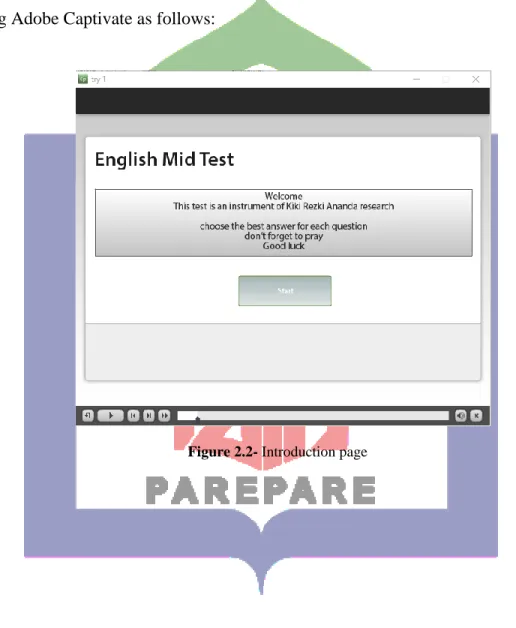
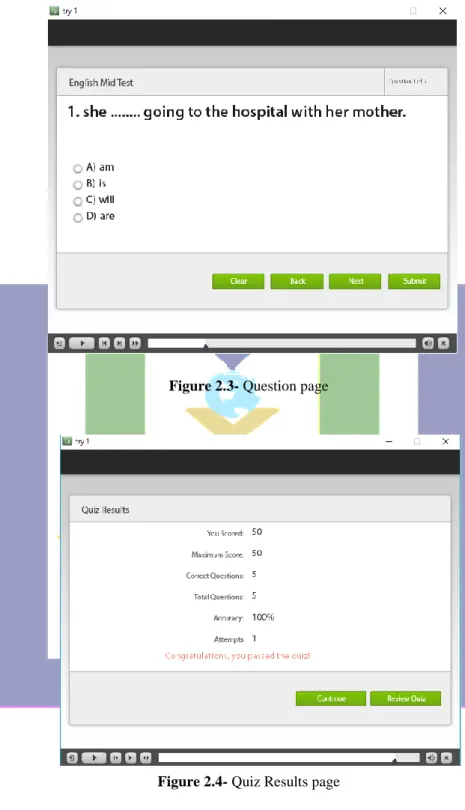
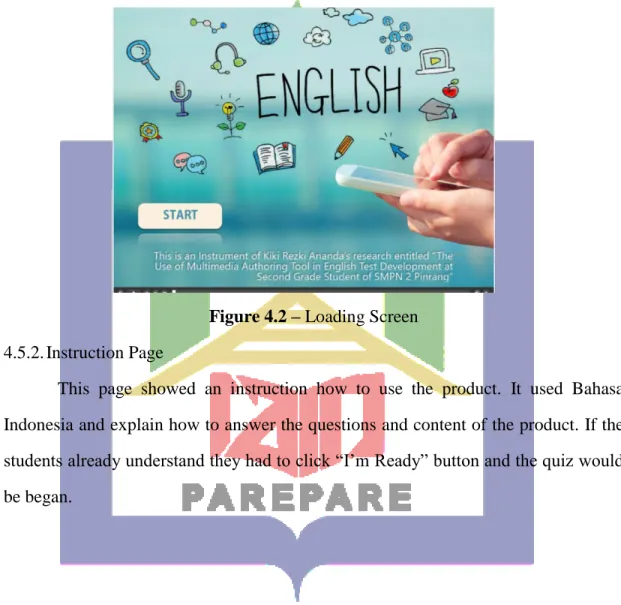
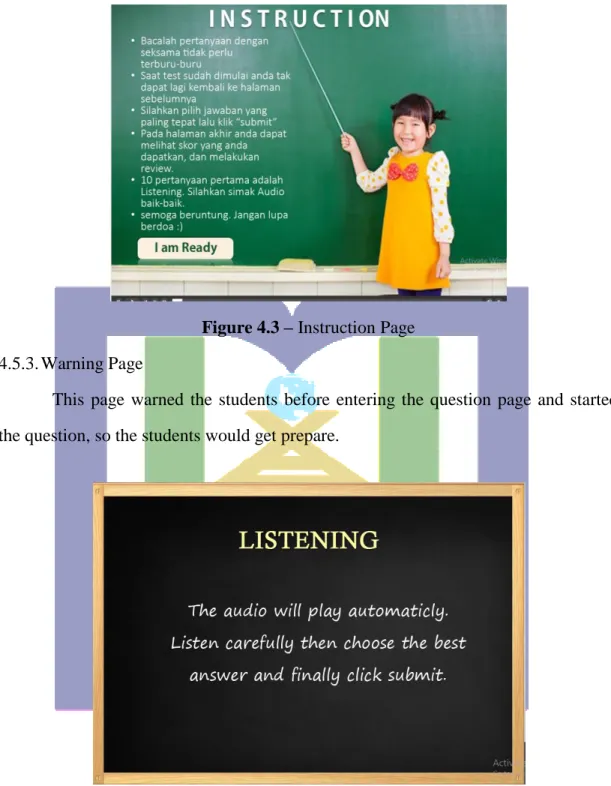
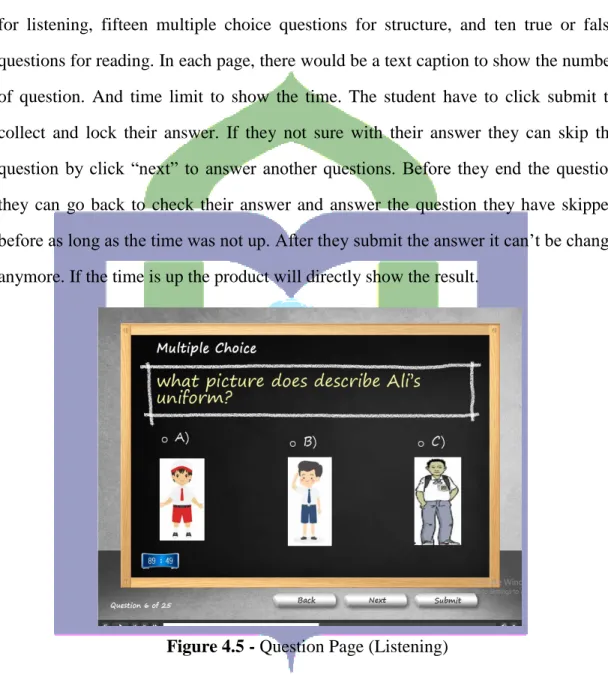
Next, some introduction displays of English computer-based test that made by using Adobe Captivate as follows:
Figure 2.2- Introduction page
24Hema Gopalakrishnan "5 Best features of Adobe Captivate 9"
https://blog.commlabindia.com/elearning-development/5-best-features-of-adobe-captivate-9 (Accessed on May 5th, 2018).
Figure 2.3- Question page
Figure 2.4- Quiz Results page
2.3 Conceptual Framework
Some experts defined the conceptual framework, Sugiono in his book states that framework is a conceptual model of how theory relates to a variety of factors that have been identified as an important issue.25
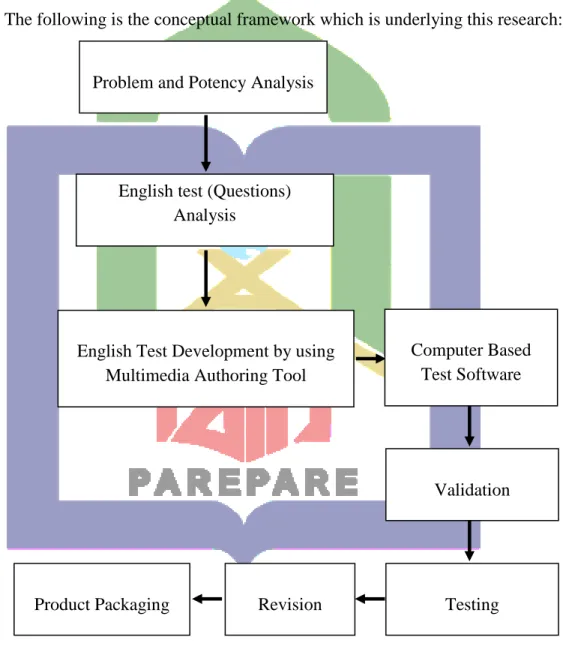
The following is the conceptual framework which is underlying this research:
Figure 2.5- Conceptual Framework of the Research
25Sugiono, Metode Penelitian Pendidikan Kuantitatif Kualitatif, (Cet. 22; Bandung: Alfabeta, 2015), p. 91.
Problem and Potency Analysis
English test (Questions) Analysis
English Test Development by using Multimedia Authoring Tool
Computer Based Test Software
Validation
Testing Revision
Product Packaging
The conceptual network above explain that Research and Development in English proficiency test began with analysis of problem that found or faced in the field and potencials that can be improved to solve the problem. The next step is analyze the questions for English testing for first grade students. Then develop the English test by using Multimedia Authoring Tool with Adobe Captivate Software.
This process produces Computer Based Test Software. Next, the product is then through the process of validation by material experts, media experts, and practitioners / teachers to demonstrate the feasibility of the media that has been produced. After the validation process, then proceed with the product testing process on the learners who serve as the subject of research. The results of this step become the reference to revise the lack of product. The last step is product packaging.
30
The design of this research was Development Research. According to Gay, Development Research is an effort to develop a product that is effective for the use of the school, and not to test the theory.1
Seals and Richey defines Development Research as a systematic assessment of the designing, development, and evaluation of programs, processes and learning products that must meet the criteria of validity, practicality, and effectiveness.2
Van den Akker and Plomp describe the Development Research based on two objectives namely:
3.1.1 Development of a prototype product
3.1.2 Formulation of methodological suggestions for designing and evaluating the product prototype.3
While Richey and Nelson distinguish two types of Development Research as follows:
3.1.1 The first type focuses on designing and evaluation of the product or specific programs with the aim to get an overview of the development process and to study the conditions that support the implementation of the program.
1Gay, L.R. Educational Evaluation and Measurement: Com-petencies for Analysis and Application. Second edition. (New York: Macmillan Publishing Company,1991), p. 132
2 Seels, Barbara B. & Richey, Rita C., Teknologi Pembelajaran: Definisi dan Kawasannya.
Penerjemah Dewi S. Prawiradilaga dkk. (Jakarta: Kerjasama IPTPI LPTK UNJ, 1994), p. 279
3Van den Akker, Principles and Methods of Development Researcp.in J. van den Akker, R.Branch, K. Gustafson, Nieven, dan T. Plomp (eds), Design Approaches and Tools in Education and Training (Dortrech: Kluwer Academic Publishers, 1999). p. 2
3.1.2 The second type focused on the assessment of development programs carried out previously. The purpose of this second type is to gain an overview of designing and evaluation procedures are effective.4
Based on the opinions above, it can be concluded that the Development Research is a process used to develop and validate the products that are used in education. Products that produced include training materials for teachers, learning materials, media, test, and learning management systems.
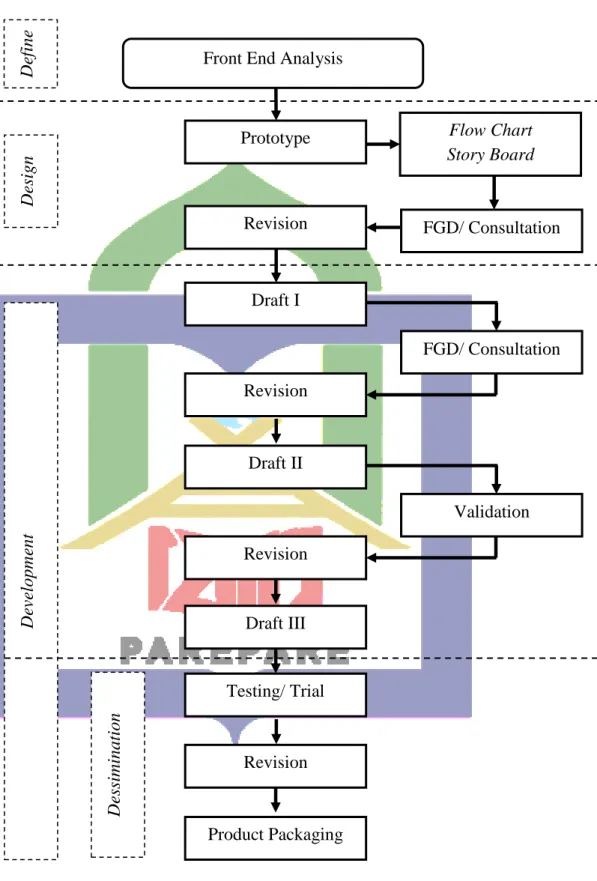
The research used 4D model popularized by Thiagrajan in 1974. This model has four steps i.e : define, design, development and disemination.5 Each step passed gradually and sistematically to the next step. Every step passed a process of structured activities. The implementation of the stage can be adjusted to the conditions and situations that facilitate the process. For instance in the FGD process if it is difficult to present all the speakers in one place, it can be conditioned by direct consultation visits by the researcher. As for the steps of research and development can be described as follows:
4Rita C. Richey, J. D. K., Wayne A. Nelson, Developmental Research: Studies of Instructional Design and Development.(2009), p. 45.
5 Sugiyono, Metode penelitian dan pengembangan (Bandung: Alfabeta, 2015), p.37-38.
Development Dessimination
Figure 3.1- 4D Model
Front End Analysis
Prototype Flow Chart
Story Board
FGD/ Consultation Revision
Draft I
FGD/ Consultation Revision
Draft II
Validation Revision
Draft III
Testing/ Trial
Revision
Product Packaging DefineDesign
Furthermore, to be able to understand each step in the design flow can described as follows:
3.1.1 Define
This step is a very important start in determining the problems and potentials in the field. This process was a series of needsassement to the needs of the development of a design or product in the form of models, media, and learning materials. Needs analysis was based on the problems faced by learner in the field in this context is the school as a place for the learning process. Then how the solutive plan to provide alternative solutions in the form of products offered based on existing potential.
3.1.2 Design
The second step after Analyze the needs was design. There were some activities that has been done as follows:
1. Making Flow Chart, which was a model of framework from media content that produced. Essentially, Flow Chart was a graphical chart showing work systems or activity trends as an executable system.
2. Writing Story Board, which was the sustainability of the flow chart. If flow chart contained only the outline of a test from beginning to end, then the storyboard was a more detailed explanation or detail about the contents of each media frame created.
3. Preparation of materials consisted of list of question, picture, animation, video, audio to fill the story board that created.
3.1.3 Development done by actualizing the design into a product that gone through several stages of revision, validation, and field trials. The test that created was
Computer-based Test of English for first grade students by using Multimedia Authoring tool named Adobe Captivate. The validaton done by three experts:
one media expert from academics on relevant studies, one material expert from academics on with scientific specifications on English, two learning practitioners English teachers. Suggestions by the validator be a reference in making revisions and improvements of the product. This revision process done several times until the product was considered feasible to be tested.
3.1.4 Dessimination
This step was process of product packaging and product dissemination to students and English teacher either directly or online.
3.2 Place and Time of the Research
This research conducted at SMPN 2 Pinrang. The research used Development Research. The overall research activity was planned as long as three months.
3.3 Subject of the Research
The subject of this research were one material expert, one media expert, and two practitioners/teachers of English. Testing or trial done by the first grade students of SMPN 2 Pinrang class VII.1 with twenty five students selected.
3.4 Instrument of the Research
The instruments used by the researcher in this research as follow:
3.4.1 English proficiency test was the main instrument in this research. The tests consisted of a set of questions that were developed from paper-based test to computer-based test by using Multimedia Authoring tool named Adobe Captivate as the main software.
3.4.2 Questionnaire was a research instrument consisted of some question and other prompts for the purpose of gathering information from respondents. The researcher used it to know the students’, experts’, and teachers’ responses.
The data obtained through the quetionnare then became the material in assessing the quality and feasibility of the english test produced. The questionnare used in this research adapted to the format of learning media evalution developed by Azhar Arsyad with some adjustment by researcher.6 The quetionnare developed with reference to Likert scale with five alternative answers that is strongly agree = 5, agree = 4, slightly disagree = 3, disagree = 2, strongly disagree= 1.7 The questionnare also contained suggestion from the experts. The suggestion would be the basis for revising the product that had been developed.
3.5 Procedure of Collecting Data
Based on the design of research above, the procedure of collecting data in this research as follow:
3.5.1 Observation done in a preliminary by conducting a direct observation of the field conditions to find early descriptions of the problems and potentials (Front End Analysis). The results become one of the basic research and development of English proficiency Test Media in SMPN 2 Pinrang.
3.5.2 Questionnare used to dig up the experts, teachers, and students responses toward English proficiency test media produced. The suggetion from responden then processed as data that showing it feasibility.
6 Azhar Arsyad, Media Pembelajaran (Jakarta: PT. Raja Grafindo Persada, 1996), p.175.
7 S. Eko Putro Widoyoko, Teknik Penyusunan Intrumen Penelitian (Yogyakarta: Pustaka Pelajar, 2016), p.106.
3.6 Technique of Analysis Data
The data that obtained in this research were related to data of test results and data from Questionnaire. The data were gotten from the experts, teachers and students. Then, the data analyzed quantitavily by calculating the answers precentages of each question given by the respondents. The researcher used the following formula:
𝑛𝑖𝑙𝑎𝑖 = ∑ 𝑠𝑘𝑜𝑟
∑ 𝑠𝑘𝑜𝑟 𝑡𝑜𝑡𝑎𝑙 𝑥 100
The calculation results using the above formula then interpreted based on the respondents’ answers. The interpretation guidelines of the analysis results were based on the following table:
Table 3.1
Attitude Interpretation Guidelines adopted from Sugiono (2016)
Category Precentage Qualification
5 80% - 100% Very Good
4 60% - 79,99% Good
3 40% - 59,99% Slightly Good
2 20% - 39,99% Bad
1 0% - 19,99% Very Bad
If the result of analysis is 80% - 100% meant the product was very good or very interesting. If the result of analysis is 60% - 79,99% meant the product was good or interesting. If the result of analysis is 40% - 59,99% meant the product was slightly good or slightly interesting. If the result of analysis is 20% - 39,99% meant the product was bad or not interesting. If the result of analysis is 0% - 19,99% meant that the product was very bad or very not interesting.