The Hospitality Service Strategy
If you don’t have a road map, or know where you are, you may be there already.
—Norman Brinker, Former CEO, Chili’s Restaurants
Running a business without a plan is like going into the forest, shooting off your rifle and hoping that dinner runs into the bullet.
—Herman Cain, Former Chairman and CEO, Godfather’s Pizza
Chapter 1 The Basics of Wow! The Guest Knows Best
Chapter 2 Meeting Guest Expectations through Planning
Chapter 3 Setting the Scene for the Guest Experience
Chapter 4 Developing the Hospitality Culture:
Everyone Serves!
1
The Basics of Wow!
The Guest K nows Best
HOSPITALITY PRINCIPLE: PROVIDE THE SERVICE QUALITY AND VALUE THAT GUESTS EXPECT
Chapter
The secret to success is to treat all customers as if your world revolves around them.
—Unknown
You don’t know what you aren’t going to get until you don’t get it.
—Theodore Levitt
L E A R N I N G O B J E C T I V E S
After reading this chapter, you should understand:
•Important differences between making products and serving guests.
•The importance of meeting the hospitality guest’s expectations.
•The importance of the guest experience.
•The components of the guest experience.
•The definition of service quality and service value in the hospitality field.
•The reasons why“it all starts with the guest.”
3
KEY TERMS AND CONCEPTS
hospitality service quality service value guest experience moment of truth guestology service product service setting
service environment servicescape
service delivery expectations guestologist internal customers service
KSAs
service delivery system service package service encounter critical incident
benchmark organizations quality
value cost
Serving guests and making products are such different activities that they require different management principles and concepts. Catching a defective tire or a paint blemish on a car’s finish at the final inspection stage of an assembly line production process is one thing. Quite another is listening to irate guests telling you in no uncertain terms that your hotel, restaurant, or airline has failed to deliver the service experience they expected. In the first instance, the quality inspector—one of many people between the maker of the product and the final customer—can send the defective product back for rework so that the customer never sees it. In the second situation, there is usually no one to buffer the relationship between the person delivering the unsatisfactory service and the guest dissatisfied with it.
At its most basic level, thehospitalityindustry is made up of organizations that offer guests courteous, professional food, drink, and lodging services, alone or in combination.
But the hospitality industry is more than just hotels and restaurants. Beyond these, the industry has been defined in many ways. An expanded definition includes theme parks, airlines, gaming centers, cruise ships, trade shows, fairs, meeting planning and convention organizations. Because we think the principles and practices presented in this book have wide application, we are going to use this more expanded concept of the industry. The challenge for all organizations in this industry is to ensure that their personnel always provide at least the level of service that their guests want and expect—every time, perfectly.
This book is designed to show all those working in this industry and those who manage them how to do that.
Even more challenging for those in hospitality organizations is the simple reality that service quality and service value are defined not by managers, auditors, or rating organizations: They are defined entirely in the mind of the guest. Although there are a few organizations, like J. D. Power, and several Web sites, like TripAdvisor, that rate the service quality of the local Holiday Inn, Friendly Travel Agency, or Olive Garden, individual guests still make their own decisions on whether the quality and value of the service they experienced met their expectations. Even thoughBusinessWeekannually rates the best service companies and the American Customer Satisfaction Index (ACSI) andConsumer Reportsfrom time to time offer evaluations of the major airline, hotel, and restaurant companies, in the final analysis, the decision about the quality and value of a hospitality experience is made anew by each individual guest in every transaction with a specific unit of a hospitality organization on a particular date with a certain service staff. If the guest comes on a date or at a time when the organization for whatever reasons fails to meet expectations, for that guest the restaurant is no good, the airline inept, and the hotel a major disappointment. One unfortunate incident can negatively influence the opinion of the guest and anyone the guest talks to both in person and virtually, through a Web site posting, or social media site.
You will find that this text is very different from traditional management texts, because hospitality organizations are very different businesses to run from those discussed in traditional management texts. Most texts emphasize different principles and guidelines for managers seeking to run these organizations well; however, the success or failure of theguest experience(to be explained shortly in detail) may depend on how a singlemoment of truth between a hospitality employee and the guest is handled. Management’s responsibility is to ensure that each moment of truth has been prepared for—has been managed—as well as humanly possible to yield a satisfying, even outstanding, outcome for the guest.
How to achieve such outcomes is the focus of this book. Once dominated by the manufacturing sector, the economy is now overwhelmingly dominated by the service sector. This shift to a service economy requires that traditional management models and methods be reorganized and redirected if they are to meet the unique challenges and opportunities of hospitality organizations.
GUESTOLOGY: WHAT IS IT?
In this book, we organize the available knowledge about meeting these challenges and oppor- tunities around guestology, a term originated by Bruce Laval of The Walt Disney Com- pany.1 Customer-guests are, to the extent possible, studied scientifically (the -ology in guestology). Guests’behaviors within the hospitality organization are carefully observed. Their wants, needs, capabilities, and expectations regarding the hospitality guest experience are de- termined. And ultimately, the service product is tailored to meet their demands and those of future guests. Guestology means simply that all the organization’s employees must treat cus- tomers like guests and manage the organization from the guest’s point of view. All the while, this is a business, and an eye must be kept on the bottom line to ensure that services can continue to be provided in the future. The good news is that guestology makes good busi- ness sense. The practice of guestology makes it possible to increase guest satisfaction, which leads to more repeat visits, which in turn drives revenues up. The findings of guestology turn into the organizational practices that provide sustained outstanding services. The organiza- tion’s strategy, staff, and systems are aligned to meet or exceed the customer’s expectations regarding the three aspects of the guest experience:service product,service setting(also calledservice environmentorservicescape), andservice delivery. These aspects or ele- ments are carefully woven together to give guests what they want and expect, plus a little bit more.“It all starts with the guest”is not just an inspirational slogan; in the service-centered hospitality organization, it is the truth and everybody accepts and lives up to it.
Guestology turns traditional management thinking on its head. Instead of focusing on organizational design, managerial hierarchy, and production systems to maximize organiza- tional efficiency, guestology forces the organization to start everything it does by looking systematically at the guest experience from the customer’s or guest’s point of view. What customers do and want are first systematically studied, modeled, and predicted. Only then can the rest of the organizational issues be addressed. The goal is to create and sustain an organization that can effectively meet the customer’s expectations and still make a profit.
Meeting Customer Expectations
Customers come to a service provider with certain expectations for themselves, their businesses, and/or their families. First-time guests may have general expectations. For ex- ample, a first-time guest of a major hotel may simply expect a nice room, a comfortable mattress, clean surroundings, satisfactory meals, and a reasonable price. A repeat guest may have more specific expectations based on past experience. Olive Garden knows that
all guests, new and repeat, have certain expectations that drive their evaluation of the quality and value of the Olive Garden experience. From extensive research of their custo- mers, Olive Garden leaders know that their guests’ key drivers are food of good quality, fast and attentive service, cleanliness, and a pleasant atmosphere. Olive Garden not only asks and studies their guests to find their key drivers, they also solicit comments about how well they delivered on those characteristics by gathering customer feedback.
Aguestologist seeks to understand and plan for the expectations of an organization’s targeted customers before they ever enter the service setting, so that everything is ready for each guest to have a successful and enjoyable experience. The road from the Magic Kingdom’s Main Street, U.S.A. hub off to the right to Tomorrowland in Orlando’s Walt Disney World Resort is wider than the road to Adventureland which is off to the left.
This is because Disney carefully studied guest behavior and discovered that when people were otherwise indifferent as to which direction to go, they tended to go in the direction of their handedness. Since there are more right-handed than left-handed guests, Disney made the road to the right wider than the other roads off the main hub anticipating that more people would go in that direction. That is guestology in practice. Here is a second illustration of the concept. Disney knows that one of its greatest assets is its reputation for cleanliness. Keeping a theme park clean is a big job, so the Disney organization en- courages its guests to help out by disposing of their own trash. After all, whatever people throw away themselves does not have to be cleaned up by a paid employee. In studying guest behavior, Disney learned two things. First, if cast members (the Disney term for its employees) are visible constantly picking up even the smallest bits of trash, park guests tend to dispose of their own trash. The cast members model the desired behavior of keep- ing the parks clean to show respect for cleanliness, and guests copy them. Second, people tend to throw their trash away if trash cans are convenient, easily seen, and not far apart. Disney locates the trash cans to match these criteria. For example, visit the Magic Kingdom on a quiet day when the crowds are not distracting; you will notice that Main Street, U.S.A. looks like a forest of trash cans, located 25 to 27 paces apart. Understand- ing how guests respond to environmental cues and using that knowledge to help maintain a high standard of cleanliness is guestology in practice.
Managers of all hospitality organizations can extend the lessons learned by Disney guestologists and other leading hospitality firms to their own companies. If the organiza- tional goal is to provide an outstanding guest experience, then the organization must un- derstand why its guests come to the hospitality organization, what those guests expect, and what the company can and will actually do in order to meet their guests’ expecta- tions. Many people think running a restaurant is simple: Offer good food at a fair price, and everything else takes care of itself. Profitable restaurants know that guests patronize them—or get angry and leave—for a variety of reasons other than food quality and value.
Managing the total dining experience is a much bigger job than merely executing a good recipe. Guestology involves systematically determining what those factors are, modeling them for study, measuring their impact on the guest experience, testing various strategies that might improve the quality of that experience, and then providing the combination of factors or elements that attracts guests and keeps them coming back.
Serving Internal Customers
In addition to public consumers, the hospitality organization has within itself manyinter- nal customers, persons and units that depend on each other and“serve”each other. The principles for providing an outstanding service experience for external customers also apply to these many internal customers. For example, a computer help desk that serves
internal customers should understand and fulfill the expectations of these customers just as any organization tries to meet and exceed the expectations of its external customers.
This logic can easily and rightfully be extended to the level of the individual employee.
The organization must meet or exceed the expectations of employees about how they will be treated. Smart hospitality organizations know that their employees must get the same care and consideration that they want their employees to extend to their guests. They un- derstand that they can’t mistreat their own employees and expect them to then treat the customers well. They know that the way in which the organization treats its own employ- ees will inevitably spill over onto the way their employees treat guests and each other. In these organizations, everyone works hard to avoid employee mistreatment and unfairness.
As expressed in the Southwest Airlines mission statement, “Employees will be provided the same concern, respect, and caring attitude within the organization that they are ex- pected to share externally with every Southwest customer.”Extending guest treatment to employees is so important to organizational success that much of Chapter 7, on employee motivation and empowerment, will be devoted to it.
Meeting Increased Competition
The competition for guest loyalty and dollars (and euros, rupees, won, yen, yuan, etc.) is intense and will only grow more so in the future. New hospitality organizations spring up every day. Although opening a hospitality organization like a hotel, convention center, travel Web site, or airline costs a lot of money, for thousands of restaurants, travel agen- cies, sports bars, and convention services organizations, the amount of start-up capital needed is comparatively small. This book is not just for large corporations. These smaller organizations, like the larger ones hoping to survive and prosper in this competitive envi- ronment, need to master and practice the principles of guestology. If they don’t provide the experience their guests expect, someone else will.
Service
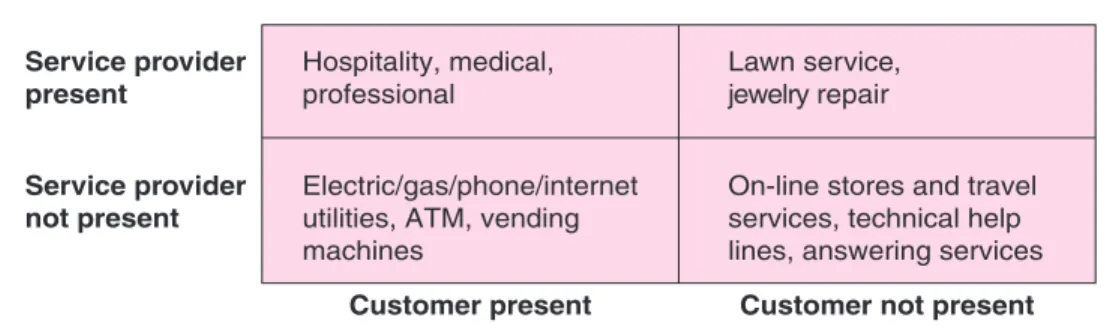
We have frequently spoken ofservice, a word with numerous meanings. A common way to think of service is as the intangible part of a transaction relationship that creates value between a provider organization and its customer, client, or guest.2More simply, a service is something that is done for us. Services can be provided directly to the customer (e.g., a spa treatment, a haircut, and medical procedures) or for the customer (e.g., finding and purchasing tickets to a show, lawn care, and car repair). The services can be provided by a person (e.g., by a service associate in a restaurant or by a travel agent) or via technology (e.g., by booking a ticket online or using an ATM). Some of these relationships are depicted graphically in Figure 1-1, later in the chapter. And, of course, services can be provided as a combination of these characteristics.
Most services include a tangible physical product or tangible materials and equipment in the transaction as well: At McDonald’s you get a hamburger you can see, touch, eat, or take home in a box; you also get service along with the hamburger. A cruise line will in- clude a ship, a dining experience will provide food, and a teacher’s lesson may require chalk, texts, and notes. Other service transactions, like a session with a psychiatrist or So- cial Security counselor, offer only the customer-provider interaction.
Service Product
Another, perhaps even more common, meaning of service refers to the entire bundle of tangibles and intangibles in a transaction with a significant service component. If you leave town for a month and pay for pet-sitting service, the organization or individual may buy and serve pet food, brush and comb pets, interact with them, bring toys, clean their
litter box, and so forth. Some of what you pay for when you purchase the pet-sitting ser- vice is tangible (e.g., the cat food); some is intangible. For such tangible-intangible mix- tures or bundles, the term service package or service product is often used. It is used to describe pure services as well, since the pure service provided is the product the organiza- tion offers for sale. Although these overlapping meanings can be confusing (servicesome- times referring to a tangible-intangible mixture, service product sometimes referring to a pure service with no tangible product), the way the term is used in context should make clear what we are talking about in this book. In different contexts, sometimes one term will feel appropriate, sometimes the other.
One necessary distinction to realize is that the service product does not refer specifi- cally to the tangible items that may accompany the transaction, though it can include them. That is, if you go to Olive Garden for dinner, the actual meal is not the service product; it is just a tangible part of the service product that Olive Garden delivers to di- ners within rooms themed to resemble a classic Italian restaurant and a feeling that when you are there“you’re family.”
A final point about the service product: Both the organization and the guest define it, and the definitions may not be the same. The organization may think its service product is the well-made, tasty hamburger, reliably consistent from location to location. But the guest may be “buying” a more extended service product: a well-made, tasty, consistent hamburger delivered quickly in clean surroundings by a cheerful server. Cleanliness and cheerfulness may be as important as burger taste for many guests. Since it all starts with the guest, a hospitality organization always needs to define its service product not in terms of its own interests but in terms of what its guests want and expect. Charles Revson, founder of Revlon, Inc., long ago drew this important distinction between what his orga- nization makes and what the clientele buys: “In the factory we make cosmetics; in the store we sell hope.”3
Service Industries
Just as the service product is a mixture of tangible and intangible elements, so are the en- tire industries that provide these products. Although some industries have traditionally been referred to as service industries, marketing writer Theodore Levitt made an impor- tant point about service as early as 1972:“There are no such things as service industries.
There are only industries whose service components are greater or less than those of other industries. Everybody is in service.”4
Goods to Services to Experiences
A characteristic of the contemporary economy that hospitality organizations were the first to understand is that, for many consumers, receiving well-made goods or well-rendered services may no longer be sufficient. If you build a better mousetrap today, the world may or may not beat a path to your door. More and more, today’s consumers want their goods and services packaged as part of a memorable experience that has an emotional impact. Of course, today’s airlines must fly passengers safely from point to point on sched- ule; restaurants must serve tasty, safe-to-eat food; hotels must provide clean rooms—all at a price customers are willing to pay. But the most successful hospitality organizations, and an ever-increasing number of organizations of all types, are recognizing the competitive advantage they can gain by providing carefully designed experiences that unfold over a period of time for their customers, clients, and guests.
B. Joseph Pine and James H. Gilmore were among the first to note that just as we had moved from an industrial to a service economy, we have now transitioned to an experi- ence economy.5 If this is true, thinking in terms of providing customer experiences is
important for many organizations in varied industries; in the hospitality industry, such thinking is already considered essential to a successful competitive strategy.
Understanding the Guest
To well-managed hospitality organizations, guests are not statistical entities, vague con- cepts, or abstractions. They understand that within the heterogeneous mass of people they serve or want to serve, each is an individual, each is unique; some companies use the term VIP to remind their employees that they are serving “very individual people.” Each guest brings to the guest experience a different bundle of needs, wants, capabilities, and expectations. Some guests will arrive happy and excited about whatever is going to happen to them. Others will arrive unhappy, bored, or even angry. Some guests know how to use the fondue pots. Others need to be taught so they don’t burn themselves.
Even more challenging is that it is possible that the happy excited guest that came yester- day is the unhappy angry guest coming in the door today. The hospitality organization must not only strive to satisfy each of the guests it seeks to serve in its target market but also adapt what it does to account for the changes in expectations, wants, needs, and capabilities that those guests may have from visit to visit.
The first step in understanding how to manage the guest experience then is to under- stand the guests that are in their target market, to whatever extent possible. Ideally, this understanding would include (1) the traditional demographic breakdowns of age, race, gender, and guests’home locations; (2) the psychographic breakdowns of how they feel, what their attitudes, beliefs, and values are, and what kind of experience they need, want, and expect the hospitality organization to deliver; and (3) the capabilities (their knowledge, skills, and abilities [KSAs]) to coproduce the experience.
Meeting the expectations of a customer who arrives needing but not really wanting the service and angry at the service provider, perhaps even at the world itself, is difficult. In such situations, ensuring the quality of the service experience is even more crucial because of the circumstances leading to the need for the services. For example, those employing the services of a funeral home rarely do so under happy circumstances. Most dental pa- tients coming in for a root canal will neither enter nor leave the dentist’s office filled with joy. In hospitality, sometimes people must travel but don’t particularly want to, like the overtired business traveler, the reluctant wedding guest, or the child forced to go on the family vacation or out to a family dinner. Fortunately, most guests of hospitality organiza- tions not only are capable of coproducing the experience but also eagerly anticipate the service and have no problems with needing it or wanting it. They are easier to keep happy than the person waiting for the dentist’s drill, surgeon’s knife, or divorce lawyer’s advice, or otherwise forced into circumstances not by their choosing.
Understanding and appreciating that guests, their expectations, and their capabilities are varied motivates the guest-focused organization to design each guest experience from each guest’s point of view, to offer a personalized experience insofar as possible.
THE GUEST EXPERIENCE
A term that we have already repeatedly mentioned and will recur many times in the follow- ing pages isguest experience. It is the sum total of the experiences that the guest has with the service provider on a given occasion or set of occasions. If you tell your friend that last night you had a“wonderful evening at the dinner theater,” you are referring to the evening as a whole and are thinking of it that way; the evening of theater was your guest experience.
Providing you with the different phases and aspects that made up your wonderful evening, however, took many dinner theater employees, some of whom you saw and some of whom
you were not even aware, who produced those different activities and projects flawlessly. For purposes of planning and execution, most hospitality organizations divide the total experi- ence they offer into convenient units or components. For purposes of explaining the total guest experience, we shall do the same, even though such a division is to an extent artificial.
W. Neu and S. W. Brown suggest that even traditional manufacturing organizations are increasingly interested in the service component of the manufactured product as they have recognized the value of the total product offering, including the services associated with it.6 Product, Setting, and Delivery
In a way, this entire book can be oversimplified into one (fairly long!) sentence: We are going to show how the benchmark hospitality organizations use their strategy, staff, and systems to provide each guest with a seamless three-part guest experience—service prod- uct, service setting, and service delivery—each part of which will at least meet the guest’s expectations and the sum total of which ideally will make the guest say, or at least think,
“wow!” In a simple service situation, the entire guest experience might be delivered by a single person in a single moment, but for the typical guest experience, speaking of a service delivery system seems more accurate. That system consists of an inanimate technology part (including organization and information systems and process techniques) and the people part—most importantly, the frontline server who delivers, or presents the service, or co-produces it with the guest.
Here is the basic equation that captures all the components of the customer experience that must be effectively managed by the guestologist:
Guest experience = service product + service setting + service delivery system
All the moments you spent at the theater add up to the guest experience you later de- scribe as a “wonderful evening of theater.” But you probably had many, smaller service experiences during the evening. If, for example, at intermission you went to a designated area and received beverage service, that short experience would have its own service, set- ting, and a delivery system. The next time you go to a vacation resort, take a cruise, fly, or visit a theme park, although you will have numerous separate service experiences, you will end up making a judgment about the quality and value of theoverallguest experience. If you spend three days or a week at a resort—as many people do—each day’s individual guest experiences will add up to the overall day’s experience, and the one-day experiences will add up to the overall resort experience.
Unique, Yet Similar
Because incidents and occurrences are never exactly the same for two people—whether at a theater, hotel, vacation resort, restaurant, or on a cruise ship—no two guest experiences are exactly alike. Even if the incidents and occurrences were exactly the same, your expe- rience of them would be unique because the wants, needs, tastes, preferences, capabilities, and expectations you bring to the experience are uniquely yours and may change from day to day. Add in the intangibility of service itself, and the uniqueness of each guest ex- perience cannot be questioned. That uniqueness is what provides the primary challenge to the hospitality service provider. The old saying has it that“you can’t please every guest,” but the hospitality organization has to try, even though everybody is different.
On the other hand, guests do respond to many experiences in similar if not identical ways. These categories of responses can be sampled, studied, and modeled to produce extremely accurate predictive models of what guests will do and how they will behave.
Probabilistic statistics is a major tool in the guestologist’s kit for identifying how hospitality
organizations can best respond to the needs, wants, and expectations of their targeted guest markets. Successful hospitality organizations spend considerable time, effort, and money studying their guests to ensure that each part of the entire guest experience adds something positive to it. They also expend significant resources finding and fixing the inevitable mis- takes as best they can.
Components of the Guest Experience
Though the three elements that the hospitality organization has to work with often blend seamlessly into one experience—and should do so—we can for the purpose of discussion break them out into the service product, setting, and delivery system. Here is a fuller de- scription of each.
The Service Product
The service product, sometimes called the service package or service/product mix, is why the customer, client, or guest comes to the organization in the first place. An organi- zation’s reason for being is often embodied in the name of the business: Riverside Amuse- ment Park, Omni Convention Center, Sally’s Video Arcade, Multiplex Movie Theater, Cheers Bar and Grill. The basic product can be relatively tangible, like a hotel room, or relatively intangible, like a rock concert. Most service products have both tangible and in- tangible elements and can range from mostly product with little service to mostly service with little if any product.
The Service Setting
The second component of the guest experience is thesettingorenvironmentin which the ex- perience takes place. The term servicescape, the landscape within which service is experi- enced, has been used to describe the physical aspects of the setting that contribute to the guest’s overall physical feel of the experience. Las Vegas casinos are famous for using their hotels’designs to make the focus of the service setting on the gambling. Hotel lobbies are lavish, making the customer feel he or she is in a resort. Everything the customer needs— the rooms, bars, fancy restaurants, fast food, shopping, shows—are all conveniently inside the casino. And to get to any service you need—for example, the front desk to check in or out, or to get to any restaurant—you must always pass through the casino. The design of the service setting keeps the customer focused on where the hotel makes its money: from the casino. The servicescape is also extremely important to the themed“eatertainment”res- taurants like Bahama Breeze, Hard Rock Cafe, and Rainforest Cafe. They use the distinc- tive theme of the food-service setting—from the building exterior, to decorations inside the restaurant, to background music choice, to table and menu design—as an important means of making themselves memorable and distinguishing themselves from other restaurants.
The Service Delivery System
The third part of the guest experience is the service delivery system, including the human components (like the restaurant server who places the meal on the table or the sound en- gineer at the rock concert) and the physical production processes (like the kitchen facili- ties in the restaurant or the rock concert’s sophisticated amplification system) plus the organizational and information systems and techniques that help deliver the service to the customer. Unlike a factory’s assembly line system, which is generally distant from and unobservable to consumers, many parts of service delivery systems must necessarily be open to consumers who can avail themselves of the services directly and coproduce the experience. Also, the output products of an assembly line system can be touched,
physically owned, and seen; the services produced by the service delivery system are in- tangible memories of experiences that exist only in guests’minds.
While all aspects of the service delivery system are important, the people interacting with customers or guests are by far the most able to make a difference in how customers feel about the value and quality of the experience. While there is little they can do if the food is ruined or the concert amps fail, customer contact employees make the difference in both how angry the customers are with a failure in the service experience and how happy they are when everything went right. They can be the most important component of the service delivery system—and the most challenging to manage. It is the waitstaff, the cabin crew, the front desk agents, the valet parkers—their attitude, friendliness, genu- ine concern, and helpfulness in ensuring the success of the guest’s coproduction—who largely determine both the value and the quality of the experience for the guest. At the moment or over the series of moments when the service is produced and experienced, that one person, that single employee, is the server’s department, the entire organization, perhaps in effect the entire hospitality industry to that guest. The feeling that the guest takes away from the guest experience is largely derived from what happens during the encounters or interactions between the guest and the employee, and the less tangible the service product, the more important the server becomes in defining the quality and value of the guest experience. They make the“wow.”No wonder the leading hotels, res- taurants, and other hospitality organizations invest substantial time and money finding, training, and supporting their frontline employees. If these folks fail to do it right, the guest and everyone the guest ever tells about the experience may be lost.
Service Encounters and Moments of Truth
The term service encounter is often used to refer to the person-to-person interaction or series of interactions between the customer and the person delivering the service.
Although both parties are usually people, the many situations or interactions between organization and guest which are now automated—the automatic teller machine, check- in kiosks, and online transactions being familiar examples—may also be considered Bahama Breeze uses its
architecture, landscaping, and design to help com- municate to the customer the Caribbean theme of the restaurant.
CourtesyofDardenRestaurants
service encounters. The heart of a service is the encounter between the server and the cus- tomer. It is here where emotions meet economics in real time and where most customers judge the quality of service.7
An encounter is the period of time during which the organization and the guest interact.
The length of a typical service encounter will vary from one service provider or organiza- tional type to another. The purchase of a ticket is a brief service encounter; the interaction between guest and agent at a hotel front desk is usually somewhat longer; and the series of interactions between guest and server comprising a restaurant meal is an even longer encounter. A day in a theme park may involve fifty to a hundred service encounters.
Other service encounters can last for an extended time. For example, at Club Med, where vacationers may spend more than a week at a resort, the guests—called GMs (Gen- til Member)—regularly interact with Club Med staff—called GOs (Gentils Organisateurs)— who play, dance, dine, and drink with the guests every day and night. On cruises, guests may develop a personal relationship with their cabin steward over a multiday voyage.
Lindblad Expeditions offers week-long trips to exotic locations which make for extended interactions between service providers and guests on a ship with at most 148 or as few as 12 guests.
Service encounters or interactions, and especially certain critical moments within them, are obviously of crucial importance to the guest’s evaluation of service quality; they can make or break the entire guest experience. Jan Carlzon, the former president of Scandina- vian Airline Services (SAS), coined a term to refer to the key moments during these inter- actions, and to some brief encounters or interactions themselves, as moments of truth.8 Obviously, if the airplane wouldn’t fly, the meal was bad, or the air conditioning in the hotel room didn’t work, you won’t care how pleasant the server was or how good that per- son made you feel. On the other hand, since most plane rides are like other rides, most meals are similar to other meals, and most hotel rooms are like other hotel rooms, the dis- tinguishing characteristic of most guest experiences is how the people providing the ser- vice did it! Even if the plane ride, meal, or hotel room is the best of your life, a rude or careless service person can wreck your guest experience in a moment. If that happens, all of the organization’s other efforts and expenditures are wasted. It is little wonder that the most effective hospitality organizations spend serious time and money managing those moments.
For example, a potential passenger’s first interaction with airline personnel is an obvi- ous moment of truth; it can determine whether the potential passenger leaves your airline and goes to another, or whether a potentially lifetime relationship with the passenger is begun. Carlzon managed the entire airline so as to provide good service at the moment of truth,“the fifteen golden seconds”during which an entire airline is represented to one guest by one server, because the success of the entire organization depends on those first fifteen seconds. The original definition of moment of truth was Carlzon’s, but other wri- ters have expanded the term to include any significant or memorable interaction point between server and guest or, if no server is present as at an ATM or a Web site, between organization and guest. In most hospitality organizations, the first fifteen seconds are make-or-break moments as the hospitality organization, like everyone else, gets only one chance to make a first impression.
At the moment of truth, a server or other organizational representative is typically pres- ent and attempting to provide service. Some writers include interactions with inanimate objects as potential moments of truth. Opening the door of a hotel room might be such a moment. If the guest’s first impression of a room’s appearance is negative, or if the
organization has slipped up and forgotten to clean the room, for example, a crucial mo- ment has not been properly managed and a guest, possibly an excellent long-term cus- tomer, may be lost for good.
The moment-of-truth concept is very important: Each guest may have only a few moments of truth during a single guest experience or many moments in a lifetime rela- tionship with a company, but each one needs to be positive. The best organizations iden- tify when and where these moments of truth occur and ensure they are managed well.
Since many involve a customer coproducing an experience with an employee, these orga- nizations make a special commitment to ensuring that their servers know how to deliver on the many make-or-break moments of truth every day by not only delivering a flawless service but by doing so in a way that is memorable to the guest.
Another term often used in the services literature is critical incident. Dwayne Gremmler, in his review of the technique for collecting data on critical customer experi- ences, describes its uses, advantages, and disadvantages. His extensive review of the tech- nique offers a helpful checklist of how to use it and interpret its findings.9
Many hospitality organizations have asked their employees to identify such moments of truth or critical incidents and record them in a database. Gaylord Hotels, Hyatt, and Disney, for example, ask their staff members to share stories about critical incidents that they have observed so they can use these stories to help teach employees about their service culture.
The Nature of Services
Services and manufactured products have different characteristics. Manufactured pro- ducts tend to be tangible; produced, shipped, and purchased now for consumption later;
and lacking in much if any interaction between the manufacturer and the consumer. Ser- vices tend to be intangible, purchased (if not always paid for) first, then simultaneously produced and consumed, and accompanied by considerable provider-customer interac- tion.10Let’s look at these characteristics more closely.
1. Services Are Partly or Wholly Intangible If the service rendered includes a tangible item (the Mickey Mouse hat, Mardi Gras beads, a good meal), then the total guest expe- rience is the sum of the service-product mix, the environment within which it is delivered, and the service product’s delivery. Because all or part of the service product is intangible, it is impossible to assess the product’s quality or value accurately or objectively, to inven- tory it, or to repair it (although we will talk later about correcting service failures). Since the customer decides whether or not the quality is acceptable or value is present, the only way to measure either quality or value is through subjective assessment techniques, the most basic of which is to ask the customer.
A second implication of this intangibility characteristic is that every guest experience is unique. Even though a room at the Ritz-Carlton looks the same to everyone, the overall experience at the Ritz will be different for each guest each time. The less tangible the ser- vice provided, the more likely each guest will define the experience differently. The point is simple: Since every guest is unique, every guest experience will also be unique.
Another implication of intangibility is that hospitality organizations cannot keep an inventory of guest experiences. The stockpile of airline seats on today’s 10 a.m. flight to New York is gone after the plane leaves. Tonight’s unsold hotel rooms cannot be held over until tomorrow night, nor can seats at tonight’s rock concert. Once a convention ends, the opportunity to participate in an exciting meeting session is gone. The inability to
inventory experiences has important implications for hospitality organizations. One of the more important is the management of capacity. Because capacity is limited and demand for guest experiences varies over periods of time, capacity must be carefully managed to meet demand. If demand exceeds capacity, then guests have to wait or don’t get served at all. If capacity exceeds demand, then the hospitality organization’s human and physical resources sit idle.
Finally, because services are intangible and therefore difficult to comprehend fully before they are delivered and experienced, organizations wanting guests to try their services rather than those of competitors must find ways to make the intangible tangible—through photo- graphs in advertising, a virtual tour of a hotel interior on the internet, using cloth versus plastic tablecloths at a restaurant, hanging awards on the hotel lobby wall, getting endorse- ments by famous people, and so forth. Such efforts to give tangible evidence of service qual- ity help the employees as well. After all, the service is as intangible for the organization’s employees as it is for guests. Tangibles help organization members form a mental image of what their service should be like and what their organization’s quality level should be.
2. Services Are Consumed at the Moment or during the Period of Production or Delivery Even if the guest takes home the Mickey Mouse hat, or the plastic beads, or the full stom- ach, or even if the luncheon was prepared an hour before the customer had it, the service as a whole and from the customer’s perspective was consumed as delivered. The customer can take home the hat, beads, and the memory of the experience but not the service itself. What are the important implications of this characteristic for hospitality managers?
Organizational systems must be carefully designed to ensure that the service is consis- tently produced so that each guest has a high-quality experience that both meets expecta- tions and is nearly equal to that experienced by every other guest (except for differences supplied by servers in response to each guest’s unique needs and coproduction capabili- ties). In addition, the experience must at least equal that which the same guest had in pre- vious visits. The hospitality organization must think through the service delivery process byworking from the guest backward.
This working backwards to meet customer desires and expectations is a major difference between hospitality organizations and typical bureaucratic functional organizations, which are often designed for the convenience and efficiency of organizational members. In a well- designed hospitality organization, the focus is on the guest experience and those who copro- duce it. All the traditional organizational and managerial concepts that have been classically taught as the best way to manage are turned upside down. Instead of concentrating on top-down managerial control systems to ensure consistency and employee predictability, hospitality organizations must concentrate onemployee empowerment. They know managers cannot watch every guest-employee interaction. The guest experience cannot be held back until the boss checks it for errors, as would be true of a new book, tractor, or suit. The front- line service provider who cares about the service, the organization, and the guest must be selected in the employment process and then trained and trusted to deliver the guest experi- ence as well as that person knows how. Instead of managers following the traditional model of reviewing employee performance after the fact, in the hospitality organization they must use goal setting skills and create service standards that help the employee know how and why the consistent delivery of a high-quality guest experience is critical to guest satisfaction and organizational success. Instead of tracing information and authority from the top down, the guest-focused organization must trace it from the bottom up.
3. Services Usually Require Interaction between the Service Provider and the Customer, Client, or Guest This interaction can be as short as the brief encounter between the
customer and the order taker at a McDonald’s drive thru, or as long as the lifetime rela- tionship between the patient and the family physician. These interactions can be face to face, over the phone, on the Web, or by mail, e-mail, or texting.
When the interaction is face to face, customers and employees must be taught how to coproduce the experience in some systematic way. The Fondue Restaurant trains its ser- vers to train guests on the proper way to cook in a fondue pot, the convention services group stations people to give directions to attendees, and an airline has staff at its check- in counter to help passengers navigate the technology. When the experience happens at the moment of its consumption, then the organization needs to plan on how to ensure that new, untrained, inexperienced, and unknowledgeable customers get the same service experience quality and value that the returning, trained, experienced and knowledgeable ones get. Since each customer is different, the organization cannot expect each customer to consume the same amount of time or resources in the experience. Accommodating the variability in customer differences is how a guestologist can make an important contribu- tion by careful research and thoughtful planning to adjust the service experience provided for each customer.
Figure 1-1 displays four types of relationships between provider and customer, with ex- amples of each type noted inside the respective boxes. Different service situations call for different strategies in systems, personnel, and service environment by the service provider.
If the provider is not going to be present in the encounter, the service system must be foolproof for all types of customers who are in the targeted market to use it. In many places throughout the United States, ATMs and automated phone systems, for example, ask customers whether they want to read the instructions on the screen in English or Spanish or even in some other language. Some ATMs at hotels around the world give people the choice of many languages with which to complete their interactions. Web de- signers spend considerable time testing how people access their Web pages to ensure that they are logical, easily used, and quick to load. On the other hand, if the provider is pres- ent, the organization must focus on the customer’s interactions with that provider as a major means for adding value to the service product. A full-service hotel or restaurant, for example, relies extensively on its employees to deliver value in the guest experience;
the owner of a Web site does not.
Many services are delivered with customers present at some stages but not all. At car dealerships, most car repairs take place out of the customer’s sight. Two points of contact occur: at the customer service desk and the payment window. The appearance of both the physical setting and the people at those contact points is quite different from those back in FIGURE 1-1 The Different Relationships between Customer/
Guest/Client and Service Provider
© Cengage Learning 2012
Hospitality, medical, professional
Electric/gas/phone/internet utilities, ATM, vending machines
Service provider present
Service provider not present
Lawn service, jewelry repair
On-line stores and travel services, technical help lines, answering services Customer present Customer not present
the repair area, beyond the sight of customers. Each type of customer contact may call for a different managerial strategy, environment, and delivery system.
GUEST EXPECTATIONS
Guests arrive with a set of expectations as to what that chosen hotel or restaurant can and should do, how it should do it, how the people providing the service should behave, how the physical setting should appear, what capabilities guests should have to perform their roles or responsibilities in coproducing the experience, how the guest should dress and act, and what the cost and value of the successfully delivered service should be. First- time guests build a mindset of expectations based on advertising, familiar brand names, promotional devices, their previous experiences with other hospitality organizations, their own imaginations, and stories and experiences of people they know who have already been guests. The organizational responsibility for bringing new or infrequent guests to the organization usually lies with the marketing department’s ability to make promises about what expectations will be met.
People’s past experiences with an organization provide the primary basis for their ex- pectations regarding future experiences. In many instances, this sets a high standard to meet: what may create a “wow” experience for guests upon a first visit may be only “as expected” the next time. The organizational responsibility for getting the repeat business of both new and previous customers rests on the service providers’ ability to meet and maybe even exceed both the promises that marketing has made and prior experiences of repeat guests. Depending on what sort of business you are in, you may or may not want to under-promise; but the key to delighting customers is to consistently over-deliver.
Most hospitality organizations try to provide their guests with accurate information ahead of time so these customers come to the experience with expectations that the orga- nization can meet or exceed. If the hospitality organization does not provide that informa- tion, guests will obtain or infer it, accurately or inaccurately, from other sources: perhaps the organization’s general reputation, ads, experiences that friends have had with the orga- nization, those they themselves have had with similar organizations, or from the Web.
People going to Wendy’s, for example, have well-defined expectations about the quick- serve experience and soon notice when the food is not up to par, service is slow, the rest rooms are dirty, or something else is different from what they expected.
Meeting Expectations
The major responsibility for fulfilling the expectations created by the marketing department and by the past experiences of repeat guests lies with the operations side of the organization.
If what guests experience falls short of what they have been led to expect or have learned to expect, they will be unhappy. They will not remember later a delightful, carefully planned guest experience; they will remember their unmet expectations as poor service and a bad experience. To preserve its reputation and customer base, the hospitality organization must meet or exceed the expectations of its guests. If it cannot or does not, it must either change its marketing strategy and create different guest expectations or change its service product, service setting, and/or service delivery system so that it can meet present guests’expecta- tions. If enough people tell their friends what a terrible experience your restaurant or hotel provided, your reputation will be gone. With easy access to the World Wide Web, happy and unhappy guests are no longer restricted to talking with friends and neighbors over the backyard fence or on the phone. Angry customers can instantly tweet their friends or post their complaints on established Web sites or blogs dedicated to providing a means for cus- tomers to convey their experiences with different organizations or products. With such sites
easily accessed—and indeed frequently used by individuals when planning trips—customers can convey their opinions about any hospitality organization almost instantly to thousands of strangers all over the world! A visit to TripAdvisor or Eater will provide good examples of the power of individuals to influence others across the world.
The challenge for hospitality organizations is to anticipate guest expectations as accu- rately as possible and then meet or exceed them. The ones that are consistently ranked as excellent spend extra time and money to ensure that the experience of each guest—first time and repeater—not only matches but exceeds that guest’s expectations. This is an es- pecially big challenge when one considers the high expectations with which guests arrive at, say, a fancy cruise ship. First-time customers have probably received travel agency bro- chures and seen cruise ships in movies and on television for years. They probably know of the cruise line’s outstanding reputation and what that brand promises. Repeat passengers arrive with high expectations based on prior cruises. The cruise line wants new and repeat customers to leave the trip wowed and makes a concerted effort to exceed each passen- ger’s expectations.
The same is true throughout the hospitality industry. The Rocky Mountaineer claims that it proudly offers“The Most Spectacular Train Trips in the World”and Planet Earth Adventures claims on its Web page, “At the end of the day, we think you’ll treasure the memories of your time with us. We do everything we can to empower you to have the experience of a lifetime. Perhaps that’s why many past participants have told us our adventures are the best vacations they’ve ever had.”
If the organization cannot meet certain types of expectations, it should not say it can; it should not promise more than it can deliver. During difficult times for airlines, no-frills Southwest Airlines has continued to do well. One reason is superb service. But another key reason for its real success is that it does not promise more than it can deliver. As one person noted on Yelp,“I really like Southwest Airlines. While not fancy, they do exactly what they are supposed to do—get you where you are going safely and efficiently—with your luggage!”11The hospitality organization must assess guest expectations in its target market, assess its own competencies in meeting them, and try to meet or exceed them wholeheartedly.
Do Not Provide More Hospitality Than Guests Want
Organizations must be careful not to over-deliver to the point of making guests feel un- comfortable or unpleasantly surprised. If customers enter Eat ’n’ Run, which looks and sounds like a fast-food restaurant, and see white linen tablecloths, they may feel that they are about to experience expensive, leisurely, “fine” dining and incur a bigger cost than they expected. Most restaurant-goers enjoy fine dining, but they want to pick the occa- sion, not be surprised when it occurs.
Waiters are supposed to be attentive and polite. But consider a dining experience dur- ing which the waiter constantly hovers and speaks to the diners. If Mary Jones has taken her boss out for an important business discussion, or Bob Smith has come to the restau- rant with his love interest in hopes of finding a quiet moment to propose marriage, the constant presence of an overly attentive waitstaff will be a major annoyance and too much service. When does enough become too much? The excellent hospitality organiza- tion will do two things to find out. First, it will spend the time and money to train its em- ployees to be alert to customer cues, signals, and body language so they can fine-tune their interaction with their customers. Second, it will constantly survey or ask its guests what they thought about the experience, to ensure that guests receive more service value
than they expect but not so much more as to detract from the experience. As former Chili’s Restaurants CEO Norman Brinker said, “Listen to your customers. They’ll tell you what to do.”12
Just What Does the Guest Expect?
Most guests have the same general expectations when they go to a hospitality organization for service. Surveys and interviews are not required to determine that most guests expect cleanliness, courtesy, responsiveness, reliability, and friendliness.
Customers complain when they do not get what they expect or when they have an unpleasant experience. Another way to get at what customers expect is to examine their complaints. Marketing expert Len Berry has listed the ten most common customer com- plaints. Considering what customers do not want can provide insight into what they do want. A common thread running through the complaints suggests that what bothers cus- tomers most is disrespect. Here are Berry’s ten complaints13; they can help us arrive at a still general but slightly more specific set of guest expectations:
1.Guest Complaint: Lying, dishonesty, unfairness.
Guest Expectation: To be told the truth and treated fairly.
2.Guest Complaint: Harsh, disrespectful treatment by employees.
Guest Expectation: To be treated with respect.
3.Guest Complaint: Carelessness, mistakes, broken promises.
Guest Expectation: To receive mistake free, careful, reliable service.
4.Guest Complaint: Employees without the desire or authority to solve problems.
Guest Expectation: To receive prompt solutions to problems from empowered employees who care.
5.Guest Complaint: Waiting in line because some service lanes or counters are closed.
Guest Expectation: To wait as short a time as possible.
6.Guest Complaint: Impersonal service.
Guest Expectation: To receive personal attention and genuine interest from service employees.
7.Guest Complaint: Inadequate communication after problems arise.
Guest Expectation: To be kept informed about recovery efforts after having or reporting problems or service failures.
8.Guest Complaint: Employees unwilling to make extra effort or who seem annoyed by requests for assistance.
Guest Expectation: To receive assistance rendered willingly by helpful and trained ser- vice employees.
9.Guest Complaint: Employees who don’t know what’s happening.
Guest Expectation: To receive accurate answers from service employees knowledgeable about both service product and organizational procedures.
10.Guest Complaint: Employees who put their own interests first, conduct personal busi- ness, or chat with each other while the customers wait.
Guest Expectation: To have customers’interests come first.
Being aware of these common guest concerns and expectations should be part of any hospitality organization’s knowledge base and training program. As we shall see later, however, the benchmark organizationsdig deeper to discover the more specific guest expectations, which allows them to personalize each guest’s experience as much as possi- ble. Some organizations keep a record of these specific expectations in their database to be sure of meeting them on the guest’s next visit.
QUALITY, VALUE, AND COST DEFINED
In the hospitality industry, the termsquality, value, andcost have specialized meanings to fit the guest-focused orientation of the benchmark firms.
Quality
Two“equations”can help make clear what quality, value, and cost mean to the guestologist and why we say that quality and value are determined not in any absolute sense, as they might be in other situations, but entirely by the guest.14Thequalityof the entire guest ex- perience or of any part of it is defined as the difference between the quality that the guest expects and the quality that the guest gets. If the two are the same, then quality in this spe- cial sense is average or as expected; you got what you expected and you are satisfied. If you got more than you expected, quality was positive; if you got less than you expected, quality was negative. Let’s say that on successive nights you stay at a Hyatt resort hotel and at a Knight’s Inn hotel. If the Hyatt hotel did not live up to your high quality expectations and the Knight’s Inn exceeded your somewhat lower quality expectations, according to the pre- ceding definition, the Knight’s Inn guest experience was of higher quality for you.
The first equation that follows describes these relationships for the quality of the guest experience, Qe. It is equal to the quality of the experience as delivered, Qed, minus the quality expected, Qee. If the delivered and expected quality are about the same, quality is not zero as it would be if these were true mathematical equations but average or normal.
If quality is average or above average, the guest can be described as satisfied. If quality is below average, the guest is dissatisfied.
Qe¼Qed−Qee
As reflected on the right side of the equation, quality as perceived by the guest will be affected by changes in either guest expectations or organizational performance. If Qe is high enough, the guest had an exceptional, memorable, or wow service experience. The quality of any aspect of the service experience could be described in the same way.
Quality is independent of cost or value. Quality can be high and cost also high; quality can be high and cost low, and so forth.
Value
The value of the guest experience (Ve) is equal to the quality of the experience (Qe) as
“calculated”using the first equation divided by all the costs incurred by the guest to ob- tain the experience:
Ve¼ Qe
All costs incurred by guest
If the quality and cost of the experience are about the same, the value of the experience to the guest would be normal or as expected; the guest would be satisfied by this fair value but not wowed. Low quality and low cost, and high quality and high cost, satisfy the guest about the same, because they match the guest’s expectations. Organizations add value to their guests’experiences by providing additional features and amenities without increasing the cost to guests.
Cost
One source of cost difference to a guest having lunch today at your restaurant rather than someone else’s is, of course, the price of the meal. In addition, experienced
restaurant and other hospitality managers appreciate that the guest has also incurred other, less quantifiable costs, including the so-called opportunity costs of missing out on alternative meals at competing restaurants and foregoing experiences or opportu- nities other than eating a restaurant meal. The cost of the guest’s time and the cost of any risks associated with entering into this service transaction must also enter the equa- tion. The guest’s time may not be worth an exact dollar figure per minute or hour, but it is certainly worth something to the guest, so time expenditures (time spent getting to your restaurant, waiting for a table, waiting for service) are also costly. Finally, the cus- tomer at your restaurant runs some risks, slim but real and potentially costly, like the risk that your restaurant cannot meet expectations or the risk that your service staff will embarrass that customer in front of the customer’s own special guest today, as in our previous example, her boss.
All these tangible and intangible, financial and nonfinancial costs comprise the “all costs incurred by guest” denominator of the second equation. They make up the total burden on the guest who chooses a given guest experience.
Cost of Quality
An important concept in service organizations is the cost of quality. Interestingly enough,cost of qualityis often used as a reminder not of how much it costs the organiza- tion to provide service quality at a high level but of how little it costs compared to the cost of not providing quality. If the organization thinks about the costs of fixing errors, compensating guests for failures, lost customers, low employee morale, and negative word of mouth that can result from poor service, the cost of quality is low indeed and the cost of not providing quality enormous. That is why benchmark organizations expend whatever resources are necessary to accomplish two complementary goals:
exceed expectations to deliver wow to the level of guest delight and prevent failures.
Because preventing and recovering from failure are so important, we devote Chapter 13 to these topics.
Who Defines Quality and Value?
Because service is intangible and guest expectations are variable, no objective determina- tion of quality level (and therefore of value) can be made. In some areas of business, a quality inspector might be able to define and determine the quality of a product before a customer ever sees it. In the hospitality field, only the guest can define quality and value.
No matter how brilliantly the organization designs the service, the environment, and the delivery system or develops measureable service standards, if the guest is dissatisfied with any of these elements, the organization has failed to meet the guest’s expectations; it has not provided a guest experience of acceptable quality and value.
Of course, the hospitality organization may help the guest to perceive quality and value by offering a guarantee or a pledge of satisfaction that can be exercised by the guest when the guest feels that the experience did not meet expectations. Starbucks, for example, pro- mises its customers good value by claiming in its advertising,“More for your money. A value to stay with.” Starbucks adds tangibility to this promise by offering a guarantee in its Pledge of Perfection: “Your drink should be perfect every time. If not, let us know and we’ll make it right.”The customer decides.
Premier Inn in the UK likewise has used a“Good Night Guarantee”that provides its guests with some customer-defined tangibility to its promise of service quality. Its guaran- tee states,“We know you want your stay with us to be easy and hassle-free; that’s why we
have our Good Night Guarantee. We believe in our people doing a good job for you—in fact we’re so confident, we’ll give you your money back if you don’t enjoy a good night’s sleep—simple!”15
To meet or exceed the expectations of all types of guests with their different needs, wants, experiences, capabilities, and moods is the fundamental and most exciting chal- lenge of a hospitality organization. If the hospitality manager does not believe that the guest is always right (at least in the guest’s mind), then the manager had better find a new career. Even when guests are wrong by any reasonable standard, the hospitality man- ager must find ways to let them be wrong with dignity so that their self-esteem and satis- faction with the guest experience and the organization are not negatively affected.
Importance of Guestology
While guestology is obviously most helpful in organizing knowledge about the manage- ment of hospitality businesses—like hotels and restaurants, which have traditionally spo- ken of their clientele as guests—it can be used to study and understand any organization in which people are served in some way. Even manufacturing firms have“guests”or peo- ple that they should treat like guests: their customers, their own employees, and their stra- tegic partners. Nevertheless, the traditional management model found in typical texts tends to be oriented toward the manufacturing sector, the making of physical products.
Using the manufacturing model to describe how to provide hospitality services and experiences is a questionable approach.
Is hospitality management different from traditional management? Do hospitality orga- nizations face challenges different from those faced by other business organizations?
Should they therefore design themselves differently and set different types of goals? Do managers of hospitality organizations face different types of problems and require different training than managers of traditional manufacturing organizations? Do hospitality employ- ees respond best to managerial strategies different from those to which manufacturing em- ployees respond? The growing literature on hospitality management and the experience of successful hospitality organizations indicate that the answer to all these questions is yes.16 A purpose of this book is to show why.
Why bother to consider the guest part of this guestology material seriously? Why should I think of my subordinate as a guest, the person walking into my travel agency as my guest, or the family coming off I-81 to my tourist attraction as guests? Let’s look at the service situation from the other side for a moment. What hospitality organizations do you personally patronize, and what kind of restaurant or hotel would you yourself want to work for? Those that treat you like a special guest, or those that make you feel like an in- terruption to their organizational procedures and policies?
The answers to all these questions are plain. The hotels and restaurants you return to, the travel agent you call again and again, and the theme park you enjoy and recommend to friends and family are the ones that take the time to figure out what you seek in the guest experience, offer it to you, and then make clear in all they say and do that it was their pleasure that you sought it out from them. If they understand you and give you what you seek in that experience, you will like them, ascribe high value to the guest expe- rience they provide, return when you need that service, and tell your friends and neigh- bors what a terrific place that hospitality organization is.