Types, functions and reasons for code-switching by lecturers and students in the EFL classroom: A case study at the IPDN NTB campus in the academic year 2014/2015. The data are words, phrases and code-switching clauses used by lecturers and students in the IPDN NTB Campus EFL classroom.
INTRODUCTION
Based on the above description, the researcher is interested in exploring teachers' and students' code-switching, such as: types, functions and reasons for code-switching in the EFL class at IPDN NTB Campus in the academic year 2014/2015. This study attempts to investigate teachers' and students' code-switching in the EFL classroom at the IPDN NTB Campus, i.e.
LITERATURE REVIEW
Review of Relevant Studies
- Psychological and Pragmatic Functions of Code Switching
- Classroom Instruction
- Code switching in foreign language classrooms
- Lecturers’ use of code switching in the classroom
- Reasons motivate lecturers code switching in EFL classroom
Margana (2013) study investigated code switching in the English learning process in Senior High Schools in Yogyakarta. Simon claims that there has been a development in the research on code switching in foreign language learning.
Theoretical Framework
- Reasons motivate lecturers code switching in EFL classroom
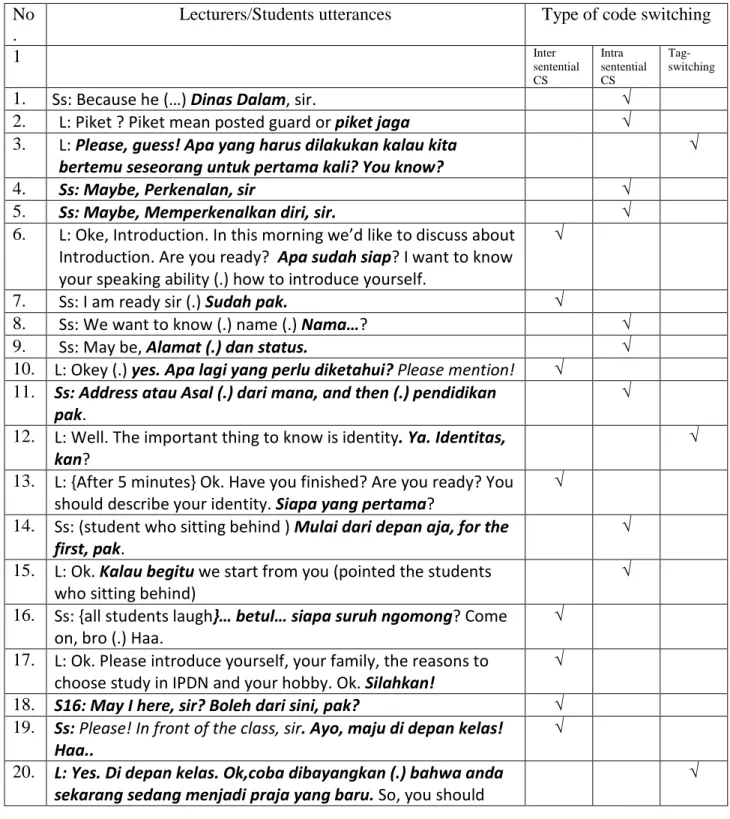
This analysis serves as a starting point for the later analysis of the functions of code switching. In the type of code, switching is used in school when, for example, something is translated or explained (grammar, exercise, etc.). Both the lecturers and the student use inter-sentence code-switching; furthermore, this type of code switching is used quite a lot in the schools.
Based on this function, the researcher analyzes the code switching function in detail in the classroom in this study. The previous three code-switching functions (seeking help, students helping each other, and self-corrections) were used by students. Generally, this code-switching function occurs when students or the lecturer talk about matters not strictly related to the lesson.
There are two functions of code switching when teaching grammar: grammar translation and grammar clarification.
Assumptions
RESEARCH PROCEDURE
Research Design
While collecting the data, the researcher used various tools in the data analysis procedures. Classroom observation used to investigate the practical use of code switching during classroom EFL instruction in relation to its types, functions and reasons. In other words, the observer has participated in the activities being studied, or pretends to be one of the participants in the class.
Field notes were written expressions of what was heard, seen, experienced, and thought while collecting and reflecting on the data. First, the researcher was reviewing field notes and transcripts collected from classroom observation to identify the data of Indonesian English code-switching practiced by English teachers in EFL classroom teaching. The code of similar nature is then classified into mayor categories to suggest the types, functions and reasons of Indonesian English code-switching in EFL classroom teaching.
Fifth, verification done by studying the theories, looking at the data and confirming with them regarding the use of English-Indonesian code-switching practiced by English teachers in EFL classroom teaching.
FINDINGS
Types of Code Switching
Both educators and students who use cross-sectional code-switching; Moreover, the type of code that is used quite a lot in IPDN NTB Campus. Even code switching by the lecturer when the student is asked to introduce himself out loud). Intersensial code switching occurred when the lecturer asks his students to introduce their friends and ask the students who perform first in the class as shown in line 1. Tag.
Example of tag code-switching can be shown below in bold and italics on line 8. However, she would argue that while Poplack's view may be true for naturally occurring discourse, in classroom discourses there is intra-sentential code-switching, even if the participants are not all fluently bilingual. Intracode switching employed by the teacher when he asked the students to put the picture on the board).
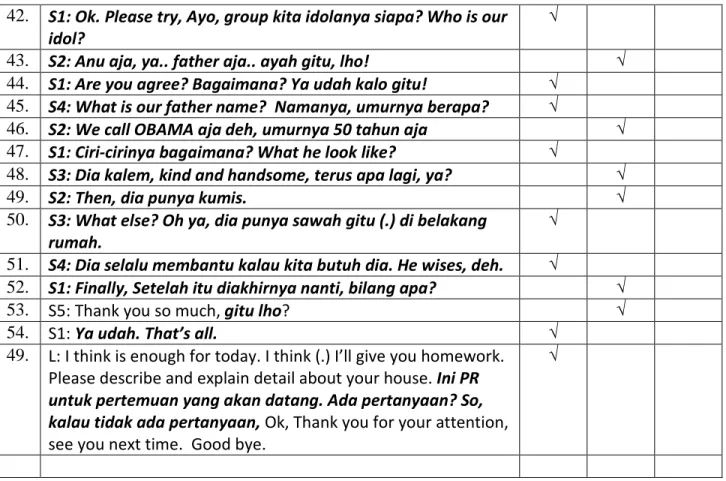
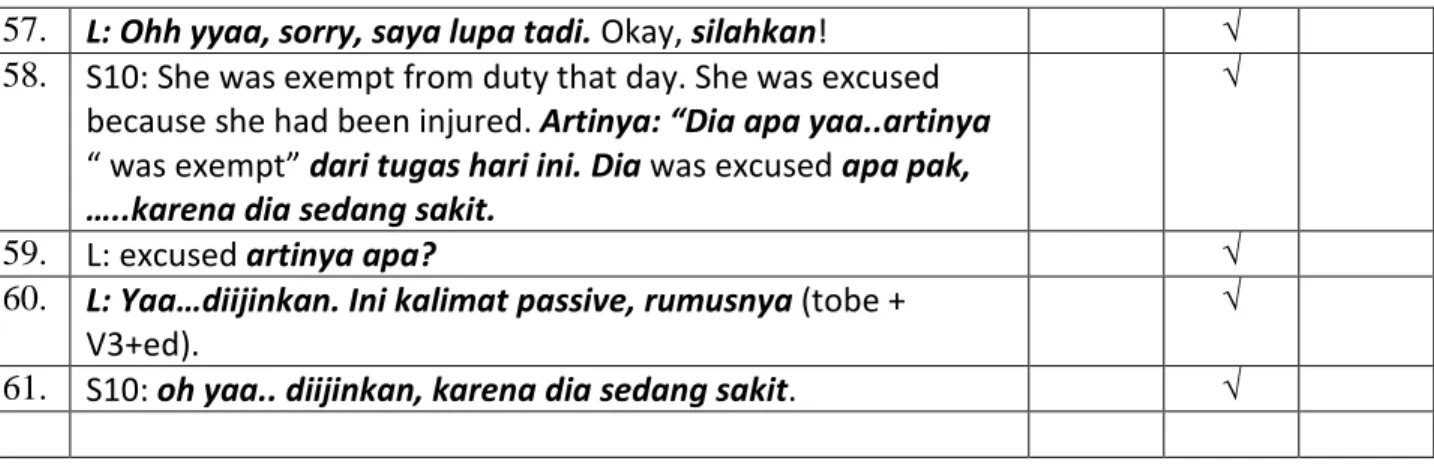
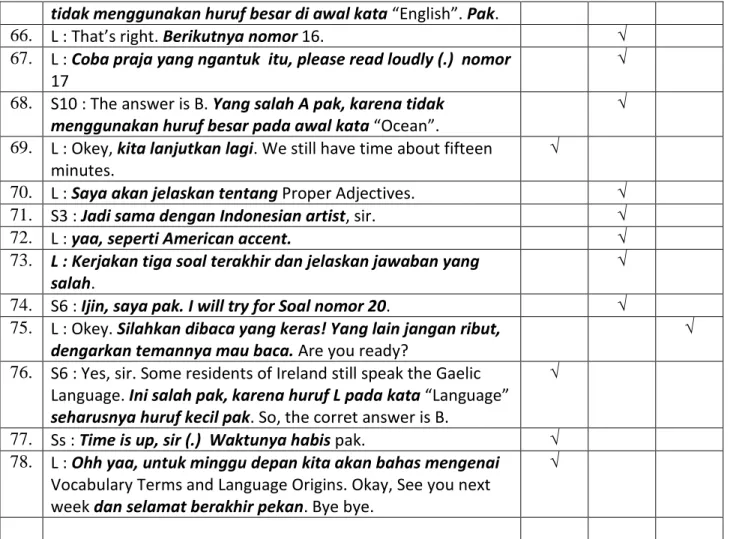
Of three types of code switching used by lecturers and students in EFL classrooms at IPDN NTB, which is predominantly used of inter-sentential code switching, followed by marker switching and the last is intra-sentential code switching.
Functions of code switching in EFL classrooms
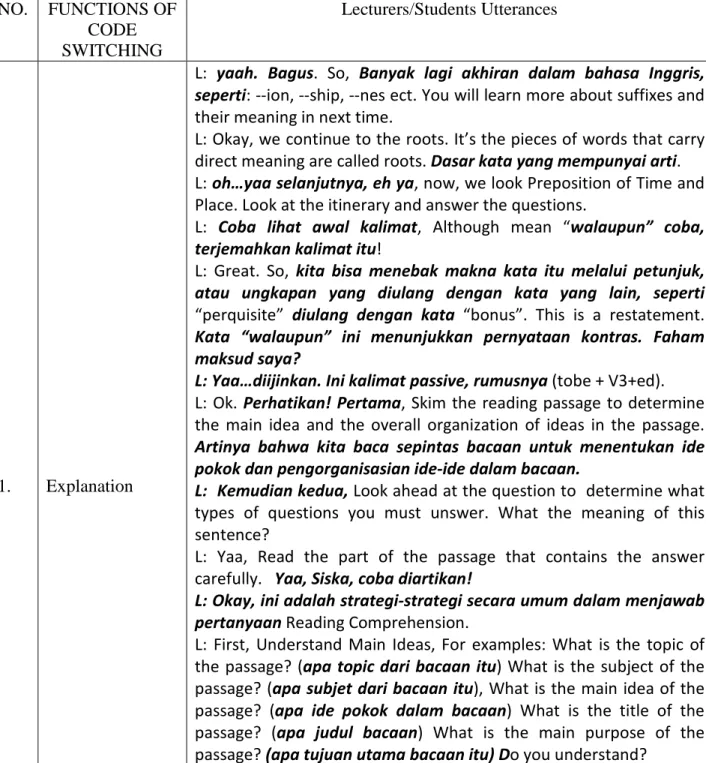
Code-switching practices to resolve misunderstandings were demonstrated in the following data, as shown in bold in rows 2–4. The conversation took place when the lecturer was clarifying a misunderstanding). An example of the data was shown in the following data as shown in bold in row 1. The lecturer used code switching after explaining the previous topic and then wants to move to another activity). You can see this in the following example, as shown in bold in lines 3-5. The conversation took place when the lecturer was teaching, suddenly the student was late).
The students' event code switching from English to Indonesian can be seen in the following examples, as shown in bold on line 2. The code switching to Indonesia was practiced by the teacher and followed by the students. In the following example, the use of code switching from English to Indonesian is performed by a student who had difficulty expressing difficult words in the English language. This can be seen in the following examples, shown in the form of bold words:
When code-switching occurs, the speaker's motivation or reasons are an important factor in the process.
DISCUSSION
Types of code switching
This is in line with the study of Timm (in Mujiono, 2012), who states that leaner code-switching refers to speakers' efforts to formulate sentences in the second language and to resort somewhere along the line to the first language due to lack of knowledge about it grammatical structures or to fill a lexical gap in the second language. Similarly, the findings of Pei-she Weng (2010) support this study when he said that the use of code switching and first language would facilitate the learning of a second language. Thus, first language can be a useful and important element to help second language learners learn a foreign language during the learning process.
Similarly, Merritt et al., and Yletyinen (2004) found in their study of the types of code switching that code switching often functions as an attention-generating device, which is also supported by this study. It also applies to this study to some extent, since the use of English has a clear educational function, whereas Indonesian can also serve a social function, for example when students comment in Indonesian about an exercise to create a bond between them. It can be concluded that in this study all three types of code switching are 98.
This means that this study supports Poplack theory about the types of code switching in EFL classroom.
Functions of code switching
This suggests that students know that it is acceptable to use Indonesian in English classrooms. The reason for the proofreader's coding could also be the fact that switching to Indonesian at an unexpected moment can have a powerful effect, for example when reminding students. Learners' attention can also be captured when the language switches from Indonesian to English, such as when the lecturer moves from one classroom activity to another.
The students know that they have to pay more attention to the lecturer's words as English is not their stronger language. The students know that they are required to use English when, for example, they do a question-and-answer exercise. This behavior by the students indicates that the two languages in the classroom have different roles and meanings.
However, especially in IPDN NTB campus, the lecturer should encourage students to use English most of the time, for example asking them to repeat in English what they said in Indonesian.
CONCLUSIONS AND SUGGESTIONS
Conclusion
Of the seven factors that cause this code to change, repetition of factors for clarification is the most prevalent. This is caused by the lecturer saying always translate from English to Indonesian in order for the students to understand the material presented. This is because many of the terms were not understood by the students, so the lecturers have to explain them to instill an understanding in the students.
This study has many limitations, besides very short time available, also limited sample size does not allow to draw conclusions about language teaching at IPDN in general. But qualitative research requires informants who are willing to observe and share their thoughts and experiences, interested in discussing the dilemma of teaching, so in-depth interviews must be honest and helpful. Only from an experienced teacher is it possible to gain an understanding of how they have formed a pragmatic approach to language teaching and how they balance the use of TL and L1.
The study, which must describe the correct use of language, should be carried out with a more quantitative focus.
Suggestions
Apa subjek dari bagian tersebut. apa topik bacaannya), apa gagasan pokok bacaan tersebut. apa gagasan pokok perkuliahan). Apa arti dari. arti kata…. ?), Manakah dari istilah berikut yang paling dekat artinya. manakah di antara kata-kata berikut yang paling dekat artinya dengan…?), Kata “…” pada barisnya kata "..." sejalan Apa nada dari bagian tersebut. apa nada bacaannya?), Apa tujuan penulis dalam bagian ini. apa tujuan penulis membaca ini), pada mata kuliah apa bacaan ini akan ditugaskan. pelajaran apa yang bisa dipetik dari kuliah ini).
Kelompok buku saya memilih dunia yang dikenal oleh Edwar P. 18) S1 : B pak, karena A tidak menggunakan huruf kapital pada huruf pertama kata “Dunia yang Dikenal”. Pada kalimat kedua menggunakan simple past tense seperti yang terungkap pada bagian pertama kalimat. Apa artinya. apa arti kata.... ?), Yang manakah di bawah ini yang paling mendekati maknanya. Manakah dari berikut ini yang paling dekat artinya dengan … ?), Kata “…” pada baris X paling dekat artinya dengan yang berikut ini. pada baris X paling dekat artinya dengan baris berikutnya).
Pada kalimat kedua, go menggunakan simple past tense seperti yang terdapat pada bagian pertama kalimat. Apa nada dari bagian tersebut. apa nada bacaannya?), apa tujuan penulis membaca bagian ini. apa tujuan penulis membaca ini), Di mata kuliah mana bacaan ini akan ditugaskan. pelajaran apa yang bisa diambil dari bacaan ini). S1 : B pak, karena A tidak menggunakan huruf kapital pada huruf pertama kata “Dunia Dikenal”.