Northeast Asia Energy Focus Northeast Asia Energy Focus
Vol. 3, No. 3
Autumn 2006JI-Chul Ryu, Executive Director, CERNA / KEEI
2Comparative Case Study: Lessons and Observations for NEA from Regional Energy Cooperation in Central Asia Region and
ASEAN
11Tumentsogt Tsevegmid
Russia’ s Oil Supply Potential to the Asia-Pacific Region
16 Sung-Kyu Lee / Kyong-Wan LeeWind Energy Potential of China and Its Development
20Fahua Zhu
China's External Energy Strategy
25Zhang Jianping
Current Status of Power Supply & Demand and Long-term
Forecast in China
32Xue Xinmin
Energy Regulatory Activities in Mongolia: First Experiences
41 R. Ganjuur / L. DemberelCoal: Future of Mongolia
46TUGSBAYAR Sundui
Oil Demand Outlook of Russia, EU, 3 Northeast Asian Countries
50Oil Import Outlook of 3 Northeast Asian Countries and Russia
Oil Supply in 2020
50Inside the KEEI
3Briefs in NEA
6News Update
Issue & Focus Editor’s Message
NEA Statistics
T
he Korea Energy Economics Institute (KEEI) is celebrating the 20th anniversary on September, 2006. The KEEI was establish ed on September 1st, 1986 as a non-profit government think-tank for energy policy research and planning under the Ministry of Energy and Resource, the Republic of Korea. Since then, the KEEI has undertaken policy-oriented researches on energy and resources issues for sustainable economic development and endeavored to establish an efficient energy and resources system not only in Korea but also in Northeast Asia.K
EEI's researches on regional energy cooperation in Northeast Asia were commenced in 1991, when Korea began to normalize diplomatic relations with China and Russia, hoping that Korea would import energy sources from the countries in the region in near future. Since then, the research scope was expanded to cover not only domestic energy issues but also international/regional energy cooperation with serious attention.T
hen it was anticipated that the development of Russia's oil and gas would be facilitated, the cross-border infrastructure for transporting energy resources being constructed in some years, thanks to the improvement of political environment after the end of the cold war era. However, the realization of this hope still seems to be a long way ahead.P
romoting energy cooperative projects in the region often appeares to be impeded by some deteriorated political situations, in particular surrounding the Korean Peninsular in respect to the nuclear related issues in the DPR Korea.Obviously, economic cooperation proved not to be free at all from the political realities in the region.
O
n the other hand, we can also observe that there has been some significant progress for the last ten years in the light of regional energy cooperation and trade in Northeast Asia. China became a major supplier of coal to Korea, for instance. Russia actively established bilateral energy relationship with China and Korea at the government level. Russia has emerged as a key source of energy in the Northeast Asian region.Already, Russia has been making efforts to promote discussion with neighboring countries to develop and supply oil and natural gas from oil and gas fields in East Siberia and the Far East to Korea, China, and Japan.
I
n commemoration of the its 20th anniversary, the KEEI is organizing an international symposium under the theme of 'Towards Regional Energy Cooperation in Northeast Asia: Key Issues in the Development of Oil and Gas in Russia,' in the middle of September with supports from the Ministry of Commerce, Industry and Energy (MOCIE), the Presidential Committee on Northeast Asia Cooperation Initiative (PCNACI), and the Seoul Broadcasting System (SBS). The objective of the symposium is to provide an opportunity for executive officers and renowned energy experts in the region to share their information and perspectives on the subject. It is expected that comprehensive discussion would be held at the symposium on the issues of energy cooperation in Northeast Asia, including opportunities for practical energy cooperation projects of private sectors. It is our sincere hope that the symposium will provide a significant momentum for enhancing energy cooperation among Northeast Asian countries.I
would like conclude this remark with a wish for a great success of regional energy cooperation in Northeast Asia in next twenty years to come.▣
Editor’s Message
Ji-Chul Ryu Executive Director, CERNA / KEEI
Inside the KEEI
The MOU signing ceremony and the Joint International Symposium between the KEEI and the YUST
O
n July 4 - 6, 2006, the second session (Management, Economics and Energy Session) of the 2006 International Symposium was held jointly by the KEEI and Yanbian University of Science and Technology (YUST) at Yanji, China.Also, two organizations performed a MOU signing ceremony for research cooperation in the energy field on July 4, 2006 in connection with this Symposium.
The theme of the Symposium was "Establishment of a Foundation of Economic Cooperation and Technology Cooperation in Northeast Asia." At the second session of the Symposium, the main focus was given to the ways to promote practical energy/resources cooperation projects in Northeast Asia, especially, power grid interconnection and new & renewable energy cooperation among Northeast Asian countries, and energy cooperation between two Koreas.
Also, the KEEI and the YUST, by concluding the MOU on research cooperation in the energy policy/planning area, agreed to conduct joint researches on commonly interested subjects through organization of co-hosted conferences, data and information exchange, and researcher exchange programs.
KEEI-Nautilus Joint Workshop
D
PRK Energy Expert Study Group Meeting"co-organized by the KEEI , the Nautilus Institute and the CISAC(Center for International Security and Cooperation, Stanford University) was held during the period of June 26 to June 27, 2006 in East Palo Alto, California, USA. At the workshop many valuable papers were presented by internationally well-known experts on the DPR Korean energy issues. Presentation and discussion on the DPR Korean sectoral energy demand and supply was the main content of the seminar, which were followed by active discussion on the impact of recent trends and challenges concerning the DPR Korean economy and the international cooperation for redevelopment of the DPR Korean energy sectors.
Research Proposal Evaluation Workshop
C
ERNA organized "Research Proposal Evaluation Workshop" for the successful implementation of research projects for 2006 on Northeast Asian Energy Cooperation. The Workshop was held during the period of July 20 to July 21 in Sangrok Resort, Cheonan, Chungcheongnam-Do, Korea. All members of CERNA and related research personnel in KEEI participated in the workshop, where 16 research proposals on Northeast Asian Energy Cooperation were closely examined and discussed.News Update
Presentations in Seminars outside the KEEI
▶The 5th Northeast Asia Economic Cooperation Forum" organized by the Northeast Asia Peace Movement(Korea) was held on 22-27 July 2006, in Khassan Russia. More than 50 experts from Russia, China, and Korea participated in the forum.
Participants discussed extensively several issues on energy cooperation, transportation, tourism, and regional development in the cross-border area among Russia, China, and DPRK.
▶ "East Asia Consultations on International Climate Regime Beyond 2012" organized jointly by the Institute for Global Environmental Strategies (IGES, Japan) and the Energy Research Institute (ERI, China) was held on 3-4 July 2006, at Beijing China. The objective of the consultations, which were informal in principle, was to promote constructive thinking on future actions against climate change beyond 2012 in the Asia-Pacific region, and contributing to the shaping of a future regime that reflects concerns and developmental aspirations of the regional countries.
More than thirty experts from China, Japan, Korea, and Mongolia participated in the consultation.
Participants discussed extensively five thematic issues, which are national perspectives on climate regime beyond 2012, energy security and development needs in relation to climate regime, technology development and transfer, restructuring CDM, and facilitating adaptation.
▶On June 27-29, 2006, International Conference was held in Yakutsk, Russia under the theme of
"Investment Potential of the Sakha Republic:
Eastern Course of Development of Russia" and
"Cooperation in Energy Industry in Asia:
Mechanisms, Risks, Barriers". This Conference was jointly organized by the Republic of Sakha and the Far Eastern Branch of the Russian Academy of Sciences. The main purpose of the conference is to discuss possibilities of investment attraction to energy and transportation sector in the Republic of Sakha and the Far Eastern Region after the change of East Siberia-Pacific Ocean Oil Pipeline route. Dr. Sung-Kyu Lee in KEEI and many experts in energy sector from Russia and foreign countries took part in this conference. In the oil and gas session were discussed the current issues about oil and gas pipeline network construction between the East Russian region and Northeast Asian countries.
Welcome to KEEI
▶In July 11, 2006, Mr. Mikhail Shabalov, Deputy Trade Representative of Russia in Seoul, paid a visit to KEEI to discuss the prospects for energy cooperation in Tumen River Area. He asked KEEI about the current situation and prospects of Tumen River Area energy cooperation.
Dr. Ji-Chul Ryu and Dr. Yong-Duk Pak explained the benefits of the establishment of international oil distribution hub in Tumen Area like Rotterdam oil spot market because the area can be a very effective channel for Russian oil supply to China, Korea and Japan. There will be a huge volume of oil trade between Russia and three big consumers of China, Korea and Japan. This prospect of huge oil trade will help the Tumen Area oil distribution hub to become a very influential international oil spot market. Mr. Shabalov showed a big interest in establishing the oil hub and agreed that we needed to promote the oil hub project with high priority put on it among energy cooperation projects in Northeast Asia.
▶ Professor Peter Drysdale of the Australian National University (ANU) visited the KEEI on June 25, 2005 and had a meeting with Dr. Ki-Yual Bang, President of the KEEI, Dr. Ji-Chul Ryu,
Executive Director of the KEEI/CERNA, and Dr.
Euy-Suk Yang. Professor Drysdale discussed research cooperation activities between the KEEI and the ANU under the theme of regional energy cooperation in Northeast Asia, particularly concerning the DPR Korea and China.
▶On May 23, 2006, the next generation leaders from Commonwealth of Independent States (CIS) countries, who are energy-related government officials in their countries, visited the KEEI as part of the Korea Foundation Invitation Program and had a small conference at the Conference Room in the KEEI. The KEEI provided introductory presentations on its current status and the energy policies and planning of Korea. After the presentation, there was a free and heated discussion on the role of a government-sponsored energy research institute concerning national energy policy making and planning.
New Publication of the CERNA Policy Reports in 2005
16
policy reports on energy cooperation in Northeast Asia have been published. These reports are the final outcome of the 2005 research projects in the CERNA. They are available in the web-site of CERNA.·Second-Phase Action Plan for Energy Coopera tion in Northeast Asia(Sang-Yul Shim)
·USA Energy Development Strategy in Eastern Russia and Energy Cooperation in Northeast Asia (Sung- Kyu Lee)
·Analysis of Northeast Asia Energy Market (Cheol- Seon Hong)
·Management of the Northeast Asia Energy Database and Information System (Tae-Won Kang)
·A Study on the Energy Expert Network for the Energy Cooperation in Northeast Asia (Ji-Chul Ryu)
·A Study on the Comparison of Energy Resources Statistic Systems in Northeast Countries (Euy-Seok Yang, Tae-Gyu Kwon)
·Establishment of Institutionalized Framework for Energy System Integration in the Korean Peninsular:
The Petroleum Sector (Kyung-Sool Kim)
·A Study on the Action Plan for the Strengthening of the DPR Korean Non-Physical Capacity in Energy Sector (Kyung-Sool Kim)
·Study on Institutional Arrangement for FTA in Northeast Asia: Energy FTA among Korea, China, and Japan (Sung-Hee Choi)
·On the Model Analyzing Economic Impact of Northeast Asia FTA in Energy Sector (Yong-Duk Pak)
·The Impact of Chinese Oil Market Opening on the Oil Product Trade in Northeast Asia (Dal-Sok Lee)
·A Strategy for Exploring Energy Resources in the Sakhalin: 2nd Phase (Dal-Sok Lee)
·The Russian Oil Market Expansion in Northeast Asia and Import & Utilization Strategies of NEA Countries (Euy-Seok Yang)
·Economic Benefit Analysis for Energy Efficiency Improvement of Korea, Japan and China (Euy-Seok Yang)
·Importation Plans of Natural Gas from East Siberia and Russia's Far East under UGSS (Seung-Jick Yoo, Sung-Gue Lee)
·Economic Benefit Analysis of Northeast Asian Strategic Petroleum Reserve Cooperation (Jin-Young Soh)
Briefs in NEA
Northeast Asia Focuses On Crude Oil Reserve
As the oil price rises, competition among Korea, China and Japan for procuring oil is relentless.
The three countries are searching for new oil and gas fields all around the world, as well as increase its reserve facilities in its own land.
China recently spurred its crude oil reserve ability and has led the competition among the three countries.
Since 2003, China has increased its ability to reserve oil, which it recently completed construction of new oil reserve facilities in Junhai province, which can hold 10 million barrels. China is in the process of adding more reserve facilities at Dalian and Huangdao province, which will roughly hold 5 million barrels.
Korea, which reserved 122 million barrels of crude oil for urgent times, utilized natural caves as reserve facilities. As it stands, 70 percent of all the reserve facilities in Korea are caves.
The caves that Korea uses, saves a tremendous amount of money on constructing oil reserve facilities.
Management expense per barrel in Korea for 2005 was recorded at 416 won, it was just 1/5 of the price compared to the management expense in Japan.
Japan, which reserved 321 million barrels, is the top among the three countries oil reserve scale. By 2010, Japan plans to construct new reserve facilities, which will hold 15 million metric tons.
Korea to Expand Overseas Search for Energy
South Korea will expand its overseas search for both coal and oil this year, Korean government officials said.
Korea Resources Corp. and SK Corp. have requested permits to take part in three additional coal projects this year, one of which in Australia
will be completely controlled by the two.
South Korean companies also operate in Indonesia, China, Russia, Canada and the United States.
While the country produces 22.2 percent of its own coal, total coal imports reached 69.3 million tons last year, and were worth 4.5 trillion won ($4.8 billion).
Coal from mines in which South Korean companies held an interest came to 15.4 million tons.
Twenty-five companies were either mining or exploring new sources of coal in 25 countries in 2005.
The bulk (45.6 million tons) of the imported coal is used to generate power, while 16.9 million tons is used by steel factories. The remainder is used by industries like cement production, according to the Ministry of Commerce, Industry and Energy.
Guaranteeing a steady supply of coal is becoming more important as high demand in China drives up prices, according to the ministry.
As the fourth largest oil importer in the world, South Korea will also try to expand independent oil projects abroad.
South Korea is completely dependent on imports for its oil supply, making it the fourth largest oil importer in the world.
Under a plan to expand independent oil development projects over the next 10 years, 12.15 trillion won ($12.8 billion) will be spent to help the Korean National Oil Corp. and private companies explore overseas oil fields, according to the Ministry of Science and Technology.
The ministry hopes to raise the percentage of imported oil produced by overseas independent oil developers from the current 3.8 percent to 18 percent by 2015.
The move is expected to help the country save 47.4 trillion won ($50.7 billion) in energy import costs and create 300,000 new jobs in the energy and resource sectors.
Japanese-Russian talks progress over ESPO oil line
Talks between Japan and Russia are said to be progressing over a proposal to have Japanese firms join Russian development of an East Siberian oil field in connection with the project to lay the 4,188-
km East Siberia Pacific Ocean crude oil pipeline.
Reports say the two sides have not yet agreed on which specific Siberian oil field they will develop but that Japan Oil, Gas & Metals National Corp., an independent administrative agency, in oil development in eastern Siberia is being considered as a participant, while private sector firms such as Sumitomo Corp. and Inpex Corp. also have indicated a desire to invest.
The two governments are talking to prepare for a deal that could be concluded by Japanese Prime Minister Junichiro Koizumi and Russian President Vladimir Putin when they meet in mid-July on the sidelines of the Group of Eight summit to be held in St. Petersburg.
Russia has long said it may be possible to export as much as 80 million tonnes/year of oil through the fully extended pipeline, but that meeting such a target will depend on output from fields in eastern Siberia which have yet to be developed.
The Japanese side hopes that an agreement with Russia on development of the fields, in which the oil produced will be exported to Japan, will speed the early construction of the eastern half of the projected ESPO line so that the Siberian oil can be shipped to Japan.
Due to such commercial considerations, Russia has not decided when, if ever, to start construction of the eastern half of the line, although it started building the western half on Apr. 28 under a plan to complete the portion in 2008.
The western half will start from Taishet near Lake Baikal and will extend to Skovorodino near the Russian-Chinese border, the midpoint of the entire pipeline route. From there, Russia plans to export oil to China via railroad or a branch line of the pipeline.
In May, Japanese Foreign Minister Taro Aso urged Russian Chamber of Commerce and Industry Pres.
Yevgeny Primakov to hasten the start of talks on construction of the ESPO line
New Undersea Energy Concession to Begin in East Sea
The Ministry of Commerce, Industry and Energy (MOCIE) announced on May 25 that they are in
the process of legislating of the revised Offshore Mineral Resources Development Act to designate an offshore lot in the East Sea where oil exploration can take place.
The newly-designated mine lot will be named as the 8th mine lot and it has a sea area of 8,481 km≤, south of the Ulleung Island.
The location is near the north of the 6-1 mine lot, which holds the East Sea-1 gas field, and is known to be a deep-sea area with 1,000 meter- depth.Within Korean territorial waters, there are a total of six mine lots, with the mine lot No.1 first designated in the West Sea,
and the seventh one south of the Jeju Island, known as the Korea-Japan joint development area.A MOCIE official revealed
that, "Since the Korea National Oil Cooperation (KNOC) has a plan to explore an oil field in the East Sea in cooperation with Woodside Petroleum Co. during the second half of this year, we have decided to designate a new mine lot in the area through legislation in order that oil exploration rights can be established."Woodside Petroleum Co. is an Australian company, specialized in oil exploration which holds technology and expertise in exploring deep sea areas, while it is in 14 years that foreign investment participates in national offshore oil exploration, reportedly.
Global Cooperation Shapes Korea`s Energy Policies
Reliance on imported oil pushes the government to focus more on developing renewable energy resources
With pressures intensifying to secure stable crude sources amid soaring global oil prices and tight supply, Korea`s dependence on imports has driven it to adopt policies for energy diversification through aggressive exploration and international cooperation.
As the world`s fifth-largest crude importer, Korea has developed long-term approaches, including international cooperation, for coping with its oil needs. These approaches entail a future-oriented
energy consumption system and aggressively pursuing overseas oil exploration projects, the Ministry of Commerce, Industry and Energy says.
Deprived of domestic oil reserves, Korea imports about 98 percent of its crude oil, which makes up the largest share of the country`s total energy consumption. Petroleum accounted for 54 percent of the country`s primary energy consumption in 2002. In 2004, the nation consumed about 2.14 million barrels a day (bbl/d), down from a high of nearly 2.3 million bbl/d in 1997. Last year, the country`s primary energy consumption during the first nine months rose by 4 percent compared to a year ago, according to the Korea Energy Economics Institute.
Eighty-one percent of the country`s oil imports come from the Persian Gulf region, with Saudi Arabia supplying about one-third, the Energy Ministry said.
By energy category, from January to September 2005, consumption of nuclear power and alternative energy increased significantly from 2004, according to the KEEI. Demand for coal and liquefied natural gas was comparatively low.
The Energy Ministry`s 2006 policy initiative outlines long-term policy goals that aim to balance environmental changes and the outlook for supply and demand. Since the 1997-98 financial crisis, the country has felt a greater need to rethink its reliance on imported oil for domestic energy demand.
Diverse exploration The reliance on imported oil has pushed the government to focus more on developing renewable energy resources and necessary technologies. Along with its goals in the 21st century of promoting green development, such as increasing the use of photovoltaic power and fuel cells, the country`s environmental outlook depends on its ability to shift its energy supply to cleaner-burning fuels and reduce the emissions of greenhouse gases blamed for causing global warming.
Another long-term policy objective is staking out oil and gas fields. This secures energy needs to reduce reliance on foreign oil and strengthens national competitiveness in the global economy.
Japan to Start Receiving Sakhalin Crude Oil This Year
Japan will start receiving its first shipments from the $13 billion Sakhalin-1 oil and natural gas project in Russia this year, helping the world's second- largest economy cut dependence on imports from the Middle East.
The Exxon Mobil Corp.-led venture will begin sending oil to Japan “in the next few months,”
Shiro Matsumoto, deputy general manager of the project department at Sakhalin Oil & Gas Development Co., a Japanese investment company with a 30 percent equity stake in the venture, said in an interview. First flows to mainland Russia began in October.
The project, 10 times closer to Japan than Saudi Arabia, will allow the Asian nation to reduce the amount of oil it buys from the Middle East, where a dispute over Iran's nuclear program threatens to disrupt supplies. Oil from Sakhalin-1 will meet about 6 percent of Japan's daily needs.
The Sakhalin projects led by Exxon Mobil and Royal Dutch Shell Plc have combined oil reserves of more than 3.3 billion barrels. A new flow of oil into Asian markets could make Russian oil a benchmark in the region along with Dubai and Oman. Russia, the world's second-largest oil producer, now directs most of its oil exports to Europe.
Japan Sales
Sakhalin Oil & Gas will sell most of its oil entitlement, equal to its stake in the Sakhalin-1 project, to refiners in Japan, Matsumoto said by phone on June 21. The light, low-sulfur Sokol grade of oil will be shipped from Russia's Far East port of DeKastri. It's piped to the port from offshore processing plants on the west coast of Sakhalin island.
This year, the project will raise production fivefold to 250,000 barrels a day. The project's three offshore fields -- Chayvo, Odoptu, and Arkutun Dagi -- have recoverable reserves totaling 2.3 billion barrels. They took a decade to develop.
Expectations that Sakhalin oil will become Asia's home-grown benchmark are increasing, because it is a North Asian grade that could compete against oil dominantly shipped from the Middle East into Asia, Nippon Oil Corp. Chairman Fumiaki Watari said. Dubai and Oman crude oil are used to set prices in Asia.
Lower Costs
Sakhalin oil may help refiners such as Nippon Oil cut costs from shipping similar low-sulfur varieties from Saudi Arabia, Abu Dhabi and West Africa.
The shipping distance to Japan from Saudi Arabia is about 6,600 miles, compared with about 650 miles for the run from DeKastri port to northern Japan.
The Middle East accounts for about 90 percent of Japan's oil imports, up from 68 percent in 1987.
All five of Japan's top oil suppliers are from the Middle East, led by Saudi Arabia. Japan is reducing the amount it brings in from Iran, the third-largest supplier, on concern the standoff over the Islamic Republic's nuclear program increases the risk of supply disruption.
Japan purchased 4.29 million barrels of oil a day in the year ended March 31, according to data from the Ministry of Economy, Trade and Industry. The country bought 1.25 million barrels a day from Saudi Arabia, or 29 percent of Japan's total oil imports that year.
Japan, which is vulnerable to supply cuts because it relies on imports for almost all of its oil, is seeking ways to secure natural resources over the next 25 years as China and India step up acquisition of oil and gas assets abroad.
Government Help
The government plans to help Japanese companies increase overseas oil assets to 40 percent of the country's total oil imports by 2030, from 15 percent now, the Trade Ministry said in an energy policy proposal on May 29.
Japan has lobbied Russia for more than three years to build a pipeline to carry Siberian oil to the Pacific coast for shipping on to Japan. When Japanese Prime Minister Junichiro Koizumi met President Vladimir Putin in St. Petersburg in May 2003, he asked Putin to agree to extend a pipeline linking eastern Siberia and China to the Pacific.
Japan's government, refiners, trading houses and exploration companies are keen to participate in Russian oil projects.
A unit of Mitsui & Co. owns 25 percent of the Sakhalin-2 oil and gas project, operated by Sakhalin Energy Investment Co. Mitsubishi Corp. holds a 20 percent stake through its subsidiary. Royal Dutch Shell has a controlling 55 percent holding in Sakhalin-2, which pumped 70,000 barrels a day
of Vityaz oil in 2005.
Stable Output
Sakhalin Energy expects to keep production unchanged this year, Belentina Kiseleva, a company spokeswoman said last week.
Sakhalin-1's partners comprise Exxon Neftegas Ltd., Japan's Sakhalin Oil & Gas Development, two affiliates of OAO Rosneft and India's state-owned oil company ONGC Videsh Ltd.
Sakhalin Oil & Gas Development is a Japanese joint venture, with the government holding a 50 percent stake. Itochu Corp. and its unit own 18.12 percent. Japan Petroleum Exploration Co. has 14.46 percent and Marubeni Corp. holds 11.68 percent.
Inpex Holdings Inc., Japan's largest oil and gas exploration company, now holds a 5.75 percent stake, and plans to buy additional shares from the Japanese government and increase its shareholding to 33 percent.
Oil imports from Russia are set to continue in the years ahead, the Institute of Energy Economics' Nagata said. The Sakhalin-1 venture pumps oil to the international market in tandem with the Royal Dutch Shell-led Sakahlin-2 project.
``In addition to the Sakhalin projects, Russian oil will be shipped out to the north Asian market, once an east Siberian pipeline is built,'' Nagata said.
In the year ended March 31, Japan increased imports of Russian oil by 9.7 percent to 30,000 barrels a day, compared with a year earlier. All of the oil came from the Sakhalin-2 project, according to the Trade Ministry's statistics.
China Maps Out Natural Gas Pipelines
E
xperts have mapped out China's natural gas pipeline network already in existence and to be constructed over the next 20 years. Natural gas, the most rapidly growing energy resource of the century in terms of consumption, was a key topic of discussion at the China Oil & Gas Pipelines Development Summit that was held in Beijing from June 15 to 16.The main highlights of the network plan were published in a Beijing Morning Post report on June 19.
Domestic arteries
Since the late 1990s, several natural gas arteries have been constructed including the Shaanxi- Beijing Pipeline, West-East Gas Pipeline that starts in Lunnan Oilfield in the Tarim Basin in northwest China's Xinjiang Uygur Autonomous Region, spans eight provinces and autonomous regions and ends in Shanghai, the Zhongwu Line that pipes gas out of Sichuan Province, and a second Shaanxi-Beijing Pipeline.
"Adding the Coastal Natural Gas Pipeline and several cross-border pipel ines through Russia and Kazakhstan, which are under construction now, a basic frame of gas transportation pipelines in China is forming rapidly," said Professor Liu Yijun from China University of Petroleum.
Currently, China's natural gas pipelines measure a total of 24,000 kilometers. According to estimates provided by Liang Chengyu, head of Guangdong Oil & Gas Association, this should increase to 36,000 kilometers by the end of 2010.
Pan Jiahua, honorary chairman of the executive council of the Petroleum Reserve and Transportation Committee of the China Petroleum Society, this period of time -- from now until 2020 -- will see rapid development of China's natural gas pipelines industry. Pan sets 2021 to 2030 as the maturation period.
Despite this rapid development, China will continue to be faced with the challenges of inadequate natural gas supplies. It is estimated that by 2020, China's natural gas shortage could be as much as 90 billion cubic meters.
“China will solve the shortage mainly through imports of liquefied natural gas (LNG) and land pipeline natural gas,” said Tang Yali, vice general manager of China National Petroleum Corporation (CNPC)'s Natural Gas and Pipeline Branch Company.
In order to satisfy growing domestic demands, China has already started several LNG import projects, Australia being one of the main exporters.
At present, 11 coastal provinces, municipalities and autonomous regions have plans to build large-scale LNG import projects, with Guangdong planning on two. An estimated 12 LNG projects are being
drafted and will be submitted for state approval.
Cooperation with Russia and Central Asia In March, China and Russia signed a Memorandum of Understanding for the transport of natural gas from Russia to China. From 2011, Russia, the world's No.1 natural gas exporter, will supply 60 to 80 billion cubic meters annually to China.
Exports will be transported in two ways: the west pipeline will enter China's Xinjiang through Siberia and Altai, and finally connect with the West-East Gas Pipeline, supplying natural gas to China's coastal areas. The east pipeline, yet to be confirmed, might transport natural gas from Kovykta or Sakhalin and Chayandinskoye gas fields located in Yakut.
Russia and two of China's major oil companies, CNPC and China Petroleum and Chemical Corporation (Sinopec), will construct the 3,000-km long west pipeline first. It is expected to transport gas within five years, which can supply 30 to 40 billion cubic meters of natural gas to China annually.
As significant is the planned natural gas pipeline between China and three Central Asian countries.
"After 2009, the 30 billion cubic meters of natural gas that Turkmenistan will supply annually will also be an important source of China's natural gas reserves," Pan said.
Pan was referring to the contract signed between China and Turkmenistan during Turkmen President Saparmurat Niyazov's visit to China in April. Under the 30-year contract, Turkmenistan will export 30 billion cubic meters of natural gas annually to China starting from 2009, two years earlier than China's agreement with Russia. The contract also provides that the China-Turkmenistan natural gas pipeline should be completed by then.
However, because China and Turkmenistan do not share any borders, certain monetary and logistical arrangements have to be made to transport the natural gas through Uzbekistan and several Kazakhstani territories before finally connecting with the West-East Gas Pipeline.
Uzbekistan and Kazakhstan also have abundant sources of natural gas, and both have expressed their willingness to export to China. Once the China-Turkmenistan pipeline is constructed, all three Central Asian countries will be able to supply natural gas to China simultaneously.
▣
Comparative Case Study:
Lessons and Observations for NEA from Regional Energy Cooperation in Central Asia Region and ASEAN
Background
A
s North East Asia (NEA) energy coopera tion advances, it is important to learn from other regions’cooperation experiences. We can see that countries in some regions, for example, Central Asia, have been able to accomp lish significant results in terms of advancing regional energy cooperation in spite of their different political and economical structures. There are many ongoing large scale projects (gas and oil pipelines, power links), which will significantly affect supply and demand patterns in China and the whole Central Asia.
Countries of the Association of South East Asian Nations (ASEAN) also are working actively to create an ASEAN power and gas networks, which require significant commitments in terms of political will, resources, etc.
The article will briefly examine current status of energy cooperation in Central Asia and ASEAN and draw lessons and observations for NEA countries to facilitate future cooperation in the region.
Current Status of Central Asia regional energy cooperation
T
he countries of Central Asia, Kazakhstan, Kyrgyzstan, Tajikistan, Turkmenistan and Uzbekistan, have enjoyed an average GDP growth of 8.7% (2000~2003), and the average growth rate of 10% were recorded in Kazakhstan.Turkmenistan grew even faster. With well- educated population of 60 million and combined annual GDP of $43 billion, the Central Asian states, such as Afghanistan, Azerbaijan, and the Xingjian Uighur region of People’s Republic of China (PRC) have enjoyed its development and prosperity1). The Central Asian countries are endowed with significant energy related natural resources, although distribution of these resources is uneven.
The Kyrgyz Republic and Tajikistan have abundant hydropower potentials but negligible reserves of commercially exploitable fossil fuels. In contrast, Kazakhstan has significant reserves of oil, gas and coal; Uzbekistan has substantial gas reserves as well as some oil and coal; Turkmenistan also has substantial gas reserves together with some oil.
Central Asian countries possess 47, 7 billion barrels of oil reserves (4% of the world’s reserves), and as of 2004 oil production reached about 2000 million barrels per year2).
Proven natural gas reserves of Central Asia are 9.2 trillion cubic meters (about 5% of world gas reserves, and current gas production stands at 133.5 billion cubic meters (2.9% of world’s total).
Among the latest regional energy projects which were recently realized, the largest one is the Baku- Tbilisi-Ceyhan (BTC) Oil Pipeline, and this project will benefit Central Asian countries to get better access for their oil exports. The Baku-Tbilisi-Ceyhan (BTC) Oil Pipeline will transport up to 50 million tons of oil per day a distance of 1,767 km from an expanded terminal at Sangachal on the Caspian Sea in Azerbaijan (443 km), through Georgia (248
Tumentsogt Tsevegmid Chief of International Cooperation Division Ministry of Fuel and Energy, Mongolia
Issue & Focus
1) Source Central Asia in the Global Economy, by S.Frederick Star
2) Source: Central Asia: Mapping Future Prospects to 2015, Malcolm Dowling and Ganeshan Wignaraja, Economics and Research (ERD) paper series, #80, Asian Development Bank (ADB), April 200
km) to the Mediterranean port city of Ceyhan, Turkey (1,076 km). The total project costs are estimated at USD 3.7 billion. There are pre- feasibility stage studies for potential extensions of the oil pipeline to Kazakhstan, and Kazakhstan signed an agreement with Azerbaijan to transport 25 million tones of Kazakh oil per annum3). The Other large project recently realized is the Kazakhstan- China oil pipeline, which is 962 km long. The first phase will transmit 10 million tons of oil a year, and will reach 20 million tons of oil4) a year by 20115). The pipeline was developed jointly by the China National Petroleum Corporation (CNPC) and the Kazakh state energy company, Kazmunaigaz.
Kazakhstan and China are working to build gas pipeline in parallel to the existing Atasu- Alashankou oil pipeline.
Kazakhstan will use Chinese loan to build power plants and grids to transmit power to China.
The installed generating capacity of all power stations of the CAPS amounts approximately 25,000 MW (2002). Annual electricity demand reached 136,128 GWh in 2003 and is expected to reach 180,225 GWh in 2020, and 206,075 GWh in 2025.
Afghanistan, Pakistan, Iran, China and Russia are all potential markets for electricity produced in Central Asia. Power links with Central Asia would help to decrease power shortages in Afghanistan, Pakistan and Iran, to balance power demand for Russia to meet its goal to increase power supply to Europe, to meet power demand in Urumqi, Xinjiang Uighur regions of China. This power in western China can also be transmitted to eastern costal areas of China, where the power supply is most needed, and support the power transmission plan from west to east. In terms of potential generation projects, most financially feasible projects to meet electricity export to the above- mentioned countries are Sangtuda I hydropower
project (670 MW), Rogun Hydropower Project (Phase I (1200 MW), Phase I and II (in total 3600 MW) in Tajikistan, Talimardjan thermal power project (800 MW) in Uzbekistan, Kambarata hydropower project II (360 MW) in Kyrgyzstan, thermal power plants at Ekibastuz in Kazakhstan etc.
Investment needs of all identified projects including rehabilitation of transmission and distribution and new projects is estimated at about US$ 13 billion in real terms of the next 20 years6).
The Central Asia region has significant energy related water resources within the Aral Sea basin, which is comprised of the Syr Darya and the Amu Darya river basins. The Aral Sea Basin includes Northern Afghanistan, southern Kazakhstan, and most of Kyrgyzstan, Tajikistan, Turkmenistan, and Uzbekistan.
The Central Asia Power System (CAPS) of Central Asia as an integrated electric power pool with the united dispatch center in Tashkent, developed in the 1960’s by the Soviet Union and, currently, the main 110 kV, 220 kV and 500 kV transmission lines link the power systems of southern Kazakhstan, Kyrgyzstan, Tajikistan, Turkmenistan, and Uzbekistan. Afghanistan is also linked to the CAPS on a limited basis7). It is necessary to introduce market-based principles in the CAPS, coupled with water use demand and management coordination.
The ADB supported energy as a priority area in promoting regional cooperation in Central Asia since 1996. ADB supported many important projects, such as Central Asia Regional Power Modernization Project, rehabilitation of irrigation and drainage etc., and commissioned a number of studies and organizational meetings.
It is notable that there are active intergovernmental organizations, such as Shanghai cooperation organization (SCO), which aimed to strengthen mutual trust and good-neighborly relations, to promote cooperation in political affairs, economy
3) www.gazeta.k
4) 15 per cent of China’s total crude oil imports for 200
5) Source People’s Daily Online, http://english.people.com.cn/200607/12/eng20060712_282194.html 6) Source Central Asia Regional Electricity Exports Potential Study (REEPS), December 2004, the World Bank 7) Source ADB, The Study on Water and Energy Nexus in Central Asia, J.Michael Biddison, 200
and trade, energy, transportation and other fields, and to strive towards creation of democratic, just, reasonable new international political and economic order among member states8).
There are many other donors contributing to the development of regional cooperation in Central Asia, and among them the Asian Development Bank (ADB) has been very active in promoting regional development and poverty reduction.
The Central Asia Regional Economic Cooperation (CAREC) Program was established in 1997.
Member countries include Azerbaijan, People’s Republic of China (Xinjiang Uygur Autonomous Region), Kazakhstan, Kyrgyz Republic, Mongolia, Tajikistan, Uzbekistan. The priority areas are energy, water, trade, and transport. The Secretariat is the Asian Development Bank, and institutional framework components consist of Ministerial Conference, Senior Officials’Committee (SOC), Project Working Groups, National Focal Points, and Secretariat. Main donor participants since 2003 have been the ADB, EBRD, IMF, IsDB, UNDP, and the World Bank. Total lending to CAREC countries reached US$ 2.6 billion, including US$ 187 million in regional projects, and technical assistance grants amounted US$ 175.8 million, including US$ 14.8 in regional projects9).
Significant amount of lending from donor countries was committed to promote regional cooperation through projects which will address priority areas to economic growth and poverty reduction. The Asian Development Bank (ADB) and other donors’rationale for supporting the Central Asia’
s regional cooperation is that the regional cooperation is not an option, but a necessity. Tadao Chino, the ADB President says, “…The countries of Central Asia are uniquely independent. Because of the region’ s remoteness, integrated infrastructure, shared natural resources, and small individual country markets, regional cooperation provides a strategic framework for
development…”
The ADB CAREC initiative has addressed priority sectors vital to the economical and regional development of Central Asian region, such as trade, transport and energy. Development of ICT Master plans for customs and tax, reforms, trade logistics development projects will bring tangible results. Extractive industries transparency initiative (EITI) is an important partnership of the Governments, nongovernmental organizations, extracting companies that will improve access to information in the oil, gas and mining industries.
It is supported by countries of the region as well.
Central Asian countries joined the CAREC Member Electricity Regulators Forum (CMERF) (i) to share regulatory and sector reform experiences; (ii) build regulatory skills and conduct training programs; (iii) cooperate to develop common electricity regulations10). Since Central Asian countries differ significantly in terms of political structure, institutional capacity, the ADB’
s initiative to improve regulatory and institutional capacity to regulate electricity sector was very important to promote regional cooperation.
Current Status of ASEAN energy cooperation
T
he challenges of globalization demand greater regional integration to increase competi tiveness, and one of regional alliances in Asia is the Association of South East Asian Nations (ASEAN)11). Today, the ASEAN region is a vast market of more than 520 million people with a total area of 4.5 million square kilometers. Its combined gross domestic product is about US$ 610 billion, and the total trade is more than US$ 700 billion.Member countries of The Association of South East Asian Nations (ASEAN) have vast reserves of 22 billion barrels of oil, 227 trillion cubic feet of natural
8) http://www.sectsco.or
9) Source CAREC newsletter, Lending and TA amounts as of April 2004 and excluding People’s Republic of China (PRC 10) Source: A Diagnostic Review of Regulatory Approaches and Challenges (DRRAC)”, Asian Development Bank (ADB) 11) Source http://www.aseansec.org
gas, 46 billion tons of coal, 234 GW of hydropower, 20 GW of geothermal capacity, and countries have worked actively to promote regional energy cooperation towards economic integration.
Guided by the Treaty of Amity and Cooperation (TAC) of 1976 as its fundamental principle, the ASEAN continues its cooperation since then in areas, such as trade, finance, investment, industry, services, finance, agriculture, forestry, energy, transportation, information communications technology, intellectual property, small and medium enterprises, and tourism. For the energy, the Senior Officials Committee (SOME) has the overall responsibility in the supervision, coordination and implementation of ASEAN cooperation programs, projects and activities. The ASEAN Ministers on Energy Meeting (AMEM) provides the issues and concerns of common interest and set policy and program directions in ASEAN energy cooperation12).
During the 2nd ASEAN Informal Summit in December 1997 Malaysia was assigned to establishing the interconnecting arrangements for electricity, natural gas, and water utilization within ASEAN member countries through the ASEAN Electricity Grid and Trans-ASEAN Gas Pipeline.
Also the ASEAN Ministers approved the ASEAN Vision 2020, which among other things, resolved to: “. . . establish interconnecting arrangements in the field of energy and utilities for electricity, natural gas and water within ASEAN through the ASEAN Electricity Grid and a Trans-ASEAN Gas Pipeline and Water Pipeline, and promote cooperation in energy efficiency and conservation, as well as the development of new and renewable energy resources.
And as a follow-up implementation action has been adopted the Hanoi Plan of Action by the ASEAN Heads of State / Government at the 6th ASEAN Summit, Hanoi, Vietnam, December 15- 16, 1998, which called to: “. . .institute the policy framework and implementation modalities by 2004
for the early realization of the trans-ASEAN energy networks covering the ASEAN Power Grid and the Trans-ASEAN Gas Pipeline Projects as a more focused continuation of the Medium-Term Programme of Action (1995~1999).”13)
At the 20th ASEAN Ministers on Energy Meeting (AMEM) in Bali in July 2002, the ministers signed the Memorandum of Understanding (MOU) on the Trans-ASEAN Gas Pipeline (TAGP) Project.
The MOU will serve as a framework for the ASEAN public and private sectors for the realization of the TAGP project. The 20th AMEM also approved the roadmaps for the concerted implementation of the ASEAN Power Grid and Trans-ASEAN Gas Pipeline Projects.
To date with the technical assistance of major donors, such as the ADB and many others, the Trans-ASEAN Gas Pipeline Master Plan, the ASEAN Interconnection Master Plan Study and many other studies were completed.
The ASEAN Interconnection Master Plan Study (2003) identified 14 interconnection projects. Two interconnection projects are operational, and these are: i) the Peninsular Malaysia-Singapore interconnection; and ii) Thailand-Peninsular Malaysia Stage #1 and Stage #2 interconnections.
For further implementation of the ASEAN Power Grid Project priority has been given to following five optimal interconnection projects:
▶Thailand-Laos Interconnection Project to be completed by 2009;
▶Thailand-Cambodia Interconnection Project to be completed by 2009;
▶Vietnam-Cambodia Interconnection Project to be completed by 2007;
▶Malaysia (Peninsula)-Indonesia (Sumatra) Interconnection Project to be completed by 2009;
▶Malaysia (Sarawak)-Indonesia (West Kalimantan) Interconnection Project to be completed by 200914).
The “Trans-ASEAN Gas Pipeline (TAGP) Infrastr ucture Project”Master Plan (2000) identified that
12) Source ASEAN Plan of Action for Energy Cooperation (APAEC) 2004-2009, Adopted by The Twenty-Second ASEAN Ministers on Energy Meeting (2n AMEM), 9 June 2004 in Makati City, Metro Manila, Philippine
13) Source Dr.Hardiv H Situmeang-KNI-WEC, South Asia Regional Energy Transmission Partnership 1t Executive Exchange, Kathmandu, Nepal, December 14-16, 200
14) http://www.egat.co.th/english
there 175 trillion cubic feet of proven and 94 trillion cubic feet of probable natural gas reserves in the seven ASEAN Council in Petroleum (ASCOPE) member countries, and Indonesia has the highest gas reserves. Seven (7) gas interconnection projects have been identified within the TAGP roadmap, and firm commitments have been secured for the gas interconnection projects between Sumatra, Indonesia and Singapore and W. Natuna (Indonesia)-Duyong (Malaysia). The TAGP task force identified that for 7 gas interconnection projects covering the length of 4200 km the total investment requirements would be at US $ 7 billion15)(2001).
Other ASEAN initiatives on energy include promotion of sustainable development and utilization of coal, promotion of energy efficiency and conservation, renewable energy, facilitation of regional energy policy and planning etc.
In terms of financing, member countries emphasize an important role of private sector in provision of needed capital investments.
Lessons and Observations from Central Asia and ASEAN regional energy cooperation
▶It is clear that the Central Asia is an important source for power, oil and gas, which will significantly enhance the supply of energy resources to China and other countries outside of the region and will diversify supply to neighboring countries and regions.
▶At this moment energy security issue prevail over concerns for economical, geopolitical and other risks, which might influence projects in Central Asia region.
▶In case of China with regard to energy cooperation with Central Asian countries, namely Kazakhstan, Turkmenistan and others, most energy resources, such as oil, gas and power, are secured on bilateral arrangements.
▶It is clear that the ASEAN countries advanced
significantly in terms of regional energy cooperation. Important studies and master plans for developing regional power links and gas pipelines already have been conducted, and main priority areas for regional energy cooperation have been identified.
▶The ASEAN has a strong institutional arrangement for regional energy cooperation, such as ASEAN Ministers on Energy Meeting (AMEM), and Senior Officials Committee as a main body for implementation and coordination of projects and activities. In regard to NEA the creation of SOC is an accomplished step, which will facilitate future activities.
▶For ASEAN the identification of major priority projects and activities in regard to energy policy and planning was vital at the beginning, which led to undertaking major regional studies and master plans. Since the first Senior Officials Committee (SOC) on Energy Cooperation in North-East Asia created the Energy Policy and Planning Working Group (EPP-WG), it shows that the countries of NEA go on the right path.
▶The role of multilateral cooperation with ASEAN, such as cooperation with EU, Japan, ASEAN + 3, ASEAN + Australia, with the Energy Charter Secretariat, was extremely important in promoting the ASEAN regional energy cooperation.
▶At the initial stage the leadership of certain countries to facilitate and coordinate other countries is important at the initial stage (at the beginning Malaysia was assigned to establishing interconnecting arrangements for electricity, natural gas, and water utilization within ASEAN member countries). In case of Northeast Asia (NEA), the role of Republic of Korea (ROK) has been and remains very prominent from the beginning of regional energy cooperation in NEA.
▣
15)Sourcehttp://www.neda.gov.ph/PCAAC/ENERGY/energyTrends.ht
Russia ’ ’ s Oil Supply Potential to the Asia-Pacific Region
Change of the First Stage of the ESPO Oil Pipeline
I
n August 2006, it was reported that the Transneft, the state-owned oil transport corporation in Russia, announced the revised route of the East Siberia-Pacific Ocean (ESPO) oil pipeline by moving the pipeline route a couple of hundred kilometers northward off the drainage basin of Lake Baikal, which was registered as a World Heritage Site by UNESCO.In the previous original plan drafted by Transneft, the route was designed to pass Lake Baikal at no more 800 meters, which used to be a target of incessant debate from environmental ecologists in
Russia, although the plan had been approved by Rostechnadzor, the Federal Environmental, Technological and Nuclear Oversight Agency in Russia, in March 2006.
However, following President Putin's order to change the route in April, Transneft has been devising a new route to detour the sensitive ecological zone of Lake Baikal. As a result, Transneft announced a preliminary route of re-projected segments on August 14, 2006, which includes; Ust- Kut in Irkutsk Region→Talakanskoye and other oil and gas fields around the boundary between Irkutsk Region and Republic of Sakha (Yakutia)→
Olekminsk→Aldan→Neryungry→Tynda in Amur Region→Skovorodino. This route is designed to bypass Lake Baikal northeasternward at a couple
Sung-Kyu Lee Associate Research Fellow, KEEI
Kyong-Wan Lee Researcher, KEEI
[Figure 1] New Route of the First Stage of the East Siberia- Pacific Ocean Oil Pipeline
Source: based on the data from the Russian press and Transneft
Construction Stage
First Stage Second Stage
Route of the Oil Pipeline
Taishet → Ust-Kut → Talakanskoye → Lensk → Olekminsk → Aldan → Neryungry → Tynda → Skovorodino
Construction of oil export terminal on the Pacific Coast
Skovorodino → oil export terminal on the Pacific Coast
Length about 2,800km about 1,919km
Transport Supply
0.6 million b/d in 2008 (30 million tons per year)
1.6 million b/d (80 million tons per year)
Cost $12~16 billion
Financing Transneft's own capital+bank loan
(Sberbank, foreign banks) Project Financing
Period April 2006~December 2008 It is up to the status of oil fields development in East Siberia
<Table 1> The East Siberia - Pacific Ocean Oil pipeline Project
Source : based on the data from the Russian press and Transneft
of hundred kilometers. Its total length between Taishet and Skovorodino will be about 2,800 km and re-projected segment - 2,000 km. Transneft, in spite of total length extended by more than 500 km, still plans to complete the construction of the pipeline system by the end of 2008 as planned before.
The first stage includes not only the trunk pipeline between Taishet and Skovorodino but also an oil export terminal in Primorsky Territory on the coast of Pacific Ocean in parallel. However, the selection of oil export terminal in Primorsky Territory faced a strong resistance from ecologists until January this year, when the Rostechnadzor disapproved Transneft's plan to construct the terminal at Perevoznaya Bay. Ecologists’opposition against the Transneft's decision on the terminal site in Perevoznaya Bay was due mainly to shallow depth of sea water and strong winds which can cause a high risk of ecological catastrophe in case of oil spills.
In compliance with Rostechnadzor's disapproval, Transneft has decided to select the Kozmino Bay area for the terminal site as alternative site.
Ecological Feasibility of the Change of Route
U
ntil March in 2006, it was not expected that President Putin would order to change a route of the first stage project, because the Rostechnadzor approved the Transneft's original plan after having an environmental assessment on the pipeline off Lake Baikal at 800 meters in March.However, ecologists' criticisms on the Transneft's plan are mainly related to a risk of irreparable damage to ecosystem around Lake Baikal, high possibility of accidents taking place and consequently a financial risk from pipeline accidents in the long term. A huge scale of artificial infrastructure system, like the trunk pipeline, itself has a high possibility of having negative effects on ecosystem highly sensitive to the environment. In case of pipeline accidents the damage would be pernicious to the ecosystem. What is worse, according to observation by the Siberian Branch of Russian Academy of Sciences, around 1,000 times of earthquakes take place in the basin of Lake Baikal a year. They estimate that with 4,000 tons of oil spilled from pipeline even in some minutes, one third of Lake Baikal would be spoiled by oil film,
irretrievably damaging unique ecosystem around Lake Baikal. It is often reported that 15% of oil pipeline accidents in Russia is attributed to geological activities.
Furthermore, concerning the ecological safety of environment around oil pipeline, there appeared recently an unexpected factor to be taken into account, that is, pipeline corrosion. BP recently took measures to shutdown the Prudhoe Bay oil field in Alaska to repair severe pipeline corrosion and a small spill from a Prudhoe Bay oil transit line, which was discovered unexpectedly. Actually, the situation in Russian oil pipeline is known to be worse. For example, the Druzhba pipeline system, which was constructed around 40 years ago, reportedly often experiences many spills caused by the pipeline corrosion, so that a half of its pipes need to be replaced. These deteriorated oil pipelines increases a concerns significantly on the ecological safety around East Siberia-Pacific Ocean pipeline route.
Finally, oilspilling accidents, if it happened, within the drainage basin of Lake Baikal would directly lead to enormous economic loss of the related companies.
In such broad context, Russian and foreign ecologists' campaign against construction of pipeline near Lake Baikal might make sense, leading to Putin's unexpected decision to change pipeline route off the basin of Lake Baikal north up by 40 km.
This pipeline issue appears to enhance the public awareness on environment protection not only in Russia but also globally in implementing a huge energy system infrastructure and is expected to serve as good model of energy development projects in future.
The New Route's Negative and Positive Effects
N
egative factor of the newly designed route can be related with some climate and economics of the projects. First of all, harsh climatic conditions in the area for the pipeline can make the pipeline construction and operation more difficult. As mentioned by Transneft, the construction of the pipeline system will be required to satisfy strictly all specific standards and requirements to lay out oil pipeline to fit characteristics of localized permafrost soil (LPS).In addition to the technological challenge, the second negative factor will be significant increase in construction cost at least in the short- and mid-terms.
The main increase factors will be the extension of the route length by more than 500 km, the additional construction of diverse infrastructure including 1,700 km of electricity grid and 300-400 km of road, and the increase in transit fee, etc. Transneft has not announced the estimate the total construction cost yet.
The third one will be a considerable increase in transport fee by the extension of oil transit length:
the estimate for transport fee in the previous plan was $38.8 per 1 ton of oil between Taishet and Skovorodino, but after revision of route the additional construction of electricity grid alone would add $1.5 per 1 ton of oil to the earlier estimate.
On the other hand, there are also positive effects from the shift of route, which are expected to offset the negative factors with. The first positive effect, above all, is the reduction of potential risk cost by avoiding the basin of Lake Baikal characterized of high seismicity.
Furthermore, the second positive effect is that the trunk pipeline will pass through oil and gas fields in northern part of Irkutsk region and southern part of Republic of Sakha including Talakanskoye and Verchne-Chonskoye. Shortened distance between trunk pipeline and oil and gas fields would lead to significant reduction of construction cost of branch linking them to trunk pipeline. It may relieve oil developers of economic burden laid on them from branch construction after completion of trunk pipeline.
The third positive one, in relation to the second one, lies in the expectation that shortened distance would stimulate development of oil and gas fields near the trunk pipeline. In particular, the development of oil fields in the middle and northern parts of Republic of Sakha will be facilitated and added on the list of oil supply sources of the pipeline.
Oil Supply Potential for the Oil Pipeline Construction Projects
T
he federal government in Russia has established a plan to provide 80 million tons of oil per annum to the Asia and Pacific region through the pipeline. According to the first stage of the plan, 30 million tons of oil per annum is planned to provide China with crude oil by branch pipeline after completion of pipeline to Skovorodino as well as Asia Pacific region through oil export terminal at Kozmino Bay by railway. China already started to construct the branch pipeline within its territory toreach Sino-Russian border.
Completion of the first stage of the ESPO pipeline system is supposed to be followed by the second stage, that is, construction of trunk pipeline linking Skovorodino to oil export terminal at Kozmino Bay.
After completion of second stage, oil supply by pipeline is supposed to be expanded to 80 million tons per annum. Among them 24 million tons will be supplied from oil fields in West Siberia, and 56 million tons of oil from those in East Siberia and Russia's Far East.
However, several major obstacles lie ahead for realization of Transneft's oil supply plan. The first obstacle lies in uncertainty of oil reserves to fill up the trunk pipeline. According the Ministry of Natural Resources of the Russian Federation, it is estimated that 9 major oil fields near the ESPO pipeline may have 0.5 billion tons of explored reserves by categories A, B, and C1 and 12.8 billion tons of explored and preliminary estimated reserves by categories A, B, C1 and C2. However, this estimation was not confirmed as authentical yet.
The second concern is that oil production in underdeveloped oil and gas fields in East Siberia and Republic of Sakha is not promising yet. At present, oil and gas fields in East Siberia and Russia's Far East are in the preliminary stage of development yet. In 2004, the oil production in East Siberia and Far East such as Krasnoyarsk Territory, Irkutsk Region, and the Republic of Sakha, had reached no more than 587 thousand tons, at an increase rate of 14.6 %. Given this situation, in order to meet the oil supply of 6 million tons after the construction of the first stage the increase in oil production should be more that 78 % per annum from 2005. This figure accounts the volume of crude oil less 24 million tons of crude in West Siberia from total crude oil supply of 30 million tons per annum.
In this respect, the prospects for crude oil supply are not so bright, in considering of sluggish oil production in West Siberia in recent years. This is due mainly to deterioration of production facilities, lack of domestic and foreign investment in modernization and construction of energy-related facilities, a so on. The increase rate of oil production in Russia, having reached around 10 % in early 2000, has continued to fall down to around 2 %. It is expected that current low increase rate of 2 or 3 % will remain at the same level even in near future.
This implies that without implementing comprehensive measures to facilitate development
of oil and gas fields in the regions would there be little possibility to fill up the trunk pipeline with capacity
of 30 to 80 million tons with oil from those regions.
The third obstacle is related to exceptionally high price of oil through this pipeline. It is roughly estimated that the overall construction cost of the ESPO pipeline project would reach US$ 12 to 16 billion. Apart from high construction cost, the transport fee is also estimated higher than that of any other pipelines in western region of Russia.
Especially the transport fee of oil produced from West Siberia to the oil export terminal near Nakhodka would increase even higher than that of oil from East Siberia and the Far East.
Considering the above-mentioned obstacles against oil supply to the pipeline, it may be necessary to devise deliberate and comprehensive policies to tackle the obstacles on the governmental and business dimensions.
Developing Large-scaled Fuel and Petrol eum Industry Complex near Nakhodka
A
t the moment, Russia's oil refining industry is known to be less competitive both global and domestic markets due to its low facility investment.Thus, in Russia, there exists a supply shortage problem of refined oil product, and for example, Russia is importing transport fuels from overseas for its domestic demand. Recently, Russian consumption of refined oil products has rapidly increased in parallel with high economic growth
and income increase.
Given that situation, the federal government in Russia set a new strategy to convert oil export structure from crude oil to the oil products by intensively developing higher added value oil refining industry.
At present, there are Khabarovsk Oil Refinery, Komsomolsk Oil refinery, Transbunker Oil Refinery (near port Vanino), PetroSakhalin Oil Refinery in the Far East, which are known to be small-scaled, inefficient and out of dated. The reason is that they had been built in the period of the Former Soviet Union and that there has been little modernization investment ever since Russia's transition to the market economy in 1990s.
As the moment, seaports equipped with shipping facilities accessible by tankers are the Magadan harbor in Magadan Region, De-Kastri harbor, Vanino harbor in Khabarovsk Territory, Nakhodka harbor in Primorsky Territory and Moskalvo harbor, Piltun-Astokhskoe harbor, Okruzhnoe harbor, Korsakov harbor, Nevelsk harbor in Sakhalin Region.
The federal government and the local government of the Far East in Russia have established the mid- and long-term measures to foster new industry complex for oil refineries, aiming at entering into the Asia-Pacific refined oil products market with huge growth potential in it. The federal government in Russia has a plan to build a large-scaled petroleum industry complex around the oil export terminal at the final destination of the ESPO pipeline, tentatively Kozmino Bay.
It also plans the construction of Sino-Russian Joint Oil Refinery at the Sino-Russian border, taking into consideration a high demand in refined oil products in China's northeast region.
The federal government is planning to create the Northeast Asia oil market, similar to those at the Amsterdam-Rotterdam and Singapore petroleum markets in oil export terminal on the Pacific Coast in Primorsky Territory. Northeast Asian countries are expected to have a high level of potentials for expanding oil trade and cooperation in future.
However, there remain some problems to be tackled in pursing creation of oil market in Primorsky Territory. The solution can be found by developing infrastructures for software and hardware for the regional oil market in Northeast Asia, ensuring stability of oil supply, and securing attractive environment for foreign investments.
▣
Fields Crude Oil Reserves
A+B+C1 A+B+C1+C2
Yurubcheno-Tokhomskoye 66.0 387.8
Kuyumbinskoye 54.4 189.3
Tersko-Kamovsky 1.5
Vankorskoye 260.0
Verkhne-Chonskoye 160.0 202.1
Yaraktinskoye 11.3
Sredne-Botuobinskoye 54.2 66.1
Talakanskoye 105.0 123.1
Chayandinskoye 42.5 50.0
Total 493.4 1,278.4
[Table 2] Reserves by Oil Fields in East Siberia and Far East (Unit: million tons)
Source: Ministry of Natural Resources of the Russian Federation (2005)
Wind Energy Potential of China and Its Development
L
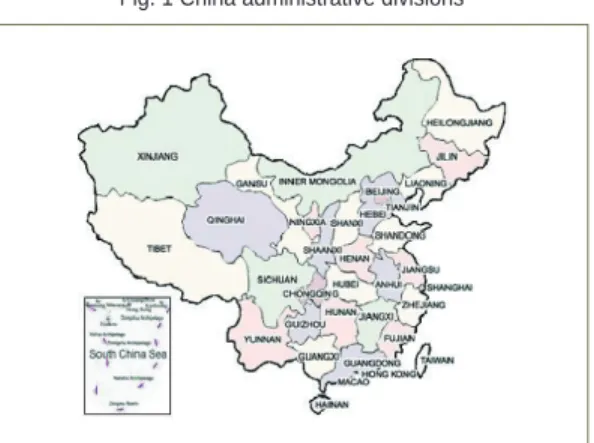
ocated in the east of the Asian continent and on the western shore of the Pacific Ocean, the People's Republic of China has a land area of about 9.6 million sq km, and is the third-largest country in the world, next only to Russia and Canada.From north to south, the territory of China stretches from the center of the Heilong River north of the town of Mohe to the Zengmu Reef at the southernmost tip of the Nansha Islands, covering a distance of 5,500 km. From east to west, the nation extends from the confluence of the Heilong and Wusuli rivers to the Pamirs, covering a distance of 5,200 km, as seen in Figure 1.
With a land boundary of approximately 22,800 km, China borders the Democratic People’s Republic of Korea to the east; Mongolia to the north; Russia to the northeast; Kazakhstan, Kyrgyzstan and Tajikistan to the northwest; Afghanistan, Pakistan, India, Nepal and Bhutan to the west and southwest; and Myanmar, Laos and Vietnam to
the south. Across the seas to the east and southeast are the Republic of Korea, Japan, the Philippines, Brunei, Malaysia and Indonesia.
China's mainland coastline measures approximately 18,000 km, with a flat topography and many excellent docks and harbors, most of which are ice-free all the year round. The Chinese mainland is flanked to the east and south by the Bohai Sea, the Yellow Sea, the East China Sea and the South China Sea, with a total maritime area of 4.73 million sq km. The Bohai Sea is China's continental sea, while the rest are marginal seas of the Pacific Ocean.
A total of 5,400 islands dot China's territorial waters. The largest of these, with an area of about 36,000 sq km, is Taiwan, followed by Hainan with an area of 34,000 sq km. The Diaoyu Island and the Chiwei Island, located to the northeast of Taiwan Island, are China's easternmost islands.
Many islands, islets, reefs and shoals in the South China Sea, known collectively as the South China Sea Islands, are China's southernmost island group.
They are called the Dongsha (East Sandbar), Xisha (West Sandbar), Zhongsha (Middle Sandbar) and Nansha (South Sandbar) island groups according to their geographical locations.
China's topography was formed around the emergence of the Qinghai-Tibet Plateau, the most important geological event over