This study aimed to understand customer satisfaction in online shopping while examining the main factors that motivate customers. Based on the findings of the survey, the respondents repurchased the product from the online shopping site because they believed the customer experience. Respondents would recommend an online shopping site to a friend if it provided transaction security and the value of the online shopping experience.
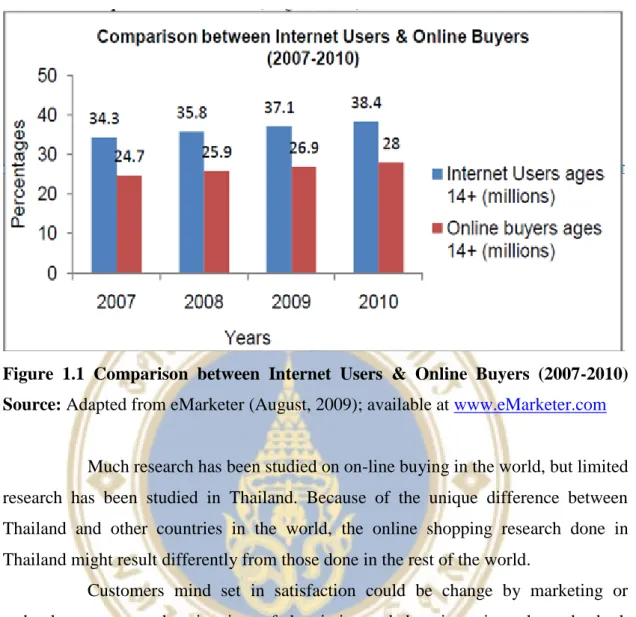
Some recommendations will be offered to online sellers to make online shopping more admired and reliable. The impact of internet usage on online shopping potential, such as the internet, has allowed retailers to connect with potential customers and express their brand in entirely new ways. Online shopping has grown in popularity over the years, mainly because people have found it convenient and easy to shop in a store from the comfort of their home or office.
With the potential trend of the shopping process in the next few years, retailers must do everything they can to catch up with online shopping. We should provide the best products and infrastructure to provide a good online shopping environment as an additional sales channel.
Research Objectives
LITERATURE REVIEW
Online Shopping behavior
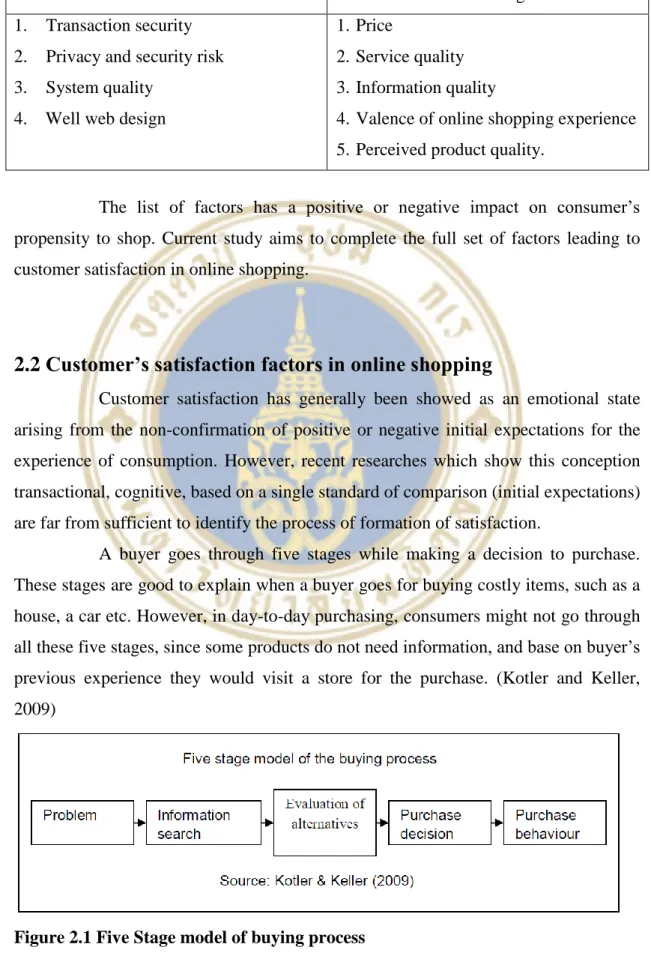
Current study aims to complete the full set of factors leading to customer satisfaction in online shopping.
Customer’s satisfaction factors in online shopping
The Internet has the potential to offer consumers benefits related to partial or even complete privacy and anonymity/aliasing throughout the purchasing process. Efforts and increasing the social value of online experience were very important for consumers to build strong brand relationships in the digital world. Companies that can create Web trust and increase the perceived value of online shopping can turn their satisfied consumers into loyal consumers in the online marketing environment (O Connor & Galvin, 2001).
Website design is an important thing in online shopping, as it directly affects the customer during the purchase process. The observed price on the Internet is lower than that in the physical store, but the consumer may be concerned about the increase of online fraud, so the online business must have confidence to satisfy the customer (Anderson, Fornell, & Lehmann, 1994; Johnson , 1999). The quality of service has a direct impact on the customer in maintaining strong and loyal relationships with online business owners.
Online business owners with excellent service quality have the advantage of learning about their customers. Quality of service can be explained as the level of assistance to online business owners in providing an efficient as well as effective shopping experience. The speed of delivery in online shopping has an impact on customer satisfaction because customers do not want to waste their time waiting.
Information quality is one of the main factors that impact customer satisfaction in Internet-based shopping (Janda, 2002; Szymanski & Hise, 2000). Valence of experience is a consumer's emotional or attitudinal state elicited by the pre-purchase online shopping experience. On the Internet, since customers could only see the photo of products instead of real products, they may worry that the real products are different from the photos of the website.
Research gaps
RESEARCH METHODOLOGY
- Research Design
- Population and sampling
- Data Collection
- Data Analysis
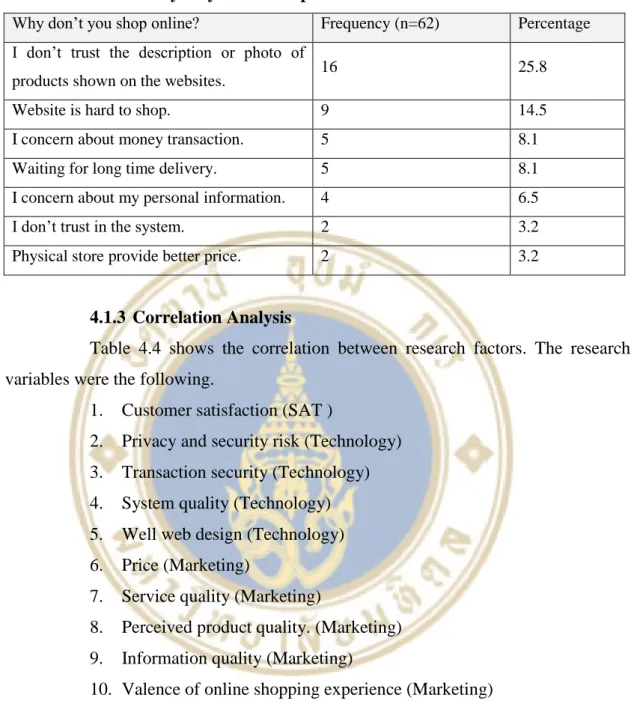
In this research, the researcher tries to solve the following research question which is related to the factors that lead to customer satisfaction in online shopping, both technical and marketing. I will prefer an online shopping website if the description or photo of the products displayed on the website is very accurate. I'd rather have a website that provides as much product information as the product should have.
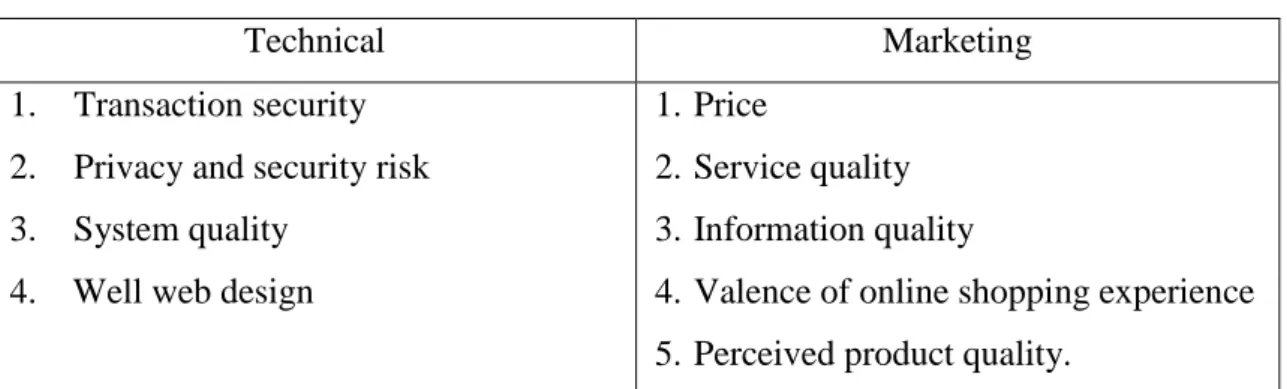
Based on your experience with the website, you are likely to purchase a product from the website again. The researcher groups and selects two categories of factors as key to influencing online consumer satisfaction: technology and marketing factors. Technical Factors include the characteristics of a website that ensure the functionality of the website, including: Transaction Security, Privacy and Security Risk, System Quality and Good Web Design.
Technological factors deal with the consumer's perception of their interaction with an online shopping site and the site owner responsible for that site. Determinants include price, service quality, information quality, value of the online shopping experience, and perceived product quality. Frequency distribution is a simple data analysis technique that allows you to get a big picture of the data.
A coefficient of +1.0, a "perfect positive correlation," means that changes in the independent variable will result in an identical change in the dependent variable. On the other hand, a coefficient of -1.0, a "perfect negative correlation," means that changes in the independent variable will cause an identical change in the dependent variable, but the change will be in the opposite direction. A model of the relationship is hypothesized, and estimates of the parameter values are used to develop an estimated regression equation.
For example, if the model is deemed satisfactory, the estimated regression equation can be used to predict the value of the dependent variable given values for the independent variables.
RESEARCH FINDINGS AND DISCUSSION
Research finding
- Respondents’ demographic profile
- Respondent online shopping experience
- Correlation Analysis
- Descriptive Statistics
- Multiple Linear Regression
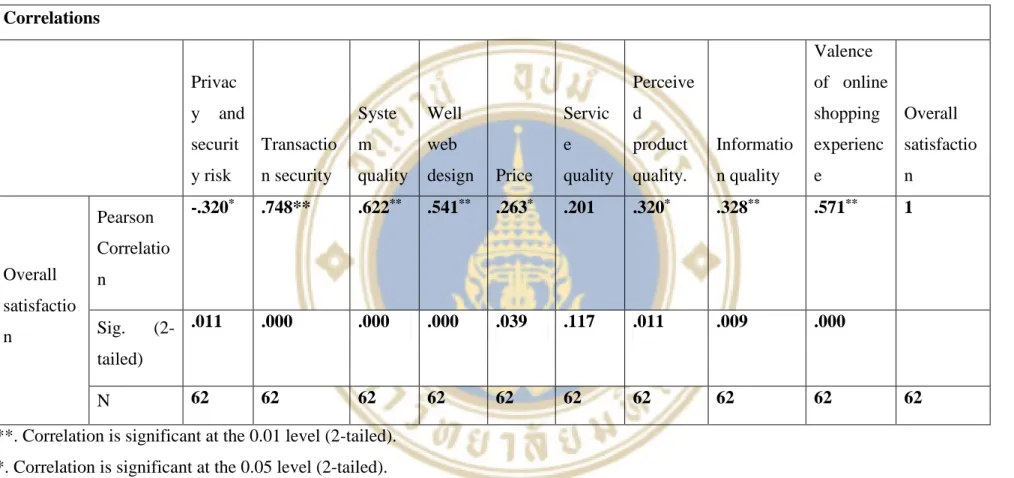
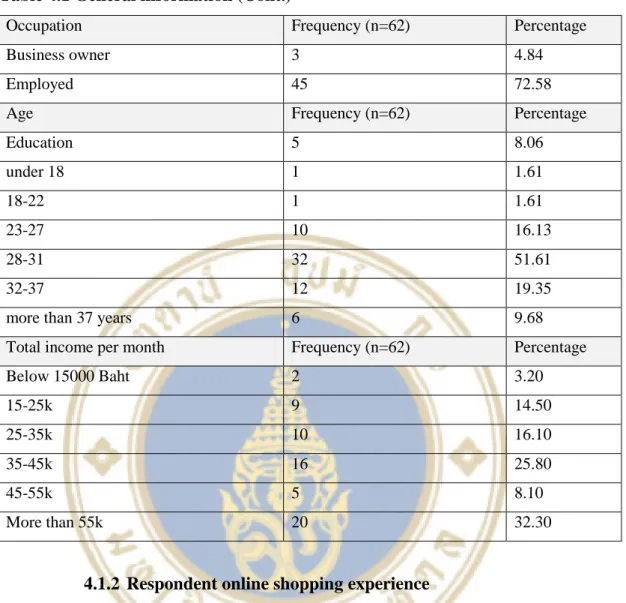
The first main set of items in the questionnaire deals with the respondents' experiences with online shopping. The strongest correlation is the relationship between SAT and transaction security (technology) (r=0.748), followed by SAT and system quality (technology) (r=0.622), SAT and the valence of the online shopping experience (marketing) (r=0.571), SAT and Well web design (technology) (r SAT and information quality (technology) (r=0.328), SAT and privacy and security risk (technology) (r=0.320), SAT and perceived product quality (marketing ). The website provides descriptions or photos products shown on the web pages, very accurate.
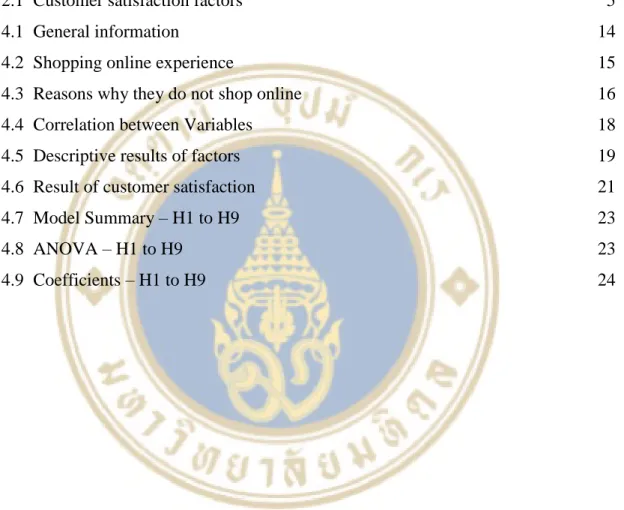
If the model is deemed satisfactory, the estimated regression equation can be used to predict the value of the dependent variable, given values for the independent variables. The model overview in Table 4.7 shows the model use for testing H1 through H9. The result was only mediocre. The outcome (R2 = 0.618) indicates that 61.8% of customer satisfaction can be predicted with this model. The ANOVA result in Table 4.8 (F = 9.359, p = 0.000) indicates that this is a significant result. The coefficients in Table 4.9 were used to determine which of the predictor variables are significant for the outcome variable.
This shows that (Tech) Transaction Security, (Tech) System Quality and (MAR) Valence of online shopping experiences contribute to customer satisfaction in online shopping, but other variables do not. Predictors: (Constant), Privacy and security risk, Transaction security, System quality, Well web design, Price, Service quality, Perceived product quality, Information quality, Valence of online shopping experience. Predictors: (Constant), Privacy and security risk, Transaction security, System quality, Well web design, Price, Service quality, Perceived product quality, Information quality, Valence of online shopping experience.
Discussion
A 2009 Schaupp study found that system quality is one factor in customer satisfaction. However, the issue of system quality is not yet a sensitive issue for buyers in developing countries, as this event does not deter buyers from preferring to conduct online transactions, as the most important thing for buyers is to be able to do online shopping. over time. Furthermore, 'Valence of Online Shopping Experiences' contributes to customer satisfaction in online shopping.
According to the research of Goldsmith and Goldsmith (2002), online shopping is strongly influenced by experience and experienced online shoppers have more confidence and a better feeling about online services than those who have no previous online shopping experience. In general, web design attracts users and is comfortable to use, so most customers like to shop on the website, which has an attractive design, clear content indication, ease of finding information and modern, but the result is different. This result contrasts with other studies (e.g. Rosen. Schaupp, Belanger & Fan, 2009). These studies have shown that excellent design adds value to the customer experience and helps low-visibility retailers with post-purchase satisfaction, which in turn increases satisfaction. customer satisfaction.
The "Privacy and Security Risk" factor does not contribute to customer satisfaction in online shopping. Most customers are not concerned about privacy and security risk when shopping online. In terms of shopping satisfaction, the consumer is considered one is the price and the price observed online is lower than that in the physical store.
However, the result of the present study contrasts with a study by Khristianto et al. 2012) who found that online retailers with excellent service quality have the advantage of learning from their customers. However, the finding of the present study contrasts with a study by Piercy (1998) which indicated that customers always see the picture of products instead of real products. They may be worried that the real products are different from the photos of the website.
The insignificant relationship between information quality and customer satisfaction is not consistent with previous studies (Janda, 2002; Szymanski & Hise, 2000), which found that information quality is one of the most important factors influencing customer satisfaction in shopping through Internet-based media.
CONCLUSION AND RECOMMENDATIONS
Conclusion
Recommendation
Limitations and Suggestions for Future Research
Results from such a narrow scale are questionable because relying on such a small scale of respondents to make complex social judgments about online shopping increases the margin of error. However, the cost of using multiple respondent views and the possibility of lower response rates are barriers against using multiple respondent views. Future research can improve and solve the problem of the method by collecting data from a larger volume of respondents' views, from different provinces of Thailand and comparing the perceptions of different people's backgrounds in online shopping.
Comparative studies can be conducted to compare online shopping in Thailand with other countries in the world. Research can also be conducted to determine customer profiles of different social backgrounds or incomes in Thailand. Future research should examine some other factors that may influence customer's online shopping behavior.
L., (1980), A Cognitive Model of the Antecedents and Consequences of Satisfaction Decisions, Journal of Marketing Research, Vol. S., (1998), Sources of competitive advantage in highly successful exporting firms, Journal of World Business, vol. 2004), Web site design: viewing the web as a cognitive landscape, Journal of Business Research, Vol.
APPENDICES
Appendix A: Questionnaire