Introduction to Cox Regression
Kristin Sainani Ph.D.
http://www.stanford.edu/~kcobb Stanford University
Department of Health Research and Policy
History
“Regression Models and Life-Tables” by D.R. Cox, published in 1972, is one of the most frequently cited journal
articles in statistics and medicine
Introduced “maximum partial likelihood”
Cox regression vs.logistic regression
Distinction between rate and proportion:
Incidence (hazard) rate: number of new cases of disease per population at-risk per unit time (or mortality rate, if
outcome is death)
Cumulative incidence: proportion of
new cases that develop in a given time
period
Cox regression vs.logistic regression
Distinction between hazard/rate ratio and odds ratio/risk ratio:
Hazard/rate ratio: ratio of incidence rates
Odds/risk ratio: ratio of proportions
By taking into account time, you are taking into account more information than just binary yes/no.
Gain power/precision.
Logistic regression aims to estimate the odds ratio; Cox regression aims to estimate the hazard ratio
Example 1: Study of publication bias
By
Kaplan- Meier methods
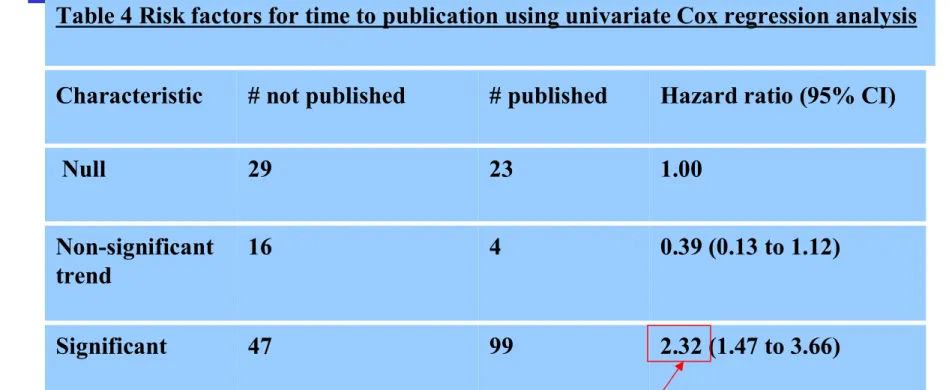
From: Publication bias: evidence of delayed publication in a cohort study of clinical research projects BMJ 1997;315:640-645 (13 September)
Table 4 Risk factors for time to publication using univariate Cox regression analysis
Characteristic # not published # published Hazard ratio (95% CI)
Null 29 23 1.00
Non-significant trend
16 4 0.39 (0.13 to 1.12)
Significant 47 99 2.32 (1.47 to 3.66)
Interpretation: Significant results have a 2-fold higher incidence of publication compared to null results.
Univariate Cox regression
Example 2: Study of mortality in academy award winners for screenwriting
Kaplan- Meier methods
Table 2. Death rates for screenwriters who have won an academy award.* Values are percentages (95% confidence
intervals) and are adjusted for the factor indicated Relative increase in death rate for
winners
Basic analysis 37 (10 to 70)
Adjusted analysis Demographic:
Year of birth 32 (6 to 64)
Sex 36 (10 to 69)
Documented education 39 (12 to 73)
All three factors 33 (7 to 65)
Professional:
Film genre 37 (10 to 70)
Total films 39 (12 to 73)
Total four star films 40 (13 to 75)
Total nominations 43 (14 to 79)
Age at first film 36 (9 to 68)
Age at first nomination 32 (6 to 64)
All six factors 40 (11 to 76)
HR=1.37; interpretation:
37% higher incidence of death for winners compared with nominees
HR=1.35; interpretation:
35% higher incidence of death for winners compared with nominees even after adjusting for potential confounders
Characteristics of Cox Regression
Does not require that you choose some particular probability model to represent survival times, and is therefore more robust than parametric methods
discussed last week.
Semi-parametric
(recall: Kaplan-Meier is non-parametric; exponential and Weibull are parametric)
Can accommodate both discrete and continuous measures of event times
Easy to incorporate time-dependent covariates—
covariates that may change in value over the course of the observation period
Continuous predictors
E.g.: hmohiv dataset from the lab
(higher age-grouppredicted worse outcome, but couldn’t be treated as continuous in KM, and magnitude not quantified):
Using Cox Regression
The estimated coefficient for Age in the HMOHIV dataset: =.092
HR=e
.092=1.096
Interpretation: 9.6% increase in mortality rate for every
Characteristics of Cox Regression, continued
Cox models the effect of covariates on the hazard rate but leaves the baseline hazard rate unspecified.
Does NOT assume knowledge of absolute risk.
Estimates relative rather than absolute
risk.
Assumptions of Cox Regression
Proportional hazards assumption: the hazard for any individual is a fixed
proportion of the hazard for any other individual
Multiplicative risk
Recall: The Hazard function
t
t T
t t
T t
t P h
t
) /
lim ( )
(
0
In words: the probability that if you survive to t, you will succumb to the event in the next instant.
) (
) (t) (
: survival and
density from
Hazard
t S
t h f
The model
ik k
i x
x
i
t t e
h ( )
0( )
1 1...Components:
•A baseline hazard function that is left unspecified but must be positive (=the hazard when all covariates are 0)
•A linear function of a set of k fixed covariates that is exponentiated.
(=the relative risk)
ik k
i
i
t t x x
h ( ) log ( ) ...
log
0 1 1Can take on any form!
The model
) (
...
) (
...
0
...
0 ,
1 1
1 1 1
1 1 1
) (
) ( )
( )
( i j ik jk
jk k j
ik k
i x x x x
x x
x x
j i j
i e
e t
e t t
h t
HR h
Proportional hazards:
Hazard functions should be strictly parallel!
Produces covariate-adjusted hazard ratios!
Hazard for person j (eg a non-smoker)
Hazard for person i (eg a smoker)
Hazard ratio
The model: binary predictor
smoking
smoking age
smoking
age smoking
e HR
e e t
e t t
h t HR h
smoking cancer
lung
j i smoking
cancer lung
/
) 0 1 ( )
60 ( )
0 ( 0
) 60 ( )
1 ( 0
/
( )
) ( )
( ) (
This is the hazard ratio for smoking adjusted for age.
The model:continuous predictor
) 10 ( age
in increase 10
/
) 60 70 ( )
60 ( )
0 ( 0
) 70 ( )
0 ( 0
age in increase 10
/ ( )
) ( )
( ) (
age
age age
smoking
age smoking
e HR
e e t
e t t
h t HR h
years cancer
lung
j i years
cancer lung
Exponentiating a continuous predictor gives you the hazard ratio for a 1-unit increase in the predictor.
This is the hazard ratio for a 10-year increase in age, adjusted for smoking.
The “Partial Likelihood” (PL)
m
i
i
p
L
L
1
) (β
Where there are m event times (as in Kaplan-
Meier methods!) and Li is the partial likelihood for the ith event time:
The Likelihood for each event
)) 18 (
) 18 ( (
)) 12 ( )
12 (
) 12 ( (
)) 4 ( ....
) 4 (
) 4 ( (
)) 3 ( )
3 ( )
3 ( )
3 ( )
3 (
) 3 ( (
)) 1 ( )
1 ( )
1 ( )
1 ( )
1 ( )
1 (
) 1 ( (
) β (
6 6 6
5
5
6 3
3 6
5 4
3 2
2
6 5
4 3
2 1
1 1
h x h h
h x h
h h
x h h
h h
h h
h
h x h
h h
h h
L h L
m
i
i p
Consider the following data:
Males: 1, 3, 4, 10+, 12, 18 (call them subjects j=1-6)
Given that a death occurred at time=3, this is the probability that it happened to subject 2 rather than to one of the other
The “risk set”
Note: there is a term in the likelihood for each event, NOT each individual—note similarity to likelihood for conditional logistic regression…
The PL
) ) 18 (
) 18 ( (
....
) ) 1 ( )
1 ( )
1 ( )
1 ( )
1 ( )
1 (
) 1 ( (
) (
6 6
6 5
4 3
2 1
1
0 0
0 0
0 0
0 0
0 1
βx βx
βx βx
βx βx
βx βx
βx
β
e x e
e x e
e e
e
e t
L L
m
i
i p
1 ....
) (
) (
6 4 5
2 3 1
1
1
x e x
e e
e e
L e L
m
i
i
p βx βx βx βx βx βx
βx
β
The PL
] ) log(
[ )
( log
) (
1
i
j
t R j j
m
i
j
p
e
L β βx
βx
m
i
t R j p
j
i j j
e L e
1
) (
) (
)
(
βx βx
β
Where, is the censoring variable (1=if event, 0 if
censored) and R(ti)is the risk set at time ti
j
Note: we haven’t yet specified how to account for ties (later)
Maximum likelihood estimation…
Once you’ve written out log of the PL, then maximize the function
Take the derivative of the function
Set derivative equal to 0
Solve for the most likely values of beta (values that make the data most likely!).
These are your ML estimates!
] ) log(
[ )
( log
) (
1
i
j
t R j j
m
i
j
p
e
L β βx
βxVariance of
Standard maximum likelihood methods for variance:
Variance is the inverse of the observed information evaluated at MPLE estimate of :
) 1
( ˆ ˆ )
( I
Var
Hypothesis Testing H 0 : =0
2. The Likelihood Ratio test:
1. The Wald test:
ˆ) ( error standard
asymptotic ˆ 0
Z
~ 2
))]
( ln(
2 [ )) (
ln(
2
) (
) ln (
2
r p
p p
full L
reduced L
full L
reduced L
Reduced=reduced model with k parameters; Full=full model with k+r parameters
A quick note on ties…
The PL assumed no tied values among the observed survival times
Not often the case with real data
Ties
Exact method (time is continuous; ties are a result of imprecise measurement of time)
Breslow approximation (SAS default)
Efron approximation
Discrete method (treats time as discrete; ties are real)
In SAS:
option on the model statement:
ties=exact/efron/breslow/discrete
Ties: Exact method
Assumes ties result from imprecise measurement of time.
Assumes there is a true unknown order of events in time.
Mathematically, the exact method calculates the exact probability of all possible orderings of events.
For example, in the hmohiv data, there were 15 events at time=1 month. (We can assume that all patients did not die at the precise same moment but that time is measured
imprecisely.) ID’s= 13, 16, 28, 32, 52, 54, 69, 72, 78, 79, 82, 83, 93, 96, 100
With 15 events, there are 15! (1.3x10¹²)different orderings.
Instead of 15 terms in the partial likelihood for 15 events, get 1 term that equals:
! 15
) ( O
iP
L
Where Oi is the ith possible ordering;
for example, here, 15!th ordering is:
100, 96, 93, 83, 82, 79, 78, 72, 69, 54,
Exact, continued
)....
( ...
... ) ... )(
( )
( :
) (
99 98
97 95
2 1
93
99 2
1
96
100 2
1
100
! 15
! 15
1
βx βx
βx βx
βx βx
βx
βx βx
βx
βx βx
βx βx
βx
e e
e e
e e
e
e e
e
e e
e e
O e P eg
O P L
i
i
Each P(Oi) has 15 terms; sum 15! P(Oi)’s…
Hugely complex computation!…so need approximations…
Breslow and Efron methods
Breslow (1974)
Efron (1977)
Both are approximations to the exact method.
both have much faster calculation times
Breslow is SAS default.
Breslow does not do well when the number of ties at a particular time point is a large
proportion of the number of cases at risk.
Prefer Efron to Breslow
Discrete method
Assumes time is truly discrete.
When would time be discrete?
When events are only periodic, such as:
--Winning an Olympic medal (can only happen every 4 years)
--Missing a class (can only happen on Mondays or Wednesdays at 3:15pm)
--Voting for President (can only happen every 4
years)
Discrete method
Models proportional odds: coefficients represent odds ratios, not hazard ratios.
For example, at time= 1 month in the hmohiv data, we could ask the question: given that 15 events occurred, what is the probability that they happened to this
particular set of 15 people out of the 98 at risk at 1 month?
....
15
) 2 ( 15
) 1 (
15
1 1
P j
j P
j
j i
i
Odds Odds
Odds L
Odds are a function of an individual’s covariates.
Recursive algorithm makes it possible to calculate.
Ties: conclusion
We’ll see how to implement in SAS and
compare methods (often doesn’t matter
much!).
) (
0
0 1
) (
) ( )
( )
(
i jj
i x x
x x
j
i
e
e t
e t t
h t
HR h
Evaluation of Proportional Hazards assumption:
Recall proportional hazards concept:
constant is
HR ratio hazard
where
; ) ( )
( :
implies hi t HRhj t
Hazard for person j (eg a non-smoker) Hazard for person i (eg a smoker)
Hazard ratio for smoking
Recall relationship between survival function and hazard function…
t
x
du e
u
e
00
( ) )
( i
i (X t) S (t)
P
t
du u h
e 0
) ) ( (
S(t) : hazard from
Survival
xi
i
t t e
h ( )
0( )
Evaluation of Proportional Hazards assumption:
) ( )
(t HRh t hi j
) ) ( (
) ( )
(
0
0 0
) (
) ( and )
(
t
t j t
j
du u h HR i
du u HRh i
du u h j
e t
S
e t
S e
t S
HR j
i du HR
u h
i t e S t S t
S
t
) ( )
( )
( ) (
) ) ( (
0
) ( log
) ( log )
( log
) (
log Si t S j t HR Si t HR S j t
Take log of both sides
) ( )
(
)) ( log log(
log ))
( log log(
)) ( log log(
)) ( log log(
t X K
t Y
t S HR
t S
t S HR
t S
j i
j i
Multiply both sides by a negative and take logs again
i.e., log(-log) survival curves are parallel,
and different by log(HR)
Evaluation of Proportional Hazards assumption:
e.g., graph we’ll produce in lab…
Cox models with Non- Proportional Hazards
Violation of the PH assumption for a given
covariate is equivalent to that covariate having a significant interaction with time.
x t t
t h
xt x
t t
h
xt x
xt x
) (
) ( log
) ( log
) ( log
) ( log
0 0
The covariate multiplied by time
Time-interaction coefficient
If Interaction coefficient is significant indicates non-proportionality, and at the same time its inclusion in the model corrects for non-proportionality!
Negative value indicates that effect of x decreases linearly with time.
Positive value indicates that effect of x increases linearly with time.
Covariate values for an individual may change over time
For example, if you are evaluating the effect of taking the drug raloxifene on breast cancer risk in an observational study, women may start and stop the drug at will. Subject A may be taking
raloxifene at the time of the first event, but may have stopped taking it by the time the 15th case of breast cancer happens.
If you are evaluating the effect of weight on diabetes risk over a long study period, subjects may gain and lose large amounts of weight, making their baseline weight a less than ideal predictor.
If you are evaluating the effects of smoking on the risk of pancreatic cancer, study participants may change their smoking habits
throughout the study.
Cox regression can handle these time-dependent covariates!
Time-dependent covariates
For example, evaluating the effect of taking oral contraceptives (OCs) on stress fracture risk in women athletes over two years—many women switch on or off OCs .
If you just examine risk by a woman’s OC- status at baseline, can’t see much effect for OCs. But, you can incorporate times of
starting and stopping OCs.
Time-dependent covariates
Ways to look at OC use:
Not time-dependent
Ever/never during the study
Yes/no use at baseline
Total months use during the study
Time-dependent
Using OCs at event time t (yes/no)
Months of OC use up to time t
Time-dependent covariates
Time-dependent covariates:
Example data
ID Time Fracture StartOC StopOC
1 12 1 0 12
2 11 0 10 11
3 20 1 . .
4 24 0 0 24
5 19 0 0 11
6 6 1 . .
7 17 1 1 7
4 events
1. Time independent predictor…
Baseline use (yes/no)
Time-dependent covariates
ID Time Fracture StartOC StopOC
6 6 1 . .
2 11 0 10 11
1 12 1 0 12
7 17 1 1 7
5 19 0 0 11
3 20 1 . .
4 24 0 0 24
Order by Time…
Time-dependent covariates
ID Time Fracture StartOC StopOC
6 6 1 . .
2 11 0 10 11
1 12 1 0 12
7 17 1 1 7
5 19 0 0 11
3 20 1 . .
4 24 0 0 24
3 OC users at baseline
Time-dependent covariates
ID Time Fracture StartOC StopOC
6 6 1 . .
2 11 0 10 11
1 12 1 0 12
7 17 1 1 7
5 19 0 0 11
3 20 1 . .
4 24 0 0 24
4 non-users at baseline
Time-dependent covariates
ID Time Fracture StartOC StopOC
6 6 1 . .
2 11 0 10 11
1 12 1 0 12
7 17 1 1 7
5 19 0 0 11
3 20 1 . .
4 24 0 0 24
Next is a censoring (non-user) Second event is in a baseline user. (risk set: 3 users/2 non)
Third event is in a non-user at baseline.(risk set: 2 users/2 non) Next is a censoring (baseline
user).Fourth and last event is in a non- user (risk set: 1 user/1 non)
Censoring.
First event is in a non-OC user at baseline. (risk set: 3 users/4 non)
The PL using baseline value of OC use
) 0 ( )
1 (
) 0 ( )
0 ( )
1 (
) 0 ( )
0 ( )
1 (
) 1 ( )
0 ( )
1 (
) 0 (
2 2
2 3
4 ) 3
(
e e
x e e
e x e e
e x e e
e Lp oc e
The PL using ever/never value of OC use
A second time-independent option would be to use the variable “ever took OCs” during the study period…
Time-dependent covariates
ID Time Fracture StartOC StopOC
6 6 1 . .
2 11 0 10 11
1 12 1 0 12
7 17 1 1 7
5 19 0 0 11
3 20 1 . .
4 24 0 0 24
Next is a censoring (ever-user) Second event is in an ever-user.
(risk set: 4 users/1 never) Third event is in an ever-
user.(risk set: 3 users/1 non) Next is a censoring (ever user).
Fourth and last event is in a never- user (risk set: 1 user/1 non)
Censoring.
First event is in a never-user. (risk set: 5 ever users/2 never)
The PL using ever/never value of OC use
“Ever took OCs” during the study period
) 0 ( )
1 (
) 0 ( )
0 ( )
1 (
) 1 ( )
0 ( )
1 (
) 1 ( )
0 ( )
1 (
) 0 (
3 4
2 ) 5
(
e e
x e e
e x e e
e x e e
e Lp oc e
Time-dependent...
ID Time Fracture StartOC StopOC
6 6 1 . .
2 11 0 10 11
1 12 1 0 12
7 17 1 1 7
5 19 0 0 11
3 20 1 . .
4 24 0 0 24
Time-dependent covariates
First event at time 6
The PL at t=6
) 6 ) (
6 ( )
6 ) (
6 ) (
6 ) (
6 ( )
6 (
) 6 (
7 6
5 4
3 2
1
6
)
( x x x x x x x
t x oc
p e e e e e e e
L e
X is time-dependent
ID Time Fracture StartOC StopOC
6 6 1 . .
2 11 0 10 11
1 12 1 0 12
7 17 1 1 7
5 19 0 0 11
3 20 1 . .
4 24 0 0 24
Time-dependent covariates
At the first event-time (6), there are 4 not on OCs and 3 on OCs.
The PL at t=6
) 6 ( )
6 ( )
6 ( )
6 ( )
6 ( )
6 ( )
6 (
) 6 (
7 6
5 4
3 2
1
6
)
(
x x x x x x xt x oc
p
e e e e e e e
L
e
) 1 ( )
0 (
) 0 (
4
3
e e
e
ID Time Fracture StartOC StopOC
6 6 1 . .
2 11 0 10 11
1 12 1 0 12
7 17 1 1 7
5 19 0 0 11
3 20 1 . .
4 24 0 0 24
Time-dependent covariates
Second event at time 12
The PL at t=12
) 0 ( )
1 (
) 1 ( )
1 ( )
0 (
) 0 (
3 2
4 ) 3
(
e e
x e e
e L
p oce
ID Time Fracture StartOC StopOC
6 6 1 . .
2 11 0 10 11
1 12 1 0 12
7 17 1 1 7
5 19 0 0 11
3 20 1 . .
4 24 0 0 24
Time-dependent covariates
Third event at time 17
The PL at t=17
) 0 ( )
1 (
) 0 ( )
0 ( )
1 (
) 1 ( )
1 ( )
0 (
) 0 (
3 3
2 4
) 3
(
e e
x e e
e x e e
e L
p oce
ID Time Fracture StartOC StopOC
6 6 1 . .
2 11 0 10 11
1 12 1 0 12
7 17 1 1 7
5 19 0 0 11
3 20 1 . .
4 24 0 0 24
Time-dependent covariates
Fourth event at time 20
The PL at t=20
) 0 ( )
1 (
) 0 ( )
0 ( )
1 (
) 0 ( )
0 ( )
1 (
) 1 ( )
1 ( )
0 (
) 0 (
3 3
2 4
) 3
(
e e
x e e
e x e e
e x e e
e Lp oc e
) 0 ( )
1 (
) 0 ( )
0 ( )
1 (
) 0 ( )
0 ( )
1 (
) 1 ( )
1 ( )
0 (
) 0 (
2 2
2 3
3 ) 4
(
e e
x e e
e x e e
e x e e
e Lp oc e
vs. PL for OC-status at baseline (from before):
References
Paul Allison. Survival Analysis Using SAS. SAS Institute Inc., Cary, NC: 2003.