Chapter 2:
The Representation of Knowledge
Expert Systems: Principles and
Programming, Fourth Edition
Objectives
• Introduce the study of logic
• Learn the difference between formal logic and informal logic
• Learn the meaning of knowledge and how it can be represented
• Learn about semantic nets
• Learn about object-attribute-value triples
Objectives Continued
• See how semantic nets can be translated into Prolog
• Explore the limitations of semantic nets
• Learn about schemas
• Learn about frames and their limitations
• Learn how to use logic and set symbols to represent knowledge
Objectives Continued
• Learn about propositional and first order predicate logic
• Learn about quantifiers
• Explore the limitations of propositional and predicate logic
What is the study of logic?
• Logic is the study of making inferences – given a set of facts, we attempt to reach a true
conclusion.
• An example of informal logic is a courtroom
setting where lawyers make a series of inferences hoping to convince a jury / judge .
• Formal logic (symbolic logic) is a more rigorous approach to proving a conclusion to be true /
false.
Why is Logic Important
• We use logic in our everyday lives – “should I buy this car”, “should I seek medical attention”.
• People are not very good at reasoning because they often fail to separate word meanings with the reasoning process itself.
• Semantics refers to the meanings we give to symbols.
The Goal of Expert Systems
• We need to be able to separate the actual
meanings of words with the reasoning process itself.
• We need to make inferences w/o relying on semantics.
• We need to reach valid conclusions based on facts only.
Knowledge vs. Expert Systems
• Knowledge representation is key to the success of expert systems.
• Expert systems are designed for knowledge representation based on rules of logic called inferences.
• Knowledge affects the development, efficiency, speed, and maintenance of the system.
Arguments in Logic
• An argument refers to the formal way facts and rules of inferences are used to reach valid
conclusions.
• The process of reaching valid conclusions is referred to as logical reasoning.
How is Knowledge Used?
• Knowledge has many meanings – data, facts, information.
• How do we use knowledge to reach conclusions or solve problems?
• Heuristics refers to using experience to solve problems – using precedents.
• Expert systems may have hundreds / thousands
Epistemology
• Epistemology is the formal study of knowledge .
• Concerned with nature, structure, and origins of knowledge.
A Priori Knowledge
• “That which precedes”
• Independent of the senses
• Universally true
• Cannot be denied without contradiction
A Posteriori Knowledge
• “That which follows”
• Derived from the senses
• Now always reliable
• Deniable on the basis of new knowledge w/o the necessity of contradiction
Procedural Knowledge
Knowing how to do something:
• Fix a watch
• Install a window
• Brush your teeth
• Ride a bicycle
Declarative Knowledge
• Knowledge that something is true or false
• Usually associated with declarative statements
• E.g., “Don’t touch that hot wire.”
Tacit Knowledge
• Unconscious knowledge(
insensible
• Cannot be expressed by language
• E.g., knowing how to walk, breath, etc.
Knowledge in Rule-Based Systems
• Knowledge is part of a hierarchy.
• Knowledge refers to rules that are activated by facts or other rules.
• Activated rules produce new facts or conclusions.
• Conclusions are the end-product of inferences when done according to formal rules.
Expert Systems vs. Humans
• Expert systems infer – reaching conclusions as the end product of a chain of steps called inferencing when done according to formal rules.
• Humans reason
Expert Systems vs. ANS
• ANS does not make inferences but searches for underlying patterns.
• Expert systems
o Draw inferences using facts o Separate data from noise
o Transform data into information
o Transform information into knowledge
Metaknowledge
• Metaknowledge is knowledge about knowledge and expertise.
• Most successful expert systems are restricted to as small a domain as possible.
• In an expert system, an ontology is the
metaknowledge that describes everything known about the problem domain.
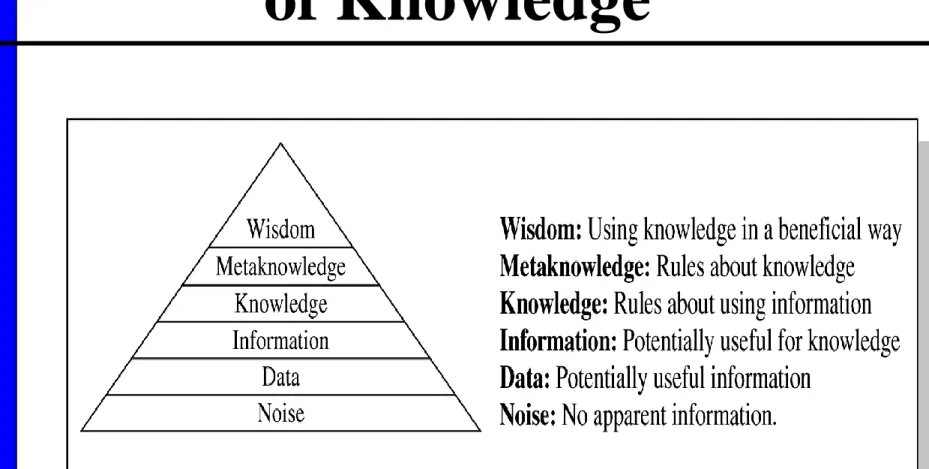
Figure 2.2 The Pyramid
of Knowledge
Productions
A number of knowledge-representation techniques have been devised:
• Rules
• Semantic nets
• Frames
• Scripts
• Logic
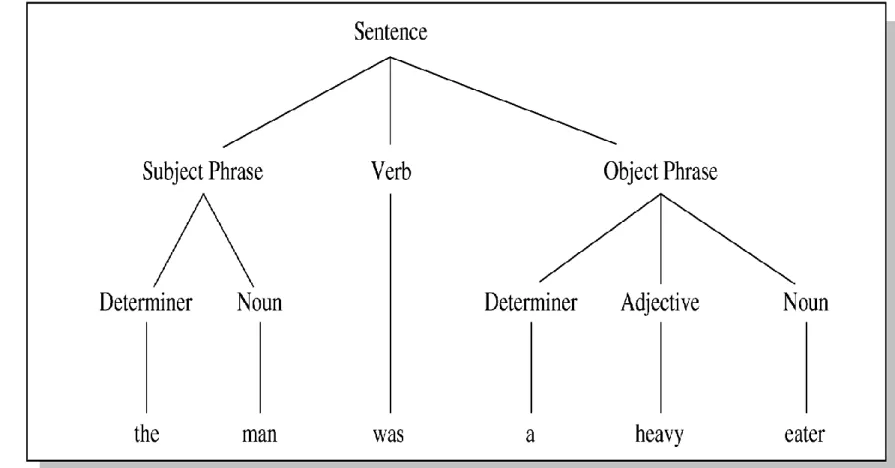
Figure 2.3 Parse Tree
of a Sentence
Semantic Nets
• A classic representation technique for propositional information
• Propositions – a form of declarative knowledge, stating facts (true/false)
• Propositions are called “atoms” – cannot be further subdivided.
• Semantic nets consist of nodes (objects, concepts,
Common Types of Links
• IS-A – relates an instance or individual to a generic class
• A-KIND-OF – relates generic nodes to generic nodes
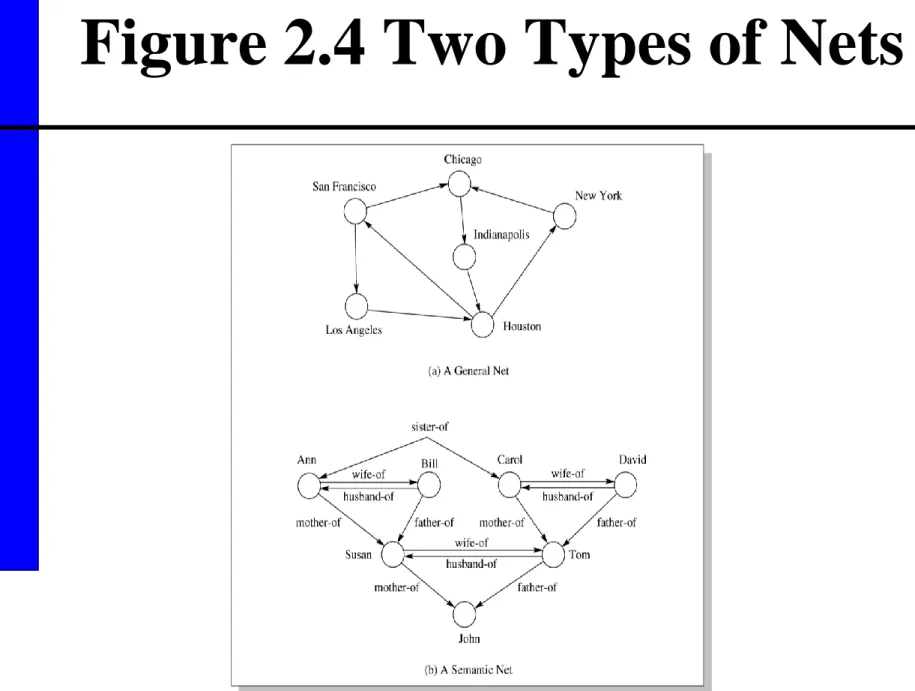
Figure 2.4 Two Types of Nets
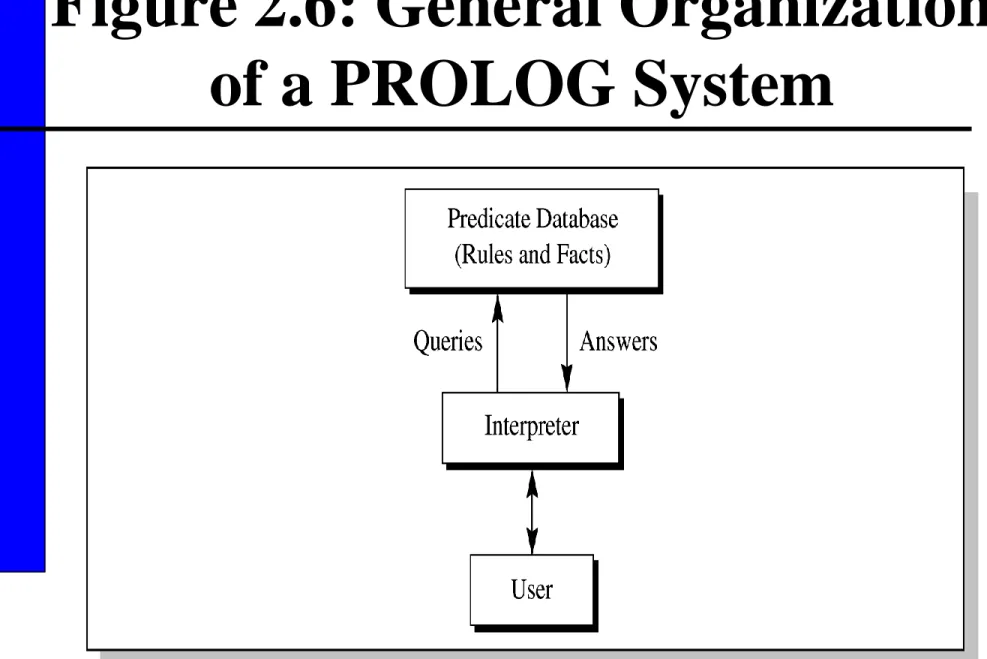
Figure 2.6: General Organization
of a PROLOG System
PROLOG and Semantic Nets
• In PROLOG, predicate expressions consist of the predicate name, followed by zero or more
arguments enclosed in parentheses, separated by commas.
• Example:
mother(becky,heather)
PROLOG Continued
• Programs consist of facts and rules in the general form of goals.
• General form: p:- p1, p2, …, pN p is called the rule’s head and the p
irepresents the subgoals
• Example:
spouse(x,y) :- wife(x,y)
Object-Attribute-Value Triple
• One problem with semantic nets is lack of
standard definitions for link names (IS-A, AKO, etc.).
• The OAV triplet can be used to characterize all the knowledge in a semantic net.
Problems with Semantic Nets
• To represent definitive knowledge, the link and node names must be rigorously defined.
• A solution to this is extensible markup language (XML) and ontologies.
Schemata
• Knowledge Structure – an ordered collection of knowledge – not just data.
• Semantic Nets – are shallow knowledge
structures – all knowledge is contained in nodes and links.
• Schema is a more complex knowledge structure than a semantic net.
Frames
• One type of schema is a frame (or script – time- ordered sequence of frames).
• Frames are useful for simulating commonsense knowledge.
• Semantic nets provide 2-dimensional knowledge;
frames provide 3-dimensional.
Frames Continued
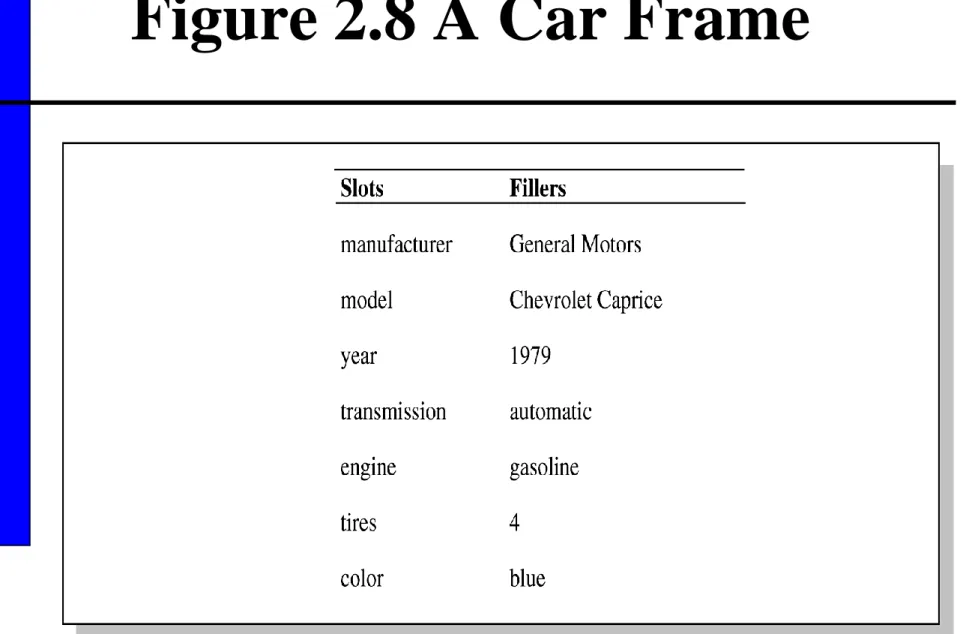
• A frame is a group of slots and fillers that defines a stereotypical object that is used to represent
generic / specific knowledge.
• Commonsense knowledge is knowledge that is generally known.
Logic and Sets
• Knowledge can also be represented by symbols of logic.
• Logic is the study of rules of exact reasoning – inferring conclusions from premises.
• Automated reasoning – logic programming in the context of expert systems.
Figure 2.8 A Car Frame
Forms of Logic
• Earliest form of logic was based on the syllogism – developed by Aristotle.
• Syllogisms – have two premises that provide evidence to support a conclusion.
• Example:
– Premise: All cats are climbers.
– Premise: Garfield is a cat.
– Conclusion: Garfield is a climber.
Venn Diagrams
• Venn diagrams can be used to represent knowledge.
• Universal set is the topic of discussion.
• Subsets, proper subsets, intersection, union , contained in, and complement are all familiar terms related to sets.
• An empty set (null set) has no elements.
Figure 2.13 Venn Diagrams
Propositional Logic
• Formal logic is concerned with syntax of statements, not semantics.
• Syllogism:
• All goons are loons.
• Zadok is a goon.
• Zadok is a loon.
• The words may be nonsense, but the form is
Boolean Logic
• Defines a set of axioms consisting of symbols to represent objects / classes.
• Defines a set of algebraic expressions to manipulate those symbols.
• Using axioms, theorems can be constructed.
• A theorem can be proved by showing how it is derived from a set of axioms.
Features of Propositional Logic
• Concerned with the subset of declarative
sentences that can be classified as true or false.
• We call these sentences “statements” or
“propositions”.
• Paradoxes – statements that cannot be classified as true or false.
• Open sentences – statements that cannot be
Features Continued
• Compound statements – formed by using logical connectives (e.g., AND, OR, NOT, conditional, and biconditional) on individual statements.
• Material implication –
p
q
states that ifp
is true, it must follow thatq
is true.• Biconditional –
p
q
states thatp
impliesq
andFeatures Continued
• Tautology – a statement that is true for all possible cases.
• Contradiction – a statement that is false for all possible cases.
• Contingent statement – a statement that is neither
Truth Tables
Universal Quantifier
• The universal quantifier, represented by the symbol means “for every” or “for all”.
(
x
) (x
is a rectangle x
has four sides)• The existential quantifier, represented by the symbol means “there exists”.
(
x
) (x –
3 = 5)Summary
• We have discussed:
– Elements of knowledge – Knowledge representation
– Some methods of representing knowledge
• Fallacies may result from confusion between form of knowledge and semantics.
• It is necessary to specify formal rules for expert systems to be able to reach valid conclusions.