i Agronomic and quantitative trait loci analyses of yield and yield-related
traits in pigeonpea
By
Seleman Rashid Kaoneka
B.Sc. Agriculture (Sokoine University of Agriculture, Tanzania) M.Sc. Crop Improvement (University of Nottingham, UK)
A thesis submitted in fulfilment of the requirements for the degree of Doctor of Philosophy (PhD) in Plant Breeding
School of Agricultural, Earth and Environmental Sciences College of Agriculture, Engineering and Science
University of KwaZulu-Natal Pietermaritzburg Republic of South Africa
November 2017
i Thesis abstract
Pigeonpea [Cajanus cajan (L.) Millsp.] is an important multi-purpose crop widely grown in the tropics and sub-tropics. However, pigeonpea productivity has been stagnant with grain yield of 750 kg ha-1due to several biotic, abiotic and socio- economic constraints. Narrow genetic diversity present in the cultivated species has further hampered progresses in the development and deployment of improved cultivars and genomic resources.
The main objective of this study was to develop improved cultivars of pigeonpea through agronomic characterization and by identifying genomic regions associated with yield and yield-related traits for efficient marker-assisted selection programs. The specific objectives of this study were: 1) to assess the phenotypic variability and to identify promising genotypes among F2 segregants of pigeonpea populations derived from crosses of six parental lines with diverse genetic backgrounds, 2) to apply correlation and path coefficient analyses and identify most useful yield and yield-related components of newly developed pigeonpea mapping populations, 3) to determine the genetic control of eight yield and yield- related traits involving a total of 460 F2 pigeonpea progenies derived from three families of varied genetic backgrounds and 4) to identify quantitative trait loci (QTL) associated with eight yield and yield-related traits using 420 F2 progenies developed from three divergent pigeonpea families.
The following six parental lines: AL 201, ICPL 20325, ICP 8863, ICPL 87119, ICP 5529 and ICP 7035 were crossed using a bi-parental mating design. Parents and a total of 611 F2 individuals were phenotyped. Data collected included days to flowering, number of primary branches plant-1 number of secondary branches plant-1 number of pods plant-1, number of seeds pod-1, seed weight and seed yield plant-1. ICP 7035 and ICP 5529, which are long maturity lines had desirable attributes such as increased seed weight, reduced plant height, greater number of primary branches and better seed yield plant-1 followed by medium maturity lines, ICPL 87119 and ICP 8863. Short maturity lines ICPL 20325 and AL 201 had the least preferred traits. Results suggested that number of pods plant-1, followed by seed yield plant-1, number of secondary branches plant-1 and number of
ii primary branches plant-1 exhibited higher variation across all the studied geneotypes. The highest phenotypic variability was exhibited by ICP 5529 × ICP 7035, followed by ICP 8863 × ICPL 87119 and AL 201 × ICPL 20325.Phenotypic correlations of eight yield and yield-related characters were investigated to determine desired characters for selection of progenies with improved seed yield.
Significantly positive correlations were found between seed yield and number of pods plant-1, followed by the number of secondary branches plant-1, number of primary branches plant-1 and 100-seed weight across all populations. Partitioning of the correlation coefficients into direct and indirect effect, revealed number of pods plant-1 and 100-seed weight to have the highest direct effect on seed yield plant-1. Selection of number of pods plant-1,100-seed weight, and number of secondary branches enhances seed yield in the present populations of pigeonpea.
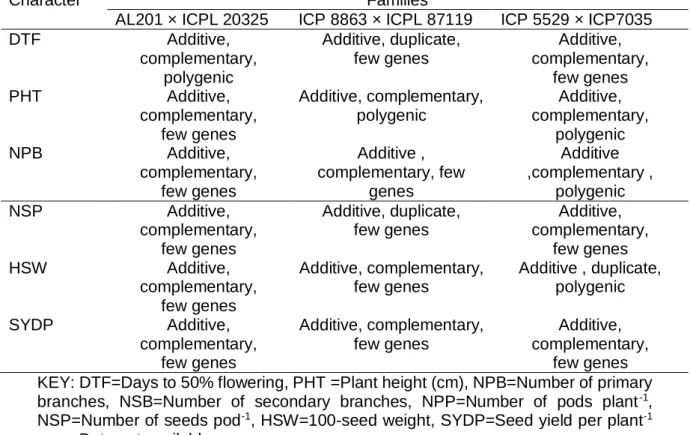
A study on the genetic control of yield and yield-related traits involving a total of 460 F2 pigeonpea individuals was conducted in three mapping populations. The skewness and kurtosis of evaluated characters were tested. The results indicated predominance of additive gene action affecting the studied characters. The estimated coefficients of skewness and kurtosis revealed there were no gene interactions found for some of the traits implying that there were no influences among the genes for the phynotypic expression of the respective traits. The traits were days-to-50% flowering in the cross AL 201 × ICPL 20325, plant height for crosses ICP 8863 × ICPL 87119 and ICP 5529 × ICP 7035, the number of primary branches, secondary branches and 100-seed weight for cross ICP 5529 × ICP 7035. Number of seeds pod-1 in cross AL 201 × ICPL 20325, days-to-50 % flowering, number of seed pod-1 and 100-seed weight in population ICP 8863 × ICPL 87119, and 100-seed weight in ICP 5529 × ICP 7035, recorded negative skewness values indicating the presence of duplicate epistatic gene interaction.
All other remaining characters in all the crosses recorded positive skewness indicating the presence of complementary epistasis interaction among loci.
QTL analyses were conducted for the above eight yield and yield-related traits using three mapping populations with composite interval mapping (CIM). A total
iii of 42 QTLs were detected of which 5 were in AL 201 × ICPL 20325, 7 in ICP 5529
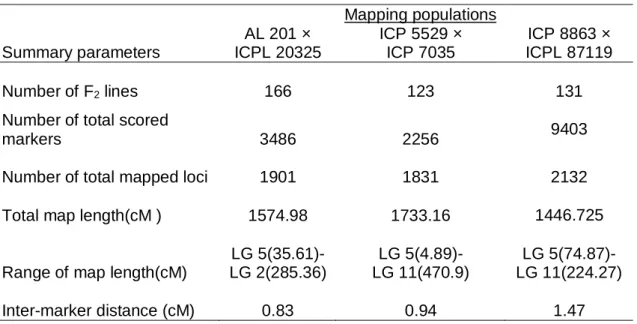
× ICP 7035 and 30 in ICP 8863 × ICPL 87119. QTLs ranged from 1 to 4 per trait and the phenotypic value explained (PVE %) ranged between 10.35 to 16.27% in AL 201× ICPL 20325, 10.44 to 17.9% in ICP 5529 × ICP7035 and 10.71 to 89.12%
in ICP 8863 × ICPL 87119. The detected QTLs were co-localized within the same genomic regions indicating the presence of pleiotropic effect or linkage.
In summary, the present study identified useful genetic resources for further breeding, determined the most influential traits in pigeonpea breeding to improve seed yield and yield components and developed mapping populations segregating for yield and yield-related traits in the crosses of AL 201 × ICPL 20325, ICP 5529 × ICP 7035 and ICP 8863 × ICPL87119. The 42 putative QTLs identified in the study associated with seed yield and yield-related traits are useful for strategic marker-assisted breeding of pigeonpea.
iv
v Acknowledgements
First and foremost, I humbly praise the Almighty God (Allah), the most beneficent and the most merciful.
The achievement of this work was realized through the help rendered so kindly by many institutions and people that I believe deserve earnest acknowledgment.
Hence, I owe a great gratitude to all those who helped me generously in one way or another for the accomplishment of this thesis.
My first earnest appreciation goes to my principal supervisor, Professor Shimelis Hussein for giving me genuine and regular advice to this study and thesis write up from its inception to culmination. I am also grateful for his gracious approach throughout my study.
I am thankful to my co-supervisor, Dr. Rajeev Varshney for giving me a chance to conduct my research at the Centre of Excellence in Genomics (CEG), the International Crop Research for the Semi-Arid Tropic (ICRISAT). I am grateful to Dr. Rachit Saxena, my immediate supervisor at ICRISAT for his thoughtful guidance and creative suggestions during the research execution. All other colleagues at CEG who contributed to the success of my research at ICRISAT are gratefully acknowledged.
My study would not be fruitful without the financial support from the United States Agency for International Development (USAID) for funding my fellowship through CEG.
All members of the academic and administrative staff at the Africa Centre for Crop Improvement (ACCI) in particular Mrs. Rowelda Donnelly and Mrs. Lesley Brown deserve many thanks for their kind and quick support during my study.
I am thankful to the Ministry of Regional Administration and Local Government, Tanzania for offering me the study leave.
vi I would like to extend my special thanks to my beloved wife Halima Nassor as her passion, love and care. She has been the source of encouragement that made my study successful.
vii Dedication
This thesis is dedicated to my late parents, Rashid Kaoneka and Halima Ally Nguzo who laid the foundation of my education.
viii Table of Contents
Thesis abstract i
Acknowledgements v
Dedication vii
List of figures xi
List of Tables xii
Abbreviations xiii
Thesis Introduction 1
Problem statement 3
Overall objective 3
The specific objectives 4
Outline of the thesis 4
Phenotypic variability among F2 individuals of pigeonpea derived from three genetic
backgrounds 4
Correlation and path-coefficient analyses of seed yield and related traits in newly
developed pigeonpea populations 4
References 5
CHAPTER ONE 7
A review of the literature 1 7
Abstract 7
1.0. Introduction 8
1.2. Challenges facing pigeonpea production and improvement 10
1.2.1. Technical challenges 10
1.2.2. Institutional challenges 12
1.3. Opportunities for Pigeonpea Production and Breeding in ESA 14 1.3.1. Increased adoption for pigeonpea production as a strategy in climate smart
agriculture 14
1.3.2. Increased market demand for pigeonpea 14
1.3.3. Improved seed access and policy support 15
1.3.4. Improved varieties and potential for hybrid pigeonpea 16 1.3.5. Availability of genomic resources for pigeonpea genetic enhancement and
breeding 18
1.4. Conclusions 19
ix
References 19
CHAPTER TWO 26
Phenotypic variability among F2 individuals of pigeonpea derived from three genetic
backgrounds 26
Abstract 26
2.1.Introduction 27
2.2. Materials and Methods 30
2.2.1. Study site 30
2.2.2. Parental materials, crosses and field management 30
2.3. Data collection and analysis 32
2.4. Results 33
2.4.1. Summary statistics of traits among parents and F2 segregants 33 2.4.2. Variation among F2 progenies for yield and related traits 34
2.5. Discussion 47
2.5.1. Phenotypic variability 47
2.5.2. Distribution patterns and transgression of F2 individuals 48
2.6. Conclusions 52
References 53
CHAPTER THREE 56
Correlation and path-coefficient analyses of seed yield and related traits in newly
developed pigeonpea populations 56
Abstract 56
3.2. Materials and Methods 58
3.2.1. Study site and experimental set up 58
3.2.2. Data collection and analysis 59
3.3. Results. 59
3.3.2. Path coefficient analysis 62
3.4. Discussion 64
3.5. Conclusions 67
References 68
CHAPTER FOUR 71
Prediction of gene action controlling yield and yield related traits in pigeonpea 71
x
Abstract 71
4.1. Introduction 72
4.2. Materials and methods 74
4.2.1. Data collection and analysis 75
4.3. Results 76
4.3.1. Significant test of differences among parents 76 4.3.2. Skewness and kurtosis of the F2 populations 77
4.3.3. Gene action 79
4.4. Discussion 80
4.5. Conclusions 85
References 86
CHAPTER 5 90
Quantitative trait loci mapping of yield and yield-related traits in pigeonpea 90
Abstract 90
5.1. Introduction 91
5.2. Materials and methods 94
5.2.1. Development of mapping populations 94
5.2.2. Phenotyping of F2 progenies 95
5.2.3. DNA extraction 95
5.2.4. Polymerase chain reactions 96
5.2.5. SSR analysis 96
5.2.6. Genotyping-by-sequencing 96
5.2.7. Linkage mapping 97
5.2.8. QTL analysis for seed yield and yield –related traits 98
5.3. Results 99
5.3.1. Parental screening for marker polymorphism 99
5.3.2. Linkage map construction 99
5.3.3. QTL analysis 100
5.4. Discussion 113
5.5. Conclusions 115
References 116
General overview of the thesis findings 121
xi List of figures
Figure Page
Figure 2.1. Distribution of F2 progenies for days-to-50% flowering, number of pods plant, 100 grain weight and grain yield plant-1 in the F2 population of the cross AL 201 × ICPL 20325
39
Figure 2.2. Distribution of F2 progenies for days to 50% flowering, number of pods per plant, 100 grain weight and grain yield per plant-1 in the F2 population of the ICP8863 × ICPL 87119
43
Figure 2.3. Distribution of F2 progenies for days to 50% flowering, number of pods per plant, 100 grain weight and grain yield per plant-1 in the F2 population of the cross ICP5529 × ICP 7035
46
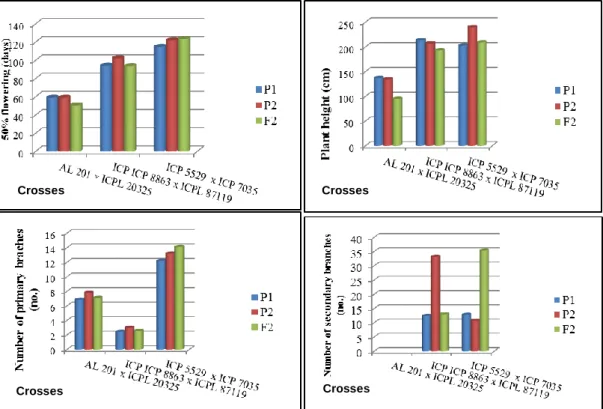
Figure 2.4: Variability for days to 50% flowering, plant height, number of primary branches, and number of secondary branches among parents and F2 progenies in three populations of pigeonpea
51
Figure 2.5: Variability for number of pods plant, number of seeds pod-1,100-seed weight and seed yield plant-1 among parents and F2 progenies in three populations of pigeonpea
52
Figure 5.1.Distribution of QTLs on the molecular map constructed based on F2
population of AL 201 × ICPL 20325
103
Figure 5.2.Distribution of QTLs on the molecular map constructed based on F2
population of ICP5529 × ICP 7035
107
Figure 5.3. Distribution of QTLs on the molecular map constructed based on F2
population of ICP 8863 × ICPL 87119
112
xii List of Tables
Table Page
Table.0.1:Structure of the thesis 4
Table 1.1. Area, yield and production of pigeonpea in five countries between 1990 to 2011 9 Table 1.2.List of popular pigeonpea varieties released in ESA 16 Table 1.3.Geographical positions and weather information of the study sites in Kenya 17 Table 1.4.Days to flowering of the selected pigeonpea genotypes tested under natural day length at the selected study sites in Kenya
18
Table 2.1.Some agro-morphological features of the parental genotypes used in the study 31 Table 2.2.Summary statistics of the parental lines and their F2 families for seven yield and related traits in three studied crosses of pigeonpea
35
Table 3.1.Pearson's correlations coefficients showing pair-wise correlation of eight agronomic characters in three populations of pigeonpea
62
Table 3.2.Estimates of direct (boldfaced main diagonals) and alternate/indirect path coefficient values (off diagonals) of SYDP with seven related traits amongst F2 pigeonpea genotypes of three crosses
64
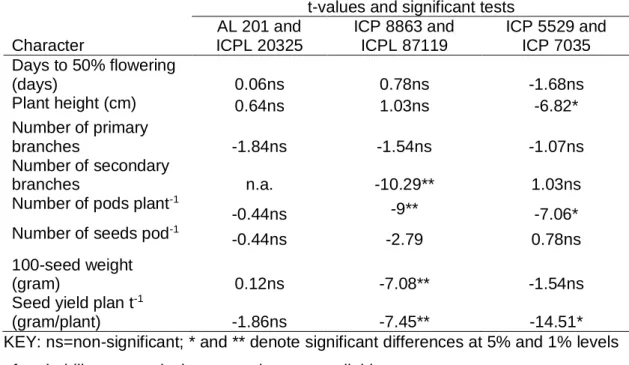
Table 4.1.Significant tests of differences among six pigeonpea parents for eight characters 77 Table 4.2.Mean values of parents and crosses and skewness and kurtosis of f2 families
for eight yield and related traits of pigeonpea
78
Table 4.3.Summary of gene action for eight yield and yield related traits of three pigeonpea families
80
Table 5.1.Features of linkage maps constructed in three mapping populations 100 Table 5.2. Additive quantitative trait loci (QTLs) for yield and related traits detected in the
AL 201 × ICPL 20325 population of 166 F2 progenies by composite interval mapping (CIM) and single marker analysis (SMA)
102
Table 5.3.Additive quantitative trait loci (QTLs) for yield and related traits detected in the ICP 5529 × ICP 7035 population of 123 F2 progenies by composite interval mapping (CIM) and single marker analysis (SMA)
106
Table 5.4.Additive quantitative trait loci (QTLs) for yield and related traits detected in the ICP 8863 × ICPL 87119 population of 131 F2 progenies by composite interval mapping (CIM) and single marker analysis (SMA)
110
xiii Abbreviations
ºC Degrees Celsius
cm Centimetre
CTAB Cetyl trimethyl ammonium bromide CIM Composite Interval Mapping
CV Coefficient of Variation DNA Deoxyribonucleic acid ESA Eastern and Southern Africa F2 Second filial generation GAB Genomic assisted breeding GBS Genotyping-by-Sequencing
ICRISAT International Crops Research Institute for the Semi-Arid Tropics LOD Logarithm of odds
MAS Marker assisted selection ng/μl Nano-grams per microlitre
NARS National Agricultural Research Systems
% Percent
PVE Phenotypic Variance Explained PCR Polymerase Chain Reaction QTL Quantitative Trait Loci SMA Single marker analysis
SSA Sub-Saharan Africa
SNP Single Nucleotide Polymorphism
1 Thesis Introduction
Background
Pigeonpea (Cajanus cajan L. Millsp.) is an important grain legume of the tropical and subtropical regions of the world.Pigeonpea is the least widely grown crop among the six major tropical legumes (Abate et al. 2012). It accounts for less than 5% of total world pulse production (Josh et al.2001). Pigeonpea is grown extensively in India, South-East Asia, East Africa, Latin America and the Caribbean, where it plays significant role in the food and nutritional security.The protein content of commonly grown pigeonpea has been reported to range between 18–26% (Odeny 2007). Further, it has significant usage as animal feed, fodder, firewood, thatching material and for improving soil structure and fertility (Odeny 2007).
There is a large variation in its maturity that helps in its wide adaptation including diverse locations and cropping systems (Saxena 2010). Generally, the short- duration (100-140 days) cultivars of pigeonpea are grown as a sole crop, while the medium (160-180 days) and long-duration (> 200 days) types are invariably grown as intercrop or mixed crop with other short-duration cereals and legumes (Saxena 2010). Pigeonpea has self-compatible flowers, but it is often cross- pollinated by bees with 25-35% outcrossing (Saxena 2008). The estimated size of pigeonpea genome packed in 11 chromosomes is 833Mbp (Varshney et al.
2012).
Pigeonpea is constrained by inadequate genomic resources, such as genome sequence or molecular markers for improving the productivity of this crop. Its yield gain has lagged behind due to limited breeding progress and lack of basic information on the genomics and genes associated with yield and yield components (Kumawat et al. 2012).
2 Constraints to pigeonpea production
Pigeonpea production has shown an increasing trend worldwide with harvested area of 2.7 million hectare (Mha) during 1961 to 4.6 Mha (2009) (FAO 2009, http://faostat.fao.org/). However, no increase has been observed in its productivity, which in the past five decades remained stagnated at around 750 kg/ha (Bohra et al. 2012). Average yields are approximately 730 and 840 kg per ha for Sub-Saharan Africa (SSA) and Southern Asia (SA), respectively, compared to 885 kg per ha of the world average productivity (Abate et al. 2011).
Pigeonpea productivity is challenged by several biotic and abiotic stresses under marginal field conditions, and as a result there is a huge yield gap between realizable yield (2500 kg ha-1) and the yield in farmer’s fields (866 kg ha-1in Asia and 736 kg ha-1in Africa) (Abate et al. 2011).
A number of factors are responsible for the poor productivity of the crop in Sub- Saharan Africa (SSA), including lack of improved cultivars, poor crop husbandry, pests, and diseases. Major diseases include Fusarium wilt caused by Fusarium udum Butler, sterility mosaic disease caused by sterility mosaic virus and phytophthora blight (Phytophthora drechsleri). The major pests include gram pod borer (Helicoverpa armigera), maruca (Maruca vitrata), pod fly (Melanagromyza obtusa), plume moth (Exelastis atomosa) causing substantial yield reduction to pigeonpea production annually (Varshney et al. 2010a).
To increase the productivity of pigeonpea, identification of candidate genes responsible for desired traits and subsequent breeding efforts to transfer the desired trait(s) in the elite background is a prerequisite (Varshney et al. 2012; and Kumawat et al. 2012). New breeding approaches using genome-wide information with high precision phenotyping can assist in harnessing the genetic diversity present in the gene pools for crop improvement programmes in a number of crop species. However, this has not been the case in pigeonpea especially in SSA.
3 Problem statement
In the past, conventional breeding of pigeonpea had limited success in overcoming biotic and abiotic challenges and in boosting productivity of the crop (Varshney et al. 2007; and Saxena 2008). Lack of intensive breeding efforts and unavailability of high yielding cultivars, among others, have significantly contributed to the stagnant productivity of the crop (Zaveri and Pathank 1998).
Narrow genetic diversity in cultivated germplasm, caused by domestication and breeding from a small number of genotypes (Bohra et al. 2012). has further hampered the effective utilization of conventional breeding as well as development and utilization of genomic tools, resulting in pigeonpea being often referred to as an ‘orphan crop legume’ (Varshney et al.2010b).
Rationale of the study
Genomic-assisted breeding has the potential of accelerating cultivar development in conventional breeding programs (Varshney et al. 2005; Varshney et al. 2010).
In addition, genomic tools can help in selecting suitable parents and promising segregants to develop elite breeding lines (Pazhamala et al. 2015). Linkage and marker-trait association analyses and efficient phenotyping of pigeonpea populations may enhance genetic gains and cultivar development.
Therefore, this study was conducted for the purpose of selecting suitable parents and promising segregants, and availing the information on genomic resources for pigeonpea, needed by conventional breeders in accelerating the pigeonpea breeding of elite cultivars through marker-assisted transfer.
Overall objective
The overall goal of the project was to identify quantitative trait loci (QTLs) associated with yield and yield-related traits in newly developed pigeonpea populations for marker-assisted breeding of the crop.
4 The specific objectives
The specific objectives of the study were:
1. To assess the phenotypic variability and identify promising genotypes among F2 segregants of pigeonpea populations derived from crosses of six parental lines with diverse genetic backgrounds.
2. To apply simple correlation and path analyses and identify most useful yield and yield-related components of newly developed pigeonpea mapping populations.
3. To determine the genetic control of yield and yield-related traits involving a total of 460 F2 pigeonpea progenies derived from three families of varied genetic backgrounds.
4. To identify quantitative trait loci associated with yield and yield-related traits using 420 F2 progenies developed from three diverse pigeonpea families for marker-assisted breeding.
Outline of the thesis
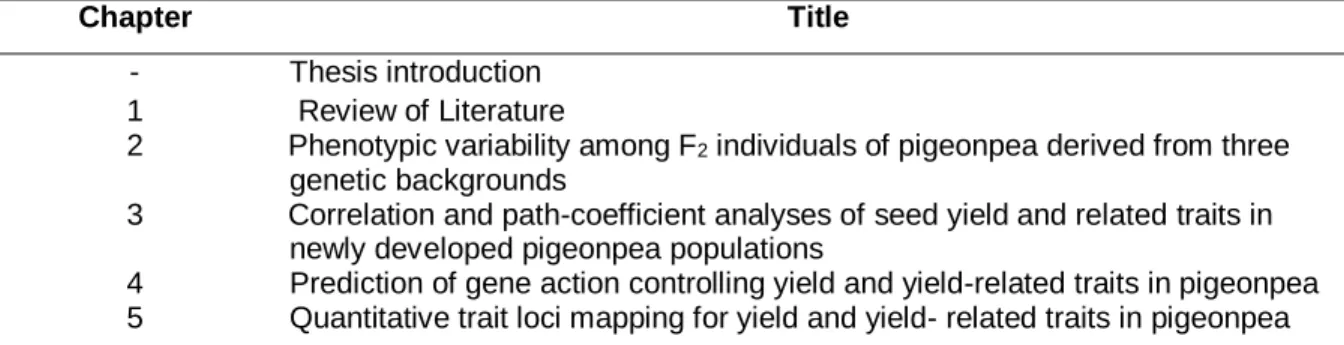
This thesis consists of five distinct chapters in accordance with a number of activities related to the above objectives. All chapters were written in the form of discrete research chapters, each following the format of a stand-alone research paper (whether or not the chapter has already been published). As such, there is some unavoidable repetition of references and some introductory information between chapters. The contents of Chapter 1 have been published in the Journal of Plant Breeding.
Table 0.1: Structure of the Thesis
Chapter Title
- Thesis introduction 1 Review of Literature
2 Phenotypic variability among F2 individuals of pigeonpea derived from three genetic backgrounds
3 Correlation and path-coefficient analyses of seed yield and related traits in newly developed pigeonpea populations
4 Prediction of gene action controlling yield and yield-related traits in pigeonpea 5 Quantitative trait loci mapping for yield and yield- related traits in pigeonpea
5 References
Abate, T., Alene, A.D., Bergvinson, D., Silim, S., Orr, A. and Asfaw, S. 2011.
Tropical legumes in Africa and South Asia: Knowledge and opportunities.
TL II Research Report No. 1.
Bohra, A., Saxena, R.K., Gnanesh, B.N., Saxena, K.B., Byregowda, M., Rathore, A., KaviKishor, P.B., Cook, D.R., and Varshney, R.K. 2012. An intra- specific consensus genetic map of pigeonpea (Cajanus cajan (L.) Millspaugh) derived from six mapping populations. Theoretical and Applied Genetics 125:1325–1338.
FAO 2009, FAOSTAT data in 2009. Available at http://faostat.fao.org/.
Joshi, P K., Rao, P. P., Gowda, C. L. L., Jones, R. B., Silim, S.N., Saxena, K B., and Kumar, J 2001. The World Chickpea and Pigeonpea Economies Facts, Trends, and Outlook. Monograph. International Crops Research Institute for the Semi-Arid Tropics, Patancheru, Andhra Pradesh, India.
Kumawat, G., Raje, R.S., Bhutani, S., Pal. J.K., Mithra, A.S.C.R., Gaikwad, K., Sharma, T.R., and Singh, N.K. 2012. Molecular mapping of QTLs for plant type and earliness traits in pigeonpea (Cajanus cajan L. Millsp.).
BioMedical Central Genetics 13:84.
Odeny, D.A., 2007. The potential of pigeonpea (Cajanus cajan. (L.) Millsp) in Africa. Natural. Resources. Forum 31: 297-305.
Pazhamala, L., Saxena, R.K., Singh, V.K., Sameerkumar, C. V., Kumar, V., Sinha, P., Patel, K., Obala, J., Kaoneka, S.R., Tongoona, P., Shimelis, H. A., Gangarao, N. V. P.R., Odeny, D., Rathore, A., Dharmaraj, P.S., Yamini, K.N., and Varshney, R.K. 2015. Genomics-assisted breeding for boosting crop improvement in pigeonpea (Cajanus cajan). Frontiers in Plant Science 6:50. doi:10.3389/fpls.2015.00050.
Saxena, K.B., 2008. Genetic improvement of pigeonpea-A Review. Tropical Plant Biology 1:159- 178.
Saxena, R.K., 2010. Study of inheritance and identification of molecular markers for fertility restorers in pigeonpea [Cajanus cajan (L.) Millspaugh]. PhD thesis, International Crops Research Institute for the Semi-Arid Tropics.
Varshney, R.K., Graner, A., and Sorrels., M.E. 2005. Genomic assisted breeding for crop improvement. Trends in Plant Sciences 10:621-630.
6 Varshney, R.K., Hoisington, D.A., Upadhyaya, H.D., Gaur, P.M., Nigam, S.N., Saxena, K., Vadez, V., Sethy, N.K., Bhatia, S., Aruna, R., and Gowda, M.C., 2007. Molecular genetics and breeding of grain legume crops for the semiarid tropics. In: Varshney R.K., Tuberosa R. (eds.). Genomics assisted crop improvement, vol II: genomics applications in crops.
Springer, Dordrecht. 207–242.
Varshney, R.K., Hoisington, D.A., Nayak, S.N., and Graner, A. 2010a. Molecular plant breeding: Methodology and achievements; In: Somers D, Langride P., Gustafson P.J. (eds.) Methods in molecular biology: Plant genomics.
Totowa, N.J., USA, The Humana Press, 283-304.
Varshney, R.K., Penmetsa, R.V., Dutta, S., Kulwal, P.L., Saxena. R.K., Datta, S., Sharma, T.R., Rosen, B., Carrasquilla-Garcia, N., Farmer, A.D., Dubey, A., Saxena, K.B., Gao, J., Fakrudin, B., Singh, M.N., Singh, B.P., Wanjari, K.B., Yuan, M., Srivastava, R.K., Kilian, A., Upadhyaya, H. D., Mallikarjuna, N., Town, C.D., Bruening, G.E., He, G., May, G.D., McCombie, R., Jackson, S.A., Singh, N.K., and Cook, D.R. 2010b. Pigeonpea genomics initiative (PGI): an international effort to improve crop productivity of pigeonpea (Cajanus cajan L.). Molecular. Breeding 26: 393-408.
Varshney, R.K., Chen, W., Li, Y., Bharti, A.K., Saxena, R.K., Schlueter, J.A., Donoghue, M.T., Azam, S., Fan, G., Whaley, A.M. and Farmer, A.D., 2012a. Draft genome sequence of pigeonpea (Cajanus cajan), an orphan legume crop of resource-poor farmers. Nature Biotechnology 30:83-89.
Zaveri, P.P., and Pathak, A.R. 1998: Hybrid cultivar development. In: S.S. Banga, and S.K. Banga (eds.), Pigeonpea, 439-449. Narosa Publishing House, New Delhi, India.
7 CHAPTER ONE
A review of the literature 1 Abstract
Pigeonpea (Cajanus cajan [L.] Millspaugh) is an important multipurpose grain legume crop primarily grown in tropical and subtropical areas of Asia, Africa and Latin America. In Africa, the crop is grown for several purposes including food , income generation, livestock feed and in agroforestry. Production in Eastern and Southern Africa (ESA) is however faced with many challenges including limited use of high-yielding cultivars, diseases and pests, drought, under-investment in research and lack of scientific expertise. The aim of this review is to highlight the challenges facing pigeonpea breeding research in ESA and the existing opportunities for improving the overall pigeonpea subsector in the region. We have discussed the potential of the recently available pigeonpea genomic resources for accelerated molecular breeding, the prospects for conventional breeding and commercial hybrid pigeonpea, and the relevant seed policies, among others, which are viewed as opportunities to enhance pigeonpea productivity.
Key words: Africa — Cajanus cajan — climate change — food security
1 This literature review was published as: Kaoneka, S.R., Saxena, R.K., Silim, S.N., Odeny, D.A., Ganga Rao, N.V.P.R., Shimelis, H.A., Siambi, M., and Varshney, R.K. 2016. Pigeonpea breeding in eastern and southern Africa: challenges and opportunities. Plant Breeding 135 (2): 148–154, doi: 10.1111/pbr.12340.
8 1.0. Introduction
Climate change and nutritional food security have attracted global concerns in the recent years. Generally, the resource- poorer developing countries are more vulnerable to climate change because of their low incomes and dependence on climate sensitive sectors such as agriculture (IPCC 2007). Although African countries have recorded improved economic growth over the last 5 years, the continent is still considered most susceptible to climate change due to its vulnerability and inability to cope with the physical, human and socio-economic consequences of climate extremes (Kabasa and Sage 2009). Furthermore, an estimated 30% of children under the age of five in sub-Saharan Africa (SSA) are underweight, mainly due to malnutrition (Mula and Saxena 2010). Sustainable solutions to agriculture and food security in Africa must consider more focused research efforts on locally adapted, highly nutritious and stress-tolerant crops alongside sustainable government support to agricultural research and development. One such crop with potential to cope with climate change and provide nutritional food security is pigeonpea (Cajanus cajan [L.] Millspaugh).
Pigeonpea, a diploid legume crop species (2n = 2x = 22), belongs to Cajaninae sub-tribe of the economically most important leguminous tribe Phaseoleae (Van der Maesen 1990). The crop derives its name from Barbados, where the seeds were once used to feed pigeons (Van der Maesen 1990). It is generally grown under risk-prone marginal lands with low inputs (Mula and Saxena 2010).
Pigeonpea is increasingly gaining importance in Africa, especially in ESA, where it occupies an area of about 990 000 ha (Table 1.1) (TIA/IAI 2012; FAO 2013).
Both local and export demand for this multipurpose legume crop continue to rise, presenting an opportunity for faster productivity enhancement and strengthening of seed delivery systems, as well as improvement of existing value chains.
Pigeonpea is likely to become a major player in ESA’s agriculture, especially with increased research investment. The aim of this review is to highlight the challenges affecting pigeonpea production and improvement and the existing opportunities for improving pigeonpea research and overall subsector in ESA.
9 Table.1.1. Area, yield and production of pigeonpea in five countries between 1990 to 2011
1.1 Historical perspectives of pigeonpea genetic diversity and breeding in Africa
The centre of origin of pigeonpea has been a subject of discussions in the past.
For instance, some studies (Leslie 1976; Purseglove 1976; Singh et al. 2001) suggest the origin of pigeonpea to be in Africa. Many other studies (Van der Maesen 1990; Fuller and Harvey 2006; Saxena et al. 2014) suggest India as the origin of the crop. The presence of several wild relatives, the diverse genepool of the crop in the Indian subcontinent and some recent molecular studies provide a stronger evidence of the latter group. Africa harbours only two wild species of pigeonpea: C. kerstingii (Harms) and C. scarabaeiodes (L.) Thouars (Van der Maesen 1990). It is most likely that pigeonpea was introduced by immigrants in the 19th century who moved to Africa to become railway workers and storekeepers (Odeny 2007).
From eastern Africa, pigeonpea spread over the African continent, albeit without acquiring a prominent position. In Africa and the Far East, pigeonpea has been
Country
Area (‘000 ha) Yield (Kg/ha) Production (‘000 t) 1990-
92
2000-
02 2011 1990- 92
2000- 02
201 1
1990- 92
2000-
02 2011 Kenya 159.8 166.7 182.3 409 465.4 608 65.2 77.4 111 Malawi 142.3 137.4 196.5 683.8 752.9 110
3 97.3 103.4 217 Mozambique - 68.8 193.2 - 465.1 504 - 32.0 97.4 Tanzania 56.0 134.0 288.1 673.2 650 946 37.7 87.1 273 Uganda 61.3 80.0 92.5 827.1 1000 102
5 50.7 80.0 94.8 Total 419.4 586.9 952.6 598.2 647.3 832 250.9 379.9 793
10 grown for at least 4000 years (Van der Maesen 1980) and therefore considerable agro-ecological adaptation has been obtained locally.
The traditional African pigeonpea genotypes are long-duration, cream- and large- seeded (Remanandan 1990). In Uganda, medium-duration, cream to mottle small-medium seeded type (Manyasa et al. 2009) have been part of the traditional cropping system (Silim et al. 1991; Kimani 2001). Uganda was the first country in ESA to implement a pigeonpea breeding programme in 1968 at Makerere University (Saxena 2008). However, there is a scope to expand further under sustainable intensification of cropping systems with pigeonpea as one of the component crops.
1.2. Challenges facing pigeonpea production and improvement
Challenges facing pigeonpea production and improvement in ESA are divided into two main categories, namely technical and institutional challenges.
1.2.1. Technical challenges
1.2.1.1. Limited use of high-yielding varieties
Low realized productivity in pigeonpea remains one of the major constraints despite past and ongoing breeding efforts. In ESA, the yield of green pods varies from 1000 to 9000 kg/ha and that of dry grain may reach 2500 kg/ha in pure stands with modern cultivars. Present regional yields are about 800 kg/ha under intercropping systems which is much lower than the realizable yield potential.
Malawi is the major producer of pigeonpea in the region with productivity of about 1327 kg/ha at present (FAO 2013). Although several improved varieties are now available, adoption is limited and most farmers grow traditional landraces that are prone to soil borne fungal diseases and grain yields are of low quality (Høgh- Jensen et al. 2007).
Short-duration varieties are much more susceptible to insect pest attack, necessitating the use of insecticides, which most ESA farmers cannot afford,
11 therefore opting to grow traditional long-duration types (Jones et al. 2002).
However, recent trend was on cultivation of medium-duration varieties that can fit very well into existing cropping systems. More breeding efforts are needed to focus on developing farmer- and market preferred genotypes with high yield, Fusarium wilt resistance and pest tolerance.
1.2.1.2. Biotic stresses
Biotic stresses significantly reduce the pigeonpea yield in ESA (Reddy et al.
1990). The most important fungal diseases of pigeonpea in ESA are Fusarium wilt, Cercospora leaf spot and powdery mildew (Brink and Belay 2006). Fusarium wilt is the most serious disease in all major pigeonpea-producing countries in the region (Silim et al. 1995). Surveys carried out in 1980 estimated wilt incidences to be 60% in Kenya, 36% in Malawi and 24% in Tanzania with annual losses of US$
5 million in each of these countries (Kannaiyan et al. 1984). Accessions with less wilt incidences and high yield, which are potential donors in resistance breeding, have been identified, such as ICEAP 00926, ICEAP 00576-1, ICEAP 00933, ICEAP 00040 and ICP 9145 (Rao et al. 2012). They have been identified as potential in terms of yield and resistance traits. Insects that are serious, widely distributed and cause heavy economic losses in pigeonpea in ESA are pod and seed boring Lepidoptera (Helicoverpa armigera (H€ubner), Maruca vitrata (=testulalis) Geyer, Etiella zinkenella (Treitschke), and pod fly (Melanagromyza chalcosoma (Spencer) (Johansen et al. 1993; Minja et al. 1999). H. armigera is the major biotic constraint to pigeonpea production (Lateef and Reed 1990), with yield loss estimated at 42% (Abate and Orr 2012). Reports on the seed damage due to pod-sucking bugs in Kenya, Malawi, Tanzania and Uganda have shown it ranges from 3 to 32% and varies among locations within and between countries (Minja 1997).
Pigeonpea lines with resistance to H. armigera have been reported, but little progress has been made in incorporating resistance in cultivars that are acceptable to farmers (Shanower et al. 1999). The development of insect-
12 resistant and/or -tolerant pigeonpea cultivars has been a high priority in the research programmes, but the progress is hindered by high variation in pest populations (within and across seasons) and the high degree of out-crossing in pigeonpea (Shanower et al. 1999).
1.2.1.3. Abiotic stresses
In ESA, pigeonpea is grown purely under rainfed conditions with varying temperatures, altitudes and latitudes (Silim et al. 2006). Pigeonpea encounters various abiotic stresses during its life cycle such as moisture stress (drought), temperature, photoperiod and mineral (salinity/acidity) stress (Choudhary et al.
2011). Among these stresses, moisture stress is most prevalent (Silim and Omanga 2001). The medium and long-duration genotypes that are commonly grown in ESA depend on residual moisture for the reproductive phase development. In some cases, this leads to terminal drought stress which is causing substantial yield reduction (Kimani 2001). In a study concerned with field evaluation of pigeonpea germplasm, a high (>50%) yield loss was attributed to a combination of a severe mid-season drought and high temperatures (Gwata 2010).
Through multi-locational and multiyear evaluations, medium-duration genotypes such as ICEAP 00673, ICEAP 01170 and ICEAP 01179, as well as long-duration genotypes such as ICEAP 01423 and ICEAP 01202 possessing drought tolerance coupled with high yield have been identified (Rao et al.
2012).
1.2.2. Institutional challenges 1.2.2.1. Shortage of improved seed
Access to improved seeds and markets is particularly limited in sub-Saharan Africa (ICRISAT 2009). Inadequate supply of the breeder seeds by the public sector (Rao et al. 2012), limited involvement of the private sector (Jones et al.
2002) and non-existence of the commercial pigeonpea seed markets (Tripp
13 2000) are the major challenges facing the pigeonpea seed industry in ESA. In addition, lack of access to quality seeds (Abate and Orr 2012) and poor extension services (Abate et al. 2012) significantly contribute to the poor adoption of the improved pigeonpea seeds in ESA.
1.2.2.2. Under-investment in research
Most of the research on pigeonpea in ESA to date has been through donor funding to the National Agricultural Research Systems (NARS) and ICRISAT (Jones et al.
2001). Despite positive growth in the 1980s, public investment in agricultural research and development (AR&D) in ESA has declined (Beintema and Stads 2010). For instance, in Malawi, the major pigeonpea producer in ESA, the government currently invests only 4% of the agricultural budget in research (Phiri et al. 2012). In Tanzania, for the past decade, the government budget approved for the Department of Research and Training has been in the average of 24% of the total actual budget requirement for all agricultural crops (ESAFF 2013).
1.2.2.3. Lack of human resource capacity
In ESA, all major producers of pigeonpea have limited capacity to carry out effective research and development on pigeonpea, which have traditionally received less attention than cereals and cash crops (Abate and Orr 2012).
Information from the Uganda National Agricultural Research Organization (NARO) revealed that is within the national programme, currently there is only one scientist who is actively involved in pigeonpea breeding (Yuventino Obong personal communication 2015). The same applies to Malawi where only one pigeonpea breeder and one agronomist within the national programme are working (Esnart Nyirenda Personal communication 2015).
There is also still a huge gap in scientific capacity left by retired scientists, due to failure by the national governments to continue hiring and support agricultural scientists for a long time (Beintema and Stads 2006). For instance, in Tanzania, the situation is most extreme at Ilonga Agricultural Research Institute, a country
14 pigeonpea mandate, where most of the posts for senior research officers are vacant (Coulson and Diyamett 2012).
1.3. Opportunities for Pigeonpea Production and Breeding in ESA
1.3.1. Increased adoption for pigeonpea production as a strategy in climate smart agriculture
The agricultural system in ESA is characterized by low productivity, low use of external inputs, traditional management practices and limited capacity to respond to environmental shocks (Tabo et al. 2007). Pigeonpea has a huge untapped potential for improvement both in quantity and in quality of production in ESA (Odeny 2007). Besides its ability to tolerate droughts and availing water and soil mineral nutrients (Valenzuela and Smith 2002; Mathews and Saxena 2005; and Adu-Gyamfi et al. 2007), pigeonpea is also a multipurpose crop (Boehringer and Caldwell 1989; Kimani 2001; Snapp et al. 2003; and Saxena et al. 2010).
Unreliable rainfall received in many parts of the sub-Saharan Africa has reduced cereal production especially maize and wheat, and made farmers to shift to legumes production especially pigeonpea which is drought tolerant, and in most cases intercropped with cereals mainly maize or sorghum. The drought-tolerant pigeonpea has a unique role in meeting food security needs of subsistence farmers in climatic risky regions of ESA (Snapp et al. 2003). With the regional breeding approach in place, the crop can now be grown in more targeted areas and breed for a wide range of uses.
1.3.2. Increased market demand for pigeonpea
Both local and export demand for pigeonpea exist in Africa, especially in ESA.
Some studies indicate that a vibrant domestic, regional and export trade of dry grain and an emerging market for vegetable pigeonpea exist in ESA (Shiferaw et al. 2008a). ESA countries export about 200,000-ton grain annually to India. In ESA, Kenya and Malawi are the two biggest producers of pigeonpea. In Kenya, 45% of the crop is sold, while in Malawi, the share is 35% (Shiferaw et al. 2008b;
15 Abate and Orr 2012). During recent years, Tanzania and Mozambique have increased area under cultivation and contributing to large quantities of grain export. Although informally traded, cross-border trade of pigeonpea between ESA countries do exist, for instance, between the northern Tanzania and Kenya (Brink and Belay 2006). In addition, the large Indian and Afro-Caribbean communities in Europe and North America offer new potential markets that can be accessed through the application of improved processing technologies such as freezing (Jones et al. 2006).
1.3.3. Improved seed access and policy support
One of the key factors for stimulating technology uptake and increasing agricultural productivity in smallholder agriculture is access to quality seed of improved varieties (Shiferaw et al. 2008b).
Many countries in ESA have regulations that only permit the sale of certified seed (Abate and Orr 2012). Community-based seed production and marketing systems like quality declared seed, which is tested in Tanzania for dissemination of truthfully labelled seed of high quality, could be one strategy for easing the seed shortage problem, especially for open-pollinated cereals or self-pollinated legumes like pigeonpea (Abate et al. 2012). For an efficient seed system to operate, the public sector must play a bigger role in plant breeding and some aspects of quality control, while the private sector has better incentives in the area of seed multiplication, processing and distribution (Minot et al. 2007).
The ongoing seed policy reforms in the region have facilitated more participation of the private sector within pigeonpea seed systems. For instance, right now in Tanzania, there are more than 10 big companies/estates producing quality seeds and grain for sale excluding community-based organizations, NGOs, PMGs, farmer’s groups and contract farmers (Rao et al. 2014). The move towards formation of strategic partnership with different stakeholders has accelerated the release of pigeonpea seeds as well as increasing the quantity of seeds produce in the region. Commercial seed companies are also expected to develop interest
16 in pigeonpea, due to ever growing demand for pigeonpea exports. About 200,000 tons of pigeonpea grain is exported annually by ESA countries to India.
1.3.4. Improved varieties and potential for hybrid pigeonpea
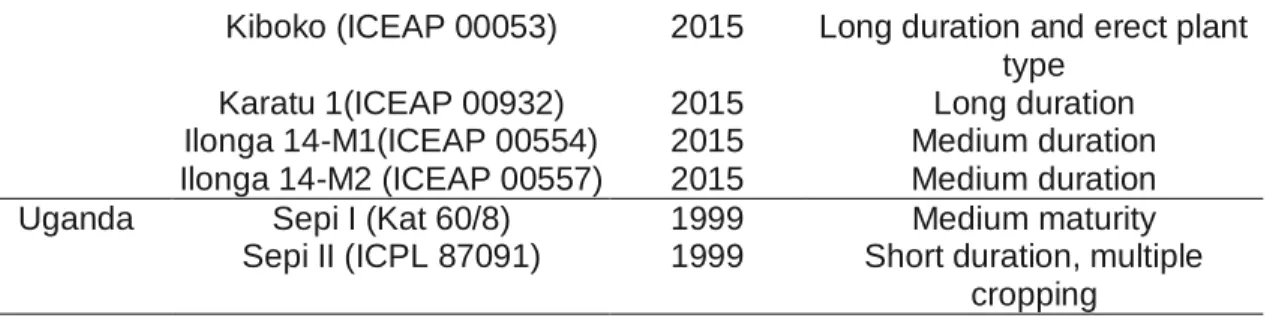
Breeding activities supported by ICRISAT over the years developed several region-specific genotypes through intensive genetic enhancement programme. In close collaboration with national programmes, 32 high-yielding varieties were released as follows; Malawi (7), Kenya (7), Tanzania (7), Mozambique (5), Uganda (2), Zambia (2), Ethiopia (1) and Sudan (1). Further, 10 varieties (4- Ethiopia, 2-Zambia, 4-Uganda) are being processed for release. Most of these varieties were developed from local germplasm with region-specific breeding priorities such as high grain yield, intercropping compatibility, photoperiod insensitivity, consumer-preferred grain quality, resistance/tolerance to Fusarium wilt, Helicoverpa pod borer and resilience to climate change. List of popular pigeonpea varieties released in ESA is given in Table 1.2.
Table 1.2. List of popular pigeonpea varieties released in ESA
Country Variety Year of
release
Special varietal attributes Kenya KARI Mbaazi2 (ICEAP
00040)
1995 Long duration, large cream seed and Fusarium wilt
resistant Katumani 60/8 (Kat 60/8) 1998
Karai (ICEAP 00936) 2011
Peacock (ICEAP 00850) 2011 Medium duration Malawi Sauma(ICP 9145) 1987 Long duration, fusarium wilt
resistant
Kachangu(ICEAP 00040) 2000 Long duration, large seeded, fusarium wilt resistant Mwaiwathualimi(ICEAP
00557)
2010 Medium duration Chitedze; pigeonpea 1
(ICEAP 01514/15)
2011 Medium duration and high pod load
Mozambique ICEAP 00040 2011 Long duration
ICEAP 00020 2011 Long duration
Tanzania Komboa (ICPL 87091) 1999 Short duration (110–120 days) Mali (ICEAP 00040) 2002 Long duration (180–270 days ) Tumia (ICEAP 00068) 2003 Medium duration (140–180
days)
17 Kiboko (ICEAP 00053) 2015 Long duration and erect plant
type Karatu 1(ICEAP 00932) 2015 Long duration Ilonga 14-M1(ICEAP 00554) 2015 Medium duration Ilonga 14-M2 (ICEAP 00557) 2015 Medium duration Uganda Sepi I (Kat 60/8) 1999 Medium maturity
Sepi II (ICPL 87091) 1999 Short duration, multiple cropping
A key to success factor in pigeonpea breeding in ESA was the adoption of the breeding strategy for the establishment of the regional approach taking into consideration the key factors such as adaptation, crop phenology, market preference and pathogen specificity (Silim et al. 1995; Silim and Omanga 2001;
and Silim et al. 2006). Kenya transect considered as an open laboratory (Table 1.3) was used. It varied from 50 to 2500 m above sea level and where temperature decreases with increase in altitude. It was the basis for understanding the adaptation for developing and targeting varieties (Table 1.4).
In addition, sources of resistance in the medium- and long-duration background were also identified. Efforts are under way to increase the adoption of these varieties in farmers’ fields.
Table 1.3. Geographical positions and weather information of the location (study sites in Kenya)
Latitude/Altitude
(m) Temp (°C)
Location
Kabete Katumani Kiboko Mtwapa Muguga 1° 150(1825) Max 24.61 22.12
Min 12.91 12.22 Mean 18.71 17.12
1° 350(1560) Max 25.61 23.62 Min 14.41 12.92
Mean 201 18.72
4° 250(900) Max 29.41 27.82
Min 17.71 15.52
Mean 23.51 21.62
4° 250( ) Max 31. 41 28.92
Min 23.21 21.52
Mean 27.31 25.22
1° 150(2110) Max 221 1 9.42
Min 11.51 10.22
Mean 16.81 14.92
KEY: Rainfall duration = 1Short, 2Long Table 1.2: Continued
18 Table 1.4. Days to flowering of the selected pigeonpea genotypes tested under natural day length at the selected study sites in Kenya
ICRISAT in Asia has developed a number of hybrid varieties that have been released by NARS and commercial seed companies. The hybrid varieties have a 20–40% yield advantage over the open pollinated varieties (Shiferaw et al.
2008b). Hybrid varieties that are regional –specific, meeting consumer preference and adapted to cropping systems are the priority of ICRISAT-ESA.
Efforts are underway to identify stable CMS lines that are adaptable to ESA, maintainers in local germplasm and heterotic parental combinations as hybrid vigour is associated with genetic diversity, crosses between the genetically diverse African and Asian gene pools could result in considerable yield improvement and create greater incentive for adoption of such varieties (Kimani 1991).
1.3.5. Availability of genomic resources for pigeonpea genetic enhancement and breeding
To meet the growing demand for pigeonpea in ESA, conventional breeding on its own will not be sufficient in developing superior genotypes. Pigeonpea genome has now been sequenced, availing more genomic resources for exploitation to speed up the ongoing conventional breeding activities (Bohra et al. 2011, Varshney et al. 2011, and Varshney et al. 2012).
Availability of DNA markers for pest and disease resistance will be of utmost importance, as it will be easier to conduct resistance breeding to achieve both
Genotype Maturity
Location
Kabete Katumani Kiboko Mtwapa Muguga
ICEAP 00040 Long 149 178 227 300 156
T-7 Long 150 185 164 – 170
ICP 6927 Medium 123 105 121 119 160
ICP 7035 Medium 119 94 125 122
ICPL 87091 Short 91 81 74 84
ICPL 9001 Extra short 80 78 64 79
19 stability and productivity of the crop which is top priority in the genetic enhancement of this pulse in ESA (Crouch and Ortiz 2004).
1.4. Conclusions
This chapter has shown that pigeonpea breeding research in ESA has moved knowledge forward and has resulted in impacts on the ground over a very short period, moving the crop from an orphan crop to where both national governments and development partners are now paying attention to it. In addition, the review has shown that much needs still to be performed to unlock the opportunities that exist in this crop. This will require a multifaceted approach from science-based solutions, policies to market requirements.
References
Abate, T., and Orr, A. 2012. Research and development for tropical legumes:
towards a knowledge-based strategy. Journal of SAT Agricultural Research 1-12.
Abate, T., Alene, A.D., Bergvinson, D., Shiferaw, B., Orr, A., and Asfaw, S. 2012.
Tropical Grain Legumes in Africa and South Asia: Knowledge and Opportunities. Research Report, International Crops Research Institute for the Semi-Arid Tropics, Nairobi, Kenya. Available at:
http://oar.icrisat.org/5680. (accessed on 18 Dec, 2014).
Adu-Gyamfi, J.J., Myaka, F.A., Sakala, W.D., Orgaard, R., Vesterager, J.M., and.
Hogh-Jensen, H .2007. Biological nitrogen fixation and nitrogen and phosphorus budgets in farmer-managed intercrops of maize–pigeonpea in semi-arid southern and eastern Africa. Plant Soil 295:127-136.
Beintema, N.M., and Stads, G.J. 2006. Agricultural R&D in Sub-Saharan Africa:
An Era of Stagnation. ASTI Background Report. International Food Policy Research Institute, Washington, DC.
Beintema, N.M., and Stads, G.J. 2010. Public agricultural R&D investments and capacities in developing countries. Recent evidence for 2000 and beyond.
Note prepared for Global Conference on Agricultural Research for Development (GCARD), Montpellier, 27-30 March 2010. Available at:www.asti.cgiar.org/pdf/global_revision.pdf. (Accessed on 22 Apr, 2015).
20 Boehringer, A., and Caldwell, R. 1989. Cajanus cajan (L.) Millsp. as a potential agroforestry component in the eastern province of Zambia. Journal of Agroforestery System.9:127-140.
Bohra, A., Dubey, A., Saxena, R.K., Penmetsa, R.V., Poornima, K.N., and Kumar, N.2011. Analysis of BAC- end sequences (BESs) and development of BES-SSR markers for genetic mapping and hybrid purity assessment in pigeonpea (Cajanus spp.). Biomedical Central Plant Biology. 11: 56.
Brink, M., and Belay, G. 2006. Plant Resources of Tropical Africa. Prota Foundation, Wageningen, Netherlands. Backhuys Publishers, Leiden, Netherlands. 298 pp.
Choudhary, A.K., Sultana, R., Pratap, A., Nadarajan, N., and Jha, U. 2011.
Breeding for abiotic stresses in pigeonpea. Journal of Food Legumes 24:
165-174.
Coulson, A., and Diyamett, B. 2012. Improving the contribution of agricultural research to economic growth: policy implications of a scoping study in Tanzania. Available at: uploads/2014/08/Coulson-and-Diyamett-final- paper.pdf.
Crouch, J.H., and. Ortiz, R. 2004. Applied genomics in the improvement of crops grown in Africa. African. Journal of Biotechnology 3: 489-496.
Eastern and Southern Africa Small Scale Farmers’ Forum (ESAFF),2013: Seeds and agriculture research processes in Tanzania: the case of small scale farmers’ participation in setting research agenda. Scoping Study report on EU - INSARD project.
FAO, 2013. FAOSTAT data in 2013. Available at: http://faostat3.fao.org.
(Accessed on 17 June, 2015).
Fuller, D.Q., and. Harvey, E.L. 2006. The archeobotany of Indian pulses:
identification, processing and evidence of cultivation. Environmental.
Archives. 11: 219-246.
Gwata, E.T., 2010. Potential impact of edible tropical legumes on crop productivity in the small-holder sector in Sub-Saharan Africa. Journal of Food, Agriculture & Environment. 8: 939-944.
Høgh-Jensen, H., Myaka, F.A., Sakala, W.D., Kamalongo, D., Ngwira, A., Vesterager, J. M., Odgaard, R., and Adu-Gyamfi, J.J. 2007. Yields and qualities of pigeonpea varieties grown under smallholder farmers’
21 conditions in Eastern and Southern Africa. Journal of African Agricultural Research 2: 269-278.
ICRISAT, 2009. Lessons from two years of Tropical Legume II. Second annual Review and Planning Meeting 16–20 November, 2009, Bamako, Mali.
Available at: www.tropicallegumes.org.
Intergovernmental Panel on Climate Change (IPCC), 2007. Climate Change 2007 Synthesis Report: Summary for Policy Makers. World Meteorology Organization, Geneva.
Johansen, C., Silim, S.N., and Singh, L. 1993. Towards a database for pigeonpea in Africa. Int. Pigeonpea Newsletter 18: 2-5.
Jones, R.B., Audi, P., and Silim, S.N. 2001. Seed delivery systems – status, constraints, and potential in eastern and southern Africa. In: S. N. Silim, G.
Mergeai. Status and potential of pigeonpea in Eastern and Southern Africa:
proceedings of a regional workshop, 12-15 Sep 2000, Nairobi, Kenya. B- 5030 Gembloux, Belgium: Gembloux Agricultural University; and Patancheru 502324, Andhra Pradesh, India: International Crops Research Institute for the Semi - Arid Tropics. ISBN 929066-432 -0. Order code C P E 130. 232.
Jones, R.B., Freeman, H.A., and Monaco, G.L. 2002. Improving the access of small farmers in eastern and southern Africa to global pigeonpea markets.
Agricultural Research and Extension Network 120: 1-11.
Jones, R., Freeman, H.A., Monaco, G.L., Walls, S., and Londner, S. 2006.
Improving the access of small farmers in Africa to global markets through the development of quality standards for pigeonpeas. Agricultural Standards, 177-191. Springer, Dordrecht, the Netherlands.
Kabasa, J.D., and Sage, I. 2009. Climate change and food security in Africa.
Climate Change in Africa: 21.
Kannaiyan, J., Nene, Y.L., Reddy, M.V., Rajan, J.G., and Raju, T.N.C. 1984.
Prevalence of pigeonpea diseases and associated crop losses in Asia, Africa and the Americas. International Journal of Pest Management30: 62- 72.
Kimani, P.M., 1991. Pigeonpea improvement research in Kenya: an overview.108-117. In: Singh L., Silim, S.N., Ariyanayagam, R.P., and Reddy, M.V (eds). Proceedings of the First Eastern and Southern Africa Regional Legumes (pigeonpea) Workshop. 25–27 Jun 1990, Nairobi, Kenya. Patancheru 502 324, Andhra Pradesh, India: International Crops Research Institute for the Semi-Arid Tropics.
22 Kimani, P.M., 2001. Pigeonpea breeding: objectives, experiences, and strategies for eastern Africa. In: S.N. Silim, G. Mergeai, and P.M. Kimani (eds.) 2001:
Status and potential of pigeonpea in Eastern and Southern Africa:
proceedings of a regional Workshop, 12–15 Sep 2000, Nairobi, Kenya. B- 5030 Gembloux, Belgium: Gembloux Agricultural University; and Patancheru 502324, Andhra Pradesh, India: International Crops Research Institute for the Semi - Arid Tropics. ISBN 92-9066-432. Order code C P E 130:232.
Lateef, S.S., and Reed, W. 1990. Insect pests of pigeonpea. In: S.R. Singh (ed.), Insect Pests of Tropical Food Legumes, 451. Wiley, Chichester, UK. 193- 242.
Leslie, S.C., 1976. An Introduction to the Botany of Tropical Crops, 2nd edition, 99. Lowe & Brydone Printers Limited, Thetford, Norfolk, Longman, UK.
Manyasa, E.O., Silim, S.N., and Christiansen, J.L. 2009. Variability patterns in Ugandan pigeonpea landraces.