1
CITY OF JOHANNESBURG
DRAFT MEDIUM-TERM BUDGET 2018/19 TO 2020/21
MARCH 2018
2
Table of Contents Page No
PART1- ANNUAL BUDGET
1.1. EXECUTIVE SUMMARY 9
1.2. OPERATING BUDGET FRAMEWORK 9
1.3. CAPITAL EXPENDITURE 17
1.4. ANNUAL BUDGET TABLES 18
1.5. TARIFF SETTING 41
1.6. COUNCIL RESOLUTIONS 65
PART 2- SUPPORTING DOCUMENTATION
2.1. OVERVIEW OF ANNUAL BUDGET PROCESS 67
2.2. OVERVIEW OF ALIGNMENT OF ANNUAL BUDGET WITH IDP 70
2.3. MEASURABLE PERFORMANCE OBJECTIVES AND INDICATORS 77
2.4. BUDGET RELATED POLICIES 94
2.5. OVERVIEW OF BUDGET ASSUMPTIONS 97
2.6. OVERVIEW OF BUDGET FUNDING 100
2.7. EXPENDITURE ON GRANTS 112
2.8. MONTHLY TARGETS FOR REVENUE, EXPENDITURE AND CASH FLOW 113
2.9. LEGISLATION COMPLIANCE STATUS 119
2.10. OTHER SUPPORTING DOCUMENTS 121
2.11. MEDIUM TERM BUDGET PER CLUSTER, DEPARTMENT AND MUNICIPAL ENTITY 132
3
List of Tables
No Description
Table A1 Consolidated Budget Summary
Table A2 Consolidated Budgeted Financial Performance
(revenue and expenditure by standard classification)
Table A3 Consolidated Budgeted Financial Performance
(revenue and expenditure by municipal vote)
Table A4 Consolidated Budgeted Financial Performance
(revenue and expenditure)
Table A5 Consolidated Budgeted Capital Expenditure by vote, (standard classification and funding)
Table A6 Consolidated Budgeted Financial Position
Table A7 Consolidated Budgeted Cash Flows
Table A8 Consolidated Cash- backed Reserves/ Accumulated
Surplus Reconciliation
Table A9 Consolidated Asset Management
Table A10 Consolidated Basic Service Delivery Measurement
SA1 Supporting detail to Budget Financial Performance
SA2 Consolidated Matrix Financial Performance
SA3 Supporting detail to Budget Financial Position
SA4 Reconciliation of IDP strategic objectives and Budget
(Operating revenue)
SA5 Reconciliation of IDP strategic objectives and Budget
(Operating expenditure)
SA6 Reconciliation of IDP strategic objectives and Budget
(Capital expenditure)
SA7 Measurable performance objectives
SA8 Performance indicators and benchmarks
SA9 Social, economic and demographic statistics and assumptions
SA10 Funding measurement
SA11 Property rates summary
SA12 and SA13 Property rates by category
SA14 Household bills
SA15 Investment particulars by type
SA16 Investment particulars by maturity
SA17 Borrowing
SA18 Transfers and grant receipts
SA19 Expenditure on transfers and grant programme
SA21 Transfers and grants made by the municipality
4
SA22 Summary councillor and staff benefits
SA23 Salaries, allowances and benefits (political office bearers, Councillors and senior managers)
SA24 Summary of personnel numbers
SA25 Budgeted monthly revenue and expenditure
SA26 Budgeted monthly revenue and expenditure by municipal vote
SA27 Budgeted revenue and expenditure by standard classification
SA28 Budgeted monthly capital expenditure by municipal vote
SA29 Budgeted monthly capital expenditure by standard classification
SA30 Consolidated budgeted monthly cash flow
SA31 Aggregated entity budget
SA32 List of external mechanisms
SA34 Consolidated capital expenditure by asset class
SA35 Consolidated future financial implications of the capital budget
5
Abbreviations and Acronyms
ALCO Assets and Liabilities Committee
Budget Lekgotla A planning forum aimed at identifying key spending priorities for the City for a specific planning cycle.
BSC Budget Steering Committee
BRT Bus Rapid Transit, a project initiated to improve public transport within the City.
CAPEX Capital expenditure, spending on municipal assets such as land, buildings, roads, etc.
CFO Chief Financial Officer
CIF Capital Investment Framework
CIMS Capital Investment Management System, a system used to prioritise capital projects in the City
CM City Manager
CoJ City of Johannesburg
CPI Consumer Price Index.
DED Department of Economic Development, one of the City’s core departments
DMTN Domestic Medium-Term Note.
DoRA Division of Revenue Act
EM Executive Mayor
ESP Expanded Social Package
FBE Free basic electricity
FBS Free basic services
FBW Free basic water
GAAP Generally Accepted Accounting Practice
GAMAP Generally Accepted Municipal Accounting Practice GRAP Generally Recognised Accounting Practice
GDS Growth and Development Strategy, the City’s long- term strategy for development.
GDP Gross domestic product
GMS Growth Management Strategy, the City’s strategy for the management of growth within the City.
HSDG Human Settlement Development Grant
IBT Inclining Block Tariff
IDP Integrated Development Plan, a strategic document detailing the City’s medium- term plan for development.
IGR Intergovernmental relations
Kl kiloliter
Km kilometer
KPA Key Performance Area
KPI Key Performance Indicator
LED Local economic development
MEs Municipal entities, companies in which the City is the sole shareholder, established to provide services to residents on behalf of the City.
6
MBRR Municipal Budgeting and Reporting Regulations
MFMA Municipal Finance Management Act, Act 56 of 2003, legislation providing a framework for financial management in local government
MIG Municipal Infrastructure Grant
MMC Member of the Mayoral Committee
MPRA Municipal Properties Rates Act MSA Municipal Systems Act, Act 32 of 2000
MTB Medium Term Budget, a three-year financial plan of a municipality MTEF Medium- term Expenditure Framework
NERSA National Electricity Regulator South Africa
NGO Non- governmental organisations
NT National Treasury of South Africa
OPEX Operating expenditure, spending on the day to day operational activities such as salaries and wages, repairs and maintenance, general expenses
PBO Public benefit organisations
PMS Performance Management System
PPP Public- Private Partnerships
RSC Regional Services Council
SA South Africa
SALGA South African Local Government Association SARB South African Reserve Bank
SDBIP Service Delivery and Budget Implementation Plan, a detailed plan containing quarterly performance targets and monthly budget estimates
SMME Small, Micro and Medium Enterprises
VOTE Segments (Departments/Municipal Entities/Programmes) into which a budget is divided for the appropriation of funds
7
List of Votes
Economic Development
Environment and Infrastructure Transport Department
Community Development Health
Social Development
Group Forensic Investigation Services Ombudsman
City Manager
Speaker: Legislative Arm of Council
Group Information Communication Technology Group Finance
Group Corporate and Shared Services Housing
Development Planning Public Safety
Municipal Entities Accounts City Power
Johannesburg Water Pikitup
Johannesburg Roads Agency Metrobus
Johannesburg Parks and Zoo Johannesburg Development Agency Johannesburg Property Company Metropolitan Trading Company Joburg Market
Johannesburg Social Housing Company Joburg City Theatres
8 Purpose
The purpose of this document is to submit the 2018/19 Medium Term Budget for information and consultation.
The Budget has been compiled within the framework of the Municipal Financial Management Act (MFMA), Municipal Budget and Reporting Regulations (MBRR), MFMA Circulars No 51, 54, 55, 59, 66, 67, 70, 74, 75, 78, 79, 82 and 85.
9
PART 1 – ANNUAL BUDGET 1.1 EXECUTIVE SUMMARY
On 1 July 2018, marks the second full year of this administration since the 2016 local government elections.
This budget seeks to deliver the electoral mandate for real change, “Diphetogo”. As we approached the 2018/19 budget, we have identified a need to focus on ensuring the basics in service delivery are addressed while accelerating implementation of Diphetogo programmes, for the benefit of all residents.
Over the past year, we have focused on identifying key interventions required to address historic infrastructure backlogs to ensure the City is a functional metropolitan municipality. We have reviewed our financial models to strengthen financial indicators that will ensure the City remains financially sustainable, whilst making funding available to effectively respond to the huge needs that exist. We remain vigilant in enforcing the rule of law, through the Buya Mthetho initiatives. The institutional review and skill audit processes will ensure optimal alignment of resources in implementing the strategic objectives, magnify the impact of our programmes, to ensure maximum benefit to all who live in Johannesburg.
In approaching the 2018/19 Medium Term Budget (MTB), we recognized a need to recognize the performance of the organization against key financial matrices and therefore build from the right budget base. We further complemented these initiatives with a reprioritization of priorities; entrenching cost containment measures and eliminating unnecessary expenditure. We are focusing on delivering service with pride in utilizing public resources.
The inner city revitalization is being prioritized to restore the core of Johannesburg, and stimulate economic activity in the hub of the South African economy. It is in this regard that we continue to focus on addressing the scourge of hijacked properties and lawlessness.
We are building from the initiatives embarked on in 2016/17 financial year including the appointment of 1500 JMPD recruits; the improvement of cleaning levels especially in the Inner City; functional road and traffic signage and increasing the number of building and environmental health inspectors. Law enforcement still needs to be strengthened in outdoor advertising, vandalism and theft of the City’s infrastructure, and bypassed meters. The City has elevated the levels of service delivery through extending operating hours in clinics and libraries; capacitation of the Johannesburg Roads Agency amongst others. Through the Group Forensic Investigation Services, we remain committed to effectively dealing with corruption and fraud.
We continue to receive recognition locally and internationally in some of the programmes and infrastructure projects implemented.
The 2018/19 MTB therefore continues the implementation of the key IDP priorities of this government:
10
• Promote economic development and attract investment towards achieving 5% economic growth that reduces unemployment by 2021;
• Ensure pro-poor development that addresses inequality and poverty and provides meaningful redress;
• Create a culture of enhanced service delivery with pride;
• Create a sense of security through improved public safety;
• Create an honest and transparent City that fights corruption;
• Create a City that responds to the needs of citizens, customers, stakeholder and businesses.
• Enhance our financial sustainability;
• Encourage innovation and efficiency through the Smart City programme; and
• Preserve our resources for future generations.
These are complemented by the game changers we have identified through the Diphetogo. The 2018/19 budget is centralized around three core principles:
• Strengthening the existing revenue capacity and fiscal efforts by improving the culture of payment, ownership of revenue activities, efficiency of customer service and improving meter reading performance throughout the city;
• Improving the capacity to spend especially on grant funding in the implementation of the City’s capital programme; and
• Managing the cost of governance in relation to the implementation of programmes and intensifying austerity measures in both the operating and capital budget planning processes;
The 2018/19 allocations and budget process continue to safeguard the levers on which the City’s financial sustainability is premised and re-affirms the commitment towards the prudent management of the City’s finances. With respect to the City’s funding strategy and the cost of borrowing, there is hope that the renewed optimism in the economy will result in increased economic activity, decreased cost of borrowing and recovery of the value of earnings. But there are worrying signs for the local government revenue envelope, characterized by changes in the patterns of consumption especially for metered services. These consumption changes challenge organizational cost structure that needs to be maintained and highlights a need to understand the appropriate organizational capital structure that should be maintained going forward.
The allocations below therefore respond to the 2018/19 priority programmes, within the available resources.
1.2 OPERATING BUDGET FRAMEWORK
The proposed operating revenue budget is approximately R53.3 billion and the operating expenditure budget is totalling R51.7 billion for the 2018/19 financial year. Revenue is increasing by 11.9% and expenditure by 10.3%
over the 2017/18 financial year. The table below set out the Medium Term Revenue and Expenditure Budget for the 2018/19- 2020/21 financial years.
11
Adjusted
Budget Budget Estimate Estimate
2017/18 2018/19 % 2019/20 2020/21
R 000 R 000 R 000 R 000
Revenue 47 670 955 53 344 473 11.9% 57 263 747 61 226 930
Internal revenue 6 317 452 7 104 376 12.5% 7 806 228 8 628 488
53 988 407 60 448 849 12.0% 65 069 975 69 855 418
Expenditure 46 884 676 51 707 859 10.3% 56 056 272 60 003 024
Internal expenditure 6 317 452 7 104 376 12.5% 7 806 228 8 628 488 53 202 128 58 812 235 10.5% 63 862 500 68 631 512
Surplus (Deficit) 786 279 1 636 615 1 207 475 1 223 906
Taxation 352 228 275 377 -21.8% 287 907 264 018
Surplus (Deficit) for the year 434 051 1 361 238 919 568 959 888
Capital grants and contributions 3 084 698 3 056 994 3 106 220 3 278 393 Surplus (Deficit) for the year including
capital grants and contributions 3 518 749 4 418 232 4 025 788 4 238 281
The City is budgeting for a surplus (before taxation and capital grants) of R1.6 billion for 2018/19. The surplus will be applied towards the City’s working capital and funding of capital investment.
Revenue Analysis
In 2017/18, the direct revenues were budgeted at R47.7 billion with revenue estimated to be R53.3 billion in 2018/19.
Adjusted
Budget Budget Estimate Estimate
Revenue 2017/18 2018/19 % 2019/20 2020/21
R million R million R million R million
Property rates 9 006 10 676 18.5% 11 252 11 916
Electricity 15 463 16 877 9.1% 18 295 19 411
Water 6 564 7 417 13.0% 7 966 8 595
Sanitation 3 761 4 272 13.6% 4 588 4 950
Refuse 1 463 1 540 5.2% 1 632 1 730
Rental 334 378 13.1% 404 426
Interest earned 287 297 3.8% 308 326
Fines, penalties and forfeits 450 450 0.0% 474 502
Agency services 701 740 5.6% 781 831
Operating Grants 7 327 8 224 12.2% 8 820 9 657
Other revenue 2 316 2 474 6.9% 2 745 2 883
Total revenue 47 671 53 344 11.9% 57 264 61 227
The increase of 12.6% in total revenue is made up of the 18.5% increase in property rates, 9.1% in electricity revenue, 13% increase in water, 13.6% increase in sewerage revenue, 5.2% increase in refuse, 13.1% increase in rental of facilities, 3.8% increase in interest earned, 5.6% increase agency services, 12.2% increase in operating grants and 6.9% increase in other revenue.
The graph below reflects the percentages per revenue category of the total revenue of the City.
12
Property rates 20.0%
Electricity 31.6%
Water 13.9%
Sanitation 8.0%
Refuse 2.9%
Rental 0.7%
Interest earned 0.6%
Fines, penalties and forfeits
0.8% Agency services
1.4%
Operating Grants 15.4%
Other revenue 4.6%
The 2018/19 revenue budget for property rates, electricity, water, sewerage and refuse amounts to R40.8 billion and it represents approximately 76% of the total revenue budget of R53.7 billion.
The table below sets out the average tariff increases for 2018/19 - 2020/21 financial years.
Service Base Year
2017/18
Budget Year 2018/19
Budget Year +1 2019/20
Budget Year +2 2020/21
Property rates 6.20% GV 2018 5.40% 5.90%
Electricity 2.28% 7.37% 9.02% 7.31%
Water 12.20% 14.20% 7.40% 7.90%
Sanitation 12.20% 14.20% 7.40% 7.90%
Refuse 6.20% 6.80% 5.40% 5.90%
The proposed tariff increases in the table above are averages; i.e. some customers may pay more and others less than the average.
Property rates: The property rates revenue is projected to increase by 18.5% on the adjusted budget, the increase is based on the new valuation roll that will be implemented as from 1 July 2018 in line with the requirements of the Municipal Property Rates Act (MPRA).
13
Service charges - electricity: The projected electricity revenue of R16.9 billion is approximately 9.1% increase from the 2017/18 financial year, the increase is based on a proposed average tariff increase for electricity of 7.37% and the strategic drive to reduce total electricity losses to a level of 17% in the 2018/19 financial year.
The bulk purchase price increase is assumed at 7%.
Service charges - water and sewerage: Projected water and sewerage charges are estimated at R11.7 billion, approximately 13% increase from the 2017/18 financial year. The increase is based on an average tariff increase of 14.2%, based on a proposed Rand Water tariff increase of 12.2% plus a retail margin of 2% and an estimated population growth increase of 1.2%.
Service charges – refuse: The projected refuse revenue of R1.5 billion is approximately 5.2% increase from the 2017/18 financial year, the increase is based on a proposed average tariff increase of 6.2% and a proposed stepped tariff to ensure affordability for lower priced properties.
Rental of facilities are increasing by approximately by 13.1% and is mainly due to the increase in rental housing unit and the increase in revenues on commercial leases and renewals of all social leases.
Interest earned increased by R10 million in line with payment and liquidity levels of the City.
Income from fines, penalties and forfeits increased with an amount of R65 thousand from the 2017/18 financial year.
Operating grants are increasing by R896.9 million or 12.2% from the 2017/18 financial year. The increase mainly relates to increased allocations for the Equitable Share, Fuel Levy, and Public Transport Network (PTNG) grant funding.
Other revenue reflects an increase of R158 million or 6.9%.
The tariffs for minor services will mainly increase in line with estimated inflation of 5.4%.
Expenditure Analysis
The City adopted the 2017/18 Adjusted Operating Budget of R46.9 billion. 2018/19 presents a budget of R51.7 billion, an increase of 10.3% from the 2017/18 adjusted budget.
14
Adjusted
Budget Budget Estimate Estimate
Expenditure 2017/18 2018/19 % 2019/20 2020/21
R million R million R million R million
Employee related cost 11 447 13 097 14.4% 14 458 15 497
Remuneration of councillors 161 170 6.0% 181 193
Debt impairment 2 958 3 583 21.2% 3 687 3 897
Depreciation and asset impairment 3 938 4 064 3.2% 4 399 4 704
Finance charges 2 472 2 318 -6.2% 2 467 2 615
Bulk purchases 15 380 16 934 10.1% 18 345 19 672
Contracted services 3 569 3 963 11.0% 4 499 4 813
Grants and subsidies 437 315 -27.8% 238 252
Other expenditure 6 524 7 264 11.3% 7 781 8 361
Total expenditure 46 885 51 708 10.3% 56 056 60 003
The increase of 10.5% in expenditure is a result of the increase in employee related cost 14.4%, remuneration of councillors 6%, debt impairment 21.2% depreciation 3.2%, finance charges -6.2%, bulk purchases 10.1%
(Eskom/Kelvin Power Station and Rand Water), contracted services 11%, grants and subsidies paid -27.8% and other expenditure 11.3%. Reasons for the increases are explained in section 2.11 of this document under each department or entity’s section.
15
The graph below reflects the percentages per expenditure category of the total expenditure of the City.
Employee related cost
25.3% Remuneration
of councillors 0.3%
Debt impairment
6.9%
Depreciation and asset impairment
7.9%
Finance charges
4.5%
Bulk purchases
32.7%
Contracted services
7.7%
Grants and subsidies
0.6%
Other expenditure
14.0%
Repairs and Maintenance
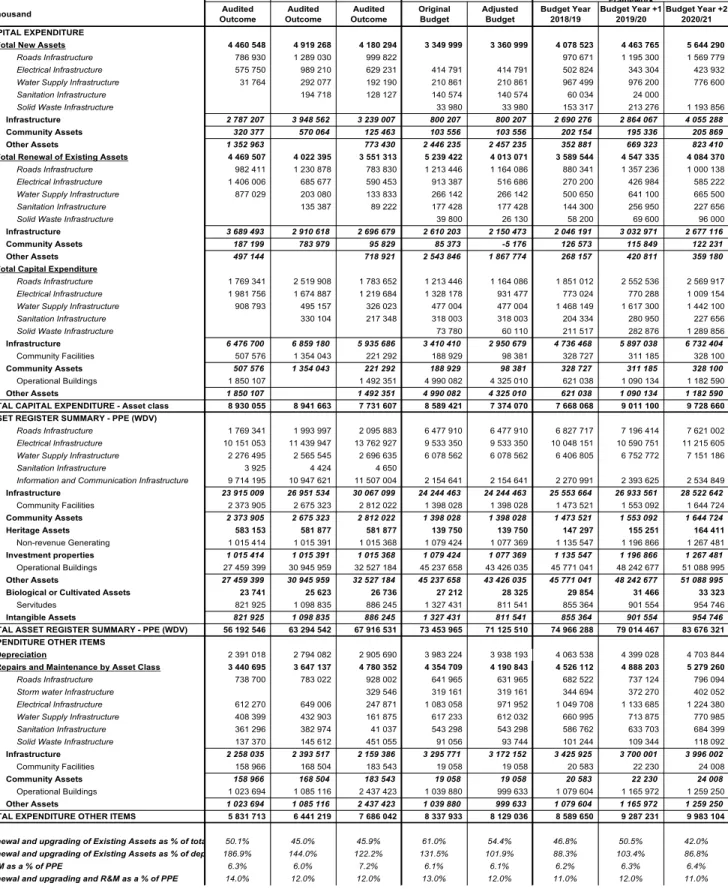
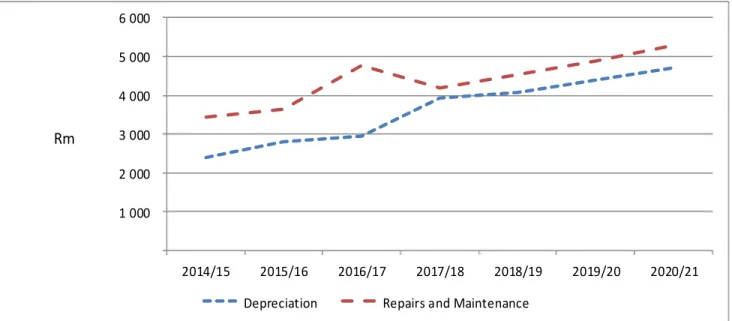
The City is placing a greater emphasis on preserving and maintaining its current infrastructure. Repairs and maintenance as a percentage of PPE has grown from 5.2% in 2013/14 to 6.1% in 2018/19. The 2018/19 repairs and maintenance represent 9.2% of total operating expenditure. In terms of the Municipal Budget and Reporting Regulations, operational repairs and maintenance is not considered a direct expenditure driver but an outcome of certain other expenditures, such as remuneration, purchases of materials and contracted services. The following table is a consolidation of all the expenditures associated with repairs and maintenance:
Description 2014/15 2015/16 2016/17 Current Year 2017/18 2018/19 Medium Term Revenue & Expenditure Framework
R thousand Audited Outcome Audited Outcome Audited Outcome Original Budget Adjusted Budget Budget Year 2018/19
Budget Year +1 2019/20
Budget Year +2 2020/21 Repairs and maintenance expenditure by Asset
Class
Roads Infrastructure 738 700 783 022 928 002 641 965 631 965 682 522 737 124 796 094
Storm water Infrastructure 329 546 319 161 319 161 344 694 372 270 402 052
Electrical Infrastructure 612 270 649 006 247 871 1 083 058 971 952 1 049 708 1 133 685 1 224 380
Water Supply Infrastructure 408 399 432 903 161 875 617 233 612 032 660 995 713 875 770 985
Sanitation Infrastructure 361 296 382 974 41 037 543 298 543 298 586 762 633 703 684 399
Solid Waste Infrastructure 137 370 145 612 451 055 91 056 93 744 101 244 109 344 118 092
Community Facilities 158 966 168 504 183 543 19 058 19 058 20 583 22 230 24 008
Other assets 1 023 694 1 085 116 2 437 423 1 039 880 999 633 1 079 604 1 165 972 1 259 250
Total 3 440 695 3 647 137 4 780 352 4 354 709 4 190 843 4 526 112 4 888 203 5 279 260
Financial Position
The table below reflects the summary of the proposed financial position.
16
Financial position Adjusted
Budget Budget Estimate Estimate 2017/18 2018/19 2019/20 2020/21 R million R million R million R million
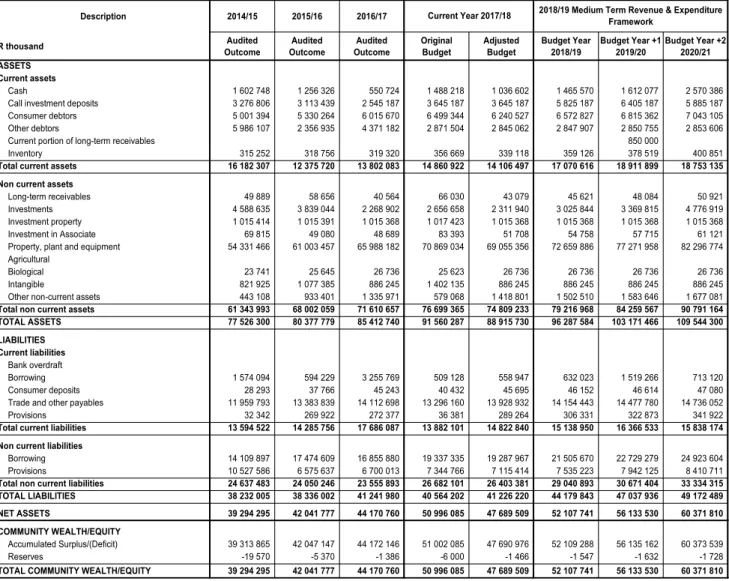
Total current assets 14 106 17 071 18 912 18 753
Total non current assets 74 809 79 217 84 260 90 791
Total current liabilities 14 823 15 139 16 367 15 838
Total non current liabilities 26 403 29 041 30 671 33 334
Community wealth/equity 47 690 52 108 56 134 60 372
The projected current ratio over the medium term is projected to be above 1:1. Cash reserves are used to fund capital investment, hence no material improvement in the current ratio.
Cash Flow
The table below reflects the summary of the proposed cash flow.
Cash flow Adjusted
Budget Budget Estimate Estimate 2017/18 2018/19 2019/20 2020/21 R million R million R million R million
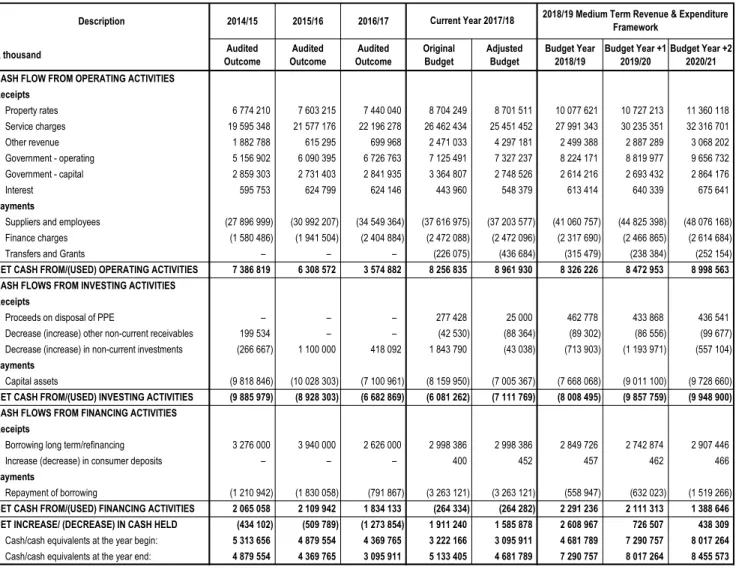
Net cash from (used) operating 8 962 8 769 8 886 9 413
Net cash from (used) investing (7 112) (8 451) (10 271) (10 363)
Net cash from (used) financing (264) 2 291 2 111 1 389
Cash/cash equivalents at the year begin: 3 096 4 682 7 291 8 017
Cash/cash equivalents at the year end 4 682 7 291 8 017 8 456
The cash of the City is projected to be approximately R7.3 billion at the end of the 2018/19 financial year. It will be approximately R8.5 billion in the outer year. Cash reserves are applied towards capital infrastructure spending.
To achieve financial stabilisation and long-term sustainability the City has a set of parameters within which financial planning should be aligned. These key financial indicators are included in the table below.
Key Financial Indicators
Actual Adjusted Bench-
2016/17 Budget marks Budget Estimate Estimate
2017/18 2018/19 2019/20 2020/21
Current ratio 0.8:1 1:1 Above 1:1 1.1:1 1.2:1 1.2:1
Solvency ratio 2.1:1 2.2:1 Above 2:1 2.2:1 2.2:1 2.2:1
Debt to Revenue ratio 51% 45% Below 45% 45% 46% 46%
Remuneration as % of Total Operating
Expenditure ratio 22.9% 24.6% Below 30% 25.5% 26.0% 26.0%
Repairs and Maintenance as a % of PPE
ratio 7.2% 6.1% 8% 6.2% 6.3% 6.4%
Capital cost (interest and redemption) as a
% of total operating expenditure 7% 12% Below 7% 6% 5% 7%
Net Operating Surplus Margin 5% 7% Above 15% 8% 7% 7%
Cash / Cost coverage (days) 30.0 37.1 45 days 54.4 55.1 54.2
Ratios
17
1.3 CAPITAL EXPENDITURE
The level of capital expenditure and borrowing are based on affordability, prudential indicators and
sustainability (debt ratio, current ratio, operating surplus and the impact or return of the capital investment on the operating account). The table below reflects the medium term capital budget over the next three years.
Adj Bud Budget Budget Budget
Funding source 2017/18 2018/19 2019/20 2020/21
R 000 R 000 R 000 R 000
Loan funding 2 998 386 2 849 726 2 742 874 2 907 446
CRR and surplus cash 1 290 986 1 761 348 3 162 006 3 542 821 Grants and contributions 3 084 698 3 056 994 3 106 220 3 278 393
Total 7 374 070 7 668 068 9 011 100 9 728 660
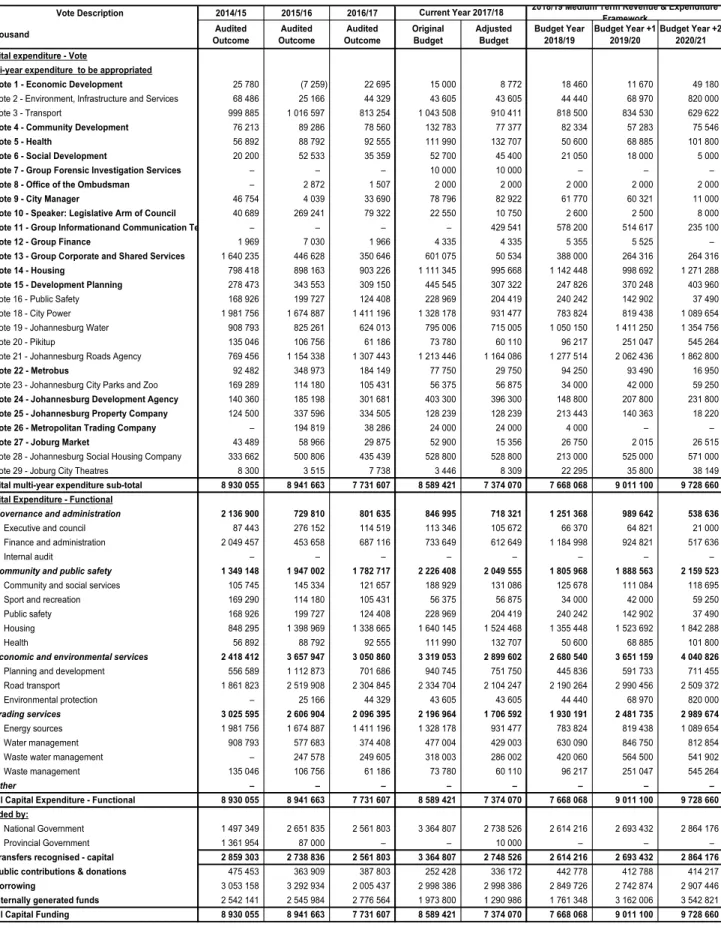
The capital budget of the City projects a spending plan of approximately R26.4 billion over the next three-year period. The capital budget for the 2018/19 financial year amounts to approximately R7.7 billion.
Approximately R4.6 billion of the capital budget will be funded by the City and R3.1 billion from grants and public contributions.
Funding Sources for 2018/19
COJ - Loans 37.2%
COJ - Cash 23.0%
National 9.9%
USDG 24.2%
Other 5.8%
R2.9 billion of capital will be funded from loans.
R1.8 billion of capital will be funded through cash surpluses.
R0.8 billion will be funded from grants received from National (PTIS - R627 million, NDPG - R40.1 million, Integrated City Development Grant - R63.5 million and National Electrification - R31.3 million).
R1.9 billion will be funded through the Urban Settlement Development Grant (USDG).
R442.8 million will be funded from other sources (public and bulk service contributions).
18
1.4 ANNUAL BUDGET TABLES
The following pages present the main budget tables as required in terms of section 8 of the Municipal Budget and Reporting Regulations. These tables set out the municipality’s 2018/19 budget and the MTB.
Table A1: Consolidated Budget Summary
Description 2014/15 2015/16 2016/17
R thousands Audited
Outcome
Audited Outcome
Audited Outcome
Original Budget
Adjusted Budget
Budget Year 2018/19
Budget Year +1 2019/20
Budget Year +2 2020/21 Financial Performance
Property rates 7 674 889 8 138 059 7 912 381 9 005 517 9 005 517 10 675 850 11 252 346 11 916 234
Service charges 21 504 935 23 477 479 25 092 442 28 704 449 27 777 582 30 661 017 33 066 484 35 306 833
Investment revenue 382 240 365 224 624 146 285 600 286 600 297 400 307 800 325 800
Transfers recognised - operational 5 987 772 6 181 068 6 740 131 7 125 491 7 327 237 8 224 171 8 819 977 9 656 732
Other own revenue 2 886 601 3 211 367 2 482 636 3 476 294 3 274 019 3 486 036 3 817 140 4 021 331
Total Revenue (excluding capital transfers and contributions)
38 436 436 41 373 197 42 851 736 48 597 351 47 670 955 53 344 473 57 263 747 61 226 930
Employee costs 8 589 106 8 999 009 9 856 853 11 805 746 11 446 574 13 096 868 14 458 162 15 497 300
Remuneration of councillors 127 499 133 887 139 593 160 691 160 691 170 336 181 234 192 831
Depreciation & asset impairment 2 391 018 2 794 082 2 905 690 3 983 224 3 938 193 4 063 538 4 399 028 4 703 844
Finance charges 1 580 009 1 941 504 2 404 844 2 472 088 2 472 096 2 317 690 2 466 865 2 614 684
Materials and bulk purchases 13 570 403 15 142 780 16 467 921 17 399 977 17 236 748 19 040 932 20 727 031 22 235 339
Transfers and grants 577 071 484 417 500 747 226 075 436 684 315 479 238 384 252 154
Other expenditure 11 081 257 10 913 984 11 561 312 11 296 012 11 193 689 12 703 016 13 585 568 14 506 872
Total Expenditure 37 916 363 40 409 662 43 836 960 47 343 814 46 884 676 51 707 859 56 056 272 60 003 024
Surplus/(Deficit) 520 073 963 535 -985 224 1 253 537 786 279 1 636 615 1 207 475 1 223 906
Transfers and subsidies - capital (monetary allocations) (National / Provincial and District)2 859 303 2 738 835 2 561 803 3 364 807 2 748 526 2 614 216 2 693 432 2 864 176
Contributions recognised - capital & contributed assets 475 453 363 909 387 803 252 428 336 172 442 778 412 788 414 217
Surplus/(Deficit) for the year 3 863 265 4 071 095 1 964 382 4 870 772 3 870 977 4 693 609 4 313 695 4 502 299
Capital expenditure & funds sources
Capital expenditure 8 930 055 8 941 663 7 731 607 8 589 421 7 374 070 7 668 068 9 011 100 9 728 660
Transfers recognised - capital 2 859 303 2 738 836 2 561 803 3 364 807 2 748 526 2 614 216 2 693 432 2 864 176
Public contributions & donations 475 453 363 909 387 803 252 428 336 172 442 778 412 788 414 217
Borrowing 3 053 158 3 292 934 2 005 437 2 998 386 2 998 386 2 849 726 2 742 874 2 907 446
Internally generated funds 2 542 141 2 545 984 2 776 564 1 973 800 1 290 986 1 761 348 3 162 006 3 542 821
Total sources of capital funds 8 930 055 8 941 663 7 731 607 8 589 421 7 374 070 7 668 068 9 011 100 9 728 660
Financial position
Total current assets 16 182 307 12 375 720 13 802 083 14 860 922 14 106 497 17 070 616 18 911 899 18 753 135
Total non current assets 61 343 993 68 002 059 71 610 657 76 699 365 74 809 233 79 216 968 84 259 567 90 791 164
Total current liabilities 13 594 522 14 285 756 17 686 087 13 882 101 14 822 840 15 138 950 16 366 533 15 838 174
Total non current liabilities 24 637 483 24 050 246 23 555 893 26 682 101 26 403 381 29 040 893 30 671 404 33 334 315
Community wealth/Equity 39 294 295 42 041 777 44 170 760 50 996 085 47 689 509 52 107 741 56 133 530 60 371 810
Cash flows
Net cash from (used) operating 7 386 819 6 308 572 3 574 882 8 256 835 8 961 930 8 326 226 8 472 953 8 998 563
Net cash from (used) investing -9 885 979 -8 928 303 -6 682 869 -6 081 262 -7 111 769 -8 008 495 -9 857 759 -9 948 900
Net cash from (used) financing 2 065 058 2 109 942 1 834 133 -264 334 -264 282 2 291 236 2 111 313 1 388 646
Cash/cash equivalents at the year end 4 879 554 4 369 765 3 095 911 5 133 405 4 681 789 7 290 757 8 017 264 8 455 573
Cash backing/surplus reconciliation
Cash and investments available 9 468 189 8 208 809 5 364 813 7 790 064 6 993 730 10 316 600 11 387 078 13 232 492
Application of cash and investments 6 804 289 10 590 652 7 466 387 7 323 769 7 471 481 8 607 099 8 992 856 10 433 080
Balance - surplus (shortfall) 2 663 900 -2 381 843 -2 101 574 466 295 -477 752 1 709 501 2 394 223 2 799 412
Asset management
Asset register summary (WDV) 56 192 546 63 294 542 67 916 531 73 453 965 71 125 510 74 966 288 79 014 467 83 676 321
Depreciation 2 391 018 2 794 082 2 905 690 3 983 224 3 938 193 4 063 538 4 399 028 4 703 844
Renewal of Existing Assets 4 469 507 4 022 395 3 551 313 5 239 422 4 013 071 3 589 544 4 547 335 4 084 370
Repairs and Maintenance 3 440 695 3 647 137 4 780 352 4 354 709 4 190 843 4 526 112 4 888 203 5 279 260
Current Year 2017/18 2018/19 Medium Term Revenue & Expenditure Framework
19
Explanatory notes to table A1: Budget Summary
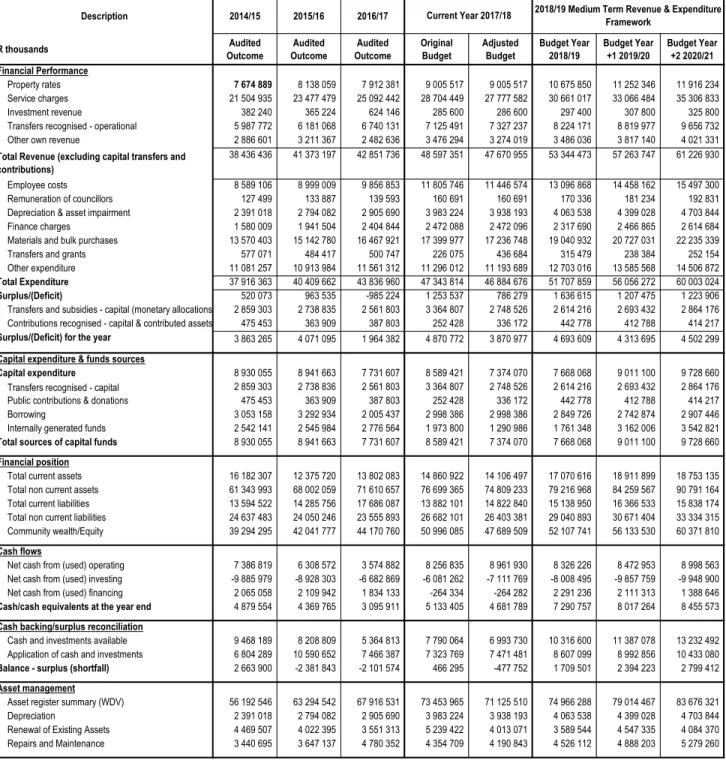
1. Table A1 is a budget summary and provides an overview of the City’s budget that includes all major financial components (i.e. operating, capital expenditure, financial position, cash flow, and MFMA funding compliance).
2. Financial management reforms emphasise the importance of the municipal budget being funded. This requires the simultaneous assessment of the Financial Performance, Financial Position and Cash Flow Budgets, along with the Capital Budget. The Budget Summary provides the key information in this regard:
a. The operating surplus is positive over the medium term;
b. The capital budget is growing from approximately R7.7 billion in 2018/19 to R9.7 billion in 2020/21. The City’s is accelerating service delivery through an intensive capital investment programme;
c. Borrowing is incorporated in the net cash from financing on the Cash Flow Budget;
d. Internally generated funds are financed from a combination of the current operating surplus and accumulated cash-backed surpluses from previous years; and
e. The cash of the City is projected to be approximately R7.3 billion at the end of the 2018/19 financial year. It will be approximately R8.5 billion in the outer year.
3. The City's cash backing / surplus reconciliation over the medium term budget shows a positive
outcome, which is an indication that the City will be able to afford its commitments over the next three years.
20
Table A2: Consolidated Budgeted Financial Performance (revenue and expenditure by standard classification)
Functional Classification Description 2014/15 2015/16 2016/17
R thousand Audited
Outcome
Audited Outcome
Audited Outcome
Original Budget
Adjusted Budget
Budget Year 2018/19
Budget Year +1 2019/20
Budget Year +2 2020/21 Revenue - Functional
Governance and administration 14 122 175 14 262 053 15 220 947 16 578 721 16 547 447 19 233 066 20 571 343 22 113 341
Executive and council 1 175 61 858 5 323 6 010 6 125 6 335 6 677 7 071
Finance and administration 14 121 000 14 200 195 15 215 624 16 572 711 16 541 322 19 226 731 20 564 666 22 106 270
Community and public safety 2 759 145 2 567 007 2 491 210 3 040 566 2 947 157 2 705 128 2 625 624 2 924 778
Community and social services 98 524 121 930 135 138 125 514 105 807 113 500 119 770 127 121
Sport and recreation 117 946 128 383 108 857 124 059 70 393 68 428 71 759 75 993
Public safety 971 978 701 131 673 345 1 118 714 939 916 959 531 1 011 873 1 071 572
Housing 1 389 166 1 417 803 1 395 744 1 491 138 1 629 567 1 391 884 1 246 908 1 462 142
Health 181 531 197 760 178 126 181 141 201 474 171 785 175 314 187 950
Economic and environmental services 2 420 192 2 356 199 1 761 557 2 782 916 2 778 517 3 254 500 3 523 775 3 609 561
Planning and development 583 825 790 814 321 710 938 482 919 083 793 193 815 165 874 802
Road transport 1 778 270 1 491 487 1 352 623 1 768 734 1 768 734 2 385 747 2 633 010 2 659 159
Environmental protection 58 097 73 898 87 224 75 700 90 700 75 560 75 600 75 600
Trading services 22 478 117 25 295 500 26 327 627 29 812 383 28 482 532 31 208 773 33 649 225 35 857 643
Energy sources 13 436 520 15 341 973 16 309 339 17 091 085 16 192 555 17 588 579 19 027 049 20 157 009
Water management 4 641 749 5 032 379 5 136 179 6 662 100 6 404 369 7 152 554 7 692 569 8 274 800
Waste water management 3 094 499 3 354 919 3 424 119 4 441 400 4 269 579 4 768 369 5 128 380 5 516 533
Waste management 1 305 348 1 566 229 1 457 990 1 617 798 1 616 029 1 699 271 1 801 227 1 909 301
Other
Total Revenue - Functional 41 779 629 44 480 759 45 801 341 52 214 586 50 755 653 56 401 467 60 369 967 64 505 323 Expenditure - Functional
Governance and administration 6 479 544 7 429 255 7 898 624 8 828 645 8 705 310 8 867 683 9 194 907 9 785 187
Executive and council 1 317 979 1 688 052 1 304 085 1 617 845 1 569 700 1 674 942 1 772 014 1 880 858
Finance and administration 5 161 565 5 741 203 6 594 539 7 150 800 7 008 191 7 058 146 7 280 759 7 753 589
Community and public safety 6 624 021 6 676 385 6 969 354 7 800 736 8 018 725 9 200 822 10 276 119 10 984 351
Community and social services 1 211 031 1 382 301 1 379 635 1 356 745 1 379 874 1 595 781 1 690 528 1 810 368
Sport and recreation 772 199 807 026 842 754 1 018 240 967 214 1 028 622 1 074 278 1 145 696
Public safety 2 770 111 2 623 912 2 623 455 3 397 455 3 306 537 4 210 825 5 065 012 5 422 765
Housing 1 185 018 1 082 560 1 300 950 1 077 599 1 435 692 1 366 940 1 387 802 1 478 771
Health 685 662 780 586 822 560 950 697 929 408 998 654 1 058 499 1 126 751
Economic and environmental services 3 743 536 4 060 282 4 040 923 5 053 854 4 888 654 5 785 354 6 544 989 7 177 716
Planning and development 748 593 1 166 323 1 033 228 1 369 332 1 310 647 1 530 983 1 650 054 1 758 111
Road transport 2 811 712 2 714 259 2 850 896 3 491 491 3 399 752 4 071 584 4 692 924 5 208 266
Environmental protection 183 230 179 700 156 799 193 031 178 255 182 787 202 011 211 339
Trading services 21 308 051 22 497 644 24 767 441 26 056 881 25 624 214 28 129 377 30 328 164 32 319 789
Energy sources 12 682 948 13 455 745 14 744 774 14 767 783 14 555 364 15 675 400 17 067 577 18 164 404
Water management 4 016 360 4 359 904 4 924 764 5 411 191 5 368 772 6 132 817 6 535 809 6 987 455
Waste water management 2 677 573 2 906 602 3 283 176 3 607 461 3 579 181 4 088 545 4 357 206 4 658 303
Waste management 1 931 170 1 775 392 1 814 727 2 270 446 2 120 897 2 232 615 2 367 572 2 509 627
Other
Total Expenditure - Functional 38 155 151 40 663 566 43 676 342 47 740 117 47 236 904 51 983 236 56 344 179 60 267 042
Surplus/(Deficit) for the year 3 624 478 3 817 192 2 124 999 4 474 469 3 518 749 4 418 232 4 025 788 4 238 281
Current Year 2017/18 2018/19 Medium Term Revenue & Expenditure Framework
Explanatory notes to table A2: Budgeted Financial Performance (revenue and expenditure by standard classification)
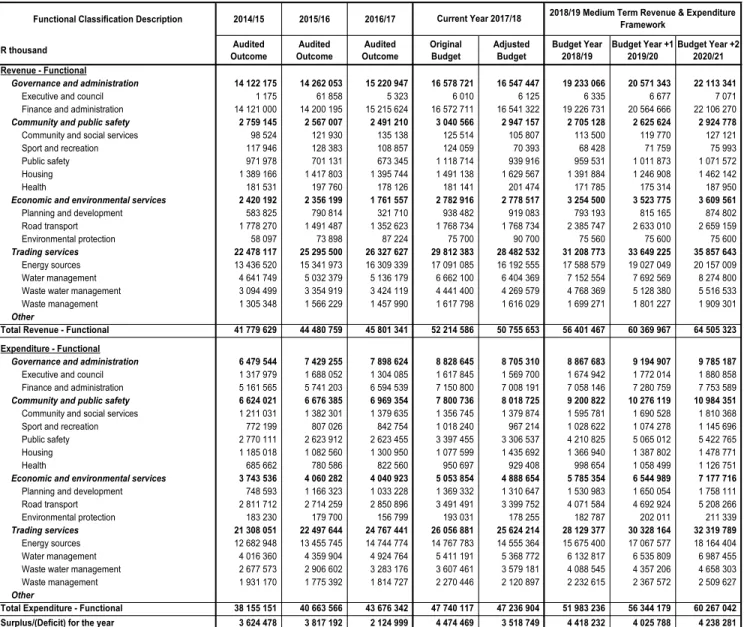
1. Table A2 is a view of the budgeted financial performance in relation to revenue and expenditure per standard classification. The standard classification divides the municipal services into functional areas.
Municipal revenue, operating expenditure and capital expenditure are then classified in terms of each of these functional areas which enable the National Treasury to compile "whole of government”
report.
2. The total revenue on this table includes capital transfers and expenditure includes taxation.
21
The table below reflects the surplus/(deficit) of trading services accounts.
Description 2014/15 2015/16 2016/17
R thousand Audited
Outcome
Audited Outcome
Audited Outcome
Original Budget
Adjusted Budget
Budget Year 2018/19
Budget Year +1 2019/20
Budget Year +2 2020/21 Electricity
Revenue (incl. capital grants) 13 526 14 577 16 015 17 091 16 193 17 589 19 027 20 157
Expendture 12 689 13 621 15 041 14 768 14 555 15 675 17 068 18 164
Surplus/(Deficit) for the year 837 956 973 2 323 1 637 1 913 1 959 1 993
% Surplus/(Deficit) 6.2% 6.6% 6.1% 13.6% 10.1% 10.9% 10.3% 9.9%
Water and Wastewater Management
Revenue (incl. capital grants) 7 826 8 637 9 154 11 104 10 674 11 921 12 821 13 791
Expendture 6 973 7 784 8 520 9 019 8 948 10 221 10 893 11 646
Surplus/(Deficit) for the year 853 853 634 2 085 1 726 1 700 1 928 2 146
% Surplus/(Deficit) 10.9% 9.9% 6.9% 18.8% 16.2% 14.3% 15.0% 15.6%
Waste management
Revenue (incl. capital grants) 1 333 1 474 1 522 1 618 1 616 1 699 1 801 1 909
Expendture 1 932 1 774 1 930 2 270 2 121 2 232 2 367 2 509
Surplus/(Deficit) for the year -599 -299 -408 -652 -505 -533 -566 -600
% Surplus/(Deficit) -44.9% -20.3% -26.8% -40.3% -31.2% -31.4% -31.4% -31.4%
Current Year 2017/18 2018/19 Medium Term Revenue & Expenditure Framework
1. The electricity trading surplus is R1.9 billion, R1.9 billion and R1.9 billion over the medium.
2. The surplus on the water and wastewater management account are increasing over the medium term translating into a surplus of R1.7 billion, R1.9 billion and R2.1 billion for each of the respective financial years.
3. The deficit on waste management are relatively stable over the medium term from R533 million in 2018/19 to R600 million in 2020/21. The deficit of waste management is cross-subsidised by the property rates account.
4. The surpluses on the trading accounts are utilised as an internal funding source for the capital investment (asset renewal, refurbishment and the development of new asset infrastructure).