Social-ecological resilience for well-being:
A Critical Realist case study of Boksburg Lake, South Africa
A thesis submitted in fulfilment of the requirements of the degree of
DOCTOR OF PHILOSOPHY
RHODES UNIVERSITY
Helen Elizabeth Fox September 2014
Abstract
This thesis is based on a case study of the degraded Boksburg Lake social-ecological system and an environmental education initiative that aimed to support its transformation. This initiative aimed to involve local people in reclaiming the lake’s social and ecological value, through a process of collectively reimagining possibilities, shaping identities, gaining knowledge and developing local human agency. The focus was on social learning processes in schools and churches to explore opportunities for co-engaged reflexivity that might produce transformation.
Schools and Christian churches, two institutions that reflect modern, western social- ecological worldviews also have the potential to bring about change.
Critical Realism was chosen as my philosophical framework as it provided the tools to explore deeper mechanisms beyond empirical reality, both influencing the degrading trajectory as well as providing possibilities for transformation. It also legitimised case study research as a means to understand more generalised processes characterising modern social-ecological systems. The choice of Critical Realism informed the scope of my primary research question: What generative mechanisms constrain and enable the development of social-ecological resilience for well-being, in the modern social-ecological system of Boksburg Lake? The following three goals were formulated to address this primary question. Goal 1: Based on a multi- theoretical perspective of social-ecological literature, develop conceptual tools that have explanatory power to probe generative mechanisms operating in the Boksburg Lake social-ecological system. Goal 2: Identify generative mechanisms driving the current degradation of the Boksburg Lake social-ecological system. Goal 3: Identify learning mechanisms that support transformation for greater social-ecological resilience of the Boksburg Lake social-ecological system. By addressing the primary question and research goals I aimed to gain insights into modern global social- ecological systems, the mechanisms that drive high social-ecological risk and the requirements for and possibilities of global systemic change.
Drawing on a broad reading of social-ecological literature from different vantage points, tools with explanatory power were developed to probe for generative mechanisms in the Boksburg Lake social-ecological system (goal 1). The human capacity for symbolic representation is identified as an emergent property of co- evolving human-ecological systems. These symbolic representations become expressed in culture and worldviews, and influence patterns of identifying, types of knowledge and forms of agency. The nature of these will determine the degree that cultural systems are embedded within ecological reality and the extent of cultural-
ecological coupling. A cultural system closely coupled with ecological realities is likely to value ecological systems and manage them for their health, while less coupled cultural-ecological systems are likely to lead to the opposite. Because of their integrated nature, the extent of ecological health and value will affect the decline or sustainability of cultural-ecological systems. There are numerous examples of the learning that can take place when cultural-ecological systems are facing decline. This learning can enhance or reduce biophyllic instincts that become encoded in patterns of identifying, types of knowledge and forms of agency. This in turn affects the strength of cultural-ecological coupling and the extent that human societies co-evolve with ecological systems.
Normalising ideologies is a concept coined in the thesis to refer to symbolic representations of reality that have become integral to a social fabric and determine meaning, while maintaining the domination of the powerful. These ideologies determine patterns of identifying, knowledge and agency and are recognised as having a fundamental influence on the resilience of social-ecological systems. Four normalising ideologies are identified that promote apparent human progress at the expense of ecological integrity and social equality and thus alienation with each other and the ecological world. These are human-ecological dualism, anthropocentrism, nature is mechanised and nature is to be controlled. There are also a number of ideologies promoting connectedness with the ecological world that, if they became normalised, would support greater social-ecological resilience for well-being.
Generative mechanisms driving the current degradation of the Boksburg Lake social- ecological system were identified (goal 2). Drawing on critical methodology, the main method adopted was document analysis of the Boksburg Advertiser archives, Boksburg’s local newspaper. Four generative mechanisms are recognised as most influential. Two of these have been named hegemonic symbolic systems. The primary symbolic system consists of the four normalising ideologies, mentioned above, that promote human progress at the expense of ecological health. The secondary, more explicit symbolic system, built on this, consists of the following normative ideologies:
economic growth is imperative, unrestrained development is promoted, competition is the necessary means and consumerism is the good life. These two symbolic systems have had causal influence on the systematic erosion of ecological processes and biological diversity that has occurred in Boksburg, with the consequent undermining of social-ecological resilience for well-being. The third mechanism that constrains resilience is the powerdynamics that have shaped Boksburg’s economic history and social-ecological system. This has resulted in a society built on inequality and
externalities. The fourth mechanism resides in Boksburg’s political and municipal dynamics. These structures are not designed to tackle complex social-ecological problems and they hold considerable agential power, yet seem dysfunctional at present.
Learning mechanisms that support transformation for greater social-ecological resilience of the Boksburg Lake social-ecological system were identified (goal 3). By adopting the role of a reflexive practitioner, supported by action research, case study and interpretivist methodologies, data on the empirical manifestations of the environmental educational initiative were collected. Methods included semi- structured interviews, focus groups, document analysis and participant observation.
Findings indicate that schools and churches are important institutions that can positively influence patterns of identifying, knowledge about and agency for Boksburg Lake and can thus play a role in transforming hegemonic normalising ideologies. Important learning mechanisms identified included: Learning reflexively together within communities of practice that provide opportunities for active rather than passive learning; involving the youth as they are a group of people with notable enthusiasm, vision, energy and motivation; learning through information acquisition, investigation, action and deliberation; learning about abstract concepts and theoretical knowledge but embedding this in local realities; and learning that provides reference markers for how things can be different.
Table of Contents
Abstract ... i
List of Tables ... viii
List of Figures ... viii
List of Boxes ... x
Acknowledgements ... xi
Chapter 1: Thesis map ... 1
1.1 Contextual and philosophical overview ... 1
1.2 Primary research question and goals ... 1
1.3 The primary assumption supported by key concepts ... 3
1.4 Motivation for thesis ... 5
1.5 Thesis structure ... 9
Chapter 2: Philosophical framework ... 12
2.1 Introduction ... 12
2.2 Typology of western philosophical approaches ... 12
2.3 Basic Critical Realism ... 18
2.3.1 Introduction ... 18
2.3.2 Ontological realism ... 18
2.3.3 Epistemological relativism ... 22
2.3.4 Judgmental rationality ... 23
2.4 Dialectical Critical Realism ... 24
2.4.1 The MELD schema ... 24
2.4.2 The three key failings of western philosophy ... 28
2.4.3 Critique of Critical Realism ... 29
2.5 Conclusion ... 31
Chapter 3: Contextual orientation ... 33
3.1 Introduction ... 33
3.2 Boksburg Lake’s urban water catchment ... 35
3.2.1 Past system characteristics ... 35
3.2.2 Present system characteristics ... 36
3.2.3 Summary of biophysical characteristics 2001-2008 ... 37
3.3 Boksburg Lake and Wetland Project ... 54
3.4 South Africa’s educational context ... 55
3.5 Schools for a Sustainable Environment Initiative ... 56
3.5.2 Approach ... 57
3.5.3 Design of the initiative ... 60
3.5.4 Plans unrealised ... 63
3.6 Conclusion ... 65
Chapter 4: Methodological and analytical framework ... 66
4.1 Introduction ... 66
4.2 Methodologies ... 67
4.2.1 Action research ... 67
4.2.2 Case study research ... 68
4.2.3 Interpretivist methodology ... 69
4.2.4 Critical methodology ... 70
4.3 Data collection methods ... 71
4.3.1 Participant observation ... 72
4.3.2 Semi-structured interviews ... 72
4.3.3 Focus groups ... 73
4.3.4 Document analysis ... 74
4.4 Analytical framework ... 76
4.4.1 Inductive and deductive philosophical approaches ... 77
4.4.2 Grounded approach ... 78
4.4.3 Modes of inference ... 79
4.4.4 RRREIC schema ... 80
4.5 Ethics ... 81
4.6 Conclusion ... 83
Chapter 5: Synthesis of social-ecological theory to develop conceptual tools with explanatory power ... 85
5.1 Introduction ... 85
5.2 Ecological system characteristics ... 86
5.3 Human systems: cultural characteristics ... 88
5.3.1 Introduction ... 88
5.3.2 Weak coupling in cultural-ecological systems ... 91
5.3.3 Strong coupling in cultural-ecological systems ... 92
5.3.4 Patterns of identifying with ecological systems ... 96
5.3.5 Knowledge about ecological systems ... 100
5.3.6 Agency in ecological systems ... 102
5.3.7 Historical influences on modern hegemonic patterns of being ... 105
5.3.8 Recent perspectives ... 114
5.4 Conclusion ... 115
Chapter 6: Boksburg’s social-ecological system: an historical
contextual analysis ... 116
6.1 Introduction ... 116
6.1.1 South Africa’s modern history ... 116
6.2 Methodological overview ... 120
6.3 Results ... 121
6.3.1 An historical overview of Boksburg’s economic and developmental trajectory ... 121
6.3.2 An historical overview of civic groups and their action campaigns ... 129
6.3.3 An historical overview of Boksburg’s civic groups and their action campaigns ... 131
6.3.4 An historical overview of Boksburg Lake ... 137
6.4 Analytical statements in a theoretical context ... 142
6.5 Conclusion ... 159
Chapter 7: The Boksburg Lake Social-Ecological System: Learning and Change ... 161
7.1 Introduction ... 161
7.1.1 Schools ... 163
7.1.2 Churches ... 164
7.1.3 Learning as a meta-narrative for transformation ... 167
7.2 Methodological overview ... 170
7.3 Results ... 172
7.3.1 A narrative of stakeholder agency and system inertia within the Boksburg Lake social-ecological system ... 172
7.3.2 Patterns of identifying with the Boksburg Lake social-ecological system ... 181
7.3.3 Knowledge about the Boksburg Lake social-ecological system ... 191
7.3.4 Agency in the Boksburg Lake social-ecological system ... 197
7.4 Analytical statements in a theoretical context ... 209
7.5 Conclusion ... 219
Chapter 8: Concluding Discussion ... 220
8.1 Summaries of research goals to answer the primary research question ... 220
8.2 Insights into modern social-ecological processes and transformative possibilities ... 232
8.3 A critical reflection of my process as a reflexive practitioner ... 234
8.4. My vision of a transformed reality ... 236
References ... 238
Appendices ... 255 (All appendices are available on the enclosed CD. Appendices B, D, E, F, G, H, I, L are also available at the end of the thesis).
Appendix A: Resource Pack on Urban Water Catchments………...(see CD) Appendix B: List of Knowledge Resources in the Resource Pack on Urban Water Catchments..………..256 Appendix C: Raw Data……….…….……….………..(see CD) Appendix D: Semi-structured interview schedules (2009-2010).……….257 Appendix E: Semi-structured interview schedule for focus groups conducted with learners (2009 to 2011).……….………..………..259 Appendix F: Full list of themes that emerged from data representations in chapter 6 and from which the analytical statements were derived………261 Appendix G: List of 59 concepts that emerged in the first round of data
analysis...266 Appendix H: List of 33 new concepts to emerge in relation to identity, knowledge and agency.……….………..……….……268 Appendix I: Article submitted to the Boksburg Advertiser about the clean-up day held on 14 May 2012……….……….……...269 Appendix J: Video recording of the song Reiger Park High learners sang the at the 2011 Boksburg Lake Day ……….………(see CD) Appendix K: Video recording of a rap by a Reiger High learner at the 2012
Boksburg Lake Day……….……….………(see CD) Appendix L: Full list of themes from which the analytical statements were derived in chapter 7.……… ……….……….270
List of Tables
Table 3.1: Rehabilitation actions for Boksburg Lake adopted by Ekurhuleni Metropolitan Municipality (Gordon 2008)
55 Table 7.1: List of acronyms specifically used in chapter 6 when referring to
data sources
170 Table 7.2: A list of solutions to the problems at Boksburg Lake as identified
by learners
195
List of Figures
Figure 1.1: A conceptual overview of the relationships between chapters and the three research goals that support the primary question
11 Figure 2.1: The three tiers of ontological realism: the empirical, actual and
real
19 Figure 3.1: A map that locates Gauteng Province within South Africa and
locates Ekurhuleni Metropolitan Municipality and Johannesburg Metropolitan within Gauteng Province
33
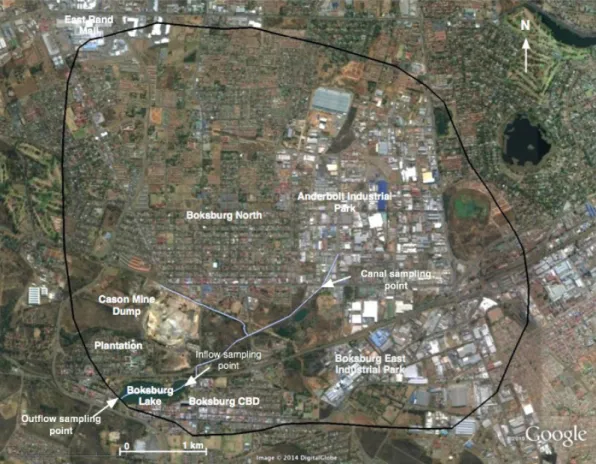
Figure 3.2: A visual representation of the challenges facing Boksburg Lake 37 Figure 3.3: A Google Earth image of Boksburg Lake and its catchment
including drainage lines
38 Figure 3.4: pH measured at the Boksburg Lake inlet, outlet, and canal
feeding the lake (October 2001 – February 2008)
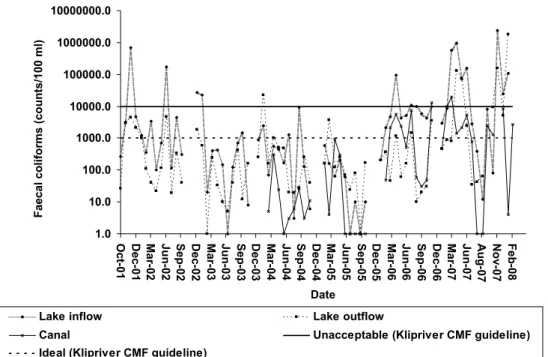
41 Figure 3.5: Faecal coliform counts measured at the Boksburg Lake inlet,
outlet, and canal feeding the lake (October 2001 – February 2008)
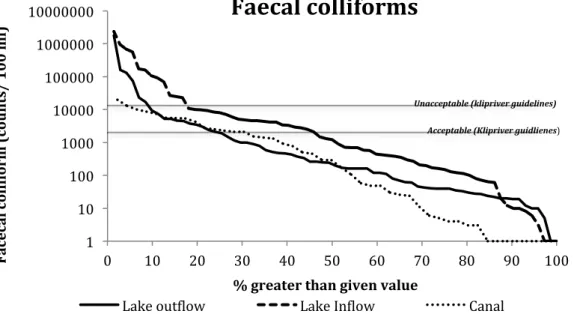
42 Figure 3.6: Percentage exceedance of faecal concentrations in the lake
inflow, lake outflow and canal (October 2001 to February 2008)
43 Figure 3.7: Chemical oxygen demand at the Boksburg Lake inlet, outlet, and
canal feeding the lake (October 2001 – February 2008)
44 Figure 3.8: Percentage exceedance of chemical oxygen demand in the lake
inflow, lake outflow and canal (October 2001 to February 2008)
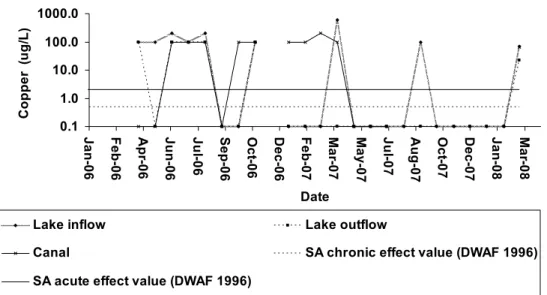
45 Figure 3.9: Copper concentrations at the Boksburg Lake inlet, outlet, and
canal feeding the lake (January 2006 – March 2008)
46 Figure 3.10: Percentage exceedance of copper concentrations in the lake
inflow, lake outflow and canal (January 2006 to March 2008)
47 Figure 3.11: Nickel concentrations at the Boksburg Lake inlet, outlet, and
canal feeding the lake (January 2006 – December 2006)
48 Figure 3.12: Percentage exceedance of nickel concentrations in the lake
inflow, lake outflow and canal (January 2006 to December 2006)
48 Figure 3.13: Zinc concentrations at the Boksburg Lake inlet, outlet, and
canal feeding the lake (January 2006 – March 2008)
49 Figure 3.14: Percentage exceedance of zinc concentrations in the lake 50
inflow, lake outflow and canal (January 2006 to March 2008)
Figure 3.15: Aluminium concentrations at the Boksburg Lake inlet, outlet, and canal feeding the lake (January 2005 – December 2006)
51 Figure 3.16: Percentage exceedance of aluminium concentrations in the lake
inflow, lake outflow and canal (January 2005 to December 2006)
51 Figure 3.17: Iron concentrations at the Boksburg Lake inlet, outlet, and
canal feeding the lake (October 2001 – February 2008)
52 Figure 3.18: Percentage exceedance of nickel concentrations in the lake
inflow, lake outflow and canal (October 2001 to February 2008)
53
Figure 3.19: Handprint series logo 59
Figure 3.20: Revised active learning framework underpinning the Handprint series (developed by O’ Donoghue 2009) that indicates the value of reading, talking about, finding out, trying out and deliberating change for effective learning
60
Figure 3.21: Visual representation of activities at the Boksburg Lake Days (2009 - 2012)
63 Figure 4.1: Philosophical, methodological and analytical framework 66 Figure 4.2: Relationships between different methodologies adopted 67 Figure 4.3: Adopted methodologies and their associated methods 71 Figure 5.1: Holling’s (1986) adaptive renewal cycle indicating that
ecosystems are not stable but rather typically cycle through the following four stages: exploitation, conservation, release and reorganisation
87
Figure 5.2: A conceptual synthesis of processes leading to cultural- ecological sustainability or collapse
96 Figure 5.3: A conceptual synthesis of important drivers, events and
normalising ideologies maintaining the resilience of the hegemonic modern social-ecological system
112
Figure 5.4: Four normalising ideologies that underpin hegemonic western social-ecological relations and promote human progress at the expense of ecological integrity
113
Figure 5.5: A suggestion of events reinforcing human: ecological dualism 113 Figure 6.1: Causal loop diagram (Pruyt 2013) of the Boksburg Lake system
indicating the economic, social and biophysical components and relationships of Boksburg Lake and its catchment.
155
Figure 6.2: A conceptual heuristic of the Boksburg Lake social-ecological system
156 Figure 6.3: Ball and valley diagram indicating that systems can cross a
critical threshold, thereby shifting from one state with particular characteristics to a different state with new characteristics
159
Figure 7.1: Knowledge, identity and agency in an interlinked framework where double arrows indicate a two-way directional relational causality
162 Figure 7.2: The three final categories that emerged from data analysis 171
(patterns of identifying, knowledge and agency) with their associated concepts
Figure 7.3: Visual representation of aspects of the emerging community of practice
173 Figure 7.4: Two concepts (values of participants; how participants relate to
Boksburg Lake) explored under the category: patterns of identifying in the Boksburg Lake social-ecological system
181
Figure 7.5: Three concepts (social-ecological problems; causes of social- ecological problems; solutions for social-ecological problems) explored under the category: knowledge about the Boksburg Lake social-ecological system
191
Figure 7.6: Letter written by a St Michael’s Primary learner to Ekurhuleni Metropolitan Municipality expressing concern about the water quality of Boksburg Lake
192
Figure 7.7: Two concepts (knowing Boksburg Lake can be transformed &
one can be part of the solution; actions undertaken) explored under the category: agency in the Boksburg Lake social-ecological system
197 Figure 7.8: Visual representation of aspects of participants’ developing
agency
198 Figure 7.9: Visual representation of Witdeep Primary’s recycling initiative 207 Figure 7.10: Ladder of young people’s participation where the higher rungs
reflect greater participation (Hart 1992)
213 Figure 7.11: Bhaskar’s (1998) transformational model of social activity that
indicates how social structures enable and constrain human agency, while human agents reproduce or transform social structures
215
Figure 7.12: The three phases of Archer’s morphogenetic and morphostasis cycle. T1 – T4 signify intervals of time (Archer 1995: 157)
216 Figure 8.1: Laminated system indicating how generative levels occur at
different emergent levels, namely physical-chemical-biological, socio- economic, psycho-social, political-institutional and normative
223
List of Boxes
Box 1.1: Primary research question with associated research goals 2
Box 3.1: A description of the Eco-Schools Programme 62
Box 6.1: Letter written by a local resident expressing a pro-development stance
135
Box 6.2: Letter written by the chairman of the CVAG 136
Acknowledgements
It is with great pleasure that I write my acknowledgements! I have felt so supported, encouraged and loved through this process and feel deeply grateful to my incredible family, mentors and supervisors, community of friends and colleagues.
Professor Tally Palmer! Thank you for your remarkable generosity of spirit and endless care, support and guidance towards my spiritual, emotional and intellectual well-being. I have benefitted greatly from your considerable input (including the few fierce moments) and generous financial support and hope to do you proud through this thesis. What a privilege it has been to have you as my primary supervisor!
Professor Rob O’Donoghue, it has truly been an honour to have an academic of your calibre as my co-supervisor. Thank you for being wild and genuine of spirit, caring of heart and incredibly generous with your creative and intellectual input. My thesis has benefited from your rich and deep intellectual insights. I hope to also make you proud!
Mum I’ve dedicated my thesis to you as an expression of how deeply I appreciate you! I can’t thank you enough for being you! Thank you for being a source of invaluable kindness, patience, strength and support through this process! And then my Dad! My wise and generous Pappa Fox, I am very grateful for your financial support, encouragement and guidance. Thank you!
The community of people in Boksburg who participated in this process; you have been an inspiration! Thank you for your time, energy, commitment and passion for making a difference. I hope Boksburg Lake will soon be a place you can once again enjoy.
Thank you, Kim Ward for generously proofreading my work and being happy to work under pressure to get it done timeously, Margaret Wolf for so willingly and carefully helping me with my reference list, Helen Holleman for your refined input into my written work, Dr Andrew Gordon and Dr Neil Griffiths for kindly assisting with my biophysical section and Dr Leigh Price for being an invaluable source of knowledge and reading through some of my work.
A big thank you to Unilever, South Africa, for five years of generous funding that made the Schools for a Sustainable initiative possible and expressed their dedication to the transformation of Boksburg Lake. A generous scholarship was also provided
through Professor Palmer from the NRF: Global Change and Society programme.
Thank you!
My dear friends, I have felt so encouraged and supported through you. I make special mention of Julia Smagorinsky, Shiloh Marsh, Treve Jenkins, Steve Ellis, Ruth Woudstra, Stephanie Penkler, Jane Tanner, Priya Vallabh, Imme Thom and Nina Rivers, my closest friend and PhD comrade with whom I’ve walked a remarkable journey.
And lastly to my God, in whom I live and move and have my being; what a joy it has been to do this knowing your grace and how passionately you love.
Chapter 1:
Thesis map
1.1 Contextual and philosophical overview
This dissertation emerged during an environmental education initiative called Schools for a Sustainable Environment (SSE) that focused on Boksburg Lake, a severely degraded urban lake. It is situated in the Central Business District of Boksburg, an industrialised city in the East Rand, Gauteng Province of South Africa, under the jurisdiction of the Ekurhuleni Metropolitan Municipality (EMM). Boksburg Lake was well known for its previous high societal value, outdoor recreational and aesthetic benefits; in addition the lake is closely associated with the city’s identity. It is, however, currently notorious for serious water pollution, crime, deterioration of infrastructure and aesthetics and is little used. The lake’s degradation mirrors more globalised modern social-ecological patterns and themes.
The SSE initiative aimed to involve local people in reclaiming the lake’s social and ecological value, through a process of collectively reimagining possibilities, shaping identities, gaining knowledge and developing local human agency. An examination of this attempted change process and its consequences provided a means to better understand possibilities and requirements for global systemic social-ecological change.
The focus was on social learning processes in schools and churches to explore opportunities for co-engaged reflexivity that might produce transformation. Schools and Christian churches, two institutions that reflect modern, western social-ecological worldviews also have the potential to bring about change (Weber 1930; Bourdieu &
Passerson 1990; Clark 1993).
1.2 Primary research question and goals
This case study of the Boksburg Lake social-ecological system has provided the context to explore the primary research question and associated research goals (see box 1.1).
I initially adopted the position of a reflexive practitioner and collated a wide range of empirical data on the effects of the SSE initiative, but with a particular focus on identifying participants’ emergent knowledge, roles, identities and agency. My initial research journey had a strong empirical focus with the intention of describing the
Boksburg Lake SSE case study in detail. My introduction to Critical Realism (examined in detail in chapter 2, section 2.3), a meta-philosophical framework that is increasingly influential in both social and natural sciences and interdisciplinary endeavours, increased the scope and theoretical aspect of my thesis, and informed the scope of my primary research question and associated goals.
Box 1.1: Primary research question with associated research goals
Primary research question: What generative mechanisms constrain and enable the development of social-ecological resilience for well-being, in the modern social-ecological system of Boksburg Lake?
• Goal 1: Based on a multi-theoretical perspective of social-ecological literature, develop conceptual tools that have explanatory power to probe generative mechanisms operating in the Boksburg Lake social-ecological system.
• Goal 2: Identify generative mechanisms driving the current degradation of the Boksburg Lake social-ecological system.
• Goal 3: Identify learning mechanisms that support transformation for greater social-ecological resilience of the Boksburg Lake social-ecological system.
By addressing the primary question and research goals I aimed to gain insights into modern global social-ecological systems, the mechanisms that drive high social- ecological risk and the requirements for and possibilities of global systemic change.
The question is serious because it is examining the real world at risk. The question in turn required a meta-philosophical framework that is reality congruent. Critical Realism provided three points of purchase to answer the primary question.
• Firstly, Critical Realism provides an ontology that includes a real world, beyond our human perception of it, which is structured and complex, where generative mechanisms (which may not be empirically manifest) have causal effects on the world, and are a fruitful focus for research (Bhaskar 1998;
Danermark et al. 2002). Generative mechanisms is a term used in Critical Realism that is useful for exploring the underlying causes determining observed empirical data. A Critical Realist discourse encourages researchers to identify and understand the underlying generative mechanisms operating in a particular context (Bhaskar 1998; Danermark et al. 2002; Mingers 2011). However, these generative mechanisms tend to be more generalised in scope than their unique manifestations in each case study (Price 2007). It therefore becomes possible to examine the Boksburg Lake social-ecological system case study as a means to explore broader modern social-ecological generative mechanisms.
• Secondly, Critical Realism provides an epistemology to examine Boksburg Lake as an integrated social-ecological system and combined a variety of research methods and perspectives from different disciplinary traditions (Bhaskar 2010). This meta-philosophy is theoretically and empirically inclusive, while also providing conceptual tools to discern plausible, compelling lines of argument (Archer et al. 2004).
• Thirdly, Critical Realism provides an in-depth critique of prevailing western philosophies that have held sway since the time of Plato (Norrie 2010). This critique provides insight into the role that dominant philosophical thought has played in western social-ecological relations. In turn, Critical Realism presents a philosophy of science that I believe can help address some of the fundamental knowledge problems in western social-ecological relations.
The thesis therefore has a strong philosophical base, with the aim of developing new theoretical insights into modern social-ecological systems and current crises. It is also empirical, being grounded in a particular case study. The study therefore moves between data and theory in an iterative process.
1.3 The primary assumption supported by key concepts Social-ecological coupling, identity, knowledge and agency
A foundational assumption in this thesis is that the more closely human systems are coupled to ecosystems, the healthier and more valued by local people they will be. This in turn improves social-ecological resilience for well-being. The premise explored is that individual and collective patterns of identifying with, types of knowledge about and forms of agency in social-ecological systems, have fundamental effects on coupling processes and the consequent level of resilience. The concept of coupling is explored in section 5.2. This assumption is supported by three key concepts used in this thesis and summarised below, namely social-ecological systems, resilience and modernity. Together these concepts highlight firstly, how interconnected humans are with ecological systems (social-ecological systems), that the health of this relationship is not guaranteed (resilience) and that modern systems are increasing the vulnerability of human-ecological systems (modernity).
Social-ecological systems
Social-ecological systems is a relatively new concept that emerged out of a combination of theoretical spaces, including systems ecology and complexity theory and incorporates ideas about resilience, robustness, vulnerability and sustainability.
Authors who have developed and worked with the concept of social-ecological systems include Berkes and Folke 1998; Woodgate and Redclift 1998; Posey 1999; Berkes and Folke 2002; Folke et al. 2003; Plummer 2010, Folke and Gunderson 2012 and the Stockholm Resilience Centre. Through this concept recognition is expressed that human and ecological systems are interdependent, interconnected, constantly co- evolving and make up an integral system; that ecological processes have been fundamentally affected by cultural patterns of human use; that economic and social development are dependent on a biophysical foundation; and human actions directly or indirectly affect the capacity of ecosystems to sustain human societies. Complexity is inherent in these systems where they are characterised by non-linearity, emergence, uncertainty, adaptability and self organisation.
Resilience
Resilience emerged in the 1970s in ecological discourse as a challenge to stability thinking (Holling 1973). In social-ecological discourse resilience is defined as the amount of change the system can undergo and still retain its function and structure; the degree to which the system is capable of self-organisation; and the ability to build and increase the capacity for learning, adapting and where necessary transforming (Armitage et al. 2012). Resilience is a neutral term, which does not specify whether a particular system being resilient is good or bad. However, this neutrality also has normative implications because of the need to decide which resilient systems to protect and which to change (Armitage et al. 2012). There are examples of resilient ecological systems that provide highly valued ecological services and others, also resilient, which provide little value to people. There are also examples of resilient socio-economic systems that benefit some while producing harm to others (including both humans and other living creatures).
In this thesis desirable resilience is that which has implications of well-being, both for people (with particular consideration of the poor and marginalised) and the planet as a whole. Armitage et al. (2012: 3) defined social well-being as “A state of being with others and the natural environment that arises when human needs are met, where individuals and groups can act meaningfully to pursue their goals, and where they are satisfied with their way of life”. This definition covers a multi-dimensional perspective that has material, relational and subjective aspects. Planetary well-being includes high biological and landscape diversity and productivity, and stable slow variables and feedback loops (Biggs et al. 2012).
Modernity
Modernity originated in Europe during the time of colonial expansionism (Giddens 1990), emerged from the Scientific Revolution (fifteenth to sixteenth centuries) and the Enlightenment project (eighteenth century) (Swilling & Annecke 2012) and is now worldwide in scope (Giddens 1990). It is built on experience that the world can be transformed by humans; is characterised by a separation between time and space, as elaborated in section 5.3.6 (Giddens 1990); has a number of defining economic structures, namely capitalism and industrialisation; is future-oriented; supports the nation state and mass democracy; has a particular suite of ideologies and values that influence the dominant worldview (as discussed in section 5.3.4); has globalising forces in its foundation and is discontinuous from traditional forms of life (Giddens &
Pierson 1998). According to Swilling and Annecke (2012: 7) additional key characteristics defining the “culture of modernity” include a “belief in progress, the power of reason, the primacy of the individual, the sanctity of empiricism, the unlimited universalism of scientific knowledge, and the virtues of secularism” that all contribute to building the Enlightenment promise of the ‘good society’. Modernity is also characterised by global social-ecological risks and Beck (1992) has coined the term "risk society" to characterise this time in history. The extent of these social- ecological risks has necessitated that modern society reflects on itself and Beck, Giddens and Lash (1994) describe this era as reflexive modernisation. It can be assumed that these risks result from the seventh characteristic identified by Swilling and Annecke (2012: 20), namely “the separation of nature and eco-systems from the logic of socio-economic development, with nature and ecosystems regarded as sources of unlimited resources which will always be extractable by modern technologies derived from scientific advances”.
1.4 Motivation for thesis
… at a deep level of our being we find it hard to suppress the cry of anguish, the scream of horror – the wild words required to express wild realities. We human beings are being led to a dead end – all too literally. We are living by an ideology of death and accordingly we are destroying our own humanity and killing the planet. (Daly & Cobb 1994: 21)
Over the past two millennia many writers from diverse and different perspectives have alerted humanity to the dangers and latent crises that can result from discordant patterns of being that damage our relationship with nature. The following quotations, beginning in ancient Judeo-Christian literature and ending with views on the recent
realisation of imminent collapse in the twenty-first century, highlight how critical thinkers have presented their fears of social-ecological collapse.
Over 2000 years ago the dangers of a barren world through ecological exploitation and a void of morality were expressed in religious texts. For example,
Woe to you who add house to house and join field to field till no space is left and you live alone in the land. (Isaiah 5: 8, New International Version)
There is no faithfulness, no kindness, no knowledge of God in your land. You curse and lie and kill and steal and commit adultery. There is violence everywhere, with one murder after another. That is why your land is not producing. It is filled with sadness, and all living things are becoming sick and dying. Even the animals, birds, and fish have begun to disappear. (Hosea 4: 1-3, New Living Translation)
Numerous historical case studies of local social-ecological collapse, due to ecological exploitation (discussed in more detail in section 5.3.2), indicate that human communities can cause severe ecological harm, destroying life support systems (Weiskel 1989; Janssen & Scheffer 2004; Anderson 2010). However, the modern western track record for the scale of social-ecological destruction is unprecedented (Jensen 2004). The globalised and profoundly interconnected nature of modern social- ecological systems as well as the highly unrealistic economic trajectory, based on the assumption of unlimited economic growth on a finite earth is an extremely serious, risk infused situation (Beck 1992), expanded further in chapter 5. Daly and Cobb (1994:
390) express some of the devastation incurred from the beginning of modern western expansionism:
All the ancient cultures of the world felt the power of the Enlightenment critique. For the enormous accomplishments of their communities rooted in great traditions they heard no support. Then there fell upon them the power of an economic system, rooted in this way of thinking. To succeed in this new system, the ancient cultures required modernization or rationalization, which meant the destruction of the power of tradition and community. Land and labour – that is the earth and human beings – had to become commodities. The result has been a holocaust, and this process of rationalization and commodification threatens to destroy yet more.
This holocaust includes the severe diminution of ecological integrity and abundance.
The Millennium Ecosystem estimates present extinction rates to be 100 to 1000 times above the background (United Nations 2005), which if continued unabated will
account for the loss of 30-50% of all current species by the mid 21st century (Wilson 1988).
To provide some perspective, early European accounts of the North American continent provide a picture of bountifulness unthinkable in today’s world:
Early Europeans describe towering forests of cedars, with an understory of grapes and berries that stained the legs and bellies of their horses. They describe rivers so thick with fish that they ‘could be taken not only with a net but in baskets let down (and weighted with) a stone’. They describe birds in flocks so large they darkened the sky for days at a time and so dense that ‘a single shot from an old muzzle-loader into a flock of these curlews (Eskimo curlews made extinct by our culture) brought down 28 birds’.
[There are descriptions of rivers so full of salmon that] at night one is unable to sleep, so great is the noise they make [and lobsters] in such plenty that they are used for bait to catch the Codd fish. (Jensen 2004: 85, 86)
Future social-ecological scenarios are terrifying and are being driven by modern, western hegemonic and increasingly global patterns of being. For example, the Living Beyond Our Means statement (from the Millennium Ecosystem Assessment's Board) explains that, “Human activity is putting such strain on the natural foundations of the Earth that the ability of the planet’s ecosystems to sustain future generations can no longer be taken for granted” (quoted in Glasser 2007: 42). Rockstrom et al. (2009) have discussed planetary boundaries and highlighted that critical thresholds are being crossed in the high rate of biodiversity loss, climate change and the disruption of the global nitrogen cycle. The Millennium Ecosystem Assessment states that 15 of the 24 (60%) ecosystem services humans depend on are degraded and already detrimentally affect human well-being (United Nations 2005). The current ecological overshoot has been calculated as 1.33 times the earth’s available resources and it is estimated that by 2050 humanity will require two times the earth’s available resources to be sustained (Massey 2013). This period in ecological history from the 19th century onwards has been defined as the Anthropocene, expressing the extensive human impact on ecological processes (Crutzen 2002; Folke & Gunderson 2012), while Beck (1992, 2002) referred to social-ecological degradation being at the heart of modern experience. There have also been extensive human losses. For example, the human well-being index (HWI), which integrates data on health, wealth, population, knowledge, community well-being and equity, indicates that two thirds of the world’s population live in countries with a poor HWI. There is also a gap between the top and bottom performers where countries in the top 10% have median values eight times higher than countries in the bottom 10% (Glasser 2007). UNDP statistics indicate that
the gap between the 20% poorest and 20% richest has more than doubled over the last 40 years and Rist (2007: 490) has described development as a period of “successive losses” instead of a history of progress as it is normally seen.
Badke (1991) has described the earth as a mirror, reflecting the collective emotional and spiritual condition of a culture on the land. Gottlieb (2009: 6) supported this by stating that when we look to nature and “find broken beer bottles on mountaintops or birds choking on plastic bags; we will find, that is, only ourselves”. The present ecological degradation is therefore a mirror of the condition of modern hegemonic culture.
According to Jickling (2013) modern society has come to normalise catastrophe. This is largely because of a TINA complex, a term used in Critical Realism to refer to ideologies (particularly economic) so entrenched that people believe that ‘There Is No Alternative’ (TINA) (Norrie 2010). Sachs (1996: 245), for example, has stated that politicians, industrialists and scientists repeatedly give the following message:
“Nothing should be done (the dogmatic version) or can be done (fatalistic version) to change the direction the world’s economies are taking… alternatives to development are blackballed, but alternatives within development are welcome”. However, many authors believe that alternatives are possible. Frank (2010: 101, 102), for example, called for “life-affirming, emergent social imaginaries” instead of the death imaginaries that presently have effect: “A world that is sustainable and health- enhancing must become more of a real socially emergent imaginary”. This thesis explores possible life-affirming social imaginaries that challenge the hegemonic order.
My intention in this study has been to contribute to social-ecological discourse by providing a broad rather than in-depth conceptual analysis of the relationship between humans and ecological systems in the modern world, and possibilities for transformation, that are rooted in a particular case study. In light of the profoundly complex nature of human-ecological systems and the many nuances that characterise modernity, this broad approach has meant some areas touched on in this thesis necessarily lack an in-depth examination (both empirically and theoretically).
Although this thesis has been researched under the auspices of a science faculty, the first person has been adopted to express that a subjective person (me), in relationship and partnership with the world and people, undertook the study. This expresses my ontological and epistemological assumptions that challenge the dominant scientific idea that I am a detached observer, examining an external reality that can be
1.5 Thesis structure
The thesis is presented in eight chapters. See figure 1.1 for a conceptual overview of the relationships between chapters and the three research goals that support the primary question.
The thesis map (chapter 1) has introduced the study, stated the primary question and its three supporting goals and explained the philosophical and contextual context underpinning these. The motivation for the study is also provided.
The philosophical framework (chapter 2) provides a philosophical framework for the thesis. Critical Realism is the chosen meta-philosophy and is described in detail. This includes both Basic Critical Realism, which deeply informed the ontology and epistemology underpinning the thesis and guided the development of the primary question and associated three goals; and Dialectical Critical Realism, which critiques western philosophy and provided the conceptual tools to examine possibilities for change.
The contextual orientation (chapter 3) introduces the social-ecological system of Boksburg Lake and the SSE initiative that focused on the reclamation of this socially and ecologically degraded system. The chapter describes the geographical, biophysical, historical and educational context of the Boksburg Lake case study. The SSE initiative that attempted to bring about change to this degraded system is then described in some detail, including its underpinning philosophies and design. The chapter concludes with a list of ideas and plans that were identified but not subsequently implemented due to various constraints.
The methodological framework (chapter 4) discusses the methodological and analytical process adopted in this thesis. As a reflexive practitioner I undertook an action research project on a particular case study, which was explored from both a critical perspective, to identify and critique processes of social-ecological degradation, and an interpretivist perspective, to explore people’s subjective experiences. An adapted version of the inductive, grounded approach was used to allow the data to emerge without a preconceived hypothetical lens. The RRREIC (Bhaskar 2010) schema was then employed as a tool to identify key generative mechanisms operating in the Boksburg Lake social-ecological system.
The synthesis of social-ecological theory to develop conceptual tools with explanatory power (chapter 5) provides a synthesis of current social-ecological
literature from a multi-theoretical perspective. From this synthesis conceptual tools with explanatory power have been developed to probe generative mechanisms operating in the Boksburg Lake social-ecological system (research goal 1). The chapter thus orientates the reader to the main conceptual tools used in this thesis to identify key generative mechanisms enabling or constraining social-ecological resilience of the Boksburg Lake modern social-ecological system. An important aspect of the chapter is an exploration of western historical factors influencing modern social- ecological systems. A conceptual map indicates how these factors have reinforced each other to make the hegemonic socio-economic system highly resilient to change.
The historical-contextual analysis of the Boksburg Lake social-ecological system (chapter 6) explores the history of the Boksburg municipal social-ecological system from the early 1900s until 2008, from when the SSE initiative was implemented. It is a case study of a modern social-ecological system that is currently experiencing high social and biophysical risk after decades of economic growth and expansion (Beck 1992). The exploration of generative mechanisms driving the degradation of the Boksburg Lake social-ecological system (research goal 2) contributes to an understanding of degrading processes in modern, industrialised social-ecological systems.
Learning and change in the Boksburg Lake social-ecological system (chapter 7) explores the patterns of identifying, types of knowledge and forms of agency that have emerged through the SSE initiative, with a particular focus on schools, although the broader community of practice, including the role of churches, is also examined. The chapter explores learning and change in the Boksburg Lake social-ecological system to identify learning mechanisms that support transformation for greater resilience of the Boksburg Lake social-ecological system (research goal 3).
In the concluding discussion (chapter 8) the analysis of the Boksburg Lake social- ecological system is re-examined. A summary of the main findings of applicable chapters to address each research goal is provided and then used to answer the primary research question. This reflexive assessment seeks to better understand more generalised modern social-ecological systems and to identify requirements and possibilities for global systemic change. The chapter also provides a self-critical reflection of the processes undertaken in the thesis. The thesis ends with my vision of a transformed social-ecological reality.
Figure 1.1: A conceptual overview of the relationships between chapters and the three research goals that support the primary question (highlighted in bold). Chapters 2, 3 and 4 provide context to the primary research question that is addressed in terms of the three research goals examined in chapters 5, 6 and 7. Arrows indicate relationships between chapters and linkages between chapters and the research goals and key question.
What generative mechanisms constrain and enable the development of social-ecological resilience for well-being in the modern social-ecological
system of Boksburg Lake?
Goal 1: Develop conceptual tools that have explanatory power to
probe generative mechanisms operating in the Boksburg Lake
social-ecological system.
Goal 2: Identify generative mechanisms driving the current degradation of the
Boksburg Lake social- ecological system.
Goal 3: What is necessary for social learning processes
to support transformation of the Boksburg Lake social-
ecological system?
Chapter 5: Synthesis of social- ecological theory to develop conceptual tool with explanatory power
Chapter 6: Boksburg's social-ecological system: an historical contextual analysis
Chapter 7: Boksburg's social-ecological system:
Learning & change Chapter 2:
Philosophical framework
Chapter 3:
Contextual orientation
Chapter 4: Methodological and analytical framework
Chapter 2:
Philosophical framework
God help us. With great skill and energy we have ignored the state of the human heart.
With politics and economics we have denied the heart’s needs. With eloquence, wit and reason, we have belittled the heart’s wisdom. With sophistication and style, with science and technology, we have drowned out the voice of the soul. The primitive voice, the innocent voice. The truth. We cannot hear our heart’s truth and thus we have betrayed and belittled ourselves and pledged madness to our children. With skill and pride we have made for ourselves an unhappy society. God be with us. Amen. (Leunig 2006)
2.1 Introduction
This chapter introduces the meta-philosophical framework of my thesis, namely Critical Realism. The chapter has four main sections. Firstly, conventional western philosophical approaches to knowledge acquisition are critically examined, including their impact on western social-ecological relations. This is based on Bhaskar’s (1977) critique of western philosophy that influenced his development of Critical Realism.
While recognising the many nuances within the traditions, I have adopted his broad generalisation of the three main philosophical approaches, namely empiricism, transcendental idealism and transcendental realism (Bhaskar 1977). Secondly, the main tenets of Basic Critical Realism are provided, including ontological realism, epistemological relativism and judgmental rationality. Thirdly, Dialectical Critical Realism is introduced with a focus on the MELD schema. Fourthly, a critique of Critical Realism is presented.
2.2 Typology of western philosophical approaches
Bhaskar (1998:122) has stated that philosophy “is a causal agent in society”, the dominant philosophies are historically conditioned and there is often a link between a contradiction, inconsistency and point of difficulty in a dominant philosophy and a wider socio-political or socio-historical problem (Norrie 2010). Drawing on Bhaskar’s (1993) work, Norrie (2010: 158) explained that, by critiquing a philosophical approach, a bridge is created “between the theory or practice under scrutiny and the wider world of structured power relations which the theory reflects on, participates in and embodies”. Bhaskar (in Norrie 2010: 112) argued that in spite of some differences, there is an underlying unity that holds western philosophy together where it can “be
supported by a pervasive anthropocentrism where people are viewed as knowers of complete reality, a consequence of conflating epistemology (the theory of knowledge) with ontology (the theory of reality). Bhaskar calls this the ‘epistemic fallacy’, which he argues is one of the primary failings of western philosophy (elaborated further in section 2.3.3). This misleading notion has undermined the possibility of western scientific philosophical approaches being fully cognisant of reality and the chance of developing cultural systems that embed us in the ecological world.
Bhaskar (1977) identified three main western philosophical positions of science, namely, empiricism, transcendental idealism and transcendental realism. He stated that these three positions do not provide a complete typology, but by highlighting them, the current issues and limits in the philosophy of science surface (Bhaskar 1975). Bhaskar (1977) developed transcendental realism (a philosophical approach that provided the ontological and epistemological foundations of Critical Realism) to address the inherent weaknesses in the above two mentioned approaches. These three philosophical approaches will be discussed in turn. I then go on to discuss critical naturalism, which explores the implications of transcendental realism for the social sciences by examining the ontological and epistemological differences between natural and social research objects. The section concludes with an outline of critical realism that emerged from the combination of transcendental realism and critical naturalism.
Empiricism advocates that all knowledge is derived from sense experience and has had an important influence on our image of science (Bhaskar 1975). This philosophy is aligned with a rigorous quantitative methodology, which uses experimentation and sophisticated statistics to develop and test hypotheses based on deductive and inductive inferences. Positioning oneself as an objective researcher is important in an attempt to reduce subjective bias and provide a true representation of reality (Malone 2006). This reflects the view that the natural world is an object that is separate from scientists and something that can be examined from a detached position (Connole 1998). The goal is to understand, predict, and ultimately control these systems (Connole 1998; Hindmarsh 2008) through technological development (Janse van Rensburg 2001). It is a perspective that validates observation, measurement and replication in the advancement of knowledge and views an event as meaningful only if it can be demonstrated by empirical evidence (Connole 1998; Janse van Rensburg 2001).
Bhaskar (1975) identified Hume as a central figure in empiricist philosophy where the
“impoverished” (Mingers 2011: 4) and reductionist Humean theory of causal laws as a
“constant conjunction of events” has held sway and discovering empirically based correlations between different elements is the aim (Bhaskar 1975; Norrie 2010). It is
therefore a philosophy that “adopt[s] a perceptibility criterion for existence” and ignores the unobservable and immeasurable (Mingers 2011: 9). This approach was a reaction to blind faith in religious authorities that characterised the Middle Ages and was seen as a way of offsetting the dangers of superstition, hearsay, rumours, doctrine, imagination and intuition (Janse van Rensburg 2001). Emotions, intuitions and spiritual revelations have consequently been de-legitimised as adequate means of obtaining true knowledge. From the perspective of Critical Realism this philosophy is viewed as seriously flawed (Benton & Craib 2001) and based on its limited ontology, has been described as naïve realism (Janse van Rensburg 2001) that supports the epistemic fallacy (section 2.3.3).
Mingers (2011) argued that Empiricism does not reflect the actual practice of scientists who hypothesise about the existence of unobservable laws and then look for their evidence. This frequently occurs in mathematics and physics where scientists move from the theoretical in search of evidence. In practice therefore not all modern science is limited to the perceivable.
Empiricism has proved successful in some important respects, where the emphasis on rigorous and controlled observation of the world has resulted in valuable scientific discoveries, technological advancements and the seemingly increased control of natural systems. These gains justified the dominant position of this philosophical approach, despite its serious flaws (Bhaskar 1975).
Social science initially adopted the empiricist philosophy, collecting observable, measurable data and conducting statistical tests to determine correlations. This universal approach to studying both natural and social research objects was termed the
‘naturalist view’ (Mingers 2006). An opposing view argued that the characteristics of social objects are fundamentally different from natural objects and that empiricism alone was untenable (Cohen et al. 2000). A different suite of philosophical approaches, which included post-modernist and post-structuralist approaches, emerged to better understand social research objects (Dickens & Fontana 1994). There has consequently been a swing away from the empiricist philosophy, to a position where reality is viewed as highly subjective and the possibility of making valid generalisations problematic. The emphasis shifted to qualitative, interpretivist research that had a post- modern alignment and there were paradigmatic conflicts on the validity of quantitative versus qualitative research (Erzberger & Kelle 2003).
Bhaskar (1975) coined the term ‘transcendental idealism’ to express some fundamental
that language and social constructs are critical in defining scientific interpretations of reality, as its formative philosopher. Bhaskar argued that transcendental idealism lacks an adequately developed ontology with the result that “the natural world becomes a construction of the human mind or, in its modern versions, of the scientific community” (Bhaskar 1975: 25). This is a type of epistemic fallacy, discussed in detail in section 2.3.3.
To summarise this section thus far, scientists influenced by empiricism adhere to a flat ontology that inadequately allows for structures and mechanisms beyond the empirical;
what “cannot be experienced cannot be” (Mingers 2006: 21), while those influenced by transcendental idealism emphasise that knowledge and access to the world is mediated through language. In its more extreme form, this perspective questions whether reality exists beyond human language. As Mingers (2006: 26) stated “limitations of knowledge of being are taken to be limitations of being itself”. Empiricism, which was designed to examine natural objects of enquiry, and transcendental idealism, which developed in the context of social objects of enquiry, are two apparently opposed philosophical approaches. This tension points to the significant challenge of authentically combining social and natural research objects in a thesis examining a social-ecological system.
Transcendental realism, a philosophical approach developed by Bhaskar (1975), provides a “philosophical ontology” for the natural sciences that addresses some of the important weaknesses of both empiricism and transcendental idealism (Harvey 2002:
164). Compared to empiricism’s flat ontology that focuses only on the empirical, Bhaskar (1975) advances an ontology that is structured and layered, where the empirical constitutes only a small part of reality. Transcendental realism engages in model building to uncover what is behind the empirical, a similar approach to transcendental idealism. However, a fundamental difference is that transcendental realism argues that there is a real world, which the model reflects to varying degrees of accuracy (Bhaskar 1975). Because of this understanding of a real world, it becomes possible to judge between the reality congruence of different models (Bhaskar 1975).
Critical naturalism, also developed by Bhaskar (1989), explored the methodological and philosophical implications of transcendental realism for the social sciences. He argued that in spite of some fundamental differences (as explained below), society and nature can be studied in an integrated way. This is because of a stratified ontology in which physical, social and conceptual entities have causal power in the world (Mingers 2006). In contrast with empiricists, who aim to discover universal laws determining
empirical reality, Bhaskar spoke of universal laws as generative mechanisms that have tendencies for causal effects. According to Carter and New (2005: 1):
The complexities of human ambition, desire, interests and relationships are such that social relations could never be reduced to a set of generalisations. This does not mean that human behaviour is inexplicable or chaotic. The many interwoven dimensions of social life are roughly patterned rather than law-determined. However, the contrast with the natural world has been overdrawn. Many causal ‘laws’ in the natural sciences are not invariant successions of events but express tendencies, the likelihood of certain things occurring, given certain sorts of conditions.
In this perspective both social and natural objects can be subject to a scientific inquiry that integrates both systems.
Bhaskar (1998) identified important ontological and epistemological differences between natural and social research objects that limit a universal scientific approach.
Ontological differences
Firstly, social (unlike natural) structures and mechanisms only manifest through activities that they affect (Bhaskar 1998; Mingers 2011). As Mingers (2006: 25) explained, “Social structures enable social activities and through that activity are themselves reproduced or transformed. Thus, they are themselves the result of social activity. In contrast, the laws of the natural world are not affected by their own operation”. A consequence is that social structures can only be empirically identified through their activities, i.e. they exist in their effects, and they do not exist apart from human agents (Bhaskar 1998). Secondly, social (unlike natural) structures and mechanisms are dependent on agents’ conceptions of their activity and are thus concept dependent (Bhaskar 1998). Thirdly, social (unlike natural) structures and mechanisms, rather than being universal, are only relatively enduring, being connected to particular cultures in space and time and are therefore more variable and changeable (Bhaskar 1998; Mingers 2011). Realistic explanations in the social sciences are thus activity dependent, concept dependent, and spatio-temporally dependent (Bhaskar 1998).
Epistemological differences
Most orthodox natural science relies on creating ‘closed’ systems for experimental purposes to test their theories (Bhaskar 1998: 45). This experimental technique cannot be applied to social systems and it is therefore more difficult to test theories by seeing the operation of an isolated mechanism (Bhaskar 1998; Danermark et al. 2002;