The Impact of Migration and Remittances: The Case of Migrant Households in Endingeni Rural Area in Ladysmith.
by Sakhile Mazibuko (214519606)
Submitted in partial fulfilment of the academic requirements for the degree of Master of Population Studies in the School of Built Environment and Development Studies,
University of KwaZulu-Natal Howard College Campus, Durban.
Supervisor: Nompumelelo Nzimande
March 2021DECLARATION
This research report represents the work that has been carried out in KwaZulu-Natal, Endingeni rural area in Ladysmith, under the supervision of Nompumelelo Nzimande.
I Sakhile Mazibuko (214519606) hereby declare that this dissertation is my own work. It has not otherwise been submitted in any form to any institution. The information from other sources used in this dissertation is duly acknowledged both in the in-text and in the reference list. The research of this dissertation was carried out in the School of Built Environment and Development Studies, University of KwaZulu-Natal, Howard College Campus, Durban, South Africa.
……….
Signature
……….
Date
ABSTRACT
Migration and remittances with their growing volume and stable nature have become a topic of interest to many researchers. Migration generally impact positively on migrant households because it is associated with improved standard of living. The aim of this study is to understand the effects of migration and remittances as well as migration decision making in migrant households in Endingeni rural area in Ladysmith. An in depth understanding of the impact of migration and remittances on migrant households in rural area of Endingeni in Ladysmith is important and this study aims to learn and understand the impact of migration and remittances on migrant households. The researcher further intend to study the decisions for migration and the effects of migration and remittances on migrant households. This study aims to provide information and statistics on the impact of migration and remittances with regards to the particular rural area of Endingeni and contribute in enhancing knowledge in the study of migration and remittances in South Africa and their impact on migrant households.
To achieve this - a qualitative approach was explored, where a sample of 20 participants from migrant households in the rural area of Endingeni in Ladysmith were interviewed through individual semi- structured interviews.
The study found that majority of migrant households receive remittances from their members who migrated for employment. Household’s standard of living and limited opportunities of generating income in rural areas is noted as a main reason that encourage people to migrate for employment and send remittances to their families left behind. Migration is often a household’s strategy for its survival and livelihoods. Thus households act collectively in making migration decision for their members. And as a result migration benefits several households through remittances and improve their livelihoods. This study recommend that further research be done on exploring how migration and remittances affects migrant households in order to know more about migration and remittances.
Key words: migration, remittances, households, migrants, rural areas, livelihoods
ACKNOWLEDGEMENTS
I would like to express my gratitude to my research participants, without them this study would have not been possible; I am humbled and honoured.
My supervisor for her patience, support and guidance; I am short of words to express my gratitude.
To my family and friends for the support, advices and words of courage which kept me going.
The foregoing research attempted by all means possible to observe the Research Policy of the institution, which is the University of KwaZulu-Natal. The researcher further formalized the requirements for the Research Ethics Committee by signing the relevant documents and observing all the ethics protocol as required by the University by-laws.
DEDICATION
This work is dedicated to my blessed grandmother and the entire Mazibuko family.
DEFINITIONS
Migration – “The movement of persons away from their place of usual residence, either across an international border or within a State” (IOM, 2011:135).
Remittances refer to the money and goods that are transmitted to households by migrant workers working outside their communities of origin. In addition they are “private international monetary transfers that migrants make, individually or collectively” (IOM, 2011:178).
Household “a household is a group of persons who live together and provide themselves jointly with food and/or other essentials for living, or a single person who lives alone” (Stats SA, 2004:8).
Rural area -is defined as “any area that is not classified urban. Rural areas are subdivided into tribal areas and commercial farms.” (Stats SA, 2004:14). This area is rural because it categorizes traditional dwelling which is a dwelling made of clay, mud, reeds or other locally available materials. This is a general term which includes huts, rondavels.
Employment- “an activity in which a person is engaged for pay, profit or family gain or a combination of any of the three” (Stats SA, 2004:8). The lack of employment opportunities in rural bothers households and influence the initiation of migration by households members to find employment elsewhere and benefit with their families.
Table of Contents
Declaration………...………. ii
Abstract……….... iii
Acknowledgement……….. iv
Dedication……….… v
Definitions……….... vi
Table of Contents………..………. vii
Chapter 1: Introduction
1.1 Introduction………..………..……….. 1
1.2 Context and Rationale ... 3
1.3 Problem Statement ... 3
1.4 Study Aim …………...………. 4
1.4.1 The Objectives of the Study seeks to:…….………..………...………... 5
1.5 Research Questions ... 5
1.6 The Structure of the Dissertation ……….……….…...…….………. 5
Chapter 2: Research Methods
2.1 Introduction………….……….………..….. 7
2.2 Research Design………..……..….... 7
2.2.1 The Qualitative Research Approach……….……..… 7
2.3 Sampling...………..………..………..….…… 9
2.3.1 Study Area…………..………..………….……….. 9
2.3.2 Target Population……….………... 9
2.3.3 Sample Size………...….………. 9
2.3.4 Sampling Strategy………...……….……...…. 10
2.3.5 Profile of the Sample……….……… 11
2.4 Data Source………....……….…. 12
2.4.1 Data Collection………...……….……….. 12
2.4.1.1 Primary Data Collection……….. 12
2.4.1.2 Secondary Data Collection……… 13
2.4.2 Methods of Data Analysis………..………..…... 14
2.5 Rigour (Trustworthiness)…..…………..……..………...………... 14
2.6 Limitations………....………..………..…. 15
2.7 Conclusion………..………..………..………... 15
Chapter 3- Literature Review
3.1 Introduction……….……..……….………...………..…….. 16
3.2 The Levels of Migration and Remittances……….………. 17
3.2.1 Global………..……... 17
3.2.2 Sub Saharan Africa……….……….. 19
3.2.3 South Africa……….………..…… 20
3.3 Internal Migration in South Africa…………..……...………..………...……... 21
3.3.1 The History and Pattern of Migration in South Africa………...…… 22
3.3.2 The Context of KwaZulu-Natal……….……….………..………...….... 24
3.3.2.1 UThukela District Municipality…..…….….………....………. 25
3.4 The Impact of Migration and Remittances on Migrant Households…..….……… 26
3.4.1 Poverty Reduction ………...………...….….………... 27
3.4.2 Income Inequality..………...…………..….……….……….... 28
3.4.3 Health………..…………..…….… 29
3.4.5 Investment………...……….. 31
3.5 The Demographic Characteristics of Migrants……….………..……..……… 32
3.6 The Transfer Remittances ……….…….……..………...………... 34
3.6.1 Formal Remittance Channels…………...……….………..…………..…. 34
3.6.2 Informal Remittance Channels………..………..….…....….…. 35
3.6.3 The Process and Perspective of Remittances……….………...…….. 36
3.7 The Theoretical Framework………..………..……… 37
3.7.1 The Perpetuation of International and Internal Movement………..…….……... 39
3.8 The Conceptual framework………..………..………. 39
3.8.1 Migration……….…….……….. 40
3.8.2 Remittances……….……….. 41
3.9 Conclusion………..……….…..……... 42
Chapter 4- Presentation and Discussion of Findings
4.1 Introduction…..………..……….………..… 43
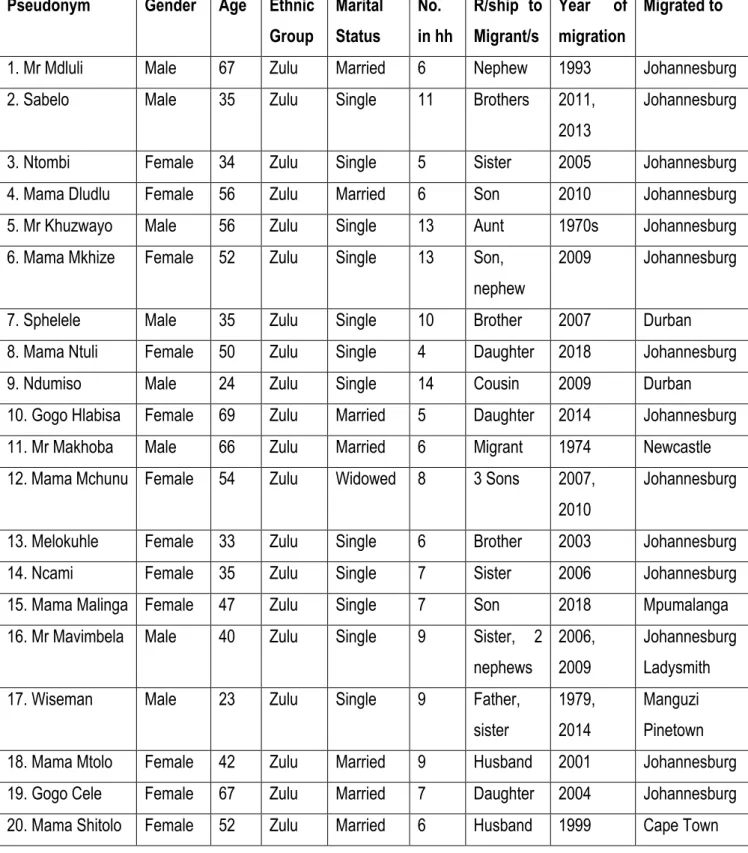
4.2 The Participants and Households………..………….….………..… 43
4.3 The Findings………..…….………..……....…… 45
4.3.1 Household Circumstances ..………... 45
4.3.1.1 Reason for Migration……….………...…….... 45
4.3.1.2 Migration Decision ……….…..……….. 46
4.3.1.3 How Household Member/s Migrated………..………...…. 48
4.3.2 Household Sources of Income……….…………...……...…. 49
4.3.3 The Impact of Migration and Remittances on Migrant Households……..…..………... 51
4.3.3.1 The Remittances and Household Expenditure……….….…...……….. 51
4.3.3.2 Challenges of Migration and Remittances……..…….………..………..…... 53
4.3.3.3 The Relationship between Household and Migrant Member..…...………....… 54
4.3.4 Perceptions of Migration and Remittances by Households……….…….………..………… 56
4.3.4.1 The Impact of Migration on Family Unit………….………..………..….. 56
4.3.5 Channels of Transferring Remittances to Households……..………...….………...….. 57
4.3.6 The Educational Level of Household Migrant Members……….………. 59
4.4 Conclusion…..…………..………..………….………...…..………. 61
Chapter 5- Conclusion and Recommendations
5.1 Introduction………..………..……….……….…. 62
5.2 Summary of the Findings and Analysis………..………..……..… 62
5.3 Conclusion………..…..……….………... 65
5.3 Recommendations………..………..………..………. 66
References………..……….………...……… 67
Tables and Appendixes
Table A- Profiling of Participants ………..……..………..………... 44
Appendixes………...………..………..…………. 76
Appendix A: Information Sheet and Consent Form ………....…………..………...…. 76
Appendix B: Interview Guide Prompts ………..………..…………..……….……… 78
Chapter 1- Introduction 1.1 Introduction
Migration and remittances have remained a worldwide phenomenon that affect different areas in the world. The study of migration and remittances has gained attention due to the trends in migration and remittances both internationally and internally. International and internal migrants who migrates across and within boarders have both contributed to the increasing trends in migration and remittances. The recently upward trends of migrant’s monetary flows has led to the increment of emphasis on remittances, thereby every day gaining more importance research and policy consideration on their impact (Lubambu, 2014). In several places, the incident of migration and remittances is stimulated by such factors. The lack of employment, low salaries and wages and such delays in receiving salaries and wages encourage people to improve their livelihoods through migrating from their areas of origin to work abroad and send remittances (Vladicescu et al, 2008). Migration has contributed to improvement of people’s lives in both origin and destination countries, it has also provided an opportunity for several people to create meaningful lives (McAuliffe and Ruhs, 2018). Thus the incident of migration and remittances is growing and trends are noted.
The number of migrants working abroad has extensively grown, with thousands of young individuals migrating every day from their home countries to secure employment in rich countries and start sending remittances back home in countries of origin (Mehedintu et al, 2019). Through these remittances sent, developing countries are the most benefiting countries in the share of remittances. It is noted that “there are large differences across regions, with the highest gains (in percentage terms) accruing to migrants from Sub- Saharan Africa (619 percent) and the lowest to migrants from the Middle East and North Africa and Europe and Central Asia” (World Bank, 2005:37). This concurs with the findings of Ellyne and Mahlalela (2017) that remittances to Africa have increased substantially and are currently the prevalent source of external financial flows. In addition, United Nations projections pointed out that remittances to the region of Sub-Saharan Africa will keep growing (Migration and Development Brief 31, 2019).This reflects the high volume of migrants from Sub-Saharan Africa to developed regions.
Migration and remittances as external financial flows contribute to the development of origin countries.
Remittances are an in effect indicator of the links maintained by migrants with areas of origin at different levels that are micro, mezzo and macro (Adepoju, 2006). In sending countries remittances have thus became a key source of income thereby boosting their economy. United Nations (2011) asserts that remittances from migrants are a significant and growing source of foreign income for a number of developing countries. Studies found that remittances in other countries are equivalent to more than three
times the official development assistance and can contribute to human welfare and economic development (Migration and Development Brief 31, 2019; Lubambu, 2014). It is documented that remittances have positive impact on the growth of GDP when financial markets are relatively weak (Lubambu, 2014). For instance from 2003, the portion of total remittances in GDP of all developing states has become constant at around 1.75 percent (United Nations, 2011). This reflects that other economies are reliant on the flows of remittances.
Accordingly remittances have been acknowledged as an important mechanism to poverty alleviation.
Remittances are a helping hand sustaining poor migrant households (Adepoju, 2006). Such analysis across countries worldwide have actually indicated the effects of remittances on poverty reduction, as well as remittances ability to alleviate poverty and promote human development are reported as beneficial overall development (United Nations, 2011). The effects of remittances that are due to migration has also transformed countries and households to partake in migration so as to increase their income and improve their well-being. Partly because migration is associated with limiting negative effects on food security for families (Vargas-Lundius et al, 2008).It is a potential mechanism for households to diversify income to overcome their financial crisis situations by means of remittances that reduce poverty and empower households to meet their needs. For instance, remittances have been related with increased household funds for education, health and entrepreneurship where in most situations all of this have high social return (United Nations, 2011).
Frequently, migration is a household strategy to supplement its income hence the decision to migrate is made collectively by the household at large rather than solely individual. To underpin this Vargas-Lundius et al (2008), notes that in general, migration is a household decision and is a highly difficult process which considers different aspect that involve benefits, costs, risks and other aspects that influence decisions to leave or stay in the household. However if expected benefits worth more than any other aspect, household members migrate and then send remittances. Additionally the process of migration and remittances has been characterised by male migrants from rural households. However the increasing number of migrants involve the participation of females in migration especially at the internal level (Posel and Casale, 2003). Thus household member migrate and then remittances through different channels which are either formal or informal transfer channels.
This study focuses on the impact of migration and remittances in migrant households in Endingeni rural area in Ladysmith. This chapter provides a contextual understanding of the problem as well as the rationale and the research problem statement. It also states the main aims of the research and research questions, the value of the study. Finally the chapter will outline the structure of the dissertation.
1.2 Context and Rationale
The rural urban migration is on the rise and it is believed that is due to such reasons that include better livelihoods. Rural areas have few opportunities for generating income, a situation that has persisted for many years. Hughes et al (2007) found that rural migration encompasses the majority of movement in the southern African region over the last 100-150 years ago. Whereas land and infrastructure are part of the reasons for these movements, but employment remain a predominant reason for migration (Muhwava et al, 2013). Every year rural migrants perceive it valuable to migrate to towns and cities to search for work so they can support their families (Rwelamira and Kirsten, 2003). For that reason “migration has been seen as a response to the socio-spatial inequalities as people migrate in anticipation of securing better livelihoods” (Dube, 2015:3). Migration allow migrants to raise income for their families to overcome family financial constraints.
People migrate to urban areas for better income opportunities. Consequently notable migration in South Africa has been particularly circular and benefiting migrant households with remittances. Dzomba (2014), argue that in South Africa considerable circular migration results in remittances being a foremost source of income for the migrant household. It has appeared that in South Africa there is a large number of people who send and receive domestic remittances where this is due to the high number of internal migrants sending remittances to their households (World Bank, 2017). The role played by migration and remittances is often seen as significant in improving household’s livelihoods and is perceived as a more significant process in generating income for various households. The province KwaZulu-Natal is viewed as a sender of migrants whereas Gauteng and Western Cape provinces are net receivers (Rogan et al, 2009). This is partly due to that these provinces appear to have great economic activities than KwaZulu- Natal. Therefore people move from KwaZulu-Natal to these richer provinces and from rural areas to cities.
1.3 Problem Statement
In rural areas there are limited opportunities that can enable people generate income to overcome households’ financial constraints. Therefore many people leave rural places for their families and their lives, this in most cases have such positive impact on the livelihoods of migrant households. In the rural area of Endingeni a large number of people have migrated because of limited economic opportunities that can support their livelihoods and this has continued for years. In general, reasons for migration often originate from various observed benefits that may be achieved by the family if one or more member migrate and send remittances. The central thrust of the study will be ascertaining the impact of migration and remittances as well as migration decision making in migrant household.
Migration and remittances have been a subject matter of concern and affect migrant households in rural areas. Migration is important to migrant households through remittances which are a stable source of income for various families in developing countries, particularly in rural areas (Vargas-Lundius et al, 2008). Thus remittances help mitigate financial restrictions while allowing smooth consumption and overcome difficulties in times of crisis. Actually remittances contribute to the survival and wellbeing of rural households (Vargas-Lundius et al, 2008). They further noted that flows of remittances to rural areas are important for developing regions and lead to economic growth in rural areas.
When migrants migrate, secure jobs and earn income, then send remittances to their families left behind.
Whereas remittances are an important achievement of migration and have positive impact on migrant households. Once households make a costly and risky decision for their member/s to migrate to another area, it generally consists of the anticipation of income increase which is described by the economist as the present value of lifetime earnings (World Bank, 2005).As a results migration is possibly valued as an important means for households in rural areas because of limited income generating activities. Rural households find it valuable for their members to migrate and earn income elsewhere rather than staying in the place of origin while being unable to earn income and improve livelihoods. In the view of World Bank (2005) emigration generally impose hardships on household members in the area of origin, however it also improves household’s income and increase household’s ability to pay costs that reduce those hardships.
In KwaZulu-Natal there are limited studies exist on the impact of migration and remittances and households migration decision making in rural areas. While migration and remittances affects migrant households and remittances are determinants of households in making migration decisions for their members. It is argued that in South Africa most labour migration originated from rural areas, where there are few opportunities for generating income (Posel et al, 2004). However studies examining migration and remittances have predominantly focused on its general impact on communities and on country at large while leaving out its impact on migrant families and migration decision making in rural households.
As rural households believes and participate in migration there is a necessity to find out how do they make decision for migration and how does the process of migration affects them.
1.4 Study Aim
The main aim of this study is to understand the effects of migration and remittances in migrant households in Endingeni rural area in Ladysmith. While in South Africa there is such information and statistics on the impact of migration and remittances in migrants’ households however there is no information and
statistics particular to this rural area. This study aims to fill this gap and contribute in enhancing knowledge in the study of migration and remittances in South Africa and their impact on migrant households.
1.4.1 The Objectives of the Study seeks to:
1. To understand migration decision making process in a household
2. To understand the household’s source of income and the contribution of remittances to overall sources of income.
3. To learn the perspectives of these families regarding the impact of remittances on the household well-being.
1.5 Research Questions
In line with the aims stated above, the following research questions are addressed in this study:
1. How the decision for the migrant to migrate was made?
2. What are household sources of income?
3. What is the impact of remittances in household expenditure?
4. What are the threats faced by the household regarding the role of remittances in the household?
5. How does the family perceive migration and remittances and the relationship with their migrant?
1.6 The Structure of the Dissertation This dissertation is structured into five chapters:
Chapter one is the introduction chapter and provides a context and rationale; the problem statement;
main aims and questions of the research as well as value of the study.
Chapter two provides research methodology of the study. The chapter describe the background of the study; the research design; the sample; explains the data collection and data analysis methods. Finally it presents the ethical consideration that guided the researcher. It further discuss the limitations of the study.
Chapter three presents the literature review which addresses the extent of migration and remittances at both international and internal level (South Africa); the impact of migration and remittances on migrant households, the demographic characteristics of migrants as well as the transfer of remittances. This is followed by theoretical framework which guides the study.
Chapter four presents the discussion of findings of the study.
Lastly Chapter five presents a summary and conclusions of the entire dissertation as well as recommendations based on the findings of the study.
Chapter 2: Research Methods 2.1 Introduction
This chapter describes the methodology that was used in this research. The chapter firstly describe the research design and then presents the sampling. It further presents data source which states the methods used to collect and analyse data, discuss rigour for the study and finally explains limitations of the study.
2.2 Research Design
It is important to have a research design for a research to meet its aims and answer the research question.
This is because it serve as linkage between research questions and aims as well as the implementation of the research. In terms of Adarkwa (2017), research design provide step by step account of method being applied to answer the research question and meet the aims of the research and for that reason it is quiet important in a study. Neuman cited in Alpaslan (2010:16) defined research design “as a plan of strategy, specifying how and from where participants will be selected, the data gathering techniques to be used and how data collection and analysis will be done.” According to Thyer cited in Kumar (2011:96)
“a research design is a procedural plan that is adopted by the researcher to answer questions validly, objectively, accurately and economically.” Thus research design consist of what the researcher want to discover and also determine the best way to do it (Babbie & Mouton, 2001).
For the purpose of this study the descriptive research design was used. Descriptive research design “as its name suggest, descriptive research seek to provide an accurate description of observation of a phenomena” (Nielsen, 2011:25). It is used to provide a detailed description of what was being explored.
A major purpose of many studies in social sciences is to describe situations and events (Babbie &
Mouton, 2001), while the purpose of this study is to describe the situation of migration and remittances on migrant households in Endingeni rural area. In this instance the study chose to use descriptive research design in order to find out the impact of migration and remittances on migrant households in Endingeni rural area in Ladysmith and to learn their decision making and perceptions regarding migration and remittances as well as how does it affects them.
2.2.1 The Qualitative Research Approach
This study has undertaken qualitative research approach with the purpose of having an in-depth understanding of migration decision making process and impact of migration and remittances on migrant households in Endingeni rural area in Ladysmith. Kumar (2011:343) asserts that “qualitative research is based upon the philosophy of empiricism, follows an unstructured, flexible and open approach to enquiry,
aims to describe than measure, believes in in-depth understanding and small samples, and explores perceptions and feelings than facts and figures.” In addition, qualitative research is a form of scientific research that consist of an investigation that look for answers to a question, systematically uses a predefined set of procedures to answer the question, gather evidence, produce findings that were not determined in advance and produce findings that are appropriate beyond the immediate margins of the study (Tolley et al, 2016). The qualitative research is useful for investigating social conditions and clarifying them in detail. It studies people in their natural setting to recognize how their experiences and behaviours are shaped by the setting of their lives (Hennink et al, 2011), where it emphasis is on giving a holistic understanding of the social setting in which the study is conducted. Thus qualitative research is undertaken in this research to understand the experiences, opinions and behaviour of migrant households who receive remittances, how they cope with the situation of migration and remittances and how this impact on their households.
It is argued that qualitative approaches are used in producing knowledge, as well as in design and testing of quantitative questionnaires in order to understand unexpected results of survey and to understand sensitive issues, perceptions, cultural contexts and other components of the social world that are difficult to measure quantitatively (Coastet al, 2009). In addition for complex issues, statistics may show what is happening while not providing the reason why it is happening, so qualitative research may be key to find out why something is happening. The reason of using a qualitative instead of quantitative approach in this study arise from the main aim of the research study, which is to understand migration decision making process and the impact of migration and remittances on migrant households in Endingeni rural area in Ladysmith. Furthermore the qualitative approach allow the interpretation of individuals experiences, opinions and behaviours without being restricted to quantified measures.
According Terre Blanche et al (2006) the qualitative method permit researchers to study issues in depth, openness and in detail as researchers identify and try to understand sorts of information that appear from the data. Thus interactions with people which is the main concern of qualitative research usually help researchers gain deeper insights into why people do what they do. For that reason, in this study qualitative approach is believed to be effective to offer a greater insight and extensive understanding of migration decision making as well as the impact of migration and remittances on migrant household within Endingeni rural area.
2.3 Sampling 2.3.1 Study Area
The study took place in rural area of Endingeni which is located at Matiwaneskop village which has a population of 10075 in ward 24 of Alfred Duma Municipality (Ladysmith) UThukela District Municipality under Midlands Region in KwaZulu-Natal. This is a rural type of community governed by chief and dominated by Africans who speak IsiZulu. Since Matiwaneskop is a village, it consist both activities of rural and urban settlements. Moreover community member’s participation is acknowledged. This may be that community members participate in decision making and in electing their political representatives which are ward councillors. The community has no shopping centres or malls since it is a rural area nonetheless consists of agricultural practices, taxi industry, trading stores and tuck shops. The rate of employment is very low, since employment opportunities are limited. This prompt family members within the community to migrate for labor to support their families through remittances. As a result, migration and remittances has become prevalent in the area as way to escape poverty and improve livelihoods in many households.
This study specifically focused on Endingeni rural area as the area of concern with limited economic opportunities that lead people to migrate for better economic opportunities in urban areas that can benefit them with their families. This research aims at understanding the impact of migration and remittances on migrant households as well as their decision making regarding migration and remittances. Therefore the area of Endingeni was selected for the study because it was easily accessible without difficulty to the researcher as he is based there and possibly would observe the prevalence of migration and remittances impact on migrant households.
2.3.2 Target Population
This is the aggregation from which the sample is truly selected (Babbie and Mouton, 2001). The target population for this study was migrant households who have a member or members who migrated for work and sending remittances to the household. Those households who are within the rural area of Endingeni in Ladysmith where the study specifically focused, including both males and females from remittance receiving households. A total of 20 migrant households from Endingeni were sampled and 20 participants from each of these migrant households were interviewed.
2.3.3 Sample Size
There are approximately 957 households in in rural area of Endingeni in ward 24 of Alfred Duma Local Municipality (Ladysmith). Of these total households a total of 20 migrant households from Endingeni were
sampled and 20 participants from each of these migrant households were interviewed. After a careful consideration of the area of Endingeni this number of 20 was obtained. The area of Endingeni have a dispersed settlement pattern, households in this area are situated far from each other. Thus it was believed that each chosen and interviewed household in the study, is almost on behalf of the large proportion of the area. The small sample size was used because the possibility of obtaining such sample was lessened by several reasons that include funding and time. Consequently the researcher was advised to at least study 20 migrant households.
2.3.4 Sampling Strategy
A sample is a purposefully selection of an element of the whole population to gain knowledge and information (Hollaway and Wheeler, 2010:137). Sampling is an important part of the research procedure and specific sampling method chosen has to be suitable for the research topic and questions. This research used two methods of sampling: purposive and snowball sampling.
A purposive sampling which is also known as judgmental, selective or subjective is a non-probability sample where participants are selected based on characteristics of a population and the objectives of the study (Goodman, 1961). According to Yin cited in Gentles et al (2015:1778) purposive sampling refers to
“the selection of participants or sources of data to be used in a study, based on their anticipated richness and relevance of information in relation to the study’s research questions.” In addition the power and reasoning of purposive sampling lies in selecting participants from which the researcher can explore a great deal about issues important to the purpose of the study and this produces insights and in-depth understanding (Gentles et al, 2015). Thus participants were selected for their ability to provide rich information as the main concern of purposive sampling is the researcher’s judgement as to who can provide rich information to achieve the objectives of the research (Kumar, 2011). In this study, migrant households who receive remittances were chosen as participants.
For instance in the study of exploring the relationship among international migration and remittances in a case of African migrants in Cape Town. Purposive sampling was utilised for the reason that some migrants who send remittances were known by the researcher. In some cases selecting the sample based on researcher’s judgement and objectives of the study is appropriate for the study (Babbie and Mouton, 2001). In this study purposive sampling was preferred for the reason that some migrant households in Endingeni rural area were visible to the researcher, thus in sampling these households the researcher would collect enough data for research objectives.
Snowball sampling which also known as chain sampling, chain-referral sampling or referral sampling is
their acquaintances (Goodman, 1961). The snowball sampling also refers “to process of accumulation as each located subject suggest other subjects” Babbie and Mouton (2001:167). Furthermore it is “the process of selecting a sample using networks. To start with, a few individuals in a group or organisation are selected and the required information is collected from them. They are then asked to identify other people in the group or organisation, and the people selected by them become a part of the sample”
(Kumar, 2011:190). This sampling strategy was used to include any referred migrant household which is a remittance receiving household and willing to participate in the research.
For example in study of understanding homelessness and migratory behaviour snowball sampling was used because homeless people are extremely mobile and difficult to recruit and find. Babbie and Mouton (2001) states that snowball sampling is applicable where it is difficult to locate participants of a specific population. For that reason snowball was used to reach the required number of participants for this study.
2.3.5 Profile of the Sample
Migration and remittances is common within the area of Endingeni, there are many households who have migrant workers and receive remittances. Nonetheless an effort of obtaining a sample of such population came with its own challenges, given their nomadic nature. In this study the researcher approached households of Endingeni who have migrants who migrated for work and send remittances. The researcher asked for their attention and explained the study. Upon meeting with the participants the researcher presented an approach letter which briefly describe the research and also involve details of the study supervisor. The researcher further gave details about the study. Through this participants were clear and willing to participate in the study. Some of them had no problem, they just agreed for the interviews to be conducted at that time while some arranged the meetings for another time with the researcher.
During meetings with the participants the researcher asked them to suggest other migrant households that are within the area. The researcher also asked from participants to pass the message to other migrant’s households who may be willing to participate in the research. Some of the participants referred the researcher to types of participants needed for the study and that is how the study obtained other participants. As a results 20 migrant’s households were selected, where 8 participants were reached through purposive sampling and 12 participants were reached through snowball sampling. These 20 articipants participated very well however 4 of them didn’t want to be recorded but they were willing to be part of the study. They suggested that the researcher can take notes during the interview and they provided some rich information for the study. The researcher took notes and these interviews were a bit
hard to conduct than other interviews but they proved to be successful. After each of these interviews the researcher wrote down everything said by the participants immediately to ensure the availability of data.
2.4 Data Source 2.4.1 Data Collection
Data collection approaches are the means in which a researcher gathers data for the research. There are different major approaches of data that a researcher can use in the research process. Kumar (2011) categorized data collection as primary and secondary data. In the context of this study, the researcher used primary and secondary data. According to Kumar (2011) primary data source provide the first-hand data and the data is collected using the first approach, whereas secondary data source provide the second-hand data which is collected and achieved by other people.
2.4.1.1 Primary Data Collection
Semi-structured in-depth interviews which is a qualitative method of inquiry was used for this study. Boyce and Neale (2006:3) defined in-depth interviewing as “a qualitative research technique that involves conducting intensive individual interviews with a small number of respondents to explore their perspectives on a particular idea, program, or situation.” To add on this, qualitative in-depth interview is a form of framework where the practices and standards are not recorded only, but also completed, challenged and supported (Jamshed, 2014). In qualitative studies interviews are a regularly used form of collecting information. They involve a form of interaction between the researcher and individuals, therefore are considered to be crucial in obtaining information, beliefs and opinions of participants on the study. The interaction between the researcher and participants provide the whole picture of the issue being studied (Boyce and Neale, 2006) as well as participant’s perspective. Due to that interviews give more comfortable atmosphere when collecting information and participants feel free to interact with the researcher as opposed to filling out a survey (Boyce and Neale, 2006:3).
The value of in-depth interviews lies in that they provide more detailed information than what is obtainable through other data collection methods such as surveys (Boyce and Neale, 2006:3). This stipulates that in-depth interviews are useful in studying sensitive issues and in studies that require detailed information.
Within demography and population studies “qualitative approaches incorporate a richness of information that cannot be captured using only quantitative data” (Coast et al, 2009). Thus interviews can provide data on attitudes and behaviour as well as perceptions of individuals on an issue since they collect data in the form of spoken language rather than in numbers. Whereas this offers best information regarding
the experiences of individuals on a certain issue. To underpin this, Henninket al (2011) postulates that the use of interviews is for eliciting information about individual experiences on specific issues.
This research consisted of semi-structured interviews to seek information on experiences of migration and remittances in migrant households. These semi‑structured interviews are made of interview guide, which is a representation of questions need to be explored by the interviewer (Jamshed, 2014). Interview guides help keep the interview focused in an anticipated way and are valuable for exploring and understanding participants more thoroughly. This concurs with that semi-structured interviews allow the researcher to combine a set of pre-determined open questions with the opportunity for the interviewer to explore particular themes or responses further (Terre Blanche et al, 2006). Open-ended questions were used and they allowed the flow of discussion with participants and this provided rich data for the study.
At the start of each interview the researcher read out the consent form and clarified the aim of the research to the participants in a language they understand, particularly in IsiZulu and English. This was to make certain that participants understood what is required by the study and its objectives. As a result a total of 20 interviews were conducted and participants contributed well in the study. A tape recorder was used to record interviews that were conducted in a private and conducive environment to circumvent such any possible disturbances and ensure that the recording sound clear. Moreover questions were included where it was important to seek clarity and further information.
2.4.1.2 Secondary Data Collection
On the other hand secondary data was obtained from the existing sources. Secondary sources of data are generally regarded as existing academic literature. Through literature review the researcher can build upon the existing body of knowledge and hence avoid duplication (Babbie and Mouton, 2001). It is contended that “literature review informs the researcher on what has already been done on the topic as well as the gap within the existing literature” (Adarkwa, 2017:56). This concurs with the assertion of Kumar (2011) that there are incidents when the researcher’s data have already been collected by someone else and the researcher only need to extract the required data for the purpose of his/her research. The study has consequently built upon the findings of other researchers. The selection of findings, concentrated on those that are relevant, drawn from academic sources such as books, journals, articles, internet sources, research reports and dissertations focusing on migration and remittances as well as its impact on migrant households. Additionally, findings were also drawn from relevant international organizations and government reports.
2.4.2 Methods of Data Analysis
Data analysis is the process whereby the researcher bring structure, order and sense of the collected data. According to Terre Blanche et al (2006), data analysis encompasses the researcher to read through his data repetitively and engage in activities of separating the data and building it up again in novel ways.
This study used interpretive data analysis with the aim of offering thick description which is an in-depth description of the characteristics, processes, transactions and contexts that form a phenomenon as well as a description of the role of the researcher in constructing this description (Terre Blanche et al, 2006).
The interpretive analysis of data consist of five steps of analysing the data: familiarisation and immersion, inducing themes, coding, elaboration as well as interpretation and checking. Therefore through these steps:
Recordings were listened multiple times, data was transcribed and summaries of each interview were made.
Languages of the research participants was used to label the categories. The study then looked for common themes from the information provided by the participants.
Different sections relevant to the research were marked and most important points relevant to the research topic were written down and different colour highlighters were used as symbols.
The study explained the information that has not been captured by the original system. For instance the information spoken when the recorder was switched off. This was also the opportunity to revise the coding system.
The study interpreted the data against literature and the theoretical framework.
2.5 Rigour (Trustworthiness)
This element can have any kind of effect between a quality and a poor research approach and findings.
According to Babbie & Mouton (2001:277), trustworthiness is considered as “another approach to clarifying the notion of objectivity as it is manifested in qualitative research, is found in the highly influential work of Lincoln and Guba (1985). For them, the key criterion or principle of good qualitative research is found in the notion of trustworthiness.” Hence trustworthiness is the criteria for judging goodness and quality of a research and is determined by four concepts which show validity and reliability in qualitative research (Kumar, 2011). Additionally, it is about establishing how credible, transferable, dependable and confirmable the research is for it to be accepted as an academic research (Lincoln & Guba, 1985).
Credibility refers to a situation of ensuring that the data collected from the study participants corresponds to the research questions (Babbie & Mouton, 2001). To ensure credibility, the researcher was guided by the interview schedule during the interviews to keep the interviews focused and to limit asking misleading questions.
Transferability is “the extent to which the findings can be applied in other context or with other respondents” (Babbie and Morton, 2001:277). This was reached by ensuring a thick description of data that acknowledges migrant households who are remittances receivers as experts.
Dependability according to Babbie and Morton (2001:278) “an inquiry must provide its audience with evidence that if were to be repeated with the same or similar respondents (subjects) to the same or similar context, its findings would be similar.” This research report is made point by point clarifying data collection and data analysis so that the review could be reproduced. The study utilized request review with a specific end goal to build up trustworthiness: research supervisor had to analyse the research procedure, interpret the research data and the data analysis to guarantee that the discoveries are reliable and review can be repeated.
Confirmability refers to “the degree to which the findings of the research study were the product of the focus of the inquiry and not the biases of the researcher involved in this inquiry” (Babbie and Mouton, 2001:278). Additionally this “refers to the degree to which the results could be confirmed or corroborated by others” (Kumar, 2011:172). This was achieved by submitting the transcripts of the interview recordings and the field notes to research supervisor to review.
2.6 Limitations
i) Other participants did not attend the interview on the time agreed and even thereafter when rescheduled. Snowball sampling was used to get other participants.
ii) Some participants were not concentrating during the interview and thus they were not providing rich information, therefore snowball sampling was used to get other participants.
2.7 Conclusion
This chapter discussed the methodology that was used in this research project. The chapter also revealed the research design that was used, the sample population and how the sample was selected and then data verification. This chapter included discussion on methods of how data was collected and analysed and study limitations.
Chapter 3- Literature Review 3.1 Introduction
Since the past decades, the flows of migration and remittances worldwide are growing in a large extent (United Nations, 2017). The relationship between migration and remittances receive much interest for researchers and policy makers. The literature on international migration is growing due to the high levels of migration. Researchers contended that there has been a globalization of migration, which is the propensity for an ever increasing number of countries to be crucially affected by migration (De Haas et al, 2018). Migration has accelerated over the past decades, migrants migrates over progressively long distances where origins and destinations have become substantially more diverse (De Haas et al, 2018).
As a result this drastic international migration has influenced the flows of remittances and therefore it is of important in this context to recognize the increased possibilities of migrants which lead to remittances, thereby having such impact on migrant families. Notwithstanding the often more substantial international migration flows between global countries, this study focuses on internal migration. Moreover the literature on international migration is broad and migration is said to have effects on households, communities and countries of origin at large through remittances (Hagen Zenker 2015). As a result this literature per se, discusses some of these effects.
In this case, motives of migration will be explored and the way in which migration and remittances affect migrant families. For instance migration is perceived as a way to escape financial hardships in a family by sending a member to earn income elsewhere (Stapleton, 2015). This may suggest that if labour is considered as an export then remittances are a portion of the compensation that returns to the place of origin for exporting labour services (Taylor, 1999). Thus households send their members to such destinations and then benefit from remittances sent by these members. This concurs with the premise that migration is seen as an investment on the part of migrant and the household, where investment returns produce greater earnings in a destination (Yang, 2015). This may happen as a result of household desire to overcome financial strain and improve livelihoods.
This study explores the impact of migration and remittances on migrant households in Endingeni rural area in Ladysmith. This chapter addresses the level of migration and remittances, internal migration in South Africa, the impact of migration and remittances on migrant households. In addition, it addresses the demographic characteristics of migrants as well as the transfer of remittances. The New Economics of Labor Migration theory will be used as the theoretical framework guiding this study. Lastly, there is conceptual framework supporting the theoretical framework.
3.2 The Level of Migration and Remittances
The increasing numbers in migration has been the subject matter of concern worldwide. This is believed to be facilitated by different reasons which include economic opportunities for better livelihoods. As migrationis used as a source of support for families to improve their livelihoods through remittances sent by their members who migrated to earn income for the family (Rwelimira and Kirsten, 2003). This means migration generates key positive returns for the migrant in the place of origin. For instance “migrant remittances have made possible a drastic improvement in the living conditions of millions of households in migrant-sending countries” (De Haas, 2005:1277). In this section the extent of migration and remittances will be discussed in three parts; firstly globally, secondly sub-Saharan Africa and then lastly South Africa.
3.2.1 Global
Due to economic, demographic, socio-cultural and political reasons that influence migration it has been found that “one of every seven persons in the world is a migrant, and there are 250 million international migrants and more than 750 million internal migrants” globally (Migration and Development Brief 27, 2017:13). Migration is increasing at both international and internal level. Large numbers of people have become migrants globally as migration currently seems to be easily initiated through modern transportation, which has facilitated the movement of people by making it easier and less costly to migrate (United Nations, 2017) from one area to another. As a result even if people are in search of better life for themselves and their families, migration becomes a means to achieve this through modernization.
According to Samuel and George (2002), the improvement of communication and transportation has facilitated migration process. Through communication, migrants become aware of migration destinations.
The modernization brought about such useful sources of information for migrants, which include electronic media, internet and social networks that raise awareness and give information to access of better life opportunities in destination areas (Samuel and George, 2002). Moreover the networks between migrants and non-migrants also contributed to migration. It is said that social networks formed by earlier migrants from one's own family and community of origin further encourage migration (Samuel and George, 2002).
In the current century various changes have been noted in migration. Particularly in the last two decades, international migration has increased in the recent years from 173 million in 2000 to 220 million in 2010 and to 258 million in 2017 (United Nations, 2017). Among these numbers, labour migration is considered to be one of the foremost factors contributing to migration increase (Wester, 2017)since it usually occurs voluntarily after the migrant has weighed the benefits of migration.
Most of the migrants are said to be found in developed parts of the world where most of them come from developing regions. According to United Nations (2017), two thirds of international migrants, about 64 percent, which equals to 165 million migrants live in high income countries. These countries are located in developed regions of Asia, Europe and North America. Highest receiving countries for international migrants in 2017 includedUnited States, Germany and Saudi Arabia.Among top sending countries India was leading followed by Mexico which have 11.9 million migrants in US in 2017 (Migration and Development Brief 29, 2018). These regions may be considered to have better opportunities that benefit migrants. For instance this is also noted on internal migration where migrants are mostly found in urban areas coming from rural for opportunities that can benefit them and share their earnings as remittances with their households behind.
Due to migration, remittances have been found to have a positive impact on migrants and their families’
in areas of origin. This may be that in some cases migration decisions often stems from family as a strategy to supplement income. There is an estimated amount of $413 billion that has been sent to countries of origin as remittances by migrants in 2016 (United Nations, 2017). This amount of remittances has increased over the years due to increasing migration levels. The inflow of remittances to countries of origin has increased (Migration and Development Brief 29, 2018). In addition, as large proportion of migrants is found in high income countries, this is the reason for remittances inflows to developing countries. Catrinescu et al (2009), argue that for various countries, remittances have driven macroeconomic development for the most part by increasing national disposable income.
Remittances have accelerated, for instance “remittance flows to low- and middle-income countries (LMICs) increased by an estimated 8.5 percent in 2017, to reach $466 billion” (Migration and Development Brief 29, 2018:3). Nonetheless a new record has been set where “Remittance flows to low- and middle-income countries (LMICs) grew by 9.6 percent in 2018 (up from the 8.8 percent rise in 2017), to reach a record $529 billion”(Migration and Development Brief 31, 2019:1). In the distribution of US $ billion remittances, top recipients of them are Asian countries followed by other countries from America and Africa. This is that in 2018 - India, China, Mexico, Philippines, Egypt Arab Republic and Nigeria were top six highest recipients of remittances inflows (Migration and Development Brief 31, 2019).This suggest that large number of migrants in developed nations come from some of these countries. As by 1990 the Mexican population of origin covered 6 percent of the total US population (Massey et al, 1994).
The increase flows of remittances is the results increase migration and is also explained by the increased competition in the remittances market, transfer costs, more remittances flow into formal channels as well as the improvement in capturing remittances in many developing countries (Vargas-Lundius et al, 2008).
Moreover the increased remittances may be also noted as due to internal migration also not international migration only. For instance Vargas-Lundius et al (2008) asserts that there is a rising number of individuals migration between developing nations or internally. For instance “in Vietnam, 4.3 million people migrated internally between 1994-9, compared to only 300,000 who left the country” (Crush, 2007:4). This postulate that in some countries internal migration outnumber international migration, thus people migrate more internally rather than internationally.
3.2.2 Sub- Saharan Africa
In the developing region of sub Saharan Africa, it has been observed that migration and remittances also take place. It is said that sub Saharan Africa is one of the regions that have faster growth of international migrants. According to United Nations (2017:5) “between 2000 and 2017, the number of international migrants in Africa and Asia grew by an average of 3.0 and 2.8 per cent per annum, respectively.”
Additionally in the sub-Saharan Africa, it is argued that South Africa is a major hub of international migrants especially from African countries, China and India (Hughes et al, 2007). Thus most of the international migrants in Africa are found in South Africa. This is evidenced by that it is the only African nation that appear among the top 18 immigrant’s destination countries which are said to host half of world migrants (Keynes, 2019).
Furthermore, South Africa had the highest number of immigrants in the top 20 African migrant countries in 2015 (McAuliffe and Ruhs, 2018). South Africa hosts the large number of migrants in the region and in Africa and 67.1 percent of these migrants come from Southern African Development Community (SADC) (Hughes et al, 2007). This means it is also a hub of intra-regional migration for countries in the southern African region. It is claimed that intraregional and internal migration in developing nations is usually far more essential than abroad migration in terms of the number of people involved, particularly from rural areas (Vargas-Lundius et al, 2008). In addition to this in most cases internal migration is often found to surpass international migration. For example, evidence in South Africa suggest that in year 2001 the province of Gauteng had the total population 8.8 million while 3.6 million of these people were internal migrants from other provinces and 473 000 were international migrants from other countries (Crush, 2007). Thus people migrate to better their livelihoods and in the region migration to South Africa is crucial to countries of origin due to migrant’s remittances.
In the sub Saharan African region there was limited literature in terms of remittances. Nonetheless, this has evolved over time as migration is on the rise, such literature is gradually becoming available in the region. Adarkwa (2017:21) stated that:
“Transfer of remittances to families and friends of migrants from Africa has gradually gained the attention of actors and agencies of development as its significance to economic development becomes more and more self- evident and data on inflows become more readily available.”
Over the past years, the study of migration and remittances has gained attention, partly because of growth in migration and remittances flow. For instance this can result to an expanding of detailed literature on remittances in the sub Saharan African region. According to Migration and Development Brief 29 (2018:33), remittances to the region of sub Saharan Africa “grew from $34 billion in 2016 to $38 billion in 2017 and they are expected to continue to grow in 2019.” Whereas the largest remittance recipient nations in sub-Saharan Africa who accounted for more than 50 percent of remittances in the region in 2017 included Nigeria, Senegal, Ghana and other countries were trailing behind.
3.2.3 South Africa
Still on sub Saharan Africa, the focus on international migration found that most labour migrants in the region are attracted into one country. In sub Saharan Africa the southern African region experience more number of migrants. McAuliffe and Ruhs (2018) states that the southern African region through the advantage of its strong economic location in the continent encounters a high volume of migration because of job opportunities in the mining, agricultural and manufacturing industries. Among these volumes of migrants to the southern African region, South Africa is the most targeted destination. It has been asserted that “in terms of the number of immigrants, South Africa is the most significant destination country in Africa, with around 3.1 million international migrants residing in the country (or around 6% of its total population)” (McAuliffe and Ruhs, 2018:46). Most of these migrants are said to originate from Zimbabwe. Since year 2000, South Africa experienced more volumes of Zimbabwean migrants (Makina, 2013). Zimbabwean migrants enter the country due to economic reasons that have led to market failure in their country. Therefore in South Africa as their destination country, they hope to find better effective economy that may help them lift up their families back home. For that reason these migrants send remittances to support their relative’s livelihoods (Makina, 2013). As a result this forms part of migration and remittances sent from South Africa to SADC countries. Where the value of R6.1 billion (US $820 million) was sent from South Africa to SADC countries (Hughes et al, 2007).
Furthermore it is said that the region is still experiencing migration flows. These flows mostly originate from Ethiopia and Somalia and involve mixed migrants including economic migrants (McAuliffe and Ruhs, 2018). The continuous flows of migration has impacted on growth of population in the country. Among components of population change, migration remain to be significant and not only demographically but
destination by international migrants in the country is Gauteng. In this instance, Stats SA (2018) ascertained that large number of international migrants is found in Gauteng (47,5%) whereas the least settle in Northern Cape province (0,7%). Hence Gauteng is considered the main economic hub for migrants in the country as it pull both international and domestic migrants from rural provinces for instance KwaZulu-Natal, Limpopo and Eastern Cape (Stats SA, 2018). Migration for economic reason has persisted as a predominant influence of migration in South Africa and has led to high migration.
3.3 Internal Migration in South Africa
International migration is said to be high at all times as there is large number of people living outside their countries of origin. However “internal migration within countries is even more voluminous” (Crush 2007:4).
In South Africa per se internal migration has been noted and is growing. It is said that “there are many people who cross inter-provincial boundaries for work but maintain close links with their household in another province” (Crush, 2007:16). This suggest that migration in South Africa is generally circulatory since most of the internal migrants migrate for work while maintaining ties with their families left behind in places of origin. Migration across provinces in South Africa whether permanently or temporary is extremely important for the reason that since the end of apartheid migration has accelerated and is continuing to grow (Crush 2007).
South Africa experience growth in both international and internal migration since pull and push factors attract and compel people to migrate. The 1993 Project for Statistics on Living Standards and Development (PSLSD) and the 1995, 1997 and 1999 October Household Surveys found that in 1993 there were more than 1.3 million households who reported migrant worker as their members and in 1999 there was an increase to 1.7 million households (Posel and Casale, 2003). The increase may be due to such reasons that can also include bureaucratic system changes that took place in the country, which involve change from apartheid to democratic government. However as people always move within and around the country, it become difficult to have exact information on migration. Mazars et al (2013), estimated about 3 million international migrants and argued that it is difficult to obtain accurate data and total number of migrants in South Africa because of inadequate data collection systems and incident of irregular migration.
Internal migration seem to have increased in South Africa in the last decades, where more people moved to urban areas to seek financial support for their families left behind. This indicate that South African population is extremely mobile as “nearly 5 million people are estimated to have changed their province of primary residence since 1992. This is far larger than the number of international migrants either arriving
in or leaving South Africa” (Crush, 2007:17). Furthermore such trends have been noted and this is evidenced by that in “2015, 31% of South African adults (11.6 million individuals) either sent or received money to or from family members, parents, and children in the past 12 months” (World Bank, 2017:87).
This postulate that South Africa has large volumes of internal migrants. As it has been noted that the volume of internal migrants in the country is large and growing since the end of apartheid (Crush, 2007) typically these are labour migrants who migrate for work.
3.3.1 The History and Pattern of Migration in South Africa
In South Africa there is a long history of labour movement, stretching from the late 19th century due to the discovery of diamonds and gold mines in Gauteng (Stapleton, 2015). Migration to mines became prevalent, where people migrated from rural areas and also from outside the country to these mines for employment. This has been an alternative for poor livelihoods in rural areas, where their economy is low and also for financial contingencies that would occur. According to Nagarajan (2009), migration is frequent in rural areas and is considered as a strategy of improving households livelihoods.
In addition, rural families are trapped in low economies, so their process of overcoming this is migration.
Low economies of rural areas have long contributed to migration and has been the most cause for rural- urban migration pattern. In terms of Hughes et al (2007), rural-urban migration is the large component of movements in the Southern African region over the past 100 to 150 years. In addition to this, historically, migration of people from rural to urban areas in South Africa was an integral part of partaking in labour market and also individual and households plan for better living standard (Casale and Posel, 2006). This form of migration has led to major growth of migration in the country. Such better opportunities of economy in urban areas than in rural are a most important magnetisms of migrants.
The transformation from apartheid era to democracy in South Africa has impacted on migration and its patterns. Migration in the country originated from racially discriminating policies of apartheid that almost restricted migration and settlement of non-whites in destination areas (Stapleton, 2015). This prohibited permanent residence as it made it impossible for migrants to permanently stay in destination areas. The Group Areas Act No. 41 of 1950 divided South African cities and towns into separated residential and business areas while removing Coloureds, Blacks and Indians from areas classified for white employment, it required physical separation and isolation among races by creating residential areas that are different for each race (Group Areas Act, 1950). Thus migrants had to migrate temporary and this resulted in a circular pattern of migration, where people have to migrate to work in urban and then come back home in rural areas (Stapleton, 2015).