TASMAN DISTRICT COUNCIL
ANNUAL REPORT
30 June 2016
V2
Message from the Mayor and Chief Executive Officer ...
Part 1 Overview
A Year in Review – our highlights from 2015/2016 ... ...5
Our Non-Financial Performance at a Glance ... 13
Key Financial Information ... ………Error! Bookmark not defined. 19 Part 2 Council Vision and Community Outcome Tasman District Council Vision Statement: ... Error! Bookmark not defined. 24 Tasman District Council Mission Statement ... Error! Bookmark not defined. 24 Community Outcomes ... Error! Bookmark not defined.24 Part 3 Roles, Compliance and Audit Statement The Role of the Annual Report and Financial Statements ... 27
Statement of Compliance and Responsibility ... 28
Independent Auditor’s Report ... 30
Part 4 Financial and Non-Financial Performance Statements of Objectives and Service Performance ... 31
Environment and Planning Engineering Community Development Governance Commercial Enterprise Support Services Part 5 Financial Statements ...144
Statement of Accounting Policies ... 145
Statement of Comprehensive Revenue and Expense... 147
Balanced Budget Statement of Financial Performance ... 148
Statement of Financial Position ... 149
Statement of Cashflows ... 150
Statement of Changes in Equity ... 151
Council Funding Impact Statement ... 152
Statement of Commitments ... 153
Statement of Contingent Assets and Liabilities ... 154
Part 6 Notes to the Financial Statements ...156
Note 1. Summary revenue and expenditure for groups of activities ... ……. 157
Note 2. Rates... ………158
Note 3. Other revenue ...160
Note 4. Subsidies and grants ...161
Note 5. Fees and charges ...161
Note 9. Tax ...164
Note 10. Cash and cash equivalents ... …….165
Note 11. Trade and other receivables ... …….166
Note 12. Derivative financial instruments ... …….168
Note 13. Other financial assets ... …….169
Note 14. Property held for resale ... …….172
Note 15. Property plant and equipment ... …….172
Note 16. Intangible assets ... …….181
Note 17. Depreciation and amortisation expense by group of activities ... …….183
Note 18. Forestry assets ... …….184
Note 19. Investment property ... …….185
Note 20. List of associates ... …….186
Port Nelson Ltd ...186
Nelson Airport Ltd ...186
Nelson Bays Heritage Trust ...186
Note 21. Interest in Joint venture ...188
Note 22. Trade and other payables ...191
Note 23. Provisions ...192
Note 24. Employee benefit liabilities ...193
Note 25. Borrowings & Finance lease ...195
Note 26. Revaluation reserve ...197
Note 27. Accumulated equity ...197
Note 28. Reserve Funds...198
Note 29. Cashflow reconciliation ...201
Note 30. Related party transactions ...202
Note 31. Severance payments ...203
Note 32. Remuneration ...203
Note 33. Financial instruments ...204
Note 34. Capital management ... 207
Note 35. Urban portions of the State Highway Network ... …….207
Note 36. Significant variances compared to the Annual Plan ... ... …....208
Note 37. Events occurring after balance date ...209
Note 38. Elected representatives ...210
Note 39. Financial performance in relation to financial regulation benchmarks ... …...211
Note 40. Rating base and insurance of assets ... …...221
APPENDICES Appendix One – Applications Processed ……….223
Appendix Three – Community Boards ... 2274
Appendix Four - Management Staff ... 2287
Appendix Five – Report on Māori Consultation Policy ... 2298
Appendix Six - Glossary of Terms ... 231
Directory ... 235
1
2
Welcome to Tasman District Council’s Annual Report for 2015/2016. This is our chance to tell you about what we have achieved during the year - our successes, and our challenges.
In the past year, we’ve seen our organisation tackle some key issues facing the District while working steadily towards the goals set out in the Long Term Plan 2015-2025. While we’ve particularly focused on the goals to reduce debt and improve Council’s financial resilience, we’ve also worked hard to make sure communities have been able to enjoy the facilities, parks, events and services that make Tasman such a great place to live.
Along with maintaining all our usual assets and services, we’ve been able to invest $26 million in capital works throughout the District over the past year. This includes progressing some large projects such as the Richmond Central upgrade, Golden Bay Community Recreation Facility, Motueka Wastewater Treatment Plant upgrade and the Saxton Velodrome.
While it’s difficult to do justice to all that has been achieved during the year, we’ve highlighted some of the bigger projects, and what is new and different in the next few pages. You’ll see that nearly all of the projects we deliver and services we provide enhance the lives of people or the environment in our District.
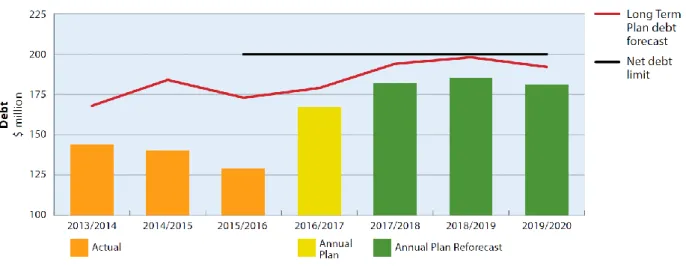
We’re pleased that this Annual Report shows our financial performance is much better than forecast and we are tracking well ahead of our self-imposed rates and debt limits. We ended the year with net debt of $129 million compared to the Annual Plan forecast of $173 million. The operating surplus was $9 million better than budgeted.
The positive financial outcome is a result of significant operational savings, and not having to spend all of the money budgeted for emergency works and clean ups. Also, our borrowing is less than budgeted due to some of our capital works programme being delayed, we’ve paid off more debt than we expected and we have more cash in the business because of ongoing population growth – among other things. Low inflation and low interest rates have also assisted us.
In the coming years ratepayers will benefit from these better-than-expected financial results. Whether that is through reduced rates, repayment of debt, carrying surpluses forward, creating reserves or spending more is a matter for the future Council to decide. But we are confident that if we maintain a strong financial position, we can meet our aims of keeping rates increases to a minimum, building our emergency fund in readiness for future natural disasters and reducing our reliance on debt.
Pleasingly, the results in this Annual Report show we are maintaining service performance levels across our core infrastructure services, despite the funding constraints we imposed in our Financial Strategy and a 26% rise in building consents for new dwellings. Population growth in wards like Richmond, Moutere-Waimea and Motueka continues to put pressure on Council to ensure there is sufficient land, infrastructure, community facilities and services.
We’ve seen good support from the community for the work we do with 74% of residents satisfied with the way rates are spent on the services and facilities provided by Council. Even with generally positive feedback from the community, we know that there is still work to do in some areas to lift our performance to meet residents’
expectations.
You’ll see in this report that we have been working towards addressing some broader issues for the District, such as planning for population growth and developing strong partnerships with Nelson City Council.
Finally, we would like to thank the community, councillors, community board members, staff, and contractors alike for your contributions through-out the year.
[photo] Richard Kempthorne, Mayor [photo] Lindsay McKenzie, Chief Executive Officer
3
1. Addressing Rates Affordability
In 2015/2016 rates income rose by 2.1%, after growth, which was below the Financial Strategy limit of 3%.
The Annual Plan 2016/2017 delivered a 1% rates income rise, well below the 2.96% forecast in the Long Term Plan 2015-2025 for the 2016/2017 year. The forecast for subsequent years continues to be below 3%.
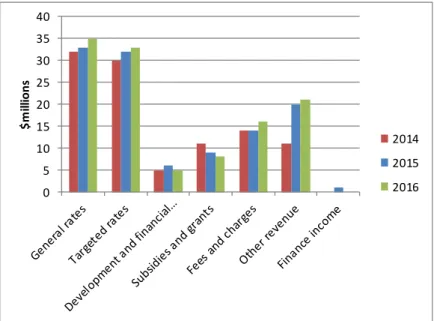
We continued to work within the fiscal envelope set in the Long Term Plan 2015-2025, which imposed a limit on general rates of $51 million per annum and targeted rates of $46 million per annum. In 2015/2016 general rates were $35 million and targeted rates were $33 million.
2. Managing the Council’s debt
Debt for 2015/2016 reached $129 million, which is well below the $200 million limit set in the Financial Strategy and $44 million less than forecast in the Annual Plan 2015/2016. Debt has been reduced by directing savings from operational budgets, favourable interest and borrowing conditions, a lower opening debt position than budgeted, delays to some large capital works, and higher than anticipated income due to things like higher population growth than forecast. We’ve also received increased dividends which have been used to pay down debt.
As part of meeting our financial goals, we are progressively funding deprecation on assets from cash flow.
We also indicated we would conduct a review of assets for potential sale in order to reduce debt. This work has been delayed as we've focused on other priorities.
3.Developing Resilient Communities Part A: Providing a secure water supply
Through the Long Term Plan 2015-2025, we committed to continue working on developing the Waimea Community Dam project to create a secure water supply for Waimea water users. The Plan allocated $25 million over the 10 years towards it. During the past financial year we spent approximately $600,000 on progressing this project. Further funding and governance decisions have yet to be made on the Waimea Community Dam. The community can expect further consultation prior to a final decision to proceed. The Long Term Plan 2015-2025 also committed Council to review options to improve water conservation, and this work is set to commence in 2016/2017.
Part B: Hazard Planning and Provisions to Recover from Disaster Events
Hazard planning has been focused on developing the Richmond Stormwater Catchment Management Plan.
We also allocated $1.24 million in the 2015/2016 budget towards the Disaster Recovery Fund. These funds were not used during the year due to favourable weather. The target for the fund is $6.5 million. At the end of 2015/2016 total funds reserved for Disaster Emergencies totalled $4.9 million.
4
experiencing the highest levels of growth. In the last year, building consents for dwellings rose by 26% from the previous year. This is a significant increase and impacts how we provide services, where they are provided and how we plan for the future. A review of Council’s Growth Strategy is underway in 2016. We have also initiated a number of zone plan changes, including for Richmond, Brightwater and Wakefield to enable future growth to be accommodated.
We spent approximately $26 million on capital works over the last year including local road improvements, the Motueka Wastewater Treatment Plant upgrade, completion of the Richmond Water Treatment Plant, and starting works on the Golden Bay Community Recreation Facility and Saxton Velodrome, among many others. Further extensions of infrastructure are planned for Richmond South, Richmond West, Motueka and consolidation of development around the existing settlements of Mapua and Wakefield.
Part B: Development contributions policy changes
The Development Contributions Policy was amended through the Long Term Plan 2015-2025 to incorporate legislative changes and increase charges by 18% overall. Development contributions for 2015/2016 provided $4.7 million income to Council. The list of projects that are funded by Development Contributions is included in the Long Term Plan 2015-2025. We will review the Development Contributions Policy prior to the development of the next Long Term Plan (2018-2028).
5. Maximising Regional Opportunities
Council is seeking to maximise regional opportunities and benefits from its investments to ensure efficient delivery of services through collaboration with Nelson City Council.
Activities that have further developed regional collaboration in the past year include the proposal for a joint committee for a regional landfill, work on a shared roading contract process, and a shared Land Development Manual that will set the same standards for development across the two councils.
We’ve also been working with Nelson City Council and Marlborough District Council on the Digital Enablement Plan (DEP). The DEP aims to achieve enhanced high-speed broadband and internet connectivity across the regions.
We remain committed to progressing a memorandum of understanding with each or all iwi in Te Tau Ihu (top of the South) and have been in discussions with several iwi over the past year.
While we haven’t undertaken any specific review of existing funding of ‘out of Tasman District’ activities, we continue to ensure that any out of District funding spent does deliver outcomes for Tasman residents. No new out of District funding activities have been entered into during the year.
Tasman District and Nelson City Councils have held discussions during the year on the future governance arrangements for Saxton Field. The current proposal, which will be considered by both councils following the October 2016 elections, is for a new joint committee between the two Councils to be formed to govern the Saxton Field complex.
5 1. Delivering more recreation opportunities to our communities
Along with maintaining the recreation facilities we already have, we’ve been working on the following new projects:
The next stage of Tasman’s Great Taste Trail
The next stage of Tasman’s Great Taste Trail – from the Wai-iti domain through Spooner’s Tunnel to Kohatu - opened in April 2016. This stage of the Trail has been made possible by the contributions of landowners, volunteers, Nelson Tasman Cycle Trust, donations, funding from the National Cycleway Project Fund and Tasman District Council.
A survey carried out early this year shows Tasman’s Great Taste Trail is growing in popularity and having positive social and economic benefits for our District and wider region. The research shows a marked increase in rider satisfaction – 94% in 2016 up from 88% in 2015.
Progressing development of Saxton Field
We’re part way through constructing a new cycling facility for the Nelson/Tasman region, which includes a new velodrome. The Saxton Velodrome will be a community facility suitable for cyclists of all ages, skills and fitness levels. The velodrome will be open to use for the general public.
The project is being funded by Nelson City and Tasman District Councils, which are contributing 80% of the total cost. The Saxton Velodrome Trust is charged with raising the remainder (approximately $320,000). The project received a significant funding boost with The Canterbury Community Trust (now Rata Foundation) providing a
$100,000 grant. Tasman District Council is overseeing the $1.6 million project, situated at Saxton Stadium.
Despite some delays due to weather holding up earthworks, construction is expected to be completed in early 2017.
Complementing the Saxton sports field facilities is a new toilet and changing facility at Avery’s Field. This is a welcome addition for the many children and athletes who regularly play sports there. We have also developed new sportsfields to the south of the Velodrome, which are now known as “Champion Green”.
Constructing the Golden Bay Community Recreation Facility
Physical progress on the new recreation and community centre at Golden Bay is underway. We have been actively planning for the new facility since 2010, in partnership with the Golden Bay Shared Recreation Facility group (GBSRF). The building in Takaka’s Golden Bay Recreation Park will house a gymnasium with indoor netball court, two outdoor netball courts, two squash courts, toilets, changing rooms, and community and function rooms. We budgeted $3.3 million towards the total project, with the community raising $830,000 to see it
completed. An additional $150,000 was allocated to pay for additional site remediation, after work on the project was delayed due to unexpected ground conditions.
We’re also working with Heritage New Zealand on a decision to remove or keep the existing grandstand.
Reviewing the Moturoa/Rabbit Island Reserve Management Plan
Consultation on proposals for the future of Moturoa/Rabbit Island started in November 2015. Over the summer of 2015/2016, 660 individuals and groups let us know what they love about Moturoa/Rabbit, Rough and Bird islands, what they think should change and what should stay the same. That feedback was used to develop the Draft Moturoa/Rabbit Island Reserve Management Plan. This Plan was then formally consulted on in June and July 2016.
Developing Walkways and Reserves
The network of walkways and reserves expanded across the District during 2015/2016, with four new reserves added, and walkways established in Wakefield from Edward Street to Faulkner Bush; and in Motueka we have completed a new concrete path through Eginton Park linking Mofffat and Pethybridge Streets; and we have completed a new walkway link from Michael Myers Street to Eginton Street. In Richmond a walkway from Meadow Lane to Forget-Me-Not Lane was established.
Takaka’s Memorial Garden redevelopment was completed and planning for a new playground at the memorial reserve got underway.
6
two to three years.
2. Improving our road network and streets
We’ve got a large road network to look after and undertake ongoing improvements. Some of the larger projects include:
Major Queen Street works to begin in 2017
A major project to upgrade underground pipes and the total replacement of the surface of Richmond’s Queen Street has been confirmed. Planning and design work has been completed in 2015/2016, including consultation with residents and businesses likely to be affected by the works. We anticipate starting extensive road works in early 2017. The $9.5 million project aims not only to upgrade services, but also to reduce the risk of flooding in severe rain storms and replace the street surface with a safer, more pedestrian-focused design.
Reducing road speeds around our schools
In response to community concerns about the safety of children walking and biking to and from school, we’ve installed variable school speed zones for Motupipi, Hope and Ranzau schools. We’ve also installed static “40 When Children Present” signs at another five Tasman schools – Brooklyn, Mapua, Lower Moutere, Appleby and Mahana.
In addition, better standard school warning signs were installed at Central Takaka, Dovedale and Ngatimoti schools.
Reducing flood risks at Champion Road
All the major works on the Champion Road culvert, a project to reduce flooding of properties in Champion Road and the Saxton Road area in major rainstorms, are now complete. The project suffered some delays and has taken several months longer to complete than expected. The new culvert will able to handle one-in-100-year floodwater flows from Saxton Creek.
Upgrading Motueka streets
Motueka streets are safer and more attractive because of two completed projects this year. An upgrade of the Queen Victoria Street-Whakarewa Street intersection was designed to make the intersection safer. This is the third intersection in Motueka where safety improvements have been undertaken in recent years.
In addition, unsightly overhead power and phone wires have been moved underground along a section of High Street, Motueka creating a much clearer and more attractive streetscape. So far, lines along High Street from Wharf Road to Whakarewa Street have been buried. New power and telecommunications cables were installed underground, as well as cabling to allow for broadband services. Network Tasman managed the project, while the Council and Chorus contributed funding.
3. Servicing our communities with good quality infrastructure
Delivering good quality, cost effective wastewater, stormwater and drinking water infrastructure are some of our core activities. This past financial year has seen some important projects get underway, and others completed including:
Motueka Plant Upgrade delivers improvements
An upgrade of the Motueka Wastewater Treatment Plant is advancing well and is expected to be complete by the end of 2016. Wetland planting will then occur over the following two years. The staged upgrades are already showing big improvements in bacterial concentrations and odour. The upgrade is intended to keep the Motueka River and Tasman Bay clean and safe by greatly improving the treatment system at the plant.
Water meters set for replacement
In March 2016 we began replacing ageing water meters as part of our ongoing programme to keep the District’s water reticulation network well-maintained. During 2015/2016 work was undertaken in some streets in Richmond and all of Motueka, Kaiteriteri and Riwaka. Further replacements will be ongoing.
7 Stormwater planning in Richmond
During the past year we have been planning major upgrades to our underground pipes along Richmond’s Queen Street, as part of the Richmond Central project that commences in 2017. Some minor works, such as replacing a water main, will take place later this year.
We’ve also been undertaking an ongoing programme to widen Borck Creek and other water courses in the Richmond catchment to improve stormwater discharge as well as amenity and environment values.
3. Managing contamination risks to drinking water
Council operates 15 separate water supplies in the district. Most of these are chlorinated, however four are not.
Two of the unchlorinated supplies: Upper Takaka and Richmond, have UV disinfection, which provides protection from both bacteria and protozoa. Richmond also has emergency back-up chlorination, in case of emergencies.
The other two supplies; Motueka and Kaiteriteri have deep bores and currently have no treatment. Both of these plants are being upgraded in the next few years, with Kaiteriteri due for completion by mid-2017. Both of these schemes will also have emergency chlorination installed.
Some of the chlorinated schemes also have UV treatment (Murchison and Tapawera), and council are working through a programme of upgrades to add UV treatment (or an alternative) to the rest of the supplies. Chlorination is effective at killing bacteria, but is not effective at killing protozoa, and so to achieve protozoa compliance with the NZ Drinking Water Standards most plants have been or need to be upgraded in some way.
The Dovedale Water scheme is an exception in that it is an old stock water scheme and has a permanent boil water notice in place. Whilst this scheme is chlorinated, the chlorine is not always effective. Boiling water before drinking will kill both bacteria and protozoa.
All of the schemes are regularly monitored in line with the Drinking Water Standards. This includes taking bacteriological samples which are analysed in a lab for E. coli, an organism which indicates faecal contamination.
Chlorine levels and other water quality parameters are continuously monitored leaving the plants. All of the treatment plants are on the telemetry system, which means they can be viewed and/or operated remotely.
4. Giving a helping hand to the environment and monitoring its health Cleaner water in Tasman Rivers
Our monitoring results show the water in many of our rivers is getting cleaner, making them even safer to swim, fish and play in. Our five-yearly State of the Environment River Water Quality report shows the hard work and collaboration between the Council and the community on stock in waterways, riparian management and riverbank planting is paying off, with a marked improvement in river water quality overall. We still have some issues in small lowland rural and urban waterways, and we are working with communities to address these.
World Fish Migration Day a success
More than 100 people turned out to help us celebrate World Fish Migration Day on 21 May at the Reservoir Creek fish pass, learning more about what our finned friends need to flourish. Native fish species use the Reservoir Creek fish ladder in Richmond to migrate, helping them get to where they need to go for breeding, feeding and to complete their life cycles.
Our engineers and scientists have been actively helping restore fish migration paths for a number of years, with the Reservoir Creek fish pass just one of 300 structures we have remediated over the past 12 years. World Fish Migration Day is a global initiative. The Richmond event was the official international launch of this year’s activities.
8
Thanks to our community’s efforts, our new recycling service is proving successful at reducing the amount of recyclable waste going to landfill. Figures for the past few months show kerbside recycling volumes are up 28%
from last year.
New Recycling Centre offers region wide benefits
A new purpose-built recycling centre in Richmond opened in Beach Road in August 2015. The facility was built by Smart Environmental in conjunction with us. Smart Environmental, which has the contract for the Tasman
District’s waste for the next eight years, paid $1.1 million for the recovery plant technology while we funded the
$1.4 million building.
It’s expected that the facility will help manage increasing recycling volumes in coming years, as people get used to using the new larger wheelie bins for re-useables.
Sharing a regional landfill with Nelson
Since March 2016, we’ve been working on a new agreement with Nelson City Council which would see
management of our Eves Valley Landfill and Nelson’s York Valley Landfill combined under a joint committee of the two councils. This is not only the most cost effective approach, but also the most environmentally sustainable for managing solid waste within the Nelson/Tasman region. It also provides benefits including shared capital costs and better use of our assets. We’ve amended our Long Term Plan 2015-2025 to enable the joint arrangement to progress.
6. Protecting our environment Wetland mapping
Our Resource Scientist has been co-ordinating wetland mapping over the past three years to fulfil our legal obligations at a national and district level. We’ve nearly completed mapping in the Buller catchment, and have started mapping in the Golden Bay area. The information helps both us and landowners be clear about where wetland rules apply. Wetlands are important for mitigating floods, for maintaining good water quality in streams and rivers, and for biodiversity. Catchments with wetlands usually have streams that flow for longer in summer and therefore support a lot more stream life and provide more water for stock.
7. Planning ahead Waimea Community Dam
The Waimea Community Dam project is being progressed to provide a more secure supply of water for the communities from the Waimea River and its aquifers. Work on the proposed solution (the Waimea Community Dam) is going well. The funding, form of the joint venture, land availability, and the tender price are expected to be certain enough to bring a firm proposal to the community by the end of next year. The Waimea Community Dam Company has asked for time to secure its funding. As a result, we now intend to consult the community on the proposal between September and November 2017.
Brightwater and Wakefield strategic reviews
Plan Changes for both settlements were notified in November 2015. They provide for the future expansion of the Light Industrial, Rural Residential and Residential zones away from flood prone land. The plan change includes revised policies, zoning and area maps and rule changes to manage flood hazard risk, cross boundary effects, and provide greater housing choice, among others.
Proposed Plan Change 59: Residential Zone Coverage
This Plan Change was notified in November 2015 and became operative in March 2016. The Plan Change updates the building coverage rule in the residential zone, allowing higher maximum building coverage in Richmond, Motueka, Brightwater and Wakefield, subject to stormwater detention.
Proposed Plan Change 60: Rural Subdivision and Land Use
We received 144 public submissions on proposed changes to the rules for rural land use and subdivision. The principle behind the changes is to protect the District’s best productive land and consider housing choices in rural areas. Hearings are programmed for August/September 2016 with final decisions following.
9
‘Sentinel’ launched at Port Motueka
The new Harbourmaster boat, Sentinel, was officially named and launched at Port Motueka in May 2016. Sentinel gives the Harbourmaster greater ability to provide assistance and guidance to other boat users. The boat’s primary role is to help keep everyone safer on the water in Tasman.
Abel Tasman Foreshore Scenic Reserve Management Plan partially reviewed
A partial review of the Abel Tasman Foreshore Scenic Reserve Management Plan (Foreshore Plan) was completed in 2015. The focus of the review was limited in scope and related to cultural access, recreation concessions, Tonga Quarry access, and the drop off/retrieval of commercial hire equipment from the reserve.
9. Responding to natural hazards Nelson Tasman Civil Defence rated best
The Nelson Tasman Civil Defence Emergency Management (CDEM) Group has achieved the highest score in the country as part of its capability assessment report undertaken by the Ministry of Civil Defence and Emergency Management. A score of 82.1% has been awarded to the Group, higher than the target of 79% set in 2013, making them the top Group in New Zealand. Our region held its top position after also being rated best in the last review in 2009.
Co-ordinated response to flood disruption and coastal damage
Severe flooding just before Easter weekend in 2016 saw a concerted effort from Civil Defence, Council staff and emergency services to clear roads, repair damage and keep residents safe. Some Riwaka residents were evacuated from their homes, while high water, fallen trees and slips closed roads from Golden Bay to Motueka.
Our engineers and contractors had a busy time checking the state of roads, riverbanks and properties, organising repairs and managing road closures.
In 2015, an easterly gale coincided with the highest tide of the year severely eroding several of Tasman’s beaches. In Tasman Bay, the beaches of Kaiteriteri and Torrent Bay were the most affected. The situation was also serious in parts of Golden Bay. The beaches of Pakawau, Parapara and Rototai bore the brunt of the storm.
At Pakawau and Parapara most of the buffers provided by the earlier sand push-up were washed away. The buffers performed as planned protecting a number of community amenities and private beachfront sections. Our scientists and reserves staff assessed the damage and advised on possible responses.
10. Enabling our communities
People-powered digital enablement for Tasman
The Tasman District now has a digital enablement plan. As a region we need to make sure we're not getting left behind as technology moves into more and more parts of everyday life. The plan is a great basis from which to start, with a range of projects supporting both business and the wider community – both at a regional and a local level.
SmartWeek ran from 27 June to 2 July 2016 at the Richmond Library. It offered free beginners workshops for businesses and the community to help them go digital – everything from e-commerce and website design through to internet banking and ancestry research. SmartWeek was part of the new digital action plan supported by Tasman District and Nelson City councils, as well as the Nelson Regional Economic Development Agency, the Nelson Tasman Chamber of Commerce and other organisations.
Children got their hands dirty for Arbor Day
Students from about 20 Tasman schools, along with green-thumbed community groups, planted more than 25,000 trees provided by Tasman District Council in June as part of Arbor Day celebrations for 2016. Areas that have been adopted by schools include Tane’s Ark at Aranui Park in Mapua, York Park in Motueka and Faulkners Bush in Wakefield.
10
estuarine birds on the Waimea Inlet by restoring habitat and trapping predators.
Children gain safe biking skills with Ride On
The Ride On programme provides classroom and on-bike learning focused on the road rules, developing riding skills and identifying safe riding routes to and from school. The total number of pupils involved during the
July 2015–June 2016 period were: Brightwater School 187, Wakefield Primary 200, Brightwater Kindergarten 40, Waimea Intermediate 300 and Lake Rotoiti 28.
Locals honoured at Outstanding Community Service Awards
What makes Tasman a great place to live is our communities and the special people in them. It’s the dedicated volunteers and philanthropists that make this place tick. The Tasman District Council Outstanding Community Service Awards aim to give some well-deserved recognition to those individuals. Each of the people
acknowledged and honoured provide something different but they all contribute towards the same thing – making our communities better places. This year 12 people were recognised with awards.
Tasman Youth Council: ‘Take Back Thorps Bush’ project
Fifteen Youth Councillors led a project to respond to concerns that Thorp Bush was an unsafe gathering place for young people. The project sought to identify issues and solutions. In total, 479 survey respondents and an estimated 800 people engaged throughout the project directly. Council staff, the Motueka Community Board and Tasman Youth Councillors are considering the recommendations and planning the next steps for the project.
11. Supporting community events Positive Ageing Expo
Nearly 2,000 people attended the popular annual Positive Ageing Expo in April 2016 in Richmond. The Expo is a showcase of the recreational, health and social services available in the region for retirees and those planning for retirement.
Family fun at Choice Children’s Day
Approximately 400 people attended the Choice Children’s Day in March 2016. The day is about people spending quality time with their children, showing them that they are special, and making new memories in a natural environment. A bouncy castle, biking challenges, fun games and a treasure hunt were among the free activities on offer at Moturoa/Rabbit Island.
Lifelong learning
Each year our libraries offer a wide range of events, programmes and outreach visits. Each is intended to raise awareness of the libraries and the resources and services available as well as to support lifelong learning, information and knowledge sharing and community engagement.
During the past year, a total of 708 events or programmes were delivered, including class visits; holiday
programmes; outreach visits to schools and preschools; book group meetings, author visits; book launches and digital training sessions. Attendance at our programmes and events totalled approximately 13,500.
12. Developing and maintaining strong partnerships with others Continued funding to sustain regional development
Tasman is already one of the fastest-growing areas in the country – Infometrics’ June 2015 quarterly economic monitor put annual GDP growth at 3.2%, matched by 3.1% growth in Nelson – and to capitalise on the region’s many strengths the Council has agreed to fund $400,000 towards regional economic development work. These services were provided through the Nelson Regional Economic Development Agency and Nelson Tasman Tourism. Now, the two organisations have been merged into a single entity - the Nelson Regional Development Agency.
11
Recent examples show the level of the commitment these groups provide:
the Waimea Inlet walk and cycleway (Richmond) has been enhanced through plantings managed by Keep Richmond Beautiful;
two new shelters over barbecues on Moturoa/Rabbit Island have been constructed by the Richmond Rotary Club;
a walkway has been developed through Wakefield’s Faulkner Bush from Edward Street by the Wakefield Bush Restoration Society;
the Soroptimist Society has provided a seat on the cycle trail in Brightwater;
the Dominion Flats Planting Group organised and hosted another planting group from Wellington;
the Nelson Heritage Rose Society gifted and planted a number of roses in Washbourn Gardens;
Keep Motueka Beautiful has completed plantings in Motueka Beach Reserve;
The Battle for the Banded Rail group has carried out a number of plantings on reserves around the Waimea Inlet.
This army of Tasman volunteers work closely with our Reserves and Facilities team to identify the areas of highest priority and the best way of enhancing the area.
13. Seeking improvements to our commercial activity performance Thousands enjoy Mapua Wharf
People are enjoying the redeveloped Mapua Wharf in big numbers, with the opening of the Shed 4 retail
development adding to its popularity as a top Tasman summer destination. We counted people going to the wharf on several days in late December 2015 and early January 2016. There were about 7,500 pedestrian movements (people both entering and exiting) in the wharf precinct on 28 December, almost 9,000 on 2 January and about 6,400 on 17 January.
The project expenditure in 2015/2016 was over budget for that year. The money was spend doing additional work and was not wasted. The investment is already seeing dividends in both the number of visitors and financial returns from the commercial leases at Shed 4.
Ratepayers were not asked to bear the costs of either the Shed 4 development or the other work that has taken place at the wharf. Income from our commercial activities, including the rents from Shed 4, will be used to repay the loan funding, and income from the sale of a surplus block of land will go towards it as well. The income from the site goes towards reducing the District-wide rates requirement.
The end result for Mapua and the whole District is a popular recreational and retail space that will be enjoyed by residents and visitors for many years to come.
Increasing our commercial income
The financial results for most of our commercial assets have shown significant improvements over the past three years following a greater focus on commercial property assets and their financial performance. Increased returns have resulted from: Shed 4 construction, commissioning a review of all leased properties to current market rates, and increased forestry returns resulting in an increase in revenue. Port Nelson continues to provide dividends to Council that are used to reduce the amount of money needed from rates.
The results have been less positive for Port Tarakohe, where reductions in volumes of dolomite, fish, aquaculture and marina activity levels have caused our revenue to be below budget. Increased costs for professional
services associated with a complaint to the Commerce Commission on the Port charging methodology have also been incurred.
12 Funding boost for community groups
We received a record 170 applications for our Community Grants funding. 138 groups have benefited from
$212,503 in Council grants. Some of the larger grants awarded this year include:
$12,000 for the Nelson Tasman Business Trust’s mentoring service for small local businesses;
$7,500 to the Fifeshire Foundation for a hardship grant to help Tasman district residents in need;
$5,000 to the Golden Bay Returned Services Association towards opening and blessing the Takaka and District Memorial Reserve;
$5,000 to the Kohatu Park Trust to go towards hiring a professional fundraising company to help raise the
$26 million needed to complete the Kohatu motorsport park;
$5,000 for the Motueka Senior Citizens’ Association to install safe sliding doors and windows; and
$4,000 to the Tarrant Memorial Fund Committee towards the restoration of a 1903 memorial to a local Boer War trooper.
The funding will also help projects including pest trapping, walkway developments, community planting and events, recording oral histories, public art, providing emergency services, youth leadership opportunities and helping at-risk youth.
15. Ratepayers’ views of our performance
Since 1996 we have commissioned an annual survey of residents’ views on a range of services we deliver. The survey is undertaken by the National Research Bureau to ensure independence and impartiality. A total of 402 residents over 18 years of age were surveyed during May 2016.
The results continue to show steady rates of satisfaction with the services and activities provided by Council.
74% of residents are satisfied with the way rates are spent on services and facilities.
79% of residents feel we supply more than enough or enough information.
Satisfaction with some services have increased, particularly for kerbside recycling and rubbish collection, environmental information, and water supply. 92% of residents are satisfied with recreational facilities, such as playing fields and neighbourhood reserves. Despite the generally positive results, satisfaction with resource management policy and planning, resource consenting, and stormwater continue to lag behind other Council activities.
We’ve also started asking our residents if they feel we have a good reputation as a council. Overall, 62% of residents feel we do have a good reputation. There is a large variation between wards within this result, with 76%
of Richmond ward residents responding positively, and only 28% of Golden Bay ward residents.
13
Term Plan. The results present a high level view of our performance. More results on other aspects of performance, such as environmental and regulatory monitoring can be found in the public reports held on our website or by contacting Council.
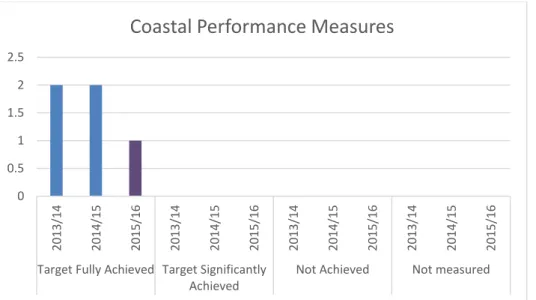
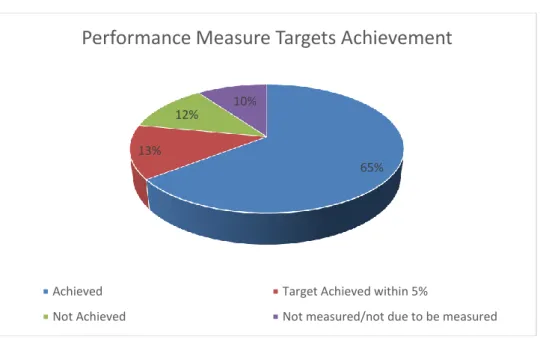
We have 129 measures that we report on through this Annual Report and within these measures there are 141 targets. We’ve either achieved or achieved within 5 percent a very high proportion of our targets. Full details on all the performance indicators are included in Part 4 of this Annual Report.
We achieved 91 of our targets fully, 19 were achieved within 5% of the target, 17 were not achieved, and there were 14 that we either did not have the full information available to report on or they were not measured this year.
It should be noted that although we did not achieve some of our targets, we have purposely set these at a high level to ensure we continue to improve our performance. Some of these targets are set as ‘stretch targets’ for us to aim for in the future. As discussed in Part 4, for many of these activities we still achieved a very high level of service.
Figure 1: Performance measure target achievement for Council activities 2015/2016
Because we have introduced a range of new measures or altered measures through the latest Long Term Plan 2015-2025, we are unable to provide a meaningful comparison with last year’s results. However, where possible we have provided comments on trends or changes in the detailed assessment set out in the Statements of Objectives and Service Performance (Part 4).
65%
13%
12% 10%
Performance Measure Targets Achievement
Achieved Target Achieved within 5%
Not Achieved Not measured/not due to be measured
14
for the 2015/2016 year was significantly higher than budgeted. The underlying operational surplus was $13.2 million[1].
The positive financial position reflects ongoing operational savings achieved by Council, delayed capital expenditure for some large projects, and lower debt. The result was also assisted by a number of external factors which moved in our favour. These external factors include:
- Increased revenue from forestry activities - Lower borrowing costs
- Low inflation
- Higher than anticipated population growth - Increased dividends
- Higher grant receipts.
A full description of the financial variances from the Annual Plan 2015/2016 is contained in Note 36 to the Accounts in this Report.
Reporting against our Financial Strategy
The Financial Strategy in the Long Term Plan 2015-2025 provides an outline of our policy on financing capital works and managing debt. The Long Term Plan provides for capital expenditure of between $28 million and $34 million per annum, and operating expenditure of between $110 million and $119 million per annum for the 2017/2018 to 2019/2020 years. The majority of proposed capital expenditure and associated loans are for engineering works such as water, stormwater, wastewater and transport (roads), with a small percentage for community facilities.
The Financial Strategy outlines how we will manage our revenue, expenses and assets, liabilities and investments.
The objective is to provide for the current and future interests of the community while also:
• providing for growth and changes in land use;
• ensuring that the level of rates and borrowing is financially sustainable and is kept within our set limits;
• being accountable for maintaining the assets that Council owns on behalf of the community;
• funding network infrastructure and maintaining levels of service;
• obtaining reasonable returns on investments; and
• meeting new Central Government standards for services such as drinking water.
Net debt
Our net debt at 30 June 2016 was $129 million. The Annual Plan 2016/2017 forecasts this to be $166 million by 30 June 2017 – although with net debt now lower than forecast at year end for 2015/2016 it is likely that we will not reach the expected $166 million debt figure.
[1] Once the non-cash items and capital funds were removed.
15
Rates affordability
To help manage rates affordability, we include a limit in our Financial Strategy on rates revenue. For the Long Term Plan 2012-2022 this limit was set at $52 million for general rates and $53 million for targeted rates per annum over the life of the Long Term Plan. This was reduced to $51 million for general rates and $46 million for targeted rates per annum in the Long Term Plan 2015-2025, reflecting the work done as part of the last Plan to address rates affordability issues. This Annual Report shows we are below the limit at $35 million for General Rates and $33 million for Targeted Rates.
Table 1: Rates Revenue
We also include a limit in our Financial Strategy on total rates income increases. Increases are currently limited to a maximum 3% per annum, plus an allowance for annual growth in rateable properties. This was a new limit set as part of the Long Term Plan 2015-2025, which is why the graph starts at 2015/2016.
The blue bars in the graph below show how we have performed against the 3% limit. The 2015/2016 year saw rates income increase by 2.1%.
16
(1) The assumptions that led to the savings in the 2016/2017 Annual Plan are not yet reflected in the 2018-2020 financial year estimates. Those estimates are based on the Long Term Plan 2015-2025, and reflect the
assumptions about interest costs, and inflation amongst other factors that were made when the Long term Plan 2015-2025 was adopted.
Debt affordability
The debt limits/affordability limits were developed based on external advice as to what levels would be
appropriate for a Council of our size. Limits set enable us to retain our current credit rating of AA-. We remain well within the limits set out in our Financial Strategy. The limits are also in line with the local government sector as a whole.
0.0%
1.0%
2.0%
3.0%
4.0%
2015/2016 Actual
2016/2017 Actual
2017/2018 Estimate Long Term
Plan 2015-2025
2018/2019 Estimate Long Term
Plan 2015-2025
2019/2020 Estimate Long Term
Plan 2015-2025
Rates Income Increases
Actual rates % increase Limit on rates % increase
17
3/2014
(1) Net External Debt = total external debt less liquid financial assets and investments.
(2) Total Operating Income = cash earnings from rates, government grants and subsidies, user charges, interest, dividends, financial and other revenue and excludes non-government capital contributions (e.g. developer contributions and vested assets).
The definitions contained in our Financial Strategy differ from those applied to the Financial Regulations Benchmarks reported in our Annual Reports. The Benchmark reporting is prepared in line with the Local Government (Financial Reporting and Prudence) Regulations 2014.
Key Financial Information Financial Performance Summary
We have again received an unmodified audit opinion from Audit New Zealand. Our credit rating is ‘AA- with a stable outlook’ (Standard and Poor’s1). This rating reflects our strong financial management, budgetary flexibility, liquidity and low contingent liabilities; and enables us to borrow funds at more favourable interest rates.
Total Council assets now total $1.46 billion, which is an increase of $48.7 million since 2015.
Revenue and Savings
Total rates revenue for the year was $67.9 million, and total revenue from all other sources totalled $5.25 million.
General rate revenue increased partially as a result of growth in the District being higher than expected for the year.
ANNUAL 2013/2014 2014/2015 2015/2016 PLAN
MEASURE LIMIT ACTUAL ACTUAL ACTUAL (ESTIMATE)
Net External Debt¹ / Total Operating Income² <225% 138% 130% 123% 156%
Net External Debt / Equity <20% 12% 11% 10% 13%
Net Interest on External Debt / Total Operating Income <15% 7% 7% 7% 8%
Net Interest on External Debt / Annual Rates Income <25% 12% 10% 10% 13%
18 Expenditure
Figure 5. Total Council Expenditure
The large spike in Corporate costs in 2015 and 2016 was due to the revaluation of interest rate swaps.
A summary of the large capital projects where capital expenditure has been delayed or deferred in 2015/2016 is set out below.
0 5 10 15 20 25 30 35
$millions
2014 2015 2016
0 10 20 30 40 50 60
$millions
2014 2015 2016
19
Please note the above variances include approved carry-overs from 2014/2015.
Project Explanation of Delay Variance
from Budget
Drainage Renewals - Transportation
Renewals were deferred as condition assessment work identified their condition would support deferring their replacement.
$707,000
Richmond Water Main renewal
Deferred until the 2016/17 year to align with the wider Richmond Central project to minimise disturbance to Queen Street users and reduce costs.
$1.0 million
Waimea Community Dam
Progress has been slower than planned as funding from other parties has yet to be secured and a funding model finalised.
$1.2 million
Water Meter Renewals
Progress is slightly behind schedule, with only $670,000 spent in 2015/2016. The works are planned to be carried out over the next two years
$607,000
Motueka Wastewater Treatment Plant
This is a multi-stage project that had been planned to be completed over several years. The project started later than planned due to a resource consent appeal. $3.6 million was spent in 2015/2016. Construction is expected to be completed by December 2016.
$4.5 million
Kaiteriteri Sewer Main replacement
To date, the design has been less complex than
expected, leading to lower construction costs. $638,000 Pohara Stormwater Main Improvement works are delayed while stormwater
modelling options are completed. $878,000
Borck Creek Stormwater Catchment Works
Project has been delayed while we work through the
property acquisition process $886,000-
Richmond Stormater Ranzau Road/Patton Road
This project has been delayed while modelling is completed, which in turn will determine what physical works will be needed.
$813,000
Golden Bay Community Recreation Facility
Delays to this project occurred due to unexpected ground conditions during construction. If there are no further delays, the project is expected to be completed by December 2016.
$1.6 million
20
The above pie chart excludes corporate costs.
Figure 7. Capital Expenditure by Activity
Council Operating Expenditure by Activity
Environmental Management (10%)
Public Health and Safety (6%)
Transportation, roads & Footpaths (22%)
Coastal Structures (0%)
Water Supply (10%)
Wastewater (9%)
Stormwater (4%)
Solid Waste (9%)
Flood Protection and River Control Works (2%)
Community Relations (3%)
Community Facilities and Parks (16%)
Council Enterprises and Property (5%)
Governance (3%)
Capital Expenditure by Activity
Transportation, roads and Footpaths (27%)
Water Supply (10%)
Wastewater (18%)
Stormwater (10%)
Solid Waste (1%)
Flood Protection and River Control Works (2%)
Community Facilities and Parks (15%)
Council Enterprises and Property (14%)
Other (3%)
21 Tasman District Council Mission Statement: To enhance community wellbeing and quality of life
Community Outcomes
Background
Community Outcomes are the outcomes Council is working towards in order to promote community wellbeing.
They reflect what Council sees as important for community wellbeing and they help to build up a picture of the collective vision for the District’s future – how we would like Tasman District to look and feel in 10 years and beyond. They also inform Council decision making and the setting of priorities.
As part of the development of this Long Term Plan, Council worked together with Nelson City Council to align the Community Outcomes of both councils. The resulting set of joint Community Outcomes retain the overall direction of the previous Outcomes, however the wording in these new Outcomes has been amended slightly. Changes made to the Local Government Act 2002 (the Act) at the end of 2010 changed the definition of Community Outcomes from being those that are developed and implemented in conjunction with the community to those that Council itself aims to achieve.
Notwithstanding this change Council believes that the Community Outcomes can only be achieved through working in partnership with the whole community, including individuals, businesses, government agencies and community organisations. Everyone’s views on describing how our District would look if we achieved these Outcomes will be slightly different, but we have put a description below each Outcome to help you understand what we are working towards.
OUTCOME 1: Our unique natural environment is healthy and protected
• Tasman is a place where everyone can enjoy the natural environment, while it is protected for the future;
• we recognise the importance of a healthy environment for tourism and productive land uses, and the need to minimise the impacts of human activities on the environment;
• we manage air quality, waste, freshwater and coastal waters;
• we treasure, protect and restore the special places, landscapes, native species and natural ecosystems of Tasman;
• natural biodiversity is widely understood and valued;
• the value of introduced species is recognised and pests are controlled;
• open spaces are linked and productive land is protected;
• we undertake an extensive monitoring programme of the environment, including air, water and soil health;
• we also provide and monitor resource consents and, if necessary, prosecute any breaches; and
• the intergenerational kaitiakitanga (guardianship) of tangata whenua iwi is recognised; the community understands the concept and are involved in caring for ngā taonga tuku iho (treasure of the ancestors).
OUTCOME 2: Our urban and rural environments are people-friendly, well planned and sustainably managed
• our current and future urban and rural living environments provide the important features that we need to enjoy Tasman;
• urban and rural areas are designed to be people friendly, particularly for children, families and our increasing, ageing population;
• we think and plan regionally and act locally within that context;
• our built environments are well planned and based on sound urban design principles;
• urban areas are attractive, safe, accessible and have parks and reserves available for residents to use;
• Tasman has affordable roading services that meet the needs of our communities; and
• there is a range of community housing and community facilities, with more intensification in towns/settlements and clear urban/rural boundaries.
22
• waste and pollution is minimised, so we have clean water, clean seas, clean air, healthy flora, fauna and soils, and public health needs are met;
• growth is well managed; and
• our public transport services are well-utilised and our developing cycleway network is popular with residents and visitors alike.
OUTCOME 4: Our communities are healthy, safe, inclusive and resilient
• we support the opportunities for Tasman residents to enjoy a good quality of life;
• we are a supportive and diverse community;
• everyone is included and involved, can participate in decision-making and is able to enjoy a good quality of life, wherever they come from and whatever their age, abilities or income;
• we are a resilient community with a Civil Defence service that assists residents and businesses to cope with disasters or emergencies; and
• our communities health and wellbeing is safeguarded by ensuring standards of construction, food safety and registered premises operation are met, and that alcohol sale and consumption, risk from fire and nuisances (e.g. from dogs and stock) do not adversely affect quality of life.
OUTCOME 5: Our communities have opportunities to celebrate and explore their heritage, identity and creativity
• we have a strong sense of community and are proud of our region, our communities and our diverse heritage;
• important heritage items, sites and stories of the District are protected for future generations;
• residents and visitors have opportunities to celebrate Tasman’s heritage and support cultural diversity;
• we celebrate and acknowledge our heritage and our history and how that contributes to our distinctive identity;
• we tell our whakapapa (history) in an honest way and acknowledge the lessons that history has taught us;
• Māori culture and tikanga (traditions) are acknowledged as taonga (treasures) that represent our regional uniqueness;
• we value and support those things that make Tasman special and unique – our Maori history, our people, art and crafts, the outdoors, local food and wines and the relaxed atmosphere;
• the two marae in Tasman are an important part of our District’s cultural services and these are essential to our community identity; and
• access to the coastal waters of Tasman is secured and safe boating practice is supported.
OUTCOME 6: Our communities have access to a range of social, educational and recreational facilities and activities
• we have a good range of sports and recreation facilities for all ages, including youth and older residents;
• there is a wide range of recreation, educational and leisure opportunities for everyone to take part in;
• we support and encourage all culturally diverse groups to demonstrate their unique recreational activities to the wider community; and
• there are many festivals and events held throughout the year in the Nelson/Tasman regions.
OUTCOME 7: Our Council provides leadership and fosters partnerships, a regional perspective, and community engagement
• we work together effectively as a region, think of the generations that will follow and listen to the full range of views;
• everyone has the opportunity to participate in the community’s major decisions and information is easy to obtain;
• leaders consult with and understand their communities and work for the good of all, including the wider region;
• our leaders take responsibility for their decisions and act to improve the big issues facing our community;
• we continue to collaborate with community organisations and build effective Council-community partnerships;
and
• we support and mentor our youth to become the leaders of the future.
23
and people of Tasman;
• we are skilled and adaptable and we see the benefits of a wide range of high-value industries and businesses;
• small, locally-owned businesses are an essential part of the community;
• we encourage appropriate new investment into our community;
• our youth can live, learn and work in Tasman; and
• we recognise, support and celebrate innovation and achievement.
24
The role of the Annual Report and Financial Statements
We are required to produce an Annual Report each year to account for the money provided by ratepayers, financial institutions and other Government agencies.
The Annual Report is also an important tool for showing how our community outcomes are being achieved. This document, therefore, also represents an opportunity to provide interested parties with a range of additional information to give a more complete picture of the District’s affairs.
The contents of this Annual Report will make reference to the District strategies and plans, including the Long Term Plan 2015-2025. The Long Term Plan 2015-2025 was adopted by Council on 25 June 2015, after
considerable consultation with ratepayers and interested others. This is the first Annual Report prepared under the Long Term Plan 2015-2025.
Many of the ways in which this information is presented are governed by legislation and standard accounting practices. However, we recognise that the readers of this report are from diverse backgrounds and steps have been taken to present the information in an accessible and understandable form.
The report from the Mayor and Chief Executive Officer provide commentary on some of the year's key strategies, objectives, highlights and challenges. The Financial Statements and Statements of Service Performance look at the District affairs in greater detail.
We thank you for your interest in our activities and its leadership role in developing Tasman District.
How the Annual Report fits into Council’s overall planning framework
25
1 The Council and management of the Tasman District Council confirm that all the statutory requirements of the Local Government Act 2002 in relation to the Annual Report have been complied with.
Responsibility
2 The Council and management of Tasman District Council accept responsibility for the preparation of the annual financial statements and the judgements used in them.
3 The Council and management of Tasman District Council accepts responsibility for establishing and maintaining a system of internal control designed to provide reasonable assurance as to the integrity and reliability of financial and non-financial reporting.
4 In the opinion of the Council and management of Tasman District Council, the annual financial statements for the year ended 30 June 2016 fairly reflect the financial position, operations and service performance of Tasman District Council.
R G Kempthorne Mayor
L McKenzie
Chief Executive Officer
M Drummond, CA
Corporate Services Manager DATE: 22 September 2016
Independent Auditor’s Report
To the readers of Tasman District Council’s annual report For the year ended 30 June 2015
27
28
29
30
Audit New Zealand
On behalf of the Auditor-General Christchurch, New Zealand
31 Statements of objectives and service performance
The service goals and objectives form the basis of our operations in the provision of works and services for the District. Council departments may be broadly categorised as follows:
Environment and Planning
Engineering Services
Community Development (formerly Community Services)
Corporate Services
Within each group of activities there may be a number of smaller activities, for example Environment and Planning includes Public Health and Safety, Building Control, Environmental Health, Animal Control, Civil Defence Emergency Management, Rural Fire Support Services, Maritime Safety and Parking Control.
The service goals, objectives and performance indicators have been listed for each of Council's significant activities (where applicable). These are followed by a statement on the level of achievement.
Each significant activity area as a whole incorporates elements of quality, quantity, timeliness, cost and location (where applicable). Unless otherwise noted, all tasks are to be completed by 30 June 2016. Quality processes (which affect the quality of the output) are also a standard feature of the internal management control systems. In particular:
Preparation of internal report
Internal reports are prepared by suitably qualified and experienced staff. Significant reports are subject to a peer review process/consultation review.
Capital works
Capital works are constructed to design specifications. Inspections of works are undertaken by suitably qualified and experienced engineers.
Resource management
These functions are performed by appropriately qualified staff and/or accredited hearing
commissioners. This is one mechanism by which Council assures the quality of service given to the public. In relation to policy investigations and the development of regional and district plans, we follow processes outlined in legislation and established public consultation procedures.
Maintenance works
Maintenance works are undertaken by employees or by contract under the supervision of suitably qualified and experienced engineers or other appropriate staff and monitored in accordance with the relevant maintenance programme.
Legislative and financial compliance
In all instances, we strive to act within the relevant statutory requirements and within approved budget levels.
Asset management planning
A common process we undertake for all outputs is the development of asset/activity management plans for Council's activities and infrastructural assets, including asset identification, valuation, condition rating, service levels, performance measures and future maintenance and development plans, as appropriate. Sufficient maintenance has been programmed and performed on all
infrastructural assets during this financial year to ensure that the service potential of assets has not deteriorated.

![Figure 12 [LTP Figure 7]. Dairy Farm Compliance, page X.](https://thumb-ap.123doks.com/thumbv2/5docco/6303703.71400/43.893.72.722.689.1155/figure-ltp-figure-dairy-farm-compliance-page.webp)
![Figure 20 [LTP Figure 13]. All Crash Types, 2011-2015 Tasman District Council roads only, fatal and Serious crashes, page X](https://thumb-ap.123doks.com/thumbv2/5docco/6303703.71400/59.893.83.828.178.1167/figure-figure-crash-types-tasman-district-council-crashes.webp)
![Figure 22 [LTP Figure 15]. Straight-lost control, 2011-2015, Tasman District Council roads only, All injury types, page X](https://thumb-ap.123doks.com/thumbv2/5docco/6303703.71400/60.893.78.826.90.1232/figure-figure-straight-control-tasman-district-council-injury.webp)
![Figure 23 [LTP Figure 16]. Smooth Travel Exposure (STE), Page X](https://thumb-ap.123doks.com/thumbv2/5docco/6303703.71400/61.893.65.825.91.1190/figure-ltp-figure-smooth-travel-exposure-ste-page.webp)