UNDERGRADUATE THESIS
GENERAL ELECTIONS 2015 / 2016 AS THE CONFLICT RESOLUTION IN CENTRAL AFRICAN REPUBLIC
Written by :
Diyanah Afifah Ramadhaniyati
20130510442
DEPARTMENT OF INTERNATIONAL PROGRAM OF INTERNATIONAL RELATIONS
FACULTY OF SOCIAL AND POLITICAL SCIENCE
UNIVERSITAS MUHAMMADIYAH YOGYAKARTA
UNDERGRADUATE THESIS
GENERAL ELECTIONS 2015 / 2016 AS THE CONFLICT RESOLUTION IN CENTRAL AFRICAN REPUBLIC
Presented to fulfill the requirement for achieving the degree of Sarjana Ilmu Politik (S.IP), Department of International Relations, Faculty of Social and Political Science,
Universitas Muhammadiyah Yogyakarta
Advisor: Dr. Surwandono , S.Sos, M.Si
Name: Diyanah Afifah Ramadhaniyati
Student’s number: 20130510442
International Program of International Relations Department
Faculty of Social and Political Science
Universitas Muhammadiyah Yogyakarta
STATEMENT OF ORGINALITY
This is to certify that to the best of my knowledge, the content of this thesis is my own work. This thesis has not been submitted for any degree or other purposes.
I certify that the intellectual content of this thesis is the product of my own work and that all the assistance received in preparing this thesis and sources have been acknowledged.
Yogyakarta, December 24th 2016
Author,
Diyanah Afifah Ramadhaniyati
“The struggle you're in
today is developing the
strength you need for
tomorrow. Don´t give
ACKNOWLEDGEMENT
The highest praise and gratitude dedicated to Almighty God, Allah SWT who always give His endless kindness and bless that make the writer possible to finish this undergraduate thesis entitled: “General Elections 2015/2016 as The
Conflict Resolution in Central African Republic”. This undergraduate thesis is submitted to fulfill the requirement for achieving S-1 Degree of International Relations major, Faculty of Social and Political Science, Universitas Muhammadiyah Yogyakarta as well as the application of the theories and knowledge that the writer had already obtained during the undergraduate study.
The writer also would like to express her sincere gratitude to all those who have contributed in the process of writing this undergraduate thesis especially for the advisor of this undergraduate thesis, Dr. Surwandono, S.Sos M.Si, also to all of the board of examiners, Dra. Mutia Hariati Hussin, M.SI and Drs. Djumadi M. Anwar, M.Si. The writer realizes that there are still rooms for improvement for this undergraduate thesis. The writer hopes that this undergraduate thesis could be useful for international relations study.
Yogyakarta, December 24th, 2016
EXTENDED GRATITUDE
Praise and Gratitude again dedicated to Allah SWT because of His blessings I could finish this undergraduate thesis. Also, there were many people who have helped and motivated me in finishing and presenting this undergraduate thesis I would like to thank:
1. My family, especially my mother and father who always supported me and prayed for me.
2. My best partner, Bimo Adietama who always gave me advices, comments, motivations and also critics in the process of finishing this undergraduate thesis.
3. My language consultant, Miss Ani.
4. All of IPIREL 2013 friends, especially Bayu, Novi, Elin, Laila, Sintya, Atikah, Latifah, Rahma, Iqbal, Linda, Aji and other that I could not mention one by one.
5. KOMAHI big family, especially Bahasa dan Budaya Division. 6. SEA UMY family, especially Speaking ministry.
7. KKN UMY 10 2016, especially Hikma, Nindy, Fafa, Dhila, Jacky, Zainur, Java and Ami.
TABLE OF CONTENTS
STATEMENT OF ORGINALITY ... i
ACKNOWLEDGEMENT ... iii
EXTENDED GRATITUDE... iv
Abstract ... Error! Bookmark not defined. TABLE OF CONTENTS ... v
LIST OF FIGURES ... ix
LIST OF PICTURES ... x
ABBREVIATION ... xi
CHAPTER I ... Error! Bookmark not defined.
INTRODUCTION ... Error! Bookmark not defined.
A. Background ... Error! Bookmark not defined.
B. Research Question ... Error! Bookmark not defined.
C. Theoretical Framework ... Error! Bookmark not defined.
D. Hypotheses ... Error! Bookmark not defined.
E. Scope of Research ... Error! Bookmark not defined.
F. Methodology ... Error! Bookmark not defined.
H. Purpose of Research ... Error! Bookmark not defined.
I. System of Writing ... Error! Bookmark not defined.
CHAPTER II ... Error! Bookmark not defined.
POLITICAL COMPLEXITY OF CENTRAL AFRICAN REPUBLIC ... Error! Bookmark not defined.
A. General Description of Central African Republic ... Error! Bookmark not defined.
1. Geography of Central African Republic ... Error! Bookmark not defined.
2. Socio-culture of Central African Republic ... Error! Bookmark not defined.
3. Economy of Central African Republic ... Error! Bookmark not defined.
B. History of Central African Republic ... Error! Bookmark not defined.
1. Colonization Era ... Error! Bookmark not defined.
2. After Independence ... Error! Bookmark not defined.
C. Complexity of Politic and Government of Central African Republic... Error! Bookmark not defined.
CHAPTER III ... Error! Bookmark not defined.
THE EMERGENCE OF CONFLICT IN CENTRAL AFRICAN REPUBLIC .. Error! Bookmark not defined.
1. The Séléka ... Error! Bookmark not defined.
2. The Anti-Balaka ... Error! Bookmark not defined.
B. Figure of Conflict between Séléka and Anti Balaka ... Error! Bookmark not defined.
1. Causes of The Conflict ... Error! Bookmark not defined.
2. The historical setting of the conflict ... Error! Bookmark not defined.
3. Impact of The Conflict ... Error! Bookmark not defined.
C. Alternative Resolutions taken in Dealing with the Conflict . Error! Bookmark not defined.
1. Repressive / Military means ... Error! Bookmark not defined.
2. Negotiation and Mediation Means ... Error! Bookmark not defined.
CHAPTER IV ... Error! Bookmark not defined.
ANALYSIS THE MEASURES ON CONFLICT RESOLUTIONS TAKEN BEFORE CONDUCTING GENERAL ELECTIONS 2015 / 2016 IN CENTRAL AFRICAN REPUBLIC ... Error! Bookmark not defined.
A. Recreation of Cultural and Social norms between Muslims and Christians Error! Bookmark not defined.
1. Faith-Based Actors Role ... Error! Bookmark not defined.
B. Humanitarian Aid and Diplomatic Assistance . Error! Bookmark not defined.
1. Humanitarian Aid and Diplomatic Support to the Transitional Government by U.S. ... Error! Bookmark not defined.
2. Humanitarian Aid by International Organizations ... Error! Bookmark not defined.
C. International Assistance ... Error! Bookmark not defined.
1. Security Assistance ... Error! Bookmark not defined.
2. Political and Electoral Assistance ... Error! Bookmark not defined.
CHAPTER V ... Error! Bookmark not defined.
CONCLUSION ... Error! Bookmark not defined.
REFERENCES ... Error! Bookmark not defined.
LIST OF FIGURES
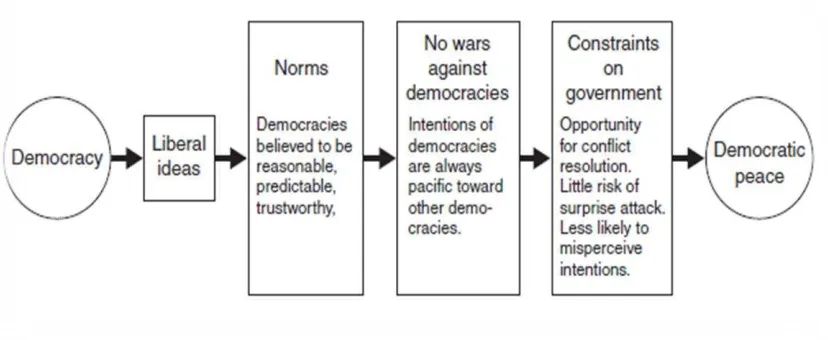
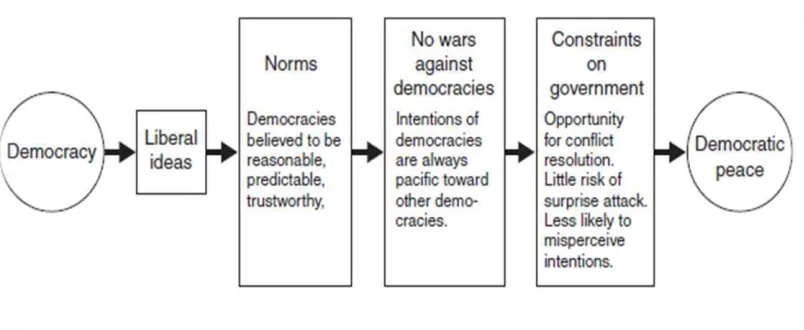
Figure of Normative Argument Democratic Peace Theory………...8
LIST OF PICTURES
Central African Republic Map……… 14
ABBREVIATION AU : African Union
C.A.R : Central African Republic
ECCAS : Economic Community of Central African States
EISA : Electoral Institute for Sustainable Democracy in Africa
EU : European Union
MINUSCA : United Nations Multidimensional Integrated Stabilization Mission in the Central African Republic
MISCA : Mission to the Central African Republic
NDI : The National Democratic Institute
UN : United Nations
UNDP : United Nations Development Program
UNSC : United Nations Security Council
Abstract
After its’ independence, Central African Republic had been facing political instability and also insurgencies. Most of the leaders gained power undemocratically and were overthrown in coups. In 2013, Séléka and Anti-Balaka emerged launching attacks against each other to gain power. Dealing with the problem, general elections were tried to be conducted several times but it only faced irregularities and security threats from the conflicting parties. The question emerged when there were international assistances in conducting general elections at the end of 2015. Thus, the conflict resolution measures were taken before conducting general elections are questioned.
The objective of this research is to analyze how conflict resolution measures were taken before conducting general elections 2015 / 2016 in Central African Republic. Furthermore, the method that was used by the writer was qualitative method by using secondary data such as article, journals, e-news, e-book and other literary sources.
As the findings, this research proves that there were national efforts done by faith-based actors and regional organization in creating cohesiveness through social and cultural norms. Also, humanitarian aid, diplomatic supports and international assistances that consist of security, political and electoral assistance played the important role in conducting the general elections as well.
Keywords:
CHAPTER I
INTRODUCTION
In this chapter, the writer will explain about the background of the topic which is general elections 2015/2016 in Central African Republic, followed by the research question of the topic and theoretical framework that was used to answer the question. Furthermore, the writer will explain about scope, methodology, range and purpose of the research. As the last part, of this chapter, the writer will explain about the system of the writing.
A. Background
The African continent has already known as a continent that consists of many conflicting countries. Central African Republic (C.A.R) is one of the countries that also had been facing difficulties in solving their internal conflict. These years, C.A.R faced the worst political crisis in their history since the central government could not play its effective role in governing the society. The conflict in this country had already emerged a long time ago, but recently, the conflict became worst into an ethnic cleansing toward Muslim (UN: Muslims ethnically cleansed in CAR, 2015).
emergence of rebels group in C.A.R (Arieff & F. Husted, The Central African Republic: Background and U.S. Policy, 2015).
In the end of 2012, Séléka as the first actor of recent conflicting party emerged. It is a Muslim minority group who lived in the north region of Central African Republic which was also the part of previous rebels group that already split into one (Herbert, Dukhan, & Debos, State fragility in the Central African Republic: What prompted the 2013 coup?, 2013). Séléka is the overview of Muslim minority disappointment toward unfair treatments done by the government like the exclusivity had by Christians and also persecution faced by them (Arieff & F. Husted, The Central African Republic: Background and U.S. Policy, 2015).
(Herbert, Dukhan, & Debos, State fragility in the Central African Republic: What prompted the 2013 coup?, 2013).
After Bozize toppled down, Séléka as the new powerful group at that time chose unilaterally their leader, Michel Djotodia to become the new president. He was the first Muslim ruler in the country. Under his administration, Séléka used power abuse to occupy all of C.A.R cities by conducting the individual attack to the citizens. However, since Djotodia was not chosen by the entire C.A.R’s citizen, he was not recognized by African leaders and Western powers as the legitimate president (Regional Leaders recognize C.African Republic rebel chief (2013) Retrieved November 13th, 2016 Regional Leaders recognize C.African Republic rebel chief , 2013).
The condition where Muslim and Christians attacked each other brought Michel Djotodia to step down from his position and again, made C.A.R facing a political vacuum and made the number of violence increased.
Since Djotodia stepped down from the position of president, the number of violence from both conflicting parties to the innocent civilians increased. If the media reported they attacked each other on behalf of their religion but however, it could not be denied that both parties have their own political interests. It could be seen from the regrouping of Séléka group, and three factions had emerged: the Union for Peace in the Central African Republic (UPC) under Ali Daras, the Popular Front for the Renaissance of Central Africa (FPRC) under Adam Nourredine and the Patriotic Assembly for the Renaissance of Central Africa (RPRC) under Damane Zacharia and Joseph Zoundeko (ACLED, COUNTRY REPORT: CENTRAL AFRICAN REPUBLIC, 2015). While Anti-Balaka also formed the Central African Party for Unity and Development (PCUD), a political party seeking to legitimate their role in C.A.R and use institutional forces to continue their struggle (ACLED, COUNTRY REPORT: CENTRAL AFRICAN REPUBLIC, 2015).
caused many victims died (ACLED, COUNTRY REPORT: CENTRAL AFRICAN REPUBLIC, 2015). Not only that, regional actor like The Economic Community of Central African States (ECCAS) also played a role in solving the problem by mediating peace accords and also deploying troops (Arieff & Husted, Crisis in the Central African Republic, 2015).
After several years conflict happened and all of the alternative ways taken to reduce the conflict, in the end of 2015 the conflict in C.A.R started to face de-escalation and in the beginning of 2016, the elections conducted as the way to solve the problem. The first legislative and presidential election that conducted after several years conflict resulting former Prime Minister of Central African Republic, Faustin Archange Touadera as the new president of Central African Republic democratically.
B. Research Question
From the explanations above regarding the background of the conflict, then the question emerged is “How conflict resolution measures were taken before conducting general elections 2015 / 2016 in Central African
Republic?”
C. Theoretical Framework Democratic Peace Theory
Democratic peace theory was first enunciated in a keynote article by Michael Doyle in the journal Philosophy and Public Affairs. (Williams, 2008).
the writings of Immanuel Kant, and in particular his work “Perpetual Peace” (Pugh, 2005).
In explaining the idea of democracy, there are three versions of democratic peace theory that had been argued by democratic peace theorists by examining real conflicts:
1. Monadic version analyzed in 1960’s and 70’s: democracies, in general, are more peaceful and are less likely to go to war (Democratic Peace Theory ).
2. Dyadic: the most commonly accepted version among democratic peace theorists. Democracies may be even robust in the use of force than non-democracies due partially to the ideological nature of democratic wars and partially to the fact that liberal democratic states are strong with large wealth base (Williams, 2008).
3. Systemic: as democratic states grow, then the international system as a whole becomes more peaceful (Democratic Peace Theory ).
In the explanation of democratic peace theory, there are several arguments proofing how democracy could result peace. One of the arguments that could be related to the case of Central Africa Republic is Normative Arguments.
According to normative arguments, democracies believe that other democracies are reasonable, predictable, and trustworthy (Maoz & M. Russett, 1993). Democratic states are bound by cultural and social norms that call for non-violent conflict resolution and negotiation. Because democratic leaders are bound by these norms they try to adopt them in the international arena which means that a democracy will respect its fellow democracy abiding by these norms and ; thus, treat the fellow with great esteem and diplomatic affection.
This logic argues that autocratic political systems are considered unjust and immoral. From the perspective of democracy, war may be necessary to free people from dictatorship. Democracies may also want to introduce the idea of human right (Democratic Peace Theory ).
achieve their interest. In this process, the actor who played a role was faith-based actors.
Figure 1 – Norms and Democratic Peace Source:
rand.org/content/dam/rand/pubs/monograph_reports/MR1346/MR1346.ap
pc.pdf
While also as explained in the normative figure of democratic peace theory, due to democratic leaders are bound by norms they try to adopt them in international arena which means that a democracy will respect its fellow democracy abiding by these norms and treat the fellow with great esteem and diplomatic affection. International assistance is showing diplomatic affection regarding non-violent resolution and negotiation done by other international actors to Central African Republic as the conflict resolution taken before conducting general elections.
Despite some arguments about democratic peace theory, this theory has been influential in public policy. The association between war, democracy, and rights prevalent in the immediate aftermath of Second World War, has also been revived (Williams, 2008).
D. Hypotheses
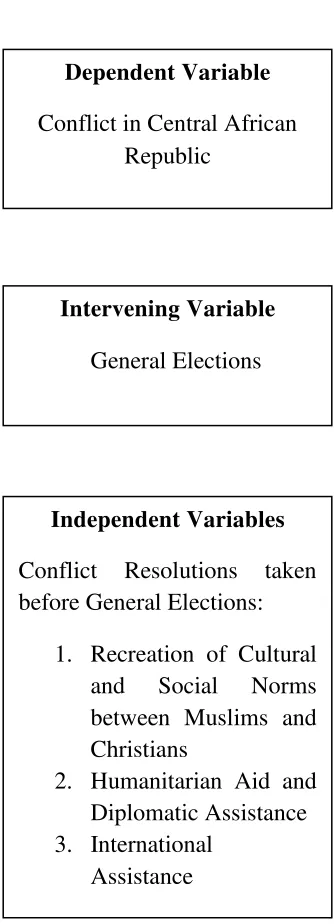
Based on background and theoretical framework, the following hypothesis that could be put to explain how conflict resolution measures were taken before conducting general elections 2015 / 2016 in Central African Republic is by:
1. Re-creating cultural and social norms between Muslims and Christians. 2. Giving humanitarian aid and diplomatic assistance.
3. Involving international assistance.
E. Scope of Research
The conflict in Central African Republic had already emerged a long time ago due to the political violence that was done by several actors which made government could not play its role. This research will primarily focus on the conflict that occurred since 2012 until the elections conducted in the beginning of 2016.
F. Methodology
information source of this research will be taken by collecting relevant secondary data like article, journals, e-news, e-book and other literary sources.
G. Range of Research
In this research, the writer only focused on the topic research by limiting the time of the phenomenon. The writer explained the understanding of the conflict and its conflict resolution in the case of horizontal conflict.
Since the conflict had already happened more than 10 years, the writer limited the time of this research start from 2012 when C.A.R was controlled by Francois Bozize until the general elections conducted democratically as one of conflict resolution in the beginning of 2016.
H. Purpose of Research
I. System of Writing
The system of writing this research was arranged as :
Chapter I. The writer explained about problem background, followed by research question, theoretical framework, hypotheses, scope of research, methodology, range of research, purpose of research, and outline of research.
Chapter II. The writer explained about political complexity of Central Africa Republic followed by the general information about political, geographical, alliance and political and governmental history of the country.
CHAPTER II
POLITICAL COMPLEXITY OF CENTRAL AFRICAN REPUBLIC In this chapter, the writer will provide the information about the political complexity of Central African Republic that will be related in answering the analysis of this research. Previously, the writer will provide general overviews of the Central African Republic such as geographical, socio-cultural and also economical overview that somehow influence the political complexity in the country.
A. General Description of Central African Republic
1. Geography of Central African Republic
As its name, geographically Central African Republic (C.A.R) is located in the center of Africa continent with 3,512,751 people as its population. It is bordered by several neighboring countries like Chad in the north area of the country, Sudan in the northeast area, South Sudan in the east area, the Democratic Republic of Congo and Republic of Congo in the south area and also Cameroon in the West area of the country (Central African Republic - CAR - Country Profile).
coordinate 7 00 N, 21 00 E, scattered hills in northeast and southwest, mainly savannas, the Sahel covers the north, forest and savanna eco-region in the south (Central African Republic - CAR - Country Profile).
Picture1. Central African Republic Map
Source: https://www.cia.gov/library/publications/the-world-factbook/geos/ct.html
river which flow in the western regions of the country is The Sangha River, while Nile River also flows in the eastern border of C.A.R.
The Central African Republic is also located near from the equator. It makes the climate of this country typically tropical hot, followed with dry winters and also wet summers. The country also has several mount which rise in the northeast to the Bongos Massif area, extending to an elevation of 1,330 meters at Mount Toussoro, and to the Tondou Massif in the east. In the west of the country there is
Karre Mountains, reaching nearly 1,410 meters at Mount Ngaoui, the country’s
highest point, before declining eastward into sandstone plateaus. In the north, the most significant mountains are those of the Dar Challa range, which rise to 1,326 meters at Mount Ngaya near the border with Sudan. In the southeast is a plain cut by a number of rivers (Thomas E. O'Toole, Lynn Giles-Vernick, & van Hoogstrate, 2016).
2. Socio-culture of Central African Republic
reason they interact with people who had different languages (Thomas E. O'Toole, Lynn Giles-Vernick, & van Hoogstrate, 2016).
Since Central African Republic (C.A.R) was colonized by France, France was the one who did promote and introduce the ethnic and regional differences among the indigenous people. Under its colonization era, France also helped the indigenous people in creating an elite group. This group became the ruling group for the whole country and became the first introduction of political positions in the country.
Since then, regional affiliations started to emerge and increased the complexity of politic among these people. However, the non-riverine of the country preferred to resent this situation and chose to take their own leadership.
Although people living in the country’s northern regions have gained more
political power since independence, southern peoples still remain an important presence in national politics (Thomas E. O'Toole, Lynn Giles-Vernick, & van Hoogstrate, 2016).
used by the people in the country is French (The World Fact Book, Africa : Central Africa Republic ).
Social class in Central African Republic is distinguished by place where they live and do their jobs which also characterized the region into rural and urban. Power differentiated the bureaucrats from the governed. Those who are considered as the intellectuals and positioned in the upper class are the people with power, economic security, and high education. While people consider people in commerce and business, most of Muslims are positioned in the middle class of society (Culture of Central African Republic : history, people, clothing, women, beliefs, food, family, social, dress).
(Culture of Central African Republic : history, people, clothing, women, beliefs, food, family, social, dress).
3. Economy of Central African Republic
Central African Republic could be indicated as one of the countries that has strong economic seen by unemployment and Inflation in C.A.R is in the position of lower ranks ( Central African Republic : Economy).
Central African Republic is also a country in Africa continent that has rich natural resources like diamond, timber, forestry and fishing products. Agriculture is also one of resource that could be dependable as one of the economic sources. It plays the largest sector and the basis of the Central African economy, contributing more than half of the gross domestic product (GDP) of the country followed by services, industry and
manufacturing sectors ( Central African Republic : Economy).
The government of Central African Republic also has been encouraging the people in developing agricultural diversification aiming to increase export products. Not only to the neighboring countries, another exports’ destinations
of C.A.R are of Tiongkok, Indonesia, Morocco and even France (OEC - Central Africa Republic Exports, Imports and Trade Partners).
C.A.R in the center of Africa makes C.A.R faced geographic isolation which also influences to the weak transport infrastructures. Unstable political and security situation in C.A.R also became one of the factors that influenced the economic grow of the country which is resulting the withdrawal of donors and investors (Central African Republic / Economic Studies - Coface).
B. History of Central African Republic
1. Colonization Era
The colonization era of France toward Central African Republic (C.A.R)
was started in 1880’s. C.A.R was divided into 17 parts by France and offered to European companies in exchange for a fixed annual payment plus 15% of agricultural profit (History of Central African Republic - Lonely Planet Travel Information). At that time, France colonial administration began to force Central Africans to pay taxes and to provide the state with free labor for their own benefits.
more weapons, which were used to capture more slaves (Central African Republic - New World Encyclopedia).
During the second decade of colonial rule (1910-1920), armed employees of private companies and the colonial state continued to use brutal methods to deal with local populations who resisted forced labor, but the power of local African rulers was destroyed and so slave raiding was greatly diminished. While in the third decade of colonial rule (1920-1930) was a transition period during which a network of roads was built, cash crops were promoted, mobile health services were created to combat sleeping sickness, and Protestant missions established stations in different parts of the country. New forms of forced labor were also introduced, however, as the France conscripted large numbers of Ubangians to work on the Congo-Ocean Railway (Central African Republic - New World Encyclopedia).
parliament and allows local assemblies to be created (Central African Republic Profile – Timeline , 2016).
2. After Independence
In 1960, Central African Republic declared independence with David Dacko as the president. As the first president, he became repressive and dictatorial. Dacko turned the Central African Republic into a one-party state with Mouvement d'Évolution Sociale de l'Afrique Noire (MESAN) as the sole party (Central African Republic Profile – Timeline , 2016).
In 1965, Dacko was toppled down by an army commander, Jean-Bédel
Bokassa. Under Bokassa’s new administration, C.A.R faced 13 years of one
of the most brutal and notorious regimes. He declared himself as president for life and proclaimed himself as emperor and renamed the country into Central African Emperor (Central African Republic Profile – Timeline , 2016).
In 1991, political parties were permitted to be formed. In the end of 1992, multiparty presidential and parliamentary first elections was held by C.A.R resulting Ange-Felix Patasse as the new president after beating Kolingba and Dacko as the other candidates. The choosing of Patasse as the president was the ending of 12 years of military rule. France began to withdraw its forces from the republic. He even re-elected in 1999.
However, in 2000, oppositions group started to emerge and accuse Patasse of mismanagement and corruption deteriorates into riots (Central African Republic Profile – Timeline , 2016). Since then, the ‘unhealthy’
C. Complexity of Politic and Government of Central African Republic
Picture 2. C.A.R Prefectures Map
Source : http://www.globalsecurity.org/military/world/war/images/map-C.A.R-prefecture.jpg
Central African Republic (C.A.R) is governed by a president as the head of state and a prime minister as the head of government (Central African Republic : Government). It is divided into fourteen prefectures, two prefecture-economic, and one commune. Each prefecture is governed by a local assembly called General Council (Conseil Général), presided by a Prefect (Préfet).
elected every seven years. While in the context of political party’s
participation, C.A.R has multi-party system which consist of several parties like Action Party for Development (PAD), Alliance for Democracy and Progress (ADP), Central African Democratic Rally (RDC), Movement for Democracy and Development (MDD), Movement for the Liberation of the Central African People (MLPC), National Convergence (also known as Kwa Na Kwa) or KNK, National Union for Democracy and Progress (UNDP), New Alliance for Progress (NAP), Social Democratic Party (PSD), Union for Central African Renewal (URCA) and other political parties (The World Factbook – Central Intelligence Agency ).
In the legislative branch, National Assembly of the country is positioned by 131 members directly elected in single-seat constituencies by absolute majority vote with a second round if needed and have 5 years for their serving period. In parliament, the seats was divided into 13 seats for UNDP, 13 for URCA, 10 for RDC, 9 for MLPC, 7 for KNK, 56 for independents 56, and 23 by other parties (The World Factbook – Central Intelligence Agency ).
While in the judicial branch, the constitutional court of C.A.R consists of judges appointed for nine-year terms; it assists the Supreme Court and the High Court of Justice. There are also courts of appeal, criminal courts, several lower tribunals, and a military tribunal. The judicial system is loosely based on that of France, with some traditional courts still operating on the local (sub-prefecture) level (Central African Republic – Constitutional Framework ).
Getting independence after being colonized by France does mean Central
African Republic had a stable government. Since its’ independence, the
strategy to follow for those who want to occupy the country’s highest office
(Weyns, Hoex, Hilgert, & Spittaels, 2014)
Between its’ independence and early 2013, five men have led the country
as the president and transitional government always chosen to fulfill the vacuum of power caused by coups. However, most of them were overthrown in coups, sometimes with external involvement. Even when International pressure resulted a chosen president through an election of a civilian government in 1993, but like previous governments, the president became a misrule leader. Corruption by those in power has impeded the realization of the social and economic rights for Central African Republic’s impoverished
residents (Central African Republic : Legacy of Misrule , 2014).
‘Unhealthy’ political competition kept being continued in the country and
could not be avoided. After David Dacko as the first president was ousted by the next presidents, C.A.R government was dominated by political
competitions including military coup d’etat. The next presidents after Dacko
was overthrown also faced the same coup when they were changed. Even when political party was legal in the beginning of 1991 and elections firstly conducted in 1993 resulting Patasse as the president, the eagerness to rule in
power for a decade, until he was ousted by former army chief of staff Francois Bozize in March 2003 (Central African Republic ).
Several rebel groups emerged like Forces for Unity (UFDR) and the largely unknown Patriotic Convention for Saving the Country (CPSK) doing political violence toward the citizens. Those groups also were the coalitions of recent conflicting parties (ACLED, COUNTRY REPORT: CENTRAL AFRICAN REPUBLIC, 2015). The UFDR and the FDPC had signed peace agreements with the government in 2007 and 2008, under which the rebels would reintegrate into the army in ex-change for, in particular, payment to those who disarmed, and the release of political prisoners (Herbert, Dukhan, & Debos, 2013).
Under a new constitution made in late 2004 of Central African Republic, the president is head of state and limited to two consecutive five-year terms. The constitution also provided for a prime minister, a council of ministers, and a 105-member National Assembly. Assembly members are elected by universal suffrage for five-year terms. An economic and regional council and a state council advise the assembly (Central African Republic – Constitutional Framework ).
charged with restoring order to the country and organizing elections (Central African Republic – Constitutional Framework ).
By using republic presidential as the form of government, the new constitution reformed in 2015. It provides for the creation of a senate and a national elections authority, as well as requiring decisions made by the president as the head of state and prime minister as the head of government to be approved by ministers, and for the government to inform the national assembly when a contract relating to mineral resources is signed (Central African Republic – Constitutional Framework ).
In conducting international relations, there are nineteen countries have resident diplomatic representatives in Bangui, and the C.A.R. maintains
approximately the same number of missions abroad (Central African Republic
CHAPTER III
THE EMERGENCE OF CONFLICT IN CENTRAL AFRICAN REPUBLIC In this chapter, the writer will provide the information about conflicting parties in Central African Republic which consist of Séléka as Muslim minority in northern area of the country and also Christian Anti-Balaka. The information of both conflicting parties emergence will be followed by the historical setting of conflict in the countries since 2012 until the end of 2015 and alternative resolutions that had been taken to deal with the conflict.
A. The Emergence of Conflicting Parties
1. The Séléka
Séléka was one of the first current conflicting parties who consist of Muslim minority in northern area of Central African Republic. It was emerged in the end of 2012 as the disappointment of Muslim minority toward the government of C.A.R. This group was led by Michel Djotodia by making alliances with previous rebels groups like Democratic Front for the People of the Central African Republic (FDPC), and the Union of Re-publican Forces (UFR).
Spittaels, 2014). After Séléka gained C.A.R territory, to increase their power, they became alliances with several other armed groups present in the country.
Séléka itself was formed to oppose the government of Francois Bozize in 2012 who gained power to be the president of Central African Republic undemocratically by attempting coup to topple down the previous president (Central African Republic Profile – Timeline , 2016). As the response of Séléka emergence, Bozize tried to find alternative way in maintaining his position as the president of C.A.R.
One of the efforts taken to deal with Séléka was Libreville peace agreement signed by Séléka and Bozize in Libreville, Gabon, on 11th January 2013. The agreement itself was mediated by the Economic Community of Central African States (ECCAS).The agreement consist of demands asked by Séléka toward Bozize to decrease the tension of their rebellion. However it was not effective enough to stop Séléka’s eagerness to gain power since Boziz could not fulfill all of the demands asked by Séléka. The leader of Séléka, Djotodia also impeached Francois Bozize as the previous president doing such kind of discrimination toward certain ethnic and political groups, particularly Muslims by applying „exclusionist’ policies (Herbert, Dukhan, & Debos, State Fragility in the Central African Republic : What prompted the 2013 coup?, 2013).
to power in an armed rebellion 10 years earlier. (Arieff & Husted, Crisis in the Central African Republic, 2015). After Bozize was toppled down, Michel Djotodia was chosen to be the next president. He was the first Muslim leader in the country.
To avoid the international blame pointed to Séléka, Djotodia officially disbanded Séléka coalition on September 12th 2013 and blamed ―fake Séléka‖ and members of formers of Bozize’s members as the one who abused human right (Central African Republic : Legacy of Misrule , 2014). Although ―fake Séléka‖ was disbanded, but offensive attack toward the citizens was still continued. As the armed force of the country, he declared the FACA (Forces armées centrafricaines) to be the only legitimate force by still recruiting the ex-Séléka militants as the member of FACA. Also, he promoted some commanders of ex-Séléka to be senior ranks and appointing them as zone commanders throughout the country (Weyns, Hoex, Hilgert, & Spittaels, 2014). However, there was no difference between ex-Séléka who were officially integrated into the army, and Séléka as rebels group of the country.
impunity. It was also one of the reason they ignored their action to avoid international blame by disbanding the group in September 2013. The government also seemed to be without a plan to integrate or disarm Séléka. (ACLED, COUNTRY REPORT: CENTRAL AFRICAN REPUBLIC, 2015).
Séléka was let in doing its violence toward the citizens. Djotodia and two heads of the transition government, Nguendet and Samba-Panza, had not been very active in running the government. Among his signatory on more than 500 decrees, there was not a single one of those decrees that is related to socio-economic issue of the country. Majority of those decrees are relating to nominations of political and military positions. (Weyns, Hoex, Hilgert, & Spittaels, 2014). Meanwhile, Djotodia as the president of C.A.R and former leader of Séléka did power abuse in accessing public funding to increase his own enrichment. Not only the former leader of the group, the whole Séléka also benefited from the taxes gotten by them since they had power. Beside that, they also did illegal actions toward C.A.R natural resources such as trading and smuggling diamonds and also pre-financing mining activities (Weyns, Hoex, Hilgert, & Spittaels, 2014).
their homes, are living in extremely difficult conditions in the bush. Lacking humanitarian support, numerous people have died of illness, injuries, or exposure to the elements. International humanitarian agencies have been able to provide limited support to only a few affected areas. Governmental and nongovernmental health services were systematically targeted, and destroyed or closed (World Report 2014 : Central African Republic | Human Right Watch, 2014).
However, in February 2014, the violence done by Séléka to the civilians started to decrease. It may be influenced by the resignation of Djotodia as president in January 2014 under the demand and pressure of international actors since he was not considered as legal leader. Beside that, the militants of Séléka had to deal with Security Council Resolution 2134 which sent African-led International Support Mission to the Central African Republic (MISCA) and Sangaris French Mission to conduct disarmament in Bangui (ACLED, COUNTRY REPORT: CENTRAL AFRICAN REPUBLIC, 2015).
2. The Anti-Balaka
Anti-Balaka is a modern coalition of local groups who formed in self-defense to protect communities from power abuses done by certain groups like rebels, bandits, cattle-raiders and poachers that was emerged in August-September 2013 also as the response of power abuse done by Séléka under its former leader Michel Djotodia as the president of the country (ACLED, COUNTRY REPORT: CENTRAL AFRICAN REPUBLIC, 2015).
Anti-Balaka militants mainly consist of former soldiers in Francois Bozize administration, defected members of the Séléka, Christian vigilante farmers, members of the Association of Central African Farmers (ACP), and the Front for the Return to the Constitutional Order in Central Africa (FROCCA). Most of them were the supporter of the former president Francoiz Bozize (Pastoor). Together, this diverse range of predominantly Christian actors formed local units, which sought to defend communities against the actions of the Séléka, while also retaliating against Muslim communities.
started to recruit their own new militants and organize the groups as the response toward power abuse done by Séléka (Weyns, Hoex, Hilgert, & Spittaels, 2014).
In the end of 2013, Anti-Balaka started to launch counter-attack toward Séléka actions under Djotodia’s government. Christian Anti-Balaka attack Bangui as the capital city and successfully conquered it. The attack done by Christian Anti-Balaka triggered a cycle of revenge killings between Séléka and Anti-Balaka, which also made the spolitical and security situation became worse. The Anti-Balaka militants, reinforced by elements of the disorganized and scattered FACA, organized themselves and C.A.R carried out mass killings, looting and destruction of property under the pretext of retaliating for the violations against the non-Muslim and Christian communities by the Séléka forces (UNSC, The Final report of the International Commission of Inquiry on the Central African Republic, 2014). As the result, Michel Djotodia had to leave his position as the president of the country. By being mediated by the Chad, Michel Djotodia finally resigned from his position as the president of Central African Republic on January 10th 2014 (Weyns, Hoex, Hilgert, & Spittaels, 2014).
government or the administration. Moreover, Djotodia was additionally subject to U.S. sanctions (Arieff & Husted, Crisis in the Central African Republic, 2015). He was declared as persona non grata by the international community when placed under international sanctions (Weyns, Hoex, Hilgert, & Spittaels, 2014).
in the world think that conflict in the country only caused by religious reason (ACLED, COUNTRY REPORT: CENTRAL AFRICAN REPUBLIC, 2015).
B. Figure of Conflict between Séléka and Anti Balaka
1. Causes of The Conflict
1.1.Structural Causes
According to United Nations Development Programs (UNDP)’s analysis,
the structural causes of conflict in Central African Republic are due to extreme poverty, considerable inequalities, poor governance, weaknesses and failures of the political class in the country (Dieye, 2014).
1.2.Accelerator Causes
Accelerator of the conflict could be seen from changes or deterioration in the structural factors that drive a conflict (Conflict Prevention). Seeing the conflict in Central African Republic that could not face its end, the accelerator is political interests and eagerness of certain parties to gain power by establishing several rebels groups which were used to achieve their own interests to attack each other.
1.3.Trigger Causes
2. The historical setting of the conflict
Since 2013, Central African Republic had faced the worst political crisis in their history (UN: Muslims ethnically cleansed in CAR, 2015). Most of the presidents of C.A.R were overthrown in coups, sometimes with external involvement (Central African Republic : Legacy of Misrule , 2014). During its political crisis, 2014 was the year that recorded most of political violent emerged in the country. The emergence of Muslim Séléka as one of the rebels group in December 2012 resulted widespread violence toward the citizens and led to a coup in March 2013 to topple down Francois Bozize as the president (Weyns, Hoex, Hilgert, & Spittaels, 2014). As the change, the leader of Séléka, Michel Djotodia was chosen unilaterally as the new president by Séléka which made them continued in doing its violence for beneficiating them.
Like the analysis of Johan Galtung in his conflict escalation and de-escalation model, there are many complexity of conflict in Central African Republic. The conflict is dynamic and can take long periods of time to gestate unnoticed before it suddenly erupt into overt violence. The process of its escalation is also complex and unpredictable where new issues and even new parties could emerge to complicate the situation (Ramsbotham, Woodhouse, & Mial, 2015).
in August 2013 to launch a counter attack and resulted a revenge cycle attack between both parties. Since then, Djotodia got pressure to leave his presidency position.
After the fall of Djotodia administration, the troops of Séléka in Bangui were withdrawn. Most of them started moving to the northeast of the country. Although transitional president was chosen to run the government, however, the conflict between Séléka and Anti-Balaka could not be avoided. The conflicts reached the escalation in December 2013, when it was recorded the highest number of violence and attacks launched by both of conflicting parties. It could be seen from the report of hundreds of people died as the victims of the conflict. It was also reported that there were 60 cases of violence involving Muslim and Christian militias have increased, frequent targeting of people based on religion. Being targeted in the worst violence conducted by conflicting parties, there had been thousands of Muslims exodus left the country. Furthermore, Christian and Muslim militias continue to attack civilians of the other faith (ACLED, COUNTRY REPORT: CENTRAL AFRICAN REPUBLIC, 2015).
between Anti-balaka and Séléka continued in several cities of the country like Kémo, Ouaka, Nana-Grébizi and Bangui. Not only attacking each other, Anti-Balaka and Séléka also launched attack against the civilians (ACLED, COUNTRY REPORT: CENTRAL AFRICAN REPUBLIC, 2015).
3. Impact of The Conflict
As the result of conflict between Séléka and Anti-Balaka, by the end of 2015, thousands had been killed on both sides and hundreds of villages burned. An estimated 456,000 people, the majority Muslim, remained refugees. A further 447,000 remained displaced internally (Human Rights Watch World Report 2016 : Central African Republic, 2015).
Beside attacking Anti-Balaka, Séléka also burned or destroyed villages and engaged in widespread looting. For example, in late 2014 and early 2015, Séléka fighters from the Union for Peace in the Central African Republic (l'Union pour la Paix en Centrafrique), a former Séléka group, killed at least 120 people and burned hundreds of homes on the road between Kouango and Bianga, in Ouaka province (World Report 2014 : Central African Republic | Human Right Watch, 2014).
Anti-Balaka killed scores of civilians and burned homes. For example, in late March, Anti-Balaka fighters killed at least 14 ethnic Peuhl herders outside Kaga Bandoro as they were moving their cattle. Ten of the victims were children, aged between one and nine years old, and three were women. The Peuhl scattered into the bush and several others went missing and are presumed dead. Some Anti-Balaka fighters also held ethnic Peuhl hostage for ransom, raped Peuhl women and girls and, in some cases, held them as sex slaves (Human Rights Watch World Report 2016 : Central African Republic, 2015).
C. Alternative Resolutions taken in Dealing with the Conflict
During the conflict between Séléka and Anti-Balaka in Central African Republic, there had been many actors involved trying to find alternative solutions in dealing with the problem.
1. Repressive / Military means
1.1. State’s and Army’s role
The attack between Séléka and Anti-Balaka in Central African Republic supposed to be state’s responsibility. The state had enforced justice and rule of law to deal with the conflict. However, state’s role is not enough to solve
the problem since state had focused in Bangui while it had limited presence outside the capital, which led to a proliferation of self-defense militias, armed groups and bandits, particularly in the north-east. The police and army were also inadequate and completely disintegrated following the 2013 coup (Barbelet, 2015).
National army of the country (FACA) and redeploying the police only could relay on deploying peace-keepers. However, there were allegations that both the army and the police had participated in Anti-Balaka attacks on Muslims in Bangui. Some observers have claimed that the well-organized military operation attack Bangui in December 2013 was the work of professional soldiers, not a loose coalition of self-defense groups (Barbelet, 2015).
1.2. Peacekeeping actors (MISCA and Sangaris)
Mission to the Central African Republic (MISCA) was established on December 5th, 2013. It was established by the African Union’s Peace and Security Council and through UN Security Council 2127. Ten African countries contributed troops except Chad that had repeated accusations that its troops were supporting the Séléka and firing on civilians (Barbelet, 2015).
While the French force called Sangaris was tasked under Security Council Resolution 2127 „to take all necessary measures to support MISCA in the discharge of its mandate’. It was particularly active in disarming the Séléka in late December and early January, and deployed to safeguard areas of C.A.R with the objective of protecting civilians.
However, MISCA and Sangaris missed the rise of the Anti-Balaka and the increasing threat to civilians. They also failed to recognize the impact on Muslim minorities of the Séléka’s retreat in January 2014.
2. Negotiation and Mediation Means
1.3. Libreville Peace Agreement
The agreement discussed about the ceasefire of Séléka, the limitation of Bozizé’s administration as the president of C.A.R until the end of 2016 without a possibility to be re-elected, the formation of a government of national union within twelve months (to include the majority party, opposition parties, non-active rebel movements, the Séléka coalition, and civil society), elections, reformation of defense, security, territorial administration, and the judicial system, a continued DDR and SSR process with the support of the international community, and various economic and social reforms (Herbert, Dukhan, & Debos, State Fragility in the Central African Republic : What prompted the 2013 coup?, 2013).
Although the Libreville agreement had been signed by Séléka and Bozize, however, it was violated by Bozize. He hadn’t fulfilled the demands asked by Séléka except the demand for the appointment of the Prime Minister. The demands asked by Séléka consist of the release of certain prisoners, and the withdrawal of South African troops from the country who were deployed from South African army. All of the demands were not fulfilled and violated by Bozize which made Séléka continued the attacks.
CHAPTER IV
ANALYSIS THE MEASURES ON CONFLICT RESOLUTIONS TAKEN BEFORE CONDUCTING GENERAL ELECTIONS 2015 / 2016 IN
CENTRAL AFRICAN REPUBLIC
In analyzing the conflict resolutions measures taken before general elections 2015/2016 conducted in Central African Republic, the writer uses democratic peace theory by Michael Doyle which is rooted theoretically in the writings of Immanuel Kant, and in particular his work ―Perpetual Peace‖ (Pugh, 2005).
There are three versions of democratic peace theory that had been argued by democratic peace theorists by examining real conflicts:
1. Monadic version analyzed in 1960’s and 1970’s: democracies in general are more peaceful and are less likely to go to war (Democratic Peace Theory ) 2. Dyadic: the most commonly accepted version among democratic peace
theorists. Democracies may be even robust in the use of force than non-democracies due partially to the ideological nature of democratic wars and partially to the fact that liberal democratic states are strong with large wealth base. (Williams, 2008)
3. Systemic: as democratic states grow, then the international system as a whole becomes more peaceful (Democratic Peace Theory ).
Democratic Peace Idea). Democratic states are bounded by cultural and social norms that call for non-violent conflict resolution and negotiation. Because democratic leaders are bound by these norms they try to adopt them in international arena which means that a democracy will respect its fellow democracy abiding by these norms and; thus, treat the fellow with great esteem and diplomatic affection.
Figure 1 – Norms and Democratic Peace Source:
rand.org/content/dam/rand/pubs/monograph_reports/MR1346/MR1346.ap
pc.pdf
Based on the explanation about democratic peace theory above, in explaining the measures on conflict resolutions taken before conducting general elections 2016 in Central African Republic as liberal democracy idea, the writer analyzes that there are several conflict resolutions taken by both internal and external actors to support the success of the elections.
A. Recreation of Cultural and Social norms between Muslims and Christians
1. Faith-Based Actors Role
In dealing with the problem, not only state that has its role, some faith-based actors (priests, imams, missionaries), either as religious leaders or as directors of schools and health center could be influential in dealing with the problem. Based on the figure 1 about normative argument of democratic peace theory, democracy is bounded by norms. Since Muslim and Christian communities in the Central African Republic (C.A.R) are separated by mutual fear and suspicion, and the chances of restoring social cohesion in the country are dwindling rapidly, one of the conflict resolutions taken before conducting general elections as the part of democracy idea is the recreation of cultural and social norms between Muslims and Christians.
country somehow was influenced by political interests that used religious matter as the mean to achieve their interest. In this process, the actor who plays a role is faith-based actors.
In December 2012, religious leaders from different communities came together to form the Inter-Religious Platform (IRP) and to discuss about plan actions and messages aimed to reduce the tension of the conflict, also to mediate the conflicting parties. It was supported by international faith-based NGOs, including Catholic International Development Charity (CAFOD), Catholic Relief Services (CRS) and the Muslim Charities Forum. In this platform, religious leaders were influential in advocating for peace. Also, the advocacy done by those faith-based actors had called international action and the deployment of a peacekeeping mission like robust response from UN Member States, the Security Council. International NGOs such as Médecins Sans Frontières, Human Rights Watch and Amnesty International (Barbelet, 2015).
cohesion workshops the IRP has also created spaces for dialogue within and between communities, reaching more than 200 religious and community leaders (Neal, 2014). However, the given protection and assistance in humanitarian field were limited.
2. Regional Organization Role
The National Democratic Institute (NDI) is a nonprofit, nonpartisan organization working to support and strengthen democratic institutions worldwide through citizen participation, openness and accountability in government (Central African Republic | NDI). NDI had already helped the society to conduct discussion aimed to share democratic values and maintain the peace relation among citizens in Central African Republic who got the impact of the conflict.
NDI had established more than 45 local peace and reconciliation committees as the representative of cross-section of citizens in communities as the way to share the idea of conflict prevention (Central African Republic | NDI).
events that could increase a sense of shared community and appreciation for each others’ cultures, efforts, and points of view (Central African Republic | NDI).
Actions taken by NDI were also influential in recreating cultural and social norms between Muslims and Christians that were influenced by political interests of conflicting parties. Beside that, actions taken by NDI also aimed to ―re-unite‖ Muslims and Christians that was also somehow pitted against each other and seen as conflicting parties due to the image made by certain parties that had interests in gaining power. This process was analyzed as one of the conflict resolution taken before conducting general elections in Central African Republic. Based on the democratic peace theory, norms were created before the achievement of peace.
B. Humanitarian Aid and Diplomatic Assistance
As a democratic peace theory explained above, fellow democracy will treat the fellow with great esteem and diplomatic affection, managing humanitarian problems in Central African Republic was one of the processes taken before conducting general elections.
the guarantee of people’s human rights, rehabilitation of the structures…
structural violence that prefaced the manifest of violence” (Harbottle, 1994). Based on the democratic peace theory also, democracy will face constraint on government by using opportunity for conflict resolution. As one of the effort to restoration of Central African Republic government and public condition, there were humanitarian aids and diplomatic supports given by international actors. It also aimed to create conducive situation before conducting general elections.
1. Humanitarian Aid and Diplomatic Support to the Transitional Government by U.S.
Under Obama’s administration, United States of America put a high
concern toward the crisis happened in Central African Republic. By giving humanitarian aid, U.S. wanted to show its effort to elevate the prevention of ―mass atrocities‖ as the concern of its’ foreign policy. Despite of
humanitarian aid given, U.S. also scaled up the diplomatic efforts to C.A.R by resuming diplomatic operations in Bangui on September 2014 (Arieff & Husted, Crisis in the Central African Republic, 2015).
Not only in term of security, United States also provided financial support to the U.N. peacekeeping operation, MINUSCA, through assessed contributions, additional voluntary assistance to African peacekeeping troop contributors and logistical support to French forces, and funding for aid programs to promote peace and stability, justice sector capacity, and the electoral process (Arieff & Husted, Crisis in the Central African Republic, 2015).
The United States also had provided diplomatic support to the transitional government and to the Bangui Forum (national consultations) in May 2015. The Administration has also engaged in public diplomacy initiatives to halt the violence, including a recorded message from President Obama to the people of C.A.R in December 2013 and a visit to C.A.R by an interfaith delegation of U.S. religious leaders.
2. Humanitarian Aid by International Organizations
Beside United States of America, several international organizations such as International Rescue Committee (IRC) and European Union (EU) put high concern toward humanitarian crisis. As the impact of the conflict, many public infrastructures of the country were dismissed. It made the people of Central African Republic faced difficulties in accessing basic needs like health and education service. In dealing with the crisis, IRC took the actions by providing health care, restoring water sources and also building school for the survivors of the conflict. Not only that, IRC also tried to create economic opportunity for the victims of the conflict. In increasing the safety, IRC tried to conduct dialogues and workshops on gender-based violence (Central African Republic | International Rescue Committee ).
While IRC focused on its programs, European Union also took a good contribution in dealing with humanitarian crisis in Central African Republic. The European Commission was funding the humanitarian projects to enable the access of food assistance, water, sanitation, health service, and also shelter (European Commission Central African Republic , 2016).
C. International Assistance
As explained in the normative figure of democratic peace theory, democratic states are bounded by cultural and social norms that call for non-violent conflict resolution and negotiation. Because democratic leaders are bound by these norms they try to adopt them in international arena which means that a democracy will respect its fellow democracy abiding by these norms and; thus, treat the fellow with great esteem and diplomatic affection. International assistance is showing diplomatic affection regarding non-violent resolution and negotiation done by other international actors to Central African Republic as the conflict resolutions taken before conducting general elections.
1. Security Assistance
1.1.Sangaris Troops and MISCA role
Since general elections in C.A.R had already suffered from irregularities and security threats from the conflicting parties, international assistance that was firstly needed was security assistance to create conducive situation in the country before conducting general elections.
International Support Mission in Central Africa (MISCA) in December 2013 (UNSC, Mothly Forecast : Central African Republic, 2013). MISCA was tasked to protect the civilians and establish the conducive environment. There are ten African countries that contributed in the forming of MISCA including comprises soldiers from Gabon, Chad, Congo-Brazzaville and Cameroon. However, Chad troops were withdrawn since Chad supported one side of the conflicting parties (ACLED, COUNTRY REPORT: CENTRAL AFRICAN REPUBLIC, 2015).
At the same time, France also contributed in security assistance to help MISCA by establishing Operation Sangaris, which was began on December 2013 by sending French troops country. The Sangaris operation aimed to disarm the militias and also secure the capital city of the country, Bangui (Arieff & Husted, Crisis in the Central African Republic, 2015).
In doing its mission, MISCA was placed in 12 locations in the north-west of the country. The force focused on a disarmament campaign and also supported the delivery of humanitarian assistance through its presence in and around locations where aid was being delivered and by securing transport routes.
1.2.MINUSCA Role
under Security Council Resolution as the transition mission after MISCA. In the period preceding the transfer of authority between both missions, MINUSCA implemented the mandated tasks through its civilian component, while MISCA continued to implement its tasks as mandated by Security Council (United Nations Multidimensional Integrated Stabilization Mission in Central African Republic ).
The mandates brought by MINUSCA focused on the protection of civilians, support for the implementation of the transition process, including efforts in favor of the extension of State authority and preservation of territorial integrity, facilitate the immediate, full, safe and unhindered delivery of humanitarian assistance, protection of the United Nations, promotion and protection of human rights, support for national and international justice and the rule of law, Disarmament, Demobilization, Reintegration (DDR) and Repatriation (DDRR) (United Nations Multidimensional Integrated Stabilization Mission in Central African Republic ).
1.3.Bangui National Forum
from different groups including Séléka and Anti-Balaka as the conflicting armed parties (Mission Report and Post Bangui Forum Action, 2015). The forum talked about the agreements on disarmament, governance reforms, and reconciliation that could, if implemented, provide a way forward to greater peace (Arieff & Husted, Crisis in the Central African Republic, 2015).
In Mission Report and Post Bangui Forum Action (2015), Bangui national forum that was also attended by religious and political groups of the country resulted several important points as follows:
a. New disarmament agreement between Séléka and Anti-Balaka
After the debate between the participants of national Bangui Forum, Séléka and Anti-Balaka agreed to give up their weapons by the time of national elections. The former combatants of both parties would be the state security institutions as long as they did not commit war crimes while the armed actors from other countries would be sent back to the origin countries.
b. The release of child soldiers