DOI: 10.12928/TELKOMNIKA.v14i1.3041 757
Critical Success Factor in Monetizing Blog
Andika Rizky, Bens Pardamean*
Information System Management Graduate Program, Bina Nusantara University, Jakarta, Indonesia *Corresponding author, e-mail: [email protected]
Abstract
Blog usage has transformed from its initial function as a digital diary into a legitimate form of mainstream media. Nowadays any member of the public can generate income from blogging through monetization even though various factors affect the results of this process. Four factors were identified: traffic, search engine optimization (SEO), post frequencies, and media usage. This study examines the level of importance of these factors through practical implementation into blogs then quantitatively determine which factor is critical for the success of blog monetization. An empirical analysis based on thirty samples of blogs were performed to assess the impact of the received income. The finding showed that the revenue for most of the blogs increased after the implementation of critical factors with SEO being the most critical of all the factors.
Keywords: Blog, Monetize, Critical Success Factors, Search Engine Optimization
Copyright © 2016 Universitas Ahmad Dahlan. All rights reserved.
1. Introduction
The Internet technological development has led to a cultural shift, especially with the routines by which the general public spend its leisure time. Surfing the world wide web through the Internet is an activity that is currently more widespread than watching television [1]. The consequences from increased usage of Internet also means that there is an increase in funding for Internet adverstising, which motivates the need to determine opportunities that would lead to improvements in the effectiveness of online advertisement [2]. Blog is one avenue to advertise online.
Blog is a website dependent upon regular update of its contents. Since then, it has evolved from a media form catering to a small number of niche groups based shared interests [3] into a series of posts that is more like a diary with a reverse chronological order. Blogs have achieved mainstream status in the media since it is easy to obtain. For some, it has become a daily necessity, similar to a daily periodical or newspaper [4]. This is especially true for blogs that often or primarily post on topics not covered by the main media. Additionally, information from blogs spread widely and quickly, providing deeper and updated coverage [4]. Blog is often used for posting opinions and expressions by its writers, expanding its content type compared to that of the media [5]. Shared interest between blog readers and the blog writers can create blog rings. The joining and linking of several blog rings through commenting or subscribing then create a blogosphere [6]. Blog also has special features that are not as prominent in other forms of media, such as management system of contents, ease of use by any member of the general public, archive-oriented structure, information management based on the latest information post, and formation of a blog community through online interaction [7]. Blog is different then microblog. Microblogs such as facebook and twitter use many ways to release information namely using webpage, mobile phone, communication, software and email [8]. Moreover microblogs derive other applications, i.e., microblog marketing [9].
between type or topic as a chance for creating relations in blog community. Sebastian, et al., [13] examine which of the monetizing techniques is the most popular. Advertising is the most commonly used method because of its variety in form and technique. A study on fashion and lifestyle blog monetization has been conducted by analyzing three blogs. It indicated that each of three blogs has its own method to monetize, such as inbound marketing, as well as sales and affiliated marketing [14].
Blog has many functions and purposes, one of which is serving as an alternate source of income through monetization. There are various monetization methods such as advertising, paid contents, affiliated marketing, donation, paid subscription, and consulting [13]. However, various factors influence the level of revenue. Four of these factors are traffic, search engine optimization (SEO), post frequencies, and media usage. In this study, we intend to determine which of these factors is the critical factor for a successful blog monetization effort.
2. Research Method
The sample of blogs used for analyses were selected through indonesiaonline.net, the site of a company engaged in blogging and its monetization. Thirty blogs using Wordpress for their Content Management System were chosen due to their status of being lowest revenue-generating blogs as of May 2015. For thirty days, the success factors were implemented in these blogs to observe change in revenue.
The data were collected in a timely-based order with daily collection for each blog from its sponsoredreviews.com account, which is owned by indonesiaonline.net. The traffic data gathered every week on Monday from alexa.com and chkme.com was mined for the study as well. The SEO data were collected every week on Monday from chkme.com. The post frequencies data were collected from the blog itself by inspecting the entry list posted every week on Monday. The media usage data were collected from the blog itself by counting the media new article every week on Monday.
In this research, the profile blog data were also collected. The profile blog data are PageRank, Page Authority, Domain Authority, and niche. PageRank (PR) data was collected at the end of the experiment through chkme.com. For the Page Authority (PA) and Domain Authority (DA) of each blog, the data were collected at the end of the experiment using checkmoz.com. For niche, the data was provided by sponsoredreview.com and also collected at the end of the experiment.
After collecting blog profiles, setting relevant independent and dependent variable data was done. The data then were analyzed using paired t-test, correlation, regression, and two-way ANOVA. Paired t-test was used for determining the revenue difference before and after success factor implementation.
3. Results and Analysis
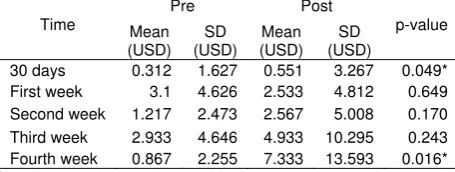
The revenue was classified and analyzed by the week, setting the before and after time frame. Table 1 summarizes the result of the paired t-test analysis for pre- and post-revenue comparison per week. Table 1 indicates that the average revenue increased after implementing the success factors from the second week to the fourth week. There are significant differences in the average revenue before and after the implementation for the entire month with a p-value of 0.049. The fourth week of implementation has the lowest p-value (0.016).
Table 1. Comparisons of Weekly Pre and Post Implementation Revenue
For further analysis, the revenue for post and pre implementation was analyzed using ANOVA, as shown in Table 2, yielding a p-value of 0.001. For deeper analysis, the revenue for pre implementation was analyzed using Post Hoc Test.
Table 2. ANOVA Revenue Pre Implementation Test Result
Sum of Squares df Mean Squares F p-value Between Groups 284.240 3 94.747 6.329 0.001*
Within Groups 1736.542 116 14.970
Total 2020.781 119
*Significant at p < 0.05
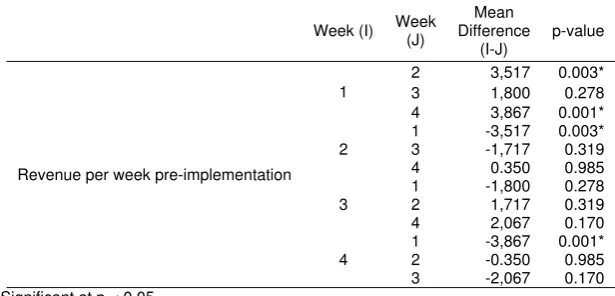
In order to determine which week is significantly different from other weeks, the revenue data were analyzed using post hoc test. Table 3 shows that there are significant differences between the first and second week as well as the first and third week. The p-value for Week 1 and 2 was 0.003 and the value for week 1 and week 2 was 0.001. Both of them have a p-value < 0.05.
Table 3. Post Hoc Test of Pre Implementation
Week (I) Week
*Significant at p < 0.05
The second significant difference of ANOVA revenue test was analyzed each week after implementation. Table 4 shows no significant difference between the groups. The average revenue for each week increased after implementation.
Table 4. ANOVA Post Implementation Revenue Test Result
Sum of Squares df Mean Squares F p-value
Between Groups 89.267 3 29.756 0.402 0.752 Within Groups 8,588.600 116 74.040
Total 8,677.867 119
*Significant at p < 0.05
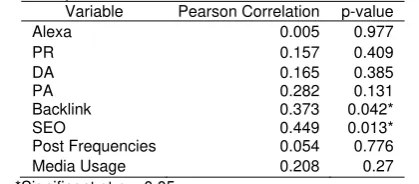
The independent variable with the highest correlation to revenue was determined the Pearson correlation test. The revenue was used as a dependent variable in this test. The independent variables used in this test were Alexa, Backlink, SEO score, post frequencies, media usage, PageRank, Domain Authority (DA), Page Authority (PA), and niche. Table 5 indicates that there were two out of nine independent variables with p-values < 0.05, namely SEO and backlink. SEO had a p-value of 0.013 and backlink had a p-value of 0.042.
had 40.6% contribution to the revenue after implementation and 59.4% is affected by other variables.
Table 5. Independent Correlation of Variables with Revenue
Variable Pearson Correlation p-value
Alexa 0.005 0.977
PR 0.157 0.409
DA 0.165 0.385
PA 0.282 0.131
Backlink 0.373 0.042*
SEO 0.449 0.013*
Post Frequencies 0.054 0.776
Media Usage 0.208 0.27
*Significant at p < 0.05
Table 6. Summary of Linear Regression Test Model
Model R Square Adjusted R Square Std. Error of the Estimate
1 .406 .138 9.46529
Further analysis with linear regression was done to find independent variables with significant effect. As shown in Table 7, only one independent variable, SEO, with a p-value of 0.049, had a significant effect on revenue after the implementation of success factors.
Table 7. Linear Regression Analysis of Independent Variable
Variable Beta t p-value Alexa -.495 -1.926 .068
PR .087 .461 .649
DA .243 1.283 .214
PA -.183 -.886 .386
Niche -.200 -.979 .339
Backlink .336 1.374 .185
SEO .435 2.098 .049*
Post Frequencies -.017 -.064 .949 Media Usage .174 .597 .557 *Significant at p < 0.05
Two-way ANOVA was used to determine which independent variables had significant impacts on revenue. The independent variables were classified into two groups as in the paired t-test. Alexa, Backlink, SEO score, post frequencies, media usage, PageRank, Domain Authority (DA) and Page Authority (PA) were used as independent variables. The result from two-way ANOVA test (Table 8) concluded that from the eight independent variables that were tested, only one independent variable had a significant impact on revenue after implementing the success factors, which was SEO with a p-value of 0.005.
Table 8. Two-way ANOVA Analysis Using Independent Variable
Variable Type III Sum of Square df Square Mean F p-value
Alexa 187.237 1 187.237 1.196 .300
Backlink 580.167 1 580.167 3.705 .083
PR 107.538 1 107.538 .687 .427
DA 602.079 1 602.079 3.845 .078
PA .000 0 . . .
SEO 2036.831 1 2036.831 13.007 .005*
Frequency .000 0 . . .
Media .000 0 . . .
4. Conclusion
The everchanging world of blog creates many motivations for blog monetization. There are many factors that influence the level of revenue generated. This study was motivated by these efforts to analyze four factors: traffic, search engine optimization (SEO), post frequencies, and media usage. By implementing these four factors into our sample of blogs, it was shown that the revenue of most blogs were increased. After analyzing all the data collected, we determined that search engine optimization (SEO) is the critical factor for a successful blog monetization effort.
References
[1] Truong Y, McColl R, Kitchen P. Practitioners’ Perceptions of Advertising Strategies for Digital Media.
International Journal of Advertising. 2010; 29(5): 709-725.
[2] Wu S, Lin CS, Lin J. An Empirical Investigation of Online Users' Keyword Ads Search Behaviours. Online Information Review. 2011; 35(2): 177-193.
[3] Hussey T. Create Your Own Blog. Second edition. Indianapolis: Sams Publishing. 2012.
[4] Hu N, Dong Y, Liu L, Yao LJ. Not All That Glitters Is Gold The Effect of Attention and Blogs on Investors’ Investing Behaviors. Journal of Accounting,Auditing & Finance. 2013; 28(1): 4-19.
[5] Deng L, Yuen AH. Towards a Framework for Educational Affordances of Blogs. Computers & education. 2011; 56(2): 441-451.
[6] Chau M, Xu J. Business Intelligence in Blogs: Understanding Consumer Interactions and Communities. MIS quarterly. 2012; 36(4): 1189-1216.
[7] Cho S, Huh J. Content Analysis of Corporate Blogs as a Relationship Management Tool. Corporate Communications: An International Journal. 2010; 15(1): 30-48.
[8] Hu Y. Clustering-Based Hot Topic Detecting in Chinese Microblog. TELKOMNIKA Indonesian Journal of Electrical Engineering. 2014; 12(3): 2096-2103.
[9] Yuan J, Wang B, Ding SA Real-time Search Structure and Classification Algorithm of Microblog Based on Partial Indexing. TELKOMNIKA Indonesia Journal of Electrical Engineering. 2014; 12(3): 2274-2277.
[10] Du HS, Wagner C. Weblog Success: Exploring the Role of Technology. Int. J. Hum.-Comput. Stud. 2006; 64(9): 789-798.
[11] Safran C, Kappe F. Success Factors in A Weblog Community. Journal of Universal Computer Science. 2008; 14(4): 546-556.
[12] Cohen E, Krishnamurthy B. A Short Walk in the Blogistan. Comput. Networks. 2006; 50(5): 615-630. [13] Muller S, Goswarni S, Krcmar H. Monetizing Blogs: Revenue Streams of Individual Blogs. 19th
European Conference on Information Systems, ECIS 2011. Helsinki, Finland. 2011.