Hak CIpta
Penulis :
Reviewer :
Hak Cipta pada penulis
Hak Penerbitan pada Universitas Pendidikan Indonesia
Dilarang mengutip sebagian atau seluruh buku ini dalam bentuk apa pun tanpa izin dari penerbit UPI PRESS.
Edisi Kedua
Cetakan Kesatu, 2010
ISBN :
Desain
Tim Ahli : Prof. Dr. Ahman, M.Pd Prof. Dr. Mustofa Kamil Dr. Johar Permana, M.A
Koordinator : Iwan Gunawan
Tata Letak isi :
Desain Cover :
Penerbit : UPI PRESS
Gedung Penerbitan dan Percetakan Universitas Pendidikan Indonesia Jl. Dr. Setiabudhi, No. 229 Bandung 40154 Tlp. (022) 2013163 Pes.4502
Fakultas Ilmu Pendidikan
Jl. Dr. Setiabudhi No. 229 Bandung, Tlp (022) 2013163 Pes.4301 Fax/Telp : (022) 2000021
BAHASA INGGRIS
Dra. Nurhasanah, M.Ed
Luqman Ginanjar M.R, S.Pd Fajar Ginanjar Mukti
Ika Lestari Damayanti, MA
Dewasa ini, guru Sekolah Dasar/Madrasah Ibtidaiyah dipersyaratkan memiliki kualifikasi S-1 sesuai dengan tuntutan profesional. Hal ini sesuai dengan ketentuan yang terdapat pada UU Nomor 20/2003 tentang Sistem Pendidikan Nasional, UU Nomor 14/2005 tentang Guru dan Dosen, PP Nomor 19/2005 tentang Standar Nasional Pendidikan dan Permen Diknas RI Nomor 58 Tahun 2008 tentang Penyelenggaraan Program Sarjana (S-1) Kependidikan bagi Guru dalam Jabatan.
Sejalan dengan itu, Universitas Pendidikan Indonesia (UPI) mulai tahun akademik 2006/2007 menyelenggarakan Program Strata I (S-1) PGSD bagi guru Sekolah Dasar/Madrasah Ibtidaiyah dengan menggunakan pendekatan dual-modes. Pendekatan ini dilakukan melalui perpaduan antara sistem pembelajaran tatap muka dengan sistem pembelajaran mandiri (self-instruction). Sistem pembelajaran mandiri dilakukan dengan cara mempelajari bahan belajar mandiri tercetak (printed materials) yang dikaji lebih lanjut pada pembelajaran tatap muka. Bahan belajar mandiri ini mencakup materi untuk peningkatan wawasan tentang berbagai konsep dan keterampilan yang berhubungan dengan peningkatan diri sebagai guru profesional.
Mudah-mudahan dengan tersusunnya bahan belajar mandiri ini, para mahasiswa dapat belajar secara mandiri dengan tidak mengganggu pelaksanaan tugas-tugas keseharian.
Bandung, Juni 2010 Rektor,
i
Daftar Isi
DAFTAR ISI
1. BBM 1 : INTRODUCTION TO ENGLISH SOUNDS ... 1
Pendahuluan ... 1
Kegiatan Belajar 1 : Reviewing English Alphabet through Greeting Introducing Self and Others and Parting... 3
Latihan .... ... 10
Tes Formatif ... 10
Balikan dan Tindak Lanjut ... 11
Kegiatan Belajar 2 : Intifying English Sound and Its Stress and Intonation ... 12
Latihan ... 14
Balikan dan Tindak Lanjut ... 23
Kegiatan Belajar 3 : Reviewing English Alphabet through Greeting Introducing Self and Others and Parting... 25
Latihan .... ... 25
Balikan dan Tindak Lanjut ... 30
Kegiatan Belajar 4 : Reviewing English Alphabet through Greeting Introducing Self and Others and Parting... 32
Latihan .... ... 33
Balikan dan Tindak Lanjut ... 34
KUNCI JAWABAN TES FORMATIF ... 34
DAFTAR PUSTAKA... 39
2. BBM 2 : VOCABULARY ENRICHMENT ... 41
Pendahuluan ... 41
Kegiatan Belajar 1 : Reviewing ‘Parts of Sentence’ Through Analyzing Simple Sentences ... 43
Latihan... 43
Rangkuman... 44
Tes Formatif... 45
Balikan dan Tindak Lanjut... 46
Kegitan Belajar 2 : Reviewing ‘Parts of Speech’ Through Analyzing Simple Sentences ... 47
Latihan... 50
Rangkuman... 64
Tes Formatif... 64
Balikan dan Tindak Lanjut... 65
KUNCI JAWABAN TES FORMATIF... 66
ii
3. BBM 3 : REVIEWING SIMPLE PRESENT TENSES IN ENGLISH
(ACTIVE VOICES) ... 71
Pendahuluan ... 71
Kegiatan Belajar 1 : Understanding The Importance of Verb and Their Conjugations and Functions In English Grammar ... 73
Latihan... 73
Rangkuman... 77
Tes Formatif... 78
Balikan dan Tindak Lanjut... 78
Kegiatan Belajar 2 :Understanding Present Tenses ... 79
Latihan... 81
Rangkuman... 91
Tes Formatif... 91
Balikan dan Tindak Lanjut... 93
Kegiatan Belajar 3 :Gerunds and Infinitifes ... 94
Latihan... 96
Rangkuman... 97
Tes Formatif... 97
Balikan dan Tindak Lanjut... 97
KUNCI JAWABAN TES FORMATIF... 98
DAFTAR PUSTAKA...105
4. BBM 4 : REVIEWING SIMPLE PAST AND PERFECT TENSES IN ENGLISH (ACTIVE VOICES) ... 107
Pendahuluan... 107
Kegiatan Belajar 1 : Understanding Past Tenses ... 109
Latihan ... 113
Rangkuman... 117
Tes Formatif... 117
Balikan dan Tindak Lanjut... 117
Kegiatan Belajar 2 : Understanding Present Perfect Tenses ... 119
Latihan... 123
Rangkuman... 125
Tes Formatif... 125
Balikan dan Tindak Lanjut... 125
Kegiatan Belajar 3 : Understanding Past Perfect Tenses... 127
Latihan... 130
Rangkuman... 134
Tes Formatif... 134
Balikan dan Tindak Lanjut... 134
KUNCI JAWABAN TES FORMATIF... 135
iii
Daftar Isi
5. BBM 5 : UNDERSTANDING PASSIVE VOICE AND CLAUSES IN ENGLISH..139
Pendahuluan ... 139
Kegiatan Belajar 1 : Passive Voices ... 141
Latihan... 142
Tes Formatif... 145
Balikan dan Tindak Lanjut... 146
Kegiatan Belajar 2 : Pengenalan Kata ‘Word’ Prase ‘Phrase’ Klausa ‘Clause’ Dan Kalimat ‘Sentences’ Dalam Bahasa Inggris ... 148
Latihan... 148
Rangkuman...149
Tes Formatif...149
Balikan dan Tindak Lanjut...149
Kegiatan Belajar 3 : Independent Clause dalam kalimat Bersusun Compound Sentences dalam Bahasa Inggris ... 151
Latihan... 152
Tes Formatif...153
Balikan dan Tindak Lanjut...153
Kegiatan Belajar 4 : Independent dan Dependent Clause dalam kalimat Majemuk Compound Sentences dalam Bahasa Inggris..154
Latihan...156
Tes Formatif...156
Balikan dan Tindak Lanjut...157
KUNCI JAWABAN TES FORMATIF...158
DAFTAR PUSTAKA...161
6. BBM 6 : COMPLEX SENTENCES I : NOUN CLAUSES ...163
Pendahuluan... 163
Kegiatan Belajar 1 : Noun Clauses ... 164
Latihan ... 166
Balikan dan Tindak Lanjut ... 171
KUNCI JAWABAN TES FORMATIF ... 172
GLOSARIUM...173
DAFTAR PUSTAKA...174
7. BBM 7 : COMPLEX SENTENCES I : ADJECTIVE AND ADVERB CLAUSES.175 Pendahuluan ... 175
Kegiatan Belajar 1 : Comparative dan Superlative Deegres dalam adjectives dan adverbs ... 177
Rangkuman...179
Latihan... 179
Tes Formatif... 180
iv
Bahasa Inggris ...182
Latihan...182
Tes Formatif...186
Balikan dan Tindak Lanjut...188
Kegiatan Belajar 3 : ‘Adverb Clauses’ sebagai Dependent/Subordinat Clause dalam Kalimat kompleks ‘Complex Sentences’ dalam Bahasa Inggris ...189
Latihan...190
Tes Formatif...192
Balikan dan Tindak Lanjut... 193
KUNCI JAWABAN TES FORMATIF...194
GLOSARIUM...197
DAFTAR PUSTAKA...198
8. BBM 8 : GRAMMAR ENRICHMENT ... 199
Pendahuluan ... 199
Kegiatan Belajar 1 : Conditional Sentences ... 201
Latihan... 202
Tes Formatif... 204
Balikan dan Tindak Lanjut... 204
Kegiatan Belajar 2 : Reported Speech/Indirect Speech...206
Latihan... 209
Tes Formatif... 212
Balikan dan Tindak Lanjut... 213
Kegiatan Belajar 3 : Reported Speech/Indirect Speech... 214
Latihan... 214
Tes Formatif... 215
Balikan dan Tindak Lanjut... 217
Kegiatan Belajar 4 : Phrasal Verbs ... 218
Latihan... 219
Tes Formatif... 219
Balikan dan Tindak Lanjut... 220
Kegiatan Belajar 5 : Parallel Structure ... 221
Latihan... 221
Tes Formatif... 222
Balikan dan Tindak Lanjut... 223
Kegiatan Belajar 6 : Inversion ...224
Latihan... 225
Tes Formatif... 226
Balikan dan Tindak Lanjut... 227
KUNCI JAWABAN TES FORMATIF...228
GLOSARIUM...231
DAFTAR PUSTAKA... 232
9. BBM 9 : COMMUNICATION AND INTEGRATION ...233
Pendahuluan ... 233
v
Daftar Isi
Latihan... 237
Kegiatan Belajar 2 : Reading Skills :SQ3R Strategy ... 238
Latihan... 242
Kegiatan Belajar 3 : ... 246
Latihan... 247
Balikan dan Tindak Lanjut... 248
Kegiatan Belajar 4 : ... 249
Latihan... 250
Kegiatan Belajar 5 : ... 251
Latihan... 252
Tes Formatif... 254
Balikan dan Tindak Lanjut... 256
KUNCI JAWABAN TES FORMATIF...257
GLOSARIUM...263
Introduction To English Sounds
Bahasa Inggris 1
INTRODUCTION TO ENGLISH SOUNDS
P
ada Bahan Belajar Mandiri 1 ini, mahasiswa mengenal Abjad dalam Bahasa Inggris (English Alphabet), Bunyi-bunyi bahasa Inggris (English Sounds) baik dalam pengucapan kata maupun kalimat bahasa Inggris yang benar, termasuk lafal dan intonasi yang tepat, yang diperkenalkan melalui konsep-konsep perkenalan diri, memperkenalkan teman, latihan mengucapkan simbol bunyi sesuai dengan standar ‘Received Pronunciation’. Selain itu mahasiswa juga berlatih mengucapkan kata-kata melalui tema-tema maupun kegiatan yang berorientasi pada situasi pembelajaran di Sekolah Dasar.Tujuan Pembelajaran Umum
Mahasiswa dapat mengucapkan bunyi kata maupun kalimat dalam bahasa Inggris dengan lafal dan intonasi yang tepat.
Tujuan Pembelajaran Khusus
1. Mahasiswa dapat mengeja kata maupun ungkapan yang berkaitan dengan salam pertemuan, perkenalan, dan salam perpisahan.
2. Mahasiswa dapat melafalkan bunyi dalam kata maupun kalimat bahasa Inggris sesuai dengan standar ‘Received Pronunciation’ serta dengan lafal dan intonasi yang tepat, melalui tema-tema dan kegiatan yang berorientasi pada situasi pembelajaran di sekolah dasar.
3. Mahasiswa dapat menuliskan informasi tentang dirinya dan merespon koreksi dosen melalui ’editing symbol’ dan melakukan ’self correction’ terhadap hasil karyanya tersebut.
4. Mahasiswa dapat menjawab pertanyaan secara langsung maupun tertulis terhadap berbagai hal yang berkaitan dengan seluruh kegiatan pembelajaran pada Bahan Belajar Mandiri 1.
Untuk membantu Anda mencapai tujuan tersebut, BBM ini diorganisasikan menjadi empat Kegiatan Belajar (KB), yaitu:
KB1 : Kata maupun ungkapan yang berkaitan dengan salam pertemuan, perkenalan, dan salam perpisahan.
KB2 : ‘Received Pronunciation’
KB3 : ’Editing Symbol’ dan ’Self Correction’
Bahasa Inggris
2
Untuk membantu Anda dalam mempelajari BBM ini ada baiknya Anda memperhatikan beberapa petunjuk belajar berikut ini:
1. Bacalah dengan cermat bagian pendahuluan ini sampai Anda memahami secara tuntas tentang apa, untuk apa, dan bagaimana mempelajari bahan belajar ini. 2. Bacalah secara sepintas bagian demi bagian dan temukan kata-kata kunci dari
kata-kata yang dianggap baru. Carilah dan baca pengertian kata-kata kunci tersebut dalam kamus yang Anda miliki.
3. Tangkaplah pengertian melalui pemahaman sendiri dan diskusikan dengan mahasiswa lain atau dengan tutor Anda.
4. Untuk memperluas wawasan Anda, bacalah dan pelajari sumber-sumber lain yang relevan. Anda dapat menemukan bacaan dari berbagai sumber, termasuk dari internet.
5. Mantapkan pemahaman Anda dengan mengerjakan latihan dan melalui kegiatan diskusi dalam tutorial dengan mahasiswa lainnya atau teman sejawat.
6. Jangan lewatkan untuk mencoba menjawab soal-soal yang terdapat pada setiap akhir kegiatan belajar. Hal ini berguna untuk mengetahui apakah Anda sudah memahami dengan benar kandungan bahan belajar ini.
Introduction To English Sounds
Bahasa Inggris 3
REVIEWING ENGLISH ALPHABET THROUGH GREETING,
IN-TRODUCING SELF AND OTHERS, AND PARTING
ENGLISH ALPHABET
A a Bb Cc Dd Ee Ff Gg
/ //
/æ //// /bi: //bi: //bi: //bi: / / si: / / si: // si: // si: / /di: //di: //di: //di: / / i: / / i: // i: // i: / /ef //ef / /ef //ef / ////i:/i:/i:/i:/
Hh
/ei t∫/
O o /Ǥʊ/ V v /vi:/ I i /ai/ /ai/ /ai/ /ai/ P p /pi:/ /pi:/ /pi:/ /pi:/ Ww
/d ʌʌʌʌ blju : /
J j
/ei/i/ i/i/ Qq /kju:/ Xx /eks/ K k /kei/ /kei/ /kei/ /kei/ R r /a:/ Y y /wai/ L l /el/ /el/ /el/ /el/ S s /es/ Z z /zed/ M m /em/ /em/ /em/ /em/ Tt /ti:/ N n /en/ /en/ /en/ /en/ Uu /ju:/
I. Face to face conversation
Listen to your lecturer explaining the greeting, introducing self and others, and parting below:
Greetings
Formal Informal
Good Morning/Afternoon/Evening/Night
(Ladies and Gentlemen/ Children/
Students, etc.)
Morning/Afternoon/Evening/Night
Bahasa Inggris
4
Introducing Myself
Formal Informal
Hello Madam/Sir,
I would like to/ Let me introduce myself
to you. My name is …. My nationality is
……….. . My address is in …. . My
interest/s is/are ..., …………,
……….. My Profession is ………. . My
responsibilities in this ………..
(Profession) are ………, ………, ……..
.
Hi,
I’m ………….. I ’m from
……… I live in ……… My
hobby/ies is/are …….,
……., ………….., ………… I’m
a/an ………… (Profession). I
……… everyday.
Introducing (friends/colleagues, etc.) to other people
Formal Informal
Hello Mister/Mrs./Miss. ………….,
I would like you to meet my …….
(friends, colleagues/etc.). He is an
expert in ……../ Let me introduce
myself to you. My name is …. My
nationality is ……….. . My address is
in…. . My interest/s is/are ...,
…………, ……….. My Profession is
………. . My responsibilities in this
……….. (profession) are ………,
………, …….. .
Hi,
I’m ………….. I ’m from
……… I live in ……… My
hobby/ies is/are …….,
……., ………….., ………… I’m
a/an ………… (Profession). I
Introduction To English Sounds
Bahasa Inggris 5
Partings
Formal Informal
It is a glad/pleasure/really nice to
meet you.
But I have to go now. By the way,
how about ……….
(continued by inviting to a meeting/an
academic activities)
See you (in the next meeting, etc.).
See you again next time
Good Bye
It’s nice to meet you. How about
………
(continued by inviting to a party/an
informal activities)
See you in (the party, etc.)
See you soon
See you tomorrow
See you
Bye
Untuk memperdalam pemahaman Anda tentang materi yang telah diuraikan di atas, kerjakanlah soal latihan berikut.
Task 1.1
Practice these expressions in ‘pairs’ or in ‘group of three’ as required (remember to (1) use the right stress and intonation and (2) ask ‘how do you spell it?’ or ‘Could you repeat it, please!, whenever you can’t catch the word). In this task you act as a new teacher, and you want to teach English to the class, you’ve been asked by a student; he is the chief of the class:
A. Introducing myself:
Teacher All Students Teacher Student A Teacher Student A : : : : : : ……….1
Good morning Madam (in chorus)
My name is ………2 (spelling your name). I would like to
……….….3 . I hope you will enjoy my class. I will
be with you in this whole semester. If you have any queries during
my teaching here, please do not hesitate to contact me to my home
telephone ………. 4or to my mobile phone ……….. 5.
My name is ……….. 6. I’m ……….. 7. Could you repeat
spelling your name again, Madam? I could not catch that.
Yes, of course, it’s ……… 8(spelling the name again).
Anyway, ……….. 9, ……….10 (mention the
student’s name).
Bahasa Inggris
6
Student A :
Anyway, ……….. 9, ……….10 (mention the
student’s name).
Nice to meet you, too. We hope we will enjoy your class, Ma’am.
A. Introducing a friend to other:
Task 1.2
You have to introduce your new colleague Intan to your headmaster, but your headmaster is in a hurry to have another appointment, and he promises to meet you in his office tomorrow.
A. When you meet your acquaintance
Biasanya jika bertemu dengan kenalan yang sudah dekat, biasanya percakapannya informal dan menggunakan nama panggilan.
Task 1. 3
Vocabulary Enrichment
Bahasa Inggris 4 1
VOCABULARY ENRICHMENT
P
ada Bahan Belajar Mandiri 2 ini, mahasiswa mengenal kelompok kata (Parts of Speech) pembentukan kata (‘word formation’) melalui pemberian awalan (pre fixes) dan akhiran (suffixes) baik yang bersifat derivatives, maupun inflectional, yang berdampak pada pengayaan kelompok kata bahasa Inggris. Mahasiswa juga mengenali persamaan kata (synonym), lawan kata (antonym), serta mengetahui pasangan kata yang sesuai (collocation) dalam bahasa Inggris.Tujuan Pembelajaran Umum
Mahasiswa dapat menguasai sejumlah kosa kata dalam bahasa Inngris dengan melakukan pengelompokkan kata, pembentukkan kata maupun pemasangan kata yang tepat dalam bahasa Inggris, dan menggunakannya dalam kalimat sederhana.
Tujuan Pembelajaran Khusus
1. Mahasiswa dapat menganalisa kalimat sederhana ke dalam unsur-unsur kalimat. 2. Mahasiswa dapat mengelompokkan kata dalam bahasa Inggris dengan
pengelompokan fungsi yang tepat.
3. Mahasiswa dapat menunjukkan ciri-ciri awalan maupun akhiran pembentuk kata bahasa Inggris dan mengaplikasikannya dalam kalimat.
4. Mahasiswa dapat menggabungkan kata dalam bahasa Inggris menjadi frasa yang bermakna.
5. Mahasiswa dapat menunjukkan persamaan kata, lawan kata, maupun pasangan kata.
Untuk membantu Anda mencapai tujuan tersebut, BBM ini diorganisasikan menjadi dua Kegiatan Belajar (KB), yaitu:
KB1 : Reviewing ‘Parts of Sentence’ through analyzing simple sentences. KB2 : Reviewing ‘Parts of Speech’ through analyzing simple sentences.
Untuk membantu Anda dalam mempelajari BBM ini ada baiknya Anda memperhatikan beberapa petunjuk belajar berikut ini:
1. Bacalah dengan cermat bagian pendahuluan ini sampai Anda memahami secara tuntas tentang apa, untuk apa, dan bagaimana mempelajari bahan belajar ini. 2. Baca secara sepintas bagian demi bagian dan temukan kata kunci dari
kata-kata yang dianggap baru. Carilah dan baca pengertian kata-kata-kata-kata kunci tersebut dalam kamus yang Anda miliki.
Bahasa Ingris
4 2
mahasiswa lain atau dengan tutor Anda.
4. Untuk memperluas wawasan Anda, baca dan pelajari sumber-sumber lain yang relevan. Anda dapat menemukan bacaan dari berbagai sumber, termasuk dari internet.
5. Mantapkan pemahaman Anda dengan mengerjakan latihan dan melalui kegiatan diskusi dalam tutorial dengan mahasiswa lainnya atau teman sejawat.
6. Jangan lewatkan untuk mencoba menjawab soal-soal yang terdapat pada setiap akhir kegiatan belajar. Hal ini berguna untuk mengetahui apakah Anda sudah memahami dengan benar kandungan bahan belajar ini.
Vocabulary Enrichment
Bahasa Inggris 4 3
REVIEWING ‘PARTS OF SENTENCE’ THROUGH ANALYZING
SIMPLE SENTENCES.
K
alimat dalam bahasa Inggris pada dasarnya terdiri dari dua unsur, yaitu (1) subject dan (2) predicate. Predicate dalam bahasa Inggris, terdiri dari (1) a predicating word (Verb), yang biasanya disertai dengan object, dan (2) a linking verb, yang biasanya disertai dengan complement berupa adjective (kata sifat) atau adverb (kata keterangan).Subject
Predicating Words
Object Adverbs
Linking Verb Complement Subject Predicate
Dengasn demikian kalimat bahasa Inggris memiliki unsur berikut
Subject Verb Object Adverb Complement (SVOAC)
Perhatikan contoh kalimat dalam bahasa Inggris berikut: 1. The boy throws the ball into the water
2. Mary is beautiful
Kalimat di atas diuraikan menjadi:
1. The boy throws the ball into the water Subject Predicating Word Object Adverb Subject Predicate
2. Mary is beautiful Subject Linking Verb Complement Subject Predicate
Untuk memperdalam pemahaman Anda tentang materi yang telah diuraikan di atas, kerjakanlah soal latihan berikut.
Task 1.1:
Analyze the pattern of these sentences. Put S for
subject, V for verb, O for object, C for complement, and A
for adverb
Bahasa Ingris
4 4
2. The boy eats the meal hungrily
3. We had delicious dinner
4. He works efficiently
5. She stares Blankly into the fire
Maka pola kalimat dalam bahasa Inggris merupakan variasi dari Subject (S) Verb(V) Object (O) Complement (Adverb). Perhatikan pola kalimat di bawah ini
Sentence Notes on Verbs
Pattern Subject Verb Complement Object Adverb
S-V I cry Intransitive Verbs (do not need an object)
S-V-A He screams loudly
S-V-C She seems Happy
Linking Verbs S-V-C Mary is Beautiful
S-V-O He throws the ball Transitive Verbs (predicating words; should have objects) S-V-O-A She sings the
song
beautifully
S-V-C-O-A
Vocabulary Enrichment
Bahasa Inggris 4 5
From the four words or phrases (A), (B), (C), or (D), choose the one that best completes the sentence.
1. ____________ in fluorescent lamps, television tubes, and other devices. (A) Phosphors are used (C) To use phosphors (B) It is phosphors (D) Using phosphors
2. The tips of some undersea mountains ____________ islands in the middle of the ocean.
(A) to form (B) they form (C) form (D) forming 3. ____________ of fish: jawless fish, cartilaginous fish, and bony fish.
(A) It is three types (C) Three types
(B) There are three types (D) Three types are
4. ____________to stop yourself from blinking except for a short period of time. (A) Impossible it (C) It impossible
(B) Impossible (D) It is impossible
5. ____________ the Sitka spruce a hundred years to grow eleven inches. (A) It takes (C) By taking
(B) To take (D) That takes
6. ____________ today was developed by the Swiss scientist Horace de Sassure around 1773.
(A) Mountaineering it as we know (C) We know mountaineering is (B) Mountaineering as we know it (D) We know there is mountaineering 7. ____________ of the surface of the Earth is covered by water.
(A) Three-quarters is nearly (C) It is nearly three-quarters (B) There is nearly three-quarters (D) Nearly three-quarters
8. By the mid-eighteenth century ____________ many new immigrants entering North America from Europe that the original colonies in the Northeast were overcrowded. (A) it were (B) were (C) there (D) there were
9. ____________ not until the end of the seventeenth century that scientists began to stress the importance of experiment as a way of gaining knowledge.
(A) There was (B) It was (C) There (D) It
10. ____________ are the most poisonous fish in the world.
(A) There are stonefish (C) They are the stonefish (B) That the stonefish (D) Stonefish
Bahasa Ingris
4 6
Cocokkanlah hasil jawaban Anda dengan kunci jawaban Tes Formatif I yang
ada pada bagian belakang BBM ini. Hitunglah jawaban Anda yang benar,
kemudian gunakan rumus di bawah ini untuk mengetahui tingkat
penguasaan Anda terhadap materi kegiatan belajar 1.
Rumus:
Jumlah Jawaban Anda yang benar
Tingkat Penguasaan = —————————————————— x 100 % 10
Arti Tingkat Penguasaan :
90 % - 100 % = Baik Sekali 80 % - 89 % = Baik
70 % - 79 % = Cukup < 69 % = Kurang
Vocabulary Enrichment
Bahasa Inggris 4 7
REVIEWING ‘PARTS OF SPEECH’ THROUGH ANALYZING
SIMPLE SENTENCES
P
ada kegiatan pembelajaran 1, Anda telah mempelajari unsur-unsur kalimat dalam bahasa Inggris, pada kegiatan pembelajaran ke-2 ini Anda akan mempelajari pengelompokkan kata dalam bahasa Inggris berikut fungsinya dalam kalimat.Dalam bahasa Inggris dikenal pengelompokkan kata (Parts of Speech), yakni: Kata Benda (Noun), Kata Kerja (Verb), Kata Sifat (Adjectives), dan Kata Keterangan (Adverb). Dalam paragraf selanjutnya akan diuraikan secara rinci masing-masing kelompok kata.
1. NOUN
A NOUN is the name of a person, place, or thing. Its function in a sentence is as ‘subject’ and ‘object’
There are three kinds of nouns:
Common Proper Collective
(General Type) (Particular) (Organized into one group) girl
park army
Mary
Central Park US Army
team crowd congress
Examples below are to show the relationship between proper nouns and related com-mon nouns:
Proper Nouns Related Common Nouns
Susan B. Anthony Henry Ford
Katharine Hepburn Alexander Bell Boston Hoover Dam Lake Superior U.S. Constitution General Motors
Leader, activist, feminist industrialist, manufacturer actress, movie star scientist, inventor city, capital, port dam, structure, feat lake, resource, water constitution, law, document corporation, business, firm
(Burtn
Concrete and Abstract Noun
Bahasa Ingris
4 8
Concrete Abstract
Name of Persons, Plants, Things,
Activities or Events
Usually derived from other words, adjectives, or
verbs plus the following suffix:
Persons
Plants
Things
Activities
Events
Carol
Orchid
Table
Christmas
-ness
-th
-ance
-cy
-ism
Happiness, helpfulness
Length, warmth
Endurance, appearance
Supremacy
Capitalism
Vocabulary Enrichment
Bahasa Inggris 4 9
Nouns’ function in a sentence (case):
Nominative Case Objective Case Possessive Case
as subject
as predicate noun as direct address
as direct objects as indirect
as objective complement
shows ownership
The girls ran outside
Einstein was a scientist
Claudia, please answer the
phone
The team won the game Pedro throw Mario the ball The team elected Terry
captain
the girl’s doll Charles’(s) book the children’s toys
POSITION OF NOUNS
The position of a noun is determined by its function in the sentence. The blanks in the fol-lowing sentences indicate the position of nouns as they fulfill different functions.
Subject The ___________ is good.
Subjective Complement
(Predicative Noun) Mary is a pretty ___________ .
Direct Object The children ate ___________.
Indirect Object The lawyer sent ___________ a letter
Objective Complement The member elected Mr. Jones ___________.
Object of Preposition He deposited the money ___________.
Noun Adjunct He bought some gas at the ___________ station.
Apposition Shakespeare, a great ___________, wrote many fine plays.
Noun in Direct Address ___________, please come here. Or Please come here, ___________.
Task 2.1.1:
Noun (thing ) Endings
Word endings in English often tell you how a word is used grammatically in En-glish; therefore, it is very important for you to recognize some common word endings. If you recognize a word ending on a word that you do not you can tell how the word should be used grammatically, even if you do not understand the meaning of the word.
The following noun (thing) endings are every common in English. It is important for you to study them and become familiar with them.
NOUN (THING) ENDINGS
-ism socialism -nce excellence -ness sadness -ion information
Bahasa Ingris
5 0
Untuk memperdalam pemahaman Anda tentang materi yang telah diuraikan di atas, kerjakanlah soal latihan berikut.
Using one of the endings above, change each of the following words into a noun (thing)
Task 2.1.2:
Noun ( person) endings
The following noun (person) endings are very common in English. It is important for you to study them and become and familiar with them.
NOUN (PERSON) ENDINGS -er employer
-or actor
-ist tourist
-cian musician
Untuk memperdalam pemahaman Anda tentang materi yang telah diuraikan di atas, kerjakanlah soal latihan berikut.
Using one of the endings above, change each of the following words into a noun (per-son):
1. teach 9. perfection
2. type 10. program
3. beauty 11. electricity
4. ideal 12. invest
5. invent 13. build
6. clinic 14. natural
7. special 15 advice
Vocabulary Enrichment
Bahasa Inggris 5 1
Task 2.1.3
Choose the correct word in parentheses.
1. Franklin was a (politics/politician).
2. Franklin was also an (invention/inventor).
3. Franklin is known in the field of (science/scientist). 4. Franklin became a successful (printer/printing).
5. In 1820 a Danish (physicist/physics) proved that electricity produced magnetism.
Task 2.1.4 : Irregular Plurals
Direction: Study the irregular plurals in the chart in Skill 41. Then, indicate whether each of the following is correct (C) or incorrect (I).
1. one men 9. several naughty children
2. lots of data 10. an in-depth analyses 3. a surprising hypothesis 11. one hundred alumni 4. one fast-growing fungi 12. lots of bright tooth 5. various criterion 13. various exotic cacti 6. a few mice 14. two required thesis 7. each syllabi for the class 15. the earth’s axis 8. a young deer 16. lots of wooly sheep
From the four underlined words or phrases (A), (B), (C), or (D), identify the one that is not correct.
1. The potato was the staple of Ireland, and when the crop failed in 1840, A B C
there was mass starvations.
D
2. Shark can maneuver considerably faster than other fish because they A B C
have no bones . D
3. Although sugar cane and sugar beet look very different, the sugars that is A B C
refined from them tastes almost the same. D
4. Textiles industries are as widespread as food industries because both
A B
Bahasa Ingris
5 2
5
2. PRONOUN
It is used in place of a noun. The followings are types of Pronouns:
There is another type of pronoun that directly relates to person either singular or plural, which also called ‘Personal Pronoun’. Study this table below:
Person
Case
Reflective & Intensive Subjective/
Nominative
Objective
Possessive
implicit noun
adjective (explicit noun)
Singular
1st I me mine my + noun myself 2nd You you yours your + noun yourself
3rd
He him his his + noun himself She her hers her + noun herself It It its its + noun itself
Plural
1st We us ours our + noun ourselves 2nd You you yours your + noun yourselves 3rd They them theirs their + noun themselves
Untuk memperdalam pemahaman Anda tentang materi yang telah diuraikan di atas, kerjakanlah soal latihan berikut.
Vocabulary Enrichment
Bahasa Inggris 5 3
1. Between …, I think he is not telling the truth.
A. I and you B. me and you C. you and me D. you and I E. he and you
2. I’ll take all the luggage out and put … by the car.
A. it B. its C. they D. them E. no word is needed
3.
I’ve had many requests for assistance but most of … have been comparatively trivial.
A. it B. its C. they D. them E. no word is needed
4. I gave her the money which I found … on my way home. A. it B. its C. they D. them E. no word is needed
5. Is that car your sister’s or … .
A. ours B. our’s C. ours’ D. of us E. of we
Etherton, 1971:32-33
Task 2.2.2
From the four underlined words or phrases (A), (B), (C), or (D), identify the one that is not correct.
1. The penguin chicks cannot go into the water to get themselves own A B food until they have waterproof coats of feathers like their parents. C D 2. Balloons rise into the air because they contain a gas who is less dense,
A B C or lighter, than air.
D
3. The narwhal is the only animal in the world that has a tusk on A B
only one side of it body. C D
4. Silver is too soft to use by itself, so it is mixed with another metal to A B C make themselves harder.
Bahasa Ingris
5 4
5. Most slugs and snails breathe using a lung which opens through a small A B
hole in the side of its bodies. C D
Broukal, 1997: 21-22
3. ADJECTIVES
An Adjective describes or modifies a noun or a pronoun. An adjective usually answers the question ‘which one?’, ‘what kind?’ or ‘how many?’.
ARTICLE USAGE EXAMPLE
indefinite a
an
Before a noun begins with consonant
sound:
Pronounced ‘h’ sound
Pronounced ‘j’ sound
a dog, a book
a house
a university
Before a noun begins with vowel sound:
Pronounced ‘a’ sound
Pronounced ‘⌃’ sound
an eye,
an hour
an umbrella
In General Statement:
An Island is a body of land surrounded by water
To introduce subject that has not been mentioned before:
I saw a snake
With certain numerical expressions:
a dozen a couple a hundred a third
a great many a great deal a lot of a half
replacement for ‘per’: fifty miles an hour, $ 10 a day
With names of professions:
Vocabulary Enrichment
Bahasa Inggris 5 5
6. Before decades and centuries: The 1800s, the twenties
7. Before expression of time and place The afternoon, the future
The North, The front
8. Before Ordinal Numbers The first, the second, etc.
9. Before names of countries, states,
cities, universities, colleges, and school
that contain the word ‘of’
The USA,
The state of Florida,
The city of Boston,
The university of Texas,
The Netherlands
The Philippines
10. Before names of ocean, rivers, seas, gulfs, and plural names of mountains, islands, and lakes
(No articles for singular mountain, islands, and lakes)
The pacific Ocean The Gulf of Mexico The Appalachian Mountain, etc
11 Before geographic areas, but not before
the names of continent
The Middle East
Europe
12 Before the names of fields of study
when they contain the word ‘of’
The history of the US
history
13. Before the names of wars The second world War
World War II
14. Before names of ships, planes, trains,
and people’s family names (but not for
the name of people and magazines
The Browns
The May Flower
The Orient Express
Robert Brown
Time Magazine
Limiting Those Books belong to John The three boys didn’t see any birds
Descriptive The large chair
The sad song
Demonstrative-
Possessive
Pronoun Possessive
Possessive Adjective
This Book is my father
Interrogative-
Relative
Ask Questions (Wh-questions)
Join two clauses and modify some words
What’s his name?
Bahasa Ingris
5 6
Untuk memperdalam pemahaman Anda tentang materi yang telah diuraikan di atas, kerjakanlah soal latihan berikut.
Exercise 2.3.1
Circle a or an in the following sentences. Write “C” on the left if the sentence is correct. Write “NC” if the sentence is not correct. Correct the error.
1. Indonesia is a country made up of thousands of islands. 2. Greenland is an big island with a permanent ice cap covering. 3. The Bahamas, which consist of 700 islands, have a superb climate. 4. Robinson Crusoe is a character in a book by Daniel Defoe.
5. Robinson Crusoe spent twenty years with his friend Man Friday on an uninhabited island.
Broukal, 1997: 61
Task 2.3.2 Fill in the blanks with the correct article a, an, the,
or 0.
1. Islands make up _____ entire land area of some countries, including _____Japan and _____Philippines.
2. _____ Florida Keys are coastal islands built on coral reefs.
3. _____Mackinac Island in _____ Lake Michigan is _____ lake island. 4. _____ city of Montreal, in_____ Canada, is built on ____ large river island.
5. _____ Aleutian Islands, part of _____ Alaska, are _____string of coastal islands that were built by_____ volcanoes.
Broukal, 1997: 64-65
Task 2.3.3
From the four underlined words (A), (B), (C), or; (D), identify the one that is not correct.
1 The watt is named after James Watt, the British engineer who developed A B
the steam engine in 1760s. C D
2 Methane is a odorless burning gas and is the main ingredient of natural gas. A B C D 3. The alcohol acts as a narcotic on the nervous system and the brain.
A B C D 4. Zachary Taylor was first president to be elected from a state west of
Vocabulary Enrichment
Bahasa Inggris 5 7
the Mississippi River.
D
5. Barnacles which are related to lobsters, shrimps, and crabs, makes
A B C
strongest glue.
D
Broukal, 1997: 66-67
Task 2.3.4 :
Adjective endings
The following adjective endings are very common in English. It is important for you to study and become familiar with them.
ADJECTIVE ENDINGS -ent -ant -ful -ic -less excellent important careful economic careless -ive -out -al -able -ible expensive dangerous natural capable possible
Using one of the endings above, change each of the following word into an adjective.
1. heart 9. courage
2. nature 10. use 3. athlete 11. enthusiasm 4. mystery 12. motion 5. help 13. tradition 6. impress 14. change 7. intelligence 15 permanence 8. comfort 16. attract
4. VERBS
Transitive Intransitive Linking Auxiliary
Need an Object Do not need an object seem, look, appears, Primary Auxiliary: Do, Have, Be Modal Auxiliary:
Can, May, Might, Should, etc. S + V + O S + V S + linking verb(s) +
adjective
S + PAux .+ Adj. S + MAux.+ Vo He borrows some
books
She cried all night The couple look very unhappy
She is beautiful.
Bahasa Ingris
5 8
Task 2.4.1 : V
erb Endings
The following verb endings are very common in English. It is important for you to study them and become familiar with them.
Untuk memperdalam pemahaman Anda tentang materi yang telah diuraikan di atas, kerjakanlah soal latihan berikut.
Using one of the endings above, change each of the following word into a verb.
Task 2.4.2 Change the incorrect sentences using Noun or Verbs.
1. In Franklin’s time electricity was mainly used as a form of entertain. 2. Franklin discovery that lightning was electricity.
3. Franklin was the only man to signature all four key documents that helped to make the United States independent.
4. Besides his many activities in the serve of his country, he found time to be an inventor.
Vocabulary Enrichment
Bahasa Inggris 5 9
Task 2.5.1
: Adverb endings
The following adverb ending is very common in English. It is important for you to be-come familiar with it.
ADVERB ENDINGS
-ly really
Untuk memperdalam pemahaman Anda tentang materi yang telah diuraikan di atas, kerjakanlah soal latihan berikut.
Using the ending above, change each of the following words into an adverb.
1. final 9. great
2. careful 10. complete 3. obvious 11. eager 4. recent 12. absolute 5. strong 13. correct 6. perfect 14. sudden 7. fearful 15 doubtful 8. quick 16. regular
6. CONJUNCTIONS
A. COORDINATING CONJUNCTIONS
Coordinating conjunctions connect words or phrases that have the same function in a sentence.
CD Function Example
And
joins two or more words, phrases, or clauses of similar function and is used to show addition.
1. Like peas and broad beans, soya beans grow in pods.
2. The plant is ready for harvesting when the leaves turn yellow and drop off, and the pods and stems dry out.
joins two subjects, the verb is plural.
1. Soya beans and peas have pods.
But joins two or more words, phrases, or clauses and is used to show contrast.
1. In the U.S. soy is not harvested by hand but my machine.
2. Soya is not a new discovery but is one of the oldest crops grown in the Orient.
Or joins two or more words, phrases, or clauses. It is used to give a choice.
1. The beans may be yellow, green, brown, or mottled.
2. After being chilled, the margarine is packed into tubs or cut in blocks.
So joins a clause.
It does not join single words or phrases.
So is used to show effect.
Bahasa Ingris
6 0
CORRELATIVE CONJUNCTIONS
Vocabulary Enrichment
Bahasa Inggris 6 1
Untuk memperdalam pemahaman Anda tentang materi yang telah diuraikan di atas, kerjakanlah soal latihan berikut.
Task 2.6.1
From the four words or phrases (A), (B), (C), (D), choose the one that best completes the sentence.
1. Both diamond __________ graphite are made of the same element, which is carbon.
(A) and (B) except (C) together (D) both 2.
Blinking helps keep the surface of the eye clean __________ moist. (A) to (B) or (C) and (D) so
3. Normally, piranhas swim alone and feed on smaller fish__________ on seeds in the water.
(A) but (B) either (C) instead (D) or
4. Most rodents eat grain, seeds, and nuts, __________ some eat almost anything.
(A) contrary (B) they (C) but (D) instead
5. Fungi do not absorb sunlight but use animals and plants, __________ dead and living, as their source of food.
(A) furthermore (B) both (C) together (D) besides
Task 2.6.2
From the four underlined words or phrases, identify the one that is not correct.
1. Peppermint originated in Europe, but the early English colonists A B
brought it to North America C D
2. The central core of the earth is made of both very hot or dense A B C material.
D
3. Many meteorite falls go unnoticed because they either happen at A B C
night nor they hit the earth in uninhabited areas. D
4. Octopuses have not only large brains and also a well-developed
A B C D
nervous system.
Bahasa Ingris
6 2
7. PREPOSITION
PREPOSITION shows time, place, and agent
A volcanic eruption occurred in Krakatoa on August 27, 1883- Due to the erup-tion, 36,000people died.
Vocabulary Enrichment
Bahasa Inggris 6 3
Untuk memperdalam pemahaman Anda tentang materi yang telah diuraikan di atas, kerjakanlah soal latihan berikut.
Task 2.7.1
Identify one of the underlined words or phrases (A), (B), (C), or (D) that should be rewrit-ten or corrected.
1. The rocky island of Alcatraz in San Francisco Bay was discovered by A B the Spanish in 1769 and named by its large pelican colony.
C D
2. Bacteria are responsible of many of the textures and flavors in our food A B C and are particularly important in milk products.
D
3. Art Nouveau, a style that was in fashion in the 1890s, was based of A B C long curving lines inspired by climbing plants.
D
4. The brain is made up of billions of neurons that differ with each other A B C
greatly in size and shape. D
5. Wood, the hardened material from which trees are composed, is A B made up of millions of tiny tubes of fibers packed together.
C D
Task 2.7.2
From the four words or phrases, choose the one that best completes the sentence.
1. Camels store water________ of fat in their humps. (A) with the form (C) by the form (B) in the form (D) form
2. Tears contain an antiseptic that helps protect our eyes ________ infection.
(A) from bacterial (C) bacterial (B) in bacterial (D) with bacterial
3. So far only two other of our neighboring planets________ the solar system have been visited by unmanned spacecraft.
(A) by (C) in
(B) that they are in (D) they are by
4. Many tropical orchids grow________ branches of trees and have aerial Roots that absorb water from the moist air around them.
(A) of the (B) the (C) they are in the (D) in the
5. ________ compact disc, sound is stored as digital information in tiny pits on the surface.
Bahasa Ingris
6 4
a. All Endings Together
Identify each of the following word as a noun-thing ( NT ), a noun – person ( NP ), an adjective ( ADJ ), an adverb ( ADV ), or a verb ( V ).
Vocabulary Enrichment
Bahasa Inggris 6 5
b. All Ending Together
Circle the letter of the word that correctly completes each sentence. 1. The __________ of the new could not be stressed enough.
A. important B. importance C. importantly
2. the detective __________ that the maid committed the robbery A. theorized B. theoretician C. theoretic
3. It is ________ that they live so close to the school
A. convenience B. convenient C. conveniently
4. The patient responded __________ to the medication.
A. weaken B. weakness C. weakly
5. The psychologist explained his ideas on ________ interaction
A. social B. society C. socialize
c. All Endings Together
The following sentences contain a number of underlined words. Each of the underlined words may or not be correct. Circle the underlined words that are incorrect, and make them correct.
1. The police inspect organized an intensively search for the robber.
2. The newspaper reporter did not exact appreciate the negation comments about her article.
3. He became penniless and homeless when a seriousness ill made him unable to work.
4. On the old college campus, the ivy-covered wall of the colonial buildings create an aura of gentility and tradition.
5. Maya Angelou is a poem , composition, and author of two autobiographically work, I Know Why the caged bird sing and My Name
Bahasa Ingris
6 6
Rumus:
Jumlah Jawaban Anda yang benar
Tingkat Penguasaan = —————————————————— x 100 % 10
Arti Tingkat Penguasaan :
90 % - 100 % = Baik Sekali 80 % - 89 % = Baik
70 % - 79 % = Cukup < 69 % = Kurang
Apabila Anda mencapai tingkat penguasaan lebih dari 80% atau lebih, Anda dapat meneruskan dengan BBM selanjutnya. Selamat dan Sukses! Akan tetapi, apabila tingkat penguasaan Anda masih di bawah 80%, Anda harus mengulangi Kegiatan Belajar 2, terutama bagian yang belum Anda kuasai. Jangan putus asa, dimana ada kemauan, disana ada jalan.
ANSWER KEYS
Kegiatan Belajar 1 LATIHAN1. S V A
2. S V O A
3. S V C O
4. S V A
5. S V A A
TES FORMATIF I
1. A 2. C 3. B 4. D 5. A 6. B 7. D 8. D 9. B 10. D
Kegiatan Belajar 2 LATIHAN
Task 2.1.1 Noun (Thing) Endings
1. Membership 5. humanity 9. alcoholism 13. leadership 2. kindness 6. election 10. permanence 14. suddenness 3. reality 7. breakage 11. mileage 15. improvement 4. movement 8. intelligence 12. confusion 16. equality
Task 2.1.2 Noun (Person) Endings
1. teacher 5. inventor 9. perfectionist 13. builder 2. typist 6. clinician 10. programmer 14. naturalist 3. beautician 7. specialist 11. electrician 15. Advisor
Vocabulary Enrichment
Bahasa Inggris 6 7
Task 2.1.3
1. politician 2. inventor 3. science 4. printer 5. physicist
Task 2.1.4
1. I 9. C
2. C 10. I
3. C 11. C
4. I 12. I
5. I 13. C
6. C 14. I
7. I 15. C
8. C 16. C
Task 2.1.5
1. D 2. A 3. C 4. A 5. B
Task 2.2.1
1. C 2. D 3. D 4. E 5. A
Task 2.2.2
1. B 2. C 3. D 4. D 5. D
Task 2.31
1. C 2. NC 3. C 4. C 5. C
Task 2.3.2
1. the 0 the
2. The
3. 0 0 a
4. The 0 a
5. The 0 0 0
Task 2.3.3
1. D 2. B 3. A 4. A 5. D
Task 2.3.4 Adjective Endings
1. heartless 5. Helpful/less 9. courageous 13. traditional 2. natural 6. impressive 10. Useful/less 14. changeable 3. athletic 7. intelligent 11. enthusiastic 15. permanent 4. mysterious 8. comfortable 12. motionless 16. attractive
Task 2.4.1 Verb Endings
1. darken 5. shorten 9. differentiate 13. personify 2. finalize 6. intensify 10. identify 14. sweeten 3. justify 7. investigate 11. lighten 15. liberalize
Bahasa Ingris
6 8
Task 2.4.2
1. entertainment 2. discovered 3. sign
4. service 5. developed
Task 2.5.1 Adverb Endings
1. finally 5. strongly 9. greatly 13. correctly 2. carefully 6. perfectly 10. completely 14. suddenly 3. obviously 7. fearfully 11. eagerly 15. doubtfully 4. recently 8. quickly12. absolutely 16. regularly
Task 2.6.1 Conjunction
1. A 2. C 3. D 4. C 5. B
Task 2.6.2 Conjunction
1. B 2. C 3. D 4. B 5. D
Task 2.7.1 Preposition
1. D 2. A 3. C 4. C 5. B
Task 2.7.2 Preposition
1. B 2. A 3. C 4. D 5. A
TES FORMATIF II
a.1. V 11. NT 16. ADJ
2. ADJ 12. ADJ 17. ADV
3. NT 13. ADJ 18. NT
4. ADV 14. NT 19. NP
5. NP 15. ADJ 20. ADJ
b.
1. B 2. A 3. B 4. C 5. A
c.
1. inspector, intensive 2. exactly, negative 3. serious, illness 4. no errors
Vocabulary Enrichment
Bahasa Inggris 6 9
REFERENCES
Behrens, Susan J. et.al. (1996) Peterson’s 2000 GMAT Success: Boots your Test Scores.. New Jersey: Peterson’s.
Broukal, Milada (1997) Peterson’s TOEFL Grammar Flash.. New Jersey: Peterson’s. Burtness, Paul S. Effective English for Colleges 6th Ed.. South Western.
Etherton, ARB. (1971) Objective English Tests: Certificate Level. Hongkong: LongmanGroup (Far East) Ltd.
Frank, Marcella. (1993) Modern English: A Practical Reference Guide.. New Jer-sey: Regents/Prentice Hall.
Phillips, Deborah (1996) Longman Preparation Course for the TOEFL Test,Vol. A. New York: Longman.
Bahasa Inggris 71
REVIEWING SIMPLE PRESENT TENSES
IN ENGLISH (ACTIVE VOICES)
P
ada Bahan Belajar Mandiri 3 ini, mahasiswa mengenal konsep waktu ‘Time’ dan penekanan sekarang dan lampau ‘Present and Past Tenses’ baik dalam bentuk kalimat sederhana ’simple’ maupun kalimat sempurna ‘perfect’, sekaligus mengenal kalimat bersusun ‘compound sentences’ serta kata penghubung ‘conjunc-tion’ yang terlibat dalam penyusunan kalimat tersebut, sehingga mahasiswa dapat menganalisa unsure-unsur kalimat ‘parts of sentence’ bahasa Inggris.Tujuan Pembelajaran Umum
Memperkenalkan konsep waktu ‘time’ dan penekanan waktu sekarang dan lampau ’present and past tenses’, baik dalam bentuk kalimat sederhana ’simple’ maupun sempurna ’perfect’.
Tujuan Pembelajaran Khusus:
1. Mahasiswa dapat menyebutkan ciri-ciri penunjuk waktu sekarang dalam bahasa Inggris;
2. Mahasiswa dapat menunjukkan kelompok kalimat ’parts of sentence’ dengan menganalisanya dalam kalimat sederhana maupun sempurna ’simple and perfect’ dalam konteks waktu sekarang ’present tenses’;
3. Mahasiswa dapat menunjukkan konsep waktu yang akan datang ’future’ dengan penekanan waktu sekarang ’present tenses’;
4. Mahasiswa dapat menggabungkan dua atau lebih kalimat sederhana dalam bentuk kalimat bersusun;
5. Mahasiswa dapat menggunakan pola kalimat tersebut dalam menyampaikan gagasan nya, baik secara tertulis maupun lisan.
Untuk membantu Anda mencapai tujuan tersebut, BBM ini diorganisasikan menjadi tiga Kegiatan Belajar (KB), yaitu:
KB1 : Undertanding The Importance of Verbs and Their Conjugations and Functions in English Grammar
KB2 : Undertanding Present Tenses KB3 : Gerunds And Infinitives
Untuk membantu Anda dalam mempelajari BBM ini ada baiknya Anda memperhatikan beberapa petunjuk belajar berikut ini:
Reviewing Simple Present Tenses In English (Active Voice)
Bahasa Ingris
72
2. Baca secara sepintas bagian demi bagian dan temukan kata kunci dari kata-kata yang dianggap baru. Carilah dan baca pengertian kata-kata-kata-kata kunci tersebut dalam kamus yang Anda miliki.
3. Tangkaplah pengertian melalui pemahaman sendiri dan diskusikan dengan mahasiswa lain atau dengan tutor Anda.
4. Untuk memperluas wawasan Anda, baca dan pelajari sumber-sumber lain yang relevan. Anda dapat menemukan bacaan dari berbagai sumber, termasuk dari internet.
5. Mantapkan pemahaman Anda dengan mengerjakan latihan dan melalui kegiatan diskusi dalam tutorial dengan mahasiswa lainnya atau teman sejawat.
6. Jangan lewatkan untuk mencoba menjawab soal-soal yang terdapat pada setiap akhir kegiatan belajar. Hal ini berguna untuk mengetahui apakah Anda sudah memahami dengan benar kandungan bahan belajar ini.
Bahasa Inggris 73
UNDERSTANDING THE IMPORTANCE OF VERBS AND THEIR
CONJUGATIONS AND FUNCTIONS IN ENGLISH GRAMMAR
D
alam ’grammar’ bahasa Inggris, perubahan yang sangat mendasar adalah perubahan kata kerja ’verb’ nya. Jadi perubahan dan penekanan waktu akan secara otomatis mengubah pola kalimat, terutama ’verb’ dalam kalimat tersebut. Perubahan Verb dalam Bahasa Inggris, adalah sebagai berikut (in affirmative positive sentences):: Type
Verb
V0 V1 V2 V3 V4
Base Verb Present Verb Present Participle Past Verb Past Participle aV0
(as printed in dictionary)
V1 P1 V2 P2
Usage 1. Impertive Sentences; 2. After modal
auxiliaries. Simple Present Tense 1. Present Progressive/ Continuous Tenses (PCT/PPT); 2. Gerunds: Verbs function as
nouns Simple Past Tense 1. Perfect Tenses; 2. Passive Voices
Example write write (s) writing wrote written Write the letter,
please!
You can write the letter
He writes
letters everyday
She was writing
letters now
Writing letters is
her job as a secretary
He wrote a
letter
yesterday
He has
written a
letter A letter has been
written
Untuk memperdalam pemahaman Anda tentang materi yang telah diuraikan di atas, kerjakanlah soal latihan berikut.
Reviewing Simple Present Tenses In English (Active Voice)
Bahasa Ingris
74
Bahasa Inggris 75
28. fly flew
29. forget forgotten
30. forgive forgiving forgave
31. froze frozen
32. get gotten
33. give gave
34. go went
35. growing grew grown
36. had had
37. hear heard
38. hide hid
39. hit hit
40. hold held
41. hurt hurt
42. keep kept
43. knew known
44. led led
No.
Verb
V0-V1 V2 V3 V4
Base/Present Verb
Present Participle
Past Verb
Past Participle
V0-V1 P1 V2 P2
45. leave left
46. lent lent
47. let let
48. lost lost
49. make making made
50. meant meant
51. meet met
52. pay paid
53. prove proven
54. put put
55. quit quit
56. read read
57. ride riding rode
58. ring rang
59. rose risen
60. run ran
61. say said
62. seeing saw seen
Reviewing Simple Present Tenses In English (Active Voice)
Bahasa Ingris
76
2. Perubahan dalam kalimat ’penyangkalan’ dan ’pertanyaan’ bahasa Inggris (dalam present tenses):
Perubahan dalam kalimat ’penyangkalan’ dan ’pertanyaan’ bahasa Inggris, biasanya menggunakan ’operator’ yang bersatu dengan ’not’ pada kalimat penyangkalan dan berubah di depan kalimat pada kalimat pertanyaan. Operator dalam bahasa Inggris terdiri dari: (1) Primary Auxiliary dan (2) Modal Auxiliary.
The formation of primary auxiliary across present tenses
Bahasa Inggris 77
2nd
S You do are have have been will will be will have will have been
P You do are have have been will will be will have will have been
3rd S
He does is has Has been will will be will have will have been
She does is has Has been will will be will have will have been
P They do are have Has been will will be will have will have been
Note: S= Singular; P=Plural
In negative and interrogative sentences: (a) Primary/Verb Auxiliaries ‘do, have, be’ as well as (2) Modal Auxiliaries ‘will/shall, can, may, must, be able to, have to’ are used as operators.
Sentences
Negative interrogative
‘Not’ is added to Operators ‘do, have, be’,
the operators ‘do, have, be’, are put in the beginning of a sentence
I’m not a teacher Am I a teacher?
She’s not listening to the lecture. Is she listening to the lecture?
He doesn’t go to campus everyday. Does He go to campus everyday?
They haven’t been living here very long. Have they been living here very long?
He hasn’t got enough money to rent the room. Has he got enough money to rent the room? The teacher can’t slow down her teaching. Can the teacher slow down her teaching?
Reviewing Simple Present Tenses In English (Active Voice)
Bahasa Ingris
78
a. Fill in the boxes with the correct forms of the verb
Cocokkanlah hasil jawaban Anda dengan kunci jawaban Tes Formatif I yang ada pada bagian belakang BBM ini. Hitunglah jawaban Anda yang benar, kemudian gunakan rumus di bawah ini untuk mengetahui tingkat penguasaan Anda terhadap materi kegiatan belajar 1.
Rumus:
Jumlah Jawaban Anda yang benar
Tingkat Penguasaan = —————————————————— x 100 % 10
Arti Tingkat Penguasaan :
90 % - 100 % = Baik Sekali 80 % - 89 % = Baik
70 % - 79 % = Cukup < 69 % = Kurang
Bahasa Inggris 79
UNDERSTANDING PRESENT TENSES
[image:53.612.11.529.258.702.2]P
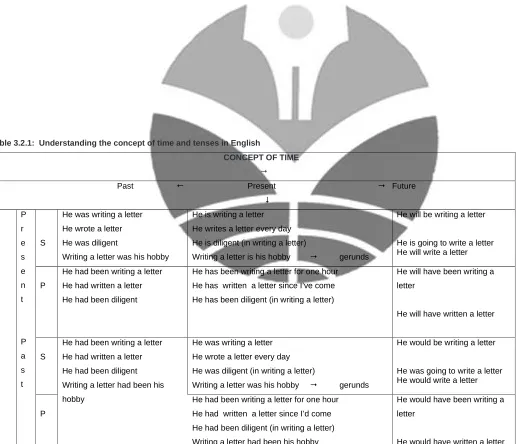
erhatikan Tabel 3.2.1 ‘understanding the concept of time and tenses ‘ pada halaman selanjutnya (perhatikan dan pelajari perubahannya dengan seksama).Table 3.2.1: Understanding the concept of time and tenses in English
CONCEPT OF TIME
Past Present Future T E N S E S P r e s e n t P a s t S
He was writing a letter He wrote a letter He was diligent
Writing a letter was his hobby
He is writing a letter He writes a letter every day He is diligent (in writing a letter)
Writing a letter is his hobby gerunds
He will be writing a letter
He is going to write a letter He will write a letter
P
He had been writing a letter He had written a letter He had been diligent
He has been writing a letter for one hour He has written a letter since I’ve come He has been diligent (in writing a letter)
He will have been writing a letter
He will have written a letter
S
He had been writing a letter He had written a letter He had been diligent Writing a letter had been his hobby
He was writing a letter He wrote a letter every day He was diligent (in writing a letter)
Writing a letter was his hobby gerunds
He would be writing a letter
He was going to write a letter He would write a letter
P
He had been writing a letter for one hour He had written a letter since I’d come He had been diligent (in writing a letter) Writing a letter had been his hobby
He would have been writing a letter
Reviewing Simple Present T
enses In English (Active V
oice)
Bahasa Ingris
8
0
T
enses dalam bahasa Inggris dap
at dikenali dan dipelajari juga dengan
memperhatikan rumus ’formula’
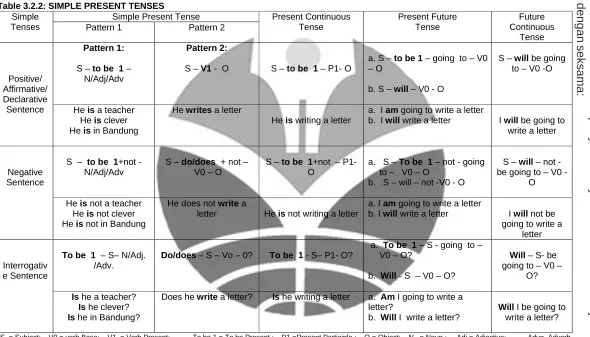
penyusunannya. Perhatikan dan Pelajari
T
abel 3.2.2:
[image:54.792.94.684.135.472.2]berikut ini dengan seksama:
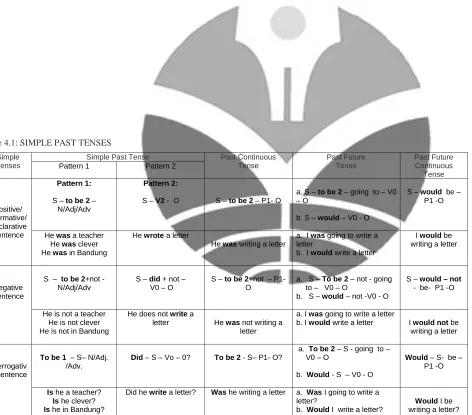
Table 3.2.2: SIMPLE PRESENT TENSES
Simple Tenses
Simple Present Tense Present Continuous
Tense Present Future Tense Future Continuous Tense
Pattern 1 Pattern 2
Positive/ Affirmative/ Declarative Sentence
Pattern 1:
S – to be 1 – N/Adj/Adv
Pattern 2:
S – V1 - O S – to be 1 – P1- O
a. S – to be 1 – going to – V0 – O
b. S – will – V0 - O
S – will be going to – V0 -O
He is a teacher He is clever He is in Bandung
He writes a letter
He is writing a letter
a. I am going to write a letter
b. I will write a letter I will be going to
write a letter
Negative Sentence
S – to be 1+not - N/Adj/Adv
S – do/does + not – V0 – O
S – to be 1+not – P1- O
a. S – To be 1 – not - going to – V0 – O
b. S – will – not -V0 - O
S – will – not - be going to – V0
-O
He is not a teacher He is not clever He is not in Bandung
He does not write a
letter He is not writing a letter
a. I am going to write a letter
b. I will write a letter I will not be
going to write a letter
Interrogativ e Sentence
To be 1 – S– N/Adj.
/Adv.
Do/does – S – Vo – 0? To be 1 - S– P1- O?
a. To be 1 – S - going to – V0 – O?
b. Will - S – V0 – O?
Will – S- be going to – V0 –
O?
Is he a teacher? Is he clever? Is he in Bandung?
Does he write a letter? Is he writing a letter a. Am I going to write a
letter?
b. Will I write a letter?
Will I be going to
write a letter?
Bahasa Inggris 81
The following tables review verb tenses:
3.2.1 The Usage of Present Tenses
Simple Present Tense Pattern 1
Primary Auxiliary ‘be’
Usage Example
Sentence Type linking verbs Positive/
Affirmative/ Declarative
Negative Interrogative
Formula
S – to be 1 – N/Adj/Adv S – to be 1+not - N/Adj/Adv
To be 1 – S– N/Adj.
/Adv.
before adjective She is beautiful She is not beautiful Is she beautiful? He is smart He is not smart Is he smart?
before noun: I’m a teacher I’m not a teacher Am I a teacher? They are soldiers.
We are in a reunion.
They are not a soldier
We are not in a reunion.
Are they soldiers? Are we in a reunion?
before adverb We are in Bandung We are not in Bandung
Are we in Bandung?
You are in Bali You are not in Bali Are you in Bali?
Untuk memperdalam pemahaman Anda tentang materi yang telah diuraikan di atas, kerjakanlah soal latihan berikut.
Task 3.2.1.1: Complete these sentences (Simple Present Tenses)
1. ‘Are you hungry?’ ‘No, but I’m thirsty
2. ‘ How are your parents?’ ‘They’re very well.’
3. ‘Is Linda at home?’ ‘No __________ at work.’ 4. ‘__________ my keys?’ ‘In the kitchen.’
Reviewing Simple Present Tenses In English (Active Voice)
Bahasa Ingris
82
3.2.2 Present Continuous/Progressive Tenses
Untuk memperdalam pemahaman Anda tentang materi yang telah diuraikan di atas, kerjakanlah soal latihan berikut.
Task 3.2.2.1: Matching sentences and picture (Present
Continu-ous/ Progressive Tenses)
Bahasa Inggris 83
G Two kites are flying in the sky.
H A man is packing his car.
I A lifeguard is watching the swimmers
J A ship is passing by.
K Several people are fishing from a boat.
L A sailboat with a flag is sailing in the distance.
M People are sunbathing to get a tan.
N A man with a beard is driving away with a child in the back
seat.
O The garbage cans are full.
P A man is cooking hot dogs and hamburgers on a barbecue
grill.
Q Someone is upside down in the water.
R A girl in a dotted swimsuit is holding a pail and a big shell.
S A beach umbrella is learning against the side of a car.
Eviewing Simple Past And Perfect Tenses In English (Activevoices)
Bahasa Inggris 107
REVIEWING SIMPLE PAST AND
PERFECT TENSES IN ENGLISH
(ACTIVE VOICES)
P
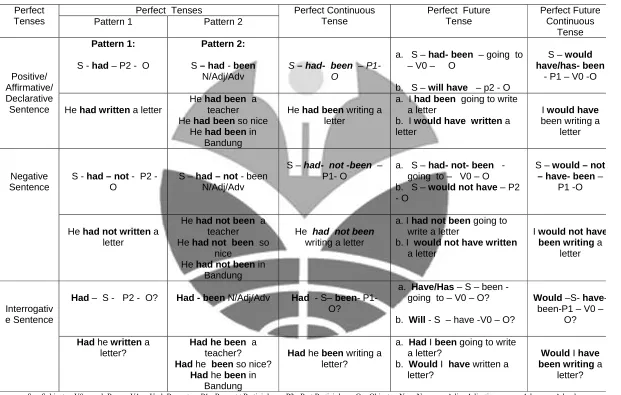
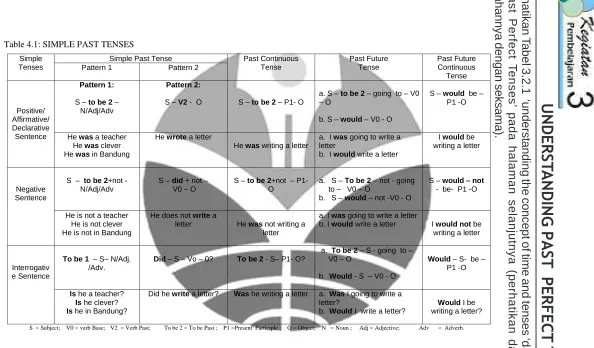
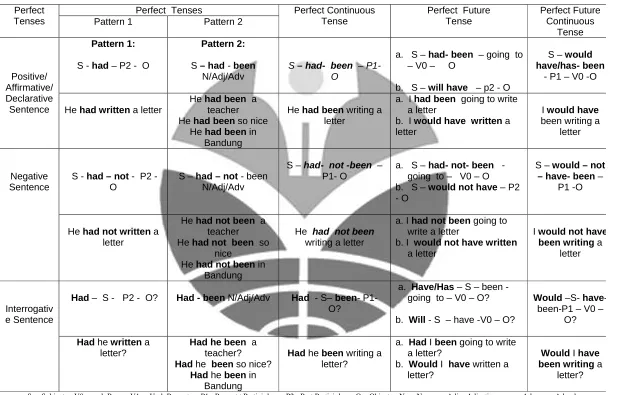
ada Bahan Belajar Mandiri 4 ini, mahasiswa mengenal konsep waktu ‘Time’ dan penekanan lampau ‘Past Tenses’ baik dalam bentuk kalimat sederhana ’simple’ maupun kalimat sempurna ‘perfect’, preset maupun past.Tujuan Pembelajaran Umum
Memperkenalkan konsep waktu ‘time’ dan penekanan waktu lampau ’past tenses’, serta kalimat sempurna ’perfect’ dalam penekanan waktu’’present maupunpas