A THESIS
Presentej ) the Faculty of Tarbiyah and Teacher's Training in Partial
Fulfi.
tent of the Requirements for the Degree of Strata I (SI)
MUHAMMAD BACHRUL ILMI
NIM:1981414352
ENGLISH DEPARTMENT
THE I
::'.ULTY OF TARBIYAH AND TEACHER'S TRAINING
SYA
F HIDAYATULLAH STATE ISLAMIC UNIVERSITY
A Thesis
Pres' セ、@ to the Faculty of Tarbiya and Teacher's Training in Partial F illment of the Requirements for the Degree of Strata I (SI)
MUHAMMAD BACHRUL ILMI NIM: 1981414352
Approved by Advisor
Drs. H. Atiq Susilo, M.A.
NIP: 150182900
ENGLISH DEPARTMENT
TI E'ACULTY OF TARBIYAH AND TEACHER'S TRAINING
セ@ lRIFHIDAYATULLAH STATE ISLAMIC UNIVERSITY JAKARTA
MOTIV, !ON AND ENGLISH SPEAKING PERFORMANCE" was examined at exami1 pn session of the Faculty of Tarbiya and Teachers' Training of Syarif Hidayatu , State Islamic University Jakarta on Monday, December 3'ct, 2004. This thesis ha: !filled the requirement for the Degree of Strata-I (S-I) at the department ofEnglis
The I-lea'
Prof. Dr.
NIP. 150
Examiner
!\\
|カセ@
.
\,
_ommittee
Drs. Sya1 M.Pd.
NIP. 150. ; 289
Examination Committee
Committee
Jakarta, January 61\ 2004
The Secretary of Committee
Examiner II
Drs. H. Atiq Susilo, M.A.
writer H )Ve m1d compassion to finish the last assignment in his study. Peace mld salutatioi e upon to the noble prophet of Islam, Muhammad SWT, the perfect mffil mld the t leader in the world, his family, relatives, and all followers.
1 y people have given contribution while this thesis is processed until it becomes 1complete to be presented to the Faculty of Tarbiyal1 and Teacher's Training セ。イエゥ。ャ@ Fulfillment of the Requirements for the Degree of Strata I (SI).
Ir 1s very meffilingful occasion, the writer would like to express his sincere gratitude セ@ love to his beloved parents, H. Mahdi Muhtadi mld Siti Jubaedab who have alw : given their love and care to wm-m the writer's heart so that he can live until nov 'he writer also thmlks to his 'big bird' dad, Robert L. Wood for his love and wisd • that teach the writer feels the wonderful feeling of being a good person for every ly, and also to his sisters, Siti Shofaroh mld Nadia Nurul Mabdi who have always セ@ n their support and have been two wonderful sisters. For them, the writer's l : Cffil never be chmlged by anything.
Ir ldition, the writer would like to express his eno1-mous appreciation mld gratitude Drs. H. Atiq Susilo, M.A. as the thesis advisor who has kindly sacrificed his time t ive his valuable advices and guidmlce to finalize this thesis.
Teacl i' Training Faculty.
3. Dra.
r
Lumbantoruan, the Head of Academic Division of LBPP LIA Ciputat (Lem :a Bahasa dan Pendidikan Professional LIA Ciputat/LIA Ciputat Lang e and Professional Training Institution).4. Drs.: uki, M. Pd., the Secretary of the Head of English Department ofTarbiyah and 1 fhers' Training Faculty.
5. Mr. I
i
the assistant of the Head of Academic Division ofLBPP LIA Ciputat. 6. Mr. I y and Mrs. Gloria, the English Language Teachers ofLBPP LIA Ciputat. 7. Hise lasting brothers; Baidhowi, S.Psi, for his guidance so that the writer couldヲゥョゥウAセ@ セエィ・ウゥウL@ Nurul Huda and Dadan Nugraha, S.Pd.
8. Mr. I Hu1111
9. The. Fajar. Dand 10. All fr
Woo< Glen) Indor
1b Chirzin, a commissioner of the Indonesian National Commission on
セゥァィエウN@
1ily of MRA-Initiatives of Change Indonesia. His best friends; Indra yas Ichsani, Miftahul Huda, Abdullah Wazin, Khoirul Uman1, S.Pd, '!MK, S.Pd., Teguh Khairudin, etc.
U.K. itain), Cornelio Sommaruga (MRA-IC Switzerland), Dick and Randy Ruffi MRA-IC USA), Stephen Young (MRA-IC USA), Altaf Khan (MRA-IC Kash -India), Yeon Yuk (MRA-IC South Korea), Ren Jou and Julie Tan (MR, C Taiwan), Hiroshi Ishida (MRA-IC Japan), etc.
T writer does realize that this thesis cannot be considered perfect without critiques :I suggestions. Therefore, is such a pleasure for him to get critiques and suggestic for this thesis betterment.
Jakarta, I ember 20'h 2004
Muham1 l Bachrul Ilmi
TABLE : CONTENTS ... iv
CHAPT I. INTRODUCTION A. Background of Study ... ! B. Limitation and Formulation of Problem ... 3
C. Objective of Study ... 4
D. Method ofResearch ... 5
E. Organization of Writing ... 5
CHAPTJ II. THEORETICAL FRAMEWORK A. Speaking ... 7
I. Definition of Speaking ... 7
2. Types ofSpeaking ... 9
3. Elements of Speaking ... .11
B. Motivation ... 14
I. Definition ofMotivation ... 14
2. Intrinsic Motivation ... 20
3. Extrinsic Motivation ... 21
2. Place of Research ... 26
3. Time ofResearch ... .31
4. Techniques of Sampling Taking ... .32
5. Techniques of Data Collecting ... 32
6. Techniques of Data Analysis ... .43
B. Research Findings I. Description of Data ... .44
2. Analysis of Data ... .46
3. Test of Hypothesis and Interpretation of Data ... .49
CHAPT
M
CONCLUSION AND SUGGESTION A. Conclusion ... 50B. Suggestion ... .50
BIBLIO APHY ... 51
A. Back mnd of Study
CHAPTER I
INTRODUCTION
A matter of fact for hundreds years, English has proven its significant role as a glo language in connecting people from various cultural backgrounds of countries the world. For instance, the United Nations, a world wide organization commiW n peace and reconciliation building among people, which members are almost al mntries in the world, has stated that English is one of their main official internati< 'languages to use since it was established in 1945.
Ir lucational field, many projects which aim to improve a better concept of educatio1 lr the sake of human beings, such as student exchanges, researches, semmars Drkshops, etc-, have been using English as their media of communication. In additi' many bibli graphical references which are utilized in many countries, presentec English. T us, it may be concluded that English plays an important role as a glob mguage.
sixth yei concentr.
c
English: skill by
other kin intereste1 L endeavo1 language contrary, with the psycho lo F attempts individw psycho lo 1 Depdikb1 2 PennyU1
Press, 199,
3
Henry Cl Company,
In line with GBPP, the teaching-learning process of English language : on the four skills, namely; listening, speaking, reading, and writing.
of the four skills above which plays a significant role in mastering peaking. Pennpy Ur stated that " ... As a skill, speaking is the most used
セーゥ・@ rather than the three other skills. People who know. language a·
e
referred to as 'speakers' of that language, as i:f speaking including all of knowing; and many if not most foreign language learners are primarily1
.
ak"2: earnmg to spe ...
ning the English speaking skill is a lengthy process, because students 1t only to learn the language, but also to learn how to speak. Learning the eans learning the forms of language grammatically and semantically. In rrning how to speak means something different because it deals not only 'arts of the students in mastering the patterns of speaking, but also the al problems inside themselves.
:y Clay Lindgren states that, " .. .learning is a process by which the self achieve a balance among the psychological forces of the needs of the and the demands of the physical and social environment".3 The al problems faced by the students in learning how to speak mean some
(urikulum Muatan Loka/ untuk Seko/ah Dasar, (Jakarta: Depdikbud, 1994), p. 30 Course in Language Teaching: Practice and The01y, (London: Cambridge University
I. 6
Jndgren, Psychology of Personal and Social Adjustment, (New York: .lµnerican Book
psycholo al emotions which students get through when they learn the English speaking 11.
0 of the psychological problems is students' motivation. Based on a research, ;emy Harmer stated that learning is usually most efficient and rapid when the learn1 \ motivated and attentive. Psychologists believe that an intermediate level of motivi h i.s best for many learning tasks. If a person's level of motivation is too low, he c :ie may give up quickly. Jeremy Harmer stated, " .. .it seems reasonable to suggest 1 the motivation that student bring to class is the biggest single factor affecting
ir
success".4T , It is such an interesting study to have a research on what have been mentione bove in order to find out whether the students' motivation has correlation with mot !ion or not. With a great hope that this correlation study may support the English ti lling-leaming process in order to make some de:velopments.
B. L fation and Formulation of Problem
1. Li tation of Problem
Ir 'S paper, the writer limits the study on some matters as follow;
a. earning the English speaking skill is considered as a process by which
セ・@ self attempts to achieve a balance among the psychological forces of
te needs of the individual and the demands of the physical and social avironment in learning the English sperucing skill.
4
b viotivation is assumed as one of psychological factors which is involved n the English speaking skill learning process.
c >peaking is considered as one of the four skills that the students need to lea! with both language fom1S and their own psychology in learning it. d :he second level intermediate students of LBPP LIA Ciputat are
onsidered as the study object.
e. ,BPP
LIA
Ciputat as one of LBPPLIA
branches focusing on English eaching-learning process is believed that one of their goals is to educate\.eir students able to speak English well.
2.
F1
iulation of ProblemT
'ormulation of problem in this paper is;"I 1ere any correlation between students' motivation and English speaking performa
'?"
C. Obj et :e of Study
D. Meth of Research
Ir fiting this paper, the writer uses two types of researches as follow;
1. L iry research, which aims to find out some support materials taken from
S( 1 theories related to the topic discussed.
2. F: research, which aims to collect the data by taking some samples from
tb htermediate second level students of LBPP LIA Ciputat from the two c< ?ared variables. Then, the data will be analyzed by using the product m 'ent theory. In social science, this field research is known as a quantitative re irch.
E. Orga ation of Writing
T paper consists of four chapters. The first chapter is introduction which describes
e
background of study, the limitation and fonnulation of problem, the objective Study, the method ofresearch and the Organization of Writing.T 'second chapter is theoretical framework which explains two matters. First, it c lains some theories of speaking itself, from general view of speaking,
types of 'aking, to the elements of speaking. Second, it e:xplains the meaning of motivatic rom some psychologists and its charactedstics.
T セゥウ」オウウゥッョ@ about research methodology and findings is wiitten in the third
A. Spea
s
living pi speaking wish to occasion those m2 for purpc
A
plays a i
skill thai learning language Motivati1 the learn
lg
CHAPTER II
THEORETICAL FRAMEWORK
jking -the faculty of oral communication- is significant to an individual's isses and experiences are the faculties of seeing and wallcing. Without )ople must remain in almost total isolation from any society. Here people phasize that they are not thinking of "speaking" solely terms of formal
! public speaking as frequently conceived. People are, rather, thinking of and very important, daily experiences when they speak to other persons I that range from simple to complex communication.
.tated before in the first chapter that speaking is o:ne of the four skills that iificant role in mastering English. It is considered as the most complex te three skills in performing and learning it. In other words, The people
セ。ォゥョァ@ deal not only with their cognitive basis to learn the forms of µt also deal with some internal psychological factors inside themselves. is considered as one of the psychological materials that affect people in process.
1. D 11ition of Speaking
there ru purposes (kinds) of speaking, namely to inform to persuade, and to entertai1 From this definition, it is clearly seen that speaking is the process of sharing th another person, or with other persons, one"s knowledge, interests, attitudes pinions, or ideas. In addition, delivery of ideas, opinions, or feelings is an importru tspect of the process of oral commimication through that a speaker's concepti becomes actual to him ru1d his audience.
I :wise, Andrew Thomas Weaver stated that " ... speaking is an aspect of human I avior, and it is learned behavior in the san1e sense that handwriting, spelling, table mrumers are learned behavior-even though skills in speaking may be somt at more complex.6 As a behavior, speaking can be learned by some teaching rning methodologies.
1
;,
it can be conceived that in communication, people use spealdng as the way in ' ressing their ideas, opinions, or feelings to others by using words or sounds c rticulation in order to inform, to persuade, and to entertain that can be learnt by hg some teaching-learning methodologies.5
Henry G. igan, Berbicara Sebagai Suatu Ketrampilan Berbahasa, (Bandung: Angkasa, 1981), p. 15
6
[image:16.595.71.493.31.707.2]2. 1 ps of Speaking
A onceived before that people use speaking to inform, to persuade, and to entertain enneth G. Hance stated that there are three major types of speaking as follows;
a.
S
Tinform a ti understo1
"Inf
requ1 to-pe resp< facul anotl cons facili Ir speaking speaking speaking student's informati
7 Kenneth 1 Publishing
1king to Inform
first type of speaking is speaking to inform. The primary purpose of ;speaking is t.o prese'lt information or message so that it can be clearly
セH・ョョ・エィ@
stated that;iative Speaking is widely varied branch of connnunication. It replies to for information or to convey infmmation. Whether it is a case of
person-ln
communication or one person speaking to a group. For examples, in セウ@ to a student's request for information about the course he is to take, theセ、カゥウッイ@ gives him a brief-nm-down of requirements. Or suppose, for
• example a couple requests information about a house they have red buying, an appraiser tells them about the condition of the house, the
i
available, and other details". 7fdition, Donald C. Bryant and Karl R. Wallace stated that in informative , . the speaker desires to supply the knowledge the audience lacks". Thus, inform aims to deliver information such as WH questions, that utilized in .inform or informative speaking as mentioned by two examples above of a juest for information about the course he is to take and a couple requests •about a house they have considered buying.
b.
s
s
of speak speaker i them to a on that cl "Inf or re desir Pare1 let m
Ir speaking attitude, · to produ< quandary
c.
s
s
other twc distinctiv
8
Ibid, p.
2:
9
Donald C Corporatio
:king to Advocate
king to advocate or persuade is the second type of the three major types . Advocacy and information are always found in the same talk; the 1ms or reminds his listeners of certain facts, and then he tries to persuade m based on those facts, or he tries to change their opinion so that the later ge may produce the desired action. Kenneth stated that;
uasive speaking, or also called speaking to advocate, the speaker informs セ、ウ@ his listeners of certain facts, or he tries to change may produce the action. For examples, a mother tries to persuade her neighbor to join the セ・。」ィ・イ@ association, or a young boy tells the bully down the street: "You !one or my father. .. my father can lick your father", etc."8
ldition, Donald C. Bryant and Karl R. Wallace stated that persuasive
verbal communication whose pfrne puri::ose or goal is the influencing of ef, or behavior.9 Persuasion certainly involves an effect and the intention
t.
The situation that prompts a speaker to try to persuade is an audience's out what to believe or not to believe, what to do or not to do.iidng to Entertain
king to entertain is the last type of the three major types of speaking, the ing information and advocacy. The usage of this type is so specialized, so and so widely used that it merits special consideration-for practical
yant & Karl R. Wallace, Fundamentals of Public Speaking, (New York: Meredith
reasons 1 Jr no other. Kenneth stated that, " ... spoken entertainn1ent, or called as
speaking entertain is speaking that contains entertainment".10
F examples, a teacher resorts to the entertainn1ent method in teaching-learning icess in order to attract his students' attention to the lesson such as by employir 1umor to put across a serious teaching material that is probably boring.
3. E セ・ョエウ@ of Speaking
A
sounds c has some
a. p
A
sure that Dictiona: a langua: pronoun< etc, espe1
10
Kenneth
11 Sun1mer
Limited, 21
l has been stated before that speaking is a skill of conveying words or [iiculation to express or to deliver ideas, opinions, or feelings, spealdng pments that have to be considered by any speaker as follow;
mnciation
ine of speaking elements, pronunciation plays a significant role to make : words production do not obscure the meaning. According to Longman
if
Contemporary English, pronunciation is considered as the way in whichlir a pmticular word is pronounced and it is a particular person's way of : a word or words. To pronounce is to make the sound of a letter, word, ly in the correct way11
Uance & David C. Ralph, Op. cit. p. 247
ella, et. al, Longman Dictionary of Contemporaiy English, (England: Pearson Education
b. ( I1
rules gc
sentence
adjunct J
defines 1
words ·(1
grammai
own or c
prescript Speech) grainmai the speal good or· usage asi "Sor meai sent( calle reco1
12 H. Doug
Francisco l
13
Contribu
mmar
efining grammar, H. Douglas Brown states that grammar is as a system of
ning the conventional arrangement and relationship of words in a
Meanwhile, Carol M. East Man who is a professor of anthropology and
fessor of linguistics and women studies at the university of Washington
lnrnar as a branch of linguistics dealing with エィQセ@ form and structure of
:phology), and their interrelation in sentences (syntax). The study of
veals how lai1guage works.13
t people first encounter grammar in connection with the study of their
second language in school. This kind of grammar is called normative, or
, because it defines the role of the various parts of speech (see Parts of
l purports to tell what is the no1m, or rule, of "cor.rect" usage. Prescriptive
'ate how words and sentences are to be put together in a language so that
will be perceived as having good grammar. When people are said to have
: grammar, the inference is that they obey or ignore the rules of accepted !ated with the language they speak.
セッカ・イL@ Carol M. Eastman states that;
grainmarians are more concerned, however, with detem1ining how the
セヲオャ@ arrangement of the basic word-building units (morphemes) and
e-building units (constituents) can best be desciibed. This approach is lescriptive grammar. Descriptive grammars contain actual speech forms
j from native speakers of a particular language and represented by means
3rown, Teaching by Principles: An Interactive Approach to Language Pedagogy, (San l University: Addison Wesley Longman, Inc, 2001), Second Edition, p. 362
ofv. neve
c. "
perceive• be built. example, express i
meaning
v
words m aspect o students
d. F
Ir
conunun; items of without
14
lbid, Mi< 15Penney1
Press, QYYセ@
16
W. Broo
en symbols. Descriptive grammars indicate what languages--often those bfore written down or otherwise recorded-are like structurally".14
tbulary
1bulary is defined as the "words" in foreign language. Words are ; the building blocks upon which a knowledge of a second language can 1wever, a new item of vocabulary may be more than a single word. For
1st office and mother-in-law which are made up of two or three words but
1gle idea. They are also multi-word idioms such as
call
ita
day, where the the phrase cannot be deduced from an analysis of1he word components.15 le W. Brookman defines in his book that "Vocabulary is the stock ofin Language. The more we master the better our performances in all inglish language. Having limited vocabulary is a barrier that presents
tn
learning a foreign language ... "16pcy
bency practice, the learners' attention is on the information they are
セョァ@ than on the language itself. Fluency practice usually combines new
er language as preparation for the use of the new items in conversation, itation, even with some e!1'ors. The language use may be guided by
oft Encarta Encyclopedia 2004, All right reserved.
\Course in Language Teaching: Practice and Theory, (London: Cambridge University . 75
dialogue ·ipts or by materials such as pictures and forms, but information gap and some fre 1m for the learners to decide exactly what they say are essential in fluency practice.
e. ( 1prehcnsion
1 last speaking element that becomes a prerequisite m making a conversa 1 possible is idea comprehension what is stated and discussed by both
speakers omprehension is defines as the ability to understand something by a reasonab :omprehension of the subject or as the knowledge of what a situation is really lik
B. Moti ion
/l he beginning of this chapter, according to Jeremy Harmer, learning is considen :o become usually more efficient and rapid when the learner is motivated and atte re. By his statement, Hatmer tried to show that motivation has a correlati1 n succeeding the learning process of students.
1. E nition of Motivation
A >rding to Longman dictionary of contemporary English, motivation is defined i agerness and willingness to do something without needing to b.e told or
17
Paul Da• ,nd Eric Pearse, Succeeding English Teaching, (London: Oxford University Press , 2000), p. 5
18
forced t1 セ@ it. For example: Jack is an intelligent pupil, but he lacks motivation. Moreov( motive is defined as the reason that makes someone do something, especiall 11hen this reason is kept hidden. For example: the police believes the motive 1 this murder was jealousy. 19 In addition, Jerome Kagan and Cynthia Jang mentiorn that " ... A motive is a state of mind created by the tension between the unsatisfa ry reality of the present and the presumably more satisfying state in the future"2c
J-rewards
conditio1 pursue a
reinforc<
"Al
do v trem eatir othe in tar
F organisrr
19
Dalla-St
20
Jerome I
Barace J01
21
H. Doug Cit., p. 73
セィ。カゥッイゥウエゥ」@ psychologist like Skinner or Watson would stress the role of ad perhaps punishment) in motivating behavior. In Skinner's operant ;; model, for example human beings, like other living organism, will
ial because they receive a reward for doing so. This reward serves to havior.
louglas brown stated in his book that,
iviorist would define motivation as the anticipation of reinforcement. We to heed the credibility of such a definition. The:re is no question that a lous proportion what we do is motivated by an anticipated reward. From to exercising to studying and even to altruistic acts of ministering to there is 'something in it for me'. The emotional overtones of the more 1le reward must not be ignored".21
1 behavioristic view, motivation is considered as a engine from a living
1 perform an action. It can be said that based on 'Stimulus-Respond
iers,et.-al,Longman.Dicliena,.y--0fConlempncazy.Englisli,.Op...Cit,;-p,..I}'29-J}' )._
an and Cynthia Lang, Psychology Education: An Introduction, (New York: Hartcourt •vich, Inc., 1978),p. 246.
theory', >tivation has a role as a stimulus to stimulate an action which is its respond.
I: mtrary, the definition of motivation will be different from a behavirostic view, ac ding to a cognitive view. A number of psychological viewpoints offer a quite dif \nt perspective on motivation. While according to behaviorists, reward is consider セウ@ a big part, the cognitive psychologists say that the difference lies in the sources · motivation and in the power of self-reward. Three different theories illustrate s side of motivation.
1 theory of drive by David Ausubel sees that human drives as fundamental to humi behavior claim that motivation stems from basic innate drives. He elaborate 1n six different drives:22
• Exp: ttion; the need for exploration, for seeing 'the other side of mountain', for prob the unknown.
• Man lation; the need for manipulation for operating -to use Skinner's term -on the e ronn1ent and causing change.
• Acti •; the need for activity, for movement and exercise, both physical and mern
" Stirn tion; the need for stimulation, the need to be stimulated by the env11
22 H. Doug
State Univ
ment, by other people, or by ideas, thoughts and feelings.
• Kno :dge; the need for knowledge, the need to process and internalize the resu. of exploration, manipulation, activity, and stimulation, to resolve cont ictions, to quest for solution to problems and for self-consistent systems of kl r!edge.
• Ego iancement; the need for ego enhancement, for the self to be known and to be a1 pted and approved by others.
P /f these drives not so much as reinforces as in behavioristic theory, but as innate p1 セーッウゥエゥッョウL@ compelling the people, to probe the unknown, to control our environn
t,
to be physically active, to be respective to mental, emotional, or physical inulation, to yearn for answers to questions, and to build our own self motivati1F 1 other view, particularly constructivist view, an American psychologist, Abralian: laslow with his 'hierarchy of needs theory', devised a six-level hierarchy of motiv that according to his theory, determine human behavior. Maslow ranks human n ls as follows: (I) physiological; (2) security and safety; (3) love and foelings 1 lelonging; ( 4) competence, prestige, and esteem; ( 5) self-fulfillment; and ( 6) curio: . and the need to understand. 23
.tv 'ow' s theory shows that what might be inappropriate viewed as rather ordinary セウイッッュ@ routines may in fact be important precursors to motivation for high atta ltent. Maslow stated that, " ... For an activity in the classroom to be
23
consider 'motivating, then, it need not be outstandingly striking, innovative, or inspiratic
l ... "
24) ther psychologist, Hunt with his 'self-control theory' focuses on the importar of people deciding themselves what to think or foe! or do. He said, "We define o elves by making our own decisions, rather than by simple reacting to others. l\ 1vation is highest when one can make one's own choices, whether they are in short-·
r
or long-term contexts".25F
h
his theory, it shows that students have opportunities to make their own choices iut what to pursue and what not to pursue, as in cooperative learning context, pents are fulfilling this need for autonomy. When students get things shoved dµ
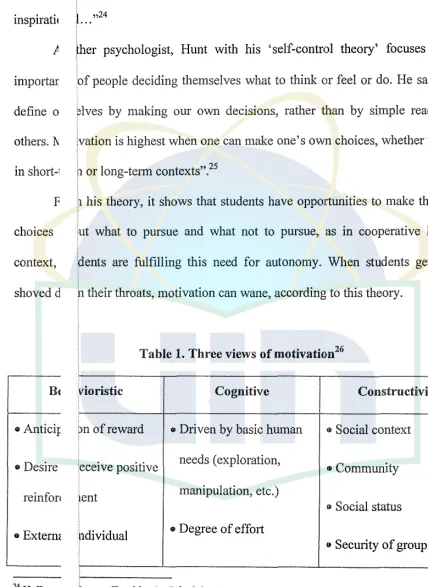
their throats, motivation can wane, according to this theory.Table 1. Three views of motivation26
•
.
vioristic Cognitive Constructivist
.
• Anticif セョ@ of reward • Driven by basic human .. Social context
"Desire :eceive positive needs (exploration, .. Community
re info re lent manipulation, etc.)
• Social status • Exterm ndividual • Degree of effort
11 Security of group
.
24
H. Doug lrown, Teaching by Principles; An Interactive Approach to Language Pedagogy, Op. Cit., p. 74
25 Ibid, p. 7 26
[image:26.595.67.495.126.713.2]forces control expended
• Internal, interactive • Internal, individual forces forces in control
in control
other psychologist from different stem tried to make a general definition on moti Ion was James 0. Whittaker. He mentioned, " ... motivasi adalah kondisi-kondisi u keadaan yang mengaktijkan atau memberi dorongan kepada makhluk untuk
terse but living th I keadaan berbuat organisn perform years fi psychoai accepted
27
Drs. Wa
(Jakm1a: P
28
Muhibbi
rtingkah laku mencapai tujuan yang ditimbulkan motivasi
Motivation is a set of conditions or situations activate and encourage any s to get their purpose that is caused by the motivation) ".27
:wise, Muhibbin Syah stated that " ... pengertian dasar motivasi ialah ternal organisme -baik manusia atau pun hewan- yang mendorongnya uatu ( ... the basic meaning of motivation is the internal condition of an whether it is a human or an animal- that stimulates the organism to action) ".28 Many other theories of motivation have emerged in the last 20
1 various psychological streams such as behaviorism, humanism, rsis, etc. In fact, no single theories of motivation have been universally 1t a direction is evident.
Soemanto, M. Pd., Psikologi Pendidikan: Landasan Kerja Pemimpin Pendidikan,
セゥョ・ォ。@ Cipta, 4"' Edition, 1994) p. 205.
I act, they have similar idea that motivation, whether it is originated from internal external force, stimulates people to do something. With regard to its origin, 1 :ivation is divided into two main motivation which are intrinsic and
extrinsic セエゥカ。エゥッョN@
2. I insic Motivation
'
intrinsic
'' ... I:
rewa
own
moti cons
yang ter
tujuan s
situation
adalah n
luar kan
29
H. Doui
30
Hamalik
1 regard to the theory of intrinsic motivation, Edward Deci defined
1tivation as;
hsically motivated act1v1t1es are ones for which there is no apparent except the activity itself. People seem to engage in the activities for their ke and not because they lead to an extrinsic reward ... Intrinsically ed behaviors are aimed at bringing about certain internally rewarding ences, namely, feelings of competence and self determination ... "29
nwhile, Hamalik oemar states that " ... motivasi intrinsik adalah motivasi :up dalam situasi be/ajar yang bersumber dari kebutuhan dan
tujuan-'a sendiri." (Intrinsic motivation is a motivation included in learning
rrces from the need and goals of the learners' themselves).30
:ldition, A.M. Sudrman mentions in his book that " ... motivasi intrinsik (-motif yang menjadi aktif atau berfungsinya tidak perlu dirangsang dari
dalam setiap individu sudah ada untuk melakukan sesuatu ... (Motivation
is motiv that are active or functioned need not to be stimulated by out forces
. . d' 'd 1 I . 'd fi "31
because : [Very m 1v1 ua , t 1ere are ms1 e -orces
3. E !insic Motivation E
psycho le
that deri'
the wish
external
learn me
threat or
success.
E
" ... E
rewai pnze: sole!) nume pums self d
s.
ekstrinsiJ 31A.M. Sai
32
PennyU
33
H. Doug
insic motivation is one of distinctive classifications in educational
· Peooy Ur mentioned his definition on this, " ... Extrinsic motivation is
from the influences of some kind of external incentives, as distinct from
foam for its own sake or interest in tasks". 32 This external incentives or
lmli
is that which influences students from the outside encouragement tothan they are used to be, such as parental approval, offer of a reward,
1islunent, a good grade, the desire to please parents a11d also experience of
lther words, all of those mentioned is known as 'motivational props'.
ard Deci defines extTinsic motivation as;
'nsically behaviors, on the other ha11d, are carried out in a11ticipation of a セッュ@ outside and beyond the self. Typical extrinsic rewards are money, [rades, a11d even certain types of positive feedback. Behaviors initiated
b
avoid punishment are also extrinsically motivated, even though :s intrinsic benefits ca11 ultimately accrue to those who, instead, view ent avoidance as a challenge that ca11 build their sense of competence a11d 1mination ... "33ima11 also mentioned his definition on extrinsic motivation, " ... Motivasi
falah motif-motif yang aktif dan be1jungsinya karena adanya perangsang
<an, Interaksi dan Motivasi Belajar, (Jakarta: Depdikbud RI, CV. Rajawali, 1990) p. 88. p. cit, p. 276
dari luai セクエイゥョウゥ」@ motivation is active motives and it functioned because of the outside s ulation)"34 As an example, that a student is willing to study is because he or she k1 1s that the day after, he will have a test and hopefully to get good marks for his 01 r friends, parents, or teachers would flatter him or her.
I: ·ever, the most important role in extrinsic motivation is the role of a teacher. learning and teaching process, a machine, a radio, a tape recorder, nor even a rr ern computer has not replaced the role of a teacher. There are still many human e 1ents contained inside the teaching that cannot be replaced, sorts of: behavior evaluation system, feelings, motivation, and habits which cannot be reached I my of those tools or machines mentioned. As Blair said that: " ... Teaching involves Be attitudes, skills and abilities needed to guide student learning".35
[image:30.595.66.493.119.696.2]From ex1 ?ic to intrinsic in educational institutions:36
Table 2. am extrinsic to intrinsic motivation in educational institutions.37
Extri
School C
34
Sardimai
35
Timothy Ohio: Meri
36 H. Doug
Cit., p. 79 37
Ibid, p. 7
c
Pressures Intrinsic Innovation Motivational Resultsiculum Learner-centered Self-esteem
Personal goal-setting Self-actualization Individualization Decide for self
M, Motivasi Be/qjar, (Jakarta: Logos, 1995) p. 90
ir, Emerging Patterns of Teaching: from Methods to Field Experience, (Columbus, hlishing Company, 1988), p. 7
Parental
Society l
Tests arn
Immedia ("M&l\
MakeM•
Competi Never Fz
pectation
•ectation
Karns
Gratification
y!
l
Family values
Security of Comfortable Routines
Task-based teaching Peer evaluation Self-diagnosis
Level-check exercises Long-term goals The big picture "things take time"
Content-based teaching ESP vocational education Workplace ESL
Cooperative learning Group work
The class is a team Risk-taking, Innovation Creativity
Love, intimacy,
acceptance, respect for wisdom
Community, belonging, identity, harmony, security
Experience Self-knowledge
Self-actualization
Cooperation Harmony
Manipulations, strength, status, security
C. Hyp, csis
E :d on the definition of both speaking and motivation, the writer comes np with the ia that student's motivation tends to have a correlation with the speaking skill perl nance. Therefore, the hypothesis to be used is one-tail hypothesis because it is cons red that both have correlation each other.
Ho= Th ds no correlation between students' motivation and English speaking skill pe mance.
CHAPTER III
RESEARCH METHODOLOGY AND FINDINGS
A. l\ bod of Research
C of the most important aspects in a research is the using of methodology determin
m.
Generally, in social sciences scope, there are two patterns of methodo ies used in researches that are quantitative and qualitative. Each methodoy
has its advantages and disadvantages. Quantitative research, for instance, LY entangle many sample research compared with a qualitative model and it is mon presentative. But, it ca1111ot explore further research subject. On the other hand, res ch qualitative has its excellence to explore further research subject. But, it ca1111ot t :onsidered representative because this research cannot entru1gle many subjects: ,Jes.B d on some reasons above, the writer chose to use the quantitative research in gainin, id analysis for its advantage ofrepresent.
1. P wse of Research
2. P e of Research
T writer chose LBPP LIA Ciputat as the research object, considering some follow re 'ns:
• The ' ance from the writer's place to LBPP LIA is fairly near. It only talces apprc nately than 15 minutes by public transpo1iation so that the research can be done te effectively and efficiently.
• LBPI IA has been constantly committed in language teaching for almost 45 years ice its establishment in 1959 with thousands of students. This fact shows its ca iility and credibility to help people learn English well.
Ii ddition, the writer chose intermediate level 2 students as the object research 1sidering some follow reasons;
• Acco ig to the LBPP LIA curricultm1, the intermediate level students cons1 ed that they have learned mostly English theoretical courses such as gram: ', listening, writing and speaking.
• The · :er only chose the intermediate level 2 students based on the writer's limit( esources and the reason of efficiency.
a. 'rofile of LBPP LIA
a. . History of LIA
in 1959 : alan Teuku Umar, Menteng, Jakarta Pusat which aimed to strengthen the friendshi etween Indonesian m1d Americfill people through cultural exchfillge. One of its ac ties was to hold fill English course aiming to help Indonesifill people in learning glish. LIA began its language course with only 40 students who enrolled in. In 191 it was temporarily closed because "September 30111 tragedy" or G30S PKI (the Indc :im1 Communist Party) emerged. It begfill to re-operate in 1966 until now with app imately 110.000 students.38
A ilentioned before that the establishment of this institution was to firm the relations between Indonesim1 and Americfill citizen, it was mainly supported by the U.S. remment through USIS (U.S. Info1mation Official). The U.S. government subsidiz; llmost all of LIA progrmns. However, the subsidy was stopped in 1976, consider: that LIA could be finfillcially independent.
11 il80, the depmiment of foreign affairs of the republic of Indonesia issued fill act 1' 1843/0111980 converting LIA to Perhimpunfill Persahabatfill Indonesia Amerika obreviated by PPIA- (Americm1-Indonesia Friendship Association). Then, consider: its rapid development, Yayasfill LIA was founded filld formally registered to the gc ·nment in 1986 in order to suppo1i its ongoing effort to help Indonesifill people ir iming English .
a
t.
Units of LIA] asan LIA has several units as follow;
" Lem セ。@ Bahasa LIA-abbreviated by LB-LIA- (LIA Language Unit). This unit is th1 :ggest and the oldest unit that LIA has. At the moment, there are 41 LB-LIA work spreading all over Indonesia with more than 110.000 students that stud) iglish language.
• Pusa 'clatihan Ketrampilan LIA -abbreviated by PPK-LIA- (LIA Training Cent This unit holds some training on computer, banking, hotel management and セ@ 'etary trainings.
• Pusa !enerbitan LIA -abbreviated by PP-LIA- (LIA Publishing Center). 2-mon1 ;ONTACT magazine and monthly bulletin are two editions that this unit publi CONT ACT magazine is a communication media for LIA students to emp< :r their English language and the monthly bulletin is an Indonesian conn tication media that is periodically published to inform any activities at LIA.
o Kerj ma dan Pcngembangan LIA-abbreviated by KP-LIA- (LIA cooperation
• Dan:
unit' forL
• Seim
Instit educi STB1 depru
b
Ir LB-LIA LIA- (LI make its
L from 41 · Soewito I
Juanda 5. Indonesii Indonesii
ensiun LIA -abbreviated by DAPEN-LIA- (LIA Pension Fee Unit). This · established in order to gather and manage fund used as pension program employees.
Tinggi Bahasa Asing -abbreviated by STBA-LIA- (Foreign Language ). In 1999, LIA expanded its activities through establishing a formal n unit called by Sekolah Tinggi Bahasa Asing (STBA-LIA). At present, :IA has 2 departments that are English ru1d Japanese language ents for undergraduate program.
•· LBPP-LIA Ciputat
)02, Yayasan LIA initiated a development by combining PPK-LIA and
! Lembaga Bahasa dan Pendidikan Profesional -abbreviated by LBPP-Language and Professional Training Unit). This combination aimed to guage and training service more effectively and efficiently.
P-
LIA Ciputat was established on May 2nd, 1995 as the 10tl1S )orted by 80 teachers and 5 supervisors, LBPP-LIA Ciputat can serve 1714 stu ts (per May 2003). Most of the students are junior and senior high school students. 1eanwhile, the remaining students are university students, private employe government employees, government, etc.
S e educational programs at LBPP LIA Ciputat: " First ps to Communicating in English (FSC) • Com nicating in English (CIE)
• Gene English (GE) • Com ation Class (CV)
• Com nicating in Business (CIB)
• 1 Ye: 'rofessional Program on Information Management • 1 Ye: 'rofessional Program on Secretary and Public Relations
• In-H1 e/In-Company Training
b. 2, セーー@ LIA General English Program
I rder to encourage students' learning motivation, LBPP-LIA Ciputat holds a schola ip program to be given for General English (GE) best student from every level. T scholarship is free of tuition fee to learn at LBPP LIA for next term. Especial :Or Advanced-4 level, the given scholarship will be equal with his or her learning le at LBPP-LIA Ciputat. The more he or she studies at LBPP LIA, the bigger s< larship he or she will get.
[image:39.595.70.494.46.716.2]I 'P-LIA has several educational levels as follow; Table 3. meral English levels at LBPP LIA
,eve I Sub-Level Learning Period
<Basic
-
44 hours•
lasic Basic I s/d 4 44 hours
:
Ir mediate Intennediate I s/d 4 44 hours
.
vanced Advanced I s/d 4 44 hours
•
T GE participant who has accomplished every level will get LBPP-LIA certificat nd may continue to Pelatihan Calon Guru Bahasa Jnggris LIA (LIA English 1 ;her Candidate Training) or TOEFL preparation program.
3. T 1 of Research
motivati and a direct interview aiming to measure students' speaking ability. The data wer )!lected on October
s"1,
12111,
141\ 19th, 21" 2004.4. 1 1niques of Sampling Taking
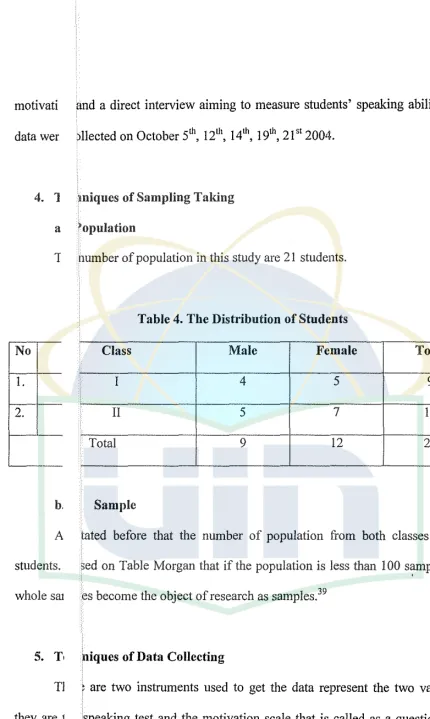
a >opulation
[image:40.595.64.494.12.730.2]1 number of population in this study are 21 students.
Table 4. The Distribution of Stud1:nts
No '
Class Male Female Total
1. I 4 5 9
-2. II 5 7 12
Total 9 12 21
b. Sample
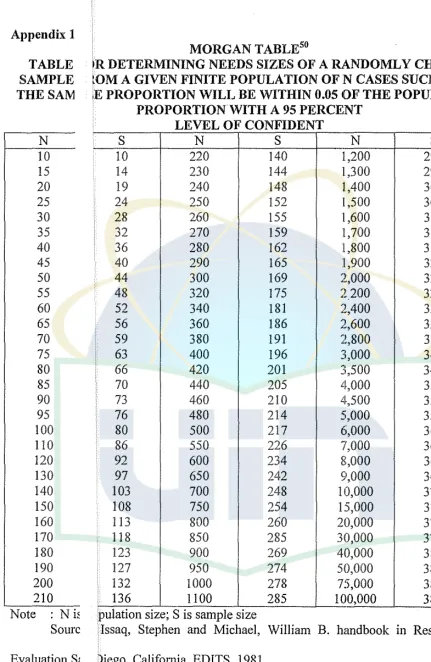
A tated before that the number of population from both classes are 21 students. sed on Table Morgan that if the population is less than 100 S';lffiples, the whole sru es become the object ofresearch as samples.39
5. T' niques of Data Collecting
Tl セ@ are two instruments used to get the data represent the two variables, they are 1 speaking test and the motivation scale that is called as a questionnaire.
39
Moreov( and Spe: for the rr
a
E
that a te domain.' items th activity< In order practical
Bandung highly st loosely s A uses an i1
40
H. Doug
San Franci:
41
Ibid, p. 3
n order to measure the validity of both research instruments -Motivation ig Skill- the wTiter performed try out that was done on October 5tl', 2004 vation and on October 12'\ 2004 for speaking skill.
!. Speaking Test
id on Teaching by principles written by H. Douglas Brown, it is stated is a method of measuring a person's ability of knowledge in a given n addition, a test is considered as a set of techniques, procedures, and constitutes an instrument of some so1i that requires performances or he part of the test-taker (and sometimes on the pmi of the tester as well).41
have a good test, a tester has to be aware of three criteria that are reliability and validity.
eover, according to LIA language testing book written by LB-LIA 1ere are two types of speaking skill tests that am loosely structured and tured speaking skill test. Because of the efficiency, the writer chooses the
セエオイ・、@ speaking skill test to be used as the instrument measurement tool.
'research instrument to measure the students' speaking ability, the writer view as its method of collecting the data.
lrown, Teaching by Principles: An Interactive Approach to Language Pedagogy, (USA:
a !. Measuring the Iuterview
E :d on some theories of measuring above, the writer made a speaking test that con: s of I 0 questions. These questions were based on the lessons that the students I learned. The interview questions had been consulted with the students' teachers.
'[ interview was relied on the lesson that the students have taken; Lesson l iife Long Education
Speakin! .etelling various developments at each stage in life. Gramma Leview of tenses
Lesson
2
セカ」イウ・。ウ@ StudiesSpeakinf Playing roles of parents and son/daughter discussing overseas studies. Expressing agreement and disagreement.
Gramma )finitives of Purpose
Ir process of collecting the data, the writer employed some requirements to get the di t>bjectively that were;
• The セイカゥ・キ・イ@ has one or more interviewees to interview each candidate separ. y.
• The i セゥ・キ・イ@ prepares a special 'oral-rating sheet' for pronunciation, grammar, vocat ry, fluency, and comprehension.
• The i rviewer reserves sufficient time:
10-15
minutes each. • The i [·viewer records the ratings after the interview.• Reco セ。エゥョァ@ is taken per item in order to make the test-rating objective. Tape-Reco r is used to avoid human error in rating the data.
• The i \·viewer tries to hold a genuine conversation and establish report with the
exam e.
Ir
セォゥョァ@
the interview question in order to measure one's speaking ability, the write ased it on the theory of speaking test by David P. Harris. According to him, spei セァ@ test must include the pronunciation, grammar, vocabulary, fluency and compreh1 ' IOU.H ]so mentions that all good test process three qualities; validity, reliability and prac1 /ity. That is to say, any test that we use must be appropriate in terms of our parti(
:r
s1tuation. • . 42 [image:43.595.68.505.143.716.2]B
p
on that book, all good speaking tests must be rated by the following rule:Table 5. The English speaking test rating
• Prom iiation
42
David P. University:
Note
4 vays intelligible, though one is conscious of a definite accent
3 tmnciation problems necessity concentrated listening and occasionally l to misunderstanding
2
:y
hard to understand because of pronunciation problem must frequentlyセウォ・、@ to repeat
1 nunciation problem to severe as to make speech virtually
• Grar ar
Score 5 .
4 I
I 3 J
I
2 I
(
1 J
• Voca
E:I
L1
Note
kes few (if any) noticeable errors of grammar or word order
:asionally makes grammatical or word order errors which do not, \rever, obscure meaning
<es frequent e1Tors of grammar and word order which occasionally cure meaning
mmar and word orders make comprehension difficult. Most often word
セイ@ so severe as to make speech virtually intelligible
ihrase sentences and or restrict to basic pattern errors in grammar
Note
4
I II 3 l
J
2 I
I
I
'
• Flue1 Score
5 I I
4 I I
3 I
I
2 I
I
'
Ii
• Com
F1
D
aetimes uses inappropriate te1ms and or must rephrase ideas because of cal inadequacies
quently uses wrong word; conversation somewhat limited because of !equate vocabulary
:use of words and very limited vocabulary make comprehension quite icult
;abulary limitation so extreme as to make conversation virtually 1ossible
Note
ech as fluent and effortless as that a native speaker
ed of speech seems to be slightly affected by language limitation ed and fluency are rather strongly affected by language limitation tally hesitant; often forced into silence by language limitation
ech is so halting and fragmentary as to make conversation virtually 'ossible
hens ion
Note
4 derstand nearly everything at normal speed, although occasional
セエゥエゥッョ@ may be necessary
3 tlerstand most of what is said at slower --than- normal speed with etition
•
2 ; great difficulty following what is said or comprehend only "social iversation" spoken slowly and with frequent repetition
1 mot be said to understand even simple conversational English
a I. Validity
P セイ、ゥョァ@ to Burhan Nurgiyantoro, research inst1ument validity questions
whether instrument that will be used has a capability to measure something to be measure1 lyforeover, he mentions that product moment theory is used to measure research trument validity.
Formula
A r the conelation coefficient was taken, the writer compared it with a directive ren as follow;
43
1
F
get is 0,'
a
R
measure<
pengerti1 konsister instrume
(Realibit time to · unchang<
T
44
Ibid, p.;
'1e 6. The validity and reliability rating of research instrnment
R Interpretation
00.00- 0.20 Very Low
00.20 - 0.40 Low
00.40 - 0.70 Moderate
00.70- 0.90 High
.
00.90 - 1.00 Very High
l the calculation about this questionnaire, the validity score that the writer It means that the questionnaire is in a high level.
!. Reliability
ibility defines whether an instrument can measure something to be mstantly. Burhan Nurgiyantoro stated that" ... Realibilitas menunjuk pada
セー。ォ。ィ@ sebuah instrumen dapat mengukur sesuatu yang diukur secara ari waktu ke waktu. Jadi kata kunci untuk syarat kualiflkasi suatu pengukur adalah konsistensi, keajegan, atau tidak berubah-ubah
uestions whether an instrument can measure something consistently from e. Thus, the key words for qualifying requirements are consistency or
セ@ 44
Split-ha! •nnula:
r,,, = 2rgg I+ rgg
r,,, = Correlation coefficient N question rgg = Correlation coefficient N question
F
ii
the calculation of try out, the reliability score that the writer get is 0, 81. It means 't the questionnaire is in a high level.lJ l. Questionnaire
1 questionnaire was given to the students consists of 38 items about motivati1 In this case, it concerns about student motivation in learning any subject. In comp• lg this questionnaire, the writer adopts the questionnaire written by Ambo Erne Ab1 ah. He bases his study about achievement motivation on people's motives and char: 1ristics from Edwards, (1988).45
b I. Measuring the Questionnaire
T questionnaire is given to the students consists of 38 items about motivati< In this case, it concerns about student motivation in learning any subject. In comp< g this questionnaire, the writer adopts the questionnaire written by Ambo
45
Enre Al: !ah. He bases his study about achievement motivation on people's motives and chai eristics from Edwards, (1988):46
• Melt tan sesuatu dengan sebaik-baiknya (Performing any task as good as poss: )
• Mele ran sesuatu dengan sukses (Succeeding any work).
• Men, !akan sesuatu dan menyelesaikan tugas-tugas yang memerlukan usaha dan I ampilan (Implementing any tasks that needs efforts and skills).
• Ingi1 1enjadi penguasa yang terkenal a/au terpandang dalam suatu bidang terte1 (Willing to be a well-know leader in one field).
• Men< ;akan sesuatu yang sangat berarti atau penting (Perfonning any impo it and valuable task).
• Jvfela ran suatu pekerjaan yang sukar dengan baik (Performing any difficult task : :essfully).
• MenJ ·saikan teka-teki dan sesuatu yang sukar (Settling any riddle and any diffic things).
• Mela ian sesuatu yang lebib baik dari orang lain (Performing something that is bette1 !in others).
• Menz novel atau cerita yang he bat dan bermutu (Writing a novel or a story that is
qw
ed).46
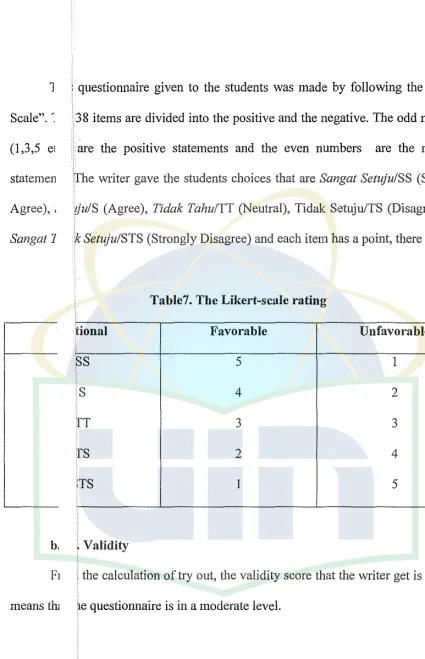
1 : questiommire given to the students was made by following the "Likert Scale". '. 38 items are divided into the positive and the negative. The odd numbers (l,3,5 el are the positive statements and the even numbers are the negative statemen The writer gave the students choices that are Sangat Setuju/SS (Strongly Agree), , 'lju/S (Agree), Tidak Tahu/TT (Neutral), Tidak Setuju/TS (Disagree) and
[image:50.595.69.494.30.689.2]Sangat 1 k Setuju/STS (Strongly Disagree) and each item has a point, there are;
Table7. The Likert-scale rating
tional Favorable Unfavorable
SS 5 1
s
4 2TT 3 3
rs
2 4ITS I 5
.
b. , Validity
l セN@ Reliability
I h the calculation of try out, the reliability score that the writer get is 0, 78. It is fair llosed with the reliability that Abdullah got to score his questionnaire that is 0, 86.
6. 1 !miques of Data Analysis
1 ind out the correlation between the students' motivation and the speaking score, th riter used Pearson product moment theory that is;
r セ@ Correlation Coefficient
X1 セ@ Speaking Score
X2 セ@ Motivation Score
N i Number of Respondent
2:X1 'Sum of Speaking Score
2:X2 : Sum of Motivation Score
l:X/ : Sum ofQuadrates of Speaking Score
IX/ 'Sum ofQuadrates of Motivation Score
B. Res1 ch Findings
I. cription of Data
:r doing the research, the writer got the following scores of both motivati and speaking. Speaking score data was taken on October 191h, 2004 and
motivati score was taken on October 14°1, 2004.
1 ,Jc 8. The speaking score of the intermediate level 2 students No Name Speaking Score"'
1. Student A 86
2. Student B 86
3.
Student C 854. Student D 84
5. Student E 77
6. Student F 75
7. Student G 74
8. Student H 74
9.
Student I 7110. Student J 71
11. Student K 70
12. Student L 70
47
13.
Student M68
14.
StudentN68
15.
Student 065
16.
Student P65
17.
StudentQ
64
18.
Student R61
19.
Student S61
20.
Student T60
21.
Student U55
ile 9. The motivation score of the intermediate level 2 students
No Name Motivation Score··
I. Student A
149
2.
Student B145
セ@
Student C
142
J.
4.
Student D141
5.
Student E148
6.
Student F 1377.
Student G142
8.
Student H152
48
9. Student I 149
10. Student J 127
11. StudentK 151
12. Student L 151
13. StudentM 123
14. StudentN 124
15. Student 0 138
16. Student P 137
17. Student
Q
14118. StudentR 139
19. Student S 143
20. Student T 147
21. Student U 124
2. A lysis of Data
Ir rralyzing the data, the writer used the correlation theory of product moment : bllow;
No Name
X1
X2
X1'
X2'
X1X2
(Speaking Score) (Motivation Score)
I. Studer 86 149 7,396 22,201 12,814
)
..
Studer 86 145 7,396 21,025 12,470•
3.
Stude"
85 142 7,225 20,164 12,0704.
Stu dep
84 141 7,056 19,881 11,8445.
Stude '-
77 148 5,929 21,904 11,396.
6.
Stude ' < 75 137 5,625 18,769 10,2757. Stude , J 74 142 5,476 20,164 10,508
8. Stude f 74 152 5,476 23,104 11,248
•
9.
Stude. i 71 149 5,041 22,201 10,57910. Stude: 71 127 5,041 16,129 9,017
11. Stude1 " • 70 151 4,900 22,801 10,570
12. Stude1
,
70 151 4,900 22,801 10,57013. Stude1
!1
68 123 4,624 15,129 8,36414. Stude1
v
68 124 4,624 15,376 8,43215. Stude1 ) 65 138 4,225 19,044 8,970
16. Stude1 • 65 137 4,225 18,769 8,905
.
17. Stude1
!
64 141 4,096 19,881 9,024•
18. Stude1 61 139 3,721 19,321 8,479
19. Stude1 61 143 3,721 20,448 8,723
20. Stude1 ' 60 147 3,600 21,609 8,820
21. Stude1 I 55 124 3,025 15,376 6,820
IX1=1,490 IX2 = 2,950 IX12= IXi2= IX1X2=
r = _ _ 21(209,898)- (1,490)(2,950)
v1m
,322 - (1,490)2][2 l ( 416,097 - (2,950)2]r= _ _ 4 407 858 - 4 395 500
v-;
[2,2_ :62 - 2,220,100][8,738,037 - 8,702,500]r=__ セSUX@
..;- :::.:::::::::===
33,61 [ 35,537
r=__ セSUX@
v-
=====
1,19 セVLTYT@
r = _ _ = :
3=58"---34, i.19558
r= 0.357 )18670195121819177545979748
r= 0.36
3. t of Hypothesis and Interpretation of Data
1 :r the calculation, the next step is to test the hypothesis. From the
calculati result, it is obtained that the value of the to is 0.36. The degree of freedom (df) is N = 21 - 2 = 19. Based on the critical values of product moment coefficient table, th egree of significance of 1 % shows 0.575 and of 5 % shows 0.456.49
} w
comparing the value of to which is 0.96 and the value of tt which are 0.575 an .456, the writer eventually drew an assumption as follow;0.575 > 0.36 < 0.456
1 hypothesis result is if
to
is smaller than t,, the alternative hypothesis (Ha) is reject and the null hypothesis (Ho) is accepted. It means that there is no significa :orrelation between students' motivation and their English speaking skill ー・イヲッイュセ@ セN@49
CHAPTER IV
CONCLUSION AND SUGGESTION
A. 1clusion
l セ、@ on the data that has been described in the previous chapters, the writer's nclusion can be drawn that the students' motivation has c01Telation between udents' motivation with the English speaking perfommnce but the correlati is not significant.
( sidering the theories at the begi1ming chapter to be compared to the fact that is 1 1ed by the research, it is concluded that motivation does not play a significa ·ole in developing students' speaking ability. In contrary, there are some other ps) )logical factors that may affect to their speaking skill.
B. S セ・ウエゥッョ@
1
the prob!
1. Al th( their shoul be ac 2. Acco psycr so thi what
writer would like to give some suggestions for whomever concerns with of English teaching especially in developing communication skill.
Ii there is no significant correlation between students' motivation and glish skill, it is still impmiant in teaching and learning process for student e based on communicative activities, since activities allow the students to : logically, they will be motivated.
BIBLIOGRAPHY
Azra, A imardi, Prof. Dr., M.A., et. al., Pedoman Penulisan Skripsi, Tesis dan
Dii bsi, Jakarta: UIN Jakarta Press & Logos, 2000
Azwar, セ@ 'uddin, Drs., M.A., Penyusunan Skala Psikologi, Jakarta: Pustaka Pelajar,
20(
Brown, l pouglas, Teaching by Principles: An Interactive Approach to Language
Pet
pgy,
San Francisco State University: Addison Wesley Longman, Inc, SecI
Edition, 2001Brown,
i
Douglas Brown, Principles of Language Learning and Teaching Tee 'gues, San Francisco State University: Addison Wesley Longman, Inc,20C Fourth Edition
Bryant, I 'aid C. & Karl R. Wallace, Fundamentals of Public Speaking, New York: Mei \th Corporation, 1969
Burhan rgiyantoro, Statistik Terapan untuk Penelitian llmu-llmu Sosial,
Yof kruta: Gadjah Mada University Press: 2000
David P. lrris, Testing English As a Second Language, Washington, DC: George Tov Jniversity: 1969
Davis, P and Elie Pearse, Succeeding English Teaching, London: Oxford Uni
セゥエケ@
Press , 2000Early, V. frookman, The Key to English Vocabulary, London: Macmillan Company, 19
Hance, l lneth G. & David C. Ralph, Principles of Speaking, Belmont California: W• sworth Publishing Company, Inc., 1965
Harmer, remy, The Practice of English Language Teaching, London: Longman, 19
Kagan, セュ・@ and Cynthia Lang, Psychology Education: An Introduction, New Ya iHartcourt Barace Jovanovich, Inc., 1978
Lindgre1 [enry Clay, Psychology of Personal and Social Acijustment, New York: An ;can Book Company, 1959.
Summer Della, et. al, Longman Dictionary of Contemporary English, England: Pe; )n Education Limited, 2001
Microso 'ncarta, © 1993-2003 Microsoft Corporation. All rights reserved. Oemar, l b.alik, Kurikulum dan Pembelajaran, Jakarta: Bumi Aksara 1995
Penny l A Course in Language Teaching: Practice and Theory, London: Ca: ridge University Press, 1996
Sardima: .M, Motivasi Be/ajar, Jakarta: Logos, 1995
Sardimru A.M., Interaksi da:n Motivasi Belajar, Jakarta: Depdikbud RI, CV. Ra. 11li, 1990
Summer Llella, Longman Dictionary of Contemporary English, England: Pearson Ed tion Limited, third edition, 200 I
Syah, M bbin, M.Ed., Psikologi Be/ajar, Jakaiia: Logos, 1999
Tai·igan, mry G., Prof. DR., Berbicara Sebagai Suatu Ketrampilan Berbahasa, Ba ng: Angkasa, 1981
Timothy air, Emerging Patter