Risk
of Anti-Hepatitis
A
Virus in
an
Urban Population in
Jakarta
Nurul
Akbar*,
BastamanBasukit, David H.
Garabrant
f,, SarwonoWaspadji*, H.M. Sjaifoellah Noer*
Abstrak
Penelitian sebelumnyamengenai Hepatitis A di Indonesia tidakmengungkapkan prevalensi risiko Hepatitis A pada populasi. Oleh karena itu penelitian ini ditujukan untuk mengetahui prevalensi antibodi terhadap virus Hepatitis A (anti-HAV), dan untuk mengetahui segmen populasi yang mempunyai risiko tinggi, serta
faktor
risiko yang berguna untuk persiapan program imunisasi. Penelitian dilakukan terhadap 987 subjek berumur 15 tahun ke atas, pada kluster keluarga yang dipitih secara acak pada tahun 1994 di daerah Jakarta Timur. Data yang dikumpulkan antara lain karakteristik subjek (informasi mengenai demografi, sosial ekonomi),faktor
risiko terhadap anti-HAV.Di samping
itu dilakukan pemeiksaan darah terhadap anti-HAV, SGOT dan SGPT. Hasil tes anti-HAVmenun-iukkan 87Vo positif, dan terdapat kenaikan risiko menurut umur, dan mencapai puncak kenailan risiko sebanyak 18.8 kati lipat (95Vo CI: 8.0-44.2) di antara yang berumur
5l
tahun atau lebih dibandingkan dengan populasi pembanding yang bentmur 15-19 tahun.Anti-HAV yang terjadi secara alamiah sangat berkaitan dengan status sosial ekonomi yang rendah. Dibandingkan denganyang bertaraf sosial ekonomi tinggi, yang bertaraf sosial-ekonomi rendah mempunyai risiko 4.9 l<nli lipat (957o CI: 2.5-9.4). Risiko anti-HAV posirtf berkurang
jika
telah mendapatkan imunisasi Hepatitis B, tetapi sebaliknya kepernahan mengalami sakit kuning meningkatkan risiko terhadap anti-HAV. Sasaran imunisasi untuk melindungi infeksi HAV ditujukan golongan dewasa muda terutama dengan taraf sosial ekonomi tinggi yang kiranya kurang mendapatkan imunitas secara alamiah dan yang alcan sangat rentan terhadap infeksi HAV bila beranjak dewasa..Abstract
In Indonesia, prior studies to identify riskfactors for hepatitis A have not provided prevalence estimates in the general population. This study was conducted to measure the prevalence of antibody to hepatitis A virus (anti-HAV), and to idenfify high risk populations andriskfactors in preparationfor animmunilationprogram. (Jsing randomly selectedhouseholds in Jakarta,987 adults andadolescents aged 15 and older were interviewed in 1994 to ascertain demographic information, socioeconomic statùs and riskfactors
for
anti-HAV. Blood samples were takenfor
anti-HAV, SGOT and SGPT. Eighty seven percent of the participants were positivefor anti-HAV.
Risk increased with age, reaching an I 8.8-fold risk (95Vo CI 8.0-44.2) among those aged 5I years and
over, compared to the reference group aged 15-20 years. Anti-HAV was strongly associated with low socioeconomic status (odds ratio 4.9, 95Vo CI 2.5-9.4). Immunization againsthepatitisBwasassociatedwithreducedriskofanti-HAV,andahistoryofjaundiceincreasedtheriskofanti-HAV. Immunization against HAV should be targeted to adolescents and young adults, particularly those in higher socioeconomic groups, who are least likely to have natural immunity andwho are most susceptible to HAV infection in adulthood.Keywords: Hepatitis
A,
Immunity, Epidemiology, RiskINTRODUCTION
Hepatitis
A
is endemic
in
Indonesia as
well
asin
other South Asian countries l'2'3 andit
is established thatrisk
is
related
to
environmental
sanitation.
Although
hepatitis
A virus (HAV) infection
is rarely fatal,it
is
aDepartment of Internal Medicine, University of Indonesin Facuby of Medicine, Jakarta, Ind.onesia
Department of Community Medicine, University
of
In-donesia Faculty of Medicine, Jakarta, IndonesinDeparrment of Internal Medicine, University of Michigan School of Medicine and Department of Environmental and Industrial Health, University of Michigan School of Public Health, Ann Arbor, Michigan, USA
serious medical
problem
and
is
associated with
sub-stantial costs.Worldwide,
over 1.4
million
casesoccur
annually,
with roughly half of
thesein Asia,
andwith
costs estimated at
$l-3
billion per year.4 Symptomatic
as
well
as asymptomatic hepatitis
A
infection
can induce theproduction of long lasting IgG antibodies to
hepatitis
A
virus
(anti-HAV).)
Although improvements
in
sanitation have
reduced theincidence
of
hepatitis
A
in
many countries, sanitation
programs are
costly
and take years toimplement,
leav-ing
a
large
segment of
the population
susceptible to
infection.b
Inactivated
virus
vaccines,
which have
recently become
available, promise to play
anVol 5, No 4, October - December 1996
since immunization
is
costly, the identification
of
groups at high
risk of infection is
an essential elementin
targeting
immunization programs. Prior
studiesof
hepatitis
A
prevalence
in
Indonesia have focused on
special groups such as blo_od donors, students, hospital employees,ind
patients
l'7 butth"y
are oflimited
valuein identifying high risk
groups
in
the general
popula-tion.
Therefore,
we
conducted
a
community-based
study onanti-HAV
toidentify
high risk populations
asan
initial
stepin
planning
animmunization
program.
Understanding
of the
epidemiology
of
hepatitis
A
facilitates
decisions on the proper use
of
vaccines.METHODS
This study
was conductedduring
January to June 1994in
an urban subdistrict
of
Jakarta, Indonesia
which
contained 34,666 people
in 7,0I7 households.
Threehundred and
forty
householdswere selected randomly
and allfamily
members agedl5
or older were
asked toparticipate.
A
total
of 1,150 subjects
from
thesehouseholds
were eligible to participate
in
the
study.Specially trained nurse-midwives visited
the homesof
theeligible
subjects to evaluatesocioeconomic
condi-tions
and
to invite
the
subjects
to visit
a local,
par-ticipating
hospital
for
this
study.
The nurse-midwives then conductedstructured interviews of the subjects
at the participating hospital regarding demographicchar-acteristics and
risk
factors
for anti-HAV,
such
asgender, age,
education,
social
status, medicalhistory
related to hepatitis disorders, and historyofhepatitis
Bimmunization. Blood
samplesfor
anti-HAV,
SGOT,
and SGPTwere taken.
SGOT and SGPT laboratory tests were carried
out
using laboratory
kit
testsfrom
Boehringer Mannheim
GMBH
and tests
for
anti-HAV were carried out
by
ELISA
(enzyme
linked
immunosorbent
assay) tests,using
a commercially available
kit
(Abbott
Labora-tories,North
Chicago,Illinois).
All
sera were collected and kept at -20 degrees Celsiusprior
to the assessment atLaboratoria
Hepatika
Mataram,
East Indonesia.Factors under study
included
education
level (high
=
study at
college/university
or more; middle
=
study at
junior or
senior
high
school;
low = illiterate,
capableof
reading
only, or
study not beyond
primary
school),
gender
(female/male),
ethanol
drinking
habits
(yes/no), smoking cigarettes (yes/no), sport
habits
(yes/no),history of transfusion (ever/never), history
of
hepatitis
B
vaccination
(ever/never),
history of
jaun-dice (ever/never),
family
history
of
jaundice
(ever/
never), SGOT level (abnormal
= 38IU/dl
for male
andRisk of Anti-Hepatitis A Virus in
Jakarta
229= 32lUldl
for
female), SGPT
level
(abnormal
=
42IU/dl for
male and
=
32
IU/dl
for
female),
socio-economic
status
(high/middle/low), and
age(15-20,
2I-30,31-40,41-50,
51
andover). Determination
of
socioeconomic status
was based on the housingcondi-tion, whether transportation
was owned, ownershipof
housing
appliances, and whether
the
house
had
electricity.
Logistic
regression was used to estimate odds ratiosfor
eachrisk factor in relation to anti-HAV
status and
to
simultaneously
control for confounding by
other
fac-tors.
For
consistency
of
presentation,
a groupof
con-founders consisting
of
gender,
cigarette
smoking,
drinking
habit, sport habit, history
ofblood
transfusion
and/oreducation
level,
social
status and age group areincluded
in
all
the models presented. Odds ratios were estimatedby
the methodof
maximum
likelihood.
The
95Vo confidenceintervals
(CI)
were based on the stand-ard errorof coefficient
estimates.8This
study
,was approvedby
theEthics
Committee
of
the Department of Internal
Medicine
of the
University
of
IndonesiaFaculty of
Medicine.
RESULTS
One thousand and
twenty
outof
1,150invited
subjects(89Vo)
participated
in this
study.
We
excluded
33subjects
due
to
incomplete and/or
conflicting
data,leaving
atotal of 987 subjects.
Eight
hundred andsixty
one subjects were positivefor anti-HAV
and 126werc
negative,
giving
anoverall
prevalence
of
87Vo.Of
the987 parricipants,
20.8Vo(205/987) had a
high
educa-tion level.
Anti-HAV
positive
and
negative
subjectswere
similarly
distributed
with
respect
to
gender,drinking habit,
cigarette
smoking
habit, sport
habits
and historyof
blood transfusion
(Table
1).Immunization
toward hepatitis
B
was associated
with
reduced
risk
of
anti-HAV
(adjusted
OR = 0.42,
95VoCI:0.23
to
0.75).
As
expected, a
history of
jaundice
was
associatedwith
increased
risk
of
anti-HAV
(ad-justed OR = 5.32,
95VoCI:
1.28 to22.08).In
contrast,
afamily history
ofjaundice
was reportedby only
119 subjects(l2Eo)
and was not associatedwith anti-HAV
(adjusted OR = 0.84, 95VoCI:0.48
to 1.45).
This
mayreflect
substantialunder-reporting
ofjaundice
in
fami-ly
members.
Abnormalities of
SGOT
and SGPT werenot
statistically
significantly
associated
with
anti-HAV (for
SGOT,
adjusted OR=
1.77, 95VoCl:0.94to
Table
l.
Demographic factors associatedwith
antibodies to hepatitis A virus (anti-HAV)Anti-HAV status
Positive (n=861) Negative (n=126)
Vo % Sex Male Female Education High Middle Low
Drinking
habits NoYes
Cigarette smoking No
Yes Sport habits
No Yes
Ilistory
of transfusionNever Ever 396 465 173 471 217 813 48 638 223 379 482 799 62 46.0 54.0 20.1 54.7 25.2 94.4 5.6 74.1 25.9 44.0 56.0 92.8 '1.2 62 64 32 75 19 122 4 101 25 48 78 119 2 49.2 50.8 25.4 59.5 15.
I
96.8 3.2
80.2 19.8
38.
l
61.9
94.4 5.6
Table 2. Hepatitis conditions associated with antibodies to hepatitis A virus (anti-HAV)
Anti-HAV status
Positive (n=861) Negative (n=126)
oR*
95Vo Cl% %
Hepatitis B vaccination
Never Ever
Ever had jaundice
Never Ever Unknown
History of
family
jaundice No Yes Unknown SGOT Normal Abnormal SGPT NormaI Abnormal8ll
50 789 65 7 70s 101 55'n5
146 828 33 94.2 5.8 91.6 7.5 0.8 81.9ll.7
6.4 83.0 17.0 96.2 3.8 108l8
123 2 Il02
l8
6 114 t2 125 I 85.7 t4.3 97.6 1.6 0.8 81.0 14.3 4.8 90.5 9.5 99.2 0.8 1.00 0.42 1.00 5.32 1.07 1.00 0.84 1.24 1.00 1.'t7 1.00 5.62 (reference) 0.23 - 0.75(reference) 1.28 - 22.08 0.13
-
8.85(reference) 0.48
-
1.45 0.52 - 2.98(reference) 0.94 - 3.31
(reference) 0.71 - 39.16
[image:3.595.60.553.104.715.2] [image:3.595.57.551.416.724.2]Vol 5, No 4, October - December 1996
The
risk
of
anti-HAV
was inconsistently related
to
education
level, with highly
educated subjectshaving
the
lowest
risk.
In
comparison, those
subjectsin
themiddle
education
group
had
a risk
of
l.8l
(95EoCI
1.06-3.20)
and thosein
thelowest
education group had arisk
of
1.24 (95EaCI0.59-2.61).
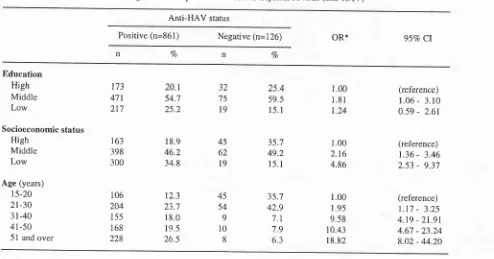
The
risk
of
anti-HAV was strongly
associatedwith
lower
socioeconomic
status(Table
3).
Compared
to thehigh socioeconomic
group, thelow
socioeconomic
group had a
4.9-fold
risk
ofhaving
anti-HAV
(adjustedOR
=
4.86,
95VoCI:2.53 to
9.31.
'fhe
prevalenceof
anti-HAV
increasedconsistently
with
age,from j\Va
(106/151) among the 15-20 year
age group
to
95Vo(2281238) among subjects
51
years and
older.
Com-pared
to
the reference
group
(ages 15-20 years)
risk
increased
in
a
stepwise manner
with
age,reaching
a18.S-fold
risk
among
those
aged
51
years and over
(adjusted OR
=
18.82, 95VoCI:8.02 to
44.20) as shownin
Table
3. Although
theage-specific
prevalence rates are moreintuitively
attractive,
the oddsratios
from
thelogistic
regression models
aremore
accurate, asthey
reflect
the adjustments
madefor
the simultaneous
ef-Risk of Anti-Hepatitis A Virus in
Jakarta
231fects
of
all risk
factors
(including
gender, education,
and
socioeconomic
status).DISCUSSION
Five
patterns
of
infection with hepatitis
A
virus
arerecognized
in
ilternational
studies
of
age-specific
sero-prevalence.4
In
the
first
pattern,
,é".r
in
thepoorest countries,
infection early in
life
leadsmainly
to subclinical
disease andmore
than 907oof children
are
infected
by
age 5years.
A
secondpattern
is
seenin
countries
with slightly
better economic conditions,
in
which fewer children
areinfected
by
age 5 , blut 90Voare
infected by
age 10years. A third
pattern,occurring
in
countries
with
moderate endemicity,
is
charac-terized
by
lower
prevalence
in
young children, but
rising prevalence
with
ageto
reach 90Voin
early
adul-thood.
Our
dataindicate that
the Jakarta
population
fits
this
pattern
(Table 3).
The
fourth pattern, which
occurs
in
developed countries such as the United
States,
is characterizedby
prevalence
which
reachesl)Voby
age
15years and
slowly
rises
to
70Voinlate
adulthood.
In
the
fifth
pattern,
seenin
Scandinavia,
Table 3. Socioeconomic status and age relationship with antibodies to hepatitis A virus (anti-HAV)
Anti-HAV status
Positive (n=861) Negative (n=126)
oR*
95Vo Cl%
Vo
Education
High
Middle
Low
Socioeconomic status High
Middle Low
Age (years)
15-20
2t-30
3t-40
41-50 51 and over
173 471
21't
163
398
300
106
204
155 168
228
20.1
54.7 25.2
18.9
46.2
34.8
12.3
23.7
18.0
19.5
26.5
32 75
l9
45 62
l9
45 54
9 10
8
25.4 59.5 15. I
35.7 49.2
l5.
l
35.7
42.9
7.1
7.9 6.3
r.00
1.81
1.24
1.00
2.16 4.86
1.00
1.95
9.58
10.43
18.82
(reference)
1.06
-
3.10 0.59-
2.61(reference)
1.36
-
3.462.53
-
9.37(reference)
1 .17
-
3.254.19 - 21.91
4.67 - 23.24 8.02 - 44.20
*
Odds ratio for education adjusted for gender, smoking habit, drinking habit, sport habits,history
of
transfusion, socioeconomic status and age group.Odds ratio for socioeconomic status adjusted for gender, smoking habit, drinking habit, sport habits, history of
transfusion, education group and age group.
[image:4.595.50.544.411.670.2]prevalence
is negligible except among older
adultswho
were infected, decades
earlier.
Hepatitis A infection early
in
life
is most
frequently
subclinical,
while infection
in
adulthood
more
com-monly
results
in
clinical
illness with
substantially
greater
morbidity
and occasionalfatalities.a
Thus,
asnatural
immunity
developed
in
early childhood
be-comes less
prevalent, the
impact of infection
later
in
life
increases.This paradox
points to
the pressing needfor
immunization
programs
in developing
countries,
especially among sectors
of
the population who are athigh
risk of infection during
adulthood.
The dramatic declines
in
the prevalence
of anti-HAV
that have been observed
recently
in
Taiwan, Thailand
and Singapor"2'e huu" been
attiibuted
to
general
im-provements
in hygienic
conditions, water
quality,
andstandards
of
living,
which
accompany
industrializa-tion.
Thus,
it
is likely
that
the recent,
dramatic
economic
growth
in
Indonesia
will
be reflected in
falling
seroprevalence
of
anti-HAV
over the next
decade.
Passive
immune prophylaxis
with
immune globulin
has been used
effectively to
prevent
Hepatitis A, but
repeated
injections
are necessary tomaintain
immunity
among
persons
who
live
in
areashyperendemic
for
HAV
infection. Unfortunately,
patient compliance
isusually poor, resulting
in
high
rates
of
infection.lu
Inactivated
andlive
attenuated hepatitis A vaccines areeffectivell'12
and, areendorsed
by the World
Health
Organization
Hepatitis
Program
asthe most
immedi-ately
effectiu" measu."
foi
viral
hepatitis control.l3
However,
in
order
to maximize the benefit
of
im-munization programs,
it
is
necessaryto
identify
thegroups at high
risk
of
HAV
infection through
epi-demiological
studies.Our
data indicate that
HAV
vaccination should
betargeted
to
adolescents andyoung
adults (rather
thanolder adults), particularly
those
in
the higher
socio-economic
groups.
Because
the
prevalence
of
anti-HAV
is
extremely high
(94Vo)
in
the
lowest
socioeconomic
group, the vast majority
of
vaccina-tions in this group
will
beof no benefit,
whereasin
thehighest socioeconomic group,
in
which
the prevalenceof anti
HAV is lower
(78Vo),vaccination
will
be
of
greater
benefit.
Ilowever,
given the universa\\y
high
risk of anti-HAV in
the urban Jakarta population,sub-stantial
benefits may derive
from
abroad
immuniza-tion
program
across
all
socioeconomic groups
andeducational
strata.
The
70Vo prevalenceof anti-HAV
that
we observed among adolescents aged 15-20
indi-cates
that
the
majority
of
the
population
has already
been
infected
with
hepatitis
A
by
this
age
and
rhatimmunization
of
younger
adolescents
will
also
bebeneficial.
The
prevalence
of
anti-HAV
in
Jakartachildren is
not
well
characterized, although
recent studies indicatesthat among
children
less than 5 yearsold,
the
prevalence
of
anti-HAV
is
estimated
to
be between 26Votand367o (Unpubtished data. Sulaiman
HA,
1993).
Further
characterization
of
the
Jakartapediatric population
is
necessary
to
maximize
thebenefits
of immunization
againsthepatitis
A.
Recent evidence indicates
that
sero-conversion after
vaccination
is
associatedwith
acquisition
of
immune
memory.
The
immune memory after vaccination
provokes
arapid anamnestic response
that is believed
to produce avery long-lasting protection
from clinical
hepatitis
A.'*
It
is possible that
this
vaccine immune
memory in the presence of high
exposure rates among the population may reduce the dosage ofHAV
vaccine
and the cost
of
vaccination.
A
study to confirm
this
possibility should be done
in
highly
endemic
areas such as Indonesia.There
are severallimitations
that must be considered
in
the interpretation
of
our findings.
First, this
study
was conductedin
an urban populationwith
high
educa-tional
andsocioeconomic
statusrelative
to
rural
areasof
Indonesia.
Thus, our resultsmay underestimate the
prevalence
of anti-HAV in rural
populations.
In
addi-tion, our
population
waslimited
to subjects agel5
andover
and
the results
for
younger children are not
known. Our study had a number of
methodological
strengths,including
large size and
apopulation-based
design
which
insure that the results are applicable to
the general
urban
population of
Jakarta(currently
es-timated at
l2 million people). In
addition,
thepopula-tion
we studied had
no
accessto
HAV immunization,
insuring
that
our
results
are unaffectedby this
inter-vention.
Opportunities
to
study populations with
naturai
immunity
will
becomeuncommon
in
the nearfuture as the
use
of HAV
vaccines
increase.
Our
participation rate was quite
high
(89Vo),
making
it
unlikely
that selection
bias
hasplayed any substantial
role
in
our
findings.
It
is
likely
our
estimates
of
the prevalenceof anti-HAV in
this population
arereliable
and canprovide
afirm
foundation
for
theplanning
andimplementation
of
a hepatitis
A
immunization
pro-gram.Acknowledgment
Vol 5, No 4, October - December 1996
kits from
Boehringer
Mannheim Indonesia.
The
authors
thank Dr. Mulyanto,
the
headof
Laboratoria
Hepatika Mataram
for
his
kindly
collaboration
in
per-forming anti-HAV
laboratory
tests.REFERENCES
1. Akbar N, Sulaiman HA, Effendi AT, Nathin M, Sumarmo, Noer HMS, Iino S, Suzuki H. Antibody to hepatitis A virus in young population in Indonesia. In: Suzuki H, Mayumi M,
Iino S, Tsuboi S, Baba S, eds. Viral Hepatitis and Its Related Diseases. Volume
I.
Kobe, Japan; ICMR 1982:20-4. 2. PoovorawanY,
TheamboonlersA,
Chumdermpadetsuk S.Changing seroepidemiology ofhepatitis A virus infection in Thailand. Southeast Asian J Trop Med Public Health 1993; 24:250-4.
3. Thuring EG, Joller-Jemelka HI, Sareth
M, Sokhan
U, RethC, Grob P. Prevalence of markers of hepatitis viruses A, B, C and of HIV in healthy jndividuals and patients of a
Cam-bodian province. South East Asian J Trop Med Pub Health. 1993;24: 239-49.
4. Hadler SC. Global impact
of
hepatitisA virus
infection: changing patterns. In: Hollinger FB, Lemon SM, Margolis HS, eds. Viral hepatitis and liver disease. Volume 2. Bal-timore; Williams and Wilkins, 199l:14-20.5. Lemon SM, Ping LH, Day S, Cox E, Jansen R, Amphlett E,
Sangar
D.
Immunobiology of hepatitisA
virus.
In: Hol-linger FB, Lemon SM, Margolis HS, eds. Viral hepatitis and liver disease. Volume 2. Baltimore; Williams and Wilkins, 1991:20-5.6.
Yao
G.
Clinical
spectrum and natural historyof
viralhepatitis
A
in a
1988 Shanghai epidemic.In:
HollingerRisk of AntiHepatitis
A
Virus in Jakarta 233FB,Lemon SM, Margolis HS, eds. Viral hepatitis and liver disease. Volume 2. Baltimore; Williams and Wilkins, 1991:
'76-8.
7. Sanjaya H, Mulyanto, Sumarsidi D, Gunawan S, Depamede SAN, Soewignjo.
HAV
andHBV viral
infection among kindergarten and elementary school students atJayapura. In: Rani AA, ed. Proceedings of the IVth National Congressof
Association Of Gastroenterology and Di gestive Endoscopy.
Jakarta; Association of Gastroenterology and Digestive En-doscopy, 1990:223-9.
8. Breslow NE, Day NE. Statistical methods in cancer research.
Vol. I. The analysis of case-control studies. IARC Scientific Publications No. 32. Lyon, France, Intemational Agency for Research on Cancer; 1980.
9. Gust ID. Epidemiological patterns of hepatitis A in different
parts of the world. Vaccine. 1992;
l0
Suppll:
556-558.10. Chen D. Prevention of viral hepatitis.
JAMA
1988;4:4-6.11.
Innis
BL,
SnitbahnR,
Kunasol
P,
Lorakpongse
T,Poopatanakool W, Kozik C, Suntayakom S, Suknuntapong
T,
SafaryA,
Tang DB, BoslegoJW.
Protection againsthepatitis
A by
an inactivated vaccine.
JAMA
1994;l0:
2t-7.12. Andre FE, D'Hondt E, Delem A, Safary
A.
Clinicalassess-ment of the safety and efficacy of an inactivated hepatitis
A
vaccine. Vaccine 1992; 10 Suppl I : S I 60-5 I 68.
13. Nalin DR. Worldwide clinical studies of VAQTA.
Intema-tional Symposium on
Viral
Hepatitis andLiver Disease.
Tokyo, Japan. May 10-14, 1993 (Abstracr).
14. Centers
for
DiseaseControl.
Protection againstviral
hepatitis: recommendations of the Immunization Practices