UNIVERSITI TEKNIKAL MALAYSIA MELAKA
Study Performance of Cylindrical
Grinding On Straightness
Thesis submitted in accordance with the partial requirement of the
Universiti Teknikal Malaysia Melaka for the Degree of Bachelor of Manufacturing Engineering (Manufacturing Process) with Honours
BY
MOHD AFFENDY BIN SAMDIN
UTeM Library (Pind.1/2007)
NO. 34, KG. KEPALA BENDANG,
06200 KEPALA BATAS, ALOR STAR, KEDAH.
Tarikh: _______________________
* Jika laporan PSM ini SULIT atau TERHAD, sila lampirkan surat daripada pihak organisasi berkenaan dengan menyatakan sekali sebab dan tempoh tesis ini perlu dikelaskan sebagai SULIT atau TERHAD.
(TANDATANGAN PENYELIA)
Cop Rasmi:
Tarikh: _______________________ (Mengandungi maklumat TERHAD yang telah ditentukan oleh organisasi/badan di mana penyelidikan dijalankan)
TIDAK TERHAD TERHAD
JUDUL:
STUDY PERFORMANCE OF CYLINDRICAL GRINDING ON STRAIGHTNESS
SESI PENGAJIAN: SEMESTER 1 & 2 2007/2008
Saya MOHD AFFENDY BIN SAMDIN
mengaku membenarkan laporan PSM / tesis (Sarjana/Doktor Falsafah) ini disimpan di Perpustakaan Universiti Teknikal Malaysia Melaka (UTeM) dengan syarat-syarat kegunaan seperti berikut:
1. Laporan PSM / tesis adalah hak milik Universiti Teknikal Malaysia Melaka dan
penulis.
2. Perpustakaan Universiti Teknikal Malaysia Melaka dibenarkan membuat salinan
untuk tujuan pengajian sahaja dengan izin penulis.
3. Perpustakaan dibenarkan membuat salinan laporan PSM / tesis ini sebagai bahan
pertukaran antara institusi pengajian tinggi.
4. *Sila tandakan (√)
(Mengandungi maklumat yang berdarjah keselamatan atau kepentingan Malaysia yang termaktub di dalam AKTA RAHSIA RASMI 1972)
iii
DECLARATION
I hereby declare that this report entitled “STUDY PERFORMANCE OF CYLINDRICAL GRINDING ON STRAIGHTNESS” is the result of my own
research except as cited in the references.
Signature :
iv
APPROVAL
This report is submitted to the Faculty of Manufacturing Engineering of UTeM as a partial fulfillment of the requirements for the degree of Bachelor of Manufacturing Engineering (Manufacturing Process) with Honours. The members of the supervisory
committee are as follow:
MOHD AMRI BIN SULAIMAN
v
ABSTRACT
vi
ABSTRAK
vii
DEDICATION
Special thanks I dedicate to my beloved family especially for my father (Samdin bin Ali) and
my mother (Pauziyah binti Abd. Ghani). Thanks for all your love and support. I also would
like to say thanks to all my friends and class mate for contributing to the success of my
project. The successful of this project cannot be achieved without all of you. Once again,
viii
ACKNOWLEDGEMENTS
ALHAMDULILLAH, thanks to Allah the Almighty God for giving me strength and patience to work on my final year thesis project. I would like to take this opportunity to express my sincere and deepest gratitude to my PSM supervisor Mr Mohd Amri Sulaiman, for his guidance and opinion in the cause of completing this report. My greatest thanks to my beloved family for their prayers, support and encouragement throughout this entire period of this project.
I also would like to convey my biggest thanks to all UTeM staff especially to all staff at manufacturing department for supporting me throughout my PSM Project. The knowledge and experience I gained from you all will not be forgotten. I’m also obliged to everyone who had directly and indirectly involve through contributions of ideas, as well as materials and professional opinions.
Last but not least, thank you very much especially to UTeM for giving me this kind of chances. Many of my projects would not be completed successfully without their help.
x
3.3 Machining Parameters Setup 44
3.3.1 Parameter setting 44
3.3.2 Identification of the control factors and their level 44
3.4 Machining Samples 48
3.4.1 Machine Preparation before Machining Using Cylindrical Grinding 48
Machine
4.3.2 Normal Probability Plot of Effects on Straightness for Mild Steel SS400 60 4.3.3 Pareto Chart of the Effects on Straightness for Mild Steel SS400 61
4.3.4 Main Effects Ploton Straightness for Mild Steel SS400 62
4.3.5 Interaction between Parameters on Straightness for Mild Steel SS400 63
4.3.6 Mathematical Model Development on Straightness for Mild Steel SS400 65 4.4 Analysis for Factorial Design Experiment for Stainless Steel SUS304 67
4.4.1 Significant Parameter of Straightness for Stainless Steel SUS304 67
4.4.2 Normal Probability Plot of Effects on Straightness for Stainless 68
Steel SUS304 4.4.3 Pareto Chart of the Effects on Straightness for Stainless Steel SUS304 69
4.4.4 Main Effects Ploton Straightness for Stainless Steel SUS304 70
xi
xiii
LIST OF FIGURES
2.1 Plain Cylindrical Grinding Machine 6
2.2 Universal Grinding Machine Showing Operating Controls and Principal Parts
7
2.3 Universal Cylindrical Grinding Machine Model OD-618 H/S 8
2.4 Internal Grinding Machine 9
2.5 The Tail Stock Position on Cylindrical Grinding Machine 11 2.6 The Head Stock Position on Cylindrical Grinding Machine 12
2.7 The Grinding Wheel Head Part Assembly 13
2.8 The Grinding Wheel Head 14
2.9 The Standard Marking System Chart 18
2.10(a & b) Abrasive Wheel Standard Marking Used For the Project 18
2.11 Wheel Shapes 20
2.12 Cylindrical Grinding Operations 22
2.13 Step Wear of a Cylindrical Grinding Wheel during Cylindrical Traverse Grinding
23
2.14 Wear Steps and Sinusoidal Displacement between Tool and Workpiece
24
2.15 Mild Steel SS400 Raw Material 25
2.16 Stainless Steel SUS 304 Raw Material 27
2.17 The Illustration of Straightness 31
2.18 Cylindricity Tolerance Specification 32
2.19 Straightness of a Median Line Tolerance Specification 32
2.15 MarForm MMQ 44 Formtester to Measure Straightness 35
3.1 Flow chart of Project Methodology 42
3.2 Flow chart of Machining Process Sequences 43
3.3 Workpiece Dimension 48
xiv
3.5 Lathe Machine 49
3.6 Universal Cylindrical Grinding Machine model OD-618 H/S. 51
3.7 MarForm MMQ 44 Formtester to Measure Straightness 52
3.8 Clean specimens sample 53
3.9 Setting the Centering and Tilting Parameters 54
3.10 Running the Centering and Tilting Operations 55
3.11 Graphical User Interface (GUI) of FORM PC software 55
4.1 Analysis result of Straightness versus Work Head Speed, Traverse
Speed and Depth of Cut Mild Steel SS400
59
4.2 Normal Probability Plot of Effects on Straightness for Mild Steel SS400
60
4.3 Pareto Chart of the Effects on Straightness for Mild Steel SS400 61 4.4 Main Effects ploton Straightness for Mild Steel SS400 62 4.5 Interaction Plot betweenWork Head Speed, Traverse Speed and
Depth of Cut for Mild Steel SS400
63
4.6 Analysis result of Straightness versus Work Head Speed, Traverse Speed and Depth of Cut Stainless Steel SUS304
67
4.7 Normal probability plot of effects on Straightness for Stainless Steel SUS304
68
4.8 Pareto Chart of the Effects on Straightness for Stainless Steel SUS304
69
4.9 Main Effects ploton Straightness for Stainless Steel SUS304 70 4.10 Interaction Plot betweenWork Head Speed, Traverse Speed and
Depth of Cut for Stainless Steel SUS304.
xv
LIST OF TABLES
2.1 Machine Specification 9
2.2 Mechanical Properties of Grade Mild Steel SS400 26
2.3 Composition Ranges for Grade Stainless Steel SUS304 29 2.4 Mechanical Properties of Grade Stainless Steel SUS304 30
2.5 Eight-Run Classical Arrays 37
2.6 Eight-Run Taguchi Arrays 37
3.1 Gantt chart of Projek Sarjana Muda 1 40
3.2 Gantt chart of Projek Sarjana Muda 2 41
3.3 The Level of Process Parameter for Cylindrical Grinding Machine 44
3.3 Orthogonal Array Table for Result taken 45
3.4 Orthogonal Array Table for Experiment using Mild Steel SS400 46 3.5 Orthogonal Array Table for Experiment using Stainless Steel SUS304 47
4.1 Experimental result on Straightness for Mild Steel SS400 58 4.2 Mean Value of Straightness for Mild Steel SS400 for each 2- Way
Interaction
64
4.3 Estimated Effects and Coefficients for Straightness of Mild Steel SS400 (coded units)
65
4.4 Experimental result on Straightness for Stainless Steel SUS304 66 4.5 Mean value of straightness for Stainless Steel SUS304 for each 2- way
interaction
72
4.6 Estimated effects and coefficients for straightness of Stainless Steel SUS304 (coded units)
xvi
LIST OF ABBREVIATIONS, SYMBOLS, SPECIALIZED
NOMENCLATURE
CNC - Computer Numerical Control DOE - Design of Experiment
FKP - Fakulti Kejuruteraan Pembuatan PSM - Projek Sarjana Muda
UTeM - Universiti Teknikal Malaysia Melaka In/min - Inch per Minute
rpm - Revolution per Minute
µm - Micron Meter
mm - Millimeter
Ls - Length of ground dimension on workpiece, in.
Ts - Total rough or finish stock depth removed from diameter, in.
D - Original workpiece diameter, in.
W - Wheel width, in.
P - Traverse for each work revolution in fraction of wheel width
fi - Infeed of wheel per pass, in./pass
v - Workpiece peripheral velocity, in. /min
PS - Manufacturer’s symbol indicating exact kind of abrasive
A - Aluminum Oxide
80 - Abrasive Grain size; 80 in fine grain size K - Grade; K is in medium grade.
8 - The wheel structure
V - Bond type; V for vitrified
xvii
LIST OF APPENDICES
1
CHAPTER 1
INTRODUCTION
1.1 Background of Project
As one of the many tools available to manufacturing, grinding is a distinctive technology that uses abrasives or synthetic minerals in loose or bonded form. Grinding is one of most important technologies used by manufacturing today. Used to machine and finish materials, grinding is in many cases the only method available to engineers, particularly when ceramic or new composite materials are involved. In other cases, grinding competes with other technologies and offers the most economical way to produce precision component. As compared with other machining processes, grinding is a costly operation that should be utilized under optimal conditions.
2
In Faculty of Manufacturing Laboratory in Universiti Teknikal Malaysia Melaka there were new types of machine called Cylindrical grinding machine. Hence, this report is mainly purpose to cover the study of performance of the cylindrical grinding. This study also to determine the machine capability in term of producing high accuracy and precision, the highly product finishing that can influence by straightness to the product.
1.2 Problem Statement
i. Cylindrical grinding machine is a new machine in FKP laboratory. Thereby, student does not have any experience of handling the machine. ii. Student does not know the machine performance because there is no
machining has done before.
iii. This study will develop the appropriate parameter for cylindrical grinding machining that can practice for the student.
1.3 Objectives
i. To study the performance of Cylindrical Grinding machine in FKP Laboratory
ii. To analyzed the straightness factor of the finish product using Mahr Formtester MMQ44 at the university Metrology Lab.
iii. To determine relationship between parameters and term of straightness factor.
3 1.4 Scope Project
4
CHAPTER 2
LITERATURE REVIEW
2.1 Introduction to Cylindrical Grinding Machines
Grinding machines finish parts having cylindrical, flat, or internal surfaces. The surface of the parts largely selects the grinding machines. A machine grinding cylindrical surfaces is called a cylindrical grinder. Machines designed for special functions, such as tool grinding or cutting off, are designated according to their operation. [13]
Cylindrical grinding machines were used extensively in engineering workshops and industries for finish pre-machined and heat-treated components. Grinders can rough out and finish the work to fine tolerances. The surface and great accuracy can be obtained more economically on grinders than other machines.
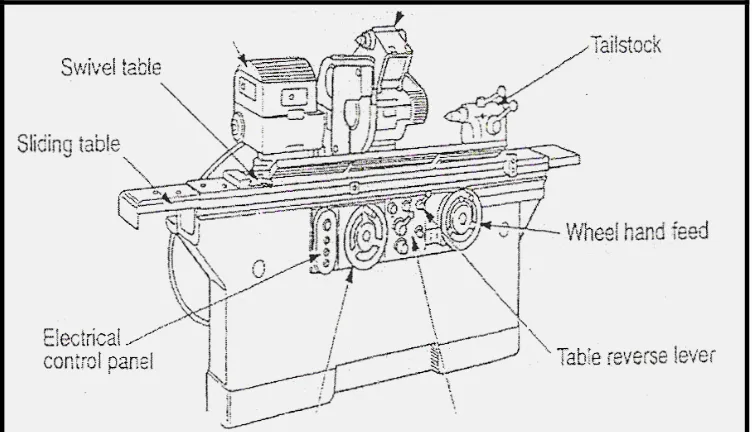
In Manufacturing Laboratory, the machine that were use for this studies is conventional Universal Cylindrical Grinder Model OD 618H/S, with variable speed table and manual wheel head in feed manufactured by SHARP Precision Machine Tools. The machine has the capability to machine both of internal and external cylindrical grinding.
A cylindrical surface being generated using the traverse motion; an operation that can be linked to cylindrical to cylindrical turning where the single point cutting tool is replace by a grinding wheel. [13]
The cylindrical grinder traverses the work, to and fro, in repeated passes along the length of the diameter, and the time to traverse is found using [18]:
time /pass = Lsx Tsx D
(WP) 2fi v
Where;
Ls = Length of ground dimension on workpiece, in.
Ts = Total rough or finish stock depth removed from diameter, in.
D = Original workpiece diameter, in. W = Wheel width, in.
P = Traverse for each work revolution in fraction of wheel width fi = Infeed of wheel per pass, in./pass
v = Workpiece peripheral velocity, in. /min
2.2 Types of Machine
Cylindrical grinding machines are used extensively in .engineering workshops to finish pre-machined and heat-treated components. Grinders can rough out and finish the work to fine tolerances. The surface finishes and great accuracy can be obtained more economically grinders than on other machines.
(a) The four types of cylindrical grinders are: i. Plain cylindrical grinding machine ii. Universal cylindrical grinding machine iii. Internal grinding machine
iv. Centreless grinding machine
2.2.1 Plain Cylindrical Grinding Machine
This machine is used for grinding parallel, tapered, stepped or formed external cylindrical surfaces. They were originally designed for finishing hardened work, but their operation efficient that they are now used for finishing most types of metals and materials.
Figure 2.1: Plain Cylindrical Grinding Machine
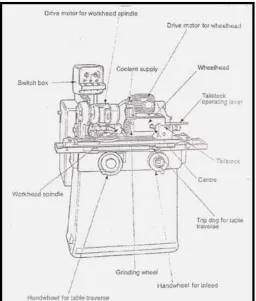
Figure 2.2: Universal Grinding Machine Showing Operating Controls and Principal Parts
2.2.2 Universal Cylindrical Grinding Machine
The universal grinding machine is very similar in construction to a plain grinding machine, except for the work head and the wheel head, both of which swivel. The work head swivels on a graduated base to 100 either side of zero. The wheel head platen not only swivels through 180° either side of zero, but is also mounted on a slide that swivels independently through 800 to 90° either side of zero. Thus, the slide can be set to the grinding angle required, and the platen swivelled through 90° presenting the wheel/face parallel to the face to be ground. A semi-universal machine in common use is very similar, except that the wheel platen and slide do not swivel independently of each other.