Teja Tscharntke
.
Christoph
Leuschner
.
Edzo Veldkamp . Heiko Faust .
Edi Guhardja
. Arifuddin bidin
.Editors
Tropical Rainforests
and Agroforests
under
Global Change
Ecological and Socio-economic
Valuations
z3
Editors
Prof. Dr. Teja Tscharntke Georg-August University Dept. Crop Sciences Agroecology Waldweg 26 37073 G0ttingen Germany
[email protected] Prof. Dr. &lzo Veldkamp Georg-August University Buesgen Institute
Soil Science and Forest Nutrition Buesgenweg 2
37077 G0ttingen Germany
[email protected] Prof. Dr. Edi Guhardja Bogor Agricultural University Dept. Biology
IPB Kampus Baranang Siang Bogor 16144
Indonesia
storma-ipb @ indo.net.id
hof. Dr. Christoph lruschner Georg-August University
Albrecht-von-Haller-Institute of Plant Sciences Plant Ecology
Untere 11n Oii1", 37073 Giittingen Germany
[email protected] Prof. Dr. Heiko Faust Georg-August University Institute of Geography Human Geography Goldschmidtstr. 5 37077 G6ttingen Germany
[email protected] Dr. Arituddin Bidin Tadulako University Dept. Forest Management Kampus Bumi Tadulako Tondo Palu
Indonesia
ISSN 1863-5520
ISBN 978-3-642-00492-6 e-ISBN 97 8-3 -&2-0M93 -3
DOI l 0. l 007/9't 8 -3 -642-W493-3
Springer Heidelberg Dordrecht London New York Library of Congress Control Numbec 2010920289 @ Springer-Verlag Berlin Heidelberg 2010
This work is subject to copyright. All righa are rcserved, whether the whole or part of the material is concerned, specifically the rights of translation, reprinting, reuse of illustrations, recitation, broadcasting, reproduction on microfilm or in any other way, and storage in data banks. Duplication of this publicarion or parts thereof is permitted only under the provisions of the German Copyright law of September 9, 1965, in its current version, and permission for use must always be obtained from Springer. Violations are liable to prosecution under the German Copyright Law.
The use of general descriptive names, registered names, trademarks, etc. in this publication does not imply, even in the absence ofa specific statement, that such names are exempt from the relevant protective laws and regulations and therefore free for general use.
Cover design: Integra Software Services Pvt. Ltd., Pondicherry Typeseuing: Camera-ready by Dr. Stella Aspelmeier
Printed on acid-free paper
Contents
Edi Guhardja, Ari,fuddin Bidin.
Tbopical rainforests and agroforests under global change: Ecological and socio-economic valuations - an introdrr"tio..
Teja Tscharntke, Chri,stoph Leuschner, Edzo Vetdkarnp, Hei,ko Fau.st,
Part I Agroforestry management in an ecological and socio economic context
Biodiversity patterns and trophic interactions in human-dominated tropical landscapes in sulawesi (rndonesia): plants, arthropods and vertebrates
Yonn Clough, Stefon Abrahomczyk, Morc-Oliuer Ad,ams, Alarn lnshary, Nunik Ariyanti, Lydia Betz, Dornayanti Buchori, Doniele Cicuzzo, Keu,in Darras, Dod,ang Dwi putra, Brigitte Fiala, S. Robbert Gradstein, Michael Kessler, Aresandra-Maria Klein, Ramadhanir Pitopang, Bandung sohari, christoph scherber, christian H. schulze, shahobudd,in, s'i,mone spom, Kothrin stenchly, sri s. Tjitrosoedirdjo, Thomas C. Wanger, Maria Weist, Am,o Wielgoss, Teja Tscharntke . -. . The potential of land-use systems for maintaining tropical forest butterfly diversity
Christion H. Schulze, Stefan Schneeweihs, Konrad" Fied,ler. Insect pollinator communities under changing land_use in tropical landscapes: implications for agricultural management in Indonesia
Bandung Sahari, Akhrnad Rizali, Domayanti Buchori
1 5
73
VI
Contents
Structure and management of cocoa agroforestry systems in
Central Sulawesi across an intensification gradient
Jana Juhrbandt, Thomas Duue, Jan Barhnann, Gerhard Gerold,
Rainer MorgSraf
. .. . .115
Land tenure rights, village institutions, and rainforest
conversion in Central Sulawesi (Indonesia)
Jqn Barkmann, G'iinter Burkard, Heiko Faust, Michael Flemerey,
S e b a s t i a n
K o c h ,
A g u s
L a n i n i
. . . 1 4 1
Rural income dynamics in post-crisis fndonesia: evidence
from Central Sulawesi
Jan Pri,ebe,
Robert Rud,olf, Julian Weisbrod,
Stephan Klasen, Iman
Sugema,
Nunung
Nuryartono
.. . . ... .161
Gender division of labor in agroforestry activities within
households: a case of Wonogiri - Central Java - Indonesia
f-Herien Puspitawoti, Ma'rnun Sorma
.. . . ..
l.
tZZ
The robustness of indicator based poverty assessment tools in
''.
changing environments - empirical evidence from Indonesia
Xenia uan Ed,ig, Stefan Schwarze,
Manlted Zeller .
. . . . .. . 191
Demography, development, and deforestation at the rainforest
margin in Indonesia
Stephan Klasen, Heiko Faust, Michael Grimm, Stefon Schwarze..
.. . . . .213
Part II Climate change effects on tropical rainforests and
egroforests
I\rnctional
biodiversity and climate change along an
altitudinal gradient in a tropical mountain rainforest
Jrirg Bendis, Hermann Behling, Thorsten Peters, Michael Richter,
E n t i . n B e c k .
. . . . 2 3 9
Spatiotemporal trends of forest cover change in Southeast
Asia
SteJan Erasmi, Muhammad Ardiansyah, Paael Propastin, Alfredo Huete .269
Comparison of tree water use characteristics in reforestation
and agroforestry stands across the tropics
Diego Dierick, Norbert Kunert, Michael K6hler, Luitgard
Schwendenmann,
Dirk Hiilscher.
.. . ..293
Contents VII
A comparison of throughfall rate and nutrient fluxes in rainforest and cacao plantation in Central Sulawesi, Indonesia
Carsten Gutzler, Stefan Koehler, Gerhard Gerold ...309 Effects of '3ENSO-eventst' and rainforest conversion on river discharge in Central Sulawesi (Indonesia)
G e r h a r d G e r o l d , C o n s t a n z e L e e m h u i s . . . 3 2 7 Adaptation to climate change in Iudonesia - livelihood
strategies of rural households in the face of ENSO related droughts
Norbert B. Binternagel, Jana Juhrbondt, Sebasti,an Koch, Mongku
Purnonto, Stefon Schwarze, Jan Barkrnann, Heiko Faust. . ...351 Terrestrial herb communities of tropical submontane and
tropical montane forests in Central Sulawesi, Indonesia Daniele Cicuzzo, Michoel Kessler, Ramadhanil Pitopang, Sri, S.
Tjitrosoeilirdjo, S- Robbert Grad,stein . . ... -.377 The hydraulic performance of tropical rainforest trees in
their perhumid environment - is there evidence for drought vulnerability?
Ale$andra Zach, Bernhard, Schuldt, Viviana Horna, Soehisman
Tjitrosemito, Christoph Leuschner . . .391
Part III Integrated concepts of land use in tropical landscapes
Principle and practice of the buffer zone in biosphere reserves: from global to local - general perspective from managers versus local perspective from villagers in Central Sulawesi, Indonesia
Mari,on Mehring, Susanne Stoll-Kleemann. . . . ... . .413 Institutions for environmental service payment programmes -evidence of community resource management arrangements in Central Sulawesi, Indonesia
Christina Seeberg-Eluerfeldt, Stefon Schwarze, Heiko Faust ...431 Agricultural expansion in the Brazilian state of Mato Grossol implications for C stocks and greenhouse gas emissions
VIII
Contents
Contribution of agroforestry to biodiversity and livelihoods
improvement in rural communities of Southern African
regions
Kanungwe Felir Kalabo, Posie Chiruta, Stephen Syampungc'ti, Clifford,
O l u y e d e A j a y i .
. . . . 4 6 1
Human ecological dimensions in sustainable utilization and
conservation of tropical mountain rain forests under global
change in southern Ecuador
Perdita Pohle, Andr6,s Gerique, Martino Park, Maria Fentand,a L6pez
S a n d o a a l
. . . . . . . . 4 7 7
Linkages between poverty and sustainable agricultural and
rural development in the uplands of Southeast Asia
Manfred Zeller, Tino Beuchelt, Isabel
Fischer, Franz Heidhues.. .. . .. ..511
List of Contributors
Stefan Abrahamczyk
Institute of Systematic Botauy,
University of Ziirich, Zollikerstrasse
107 CH-8008 Ziuich, Switzerland
Marc-Oliver Adarns
Agroecology, University of
Gtittin-gen, Waldweg 26, D-37073 GiittinGtittin-gen,
Germany
Depa.rtment of Animal Ecolory
and Tlopical Biolory (Zoolory III),
Biozentrum, University of Wiirzburg,
Am Hubland, D-97074 Wiirzburg,
Germany
Clifiord Oluyede Ajayi
World Agroforestry Centre (ICRAF),
P. O. Box 30798, Lilongwe 03, Malawi
AIam Anshary
Faculty of Agriculture, University of
Tadulako, Palu, Central Sulawesi,
Indonesia
Muhammad Ardiansyah
Bogor Agricultural Universitg
Department of Soil Sciences
and
Land resources,
Bogor, Indonesia
Nunik Ariyanti
Department of Biology, Faculty of
Mathematics and Natural Sciences,
Bogor Agricultural University, Jalan
Padjaja,ran,
16144 Bogor, West Java,
Indonesia
Jan Barkmann
Environmeutal & Resource Ece
nomics, Department of Agricultural
Economics and Rural Development,
Georg-August-University
G<ittingen,
Platz der Giittinger Sieben 5, 37073
Giittingen, Germany
Erwin Beck
Dept. of Plant Physiolory, University
of Bayreuth, Universitaetsstr. 30,
D 95440 Bayreuth, Germany
flermann Behling
Department of Palynolory and
Cli-mate Dynamics, Albrecht-von-Haller
Institute of Pla.nt Sciences.
Uni-versity of Goettingen, Untere
Karspuele 2, D 37073 Goettingen,
Germany
Jiirg Bendix
X
List of Contributors
Geography University of Marburg,
Deutschhausstr.
10, D 35032
Marburg, Germany
Lydia Betz
Agroecolory, University of
G<jttin-gen, Waldwe
g 26, D-37073 Giittingen,
Germany
Tina Beuchelt
Department of Agricultural
Eco-nomics and Social Sciences
in the
Ttopics and Subtropics, Section
Rural Development Theory and
Policy, Universitit Hohenheim,
(490a), D-70593 Stuttgart, Germany
Norbert B. Binternagel
Georg-August-University
Giittin-gen, Faculty of Geosciences
and
Geography, Department of Human
Geography, Goldschmidtstr. 5,
37077 G6ttingen, Germany
Damayanti Buchori
Peka Indonesia Foundation
(In-donesian Nature Conservation
Foundation)-Wildlife Tfust Alliance.
Jl. Uranus Blok H No 1 Perum IPB
Sindang Bara.ng 2, Bogor, West
Java-Indonesia
Department of Plant Protection,
Bogor Agricultural UniversitS
Kampus IPB Dramaga, Bogor-West
Java-Indonesia
Gtinter Burkard
Rural Sociology, Faculty of Organic
Agricultural Sciences,
University
of Kassel, Steinstr. 19, 37213
Witzenhausen, Germany
JoSo Luis Nunes Carvalho
Center for Nuclear energy in
Agri-culture (CENA), The University of
S5,o
Paulo,
C.P. 96, C.E.P. 13.40G970,
Piraci-caba, SP, Brazil
Carlos Eduardo P. Cerri
Center for Nuclear energy in
Agri-culture (CENA), The University of
S5o Paulo,
-1.P.
96, C.E.P. 13.4'0G970,
Piraci-caba. SP. Brazil
Paxie Chirwa
Stellenbosch
UniversitS
Depart-ment of Forest and Wood Science.
Stellenbosch
7602, South Africa
Daniele Cicuzza
Institute of Systematic Botany,
University of Ziirich, Zollikerstrasse
107 CH-8008 Ziirich, Switzerland
Albrecht-von-Haller-Institute of
Plant Sciences,
University of
Giittin-gen, Untere Karspiile 2, D-37073
Gottingen, Germany
Yann Clough
Agroecology, University of
Gtittin-gen, Waldwe
g 26, D37073 Giittingen,
Germany
Kevin Darras
14 all6e de Fr6nes F-01210
Verson-nex, France
Agroecolory, University of
G<jttin-gen, Waldwe
g 26, D-37 073 Giittingen,
Germany
Diego Dierick
T[opical Silviculture and Forest
Ecolory, Burckhardt Institute,
University of Giittingen, Biisgenweg
l, D- 37077 Gottingen, Germany
Dadang Dwi Putra
Celebes
Bird Club, Jl. Thamrin 63A,
Palu, Central Sulawesi,
Indonesia
Thomas Duwe
Department of Landscape Ecology,
Institute of Geography,
Georg-August University Gtittingen,
Goldschmidtstr. 5, 37077 G6ttingen,
Germanf
Xenia van Edig
Department of Agricultural
Eco-nomics and Rural Development,
University of Giittingen, Germany
Stefan Erasmi
University of G6ttingen, Institute of
Geography, Goldschmidtstr. 5, 37077
Grittingen, Germany
Heiko Faust
University of Giittingen, Institute
of GeographS Division of Human
Geography, Goldschmidtstr. 5, 37077
Giittingen, Germany
Brigitte Fiala
Department of Animal Ecology
and Tlopical Biolory (Zoolory III),
Biozentrum, University of Wiirzburg,
Am Hubland, D-97074 Wiirzburg,
Germany
Konrad Fiedler
Department of Population Ecolory,
Faculty of Life Sciences,
University
of Vienna, Rennweg 14, A-1030
Vienna, Austria
Isabel Fischer
Department of Agricultural
Eco-nomics and Social Sciences
in the
Thopics and Subtropics, Section
Rural Development Theory and
Policy, Universitdt Hohenheim,
(490a), D-70593
Stuttgart, Germany
List of Contributors
XI
Michael Flemerey
Rural Sociolory, Faculty of Organic
Agricultural Sciences,
University
of Kassel, Steinstr. 19,37213
Witzenhausen,
Germany
Andr6s Gerique
I-nstitute of Geography,
Fliedrich-Alexander-University
Erlangen-Nfirnberg, Kochstrasse
4/4,
91054 Erlangen, Germany
Gerhard Gerold
Department of Landscape Ecolory,
Insbitute of Geography,
Georg-August University Gcittingen,
Goldschmidtstr. 5, 37077 Gtittingen,
Germany
S. Robbert Gradstein
Albrecht-von-Haller-Institute of
Plant Sciences,
University of
Giittin-gen, Untere Karspiile 2, D-37073
Giittingen, Germany
Michael Grimm
International Institute of Social
Studies, Erasmus University
Rot-terdam, Kortenaerkade 12, 2518AX
The Hague, The Netherlands
Carsten Gutzler
Institute of Geography,
Department
of Landscape Ecologr, University of
Giittingen, Goldschmidtstr. 5, 37077
Gottingen, Germany
Flanz Heidhues
XII
List of Contributors
Dirk Hdlscher
Tbopical Silviculture and Forest
Ecology, Burckhardt Institute,
University of Gdttingen, Biisgenweg
l, D- 37077 Gottingen, Germany
Viviana Iforna
Plant Ecologr, Albrecht von Haller
Institute for Plant Sciences,
Univer-sity of Gdttingen, Untere Karspiile
2, 37073 Gtittingen, Germany
Alfredo Huete
University of Arizona, Department
of Soil, Water and Environmental
Science,
T\rcson, AZ, USA
Jana Juhrbandt
Environmental and Resource
Eco-nomics, Department of Agricultural
Economics and Rural Development,
Georg-August University G6ttingen,
Platz der Giittinger Sieben 5,
D-37073 G<ittingen, Germany
Kanungwe Fblix Kalaba
Copperbelt University, School of
Natural Resources,
P.O. Box 21692,
Kitwe, Zanbla
Michael Kessler
Institute of Plant Sciences,
Univer-sity of Giittingen, Untere Karspiile
2, 37073 Girttingen, Germany
Institute of Systematic Botany,
University of Ziirich, Zollikerstrasse
107 CH-8008 Ziirich, Switzerland
Stephan Klasen
University of Giittingen, Faculty of
Economics, Platz der Giittinger
Sieben 3, 37073 Gdttingen, Germany
Alexandra-Maria Klein
Agroecology, University of
Giittin-gen, Waldweg 26, D-37 07 3 GtittinGiittin-gen,
Germanv
Sebastian Koch
Environmental & Resource
Eco-nomics, Department of Agricultural
Economics and Rurrl Development,
l.eorg-August-University Gtittingen,
Platz der Giittinger Sieben 5, 37073
Gottingen, Germany
Department of Cultural and Social
Geography Institute of Geography
Georg-August-University
G6ttingen,
Goldschmidtstr.
5, 37077 Gcittingen,
Germany
Michael Kdhler
Tlopical Silviculture and Forest
Ecology, Burckhardt Institute,
University of Gottingen, Biisgenweg
l, D- 37077 Giittingen, Germany
Stefan Koehler
Landscape Ecology and Land
Evalu-ation, Faculty for Agricultural- a^nd
Environmental Sciences,
University
of Rostock, Justus-von-Liebig Weg
6, 18059 Rostock, Germany
Norbert Kunert
Tiopical Silviculture and Forest
Ecolory, Burckhardt Institute,
University of Giittingen, Biisgenweg
I, D- 37077 Gtittingen, Germany
Agus Lanini
Faculty of Law, Universitas
Tadu-lako, Kampus Bumi Tondo, Palu
94118,
Indonesia
Constanze Leemhuis
Christoph Leuschner
Plant Ecology, Albrecht von Haller
Institute for Plant Sciences,
Univer-sity of G6ttingen, Untere Karspiile
2, 3707
3 G<ittingen, Germa.ny
Maria Fernanda L6pez Sandoval
Escuela de Geografia, Facultad
de Ciencia Humana, Pontificia
Universidad Cat6lica del Ecuador
(PUCE), Quito
Rainer Marggraf
Environmental and Resource
Eco-nomics, Department of Agricultural
Economics and Rural Development,
Georg-August University Gcitt'ingen,
Platz der Grittinger Sieben 5,
D-37073 G6ttingen, Germa,ny
Marion Mehring
Applied Geography and
Sustain-ability Science,
GoBi (Governance
of Biodiversity) Research Group,
Institute of Geography and Geology,
Ernst-Moritz-Arndt Universitdt
Greifswald, Jahnstr. 16, 17487
Greifswald, Germany
Eleanor Milne
The Macaulay Institute,
Craigiebuck-ler, Aberdeen,
ABI58QH, UK
Colorado State University (NREL),
Fort Collins, CO 8052&1499
USA
Nunung Nuryartono
Institut Pertanian Bogor, Indonesia,
16710 Bogor, International Center
for Applied Finance and Economics,
Kampus IPB Ba.ranang Siang,
Gedung Uta.rna Lt.
II, Jalan R"aya
Paiajaran
List of Contributors XIII
Martina Park
Institute of Geography, Ftiedrich-Alexander-University Erlangen-Ntirnberg, Kochstrasse 4/4, 91054 Erlangen, Germany
Thorsten Peters
Institute of Geography, University of Erlangen, Kochstr.4/4, D 91054 Erlangen, Germany
Ramadhanil Pitopang
Peka Indonesia Foundation (In-donesian Nature Conservation Foundation)-Wildlife Tlust Alliance. Jl. Uranus Blok H No 1 Perum IPB Sindang Barang 2, Bogor, West Java, Indonesia
Department of Forest Managment and Herbarium Celebense, Tadulako University, Palu, Indonesia
Perdita Pohle
Institute of Geography Fliedrich-Alexa.nder-University Erlangen-Niirnberg, Kochstrasse 4/4, 91054 Erlangen, Germany
Jan Priebe
University of Giittingen, Faculty of Economics, Platz der Gtittinger Sieben 3, 37073 G<ittingen, Germany
Pavel Propastin
University of G<ittingen, Institute of Geography, Goldschmidtstr. 5, 37077 G<ittingen, Germany
Mangku Purnomo
XIV
List of Contributors
flerien Puspitawati
Department of Family and Consumer
Sciences,
Faculty of Human Ecology,
Bogor Agricultural University, Jalan
Lingkar Akademik Kampus IPB,
Darmaga, Bogor 16680,
Jawa Barat,
Indonesia
Michael Richter
Institute of Geography,
University of
Erlangen, Kochstr. 414,D 97054
Frlangen, Germany
Akhmad Rizali
Peka Indonesia Foundation
(In-donesian Nature Conservation
Foundation)-Wildlife Tlust Alliance.
Jl. Uranus Blok H No 1 Perum IPB
Sindang Barang 2, Bogor, West
Java-Indonesia
Department of Plant Protection,
Bogor Agricultural University,
Kampus IPB Dramaga, Bogor-West
Java-Indonesia
Agroecolory, University of
Gtittin-gen, Waldweg 26, 37073 GiiettinGtittin-gen,
Germany
Robert Rudolf
University of Giittingen, Faculty of
Economics, Platz der G<ittinger
Sieben 3, 37073 Gottingen, Germany
Bandung Sahari
Peka Indonesia Foundation
(In-donesian Nature Conservation
Foundation)-Wildlife TYust Alliance.
Jl. Uranus Blok H No 1 Perum IPB
Sindang Ba.rang 2, Bogor, West
Java-Indonesia
Matmun Sarma
Department of Management,
Faculty
of Economics and Management,
Bogor Agricultural University,
Indonesia
Christoph Scherber
Agroecolory, University of
Giittin-gen, Waldwe
g 26, D-37 073 Gtittingen,
Germany
Stefan Schneeweihs
Department of Population Ecology,
Faculty of Life Sciences,
University
of Vienna, Rennweg 14, A-1030
Vienna, Austria
Bernhard Schuldt
Plant Ecolory, Albrecht von Haller
Institute for Plant Sciences,
Univer-sity of G<ittingen, Untere Ka^rspiile
2, 37073 Gcittingen, Germany
Christian H. Schulze
Department of Population Ecolory,
Faculty of Life Sciencas,
University
of Vienna, Rennweg 14, A-1030
Vienna, Austria
Stefan Schwarze
University of Giittingen, Department
of Agricultural Economics and Rural
Development, Platz der Giittinger
Sieben
5, 37073 Gtittingen
Luitgard Schwendenmann
Tlopical Silviculture and Forest
Ecology, Burckhardt Institute,
University of Grittingen, Biisgenweg
l,D- 37077 Gtittingen, Germany
Christina Seeberg-Elverfeldt
Natural Resources
Management and
Environment Department (NRD),
FAO, Viale delle Terme di Caracalla,
00153 Rome, Italy
Shahabuddin
Faculty of Agriculture, University of
Tadulako, Palu, Central Sulawesi,
Indonesia
-Simone Sporn
Albrecht-von-Haller-Institute of
Plant Sciences,
University of
Gcittin-gen, Untere KarspiiLle
2, D-37073
Gtittingen, Germany
Kathrin Stenchly
Agroecology, University of
Gijttin-gen, Waldweg 26, D.37073 GtittinGijttin-gen,
Germany
Susanne Stoll-Kleemann
Applied Geography and
Sustain-ability Science, GoBi (Governance
of Biodiversity) Research Group,
Institute of Geography and Geolory,
Ernst-Moritz-Arndt Universitdt
Greifswald, Jahnstr. t6, 17487
Greifuwald, Germa.ny
Iman Sugema
Institut Pertanian Bogor, Indonesia,
16710 Bogor, International Center
for Applied Finance and Economics,
Kampus IPB Baranang Siang,
Gedung Utama Lt.
II, Jalan Raya Paiajaran
Stephen Syampungani
Copperbelt University, School of
Natural Resources,
P.O. Box 21692,
Kitwe, Zarnbia
Soekisman Tjitrosemito
Faculty of Science
and Mathematics,
Institute Pertania,n Bogor, Jl. Raya
Pajajara.n, Bogor, 16144 Indonesia
Sri S. Tjitrosoedirdjo
Department of Biolory, Faculty of
Mathematics and Natural Sciences,
Bogor Agricultural University, Jalan
Padjajaran, 16144
Bogor,'West
Java,
Indonesia
Teja Tscharntke
Agroecology, University of
Giittin-gen, Waldweg 26, D-37073 GrittinGiittin-gen,
Germanv
List of Contributors XV
Thomas C. Wanger
Agroecology,
University of
Gottin-gen, Waldwe
g 26, D-37 073 Gottingen,
Germany
Environment Institute. School of
Earth and Environmental Sciences,
University of Adelaide, Australia
Julian Weisbrod
University of G<ittingen, Faculty of
Economics,
Platz der G<ittinger
Sieben 3, 37073 Giittingen, Germany
Maria lVeist
Agroecolory, University of
G<ittin-gen, Waldwe
g 26, D-37 073 G<ittingen,
Germany
Arno Wielgoss
Agroecolory, University of
G<ittin-gen, Waldweg 26, D-37073 GiittinG<ittin-gen,
Germany
Department of Animal Ecology
and Tbopical Biolory (Zoolory III),
Biozentrum, University of Wiirzburg,
Am Hubland, D-97074 Wiirzburg,
Germany
Alexandra Zach
Plant Ecology, Albrecht von Haller
Institute for Plant Sciences.
Univer-sity of G6ttingen, Untere Karspiile
2, 37073 Giittingen, Germany
Manfred Zeller
!
I
l
I
Gender division of labor ir, agroforestry
activities within households: a case of Wonogiri
- Central Java - Indonesia
Herien Puspitawatir* and Ma'mun Sarma2
1 Department of Family and Consumer Sciences, Faculty of Human Ecolory, Bogor Agricultural university, Jalan Lingkar Akademik Kampus IpB, Darmaga, Bogor 16680, Jawa Ba.rat, Lrdonesia
2 Department of Management, Faculty of Economics and Management, Bogor Agricultural University, Indonesia
*corresponding author: H. Puspitawati, email: [email protected]
Summary
This chapter provides a brief description on the gender division of labor iu agroforestry activities within households. The introduction describes the un-derlying background of gender roles in agroforestry activities. In general it was found that there is an imbalance of gender partnership in labor divi-sion applied at cultivation, processing and marketing of cashew nuts between men and women. The unequal gender role has also existed at the accesibility and control levels towards collector traders and wholesale buyers; however, an equal gender role has been found at the accessibility and control towards farming activities, and the role of women is even more dominant in process-ing than that of men. It was also found that the unequal gender partnership at the community level is due to the socio-cultural constraints. Finally, re search and policy recommendations describe the focus of research related to gender in agroforestry, the capacity building for regional and national gov-ernment, and also community and gender empowerment. The community and gender empowerrneut includes the agreement among communities (both.men and women) in the village to reformulate its regional planning, the increase of women's potential skills and knowledge, and the strengtheiing of farmer group/institutions.
Keywords:Gender roles, gender empowerment, farming activities, agroforestry
178 H. Puspitawati and M. Sarma
1 Introduction
1.1 Underlying Background
State promotion of agroforestry produ"tion is widespread in Southeast Asia. It frequently aims at economic development and sometimes environmental protection, particularly in rural areas. State promotion is often on a large scale and can fail to consider or monitor the various localized impacts of promoting a particular agroforestry activity. In many cases, the emphasis is on production rather than maximizing benefits to poor farm households, which involves marketing issues such as improving bargaining power, ralue adding and product development.
Java is the most populous isla^nd in Indonesia, covering just six percent of its land but housing almost 60 percent of the country's 215 million or so people. Moreover, as the centre of industry and the main food production area in Indonesia, Java plays a leading role in the national economy. The government has launched a number of initiatives to ameliorate environmental degradation in Java and other parts of the country. One of them, which has been running since the early 1980s, is reforestation of upland area.s through agroforestry. Through this program, the government provides materials and other support to assist upland farmers to plant tree crops such as coffee and the cashew nut. Combined with a growing market, this policy has lead to extensive participation of community households in the agroforestry production.
Farmers in Java are generally small landholders using a low level of produc-tion technolory and limited access to market informaproduc-tion. They face a range of constraints including: tedious, complex and labor intensive processing; in-adequate grading and packing, and a lack of ma^rket information throughout the marketing chain. In addition, they generally bargain individually with middlemen, which give them less bargaining power. Despite this, cashew pro-duction contributes significantly to a processor's family income, and is well established.
Wonogiri district is located in Central Java province at the latitude of 7"32' to 8"15', with the longitude of 110o41' to 111o18' and the altitude is about 400m above sea level. The district has the size area of 182 237 Ha (BPS Provinsi Jawa Tengah 2000). In the yeax of 2000, the district's population was 966 414 people (BPS Pusat 2001). This means that the population density was 530 persons per km2. Most of the area of Wonogiri district is upland with very low soil fertility. Severe shortages of fresh water for drinking aud agriculture at the dry sea.son have been another problem that hinders economic development of this district. The severity of economic problems in this district has forced a significant part of its population to migrate to other areas of Indonesia, such as Jakarta and Lampung, for jobs. This has been the underlying factor behind the fact that its population density affects the socio-economic problems.
Gender division of labor in agroforestry 179 through improved land productivity, water conditions, and soil fertility. Thus, the agroforestry program is also considered to be a poverty-alleviation pro-gram. Based on this reasoning, the study examines the gender division of labor within households in agroforestry activities.
1.2 The Objectives of the Study The objectives of the study are:
1. To examine the gender roles in production, processing, and marketing of cashew nuts.
2. To propose strategies to improve market bargaining power of women so as to improve their contribution to their family income.
2 Literature studies
Gender Mainstreaming was defined by the United Nations Economic and So-cial Council in 1997 as a strategy for making women's as well as men's con-cerns and experiences an integral dimension of their policies and programs. The Government of Indonesia's increased efforts to Gender Mainstreani into its national development process is an affirmation of the commitment to gen-der equality and the rights of both women and men (KPP-UNDP 2007).
As a stratery, Gender Mainstreaming aims at promoting a fairer distri-bution of resources, opportunities and benefits of development processes and population programs. As Indonesia is now implementing a decentralized ap proach in the country's development, the need for mainstreaming gender con-cerns in local government's programs and policies has become more important (KPP-BKKBN-UNFPA 2004).
The mea.ning of gender is different hom the meaning of the type of sex. However, both gender and the type of sex involve both men and women. The type of sex in general is applied to identify the difference between men and women from biological anatomy that it is natural. Meanwhile, gender discusses the differences of role distributions and function between men and women that are decided by the community/culture since they were born and that it is not natural. At this point, gender does not discuss women only, but also men in relation to cooperation/partnership and the role distribution between men and women to achieve the same goal. Therefore, gender discusses the problems of both men and women in society's life. Thus, gender is the community perspectives toward roles, functions, and responsibilities among men and women are a result of social and cultural constructions that can be changed along with the dynamics of bime and community aspirations
(KPP-BKKBN-UNFPA
2004).
180 H. Puspitawati and M. Sarma
to differences in their income and other resources. The work of women at home is unremunerated, and therefore not regarded as "real" work, and ofben constrains women's opportunities to earn outside income. Thus, the public world of work is a men's domain, but the private world of home is a women's domain (Renzetti & Curran 1995).
Gender roles in agricultural work are influenced by the gender division of labor. In some countries women are virtually full-time farmers, while in other countries women do little work in fields. In some places, women are active farmers and work side.by-side with the men in the fields and in other places women are work separately from men in the fields (Osteergaard 1992).
3 Research methodology
3.1. Location of the study
The study was conducted at Rejosari village, located in the important cashew producing sub-district of Jatisrono Wonogiri District of Central Java, Indone' sia during January-March 2006 (as part of the SEANAFE Project on Mar-kets for Agroforestry Tiee Products) (SEANAFE. 2007a; SEANAFE. 2007b; SEANAFDIPB. 2OO8).
3.2 Types of Information Required and Their Sources
In this study, both primary and secondary information have been used to achieve the study's goals. The required prima"ry information was obtained from a variety of respondents. The respondents included farmers, middle men, processors, exporters, relevant government agencies, financial institu-tions, farming cooperatives and NGO's. The respondents were interviewed in-depth, either individually or collectively through FGD's (Focus Group Dis-cussions). Meanwhile, the required secondary information will be obtained from va^rious agencies (private and public agencies) and relevant publications.
3.3 Methods of Analysis
The information collected was analyzed by using a variety of analytical tools. The tools of analysis include descriptive analysis, by using gender analysis approach.
Gender division of labor in agroforestry 181
4 Findings
4.1 The Meaning of Gender and Family
The fact that Wonogiri upland is upstrea,rn of the Solo River tras been a^n-other important reason for the government to make this upland area a target for the agroforestry program. The Solo River is an essential source of fresh water for industry and people not only in Central Java, but also in East Java province. The important role of this river for the population and economic development of these provinces has, in fact, led the government of Indonesia to place the ma.nagement of this river under a special management authority called Perum Jasa Tirta 2.
The agroforestry program implemented in the Wonogiri upland areas has been quite successful, especially in promoting the cultivation of cashew nut tree crops on private farmland. This can be discerned from the data which highlight some aspects of cashew nut tree crops in Wonogiri district. Itom the data it can be seen that the area of cashew nut tree farms has increased quite significantly from 5 643 ha in 1999 to 7 738 in 2004. At the same period of time total production also has increased quite significa.ntly, from 5 304.42 tons in 1999 to 10 833.20 tons in 2004. Simila^rly average farm productivity has also increased significantly from 940 Kg/ha in 1999 to I 400 Kg/ha in 2404.
In Wonogiri district, farmers produce cashew nuts not just for their own household consumption, but also for the ma,rket. For these small farmers the cultivation of cashew nuts tree crops on their small ma.rginal land is for the purpose of obtaining cash income. Farmers are involved in the market for cashew nuts through selling of almost all of their production into their local market. The market for cashew nuts in this district is, in fact, growing over the last few years. This market phenomenon is reflected in the growing of cashew nuts of Wonogiri district to be shipped into overseas markets. The total of export of cashew nuts from Wonogiri district increased from 5 304 420 Kgs in 1998 to 10 833 200 Kgs in 2004. Similarly the value of exports also increased from USD 6 129 22I in 1998 to USD 17 027 652 in 2004 (Bappeda Wonogiri 2005).
Most of these upland farmers are small-holders, with the average farrn size of less than 0.50 ha. In fact, in 2004 the number of farmers that were involved in cashew nuts tree crop farming in Wonogiri district was 23 422 households. This meant that the average holding was 0.33 ha per fa.rming household (Bappeda Wonogiri 2005).
182 H. Prupitawati and M. Sarma
before, the cashew nut is one of the most important crops in the estate crop sub-sector.
Wonogiri has also faced persistent problems of a high level of poverty. Based on the National Socio.Economic Survey conducted in 2004, the num-ber of the people living below the povorty line is 272 795 people, a.round 24.4 per cent of total population. This poverty incidence is much higher than the national level of 16 per cent. Some other indicators ofthe high level ofpoverty in the region are the high level of illiteracy (5.3 per cent), child-mortality rate (14.6 of I 000), and a high rate of undernourished people (4.8 per cent). With this situation, the government of Wonogiri has placed its poverty alleviation program as one of the central programs. Moreover, since agriculture is the most dominant sector, then the government has promoted agricultural devel-opment as a leading sector in combating poverty.
With a total population of 1.12 million people and a family size around 4.4 people per household, Wonogiri still faces serious problems of unemployment, although population growth has been actually very low, between 0.44 0.62 per cent per annum. The official unemployment level is 2.1 per cent, but the real unemployment level must be much higher. This is because the education level of the man-power from Wonogiri is low. The education level of the man-power has is low because almost 40 per cent of the population has only completed elementary school (BPS Wonogid 2005).
Rejosari village located at Jatisrono sub-district, Wonogiri District, Cen-tral Java Province is an agricultural axea surrounded by people's forests and hilly a.reas. In 2004, the population in the village was 1,075 head of families or 4,627 people consisting of 2298 (49.67 per cent) women and 2329 (50.33 per cent) men. Almost 60 per cent of the population is engaged in agriculture a^s farmers or fa.rm workers.
The community of the Rejosa.ri village is an agricultural community dom-inated by rural traditional life. Although in general the society's norm is patriarchal, in daily life the community has been practicing close cooperation between men (husba,nd) and women (wife) at the family level since a long time ago.
vil-Gender division of labor in agroforestry 183 lage. Some of the young generations of women have started to go to the outer cities/regions for selling food (meat balls, rice a^nd soup) and traditional herbs.
The division of roles in their daily family activities has been implemented respectively both in economic and domestic activities. The community of Re-josari village has been getting used to implement the gender distribution of roles starting from the family level and continuing to the community level, even though it is still at the traditional stage. The value of the division of gender roles has been practiced in their daily fa.rnily management activities starting from collaboration between husband and wife in their domestic activ-ities to the economics and community social activactiv-ities. The values of gender equality and justice have also been implemented in formal education. Boys and girls are not discriminated against for entry into school from Primary to Junior High Schools. The community realizes that the value of boys and girls are the same, even though the community acknowledges that boys can be leaders for the family as is the root custom of Javanese culture and the majority of Moslem societies who have been practicing a patriarchal system. The villagers consider the importance of family values in every aspect of human life. They realize that a human will not have a quality of life without farnily. If somebody has a problem, he/she will ask for help to his/her family. Somebody who is successful in the citg at the end he/she will return to his/her place of origin and finally to his/her large family. Thus, the ralues of "my fa;rrily is my world" and "back to my family'' are basic values of family life in Rejosari village.
The community of Jatisrono sub'district in general, and the community of Rejosari village in particular, have been popularly seen as tough and hard-working people, people who cooperate readily, love peace and maintain a surf' tainable environment. The existence of good work ethics of the community has been provided by the good organizational structure ofvillage government, good village administration, active village cooperative, good facilitim of infras-tructure, bridges, and the village office. Most of the community infrastructures were built by local enterprise using the community's own finance. The people in the village, both men and women, young and old, were reported on partic-ipating in the construction of the village road in 1997. This activity is viewed as the community's close cooperation both in social and economic activities, with involving men and women. These activities make Rejosari Village one of the role models of community empowerment that involves gender equality and equity.
4.2 The Gender Division of Labor in Agroforestry Activities
#
ry
w.
w
184 H. Puspitawati and M. Sarma
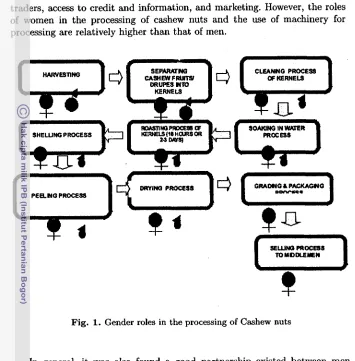
traders, access to credit and information, and marketing. However, the roles of women in the processing of cashew nuts and the use of machinery for processing are relatively higher than that of men.
GRAo|IG T PTCXAGTIG
!ffra
?r
Fig. 1. Gender roles in the processing of Cashew nuts
In general, it was also found a good partnership existed between men and women in the accessibility of control towards resources and processing technology. The role of women is limited in the accessibility of information on pricing and training. Even the access of women to credit for the production and marketing does not yet exist in Rejosari village, Wonogiri District' On the other hand, the role of women is greatest in the overall manufacturing process.
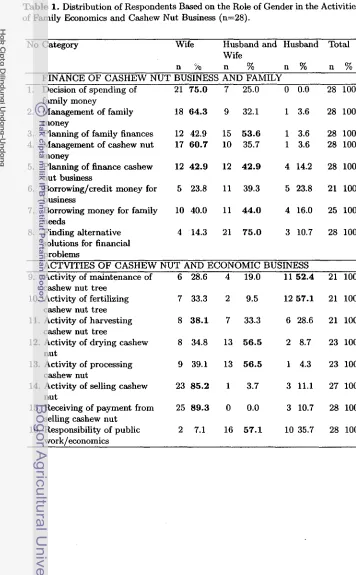
The role of gender in the household activity is a good practice and almost equal between men and women. The role of gender in the activities of financial economics of the cashew nut business is presented in Table 1.
[image:22.482.71.426.59.420.2]Gender division of labor in agroforestry 185
: Indicates a low level ot some.Vmen role
) , /
n : Indicates a high level of uomery'men role
[image:23.482.72.378.27.532.2]186 H. Puspitawati and M. Sarma
Table 1. Distribution of Respondents Based on the Role of Gender in the Activities of Family Economics and Cashew Nut Business (n:28).
Wife n T o n T o n Y o n T o
family money
2. Management of family 18 64.3 9 32.1 1 3.6 28 100 money
3. Planning of family finances t2 42.9 15 53.6 1 3.6 28 100 4. Management of cashew nut 17 60.7 l0 35.7 1 3.6 28 L00
money
5. Planning of fina^nce cashew 12 42.9 12 42.9 4 14.2 28 100 nut business
6. Bonowing/credit money for 5 23.8 11 39.3 5 23.8 21 100 business
7. Borrowingmoney for family 10 40.0 11 44.O 4 16.0 25 100 needs
8. Finding alternative solutions for financial problems
9. Activity of maintenance of 6 28.6 4 19.0 LL 52.4 21 f00 cashew nut tree
10. Activity of fertilizing 7 33.3 2 9.5 12 5T.l 21 100 cashew nut tree
11. Activityof harvesting 8 38.1 7 33.3 6 28.6 21 100 cashew nut tree
12. Activity of drying cashew 8 34.8 13 56.5 2 8.7 23 100 nut
13. Activity of processing I 39.1 13 56.5 1 4.3 23 100 cashew nut
14. Activity of selling cashew 23 a5.2 I 3.7 3 11.1 27 1OO nut
15. R.eceiving of payment from 25 89.3 0 0.0 3 10.7 28 100 selling cashew nut
16. Responsibility of public 2 7.1 16 57.L 10 35.7 28 100 work/economics
[image:24.482.53.409.61.636.2]Gender division of labor in agroforestry 187
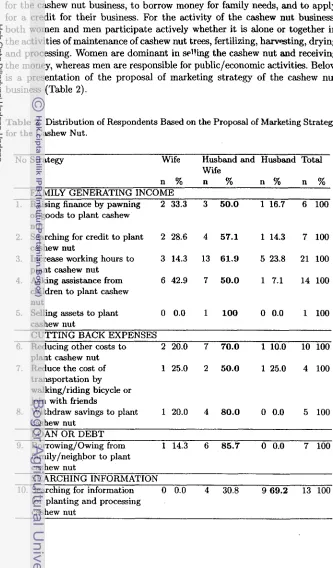
for the cashew nut business, to borrow money for family needs, and to apply for a credit for their business. For the activity of the cashew nut business, both women and men participate actively whether it is alone or together in the activities of maintenance of cashew nut trees, fertilizing, harvesting, drying and processing. Women are dominant in selling the cashew nut and receiving the money, whereas men are responsible for public/economic activities. Below is a presentation of the proposal of ma,rketing strategy of the cashew nut business (Table 2).
Table 2. Distribution of Respondents Based on the Proposal of Ma,rketing Stratery for the Cashew Nut.
Wife n T o n T o n T o n V o
1. Raising finance by pawning 2 33.3 3 5O.O 1 16.7 6 100 of goods to plant cashew
nut
2. Searching for credit to plant 2 28-6 4 57.1 1 14.3 7 f00 cashew nut
3. Increase working hours to 3 14.3 13 61.9 5 23.8 21 100 plant cashew nut
4. Asking assistance from 6 42.9 7 5O.O | 7.L 14 100 ctrildren to plant cashew
nut
5. Selling assets to plant 0 0.0 1 1OO 0 0.0 1 100 cashew nut
6. Reducing other costs to 2 20.0 7 7O.O 1 10.0 10 f00 plant cashew nut
7- Fleduce the cost of I 25.0 2 5O.O 1 25.0 4 100 trarnportation by
walking/riding bicycle or join with friends
8. Withdraw savings to plant 1 20.0 4 8O.O 0 0.0 5 100 cashew nut
family/neighbor to plant cashew nut
[image:25.482.56.389.66.634.2]188 H. Puspitawati and M. Sarma
The result of the survey consistently shows that the role of women is more dominant than that of men in the finance and economic activity in the cashew nut business and the cashew nut marketing strategy. It also recognized that both men and women a"re participating actively whether it is alone or together for implementing income generation :'lategies such as pawning assets to cul-tivate cashew nut, seeking of credit for cashew nut business, increase working hours to cultivate cashew nut trees, asking children to cultivate cashew nut trees, and selling assets to cultivate cashew nut trees. It was found that both men a"nd women are participating actively whether it is alone or together for implementing cutting back strategies such as the reduction of cost of cultiva-tion of cashew nut trees, reduce the transportacultiva-tion costs by cycling, walking or obtaining Iift,, and withdrawing savings to cultivate cashew nut trees. The role of information gathering and the forming of strategies to cultivate cashew nut trees is dominated bv men.
5 Conclusios and recommendations
In conclusion, it is found that there was an imbalance of gender partnership in the division of labor applied at cultivation, processing and marketing or cashew nuts between men and women. This unequal gender role also existed in the accessibility and control with collector traders in the collection and wholesaling processes. However, an equal gender role already existed in ac-cessibility and control of farming activities, while in the processing the role of women was the more dominant. It is also found that the unequal gender partnership at the community level was caused by socio-cultural constraints.
Gender division of labor in agroforestry 189
References
Bappeda Wonogiri (2005) Rencana Pembangunan Jangka Menengah Kabu-paten Wonogori, Bappeda Wonogiri, Wonogiri
BPS Provinsi Jawa Tengah (2000) Jawz, Tsngah dalam Angka: Tahun 1999. Semarang: BPS Provinsi Jawa Tengah
BPS Pusat (2001) Penduduk Indonesia: Hasil Sensus Penduduk 2000. Jakarta: BPS Pusat
BPS Pusat (2004) Statistik Indonesia 2003. Jakarta: BPS Pusat
BPS Pusat (2005) Data dan Informasi Kemiskinan Tahun 2004: Kabupaten. Jakarta: BPS Pusat
BPS Wonogiri (2005) Wonogiri in Figures 2004. BPS Kabupaten Wonogiri, Wonogiri
Hutagaol M, Parulian, Adiwibowo S (2002) Degradasi Lingkungan dan Keta-hanan Pangan Nasional: Investigasi Singkat Mengenai Peranan Kebijakan Pembangunan Nasional. In: Krisnamurthy Bayu et al. (eds.) Tekanan Pen-duduk, Degradasi Lingkungan dan Ketahanan Pangan. Bogor: Pusat Studi Pembangunan,pp 106- 131
KPP-BKKBN-UNFPA (2004) Bunga Rampai: Panduan dan Bahan Pembela-ja,ra.n Pelatihan Penga.msutamaan Gender dalam Pembangunan Nasional. Kementerian Pemberdayaan Perempuan Republik Indonesia Cooperation with BKKBN and UNFPA
KPP-UNDP (2007) Modul: Pengarusutamaa.n Gender dalam Pembanguna.n Nasional di Indonesia. Kementerian Pemberdayaan Perempuan Republik Indonesia Cooperation with IINDP
Ostergaard L ("d.) (1992) Gender and Development. Routledge. London, UK Renzetti, C.M., & Curran, D.J. 1995. Women, Men, and Society. Allyn and
Bacon. Boston. USA
SEANAFE (2007a) Cashew Marketing in Wonogiri District, Central Java, Indonesia: A Case Study. A Research Report. SEANAFE, Bogor
SEANAFE (2007b) Marketing Curriculum: Case Study Cashew Marketing Chain, Indonesia. SEANAFE, Bogor