THE ENGLISH EDUCATION DEPARTMENT OF UNIVERSITAS MUHAMMADIYAH YOGYAKARTA STUDENTS’ PERCEPTION
ON HOW THEY WANT TO SOUND LIKE A Skripsi
Submitted to the Faculty of Language Education
In a Partial Fulfillment of the Requirements
For the Degree of
Sarjana Pendidikan
Ayu Mulianti 2012 054 0026
English Education Department
Faculty of Language Education
Universitas Muhammadiyah Yogyakarta
i
THE ENGLISH EDUCATION DEPARTMENT OF UNIVERSITAS MUHAMMADIYAH YOGYAKARTA STUDENTS’ PERCEPTION
ON HOW THEY WANT TO SOUND LIKE A Skripsi
Submitted to the Faculty of Language Education
In a Partial Fulfillment of the Requirements
For the Degree of
Sarjana Pendidikan
Ayu Mulianti 2012 054 0026
English Education Department
Faculty of Language Education
Universitas Muhammadiyah Yogyakarta
ii
Approval Page
The English Education Department of Universitas Muhammadiyah Yogyakarta Students’ Perception on How They Want to Sound Like
We here by approve the Skripsi of Ayu Mulianti
2012 054 0026
Candidate for the degree of Sarjana Pendidikan
December, 23th, 2016 Fitria Rahmawati, S.Pd., M.Hum. The skripsi Supervisor
December, 23th, 2016 Maryam Sorohiti, M.HSc.
Examiner 1
December, 23th, 2016 Evi Puspitasari, S.Pd., M.Hum. Examiner 2
Accepted Yogyakarta, December, 23th, 2016
Gendroyono, S.Pd., M.Pd. Dean
iii
STATEMENT OF AUTHENTICITY
I am a student with the following identity:
Name : Ayu Mulianti
NIM : 20120540026
Program Study : English Education Department
Faculty : Faculty of Language Education
University : Universitas Muhammadiyah Yogyakarta
Certify that the skripsi entitled “The English Education Department of Universitas Muhammadiyah Yogyakarta Students’ Perception on How They Want to Sound
Like” is definitely my own work. I am completely responsible for the content of this skripsi. Others’ opinion or findings included in this skripsi are quoted in accordance with ethical standard.
Yogyakarta,23th December 2016
The researcher,
iv
Acknowledgement
First off all, I would like to deliver my greatest gratitude to my lord Allah SWT, for His mercy and blessing so I finally finish this research.
Secondly, my greatest thank and appreciation go to my beloved advisor, Ms. Fitria Rahmawati, S.Pd., M.Hum., for her kindness, guidance, knowledge, support, and everything that I can’t mention anymore.
I am also grateful for all my classmates, the students of class A batch 2012, such a miracle each of you stayed together in one class since our first semester. Bundel, Anna, Aji, Irfan, Fidad, Putri, Mas Angga, Anas and all of you guys, thank you for the love, togetherness, and experience that is so memorable. My gratefulness is also for the pretty ladies with all their pretty heart and uniqueness, Lisa, Kiki, Rini, Wulan, Mita, Dova, Mba Ade, and the non-pretty-one Fendita, thank you for your supports, cheers, jokes, and knowledge.
My biggest thanks is also for Inah the one who is always there, thank you for the holy flashdisk, finally it will be back to you after this four-half years. Tiwi, Santi, Siti & Religia for being my sisters from another mother. The guys who have colored my college life. Then also Berrybeanbag Family for the valuable-leadership experience, thank you for being my greatest achievement.
v
my decision and never treat me like an adult woman, to my beloved mom Ibu Zen, who always support me and love me no matter how messy I am, you are the real life angel and I am blessed to be your daughter. This undergraduate thesis is dedicated to their unconditional love and encouragement.
Yogyakarta, 23th December 2016
vi
Table of Contents
Cover ... i
Approval Sheet ... ii
Statement of Work’s Originality ... iii
Acknowledgement... iv
Table of Contents ... vi
List of Figure ... viii
List of Table ... ix
List of Appendices ... x
Abstract ... xi
Chapter One ... 1
Introduction ... 1
Research Background ... 1
Problem Statement ... 3
Problem Limitation ... 4
Research Questions ... 4
Research Objectives ... 4
Research Significance ... 5
Research Outlines ... 6
Chapter Two ... 8
Literature Review ... 8
Theorietical Description ... 8
English Pronunciation ... 8
Inner Circle ... 9
Outer Circle ... 15
Expanding Circle ... 18
Native and Non Native Speaker ... 20
Speakers’ Accent ... 24
Role Model in Speaking English ... 25
vii
Conceptual Framework ... 28
Chapter Three ... 31
Methodology ... 31
Research Design ... 31
Research Setting and Research Participants ... 32
Data Collection Method ... 34
Data Analysis ... 35
Chapter Four... 37
Findings and Discussion ... 37
What Kinds of English Pronunciation The English Department of UMY Students Want to Sounds Like ... 37
The Factors of Good English Language Usage ... 37
The English Language Preference to Sound Like ... 40
Learning English Media ... 41
The Speakers that The Student of EED UMY Prefer To be As Role Model for Their English Pronunciation ... 44
Role Model of Speaking English and The Motive of Choosing the Role Model ... 44
The Effect and Significance of Having Role Model for The Respondents ... 47
Chapter Five ... 51
Conclusion and Recommendation... 51
Conclusion ... 51
Recommendation ... 52
References ... 55
viii List of Figure
ix List of Table
Table 1. Diphtong ... 13
Table 2. Consonant /t/ ... 15
Table 3. Consonant /r/ ... 15
Table 4. Example of other differences ... 15
x
List of Appendices
Appendix 1. Interview Transcript & Coding Participant 1 ... 65
Appendix 2. Interview Transcript & Coding Participant 2 ... 71
Appendix 3. Interview Transcript & Coding Participant 3 ... 77
i Abstract
The term native and non-native are used to refer to the speakers of language. English native speakers are believed as the best sources of English, when the other sides also believe the non-native speakers can be the best source of language especially for foreign learners. These cases attract researcher’s attention to discover more about the issues of native and non-native speakers in speaking and learning English. There are two research objectives for this research: 1. What kinds of English pronunciation they want to sound like, 2. Which speakers they prefer to be as role model for their English pronunciation. This study used qualitative research methodology especially descriptive qualitative method. This researh used interview to collect the data from the students. There were four respondents that represent the students of English Education Department of Universitas Muhammadiyah Yogyakarta batch 2016. To analize the data, this research employed open coding, axial coding and the last one was selective coding. The first findings showed that there were two kinds of English they want to sound like, first is sound like British English and the other one is sound like native English but without specific accent . Besides that, there were six criteria of good English usage mentioned by the respondents such as pronunciation,
ii
Keywords: students’ sound like, students’ English preference, students’
Chapter One Introduction
This chapter present an introduction part of this research. The first section is research background which discusses the researcher’s reasons for choosing this topic. The second is problem statements which show the issues of the research followed by research objectives. The research questions is needed to concern the important issues related to the context of the study.
Research Background
The term native and non-native is used to refer to the speakers of language. This term is also utilized in English language speakers. The native speakers of English refer to west countries that use English as their mother tongue. As Andreou and Galantomos (2009) assumed, native speakers are the authority on the language, the only one, who can characterize sentences in
grammatical terminology. On the other hand, non-native speakers are perceived as the opposite of native speakers. They are seen as new learners of language.
According to Davis, Minihan, Small and Yitbarek (2007), non-native speakers are those who learn another language before they learn English. In learners’ case, non-native speakers are people who speak English in school or classroom while they use their first language in other places (Davis et al., 2007).
example, using native speakers of English as the teacher is assumed better than non-native speakers of English. This example is found by Akiyoshi (2010). He mentioned that most job vacancies in Japan are looking for English conversation teacher that must be a native speaker of English and is from North America. However, Akiyoshi (2010) stated that this thing indirectly became discrimination for non-native English teacher.
Other researchers believed that non-native students should be taught by non-native teachers. This statement had been supported by many researchers such as Jenkins (2000; 2002), Kirkpatrick (2007) in Sung (2010), who claimed that “native speakers pronunciations should not be the goal of the majority of
non-native speakers since they are more likely to communicate with non-non-native speakers of English than with native speakers in this globalized world”(p.17-18). Other support to non-native teachers was from Canagarajah (1996), Phillipson (1992) in Ulate (2011), who argued that speakers of more than one language have both a sophisticated awareness of language and the ability to relate to students’ needs. So they believed the teachers who are appropriate to teach non-native speaker students should be from non-native teacher which are have same background in national and culture.
sound preference in speaking English (Sung, 2013), the students’ English pronunciation and accent (Lin, 2014).
This research made by the researcher anxiety to Matthew Sung journal article “‘I would like to sound like Heidi Klum’: What do non-native speakers say about who they want to sound like?”. The researcher found this article in
Internationa Language Testing class and inspired to conducted the research in English Education Department of Universitas Muhammadiyah Yogyakarta to find out their perspective in how they want to sound like.
This research also made based on the researcher’s experience, the
existence of native speakers as a role model in speaking English is so important. The accent and the way they are talking inspire the researcher in speaking English. For example the Maleficient character played by Angelina Jolie in The Maleficient movie that speaks clear enough to be understand by non-native speakers.
On the other hand, based on the informal conversation with the students of English Education Department of Universitas Muhammadiyah Yogyakarta, the researcher finds that the teachers of English Education Department of Universitas Muhammadiyah Yogyakarta have big contribution in students’ speaking progress. The teachers’ pronunciation or word choices also have contribution in students’ speaking.
native speakers of English or they are proud of having their own English pronunciation.
Problem Statement
Native speakers and non-native speakers are two interesting issues to discuss. This issue had boomed over the last decade (Pierrel, 2009). This issue is related with the researcher’s interest to discover students’ of English Education Department of Universitas Muhammadiyah Yogyakarta perception on how the students want to sound like. Furthermore, the researcher is interested in
investigating the students’ perception on which speaker they prefer to be the role model in pronunciation.
Problem Limitation
For this study, the researcher focuses on students’ perception on what kind of English pronunciation that they want to sound like and who they role model in speaking English is. The researcher focuses on the speaking aspects such as pronunciations and accent.
Research Questions
The research questiona of the study are set as follow:
1. What are the English Education Department of Universitas
Muhammadiyah Yogyakarta students’ perception on how they want to sound like?
Research Objectives
This research aims at investigating the English Education Department of Universitas Muhammadiyah Yogyakarta students’ perception on how they want to
sound like. There are two points which are being explored in this study; 1. What kinds of English pronunciation they want to sound like. 2. Which speakers they prefer to be as role model for their English
pronunciation. Research Significance
This study presents the result that will be useful to enrich English Education Department students’ on their perception in pronunciation. This
research is supposed to have some valuable contributions for several people such as the researcher, the students, the teachers, the Institution and future researcher.
The researcher. The result of this study will be helpful for the researcher to give knowledge on students’ preferences on how they want to sound like. Another benefit is as the student-teacher, the researcher should be open minded toward the differences of accent that students use in speaking. This research will also motivate the researcher to learn more on English as the future teacher of English.
can apreciate and understand the language differences. So, this research will motivate the students on speaking English better.
The teachers. This study covers the report of students’ perceptions in
pronunciation they want to sound like. The research finding may help teachers to discover what students need in learning speaking. So the teachers can tolerate their students’ different perception in speaking English, especially in
pronunciation.
The Institution. This research report the English Education Department of Universitas Muhammadiyah Yogyakarta students’ perception on how they want to sound in speaking English. This research outcome may become references to understand the students’ need in speaking English. The Institution is expected to invite the native speakers of English as alternative teachers to give the students more exposure in pronunciation.
Future researchers. This research is expected to be able to motivate the future researchers to conduct new research related to this study. The future researchers may use this research finding as a model to conduct the new research that concern in speaking, especially pronunciation perception.
Research Outline
This study consists of three chapters; introduction, literature review, methodology.
problem, research question, significance of the research, and outline of the research.
Chapter Two. In this chapter, the researcher would present a review of literature that related. This chapter consists of two sub-chapters; first, the theoritical description that will present some definitions and explanations of the terminology used in this paper. Second, it will present the theoretical framework of this research.
Chapter Three. This part would discuss about research methodology. This study will use interview as the research instrument. The researcher will interview four students in English Education Department of Universitas Muhammadiyah Yogyakarta. Data analysis will employ qualitative approach.
Chapter Four. This section reports the finding and discussion. First is finding about what kinds of English pronunciation The English Education Department of Universitas Muhammadiyah Yogyakarta students want to sound like. Second one is finding the speakers they prefer to be as role model for their English pronunciation.
Chapter Five. This chapter presents about conclusion and
Chapter Two Literature Review
In this chapter, the researcher would like to discuss the theories related to the research. This research is about students’ perception on what kind of English pronunciation that they want to sound like and who their role model in speaking English is. In order to discover some theories that related with, this chapter presents theoretical description and the conceptual framework. The first
discussion is the description of the keywords on this research. Then, it discusses several components that are related with. The last, the conceptual framework summaries all relevant theories, which assists the research to solves the research problem.
Theoretical Description
In this part, the researcher would like to discover the theories which support and are related to the study about students’ perception on how they want to sound like. This part discusses some sub that related with such as English pronunciation, native and non-native speakers, speakers’ accent, and role model of speaking English.
called World Englishes (Kachru, Kachru & Nelson, 2006). According to Kachru, Kachru and Nelson (2006) world Englishes are divided into three parts; inner circle, outer circle and expanding circle.
Inner cicle. Inner circle is “the countries where English is used as native
language” (Kachru, Kachru and Nelson, 2006 p.161). The countries such as
Australia, Canada, New Zealand, United Kingdom and of course the United States. This inner circle term creates some issue that the native speakers of English should be the model of English because of their ‘native’ label and the
implication of native that means ‘authentic’ and ‘real’ (Ur, 2010).
For the pronunciation aspect that arise among them, there is no doubt that every place of native speakers area belong their own characteristic (Kachru, Kachru, and Nelson, 2006). For more clear about the differences, here the two examples of native countries; the United Kingdom and America.
The United Kingdom. The Unied Kingdom consist of England, Wales,
Scotland, and Ireland. The last three countries, Wales, Scotland, and Ireland got English by the British colonialism that spread by the arms, politics, and culture as part of an assimilative process (Kachru, Kachru, and Nelson, 2006). Indeed, Wales, Scotland and Ireland still have their local characteristic that influence their English.
British, especially when we compared to Scottish and Irish English. For the
phonology aspects, the ‘melody accent’ of Welshalso describe as “the lilting
intonation do to the rise-fall at the end of statements as opposed to the fall in other
forms of English” (Hickey, 2012, p.24). It seen in how they sounds words such as
‘beer’ to ‘bee-uh’ /bi’-λ/ and ‘poor’ to‘poo-uh’ /pƱ-λ/ (Martin, 2005). Scotland. English in Scotland according to (Corbett and Stuart-Smitt, 2012) has two different kinds, restricted and public. The ‘broad’ Scots for domestic, intimate, and spoken situations, then English for public like written registers. “Standard English assumed to be spoken by middle class speakers” (Corbett and Stuart-Smitt, 2012, p.77) and the others speak with Scots English. For example in standard English “I’m going to take the baby to the river for the
picnic” will be pronounce different like in west Scots “Um gunna tak the wee’un
ta the ruvur fe a pucnic” and in east Scots be likes “Ah’m gonny teak the wee
bairn te the riv’r f’r a pucnuc” (Natalia, 2016).
Iriland. According to Dolce and Natale (2009) the Irish English is one of those that differs most from standard British English, this Irish actually closer to the older variety of King Scots and indeed to the so-called new Englishes from areas like Africa and Asia that is not traditionally English-speaking. For the
phonology aspect, Irish English has ‘plosivisation of dental fricatives’. This
means a friction of initial sounds in ‘think’ and ‘this’ is have dissimilarity
especially in the south Ireland. The sound of /ʈ/ and /ԁ/ has strong dental stop, this is applied because the south Ireland usually has dental stop in the beginning of
(Hickey, 2012). Besides that, Irish English also identified by the /r/ that sounds clearly in verey position, for example car / ka:r /,corner / korner /, far / fa:r / (Natalia, 2016).
England. English in England or as known as British English is the country that had important role in separated English in three others countries (Kachru, Kachru, and Nelson, 2006). British English also had a long historical that arised around 449 AD. According to Algeo (2010), there are four periods of British English; Old English (449-1100), Middle English (1100-1500), Early modern English (1500-1800), and the last Late Modern English (1800-now).
The latest period of Brithis English is the language that we know todays. This English language have some characteristic especially in pronunciation aspect. The characteristics are mentioned by Kachru, Kachru, and Nelson (2006):
“New England pronunciation is most strongly characterized by the lack of
a postvocalic /r/ and by a low [a] in words like bath, glass, or aunt (known
popularly as the “Boston a”). Conservative dialects from the eastern part of
the region maintain a distinction between the vowels in Mary ([e:]),
merry([ε]) and marry([æ]). Lexical items characteristic of the region
include pail‘bucket’, darning needle‘dragon fly’, angleworm‘earthworm’,
grinder‘submarinesandwich’, and rotary‘traffic circle’.” (p.64)
The ϸand Ι alphabet pronounce as ‘th’. From the example above we know that
America. The first permanent inhabit of English speakers was in
1607. They lived in place called Jamestown in area they called Virginia. In the way they spoken, there are two features of American English according to Crystal (2003), first is the southern settlers from areas in the west of England (e.g
Somerset) and their speech was characterized by the use of /z/ sound instead of /s/
sounds (“Zummerzet” voicing) and the strong /r/ after vowels, which can still be
heard in this region today. The second area is the settlers in Plymouth to the north, came from the areas in the east of England, who did not sound the /r/ after vowels (as today, e.g or is pronounced the same as awe, /ͻ:/, not /ͻ:r/).
In additions, Kachru, Kachru and Nelson (2006) also explain the American English pronounciatin as “a lengthening and breaking tendency of vowels (p.61)”, this is showed as in
“[IƏ] in bit lack of rhoticity (now recessive), the monophthongization of
/aI/ (e.g. time [ta:m]; generally before voiced consonants and in free position, with regional and social restrictions before voiceless consonants), homophony of mid and high front vowels before nasals (known as pin/ pen-merger), the second-person plural pronoun y’all, double modals like might could, an incentive future fixin’ to, and words
such as light bread, pulley bone‘wishbone’, mosquito hawk‘dragonfly’,
granny woman‘midwife’, or jackleg ‘unprofessional, dishonest’.” (p.64).
between British Pronunciation and American in three aspects which are vowels system, consonant and stress, other differences.
The vowels system. Vowel system is the sounds of a language, especially when considered as forming an interreland and interacting group. In this part, this system are divided into two, long/tense and short/lax vowels and diphthongs.
First is long/tense and short/lax vowel, American English is usually described as having tense and lax monophthongs. Generally, long vowels are tense while short vowels are lax. But vowel length is relatively less important in American English than in British English. Nevertheless, most dictionaries shows the pronunciation differences between them retain the length diacritic [:] in the transcription of the American English vowels.
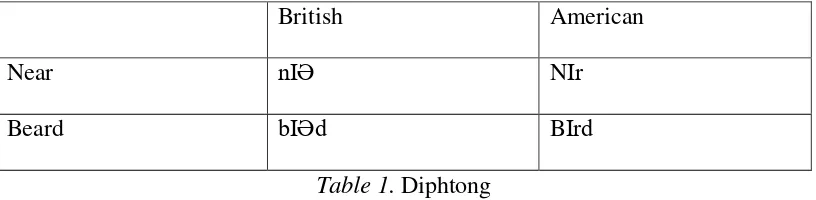
Second is diphthong, British English pronunciation has 3 diphthongs
ending in /Ə/, /ҙƏ/, /eƏ/, /ƱƏ, as in here, there, poor. American English has no
separate phonemic diphthongs which end in /Ə/. The vowels in the above three
words are pronounced as sequences of ҙ+ r, e + r, and Ʊ+ r, respectively. For
example:
British American
Near nҙƏ Nҙr
Beard bҙƏd Bҙrd
Table 1. Diphtong
individual words and across word boundaries, /t/ is pronounced as a quick tap and is accompanied by voicing, so that is sounds almost like a /d/. The symbol most frequently used in pronunciation dictionaries to show a voiced /t/ is /ṱ/, for example,
British American
City śҙti śҙṱi
Writer ŕaҙtƏ ŕaҙțƏr
Table 2. Consonant /t/
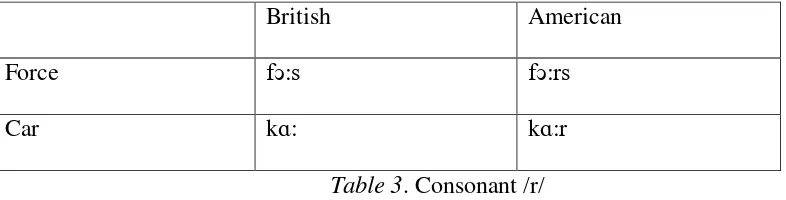
Besides that, probably the most important different between the consonant of two accents is in distribution of /r/. In American English, the /r/ is pronounce more clear that in British English, for example,
British American
Force fͻ:s fͻ:rs
Car k : k :r
Table 3. Consonant /r/
Other differences. This differences like the number of suffixes the vowels in which are pronounced differently in the accents such as the –ile suffix in hostile, fragile, futile, etc. (pronounced /-aҙl/ in British English) to have a weak
vowel or a syllabic consonant and to be pronounced /Əl/ or /ļ/ in American
English. For Example:
British American
Fragile ḟræʤaҙl ḟræʤļ
Hostile ḣ staҙl ḣ :stļ
Thus, the varieties between British English and American English pronunciation makes them had their own supporter especially for learners who wish to acquire native-like pronunciation.
Outer circle. Outer circle is “the countries where English is an
institutionalized variety, that is, is used as an official language” (Kachru, Kachru and Nelson, 2006 p.161). The countries that belong in this category are the counties that former British colonies such as Malaysia, Singapore, India and South Africa (Kachru, Kachru and Nelson, 2006). The outer circle countries used English as their second language (Jenkins,2009). They speaks English by
following their own native norm. This case created the new English likes
Singaporean English and Fijian English (Higgins, 2003). In this part, Singaporean English and Indian English will be the example to recognize the typical of outer circle of English.
Singlish. Singaporean English or commonly called Singlish is an English
speakers” (Lim, 2011, p.2). This multilingual speakers in Singapore has contribution in the development of Singapore English variety.
Moreover, Singapore citizens consists of three ethnics group; Chinese, Malay, Indian, respectively (Leimgruber, 2011) which means there are three others language that they use besides English; Mandarin, Tamil and Malay. In the evolution of English in Singapore we have to recognize the influence from the others language (Lim, 2011). This is clearly shown in the way they used some
article while they spoke. According to Lim (2011), “the earlier particles lah, ah
and what, the larger set of Singlish particles, namely hor, leh, lor, ma and meh, have their origins in Cantonese, and were acquired in Singlish in a later era.” (p.6).
Besides that, there is distinctive feature of Singlish pronunciation that
called “staccato effect”. According to Brown (1988),
“Singaporeans speaking English create this effect in a number of ways. One
way is through not distinguishing long vowel sounds like /i:/ from / ҙ/, /u:/
from /Ʊ/ and /a:/ from /Ʌ/. Thus words like seat, fool and mask sound the
same as sit, full and musk. The diphthongs like /eҙ/, /əƱ/ also become shortened and sounds like /e/, and / / ; so mate and shown sound like met and shone.” (p.115)
powerful tool for expression of national identity. After all, “if the official
languages Mandarin, Tamil, Malay, and English all also ‘belong’ to other
countries, Singlish is indeed uniquely Singaporean” (Leimgruber, 2011,p.17)
Indian English. India like the others outer circle countries, got English by
the British colonialism since 1579. English spread in India citizen by the
translator for Christian missionaries and British trades. India officially has 1,652 mother tongue language (Mehrotra, 1998) but the governments has decided three national languages in India such as English, Hindi and Tamil.
However, some Indians have protested against English as national
language because this language describing ‘a sign of slavery’ that remind them of the Britain colonialism. One of the main reason of choosing English because English can be the lingua franca amongst the different cultural and linguistic country, so do as the international language that help them to have access outsides their country (Gramley and Patzold, 2004).
According to Bhatt (2004), there are three common features of Indian English. First is the placement of stress words where it often falls on the second last syllable of the word in contrast to the stress pattern in standard English e.g British English, for example pronounce /'refer/ rather than /re'fer/ and pronounce /pro'testant/ rather than /'protestant/. Second is the sound /t/ and /d/ to replace
dental fricative sound / / and /Ι/, for example /think/ becomes /tink/ and /that/
sound likes /dat/. The last is the initial consonant in beginning of words that difficult for some speakers so they have to put vowel in the front of the consonant,
Expanding circle. According to Kachru, Kachru and Nelson, (2006 p.161)
“expanding circle consist of countries where English is used as a performance
variety, that is, foreign language”. This means, in this model English language is
just “a ‘performance’ language without any official status and therefore dependent
on the standards set by native speakers in the inner circle” (Jenkins, 2009 p.14). In
this sub, Indonesia take a part as the example countries of expanding circle. Indonesian English. Different with Singapore, English in Indonesia is not
as a nation language or second language. English in Indonesia take place as foreign language that used only for certain occasion. Though, the existence of English in Indonesia take an essential place. This is supported by Simatupang (1994) in Lauder (2008), English in Indonesia has no wide use in society, English language is not used as an official language for communication such as
government, the law courts, and the education system. English in Indonesia is not has any special status in the country’s language legislation, but it is still seen as a priority as the most important of the foreign languages to be taught. Because of this reason, we cannot identify the characteristic of English that used in Indonesia.
Lauder (2008) also mentions the English sounds that is produced by Indonesian is cannot be claim as the existence of an Indonesian variety of English like countries of the Outer Circle such as India or Singapore. The type of
learning and speaking English mostly Indonesian used the native speaker as the
speaking model. “Certainly, until now, it has been generally assumed that the
variety of English which is to be taught or learned is either British or American
English, both “inner circle” varieties.” (Lauder, 2008, p.15).
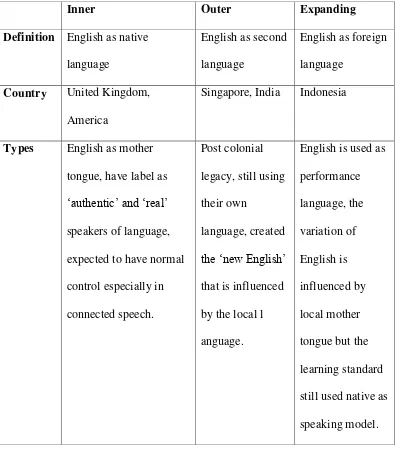
[image:33.595.110.505.305.754.2]Therefore, each circle of English has their own characteristics, especially in speaking that becomes their feature. Thus the researcher place each of them in table so it expect to be easier to understand.
Inner Outer Expanding
Definition English as native language
English as second language
English as foreign language
Country United Kingdom, America
Singapore, India Indonesia
Types English as mother tongue, have label as
‘authentic’ and ‘real’
speakers of language, expected to have normal control especially in connected speech.
Post colonial legacy, still using their own
language, created
the ‘new English’
that is influenced by the local l anguage.
English is used as performance language, the variation of English is influenced by local mother tongue but the learning standard still used native as speaking model.
Native and non-native speaker. The most common English sounds are distinguished into English as native and English as non-native. Before going further into the native sounds like and non-native sounds like, it is essential to understand the terms of native and non-native speaker.
Definition of native speaker. Cook (1999) defines native speaker as a person who just and still speaks the language they learnt since the childhood. Based on the Longman Dictionary, native speaker is someone who has learned a particular language as their first language, rather than as a foreign language. Moreover according to McArthur (1987) in Pung (2009) the place where English is used as the main language or used by the native speakers is called as the inner circle.
Native sounds like. In English speaking, mostly English speakers expect to sounds like the English native speakers. According to Shakouri and Shakouri
(2014)”Many teachers and learners today still prefer a native speaker model”
(p.223). They prefer to have native-like pronunciation when speaking English. However to pronounce like native speakers is not easy especially for EFL learner or non-native speakers. It is because there are some different backgrounds that distinguish their original pronunciation such as phonetic symbols and rules, articulation of individual sounds and the distinctive features of sounds like voice and aspiration, and voice-setting features (Zhang, 2009).
the reality and myth. The characteristic of the native speaker as the reality are. First, the native speakers are relied on to know what the score is, how things are done, because they carry the tradition, is the repository of “the language”. Second, the native speaker is also expected to exhibit normal control especially in fluent speech (though not of course in writing), and to have knowledge of characteristic strategies of performance and communication. Then, native speakers are also
“expected to “know” another native speaker, in part because of an intuitive feel,
like for like, but also in part because of a characteristic systematic set of indicators, linguistic, pragmatic and paralinguistic, as well as an assumption of
shared cultural knowledge” (p.207).
Instead of pronouncing the words to be sound like the native, the most important goal of speaking is to speak the language correctly and appropriately in order to be able to be understood by the people we are speaking to (Efrizal, 2012)
. Instead, not all native speakers’ speaking is able to be understood. Higgins
(2003) proposes that not all natives speaker have a good pronunciation. Moreover, he also lists down some spelling mistake done by the people who thought as the idealized native speaker model of pronunciation. Those spelling mistake likes critisise (criticism), now way (no way), sence (sense), trough (through), universitys, and others.
Definition of non-native speaker. Cook (2007) defines the non-native speakers as people who know and use a second language at any level.
Additionally, non-native speaker is the one who has not spoken it from the time they first learnt to talk (Oxford Dictionary, 2016).
Though, the proficiency between the native and non-native English toward the English language is still debatable. English native speaker is considered to fully-understand their mother tongue rather than the non-native speaker
(Medgyes, 1992). It is supported by Selinker (1972) in Medgyes (1992) who state that if someone born and grows up in an English-speaking surroundings, she or he would be likely to be a more-proficient user of English than if born and grows up in a non-English-speaking country. Hence, native speakers are possibly more proficient users of English than non- native speakers.
“However, it can be claimed that being a native speaker is no guarantee for
-native speakers are thought to be better than the -native speakers in terms of accuracy. It is because the non-native English speakers learn English and become more aware on what they learn, different from the native speakers who have used English since their first-speaking. They will use English fluently but might unconsciously do some mistakes without knowing what mistakes they made. Nayar (1994) states native speakers are not "ipso facto knowledgeable, correct, and infallible in their competence"(p.4). Additionally, in terms of teaching and learning process, Medgyes (1992) argues that non-native speakers have better abilities when teaching students a second language, because they are able to teach learning strategies more effectively to the non-native speakers students such as provide learners with more information about the second language, anticipate
students’ needs and difficulties when learning the second language, be more
concerned to the needs and problems of their students, and of course share the
students’ mother tongue when necessary and in order to achieve a greater
experience and understanding when teaching learning the language.
Non-native speaker sounds like. Unlike native speaker, the non-native speaker sounds like had many version of pronunciation. This is occur because of their first language interference. According to Jahan (2011) in Lin (2014), “sound
patterns of learners’ first language are likely to influence their pronunciation in
target languages.” (p.17). Besides of the influence of first language, the different
influenced by not only their language background but also their role model in speaking the second language.
In addition, Lin (2014) also mention “language is integral to both culture and identity, an understanding of language variation and language diversity is critical to multicultural education”(p. 17). It means, understanding pronunciation variations can help us to be aware of non-native accent diversity.
Therefore, to understand the non-native sounds feature we have to
recognize the essential of language that should “well enough to understood”
(jesry, 2005) and known that the great pronunciation competence in English is able to make others understand easily; whereas, English pronunciation inferior to basic level increases the misunderstanding among conversations with others (Gilakjani, 2011).
Speakers’ accent. “Accent is the way you sound when you speak”
(Birner, 2003 p.2). According to (Green, 2019), accent is used by phoneticians to discuss pitch or stress, or orthographic to refer to specific diacritics. However, this term is used as a loosely defined reference to sets of distinctive differences over geographic or social space, most usually phonological and intonation features. There are two kinds of accent according to Green (2012); first language and second language.
one or more areas, for some people” (p.42). In the same way, everyone has several variants which are available to them and which is appear into their spoken
language. Usually people use geography as the first line of demarcation, but there are also socially bound clusters of features which are indicate where they come from.
Second language. This occur when someone use speaks one language
using some of the rule or sound of another one. “When native speaker of a
language other than English acquires English, accent is used to refer to the breakthrough of native language phonology into the target language (p.43). Therefore, we can say that an individual has a Singapore accent or a Tagalog accent, because the phonologies of those language influence the learners’ pronunciation of English. However, everyone has an accent, but it is only notice by people from different region with the speakers (Birner, 2003).
Role model in speaking English. In speaking English especially for non-native speakers, the existence of role model may considered as the influence of the way they speaking English (Marino,2011). In this context it is needed to understand the role model in speaking English perspective.
The definition of role model. Role model influences someone’s behavior. In Cambridge online dictionary, role model is a person who someone admires and whose behavior they try to copy. Additionally, according to Gauntlett (2008) role
model is “someone to look up to, and someone to base your character, values or
the person who become certain person’s inspiration to behave and act like him/
her.
The roles of role model in speaking English. In terms of speaking English, role model is the ideal criteria for the English speaker especially non-native speaker they are willing to sound like. According to Moussu (2006)
“teacher is a good model of language learner and/or speaker, which the students
wish to emulate” (p.49). The language role model is supposed to be a teacher, but we cannot close the possibility that others people becomes language role model such as; an anchor, actor, famous people or might be someone that we knows having capabilities to be role model in speaking English. According to
Walkinshaw and Oanh (2014) English speaking role model is considered as the standardized of the grammatical accuracy and pronunciation perfectness. Role model is mostly the person who has more capabilities in accuracy, fluency, flexibility, and conversational authenticity (Choskun, 2013). Furthermore,
indirectly, the role model could improve the speakers’ English proficiency (Will,
2015).
Related Study
There were some researches that discuss topic that related with this study. One of the researcher that conducted research based on the non-native perception
of English pronunciation is Sung (2013) entitled “I would like to sound like Heidi
Klum’: What do non-native speakers say about how they want to sound like?”.
The research aimed was to investigate the place of native and non-native speakers
as role model for learners’ acquisition of English pronunciation. To collect the
data, the researcher interviewed fifteen students in one-hour workshop of English pronunciation in University in Hong Kong. This research found out most of the students answered that indicated to sound more native like to their pronunciation, but those students did not necessary look up the native speakers as the speaking model. In other words, they did not determine the relationship between wonder to
speaks like native and have a native speaker for the speaker ‘model’.
Other researcher also discussed about speaking English for non-native speakers in role model’s case. Oga-Baldwin and Nakata (2013) entitled “Native vs non-native teachers: Who is the real model for Japanese elementary school
pupils?”. This article discussed about the differences of native and non-native
English teacher was an ideal model for learning behaviour, trought the fact that non-native teacher has similar background that should working hard to study English. In other side, the native English teacher was remaining as the linguistic model. In the end, the researchers pointed for the elementary students, the non-native teacher may have some positive impact on their English study.
In summary, the previous studies give the researcher many information about the English speaking role model for non-native learners. The first study discuss how the participants want to sound like and their role model in speaking English. The second study discuss on the influence of native and non-native teacher as role model for participants’ English study. Those previous research become the basic knowledge in conducting this research. In this research, the researcher try to combine the first and the second study, so this research expect to have discussion about how the participants want to sound like and how their role model influence them especially in speaking skill.
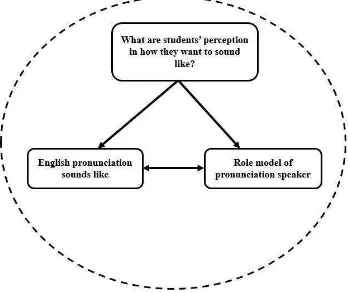
Conceptual Framework
The previous discussion has discussed some theories about the native and non-native speaker pronunciations as the role model in speaking English. The discussion that are discussed previously are the definition of English
pronunciation, English sound like, the definition of terms “native and non
-native speakers”, -native and non-native sound like, and role models in speaking
The fact about who are actually the ideal role models of English speaking is still vague. Mostly, people believe that the ideal role models of speaking English especially the pronunciation model are the native speakers. It is because they sound to be more proficient and fluent in speaking English. Some also argue that the non-native speakers’ pronunciations are able to be the ideal role model in English as they produce more understandable
pronunciation.
Chapter Three Methodology
This chapter discusses about the research methodology. The first part of this chapter discusses research design applied in this study. The second part is description of the research setting and participants. The other part explains data collection method and researcher reason for choosing the method. Data collection procedure is also described in this part. For the last part of this chapter, data analysis process is explained to complete the description of the research methodology.
Research Design
The purpose of this study was to find out what were the English Education
Department of Universitas Muhammadiyah Yogyakarta students’ perceptions on
how they wanted to sound like and which speakers do they prefer to be their role model. Therefore, the researcher made a consideration in conducting the research. The researcher considered that qualitative was an appropriate design for this research because the researcher wanted to dig out the information and explanation that related from the participants. According to (Creswell, 2012), qualitative research in one of method in conducting the research by an observation or
interview. In line with that, it is concerned with developing explanation for further information.
In the implementation of this research design, the research required an accurate action on each of the component in order to describe the subject. As the
and exploring the data, in short, making sense of data in terms of the participants’
definition of the situation, nothing patterns, themes, categories and regularities”
(Cohen, Manion, & Morrison, 2011, p.537). Hence, the data that researcher used is approaching the truth.
Under the qualitative research, this research applied descriptive qualitative. This research design was needed to describe the fact and the characteristic of subject were being researched. According to Moleong (2007,
p.72) “descriptive research is a study which purposed to describing phenomena,
activities, relationship, similarities, and differences with other phenomena”. For
this reason, qualitative descriptive was expected to be the best research design to collected data for this research.
Research Setting and Research Participant
The research was conducted in English Education Department of Universitas Muhammadiyah Yogyakarta. There are two reasons in chose the English Education Department of Universitas Muhammadiyah Yogyakarta to be the setting of this research. First, there was no previous research about students’ perception on how they wanted to sound like in English Education Department of Universitas Muhammadiyah Yogyakarta. This reason made the researcher
The participants of this research were selected based on their batch. The researcher chose students at batch 2016. There were two reasons the researcher chose participants from this batch. First, they were the youngest batch in English Education Department of Universitas Muhammadiyah Yogyakarta which was expected to still have their own perception and expectation in speaking English to be like. Second, their pronunciation could still be changing so their first
expectation and their pronunciation role model were needed for this research. The researcher chose four students as the representative of their batch. According to Creswell (2012) “the research select a sample representative of the population so that claims or interferences can be drawn from the sample for the population” (p.381).
The researcher took four students as the participants based on Creswell
(2012) in Karlina (2015) who stated, “descriptive qualitative might use small
classes. Participant one called P1 came from class A, participant two called P2 from class B, participant three called P3 from class B and participant four called P4 came from class C.
Data Collection Method
For this study, the researcher used semi-structured interviews as technique of collecting data. The researcher used this type of interview because it required more focus on question that researcher asks, but it still permits the interviewer to explore their answer so the researcher knew deeply about the topic. According to
Harrel and Bradley (2009) “semi-structured interviews are often used when the
researcher wants to explore deeply into a topic and to understand thoroughly into
the answers provided” (p.27).
Besides that, the researcher employed one-on-one interview as the type of interview. One-on-one interview meant the researcher and the interviewer meet face-to-face for the interview. So the interviewer answered the questions without hesitant because they just face the researcher as the interviewer. According to Creswell (2012), the ideal participants for interview are those hesitant to speak, speak well and who can share the idea comfortably.
In the interview process there was no limitation time. This meant when the questions that researcher asked were done, the interview was ended. Hence, if the interviewee already answer all of the questions and the researcher got the
information that researcher need, the process of data collecting was finished. While interview process, the researcher used the researcher used mobile phone as the recorder tool and Bahasa Indonesia as the working language. The aim in using Bahasa Indonesia was to make the communication between researcher and the interviewer easier. This was related with Byrne and Michelle (2001) argument that the researcher must master communication skill. The researcher should speak fluently and easy to understand, so the interviewers can understand what the researcher means. Therefore, the answer which interviewers give is not confusing and the researcher get the requirement information.
Data Analysis
After collecting the data from interview, the next step was examining the data. There were several steps in data analyzing for this research. First was transcribing the data from recorded interview to written text, then checking the data. In regard to data validity, the researcher conducted member checking. This step was helpful to validate the data. After that the researcher analyzed the data used thematic analysis started with open coding. Open coding was the process
conducted after transcribing. According to Lu (2008), “open coding is the process
selective coding. According to Strauss and Curbin (1990) in Cohen and Crabtree
(2006) “selective coding is the process of selecting the core category,
systematically relating to the other categories, validating those relationships and
filling in categories that need further refinement and development” (p.1). So in
Chapter Four Findings and Discussion
This chapter presents the finding and discussion of the research about The English Education Department of Universitas Muhammadiyah Yogyakarta
students’ perception on how they want to sound like. There are two major findings
revealed from this study to answer the research questions. First is finding about what kinds of English pronunciation The English Education Department of Universitas Muhammadiyah Yogyakarta students want to sound like. Second one is finding the speakers they prefer to be as role model for their English
pronunciation.
The Kinds of English pronunciation the Students of English Education Department of Universitas Muhammadiyah Yogyakarta Want to Sound Like.
In the beginning of the interview, the researcher asked the participants about the factors of good English language usage and the factors in speaking English so it can be called as a good English speaking. This question was introducing part that became bridge to lead the researcher found out the second findings which were related to students’ opinion on they want to sounds like.
Pronunciation. All participants mentioned the English pronunciation as the factors of this category. The clear and well pronunciation so the interlocutor will get the point of the conversation. This statement was supported by Gilakjani (2012) that stated clear pronunciation and word stress in need to make sure that student can understood and said what they want to say. “They need to master good
pronunciation not perfect accent” (Gilakjani, 2012, p.121) Here were the samples
of participants’ statements, as stated by participants:
(P.1.3) “Pronounce”.
(P.2.1) “the pronunciation, then the way they learn reading, writing, then
how the application in their daily life”.
(P.2.2) “the pronunciation then understand how to write grammatically”.
(P.2.4) “of course the pronunciation, clearly, not twist in and out”.
(P.3.2) “we demand to be a good speaker that know to pronounce well and
how to use grammar correctly”.
Understandability. This was mention by two participants. This result was supported by Efrizal (2012) that the most important goal of speaking was to speak the language correctly in order to be able to be understood by the people we are speaking to. It was proved by the statements coming from the P1 and four who stated that:
(P.1.2) “The point was understandable, it did not matter if grammatical
error was happened as long as he got the point, understand, he could
(P.4.2) “the point was understandable, although the grammatically error, the point is people understand what we talk about. It’s enough”.
Grammar. The grammar aspect was mentioned by three participants. They believed that besides the good pronunciation, grammar was being inseparable aspect of good English. This statement was supported by Subasimi and Kokilavani (2013), using the correct grammar was important to avoid misunderstandings and to help the listener to understand the speakers easily. These were the sample of participants’ statement:
(P.3.1) “The good English was the English that was having grammar”.
(P.3.2) “we demanded to be a good speaker that knew to pronounce well
and to use grammar correctly”.
(P.4.1) “The good English was English language that was having attention
in grammar. Speaking fluently and grammatically correct”.
(P.2.2) “The pronunciation then understand how to write grammatically”
(P.3.3)”Grammar”.
Expression. The right expression while speaking English was becoming one of the factors according to P2. Here the statement of the participant: (P.2.3)
“learning English language with expression while they speaks”. According to
Bachorowski (1999) the expression in speech was needed because from the
speakers’ expression the listeners were able to accurately judge emotions and the
purpose of the speech.
Vocabularies. The last element of good English was mention by the P3.
(P.3.5) “Mastering vocabularies too”. Vocabularies were an essential part in
foreign language learning as the meanings of new words that they learn. Therefore the P3 believed mastering vocabularies as the part of good English language. This result was supported by Cameron in Alqahtani (2015), who stated “vocabulary, as one of the knowledge areas in language played a great role for learners in
acquiring a language” (p.22).
Finding 2: The English language preference to sound like. There were two main answer that researcher got from the all participants. There were three participants which were P1, P2, and P3 who directly stated their language preferences in speaking English, while the other one, P4 answer researcher’s question about how she wanted to sound like without mention any specific accent.
Sound like British English. This statement was found out from P1, P2 and P3. This statement was supported by Al-Asmari and Khan (2014) gaining
used as English accent model for non-native speakers. This was supported by Shakouri and Shakouri (2014), they stated “many teachers and learners today still
prefer a native speaker model” (p.223). Thus, this finding was also supported by
Jenkins (2009) that stated English for expanding circle country such as Indonesia used English as performance language that used native speakers in inner circle as their English standard,. Here the three participants statements: (P.1.5) “British”, (P.2.15) “British”, (P.3.11) “British, because it feel more English, American a
little bit rude”.
Sound like native but without specific accent. This statement was come from the P4. She did not mention any specific country or accent. (P.4.3) “as fluently as I can. Like the foreigner”. This statement assumed that the P4 language preferences was ‘the foreigner’ that direct to native speakers of English. This assumption was based on P4 answer that mentioned American singer as the sample of foreigner that she said before, (P.4.4) “For the foreigner I loved Taylor
Swift”. This statement supported by Chomsky (1965) in Butler (2007, p.8) that
stated “native speakers, namely, an “ideal speaker-listener, in a completely
homogeneous speech community, who knows it language perfectly”.
In summary, there were six factors that take apart of good English language according to the data, such as pronunciation, the understandable
language, grammar, fluent, vocabularies and expression. The good English usage
became opening question that led the researcher to know the participants’
Universitas Muhammadiyah Yogyakarta wanted to sound like, first was British English and second was sound like native but without any specific accent.
The Role Models That Students of English Education Department of Universitas Muhammadiyah Yogyakarta Prefer.
The second purpose of this study was to find out the participants role model in speaking English. This part was divided into two main finding. The first was finding about the media that participants used in learning English. This part became opening question directed to respondents’ hobbies and habits in learning English related to their role model in speaking English. The second was finding the participants’ role model in speaking English and the motivation of choosing the role model.
Finding 1: Learning English media. In this finding the researcher tried to know the participants’ ways in learning English especially in speaking. From this media, the researcher also knew the person or the title that they used in learning English. This finding was expected to answer the language preference that participants want to sound like. There were three media mentioned by the participants.
YouTube. According to Seitz, Milroy, Orsini, Wyrick, Herring and Koech (2011), YouTube was a website which allowed the members to post videos for people to watch and also post comments to the video via online. This statement came from three participants. Here were the three participants’ statements:
(P.2.6) “watching YouTube channels that used English language”.
(P.4.7) “watching YouTube”.
From this media, the researcher found out some YouTuber name and channel that become sources of learning English by the participants such as Zoella and Alfie, Britain YouTuber and Cold in Cool an American YouTuber that
mentioned by the P1, The Kadarshians, American reality show in YouTube Channel that mentioned by P2, Fatia Izzati and Wirda Mansyur, Indonesian YouTuber that mentioned by P4. This stated is indicated from the three participant:
(P.1.6) “I love to watch YouTuber named Zoella”.
(P.1.7) “Her boyfriend Alfie with initial name Pointless Blog”.
(P.1.8) “I also like American YouTuber Cold is cool”.
(P.2.7) “Kim Kadarshian”.
(P.4.4) “but I like an Indonesian YouTuber, her name is Fatia Izzati”.
(P.4.8) “Fatia Izzati and one more, Wirda Mansyur, ustadz Yusuf Mansyur
daughter, she is also a YouTuber”.
Also, this media was used by the participants to practice their English by seen how the YouTuber speaks English. This was stated by P1 (P.1.17) “because it visual, then they spoke by using the accent and I could see how they pronounce
it”. This statement supported by Cruse (2006) explain that viewing, while it may
Movie. This media was mentioned by P2 and three. (P.2.8) “listening music and watching movie that use English”. (P.3.7) “It could be movie, listening music, but I prefer to movie”. Movie that the participants used were kind of movies that they used to learning English such as (P.2.13) “Harry Potter” that
mention by the P2 and (P.3.8) “Princess Diaries” that mentioned by P3. The P3
also added movie was ‘having expression’ which mentioned in (P.3.10) “how they spoke, it was like to the point, then it was having expression”. Besides that, the reason of choosing movie could be the same way of YouTube, because the media was visual.
Song. This learning media was indicated from three participants. According to Mishan (2005), songs have some benefits for the learners and therefore attest more productive in terms of discussion, analysis and others. Here the statements of the participants:
(P.1.18) “a lot of (song) but I loved most Over Again”.
(P.2.8) “listening music (song) and watching movie that used English”.
(P.2.10) “she (Adele) has karaoke video in YouTube, so there are a
conversation and song too”.
(P.3.7) “It could be movie, listening music (song), but I prefer to movie”.
The participant also mentioned the singer and the song that they like to be their
learning speaking sources, such as (P.1.10) “My inspiration was my Idol One
Direction”, (P.1.18) “a lot of (song) but I loved most Over Again” from P1,
(P.2.9) “Adele” with (P.2.11) “All I ask, Hello” song from P2, and (P.4.3)
Moreover, the participants supported their media learning by some statement such as the song beat was slow, so the participant could figure out the words that singer said. The other reason was the singer singing the song with clear pronunciation so the participant could understand what the singer delivered. These were statements coming from participants:
(P.1.19) “it was not that beat, it was slow, so it was calm and easy to
understand”.
(P.2.12) “the English language in that songs were to the point, it was not
twist in and out, the meaning was easy to understand and they had clear
pronunciation”.
Finding 2: Role model of speaking English and the motivation of choosing the role model. According to Gauntlett (2008, p.1) role model was
“someone to look up to, and someone to base your character, values or aspirations
upon”. In this finding the researcher found that there were four category that
became role model of their English, first was YouTuber, second was Singer, third was teacher, and last was friend.
First role model was YouTuber. This answer is came from P1 and P4 participants. The two participants’ statement are:
(P.1.6) “I loved to watch YouTuber named Zoella”.
(P.1.7) “Her boyfriend Alfie with initial name Pointless Blog”.
(P.4.4) “but I like an Indonesian YouTuber, her name is Fatia Izzati”.
(P.4.8) “Fatia Izzati and one more, Wirda Mansyur, ustadz Yusuf Mansyur
daughter, she is also a YouTuber”.
Those statement previously mentioned in finding 3 of what kinds of English pronunciation The English Education Department of Universitas Muhammadiyah Yogyakarta students wanted to sound like. Both finding had a line that the media that participants used to learning English was affected the participants’ role model in learning.
On choosing the role model, the participants had several reasons. The P1 said she love to watch it because it helped her in practicing English (P.1.17)
“because it was visual, then they spoke using the accent and I could see how they
pronounce it”. The P2 choose Fatia Izzati and Wirda Mansyur as the role model
because they were Indonesian but they could speak English fluently as good as native, those people inspired her in learning English more. She mentioned that:
(P.4.6) “She was Indonesian but all her YouTube channel spoke English,
and she was so fluently”.
(P.4.9) “Wirda because she said that she totally could not speak English,
but now she is so fluently. She said because she always study, reading
books and watching movies”.
(P.4.10) “just like Wirda, they were don’t understand English but then they
Second role model was singer. This finding came from the P1 and P4. The P1 stated that One Direction, boy group from Britain were her role model in
speaking English (P.1.10) “My inspiration is my Idol One Direction”. The
motivation of choosing the role model because they lived in Britain and spoke British, she thought that was relevant with her English preference to sound like,
(P.1.11) “One D speaks British too, so it is fit”. Besides that, she also mentioned that their sing songs were easy to understand (P.1.19) “it was not that beat, it was slow, so it was calm and easy to understand”. The P2 mention (P.4.3) “Taylor
Swift” as her singer role model. She mentioned Taylor Swift as the sample of
foreigner that fluently in English (P.4.4) “If foreigner I loved Taylor Swift”.
Third role model was teacher. This finding was mentioned by P2. She mentioned that the role model of her English speaking was her private English course teacher, Mr. Joe. The teacher was Indonesian who worked as English private teacher in Tanjung Pinang, Riau. (P.2.17) “private course teacher, Mr.
Joe”. This statement was supported by Moussu (2006, p.49) “teacher is a good
model of language learner and/or speaker, which the students wish to emulate”. In
choosing the role model, P2 had several reasons such as the teacher was having many experiences, he also had good pronunciation, sound like native and had interesting method in teaching English. The participants’ answer reflected the finding:
(P.2.19) “he taught us like friends talking but with correct English, so it was diverting”.
Last role model was friend. This last finding came from the third participant. She said that her friend became her role model in speaking English.
(P.3.12) “I had a friend name Tani”. She mentioned the motivation of choosing
Tani is role model because she speaks English fluently and helps P3 in improving her English. This was suitable with expert statement in choosing role model that
the role model could improve the speakers’ English proficiency (Will, 2015). Here
the P3 statements:
(P.3.13) “But when she talked everybody like wow, so fluently”.
(P.3.14) “The way she talked and writes something is like the real
journalist”.
To sum up, all of the participants had role model for their speaking English which are YouTubers, singers, teacher and participant’s friend. Those
answers also indicated the role model’s name and origin. From the answers, we
effectively to the non-native speakers students such as provide learners with more
information about the second language, anticipate students’ needs and difficulties
when learning the second language, be more concerned to the needs and problems
of their students, and of course share the students’ mother tongue when necessary
and in order to achieve a greater experience and understanding when teaching learning the language.
Chapter Five
Conclusion and Recommendation
This chapter consists of two major parts namely conclusions and recommendations. First, the researcher summarizes the findings of this study. While, in the second section the researcher proposed some suggestions after conducting this study.
Conclusion
This research aimed at exploring the English Education Department of
Universitas Muhammadiyah Yogyakarta students’ perception on how they wanted
to sound like. The perceptions being investigated in this resear