i
ZEALOUS ANDROID’S SOPHISTICATED TIMETABLE REMINDER AND ORGANIZER (ZASTRO) SYSTEM
HANIS HAZIQAH BINTI MAZHARUDIN
ii
ZEALOUS ANDROID’S SOPHISTICATED TIMETABLE REMINDER AND ORGANIZER (ZASTRO) SYSTEM
HANIS HAZIQAH BINTI MAZHARUDIN
A thesis submitted in partial fulfillment of the requirements for the award of the degree of Bachelor of Electronic Engineering (Computer Engineering)
Faculty of Electronic and Computer Engineering Universiti Teknikal Malaysia Melaka (UTeM)
UNIVERSTI TEKNIKAL MALAYSIA MELAKA
FAKULTI KEJURUTERAAN ELEKTRONIK DAN KEJURUTERAAN KOMPUTER
BORANG PENGESAHAN STATUS LAPORAN PROJEK SARJANA MUDA II
mengaku membenarkan Laporan Projek Sarjana Muda ini disimpan di Perpustakaan dengan syarat-syarat kegunaan seperti berikut:
1. Laporan adalah hakmilik Universiti Teknikal Malaysia Melaka.
2. Perpustakaan dibenarkan membuat salinan untuk tujuan pengajian sahaja.
3. Perpustakaan dibenarkan membuat salinan laporan ini sebagai bahan pertukaran antara institusi
pengajian tinggi.
4. Sila tandakan ( √ ) :
SULIT* *(Mengandungi maklumat yang berdarjah keselamatan atau kepentingan Malaysia seperti yang termaktub di dalam AKTA RAHSIA RASMI 1972)
TERHAD** **(Mengandungi maklumat terhad yang telah ditentukan oleh
organisasi/badan di mana penyelidikan dijalankan)
TIDAK TERHAD
Disahkan oleh:
__________________________ ___________________________________ (TANDATANGAN PENULIS) (COP DAN TANDATANGAN PENYELIA)
Tarikh: ……….. Tarikh: ……….. HANIS HAZIQAH BINTI MAZHARUDIN
ZEALOUS ANDROID’S SOPHISTICATED TIMETABLE REMINDER AND ORGANIZER (ZASTRO) SYSTEM
√
160 SURA GATE, 23000 DUNGUN, TERENGGANU.
iv
I declare that this thesis entitled “Zealous Android’s Sophisticated Timetable Reminder and Organizer (ZASTRO) System” is the result of my own original writing except the quotation and summaries that cited
clearly in the references
Signature : ………
v
“I hereby declare that I have read this thesis and in my opinion this thesis is sufficient in terms of scope and quality for the award of the degree of Bachelor of
Electronic Engineering (Computer Engineering)”
vi
To my beloved parents, family, and friends, and those who have encouraged me
throughout my journey of education.
vii
ACKNOWLEDGEMENT
Alhamdulillah, thank you to Allah S.W.T because of His blessing, I finally complete and finish my Final Year Project successfully.
I would like to express my sincere gratitude and respect towards my project supervisor, Engr. Khairul Muzzammil Saipullah for his kind encouragement and suggestions. Without his continued support and interest, the project would not be like what it likes today.
During the process to complete my project objective, I do a lot of research, either by using internet, reading past year thesis, reference books or journals. With the guidance and support from peoples around me, I finally complete the project due to the time given. Here, I want to give credit to those who helped me to achieve what I had achieved in my Final Year Project.
I also want to thanks my beloved parents because without them, I will not be able to do well in my Final Year Project. They did give me a lot of support, to help me continue for what I had started on.
viii
ABSTRACT
ix
ABSTRAK
x
CONTENTS
ACKNOWLEDGEMENT ... vii
ABSTRACT ... viii
1.2 Problem Statement... 2
1.3 Objectives ... 4
1.4 Scope of Work ... 4
1.5 Thesis Outline ... 5
CHAPTER 2 ... 7
LITERATURE REVIEW ... 7
2.1 Introduction ... 7
2.2 Overview of Android ... 7
2.3 Overview of Android Emulator ... 11
2.4 Eclipse ... 13
2.5 Development of Android application ... 15
2.6 Existing application ... 18
CHAPTER 3 ... 22
METHODOLOGY ... 22
xi
3.2 Project Overview ... 24
3.3 Process of Android Application Development ... 25
3.4 Web based System Development ... 28
3.5 Integration through Database and Networking ... 30
3.6 Testing and Debugging ... 31
3.7 Overall Project Flow... 31
CHAPTER 4 ... 33
RESULTS AND DISCUSSION ... 33
4.1 Introduction ... 33
4.2 The Android Application ... 33
4.3 Administrator Web-Based System ... 42
4.4 Overall Development... 47
CHAPTER 5 ... 48
CONCLUSIONS AND FUTURE WORK ... 48
xii
xiii
LIST OF FIGURES
Figure 1: Sample of student's timetable taken as pictures from the notice board .. 3
Figure 2: Existed system in SMP that is not functioning ... 3
Figure 3: Communication and integration of the system ... 5
Figure 4: Android Architecture ... 9
Figure 5: Screenshot of Android Emulator's Interface ... 12
Figure 6: Screenshot of Android Emulator Menu Screen and Navigation keys .. 12
Figure 7: The environment of Java Eclipse ... 13
Figure 8: Java Eclipse Debugging Perspectives ... 14
Figure 9: Java Eclipse Programming Perspective ... 15
Figure 10: The screenshot of A+ Timetable - Week Overview ... 19
Figure 11: The screenshot of A+ Timetable – Tab days view ... 19
Figure 12: The screenshot of My Class Schedule ... 20
Figure 13: The screenshot of iStudiezPro ... 21
Figure 14: Flowchart of the system for administrator and students ... 24
Figure 15: Illustration of overall Android application development ... 25
Figure 16: Setup domain name ... 29
Figure 17: Flow Chart of Overall Methodology ... 32
Figure 18: Application icon ... 34
Figure 19: Welcome Screen and Menu Screen ... 35
Figure 20: Options of days and the example of timetable display. ... 36
Figure 21: Features of Zastro System ... 37
Figure 22: Functions in To-Do-List ... 38
xiv
Figure 24: Notification Alert ... 39
Figure 25: Functions of class reminder ... 40
Figure 26: The screenshot for developer credential ... 41
Figure 27: Account Information of Zastro System's Web ... 42
Figure 28: XML Files uploaded into 000webhost.com ... 43
Figure 29: Editing Thursday file. ... 44
Figure 30: Android timetable Interface ... 45
1
CHAPTER 1
INTRODUCTION
This project is discussing about the development of Android Application and web-based system. Both is depended on open source software and open source development environment. The background of the project is thoroughly elaborated. This chapter also outlined on the objectives and scope of the project.
1.1 Background
In the last decades, world had witnessed an enormous increased in the acceptance of mobile communication all around the world. The usage of mobile communication had become one of the most important devices that merged to every angle of human’s life. They are used not only for communication, but also to help people manage or organize everything.
Looking into this last few years, Android Operating System had rapidly increased in the use of platform for various devices, especially mobile phone. Since the first release of entering the mobile space until today, Android is going through a very fast development and giving no sign of slowing down.
2
and the virtual machine that optimizes the usage of memory and resources [1]. This project is about the development of Android application and web-based system that is based on an open source software and open source development environment.
The aim is to provide students a sophisticated tool in managing their timetable easily through mobile phone. Zealous Android’s Sophisticated Timetable Reminder & Organizer (ZASTRO) System, is an Android-based Application that will allow students to view their timetable easily and also set a reminder of the next coming class. Through this application, student will always have all useful information about their class, (subjects, time of classes, classroom) and keep themselves organize and ready for class.
The advantage of this system is it provides specific web based platform for administrator to upload the student’s timetable in a simple way. The ZASTRO System will repeal all the appropriate skills required for administrator to create a particular tool as a way in delivering timetable to students. This system will let the administrator to input details of the timetable in the most easy and fast way into the Android database. The implementation of this project will benefit both sides of users (student and administrator) in completing each other’s need.
1.2 Problem Statement
Nowadays, the phenomenon of student’s life which always full of dizzying mix of class and personal activities make students sometimes unorganized. They missed class, late to lecture or lab session, and mistakenly enter a wrong class. Some of the students are always depending on others to know which class to enter. Other than that, they also forget to submit assignment on the submission date and much more. All of this proves the messy management in a life of students.
3
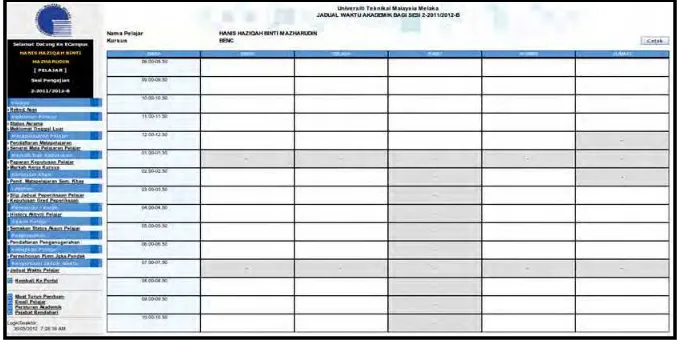
on the notice board. Later, students will copy the timetable by hand or by taking pictures. This method is very tedious, inefficient, and very classic to be used with today’s technology.
Figure 1: Sample of student's timetable taken as pictures from the notice board
Not only that, the existed system of SMP for students timetable in not well functioning. This can be interpreting as the difficulties in maintaining heavy system as in SMP, which allowed only dedicated administrator with expertise to maintain the system. As a result, it is left ignored.
Figure 2: Existed system in SMP that is not functioning
4
for administrator to easily deliver timetable for student’s needs without the requirement of skills and knowledge in maintaining system.
1.3 Objectives
The general and specific objectives of this project can be summarized as below: i. To develop an Android application which help students in organizing
timetable through mobile phone.
ii. To develop a platform that can be easily used by administrator in delivering student’s timetable.
iii. To integrate between Android device and application, with the web-based server for administrator use.
1.4 Scope of Work
This project consists of three parts, which is Android Application, web-based system, and integration of the whole system.
1.4.1 Android Application:
The Android Application is designed by using Eclipse SDK software. Throughout the development process, the application is tested on Android Emulator as the Android Virtual Device (AVD) and also ported to the real device to test the integration of application with the device. This application is connected with the server to retrieve the data of timetable.
1.4.2 Web-based system:
5
1.4.3 Communication and Integration
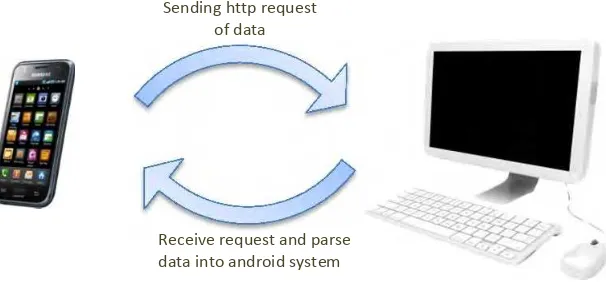
The integration of the whole system is implemented with server-client model. Android acts as the client that request and retrieve data from the server, while the web server will receive request and parse data into the Android application.
Figure 3: Communication and integration of the system
1.5 Thesis Outline
This thesis consists of five chapters. The first chapter discussed about the introduction of the project. This includes the background, problem statement, objectives of the projects, scopes of work, and thesis outline.
The second chapter contain the literature review, theories of related topics, and information about relevant structure for this project.
The process and methods employed in this project will be discussed in detail in Chapter 3, which is methodology. This chapter explain the flow of this project from the very beginning of the data collection until how the results is obtained.
The fourth chapter will discussed about the result and discussion. This is where the output of the project is presented and thoroughly analyzed. All the screenshot of the Android application is inserted along with the related explanation.
Receive request and parse data into android system
6
7
CHAPTER 2
LITERATURE REVIEW
2.1 Introduction
This chapter will explain about the overview and structured of Android, including its architecture, versions in Android Application, and Android Emulator. Also the explanations about few other importance parts in the project are thoroughly elaborated; that is Eclipse SDK Software, components in the development of Android application, and existing application with similarity to the project.
2.2 Overview of Android
Android is a software stack for mobile devices that includes an operating system, middleware and key applications. The Android SDK provides the tools and APIs necessary to begin developing applications on the Android platform using the Java programming language [2]. It has a set of API libraries for writing mobile applications that can shape the look, feel, and function of mobile phone.
Generally, the Android platform is a device-independent platform, which means that the application that was developed can be used for various devices. These devices are not just limited to phones, but also e-book readers, netbooks, and GPS devices. However, this thesis is specifically about the development of android application on mobile device.
8
mobile platform, the number of developed applications that are based on the Android operating system is increasing.
One of the reasons of increased interest into android development lies in the existence of free of charge and open source development environment, such as Eclipse, with rich toolset and a number of interacting possibilities [1]. In the other words, Android represents an exciting new opportunity to write innovative applications for mobile devices.
In fact, Android has a wide range of advantages. For example, it allows full multitasking, provides better interfaces with widgets and notifications and gives more freedom to user. Users can have their own personalized interfaces, choose carriers and install custom ROMs in their phones.
It is also well-equipped with mature Google and Social applications. Most importantly, Android applications are easy to develop and manage. This contributes to a rapid growth in the completely open Android application market. Because of these advantages, more mobile users are fascinated by the speed, freedom and diversity of services provided by Android mobile device. [3]
2.2.1 Android Architecture
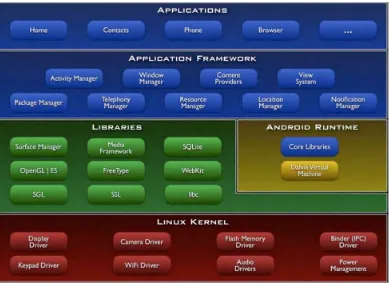
Android internal architecture is relies on Linux kernel version 2.6 for core system services such as security, memory management, process management, network stack, and driver model. The kernel also acts as an abstraction layer between the hardware and the rest of the software stack.
9
Figure 4: Android Architecture
The explanation of each section is as follows:
1. Applications: Android will ship with a set of core applications including an email client, SMS program, calendar, maps, browser, contacts, and others. All applications are written using the Java programming language.
2. Application Framework: By providing an open development platform, Android offers developers the ability to build extremely rich and innovative applications. Developers are free to take advantage of the device hardware, access location information, run background services, set alarms, add notifications to the status bar, and many more.
10
libraries as examples are SQLite, System C Library, media libraries, and free type.
4. Android Runtime: Android includes a set of core libraries that provides most of the functionality available in the core libraries of the Java programming language. Every Android application runs in its own process, with its own instance of the Dalvik virtual machine. Dalvik has been written so that a device can run multiple VMs efficiently.
2.2.2 Android Platform Version
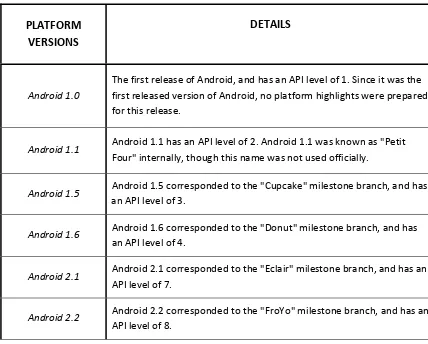
Android has been updated many times since it is released. These updates were to fix bugs and add new functionalities. Each Android update has a name of a dessert. Figure below are the feature overviews of the various Android platform versions:
PLATFORM
VERSIONS
DETAILS
Android 1.0
The first release of Android, and has an API level of 1. Since it was the
first released version of Android, no platform highlights were prepared