UTeM SECURITY MONITORING SYSTEM (UTeM SEMS)
Zainolizam Bin Musa
Bachelor of Electrical Engineering (Control, Instrumentation and Automation)
“ I hereby declare that I have read through this report entitle “UTeM Security Monitoring System (UTeM SEMS)” and found that it has comply the fulfillment for awarding the degree of Bachelor of Electrical Engineering (Control, Instrumentation and Automation)”
Signature : ………
Supervisor‟s Name : Mr. Ir. Norazhar Bin Abu Bakar
UTeM SECURITY MONITORING SYSTEM (UTeM SEMS)
ZAINOLIZAM BIN MUSA
A report submitted in partial fulfillment of the requirements for the degree of Bachelor Electrical Engineering (Control, Instrumentation and Automation)
Faculty of Electrical Engineering
UNIVERSITI TEKNIKAL MALAYSIA MELAKA
I declare that this report entitle “UTeM Security Monitoring System (UTeM SEMS)” is the result of my own research except as cited in the references. The report has not been accepted for any degree and is not concurrently submitted in candidature of any other degree.
Signature : ………..
Name : Zainolizam Bin Musa
ACKNOWLEDGEMENT
Firstly, I would like to convey my grateful to my supervisor, Mr. Ir. Norazhar Bin Abu Bakar who has given guidance and direction to complete this project.
Second, I also wish to send my gratitude to my colleagues especially my course mate that‟s always gave help, support opinion and share knowledge to teach me to complete this report.
In addition, I also wish to convey my sincere appreciation to my partner in my group who has spent much time together to help and teach me some solution and coding for image processing by using MATLAB software and on finishing this report. Their views and tips are useful indeed.
ABSTRACT
ABSTRAK
TABLE OF CONTENTS
CHAPTER TITLE PAGE
ACKNOWLEDGEMENT ... ii
ABSTRACT ... iii
ABSTRAK ... iv
TABLE OF CONTENTS ... v
LIST OF TABLES ... viii
LIST OF FIGURES ... ix
LIST OF APPENDICES ... xii
1 INTRODUCTION 1
1.1 Introduction ... 1
1.2 Problem Statement ... 2
1.3 Objective ... 3
1.4 Scope ... 3
2 LITERATURE REVIEW ... 4
2.1 Type of License Plate Number ... 4
2.2 Plate Recognition ... 6
2.3 Image Processing ... 7
2.3.2 Edge Detection ... 8
2.3.3 Threshold ... 9
2.4 Type of Method ... 9
2.4.1 Character segmentation ... 10
2.4.2 Hough Transform ... 10
2.4.3 Neural Network ... 11
3 METHODOLOGY ... 12
3.1 Introduction ... 12
3.2 Flow Chart ... 12
3.3 Hardware Requirement ... 15
3.4 Software Requirement ... 15
3.4.1 Familiarize with MATLAB software ... 15
3.4.2 Filtering process ... 16
3.4.3 Recognition Process ... 17
3.4.4 Developing MATLAB GUI ... 23
3.5 Experiment ... 25
3.6 Analyze ... 25
4 RESULT ... 26
4.1 Introduction ... 26
4.2 Result ... 26
4.2.1 Filtering Process ... 27
4.2.2 The result for plate recognition ... 41
5 ANALYSIS AND DISCUSSION ... 45
5.1 Analysis ... 45
6 CONCLUSION AND RECOMMENDATION ... 53
6.1 Conclusion ... 53
6.2 Recommendation ... 54
REFERENCES ... 55
LIST OF TABLES
TABLE TITLE PAGE
5.1 Data for Filtering Image 45
LIST OF FIGURES
FIGURE TITLE PAGE
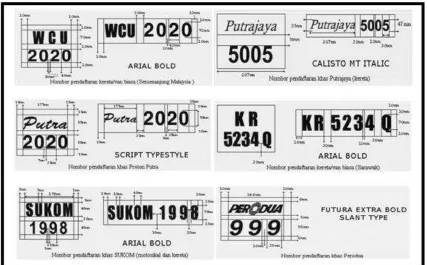
2.1 Standard size for plate number set by JPJ 5
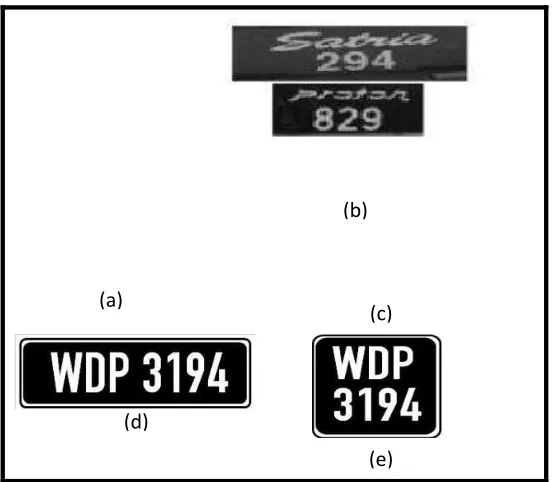
2.2 (a) Samples of common Malaysia license plates. (b) Samples of special Malaysia license plates. (c) Samples of taxi license plates.
(d) Horizontal license plate form
(e) Vertical license plate form. 6
2.3 Sobel masks for edge detection, (a) Vertical,
(b) Horizontal 9
3.1 Flow Chart of this project. 14
3.2 Interface of the MATLAB software 16
3.3 The flow for filtering process 17
3.4 Example of specific file for images of characters 18
3.5 The example for creating data with four example of each
numbers and alphabets. 19
3.6 Example of template file. 19
3.7 The example 20
3.8 Example of template file. 20
3.11 The example of algorithm to compare the output 22
3.12 Example of the GUI for this project 24
3.13 Example of data for driver details 25
4.1 Example coding to load and read image on MATLAB
Interface 27
4.2 The original Image 28
4.3 Example coding to resize and crop the image 29 4.4 (a) The original image; (b) The resized image 29
4.5 Image for the first time cropped 30
4.6 Image for the second time cropped 30
4.7 Example coding to adjust threshold for the image. 31
4.8 Image for adjust threshold 31
4.9 Example coding to filtering image for first time. 32 4.10 Output image for 1st filtering (step 1) 32 4.11 Output image for 1st filtering (step 2) 33 4.12 (a) and (b) are output images for first filtering (last step) 33 4.13 Example coding to gray scale the first filtered image. 34
4.14 (a) and (b) are the gray scale image 34
4.15 Example coding to change gray scale to binary image. 35
4.16 (a) and (b) are the binary image 35
4.17 Example coding to filtering image for second time. 36 4.18 Output image for remove large unwanted object around
plate number 36
4.22 Example coding to locate the coordinate of plate number 39 4.23 Output image from locate the coordinate of plate number 39 4.24 Example coding to crop each character on the plate number. 40 4.25 Output image for cropped each character 40
4.26 The flow for recognition process 42
4.27 The GUI shows the match plate number with driver details
in database. 43
4.28 The GUI shows the mismatch plate number with driver
details in database. 44
LIST OF APPENDICES
APPENDIX TITLE PAGE
A Sample Coding for Filtering Process 57
B Sample Coding for Recognition the Filtered Image 64
C Sample Coding to Create neu_net 65
D Sample Coding for Comparing Train Data and
Testing Result 74
E Sample Coding for UTeM_SEMS gui 79
F Sample Coding for Create Recognition File for
Integrate with GUI 84
CHAPTER 1
INTRODUCTION
1.1 Introduction
Lately, the news often appears either in newspapers or on television about road accidents, traffic congestion, crime prevention operations and accidents, and others that involving various vehicles. It also occurs in the UTEM campus at the main entrance. However, what happens is not like the news in the newspapers or on television about the car accident, but traffic congestion caused by vehicles had to stop in this area for security checks. Congestion problems that too often occur especially during peak hours in the morning because of all employees and all students will be rushed to their class or to their offices.
control and speed control. In addition, there are many type of method for plate recognition, but for this project, neural network is used by referred from another previous project for successful recognition of the plate number of vehicles [7].
Once the plate has been correctly identified, information on the vehicles can be obtained and then the identified plate number will be transferred to MATLAB GUI to check the information for identifying whether the owners of cars registered with UTeM or not.
1.2 Problem Statement
1.3 Objective
The objectives of this project are:
1. To design Smart Malaysian Plate Recognition System for UTeM traffic control. 2. To develop plate recognition algorithms for plate recognition system.
3. To analyze the accuracy of the system to recognize the plate number of each vehicle that might entering UTeM‟s gate entrance.
1.4 Scope
CHAPTER 2
LITERATURE REVIEW
2.1 Type of License Plate Number
Generally, there are many types of vehicles such as motorcycle, car, taxi, lorry, tractor and so on. A license plate number or also called number plate is a small metal or plastic plate attached to a motor vehicle for official identification purposes. On each vehicle, it must be appeared in pairs, with the one attached at the front and another one attached at the rear. The license plate has an alphanumeric number on it, which is specific for the vehicle. For each vehicle, it must follow the specification that has been approved by Department of Road Transport (JPJ).
In Malaysia, for normal vehicle such as personal car it has plate number with black color for the background and the font color is white, while for taxi is the background color of plate number is white and the font color is black [9]. Vehicles license plates are in the form of vertical or horizontal with normal fonts that has been standardized by JPJ which comprise of perhaps 90% of the all vehicles as shows in Figure 2.1. There are also taxi plate number and special fonts as shows in Figure 2.2.
plate form while the project by Othman Khalifa, Sheroz Khan, Rafiqul Islam and Ahmad Suleiman [7], and by Siti Norul Huda Sheikh Abdullah, Marzuki Khalid and Rubiyah Yusof [5], they were use both of license plate form. All of them were also focus on car license plate only. So that, in this project will also focus on car license plate and horizontal car license plate form.
Figure 2.2: (a) Samples of common Malaysia license plates. (b) Samples of special Malaysia license plates. (c) Samples of taxi license plates.(d) horizontal
license plate form (e) vertical license plate form.
2.2 Plate Recognition
According to Lee J. Nelson [10], plate identification/recognition is one form of ITS technology that not only recognizes and counts vehicles, but distinguishes each as unique. For some applications, such as red-light violation enforcement and electronic toll collection, plate identification/recognition records the license plates alphanumeric so the vehicle owner can be assessed the appropriate toll. Another application can be used with plate recognition are [12]:
a. Traffic management systems b. Marketing tool
c. Stolen cars
d. the car plate number is registered in the entry or exits to the country at Border Control e. To measure average vehicle speed over longer distances for section control
(d)
(b)
f. To automatically recognize customers based on their license plate and offer them the items they ordered the last time they used the service by Drive Through Customer Recognition which can improving service to the customer
g. To assist visitor in recognizing guest vehicles h. Airport parking
Plate identification/recognition is a new tool for automatic vehicle and traffic monitoring by using digital image processing.
2.3 Image Processing
Digital image processing is the use of computer algorithms to perform image processing on digital images. As a subfield of digital signal processing, digital image processing has many advantages over analog image processing, it enables a wider range of algorithms used for data input, and also can prevent problems such as increased noise and signal distortion during processing [10]. For digital image processing, enhancing the image was the most interesting part. Enhancement program will make the information more clearly and several techniques have been used to achieve the target.
2.3.1 Pre-processing
There are various problems with various image of license plate such as license plate can be dirty, the car can be of a bright color, poor lighting and so on. Hence, the captured image need to pre-processes based on some approaches. Pre-processing is very important step for the good performance of character segmentation. According to the project by Norfaeza binti Mat Noor [6], and by Othman Khalifa, Sheroz Khan, Rafiqul Islam and Ahmad Suleiman [7], they stated that input image is initially processed to improve its quality and prepare it to next stages of the system. First step, they were used NTSC standard method to convert RGB images to gray-level images:
Gray = 0.299*Red + 0.587*Green + 0.114*Blue (1.1) Second step, to remove the noise, while preserving the sharpness of the image they applied median filter (5 x 5) to the gray-level image. The median filter is a non-linear filter, which replaces each pixel with a value that obtained by computing the median of values of pixels (in the case) in a 5 X 5 neighborhood of the original pixel.
2.3.2 Edge Detection
The edge in an image is the reasonably gradual or sudden change from dark to light or from light to dark of pixel intensity. To calculate the gradient image of the edges, the most common ways to extract the edges is by filtering the image with a suitable mask. Sobel was developed a filter known as the Sobel operator which is composed of two 3 x 3 masks as shown in Figure 2.3 [2].