Master of Science in Manufacturing Engineering
Faculty of Manufacturing Engineering
EFFECT OF INJECTION MOULDING PARAMETERS ON
WARPAGE DEFLECTION
Siti Salmah Binti Mohd Sani
EFFECT OF INJECTION MOULDING PARAMETERS ON WARPAGE DEFLECTION
SITI SALMAH BINTI MOHD SANI
A thesis submitted
in fulfillment of the requirements for the degree ofMaster of Science in Manufacturing Engineering
Faculty of Manufacturing Engineering
UNIVERSITI TEKNIKAL MALAYSIA MELAKA
DECLARATION
I declare that this thesis entitled “Effect of Injection Moulding Parameters on Warpage Deflection” is the result of my own research except as cited in the references. The thesis
has not been accepted for any degree and is not concurrently submitted in candidature of any other degree.
Signature : ...
APPROVAL
I hereby declare that I have read this thesis and in my opinion this thesis is sufficient in
terms of scope and quality for the award of Master of Science in Manufacturing Engineering.
Signature :………. ... Supervisor Name :……… ...
DEDICATION
i
ABSTRACT
Injection moulding is a process that can be characterised as their ability to produce high production rates with accurately product size and complex part shape. Generally, there are four elements affected the quality of injection moulded parts such as machine parameters, mould design, plastic materials and operator. In order to ensure quality of injection moulding parts can be produced at minimum cost and maximum productivity, the appropriate machine setting parameters are the priority should be achieved. Variation of process parameters are unavoidable in production of injection moulding and affected the quality of part because involved enormous process parameters. The purpose of this study is to analyze the effect of injection moulding parameters that are including cavity temperature, core temperature, mould temperature, melt temperature and cooling time. The main response of this study is to investigate the warpage deflection using simulation software and actual experimental method. The experiment was performed using injection moulding machine Arburg 420C 800-250 while simulation was done using MoldflowTM Plastic Insight (MPI) software. Design of experiment (DOE) using Taguchi
method was applied to design the experimental runs and it was used to analyze the significant factors that affected the warpage deflection. Three methods of investigation work were performed in this research. First investigation work was performed by compared the deviation percentage between simulation MoldflowTM software and actual
experimental method using different core and cavity mould temperature gradient. Second and third investigation works focus on optimized parameters using whole cold mould and whole hot mould where both investigation works were performed using simulation MoldflowTM software. Analysis of variance (ANOVA) was used as statistical
ii ABSTRAK
Pengacuan suntikan adalah satu proses yang dapat disifatkan mempunyai kemampuan untuk menghasilkan sesuatu produk dengan kadar pengeluaran yang tinggi, saiz produk yang tepat dan bentuk produk yang kompleks. Secara umumnya, terdapat empat elemen yang memberikan kesan ke atas kualiti pengacuan suntikan sesuatu produk seperti parameter mesin, reka bentuk acuan, bahan plastik dan operator. Bagi memastikan kualiti produk acuan suntikan boleh dihasilkan pada kos yang minimum dan produktiviti yang maksimum, tetapan parameter mesin yang sesuai adalah perkara pertama yang perlu dicapai. Variasi proses parameter tidak dapat dielakkan dalam pengeluaran acuan suntikan dan ianya memberi kesan kepada kualiti sesuatu produk kerana melibatkan proses parameter yang sangat banyak. Tujuan kajian ini adalah untuk menganalisa kesan parameter pengacuan suntikan seperti suhu rongga, suhu teras, suhu acuan, suhu leburan dan masa penyejukan. Respon utama kajian ini adalah untuk menyiasat kesan ledingan dengan menggunakan kaedah simulasi dan eksperimen. Eksperimen ini dijalankan dengan menggunakan mesin acuan suntikan Arburg 420C 800-250 manakala simulasi dilakukan dengan menggunakan perisian MoldflowTM
Plastic Insight (MPI). Rekabentuk eksperimen (DOE) menggunakan kaedah Taguchi telah digunakan untuk merancang eksperimen dan ianya digunakan untuk menganalisa faktor-faktor penting yang mempengaruhi ledingan. Tiga kaedah penyelidikan telah dijalankan dalam kajian ini. Kaedah penyelidikan pertama ialah melalui perbandingan peratusan sisihan antara perisian MoldflowTM simulasi dan kaedah eksperimen sebenar
dengan menggunakan suhu acuan teras dan rongga yang berbeza. Kerja penyelidikan kedua dan ketiga memberi penekanan kepada mengoptimumkan parameter menggunakan simulasi perisian MoldflowTM. Analisa varians (ANOVA) digunakan
iii
ACKNOWLEDGEMENTS
First and foremost I thank to Allah S.W.T, the Almighty God for His will and grace for giving me patience and spirit throughout this research until the research is successfully completed.
The highest appreciation to my principle supervisor, Dr. Mohd Amran bin Md Ali for his supervision, guidance, knowledge and valuable support in all moves during the course at my study.
Special thank and gratefully acknowledge to all the Universiti Teknikal Malaysia Melaka (UTeM) staff especially at Faculty of Manufacturing Engineering (FKP) and Faculty of Technology (FTK) for providing research facilities, support, advice and assistance throughout my master project.
I am also grateful to UTeM for the financial support through the short term grant PJP/2012/FKP (25B) S1028.
Lastly, I would like to express my special thanks and appreciation to my beloved parents, family members and colleagues who continuous giving me patience and supports all the time. I offer my regards and blessings to all of those who supported me in any aspect during the completion of this project.
iv
2.2 Injection Moulding Parameters 13
2.2.1 Melt Temperature 18
2.6 Computer Aided Engineering (CAE) Simulation 32
v
2.8 Analysis of Variance (ANOVA) 45
2.9 Summary 46
3. METHODOLOGY 47
3.1 Introduction 47
3.2 Equipment, Tool and Material 49
3.2.1 Machine 49
3.5 Warpage Analysis Using MoldflowTM Plastic Insight (MPI) 66
3.6 Summary 69
4. RESULT AND DISCUSSION 70
4.1 Framework of Discussion Result 70
4.2 Product Pre-Simulation and Meshing Statistics 73 4.3 Mould Temperature Gradient Simulation 77 4.3.1 Taguchi Analysis for Mould Temperature Gradient 81 4.3.2 Analysis of Variance (ANOVA) for Mould Temperature
Gradient 84
4.3.3 Interaction Plot for Mould Temperature Gradient 85 4.3.4 Comparison between Simulation and Experiment 86
4.4 Cold Mould Temperature Simulation 88
4.4.1 Taguchi Analysis for Cold Mould 90 4.4.2 Analysis of Variance (ANOVA) for Cold Mould 94 4.4.3 Interaction Plot for Cold Mould 94
4.5 Hot Mould Temperature Simulation 95
4.5.1 Taguchi Analysis for Hot Mould 97 4.5.2 Analysis of Variance (ANOVA) for Hot Mould 101 4.5.3 Interaction Plot for Hot Mould 101
4.6 Summary 104
5. CONCLUSION AND RECOMMENDATIONS 105
FOR FUTURE RESEARCH
REFERENCES 108
vi
LIST OF TABLES
TABLE TITLE PAGE
2.1 Market segment for injection molded products 10
2.2 Commonly used parameters and responses in injection moulding
process 16 2.8 Optimization and modelling application of Taguchi method 44
2.9 Summarization of ANOVA 46
3.8 Process parameters and working levels mould temperature gradient 62 3.9 Planning matrix for gradient mould temperature 63 3.10 Process parameters and working levels cold mould 64
3.11 Planning matrix for cold mould 64
3.12 Process parameters and working levels hot mould 65
3.13 Planning matrix for hot mould 66
vii
4.2 Simulation result of warpage deflection for mould temperature
gradient 79
4.3 Signal to noise (S/N) ratio for mould temperature gradient 81 4.4 Response table (S/N) ratio for mould temperature gradient 83 4.5 Analysis of variance (ANOVA) of mould temperature gradient 85 4.6 Simulation result of warpage deflection for cold mould 90 4.7 Signal to noise (S/N) ratio for warpage deflection of cold mould 91 4.8 Response table S/N for warpage deflection of cold mould 92 4.9 ANOVA for warpage deflection of cold mould 94 4.10 Simulation result of warpage deflection for hot mould 97 4.11 Signal to noise (S/N) ratio for warpage deflection of hot mould 98 4.12 Response table S/N for warpage deflection of hot mould 99 4.13 ANOVA for warpage deflection of hot mould 101 4.14 Percentage of improvement warpage deflection using Taguchi
method 103
4.15 Percentage of improvement warpage deflection between mould
condition 104
viii
LIST OF FIGURES
FIGURE TITLE PAGE
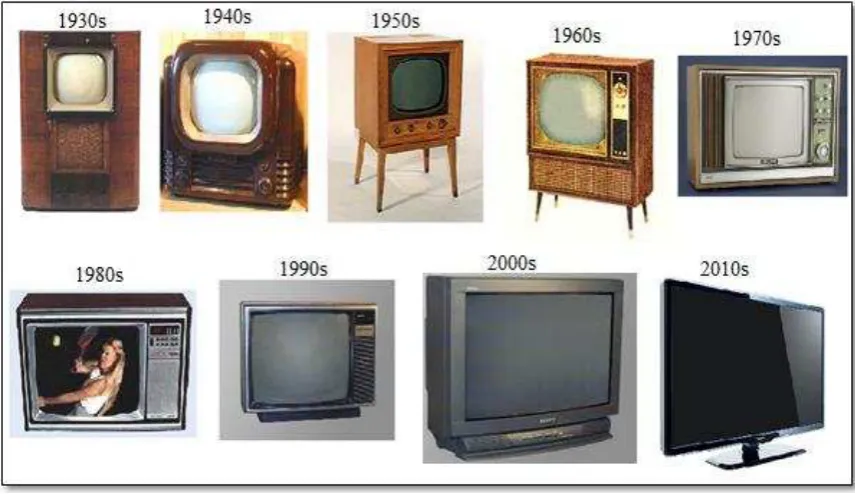
1.1 Development of television commercialization 4
2.1 Cyclic process injection moulding 11
2.2 Injection unit of injection moulding machine 11 2.3 Ishikawa cause-effect diagram of injection moulding process parameters 13 2.4 Investigated process parameters in injection moulding of plastic 17 2.5 Investigated responses in injection moulding of plastic 17
2.6 Two plate mould 21
2.7 Types of injection mould 23
2.8 Feeding system 24
2.9 Components of mould 25
2.10 Example of warpage deflection 27
2.11 Types of polymer 29
2.12 Break down of US themoplastic production into common types 31 2.13 Location, distance, and diameter of cooling channels 34
2.14 Flow chart of Taguchi sequence 43
3.1 Methodology outline 48
3.2 Injection moulding machine 49
3.3 Mould plate (a) core (b) cavity 50
3.4 Dumbbell part 51
3.5 Horizontal optical comparator 53
3.6 Heater mould temperature controller 56
ix
3.8 Infrared thermometer 58
3.9 Mould temperature measurement for first investigation work 58 3.10 Mould temperature measurement for first investigation work 59
3.11 Overall Taguchi approach 61
3.12 Example of mesh statistics 67
3.13 Example of process setting wizard 69
4.1 Overview framework of discussion result 72
4.2 3D solid modelling using solid work software 73
4.3 Meshing process 74
4.4 Visualization of minimum warpage deflection for mould temperature
gradient 77
4.5 Visualization of maximum warpage deflection for mould temperature
gradient 78
4.6 Warpage of injection moulded part due to different mould temperature 80 4.7 Assymmetrical flow front due to different mould temperature 80 4.8 S/N response diagram of mould temperature gradient 83 4.9 Prediction suggested for optimization by Taguchi method in minitabTM
software for mould temperature gradient 84
4.10 Result prediction optimization of Taguchi method for mould temperature
gradient 84
4.11 Interaction plot of core and cavity temperature for mould temperature
gradient 86
4.12 Comparison between simulation and experimental warpage deflection for
mould temperature gradient 87
x
4.23 Result prediction of Taguchi method for hot mould 100
xi
LIST OF APPENDICES
APPENDIX TITLE PAGE
A Specification of injection moulding Arburg 420 C 800-250 120
B Dumbbell part drawing 121
C Visualization warpage for mould temperature gradient 122 D Visualization warpage for cold mould temperature 128
E Visualization warpage for hot mould temperature 134
xii
LIST OF ABBREVIATIONS
DOE - Design of experiment ANOVA - Analysis of variance MPI - MoldflowTM plastic insight
OA - Orthogonal array
CAE - Computer aided engineering
PP - Polypropylene
US - United State
RSM - Response surface method S/N - Signal to noise
SS - Sum of square
DF - Degree of freedom
MS - Mean square
s - Second
mm - Millimeter
xiii
LIST OF PUBLICATIONS
Mohd Amran, Siti Salmah, Mohd Zaki, Raja Izamshah, Mohd Hadzley, Sivarao Subramonian, Mohd Shahir, Mohd Amri, 2014. The Effect of Pressure on Warpage of Dumbbell Plastic Part in Injection Moulding Machine. Advanced Materials Research, Vol. 903 (2014), pp. 61-66.
Mohd Amran, Siti Salmah, Abdul Faiz, Raja Izamshah, Mohd Hadzley, Manshoor Bukhari, Mohd Shahir, Mohd Amri, 2015. Effect of Injection Moulding Machine Parameters on the Warpage by Applying Taguchi Method. Applied Mechanics and Materials, Vol. 699 (2015), pp. 20-25.
Mohd Amran, Siti Salmah, Zolkarnain Marjom, Umar Al-Amani, Raja Izamshah, Mohd Hadzley, Zulkeflee Abdullah, Mohd Sanusi, 2014. Warpage Analysis Verification between Simulation and Experimental of Dumbbell Plastic Part in the Injection Moulding Process. International Symposium on Research in Innovation and Sustainability, Vol. 26 (4), pp. 1575-1579.
Mohd Amran Ali, Siti Salmah, Zulkeflee Abdullah, Liew Pay Jun, Mohd Razali Muhamad, Raja Izamshah, Mohd Hadzley, Abu Abdullah, Zolkarnain Marjom, 2014. Effect of Cold and Hot Mould on Warpage using Mouldflow Insight Analysis. Proceeding of International Conference on Design and Concurrent Engineering (iDECON 2014). September 22-23. Melaka: Universiti Teknikal Malaysia Melaka (UTeM).
1 CHAPTER 1
INTRODUCTION
This chapter describes the background of the project research, problem statement, scope of study, objectives and the overall organization of the contents in this thesis.
1.1 Background
Plastic industry is one of the fastest growing major industries in the world. Usage of plastic materials increases from time to time. Life without plastics is rather hard to
imagine. Every day, human rely on plastic items such as household, automotive parts, medical devices and others. Department of Skills Development Ministry of Human
Resources (2013) reported that Malaysia produces more than 60% of the products is manufactured from plastic materials.
There are varieties of processing method that can be used to convert the plastic raw
materials into end product. Common plastic processes involved are extrusion, injection moulding, blow moulding, compression moulding, transfer moulding and rotational
moulding.
However, injection moulding is one of the most important polymer processing operations in plastic industry. Zhou (2013) reported that among, all plastic products about
2
because of injection moulding process having many advantages such as can produce
complex shape of plastic parts, ability to produce good dimensional ability, mass production, short cycle operation time etc. Subsequently, injection moulding is widely used
for manufacturing a variety of plastic parts, from the smallest component to entire body panels of cars (Wolf, 2012).
Four elements that affected the quality of injection moulded parts are machine setting parameters, mould conditions, type of plastic materials and human error during handling the injection moulding operations. Further, contributions of each element
approximately are type of plastic materials 10%, human error 10%, mould conditions 20% and machine setting parameters 60% (Kamal et al., 2009). Nevertheless, it is difficult to
control injection machine setting parameters due to many parameters involved in injection moulding process. Thus, several approaches have been applied in injection moulding to study about the process parameters such as using trial and error method, simulation using
software and optimizing process parameter by design of experiment (DOE). Trial and error method has insufficiently to support the plastic polymer product development due to
increasing demand for high quality product and short production time (Fuh et al., 2004). Simulation of polymer processing is getting more applicable in industry because it helps to forecast the problems that may occur, study of process parameters control and optimized
processing conditions. In addition, DOE approached enables to gaining an in-depth knowledge of the process interaction. Therefore, simulation method and DOE approached are more preferred in injection moulding due to their capability to lead toward fast, cost
effective and reliability.
Although, injection moulding is an important process for plastic production,
3
Defects such as warpage, short shot, flashing, burn marks, sink marks, shrinkage, and weld
line are the common problems that impact product quality in injection moulding process. Warpage defect becomes a common pitfall in injection moulding process especially
for thin plastic parts. Warpage can be defined as dimensional distortion from the intended shape of the plastic part in a moulded product after it was ejected from the mould in
injection moulding process (Fischer, 2012). It causes a part to bend or twist out of shape and alters dimensions as well as the contours and angles of the part (Alfreda, 2006). Consequently, the warpage part can cause failure to surface quality and poor part
assembly. Therefore, the ability to reduce the amount of warpage in plastic is very useful in all stages of the product life cycle. Knowing how process setting parameters contribute
to warpage phenomenon and minimize them becomes increasingly important. Therefore, this research studies the effect of injection moulding parameters on the warpage of dumbbell product. The simulation method using MoldflowTM software and experimental
operation are performed through input various process parameters; melt temperature, mould temperature, cooling time, core and cavity temperature. Then, warpage deflection is
4 1.2 Problem Statement
Nowadays, electronic product such as handphone, remote control, digital watch, laptop, note book, camera, video cam, television etc. are design to become lighter, thinner
and smaller to fulfil market demand. Figure 1.1 shows the example of product development for television from era 1930 to 2010 century. It is obviously shown that the
development of the television becomes lighter and thinner. One way to ensure lighter and thinner plastic part produce is by reduces the wall thickness. However, producing a lighter, thinner and smaller part was the challenges to the plastic industry because it can produce
higher of warpage deflection (Huang and Tai 2001). Ranran and Huimin (2013) investigate the defect of warpage on the washing machine control panel using moldflow software and
found that mould having unbalanced gate location produce higher warpage deflection. Wang et al., (2012) reveal that automobile dashboard having higher warpage due to the limitation of the gating system. Furthermore, Sun et al., (2011) found that warpage
deformation was minimized after analyse using orthogonal experiment designation.
5
As well know that, warpage defect is one of the big issues in injection moulding
process (Subramanian, 2011). This defect will impact the final of the product and will cause the product to be rejected. Therefore, it’s become motivation to many researchers to
find the best combination of plastic materials, optimum process setting parameters and prediction using simulation study. Simulation method become essential due to many
parameters involved in injection moulding process.
In injection moulding process, plastic material is heated until molten, injected into the mould, cooled rapidly and then ejected from the mould. Normally, the mould
temperature is lower than hot melt plastic temperature during injected. Consequences, the skin touching of hot melt plastic and mould surface lead the temperature of the mould wall
instantaneously causing enormous temperature change between them. The exchange of heat adding with as well as thickness and pressure variations throughout the structure, cause the component to have a non-uniform shrinkage rate. The non-uniform shrinkage is
one from the most contribution causes of warpage which involved many process parameters. Hence, knowing the process parameters that contribute to warpage defect
becomes increasingly important. In order to minimize the formation of warpage defect, studies about how process parameters affect on the warpage is very significant. Then, this research focuses on the effect of melt temperature, mould temperature, cooling time, core
6 1.3 Objectives
The main objective of this research is to study the effect of injection moulding parameters on warpage deflection. To achieve main objective, three sub objectives are
outline as follows:
1. To investigate the effect of injection moulding parameters such as melt
temperature, mould temperature, cooling time, core and cavity temperature on warpage deflection.
2. To identify the percentage of deviation warpage deflection between simulation
software and actual experiment.
3. To determine the smallest warpage deflection between three investigation
works that are different core and cavity mould temperature gradient, whole cold mould and whole hot mould.
1.4 Scope
This project focuses on study the effect of injection moulding process parameters
on warpage deflection. Injection moulding machine Arburg 420C 800-250 was used as main equipment in this research. It is due to availability of this machine in Polymer Laboratory, Faculty of Manufacturing Engineering, Universiti Teknikal Malaysia Melaka
(UTeM). Injection moulding parameters that investigated were melt temperature, mould temperature, cooling time, core and cavity temperature. The mould used in this research was two-plate dumbbell injection mould. Horizontal optical comparator was used as
measurement equipment the warpage deflection. There were three investigation work of research study. The first investigation work was performed using different mould