• Tidak ada hasil yang ditemukan

CAN BALANCED SCORECARD BE APPLIED TO ANALYZE THE MISSIONS OF LOCAL GOVERNMENT? DOUBLE CASES OF INDONESIAN LOCAL GOVERNMENT MISSIONS

N/A
N/A
Protected

Academic year: 2017

Membagikan "CAN BALANCED SCORECARD BE APPLIED TO ANALYZE THE MISSIONS OF LOCAL GOVERNMENT? DOUBLE CASES OF INDONESIAN LOCAL GOVERNMENT MISSIONS"

Copied!
10
0
0

Teks penuh

(1)

177

CAN BALANCED SCORECARD BE APPLIED TO ANALYZE THE MISSIONS

OF LOCAL GOVERNMENT? DOUBLE CASES OF INDONESIAN LOCAL

GOVERNMENT MISSIONS

Agung Riyardi*; Sri Wahjuni**; Latifah***; Widojono***

* Economics Department of Universitas Muhammadiyah Surakarta; email: [email protected] ** Accounting Department of Universitas Muhammadiyah Malang

*** Management Department of Universitas Muhammadiyah Surakarta

Abstract. A useful tools to design effective organization, balanced scorecard is rarely applied to analyze the effectiveness of organization. This paper shows that balanced scorecard can be applied to analyze Indonesian local government missions. The methods are comparing the perspectives of the balanced scorecard to the missions, forming the strategy map and developing strategy keys that support the mission achievement. The result is balanced scorecard can analyze the local government missions. The perspectives show how comprehensive are missions, and the strategy map and strategy keys show how focused are missions. Balanced scorecard can be used to analyze local government missions.

Keywords: Balanced Scorecard, Local Government, Missions

INTRODUCTION

Introduced firstly by Robert Kaplan and David Norton in 1990s, balanced scorecard is a very popular tool to design effective organization. Not only pure business organizations apply balanced scorecard to design their organizations, but public organizations do also. The application in public organization is very wide: health such as clinical laboratories and hospitals, education and universities, public institutions including libraries and public services, air forces and sports. (Severović & Halmi, 2013).

The reason behind the growing interest to use balanced scorecard is its comprehensive and accurate content. Balance scorecard incorporates financial performance with other performances. Furthermore, balanced scorecard translates strategy into action. Among performance measurements, it is the best to face competitiveness environment and to serve consumers. (Kuncoro, 2011).

Small and medium enteprises (SMEs) also design their organizations using balanced scorecard. Several of them is success, success after solving big obstacles or choosing to implement part of balanced scorecard. However some are failed to implement balanced scorecard. (Rompho, 2011).

Balanced scorecard is expected to be used to analyze Indonesian local government missions because Indonesian local government missions are rarely examined. Local governent missions is essential. It is obligated by Indonesian governmental as an important part of a local government strategic planning such as obligated by governmental decree number 108/2000 and number 8/2003. Mufiz (2004) argued that missions is important to guide local government so that political rationality can be incorporated into substantial rationality and serving society, and to face any significant changes and uncertainties.

Strategic planning and its variations in the public sector are analyzed from many perspectives, such as studied by Sithole, Chirasha, & Tatire (2013), Deželan, Maksuti, & Uršič (2014) Mugambi, Gakure, & Orwa (2014), Apriandes, Ranius, & Syakti (2013), Budiman & Anggono (2012), Suprawito & Darmawan (2011), Sirojuzilam (2005), Misrina (2010), and Paramasari (2009). All of them analyzed strategic planning, but missions as one of the important content of a strategic planning was not analyzed.

Nine important components of mission is studied by Papulova (2014), David, David, & David (2014) or Rajasekar (2013). In addition, factors affect and affected by missions are observed by Marina & Wahjono (2013), Anthony (2012), or Darby (2012). However, these studies focused on entreprises or on local governments but failed to consider local government mission content.

(2)

178

THEORITICAL REVIEW

Balanced Scorecard

Balanced scorecard is a tool to design effective organization. Balanced scorecard designs an organization by assuming that organization vission and strategies should be operated clearly. The method is by developing 4 balanced perspectives, deriving a cause and effect strategy map and its key strategies based on the perspectives, and monitoring all of the relevant performances. Balanced scorecard designs working strategies and accomplished comprehensive performances. (IŠORAITE, 2008). The focus of balanced scorecard is the cards called the perspectives. They are learning and development, internal processes, finance and citizen perspectives. All of them should be balanced so that organizations and firms can develop their strategies and increase their performance. (IŠORAITE, 2008).

Balanced scorecard causes a manager is like a pilot in the airplane cockpit. The manager obtains all of complex informations so that he can measure anything. Furthermore, he can drive organization into its performances. (Kaplan & Norton, 1992).

Adjustment should be implemented when balanced scorecard is used to design public sector organization. The adjusment is in the cause and effect strategy map. The causes are financial, internal processes, and learning and growing perspectives, while the effect is customer/public perspective. The reason behind the adjustment is the public sector orientation. The public sector organization does not seek profit. (Irwin, 2002).

Public balanced scorecard was apllied in many areas. Irwin (2002) is considered as the first to apply balanced scorecard in the public sector. He applied balanced scorecard to the UK Small Business Service Organization. Yongping (2008) explored balanced scorecard in Qingdao Municipality in China. Anthoula & Alexandros (2011) transformed the usual balanced scorecard for local authority organization, stated that balanced scorecard can be linked to Analytic Hierarchi Process (AHP) tool and analysed that the application of balanced scorecard to local goverment in Greek is documented in 2 municipalities: Amaroussian and Ierapetra municipalities. Bigliardi, Dormio, & Galati (2011) implemented succesfully balanced scorecard to a medium municipality in Emilia Rogmana region in Italia. Not only the important aspects of balanced scorecard are established such as the performance indicators and the strategy map, but is also the balanced scorecard dashbord for the municipality. Sivaraman, Al Balushi & Rao (2014) designed strategy map and key performances indicators for enginering college in Oman, while Pietrzak (2014) designed strategy map as a communication tool among Warsaw University of Live Science stakeholders. Hagood & Friedman (2002) studied the development and implementation of balanced scorecard in the human resources information system of CIA. Bolivar, Hernández and Rodriguez (2010) studied the application of balanced scorecard, strategy map and performance indicators to the municipal agency of sport in Granada, Spain.

Balanced scorecard is also used to analyze local government organization. Chan (2004) analyzed that not more than 8% of municipalities in the USA and Canada implemented balanced scorecard. Perera, Schoch, & Sabaratnam (2007) analyzed limited municipalities in Sydney Metropolitan Area that adopted balanced scorecard. The limitations were caused by some constrints such as financial and human resources, time constraints, or organizational culture. Butts (2009) analyzed 14 local government organizations and concluded that local governments balanced all of performances including financial performance. Latifah, Fitria,

& Zubaidah (2016) implemented perspectives of balanced scorecard to analyse performances of Bangil Local Hospital in East Java Province of Indonesia. It is found that the average performance of financial and others performances is moderate.

Local Government Missions Statement

Missions are important aspects of a strategic management and planning. Missions are different to the vision. Both are established in the second phase of strategic management and planning called strategy formulation, and derived from stakeholder aspirations. However, missions are general activities showing specific identity of organization, while vision is the future of organization. Therefore, missions are important to actualize vision and the future of organization (Joachim, 2010). Missions are also important because are on the middle position of the strategy formulation. Before missions are vision, and after missions are strategic objectives and strategy development. Therefore, missions are important because serve as a global strategies of organization from vision and will be derived into operational strategy. (Papulova, 2014).

The problem facing by missions--and also by vision--lies on their implementation. Missions are often presented only as a compiled report but are not implemented. Organizations often run without the enlightenment of missions. In some cases, organizations even operate contrary to their missions.

(3)

179

mission to a compiled thick report but cannot ensure their implementation, whereas placing the mission statement throughout the organization allows these components to be better understood. Additionally, such a statement is expected to control (and inspire) all stakeholders’ activities. The explicit mission statements are placed in strategic locations around the organization to address the problem of implementing them.

However, missions are rarely analyzed. Several previous studies have analyzed strategic planning without including mission analysis. Sithole, Chirasha, & Tatire (2013) analyzed the implementation of strategic planning in local authorities in Zimbabwe. Based on a case study of Nyanga Rural District Council, the study described a gap between strategic planning and its implementation caused by political orientation, central governmental financial support and stakeholder participation. Deželan, Maksuti, & Uršič (2014) analyzed strategic development plannings in some Slovakian cities and municipalities. It is found that all of the plannings suffer from some weaknesses such as structure inconsistencies, ignoring inclusivity planning, financial insuffiency, without measurable performance indicators, and not considered to the global crisis effect. Mugambi, Gakure, & Orwa, (2014) analyzed that strategic planning did not have an effect in the Kenyan Secondary School. Some Teachers rejected the performance contract. The reason is teachers were not involved in the strategic planning arrangement.

Apriandes, Ranius, & Syakti (2013) employed the strength, weakness, opportunity and threat method to develop strategic planning for e-government in Muara Enim municipality. That study provided useful information to develop global planning and strategic planning for e-government implementation. Budiman & Anggono (2012) analyzed the strategic planning of PD Kebersihan, a company owned by Bandung city. Financial, operational and organizational scenarios for restructuring the one-year strategy are presented. The results for

5 years after the restructuring include increased revenue, reduced costs and positive prosperity for employees. Suprawito & Darmawan (2011) developed sofware to map strategic planning for city or municipality educational unit based on district planning information support system (DPISS). Sirojuzilam (2005) analyzed startegic planning of Medan City Indonesia. It is analyzed that the planning recognized regional planning by considering industry as the leading sector, Medan is one of the development centres for west of Indonesia and Medan has international competency.

Misrina (2010) analyzed the implementation of the 2008-2013 strategic planning by the Department of Industry, Trade and Cooperation of Banyumas municipality. The strategic plans were derived from annual planning that occurred in 2008 and 2009. However, municipal budgetary limitations in 2008 and 2009 resulted in the failure to implement several planned activities. Paramasari (2009) analyzed strategy implemented by the Department of Cooperation and Small and Medium Business of Surakarta city based on strategic management and planning to help the public sector develop small and medium-sized businesses. That study found that the strategic plans to develop small and medium-sized businesses were derived from national strategic plans made by the central government’s Department of Cooperation and Small and Medium-sized Business. The study also found the small and medium-sized businessmen themselves challenged the activities to develop small and medium-sized businesses, particularly their minimal entrepreneurial spirits.

Other studies have attempted to analyze different aspects of mission. These types of studies can be classified into 3 groups. The first group tried to analyze any force that influences missions. For example, Marina & Wahjono (2013) analyzed the role of business ethics in designing hospital missions. Analyzing Muhammadiyah’s hospital in Ponorogo municipality, the study identified 3 influential Islamic ethics: the intentions to help others, support one another and compete in goodness. These principles influenced the vision and mission of Muhammadiyah’s hospital in Ponorogo municipality. The second group of studies attempted to analyze the impact of mission. For example, Anthony (2012) observed the missions of the private sectors in Abeokuta, Nigeria. Using the correlation method, the study concluded that mission influence organizational effectiveness. Darby (2012) analyzed the effect of mission on the employees of academic, financial and administrative organizations serving the public in Ghana and other West African countries. The employees felt that they were not influenced by the vision and mission because these components did not belong to them, and as a consequence they were not influenced by the vision and mission.

(4)

180

content of missions are firm philosophy and product/service, while other components (technology, geographic market, employees, distinctive competence, concerns for growth/survival, public image, and customers) are not recognized. Another finding is the missions are not readibility missions because the mission statements are too long.

RESEARCH METHOD

A content analyzing method is used. The balanced scorecard tools will be used to analyze missions of 2 local governments. Three steps will be performed:

a. The Perspectives of the balanced scorecard will be compared to the content of the local governments missions. The perspectives are learning and development, the internal processes, the finance and the citizen perspectives. (IŠORAITE, 2008). The focus of the comparison is the similarity comparison. If similarity is found, then a perspective contains a mission content.

b. Forming the adjusted strategy map. The technique to form the strategy map is the cause- and-effect relationship between contained-missions perspectives.

c. Developing strategy keys that support the strategy map. The pre-determination technique is used to develop the strategy key.

Objects representing municipality and city missions are selected to produce a comprehensive analysis of a local government missions. The objects are the missions of Sragen municipality and Surakarta city governments in the Central Java Province of Indonesia. They are seleceted based on general assumption that they can represent all of Indonesian local government missions statement. The mission statement are obtained from each local government websites, while the necessary supporting data are obtained from local government data.

RESULT AND ANALYSIS

Missions of Sragen Municipality and Surakarta City

The misisons of Sragen municipality are (1) Reform bureaucracy toward a clean and public service-oriented apparatus with a sound budget to eliminate criminal corruption (2) Establish professional and ethical human resources quality, (3) Extend an opportunity to all to participate in planning, directing and controlling development and obtaining benefits from development output, (4) Solve the problem of development stagnation so that society prospers, particularly in terms of wisely improving purchasing power, education and health quality, and (5) Develop a small economy based on sustainable development of the agricultural sector. Sragen’s missions can be viewed online at sragen.go.id

This missions were articulated in 2011 to address the existing conditions of Sragen municipality. The main condition is the potential for citizen occupation. Most citizens work in the primary sector, such as paddy, corn and soybean farming; log and timber foresting; and garut and sugar cane plantation. This

potential is supported by an extensive agricultural area. Approximately 42.55% or 400 km2 of Sragen land is agricultural. Another area of potential is the city’s strategic position. The Surabaya-Jogyakarta main road passes through Sragen, which supports industry and trade activities. The governmental sector also has potential. Employing more than 13,000 local government officials, the government provides public services and important infrastructure. The Sragen governmental expenditure in 2011 was approximately 15% of its Regional Gross Domestic Product (RGDP).

The Surakarta missions were established in 2000 due to the city’s unique culture, economic potential and the role of important infrastructure. Besides Jogyakarta city, no other city is more central to Javanese culture than Surakarta. It includes many cultural heritage sites, such as Surakarta Palace, and periodic cultural activities. Surakarta is the center of economic agglomeration for its surrounding municipalities, such as Klaten, Boyolali, Sragen, Karanganyar, Sukoharjo and Wonogiri municipalities, as indicated by the growth of trade, services and hotels and the high population density. Some infrastructure plays a significant social role. For example, Manahan Sport Centre is one of five large in Indonesia, and it is used for daily and international sport activities.

Both local governments’ mission statements are consistent to Darby (2012), Rajasekar (2013), David, David, & David (2014), and Papulova (2014) argumentation. The missions are stated explicitly, and they convey important information. Missions can be used as a basis for the activities of stakeholders in Sragen municipality and Surakarta city and as a check on their activities.

Comparing Perspectives of the Balanced Scorecard to the Missions of Sragen Municipality and Surakarta City

(5)

181

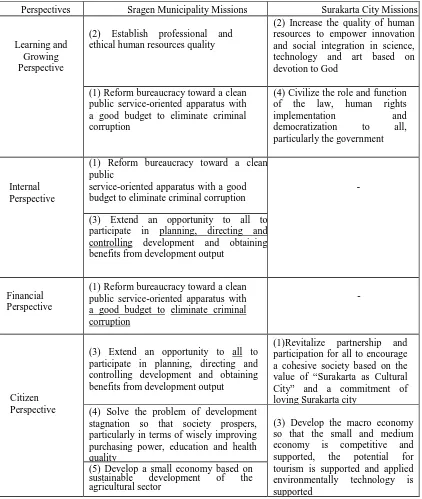
Surakarta city indicate full similarity to the perspectives. The partial similarity comparison is a partial comparison. The perspectives contain part of the missions. Missions 1 and 3 of Sragen municipality indicate partial similarity. The dissimilarity comparison occurs when the perspective does not contain missions. For example, the internal and fiinance perspectives do not contain any missions of Surakarta city. The perspectives of a balanced scorecard is described in the missions of Sragen Municipality and Surakarta City.

Table 1 presents the comparison between the perspectives of balanced scorecard to the missions of Sragen municipality and Surakarta city. The first column indicates the perspectives of the balanced scorecard. The second and third columns refer to Sragen municipality and Surakarta city missions. The missions are not in order but are adjusted to the perspectives. The fully comparisons are indicated by regular fonts of missions, while the partially comparison indicated by underlined fonts and the dissimilrities are indicated by blank cells.

Table 1. Similarity of Perspectives of Balanced Scorecard to Sragen Municipality and Surakarta City Missions

Perspectives Sragen Municipality Missions Surakarta City Missions

Learning and participate in planning, directing and controlling development and obtaining participate in planning, directing and controlling development and obtaining benefits from development output

(1)Revitalize partnership and participation for all to encourage a cohesive society based on the value of “Surakarta as Cultural City” and a commitment of loving Surakarta city

(6)

182

The missions of the Sragen municipality have 2 characteristics. First, the missions match to the perspectives of the balanced scorecard. The missions can be classified into learning and growing, internal, financial and citizen perspectives. Second, some comparisons are full comparisons, and others are partial comparison.

The missions of Surakarta city are characterized by full and dissimilarity comparisons. Not all missions match the perspectives of the balanced scorecard. The missions match the learning and growing and citizen perspectives but not the internal process and financial perspectives.

The comparison indicates that local government missions represent perspectives of a balanced scorecard. There are 2 meanings. First missions as comprehensive identities. Second, missions as strategies to reach purpose and direction. As comprehensive identities, missions show all of local government indentities. The missions show learning and growing, internal, financial and citizen identities. As strategies, missions have relationship among them, and can be formed as strategy map. These are in line to Rajasekar (2013), David, David, & David (2014) and Papulova (2014).

The missions that represent the learning and growth and the citizen perspectives are considered to be dominant identities and strategies. The reason is the intention to change from unresponsive to responsive local government as stated by Alwi (2005) and Pujiono (2006). Consequently, the local governments focus on their low human resources quality that are expected as the source of unresponsiveness. The quality of human resources is developed. Additionally, the local governments focus on their citizenship services that are expected as the fact of the local government unresponsiveness. The quality of citizenship services are increased. Therefore, considering missions as an identitiy and a strategy, the local governments focus on the learning and growth and the citizen perspectives.

Strategy Maps of Sragen Municipality and Surakarta City

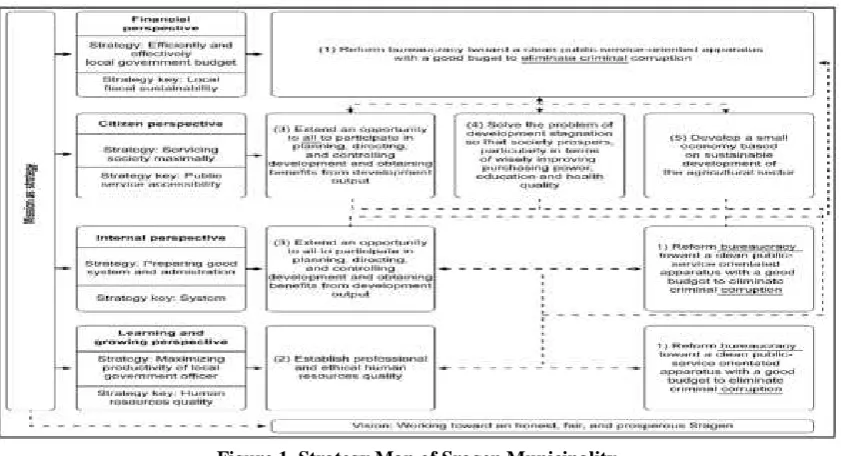
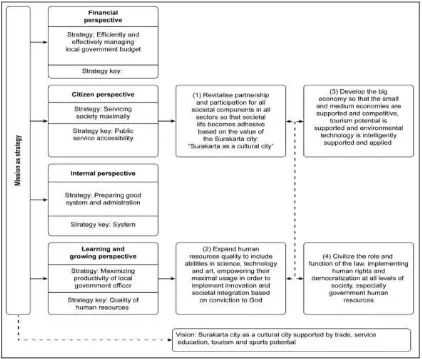
The strategy maps for Sragen municipality and Surakarta city describe the cause-and- effect relationship between missions. The effect is missions that contain citizen perspectives and the cause is missions that contain financial, internal, and learning and growing perspectives. The strategy maps connect all of missions so that Sragen municipality and Surakarta city become focused organizations.

A professional, ethical and public service-oriented apparatus is expected to have a dual impact. The apparatus will influence the services provided to citizens, such as reducing discrimination in public health and education services and the development process and its result. The apparatus will also influence improvements to the system and administration, such as enhancing the management of development and reducing criminal corruption.

Improving the management of development and reducing corruption will encourage efficient and effective budget management. Citizens of Sragen municipality can also participate in development, potentially encouraging a healthy local government budget and using it to influence public services.

Figure 1. Strategy Map of Sragen Municipality

(7)

183

from other perspectives. The mission derived from the citizen perspective is a goal mission that will be achieved by the missions derived from the learning and growing perspective.

Improving the quality of the Surakarta city local government human resources in science, technology, art, law, and ethics is an important strategy. Increasing the quality of human resources can support social development and economic development such as big-, medium-and small-scale business development. Consequently, many problems can be solved.

Figure 2. Strategy Map of Surakarta City

The Strategy Key

As depicted in Figure 1, the strategy keys of Sragen municipality are human resources quality, the system, the local fiscal sustainability and the accessibility of public services. All of these strategy keys support the learning and growing, internal business, financial, and citizen perspectives, respectively. All of them are keys of the Sragen local governmental organization.

The strategy keys of Surakarta city as indicated in Figure 2 are human resources quality and public service spending. All of these strategy keys support the learning and growing, and citizen perspectives, respectively. All of them are keys of the Surakarta local governmental organization.

Overall Analysis

(8)

184

effectiveness of missions especially based on 9 elements of mission such as Papulova (2014), David, David, & David (2014) and Rajasekar (2013) or by applying balanced scorecard to the missions as strategies. Third, Indonesian local government missions characterized by a similarity to perspective of balanced scorecard, a public sector strategy map and containing some strategy keys. These characteriztics are important because strengthen a local government as a responsive local government such as indicated by Mufiz (2004), Alwi (2005) and Pujiono (2006). However, the missions should be improved so that they state balanced scorecard perspectives and governmental strategy map completely.

CONCLUSION

Balanced scorecard can be used as a tool to analyse local government missions. Balanced scorecard opens an opportunity to analyze missions completely such as the similarity of perspectives to missions, the strategy map developed from missions and the strategy keys determined from missions. Balanced scorecard can analyse how comprehensive and focus is a local government missions.

Balanced scorecard is an alternative tool to analyse missions besides 9 elements of missions statement. Both of them offer complete perspectives and elements, but balanced scorecard has advantages in form of strategy map and strategy keys development. Balanced scorecard can be used to analyse local government missions.

Double cases of Indonesian local government missions show that balanced scorecard is a good tool to analyse missions. Sragen municipality missions shows that Sragen local government concerns to learning and growing, internal, financial and citizen perspectives, while Surakarta city missions shows that Surakarta local government concerns to learning and growing and citizen perspectives. The level of comprehensiveness and focused of missions can be analysed by balanced scorecard.

REFERENCES

Alwi. (2005). "Kecil itu Gesit" Visi Baru Manajemen Pemerintah Daerah di Indonesia. Jurnal Ilmu Administrasi, 2(4), 332-334.

Anthony, S. O. (2012). Influence of Vision and Mission Statement on Organizational Effectiveness: An Appraisal of a Private Sector Experience in Nigeria. The Pacific Journal of Science and Technology, 13(1), 389-397.

Anthoula, K., & Alexandros, H. (2011). Designing Balanced Scorecard for the Evaluation of a Local Authority Organization. Europian Research Studies, XIV(2), 65-80.

Apriandes, E., Ranius, A. Y., & Syakti, F. (2013). Analisis SWOT Guna Penyusunan Rencana Induk E-Government pada Pemerintah Dearah Kabupaten Muara Enim. Jurnal Ilmiah Teknik Informatika Ilmu Komputer, 17(2), 1-11.

Bigliardi, B., Dormio, A. I., & Galati, F. (2011). Balanced Scorecard for Public Administration: Issues from Case Study. International Journal of Busines, Management and Social Sciences, 2(5), 1-16.

Bolivar, M. P., Hernández, A. M., & Rodriguez, D. O. (2010). Implementing the Balanced Scorecard in Public Sector Agency: An Experience in Municipal Sport Service. Academia, Revista Latinoamericana de administratión, 45, 116-139.

Budiman, L., & Anggono, A. H. (2012). Restructuring Strategy of State Owned Municipal Solid Waste Company at PD. Kebersihan Bandung Indonesia 2012. The Indonesian Jurnal of Business Administration, 1(8), 528-537.

Butts, D. (2009). Does a Balanced Scorecard Dillute a Local Government Focus on Result?Retrieved February 10, 2012, from DarrellButts: http://www.mpa.unc.edu

Chan, Y. L. (2004). Performance Measurement and Adoption of Balanced Scorecard: A Survey on Municipal Goverments in the USA and Canada. International Jurnal of Public Sector Management, 17(3), 204-221.

Darby, W. P. (2012). Of Vision and Mission Statement and Their Potential Impact on Employee Behavior and Attitudes: The Case of A Public but Profit-oriented Tertiary Institution. International Journal of Business and Social Science, 3(14), 95-109.

(9)

185

Deželan, T., Maksuti, A., & Uršič, M. (2014). Capacity of Local Development Planning in Slovenia: Strengths and Weaknesses of Local Sustainable Development Strategies. Lex Localis, 12(3), 547-573.

Hagood, W. O., & Friedman, L. (2002). Using the Balanced Scorecard to Measure the Performance of Your HR Information System. Public Personnel Management, 31(4), 543-557. Irwin, D. (2002). Strategy Mapping in the Public Sector. Long Range Planning, 35(6), 637-647.

IŠORAITE, M. (2008). The Balanced Scorecard Method: From Theory to Practice. Intellectual Economics, 1(3), 18-28.

Joachim, A. (2010). Interface between Corporate Vision, Mission and Production and Operation Management. Global Journal of Management and Business Research,10(2), 18-22.

Kaplan, R. S., & Norton, D. P. (1992). Balanced Scorecard - Measures that Drive Performance. Harvard Business Review, 71-79.

Kuncoro, M. (2011). Survei Perkembangan Indikator Kinerja. Jurnal Mega digma, 4(3), 295- 326.

Latifah, S. W., Fitria, L., & Zubaidah, S. (2016). Balanced Scorecard untuk Mengukur Kinerja RSUD Bangil. Malang: Universitas Muhammadiyah Malang.

Marina, A., & Wahjono, S. I. (2013). Business Ethics as a Basis for Designing The Vision and Mission Hospital: Empirical Evidences from Muhammadiyah Hospital Ponorogo, Indonesia. Journal of Economics, Business and Accountancy: Ventura, 16(3), 399-408.

Misrina, E. (2010). Analisis P erbandingan antara Rencana Strategis Tahun 2008-2013 dengan Rencana Kerja Tahun 2008 dan 2009 di Dinas Perindustrian, Perdagangan dan Koperasi Kabupaten Banyumas. Surakarta: Universitas Sebelas Maret.

Mufiz, A. (2004). Rencana Strategis Pembangunan dan Pelayanan (Suatu Pengantar). Jurnal Ilmu Administrasi dan Kebijakan Publik, 1(3), 370-380.

Mugambi, H. N., Gakure, R. W., & Orwa, G. O. (2014). Implication of Strategic Planning on the Acceptance of Performance Contracting in Kenyan Secondary Schools. Prime Journal of Social Science, 3(1), 565-570.

Papulova, Z. (2014). The significance of Vision and Mision Development for Entreprises in Slovak Republic. Journal of Economics, Business and Management, 2(1), 12-16.

Paramasari, D. A. (2009). Strategi Dinas Koperasi dan UKM Kota Surakarta dalam P engembangan Sektor Usaha Mikro, Kecil dan Menengah (UMKM). Surakarta: Universitas Sebelas Maret. Perera, S., Schoch, H., & Sabaratnam, S. (2007). Adoption of the Balanced Scorecard in Local

Government Organizations: An Exploratory Study. Asia -Pacific Ma nagement Accounting Journal, 2(1), 53-70.

Pietrzak, M. (2014). Using a Strategic map as a Communication Tool in Higher Education: A Case Study of Warsaw University of Life Science. Online Journal of Applied Knowledge Management, 2(2), 26-42.

Pujiono. (2006). Struktur Organisasi Birokrasi Daerah yang Ideal Berdasarkan Peraturan Pemerintah (PP) Nomor 8 Tahun 2003 Tentang Pedoman Organisasi Perangkat Daerah. Yustisia, 69, 44-54.

Rajasekar, J. (2013). A Comparative Analysis of Mission Statement Content and Readablility. Journal of Management Policy and Practice, 14(6), 131-147.

Rompho, N. (2011). Why the Balanced Scorecard Fails in SME: A Case Study. International Journal of Business and Management, 6(11), 39-46. Severović, K., & Halmi, L. (2013). Balanced Scorecard: A Contemporary Management Tool for Performance Management. The Malopolska School of Economics In Tarnow Research Paper Collection, 23(2), 183-189.

Sirojuzilam. (2005). Regional Planning and Development (Kasus Medan). Wahana Hijau, 1(1), 10-14. Sithole, A., Chirasha, V., & Tatire, M. (2013). Implementation of Strategic Plan by Zimbabwean Local

Authorities: A Case of Nyanga Rural Distric Council. Journal of Emerging Trends in Economics and Managmeent Sciences, 4(1), 106-110.

(10)

186

Suprawito, & Darmawan, D. (2011). Sistem Pemetaan Program Rencana Strategis Dinas Pendidikan Kab/Kota Berbasis District Planning Support System (DPSS) dalam rangka Otonomi Daerah. Jurnal Penelitian P endidikan, 1(1), 62-71.

Gambar

Table 1. Similarity of Perspectives of Balanced Scorecard to Sragen Municipality and Surakarta City Missions
Figure 1. Strategy Map of Sragen Municipality
Figure 2. Strategy Map of Surakarta City

Referensi

Dokumen terkait

33 Tahun 2004 Tentang Perimbangan Keuangan Antara Pemerintah Pusat dan Daerah: untuk mendukung penyelenggaraan otonomi daerah, pemerintah daerah didukung sumber-sumber

[r]

Sehubungan dengan telah selesainya masa sanggah terhadap pengumuman pemenang untuk paket pekerjaan Perencanaan Teknis Saluran D.R Mas Bangun, Pokja Pengadaan Jasa Konsultansi

Sanggahan hanya dapat diajukan apabila terjadi hal-hal sebagaimana diatur pada lampiran III Perpres 54 Tahun 2010 Tanggal 6 Januari 2010. PANITIA PENGADAAN BARANG./ JASA

dengan ini kami umumkan pemenang penunjukan langsung untuk pekerjaan tersebut di atas yaitu :.

padatan.. b) Sebelum digunakan, encerkan bagian larutan tersebut dengan akuades, dengan perbandingan 1: 5. b) Larutan dapat diawetkan dengan penambahan (2-3) mL HNO 3 untuk tiap

Pada periode ini penyediaan makanan harus benar-benar dapat memenuhi kuantitas dan kualitas gizi yang baik yaitu jumlah energi dan komposisi gizi seimbang,

[r]