STAND ALONE POWER LIGHT SYSTEM
SITI NUR NADIAH BINTI SK ABD AZIZ
This Report Is Submitted In Partial Fulfillment Of Requirements For The Award Of Bachelor Of Electronic Engineering (Computer Engineering) With Honours
Faculty of Electronic Engineering & Computer Engineering Universiti Teknikal Malaysia Melaka
UNIVERSTI TEKNIKAL MALAYSIA MELAKA
FAKULTI KEJURUTERAAN ELEKTRONIK DAN KEJURUTERAAN KOMPUTER
BORANG PENGESAHAN STATUS LAPORAN PROJEK SARJANA MUDA II
Tajuk Projek : STAND ALONE POWER LIGHT SYSTEM
Sesi Pengajian : SESI 2009/2010
Saya SITI NUR NADIAH BINTI SK ABD AZIZ
………. (HURUF BESAR)
mengaku membenarkan Laporan Projek Sarjana Muda ini disimpan di Perpustakaan dengan syarat-syarat kegunaan seperti berikut:
1. Laporan adalah hakmilik Universiti Teknikal Malaysia Melaka.
2. Perpustakaan dibenarkan membuat salinan untuk tujuan pengajian sahaja.
3. Perpustakaan dibenarkan membuat salinan laporan ini sebagai bahan pertukaran antara institusi pengajian
tinggi.
4. Sila tandakan ( √ ) :
SULIT*
(Mengandungi maklumat yang berdarjah keselamatan atau kepentingan Malaysia seperti yang termaktub di dalam AKTA RAHSIA RASMI 1972)
TERHAD* (Mengandungi maklumat terhad yang telah ditentukan oleh
organisasi/badan di mana penyelidikan dijalankan)
TIDAK TERHAD
Disahkan oleh:
_______________________ ___________________________________
Alamat Tetap: 418 JLN MASJID BATU UBAN 11700 GELUGOR
PULAU PINANG
(COP DAN TANDATANGAN PENYELIA)
“I hereby declare that this is the result of my own work except for quotes as cited in the references.”
Signature :
Author : Siti Nur Nadiah Binti Sk Abd Aziz
“I hereby declare that I have read this report and in my opinion this report is sufficient in terms of the scope and quality for the award of Bachelor Degree of
Electronic Engineering (Computer Engineering) with Honours.”
Signature :
Supervisor Name : En. Zulkifli Bin Shariff
This project and research work is dedicated to my beloved parents for their devoted caring throughout my life, my loving brother and sisters also my friends for
ACKNOWLEDGEMENT
First of all, I would like to express my sincere thanks and indebted to En Zulkifli bin Shariff as my supervisor, thank you very much for accept me as one of your PSM student and the collaborative leadership that you show will always I remembered. I also would like to thank to my PSM1 panel Dr Yosza Dasril and En Ridza Azri who gave me idea on my project.
I would like to express my special thanks and a very down to earth and full with sense of humor-great experience to the Faculty of Electronic Engineering and Computer Engineering (FKEKK) on putting into practice the Final Year Project as a compulsory chore for the final year students prior to complete their course. Indirectly, this pertain prepare the students technically to facilitate the world of electronics all over their working verve. Not forgetting Universiti Teknikal Malaysia Melaka for their contribution on the facilities and also equipments as well as creating a platform to the final year student to achieve and carry out their projects in durable manner.
I also wish to extend heartfelt thanks to my friends Ridhwan Merican, Kong Siow Lian, Chelvakumari, Siti Hajar, and all my classmate for your help and support during this three years in University Technical Malaysia Melaka. The memory we spent together will not I forget.
Finally, I wish to thank to my lovely parents and my siblings, I love you so much and also to my lectures and friends for their encouragement, strength and support.
ABSTRAK
ABSTRACT
Nowadays, the usage of electrical energy are uncontrolable due to the electrical appliance used whether at home or others. Instead of water, charchoel and nuclear, solar energy can be used to generate electricity. With solar energy, it could generate energy without pollution. In this projek, solar energy is used as a main supply. From solar panel, it would charged the battery during sun hour to be used at night. From the research, solar panel can generate up to 4V when it is not exposed to the light and could achieve up to 8V when it is exposed to light of lamp. By exposed it to full of sunlight, it can achieve more than 12V. For this project, shunt regulator was used to prevent the solar panel from overcharging the battery. Since the solar panel are very sensitive to the shading, it set to move from east to west to generate maximum energy as it can. As a backup system, sensor circuit is created to sense the light during rainy or cloudy day. To implement this project, it needs high cost but for long
TABLE OF CONTENTS
CHAPTER TITLE PAGE
PROJECT TITLE i
REPORT VERIFICATION STATUS FORM ii
DECLARATION iii
SUPERVISOR DECLARATION iv
DEDICATION v
ACKNOWLEDGEMENT vi
ABSTRACT vii
ABSTRAK viii
TABLE OF CONTENTS ix
LIST OF TABLES xii
LIST OF FIGURES xiii
1 INTRODUCTION 1
1.1 BACKGROUND 1
1.2 HOW SOLAR WORKS 2
1.3 OBJECTIVES 5
1.4 PROBLEM STATEMENT 5
1.5 SCOPE OF WORK 6
1.6 PROJECT METHODOLOGY 7
2 LITERATURE REVIEW 8
2.1 PHOTOVOLTAIC PANEL
2.1.1 BASIC OPERATION OF PV PANEL 2.1.2 SOLAR MODULE CHARACTERISTICS 2.1.3 PV MODULE SENSITIVITY
10 12 14 15
2.2 SOLAR ARRAY AND SYSTEM 17
2.3 BENEFITS AND PERFORMANCE 19
2.4 SOLAR ENERGY IN MALAYSIA 21
2.5.1 LEAD ACID BATTERY
2.5.2 CHARGE CONTROLLER / REGULATOR
2.5.3 CHARGE CONTROLLER CIRCUIT
OPERATION
2.5.4 CONNECTING PV PANEL WITH CHARGE CONTROLLER
2.5.5 DC MOTOR 12V 2.5.6 DC CONVERTER
2.5.7 MICROCONTROLLER
2.5.7.1 PERFORMANCES
2.5.7.2 PERIPHERAL FEATURES 2.5.7.3 ANALOG FEATURES 2.5.7.4 DEVICE FEATURES
2.5.7.5 PIC16F877A PIN DIAGRAM AND BLOCK DIAGRAM 22 25 27 29 30 31 32 32 33 33 34 35 35 36
3 METHODOLOGY 37
3.1 PROJECT TITLE 37
3.2 PROPOSE TITLE TO THE SUPERVISOR 38
3.3 PROJECT ANALYSIS 3.3.1 OBJECTIVES
3.3.2 SURVEY MATERIAL 3.3.3 LITERATURE REVIEW 3.3.4 PROBLEM STATEMENT 3.3.5 DESIGN THE PROJECT
3.3.6 HARDWARE CONSTRUCTION
3.3.7 PROGRAM THE MICROCONTROLLER 3.3.8 TROUBLESHOOTING
3.3.9 FINAL PRESENTATION
38 38 38 39 39 39 40 40 40 41
3.5 PROJECT GANTT CHART 44
4 RESULT 45
4.1 INTRODUCTION TO PIC CONTROLLER CIRCUIT 45
4.2 PIC CIRCUIT 46
4.3 MOTOR CIRCUIT 47
4.4 SENSOR CIRCUIT
4.4.1 SENSOR CIRCUIT USING TIMER 555
48 48
4.5 CIRCUIT DESCRIPTION 49
4.6 PROGRAMMING USING PIC C COMPILER 4.6.1 SENSOR PROGRAM
4.6.2 MOTOR PROGRAM
51 52 53 4.7 PROJECT PROTOTYPE DESIGN
4.7.1 BUILDING THE BASE
53 53 4.8 TROUBLESHOOTING AND MAINTENANCE
4.8.1 EQUIPMENT FAILURE 4.8.2 MAINTENANCE 4.8.3 PV PANEL
4.8.4 KEEPING PROPER RECORD
58 58 59 59 60
5 CONCLUSION AND SUGGESTION 61
5.1 CONCLUSION 61
5.2 SUGGESTION 62
REFERENCES 63
APPENDIX A 64
LIST OF TABLES
NO TITLE PAGES
1 Motor Output 30
LIST OF FIGURES
NO TITLE PAGES
1.1 The Block Diagram Of S.A.P.L.S 4
2.1 PV Panel 10
2.2 Basic operation of PV panel 12
2.3 Photovoltaic module 13
2.4 PV module possible operating points 15
2.5 Examples of partial-cell shading that 16
reduce PV module power by ½
2.6 shaded full cell 16
2.7 Elements of a PV System 17
2.8 Graph showing power output for tracked and non- 18
tracked array
2.9 The World Solar Energy Map showing the global 19
solar resource available to PV applications
2.10 Lead Acid Battery 22
2.11 Over-charge reactions begin earlier (indicated by 24
the sharp rise in cell voltage) when charge rate is
increased
2.12 Shunt mode solar charge controller 27
2.13 DC Motor 30
2.14 DC Converters 31
2.15 40 pin 16F877A 35
2.16 PIC 16F877A block diagram 36
4.1 PIC circuit Diagram 46
4.3 Motor and lamp driver circuit 47
4.4 Driver circuit on stripboard 47
4.5 Sensor circuit 48
4.6 Sensor circuit using timer 555 48
4.7 Sensor circuit with timer 555 in stripboard 49
4.8 Project base design 56
4.9 Battery Holder Design 56
4.10 Project Base 57
4.11 The mast to support the motor and panel 57
4.12 Motor and PV panel 58
4.13 Project Prototype 58
4.14 Solar panel during starting time (7a.m) 59
4.15 Solar panel after 5 hours (at 12 noon) 59
4.16 Solar Panel at night (7.30 p.m) 60
LIST OF APPENDIXES
NO TITLE PAGE
A COMPLETE PROGRAMMING 65
CHAPTER 1
INTRODUCTION
1.1 BACKGROUND
Nowadays, many devices use sensors instead of switches. Switches have been
replace by sensor because the significant of sensor. With sensor human don’t need to
push any buttons, everything will be done automatically. Solar cells are converters. They
take energy from sunlight and convert the energy into electricity. Solar power is useful
and could replace the electricity power that is used today and it also save a bills and
operating cost. But this technology is not famous in Malaysia even in our University.
People will think a better way to replace cable because cable is hard to manage and
untidy. In this project, the advantages of sensor and solar power are taken. It will insert
in this project as the input and output of the microcontroller. Sensor will make the output
work remotely. The project name is ‘Stand Alone Power Light System’ because the light
is turn ON automatically when the sensor doesn’t sense any light. Sensor will turn on a
multiple output for motor to rotate the PV panel clockwise or counterclockwise. Solar
cells alone cannot produce usable power.
They need to be interconnected with other system components that ultimately conduct a
Photovoltaic (PV) systems can either be stand alone or grid connected. The main
difference between these two basic types of systems is that for grid connected systems,
the PV systems produce power in parallel with the electrical utility. It can feed power
back into the utility grid if the onsite load does not use all of the PV systems output.
Others output is a florescent light that will light on when is dark. When the sun
is shining, the direct current (DC) electricity from the PV modules is converted to
alternating current (AC) by the power of an electronic inverter, and then fed directly into
the side power distribution system where supplies electric power. Any excess solar
power is exported to the utility power grid and any shortfall is made up which electricity
supplied by the grid. During non sun hours, the site is supplied by utility power alone.
All of this device are been controlled by a single microcontroller chip that is PIC
16F877A microcontroller.
1.2 HOW SOLAR WORKS
Most electricity today is produced by electrical generators. A generator is a
device that spins wire through a magnetic field inducing electricity flow in the wire.
Some power plants use hydro or water power, but in most large power plants, fossil or
nuclear fuels are used to create steam, which in turn is used to spin a turbine. The turbine
then spins the generator. This is called “thermodynamic” cycle.
A solar cell converts light directly into electricity using “Photovoltaic Effect”.
There is no fuel, steam or thermodynamics involved. When light hits a solar cell, it
instantly produces electricity. Solar cells today do not store electricity. In other words,
when the light is taken away from the cell, it stops producing electricity. It is very
Because most applications require electricity when the sun is not shining, battery
storage of electricity is usually necessary. The batteries used in PV systems are similar
to automobile batteries, but are specially constructed to withstand many deep discharge
cycles. (Current is provided for extended periods) Automobile batteries are designed for
shallow discharge cycles (to provide large current for short periods) and are not suitable
for PV systems.
The two most common types of batteries used in PV systems are not flooded lead
acid batteries that require periodic maintenance (addition of distilled water and
equalization), and valve regulated lead acid batteries, which are “maintenance free”. To
reduce the maintenance frequency required by flooded batteries, catalytic recombine
caps can be used. These caps recombine the hydrogen and oxygen gases emitted by the
battery cell into water that is returned to the battery.
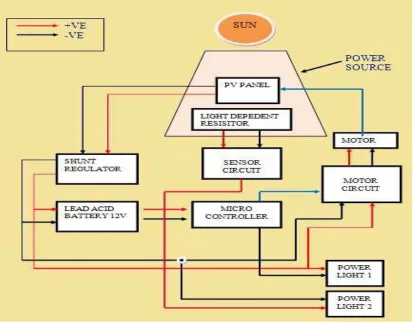
The Stand Alone Power Light System was control using PIC16F877A. This system
consists of:
i. PV panel
ii. Motor
iii. Sensor
iv. Microcontroller
v. Shunt regulator
vi. Lead Acid battery
FIGURE 1.1: THE BLOCK DIAGRAM OF S.A.P.L.S
1. Figure 1 shows how the SALPS system works. This system was a stand-alone
and it has own source power from the solar panel.
2. The Sun was the major power source to operate this system and also recharging
the battery for load device such as motor and power light.
3. From the power of PV panel it will flow into lead acid battery 12V and converter
4. Micro controller will be used to control the motor and power light. This system
depending on light sensor. At night the power from solar panel will be cut
through lead acid battery and then the battery will supply the power light.
1.3 OBJECTIVES
Today, we could see at our rest shelter doesn’t have lamp to lighten on the shelter
at night. By investing in solar power today, it can gain energy independence and
generate the own clean, renewable electricity from the sun while:
1. Lowering the utility bills & operating costs.
2. Hedging against rising electricity prices.
3. Reducing distinct energy demand from utility grids.
4. Help sustain environment.
1.4 PROBLEM STATEMENT
Nowadays, the increasing of the electrical usage is unctrollable due to many
types of electrical equipments or appliances we used. Our country also doesn’t have
enough electrical source to support our needs daily. Instead of charcoal, nuclear, water
and wind, solar energy also can generated electical power. Solar is used because it can
gain energy indepence and generate the own clean, renewable electricity form the sun
while help sustain environment. In this project, a random survey is done around girl
hostel at taman tasik utama and it seen that at the rest shelter doesnt have lamp to light
on the shelter. An association between female students and male students especially
during night can produce a suspicios among the outsider even they are discussing about
their study. By investing this project, it can reduce the suspicious and also the students
can discuss their work comfortly without any worry. Using a solar power also have some
i. Portability: it can move easily.
ii. Reliability: it can operate for long period with little maintenance.
iii. Low operating cost: the fuel is free.
iv. Low environmental impact: it is quiet and nonpolluting.
v. Stand alone capability: they operate in remote area far from power line.
vi. Modularity: power output can be increased by adding more modules.
vii. Safety: they are not flammable.
viii. Ease of installation: no heavy construction equipment is required.
1.5 SCOPE OF WORK
This project will cover hardware and software parts. The hardware part are the
microcontroller circuit as the controller for this project, sensor circuit to detect the light
from the sun and the motor circuit to rotate the pv panel by following the sun movement.
Charger controller circuit also will be implemented in this project to limit the maximum
voltage to the battery charger when on charge from PV panel. The software part will
CHAPTER 2
LITERATURE REVIEW
“The Earth receives more energy from the Sun in just one hour than the world
uses in a whole year,” according to Solarbuzz, a San Francisco-based solar energy
research and consultancy firm. With that knowledge, it’s no wonder that renewable
energy enthusiasts have high hopes for the future of solar technology. But forget the
future, today, financing strategies are making it possible to benefit from solar
technology.
The Stand Alone Power Light System was using the advantages of light source. The
important device used in this system called as Photovoltaic’s are best known as a
method for generating electric power by using solar cells to convert energy from the sun
into electricity. Photovoltaic (PV) Solar Panels generate electricity by the Photovoltaic Effect. Discovered in 1839 by 19 year old Edmund Becquerel, the photovoltaic effect is the phenomenon that certain materials produce electric current when they are exposed to
light.The photovoltaic effect refers to photons of light knocking electrons into a higher
state of energy to create electricity energy. The term photovoltaic denotes the unbiased
operating mode of a photodiode in which current through the device is entirely due to
the transduced light energy. Virtually all photovoltaic devices are some type of
Solar cells produce direct current electricity from light, which can be used to power equipment or to recharging a battery. The first practical application of photovoltaic’s was to power orbiting satellites and other spacecraft, but today the majority of photovoltaic modules are used for grid connected power generation. The light from the sun is made up of packets of energy called Photons. Each photon carries an amount of energy corresponding to its wavelength of light. When a visible light photon strikes a solar cell it can do one of three things which is pass straight through, be reflected, or be absorbed. If the photon is absorbed, its energy is absorbed by an electron in an atom of the solar cell enabling it to escape from its normal position (photon excitation), cross the junction and fill a hole. Since electrons are physically moving across the PN junction, the positive charge carrying holes are effectively moving in the opposite direction around the load circuit (a rechargeable battery or light bulb etc). This completes the circuit providing more holes for the electrons to combine with and providing usable electricity. Because this system is reliability, the process can be repeatedly over many years due to its usable lifetime. A basic photovoltaic (PV) solar electric panel system for 12V battery charging comprises a solar panel, charge controller, battery and appliances.
Whenever exposed to daylight PV panels will produce a more or less constant output voltage. This means that even in temperate zones in winter, a useful charging current can be produced. This output current however does vary with light intensity. The rated output of all panels are measured by a standard illumination of 1kw/m (1 sun) at a temperature of 25°c.