i
Pre-Questioning Technique toward Students’ Reading Comprehension of Descriptive Text: A Quasi Experimental Study at the First Grade Students of MAN Pandeglang. A “Skripsi” of English Education at Faculty of Tarbiyah and Teachers’ Training of State Islamic University of Syarif Hidayatulah Jakarta, 2015. The first advisor is Drs. Nasifuddin Djalil, M. Ag. and the second advisor is Maya Defianty, M.Pd.
Key words: pre-question technique, reading comprehension
Reading comprehension is considered as the important language skill that should be mastered by everyone. Good comprehension of a text depends on readers’ knowledge. Therefore, it is important to provide background knowledge prior to reading comprehension achievement.
This research was conducted to improve the students’ comprehension of reading descriptive text through pre-questioning technique in the first year of Madrasah Aliyah Negeri Pandeglang students, academic year 2013/2014. The method used in this study was quasi-experiment. This research was conducted in Madrasah Aliyah Negeri Pandeglang with the total number of sample 46 which divided into two classes: 23 samples from experimental class and 23 samples from control class. The technique of data collecting used pre-test and post-test. The test item in this research is multiple choices and used t-test to analyze the data. The result of the research showed that there was improvement of the students’ comprehension in reading descriptive text through pre-questioning technique. Most of the students gradually gained good scores at the end of the treatment. The value of ttable in the significance level 5% is 2.021 while the value of tvalue is 7.54 It
showed that Null Hypothesis (Ho) was rejected and Alternative Hypothesis (Ha)
was accepted. In conclusion, pre-question technique can improve students’ reading comprehension of descriptive text.
ii
Pandeglang. Skripsi Jurusan Pendidikan Bahasa Inggris Fakultas Tarbiyah dan Ilmu Keguruan Universitas Islam Negeri Syarif Hidayatullah Jakarta, 2015. Dosen Pembimbing pertama yaitu Drs. Nasifuddin Djalil, M. Ag. dan yang kedua adalah Maya Defianty, M.Pd.
Kata kunci: teknik pre-question, pemahaman membaca
Pemahaman membaca merupakan kemampuan bahasa yang sangat penting yang harus dikuasai oleh semua orang. Pemahaman yang baik tehadap sebuah teks tergantung pada pengetahuaun sebelumnya. Oleh karena itu sangat penting untuk mengaktifkan pengetahuan awal tersebut untuk meningkatkan kemampuan membaca.
Penelitian ini telah dilakukan untuk meningkatkan pemahaman siswa dalam membaca teks deskriptif melalui teknik pre-question tehadap siswa kelas satu Madrasah Aliyah Negeri Pandeglang tahun ajaran 2013/2014. Metode yang digunakan dalam penelitian ini adalah kuasi-eksperimen. Penelitian ini telah dilakukan di Madrasah Aliyah Negeri Pandeglang dengan jumlah sampel 46 siswa yang terbagi dalam dua kelas: 23 siswa dari kelas eksperimen dan 23 siswa lainnya dari kelas kontrol. Teknik pengumpulan data dalam penelitian ini menggunakan pre-test dan post-test. Item tes yang digunakan dalam penelitian ini adalah multiple choice dan menggunakan t-test untuk menganalis data. Hasil penelitian ini menunjukkan bahwa terdapat kemajuan terhadap pemahaman siswa dalam membaca teks deskriptif melaui teknik pre-question. Sebagian besar siswa memperoleh skor yang bagus secara bearangsur-angsur pada akhir penelitian. Nilai ttable pada level signifikan 5% 2.021, sementara nilai to adalah 7.54. Hal ini
menunjukkan bahwa Null Hypothesis (Ho) di tolak dan Alternative Hypothesis
(Ha) diterima. Kesimpulannya, teknik pre-question dapat meningkatkan
iii
believes that without His help, there is nothing she could do. May solution and benediction be into the man who brings human from the darkness to the brightness. The man who never feels tired to tell his teachings, the prophet and messenger, Muhammad Peace Be Upon Him.
Second, the writer would like to thank to the people who have given their contribution in the process of making this paper. First, thanks to my parents who never stop giving their prayers, financial, and support in finishing this paper. The writer also deeply grateful to her advisor, Drs. Nasifuddin Djalil, M. Ag. and Maya Defianty M.Pd. who always guide the writer patiently during the process of accomplishing this paper. Without their help, this paper will mean nothing. The writer also gratitude to Drs. Syauki, M.Pd., the Head of English Department who always motivate the writer in writing the paper without any tiredness. And then, to the Secretary of English Education Department, Mr. Zahril Anasy, M.Hum., the writer would like to gives her deep thank to him. All lecturers in English Education Department, who I cannot mention one by one, thank you very much.
Furthermore, the writer also gratituded to Abdul Aziz, S.Pd., the English teacher of the first grade of MAN Pandeglang, Rasyid, S.Pd., the Head of Administration of MAN Pandeglang, all students of the first grade of MAN Pandeglang, the librarians of State Islamic University Syarif Hidayatullah Jakarta and Atmajaya University who help the writer in finding the references neither books nor articles and all the writer’s friends who care and support her in finishing this paper. Special thanks to Nuno, my best friend all the time who always help me when I need help.
The writer realized that this paper cannot be considered perfect without any critiques and suggestions. Therefore, it would be a pleasure for her to get critiques and suggestions to make this paper better.
Jakarta, March 2015
iv APPROVAL
ENDORESEMENT SHEET
ABSTRACT ……….. i
ABSTRAK ……… ii
ACKNOWLEDGEMENT ……….. iii
TABLE OF CONTENT ……….. iv
LIST OF TABLE ……..……….. vi
LIST OF APPENDIX ………... vii
LIST OF FIGURE ………..… xii
CHAPTER I: INTRODUCTION A.Background of Study ……….. 1
B.Identification of Problems ……….. 3
C.Limitation of the Study ………... 3
D.Formulation of the Problem ... 4
E. Objective of the Study ... 4
F. Significance of the Study ……… 4
CHAPTER II: THEORETICAL FRAMEWORK A. Reading Skill 1. The Definition of Reading ... 5
2. Purpose of reading ……... 7
v
3. Kinds of Questioning in Reading Comprehension …... 13
4. Advantages of Pre-questioning Technique ……… 16
5. Disadvantages of Pre-questioning Technique ………... 16
C. Relevant Previous Researches ………. 16
D. Conceptual Framework …………... 18
E. The Hypothesis of the Research ……...………... 19
CHAPTER III: RESEARCH METHODOLOGY A. Research Design ……….. 20
B. Population and sample ……… 20
C. The Time and the Place of the Research ……… 21
D. The Intervention of the Study ………. 21
E. The Instrument of the Research ……….. 22
F. The Validity ……… 22
G. The Reliability ……… 23
H. Technique of Data Collecting ……….... 24
I. The Technique of Data Analysis ……… 25
CHAPTER IV: FINDING AND DISCUSSION A. The Description of Data ……… 30
B. The Analysis of Data ………. 37
C. Discussion ………. 40
CHAPTER V: CONCLUSION AND SUGGESTIONS A. Conclusion ……….... 43
B. Suggestions ………... 43
vi
Table 4.1: The Research Data ………..….37
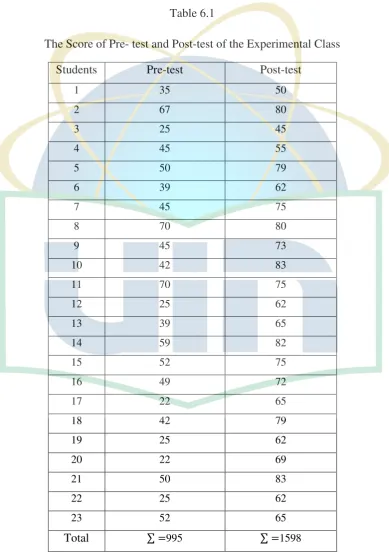
Table 4.2: Result of Normality Test with Chi Square ………..38 Table 4.3 Result of Homogeneity Test with F-Test ………...39 Table 6.1: The Score of Pre-test and Post-test of the Experiment Class….…….49 Table 6.2: The Score of Pre-test and Post-test of the Controlled Class……...50 Table 6.3: Score of Frequency Distribution of the Pre-test of the Experimental
Class………52
Table 6.4: Score of Frequency Distribution of the Post-test of the Experimental
Class ………54
vii
Appendix 1: The Calculation of Frequency Distribution……….. 49
Appendix 2: Normality Test ………... 60
Appendix 3: Homogeneity Test ………... 72
Appendix4: Statistical Hypothesis Test Calculation …………... 76
Appendix 5: Lesson Plan………... 78
Appendix 6: The Instruments of the Research………... 99
Appendix 7: Answer Key of Instruments ……….………... 111
Appendix 8: Kisi-Kisi Soal Pre-Test ………....…….. 112
Appendix 9: Pre-Test Items……….. 113
Appendix 10: Kisi-Kisi Soal Post-Test ……….. 114
Appendix 11: Post-test Items ………. 119
Appendix 12: Pre-Questions ………... 124
viii
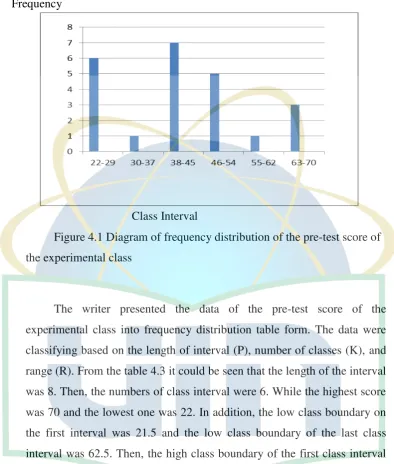
Figure 4.1 Diagram of frequency distribution of the pre-test score of the
[image:13.595.116.509.225.576.2]experimental class ………..32
Figure 4.2 Diagram of frequency distribution of the post-test score of the
experimental class ………..33
Figure 4.3 Diagram of frequency distribution of the pre-test score of the
controlled class ………..35
Figure 4.4 Diagram of frequency distribution of the post-test score of the
1
This chapter describes background of the study, identification of the problems, limitation of the problems, formulation of the problem, objective of the study, and significance of the study.
A.
Background of the Study
Reading is one of language skill which have essential role especially for those who have many activities in academic or journalistic world. It has been considered that as one of four English skills, reading should be mastered by students because reading is not an innate skill. Sousa stated that intelligence generally does not play a critical role in learning to read.1 It means reading does not have any connection with someone’s intelligence. Thus, this skill only can be mastered by learning from the basic and it needs more attention to be learned.
Unlike speaking, reading is not human natural ability. So, reading skill is very important to be mastered, especially to read in a foreign language likes English to communicate with people in the world internationally. And it is a common issue that in non-English speaking country, i.e. Indonesia, reading is difficult for most students. As we have known English in Indonesia is a foreign language in which its opportunity less to use broadly than English as a second language. Therefore, students’ English achievement in Indonesia is not as good as the students who live in English speaking countries. By this fact, student’s English skills such as listening, writing, reading, and speaking is more likely unsuccessful.
1
Based on the writer’s experience when she was a student of MAN Pandeglang, she found some reading problems in the class. First, the teacher’s style was very obsolete. He sat down on his chair talking about the text and then he asked the students to translate the words that unfamiliar to them. Second, many of students got difficulties with the text because less of vocabulary. Third, students were bored with their class because they had to memorize the text and retell it in front of the class.
These problems, however, affected teaching and learning process in reading class especially for students in understanding the content of the text. Sometimes, students did not know what the text about. And it was not only because they poor of vocabulary but also was lack of information about the content of the text. It meant students who did not have any background knowledge of certain topic on the text would fail to understand the text itself. On the contrary, students who had already know or experiences were more likely easy to understand the topic on the text.
In line to this, Keith Johnson proposed that where students do not have background knowledge appropriate for the understanding of a passage, ways of giving it to them needed to be found.2 It meant that students’ background knowledge should be activated before they read the text. Because when reading process occurs, the brain works to comprehend the meaning and to correlate the content to the previous knowledge which already have.
Thus, it can be said that activating background knowledge is required to comprehend the text explicitly. Students with good background knowledge are able to comprehend better than who don’t have or less any background knowledge of the topic in the text. Since the background knowledge has an important role to the reading comprehension, so that one of pre-reading activities should be done in teaching reading to activate students’ background knowledge before they read the text. Thus, the writer decided to choose the pre-questioning technique to be applied in the reading class. Besides, this
2
technique will activate students’ background knowledge toward their reading comprehension with appropriate questions. Students will be given some questions that related to the content of the text.
Based on the writer’s experience being a student in MAN Pandeglang, most of teachers always asked the students to memorize the texts and some of vocabularies. Automatically, students got difficulties in understanding the content of the text. Furthermore, they had no chance to make questions related to the text because they were busy to open their dictionary and to write the words on the paper. This fact made the writer realized that questions would affect the learning outcomes of the students.
According to Nation, comprehension questions is one form or other are one of the language teaching techniques most frequently used to train learners in reading.3 This meant that the questions which help students to understand the text are needed to be given. Moreover, by giving questions it hoped that students can activate their background knowledge while they read. So, they will comprehend the text easily. Therefore, the writer did the research to apply the pre-questioning technique in teaching reading.
B.
Identification of the Problems
Based on the explanation above, the problems can be identified as follow: 1. The teacher did not use a particular technique in which students would
learn enthusiastically in reading subject
2. Students were less of background knowledge or experience about the topic on the text given
3. Students were lack of vocabularies which evoke them getting difficulties in understanding the text
C.
Limitation of the Problems
3
To limit the problems, the writer focused on students’ background knowledge toward their reading comprehension of descriptive text.
D.
Formulation of the Problem
The formulation of the problem in this study was “does pre-questioning technique influence students’ reading comprehension of descriptive text at the First Grade Students of MAN Pandeglang?”
E.
Objective of the Study
The objective of the study was to find out whether or not the pre-questioning technique influences students’ reading comprehension of descriptive text at the First Grade Students of MAN Pandeglang.
F.
Significance of the Study
5
In this chapter, the writer would like to describe some theories related to the study. The theories focus on the definition of reading, the purpose of reading, the kinds of reading, background knowledge in reading comprehension, the definition of pre-question, the kinds of pre-question, advantages and disadvantages of pre-questioning, the relevant previous studies, conceptual framework, and the hypotheses of the research.
A.
Reading
1. The Definition of Reading
Reading is one of language skills that should be mastered by a learner of foreign language. And most of us know that reading skills is very important. This is similar to what Rezvan saffarian and Bahman Gorjian’s statement.1 They said that reading skill is important for students to become academically successful. Reading is also considered by many people as a very pleasurable free time activity that broadens ones knowledge and vocabulary.
Talking about the definition of reading, some experts have given various statement about reading. According to Sandra Silberstein, reading is a complex information processing skill in which the reader interacts with text in order to (re)create meaningful discourse.2 She emphasized that reading is a process between a reader and a text to get information. The process itself happens when the eyes looking at the printed page and the brain works to
1
Rezvan Saffarian and Bahman Gorjian, The Effective Strategies for Developing Reading Comprehension among Primary Students: Males and Females, Journal of Comparative Literature and Culture (JCLC) Vol. 1, No. 2, 2012, p. 39, the article accessed on Wednesday, January 2013 at 9 p.m.
2
create a meaning from a text. Similarly, Cortina and Elder conveyed their idea that reading is a form of thinking.3 Because the brain plays a vital role in reading activity to process the words, sentences, or paragraphs to create meaning. And the eyes are only transmits the written text to the brain. It means that reading is a skill to predict the meaning in which the process involves the eyes and the brain. Thus, the first key skill needed for reading success is decoding.4 It means the readers should be able to interpret the letters of a word in the written text into sound to produce the word in the mouth or mind.
Accordingly, a child who learns to read for the first time should be taught about phonology, how the words sounded, spelled, and divided into syllables. Therefore, decoding skill is very important for those who begins to learning reading because at the time a child know the sound of a letter and the words syllables, she or he can increase the ability to comprehend the sentence. Furthermore, Sousa stated that decoding starts with learning the letters of the alphabet and the basic sound of they represent.5
Another definition is reading as a very complex process that requires many different skills,6 such as decoding ability, understanding meaning, and interpreting words. Beginning reader needs to understand phonology and to able to sound out the words clearly before she or he comprehends the content of the text to interpret the meaning in the printed page. It means reading is an active process which requires some skills and knowledge. So, it can be said that reading is a mental process of interaction between a reader and a writer which dominated by the eyes and the brain.
3
Joe Cortina and Janet Elder, Opening Doors: Understanding College Reading, (New York: McGraw-Hill, 2005), p.75
4
Larry Lewin, Paving the Way in Reading and Writing, (San Francisco: Jossey-Bass, 2003), p. 3
5
Sousa, Op.Cit., p. 37
6
2. The Purpose of Reading
People read the book because they have some reasons. They may read in order to get some information, to increase the knowledge, or to get pleasure. Harmer stated that many students reading English text for study purposes or simply for pleasure.7 It determines what the important in the text is. Thus, a reader should know firstly what the content of the text he will read then he can determine whether the information important or not for him.
Futhermore, Aebersold explained that purpose influences reading at all levels.8 It means that in reading process no matter the reader should has sufficient knowledge about the content of the text. Therefore, determining the purpose before reading is very important for the reader. It was also clear that the purpose of reading depends on a reader’s need whether because want to increase the knowledge, to get some information, or to get pleasure.
From the discussion above it can be said that people read with some purposes; getting information about movies, political issues, up dated score of football, new novels list, menu in a restaurant, racing car schedule, newspapers, etc.
3. The Kinds of Reading a. Intensive Reading
According to Harmer, the term of intensive reading refers to the detailed focus on the construction of reading texts.9 Intensive reading is usually accompanied by study activities. Jack Richard stated that aim of intensive reading is to help students obtain detailed meaning from the context, to develop reading skills, such as identifying main ideas and recognizing text connectors and to enhance vocabulary and grammar knowledge.10
7
Jeremy Harmer, How to Teach English, (China: Pearson Education, 2007), p.99
8
Jo Ann Aebersold and Marry Lee Field, From Reader to Reading Teacher; Issues and Strategies for Second Language Classrooms, (USA: Cambridge University Press, 1998), p. 66
9
Harmer, Op.Cit., p. 99
10
In intensive reading Nation stated that the reader can focus on following aspects, such as comprehension, regular and irregular sound-spelling relation, vocabulary, grammar, information structure, etc.11 It means that intensive reading is the reading activity where a reader reads intensively. It can help the students get the details meaning in the text, to find particular vocabulary and grammar so that they can use the information that they get in the text to move on to other learning activities.
b. Extensive Reading
Extensive reading is reading activities which the reader read extensively. According to Gebhard, the goal of extensive reading is to improve reading skills by processing a quantity of materials that can be comprehended and pleasurable.12 The teachers who implement extensive reading set up an open library where the students can select from any kinds of reading materials. It means that extensive reading is one kind of reading activity where a reader reads extensively.
4. Background Knowledge in Reading Comprehension
The term of background knowledge has the same meaning with other terms such as prior knowledge, schema (plural schemata), or world knowledge. According to Jo McDonough, schemata allow us to predict what may happen in a future context.13 It is one of important elements in reading activities that affect to a readers’ comprehension. This knowledge helps them to comprehend a reading text with better outcomes. Because readers with prior knowledge understand and remember texts better than readers with little prior knowledge. It means readers’ prior knowledge is one of many factors that affect learning from texts.
11
Nation, Op.Cit., p. 27
12
Jerry G. Gebhard, Teaching English as a Foreign or Second Language, (USA: Macmillan, 2009), p. 203
13
Schema theory, in its more popular explanations, assumes that readers have stored in their minds generalized networks ort information that reflect common events, scenarios, objects, or locations.14 Actually, in reading a text someone should have background knowledge to understand the messages in the written text. In this line, the writer defines background knowledge as stored information in a reader’s memory which is related to the topic in a text he or she is reading. In short, background knowledge or prior knowledge gained likes an abstract structure of knowledge in our mind.
The similar definition also stated by Larry Lewin that prior knowledge is what readers already know about the incoming topic.15 This definition is similar to Gillet, Temple, and Crawford. They said that prior knowledge is what we already know or have experienced, directly or vicariously, that we bring to the act of reading.16 These two definitions stated that prior knowledge or background knowledge is what the readers have already known about a topic. And this knowledge also includes experience of life or any information which saved in memory. Besides, Alderson also said that schemata are seen as interlocking mental structures representing readers’ knowledge.17
Therefore, the more background knowledge students have, the more comprehend they are in reading the text.
Peter Tze-Ming Chou also stated that one of research result in second language research shows that there is an evidence that having this prior knowledge plays a significant role in comprehension.18 It can besides that background knowledge has an influence towards learning reading comprehension outcomes.
Background knowledge, as the writer said before has a significant effect to a reader’s comprehension. For example, a teacher is likely more
14
William Grabe, Reading in a Second Language, (USA: Cambridge University Press, 2009), p. 77
15
Lewin, Op.Cit., p. 23
16
Jean Wallace Gillet, et.al., Understanding Reading Problems, (USA: Pearson Education, Inc., 2002), P.167
17
Alderson, Op.Cit., p. 33
18
understand to read an article about journal of education than journal of medical science. It means someone’s background knowledge in memory may vary from each other. So, background knowledge is very helpful to comprehend the text. As Patricia Grant said, background information (background knowledge) will help us remember better.19 It indicates that background knowledge has a great function in reading comprehension. Without having background knowledge, a reader likely failed to comprehend the written text.
In addition, Gebhard stated that student’s ability to comprehend the content of the reading material depends in part on their knowledge about the topic of the reading selection.20 Thus, comprehension in reading emphasized on the importance of the prior knowledge or information which is already know to get better comprehension. Furthermore, Thom Hudson said that the advantageous of background knowledge is when a reader who already has an elaborate schema can more easily fit incoming textual information into that schema.21 It means that a reader’s knowledge of the text content depends on lived experience. And this is different in different countries, regions, or cultures. So, the instruction of reading should be sensitive to the types of background knowledge which is needed by the readers to understand the text.
From his statement, it can be said that students who have relevant background knowledge will get benefit because such background knowledge can help them in understanding the text. One researcher also said that background knowledge plays an important role in reading comprehension that any teacher cannot teach reading well without watching out for the background knowledge.22 It is because the students getting the meaning from the text by analyzing its content based on to their own personal knowledge or information.
19
Patricia Grant, Reading and Study Skills, (Singapore: Prentice-Hall, Inc., 1999), p. 161
20
Gebhard, Op.Cit., p. 205
21
Tom Hudson, Teaching Second language Reading, (China: Oxford University Press,2007), p. 142
22
Accordingly, the important thing in reading comprehension is the ability of students to connect new knowledge or information to the knowledge they already possess. A good comprehension will occurs if the readers have the match between their background knowledge and the content of a text because comprehension depends on knowledge. The tudents’ comprehension depends on how much related background knowledge they have while reading.
To conclude, background knowledge has a big influence towards students’ reading comprehension and their learning outcomes. Therefore, teachers need a particular way to activate students’ background knowledge in reading comprehension.
B.
Pre-questioning Technique
1. The Definition of Pre-question
Pre-question is one of pre-reading activities which can be used to facilitate students’ reading comprehension. Pre-question can help the readers to activate their background knowledge before reading the text. According to Brown, pre-questioning implicitly as some questions which are provided before the students read the whole text, in order to build the students’ interest and motivation, also their cognitive factors and pre-questioning is very useful to activate the schemata, thus the students can predict what will be faced by them in the reading text.23 This is similar to what Anderson said in his book that activation of background knowledge can be initiated by setting goals, asking questions, and making predictions.24 It means that the readers’ background knowledge can be activated by giving a number of questions. It is also make the reading activities more effective because the readers easily comprehend the content of the text.
23
H. Douglas Brown, Teaching by Principles, (San Fransisco: Addison Wesley Longman, Inc.,2001), p. 100
24
Furthermore, Haynes and Zacarian stated that good readers are always asking themselves questions before, during, and after reading. 25 So, this pre-question technique is really a good and appropriate tool to support teachers in teaching reading comprehension. The students would also more interest in their reading activity. According to Parviz Ajideh, questions may be generated by the teacher or by the students and should be done before the reading, rather than after the reading.26 And as one of the pre-reading activities, pre-question technique is also useful to build the students’ interest and motivation. It is one of the best ways for teachers to develop their role as a leader to create interactive interaction in the classroom. Besides, the aim of pre-reading tasks is to activate schemata. So, the students can predict what will be faced by them in reading the text. It can be said that the pre-questioning technique is highly encourages in pre-reading activities to use by the teachers in teaching reading comprehension. The questioning technique is also helps teachers to assess how much students learn the materials or understand the reading text. Besides, one research result showed that questioning strategies can be used not only for learning content, but also to guide students to think critically and analytically, leading to deep levels of understanding.27
It was clear to say that questions in teaching reading comprehension is essential to improve the students’ learning outcomes because the technique emphasizes on stimulation in reading skill by activating background knowledge with some questions.
25
Judie Haynes and Debbie Zacarian, Teaching English Language Learners, (USA: ASCD, 2011), P. 79
26
Parviz Ajideh, Schema–theory Based Considerations on Pre-reading Activities in ESP Textbooks, The Asian EFL Journal. Teaching Articles. November 2006, Vol 16, p. 7, the article accessed on Wednesday, March 2013 at 3 p.m.
27
2. The Kinds of Pre-question
According to Harmer some kinds of pre-questioning are:28 a. Pre-questioning before reading to confirm expectations
The use of pre-questioning as a tool is to motivate students and to encourage them to predict the content of the text. For example: reading the fairy book, and comic.
b. Pre-questioning before reading to extract specific information Pre-questions as a tool to force the students to extract specific information and to answer before reading the text. For example, reading the contents of vitamin in a supplement, reading the substance in book recipe.
c. Pre-questioning before reading for general comprehension
In this case pre-questioning used to build up the students’ prior knowledge. For example, reading the sport magazine.
d. Pre-questioning before reading for detailed comprehension
This kind of pre-questioning intends to give the students some detailed information that should be found in the whole of the text. For example, reading the story book.
3. Kinds of Questioning in Reading Comprehension
Based on the article written by Richard and Jeoung-suk Park there are five forms of comprehension questions to stimulate students in understanding the written text.29 They are yes/no questions, alternative questions, true or false, wh- questions, and multiple-choice. And according to Anne Juwita, usually the questions in reading comprehension tests are about:30
28
Jeremy Harmer, The Practice of English Language Teaching, (Esssex: Longman, 1991), p. 153
29
Richard R. Day and Jeong-suk Park, Developing Reading Comprehension Questions, Reading in a Foreign Language,Volume 17, No. 1, April 2005, p. 65
30
a. Main idea
The question about main idea asks the reader to determine or the topic from a text, and commonly it is signed by words such as: mainly discussed, main idea, best title, main purpose, main purpose, mainly concerned, mainly topic.
Here are some examples of questions to ask about main idea: - What is the main idea of the passage?
- With which of the following is the passage mainly concerned? - What is the main part of the passage?
- Which of the following would be the best title? b. Supporting details
The question about supporting detail asks the reader to find detail information that is printed explicitly in the text. It is commonly signed by words such as: according to the author …, according to the passage…, who, what, which, when, where, why, how.
Here are the examples of questions to ask about supporting details: - Which of the following question does the passage answer?
- According to the passage, which statement is true?
- When did ‘something’ happen?
- Who did ‘something’?
c. Implied questions
In the test of reading comprehension, there is a passage shown facts or information. Based on it, we are asked to make a decision. It is signed by words such as implied, probably.
Here are some examples of questions about implied questions: - It is implied in the passage that …?
- What probably happened in the passage …?
d. Find the details of question
statement. It means that if there are four answers, it is three right answers but one wrong answer.
Here is the example of questions to ask about details of questions: - All the following are stated in the line ….except?
e. Pronoun
It is to determine who or refers to pronoun itself. The first sequence is noun and after that pronoun. The example of the question to ask about pronoun is:
- The person … in the line … refers to? f. Passage organization
This is the question related to the passage or information in the paragraph. There is relationship between every paragraph in answering the questions. It is commonly signed by words such as: …passage organized, differ …, is included …, relatedto the first paragraph….
Here are some examples of questions to ask about passage organization:
- How is the information in the passage organized?
- How is the information in the passage related to the first paragraph?
- How does the information in the first paragraph differ to the second paragraph?
- What type of information is included in the first paragraph? g. Transition of the question
The question is usually to guess what is content of previous or obvious passage in the paragraph. It is commonly signed by words such as the preceding paragraph …, the following paragraph ….
4. Advantages of Pre-questioning Technique
a. Pre-questioning greatly assist students in reading comprehension cognitive especially since students are challenged and feel aroused reading comprehension is highly complex information processing that involves the interaction between a reader and a text.31
b. Pre-questions can build the interest and the motivation before students read the text.
5. Disadvantages of Pre-questioning Technique
a. For teachers, applying this technique needs more time in the class. If the teachers do not mastering the material about the content of a text, teaching and learning activity will be failed.
b. For students, they have to be more creative in developing questions about the topic on the given text. If the students’ vocabulary poor, automatically they will have little question about the content of the text and finally they will also have less comprehension on it.32
C.
Relevant Previous Studies
There were previous researches which related to the study here. First, the research which was done by Siti Hodijah entitled Teaching Reading Using Pre-Questioning Technique at the Second Grade Students of SMPN 1 Cihampelas Kabupaten Bandung Barat. The objective of this research was to improve the students reading comprehension ability. The populations of this study were thirty one of the second grade students of SMPN 1 Cihampelas Kab. Bandung Barat and the sample was entire population. This research used one group pretest-posttest design and quantitative method. The instruments used in this research were pretest and posttest. The collected data were
31
Silberstein, Loc.Cit., p. 12
32
analyzed by using t-test formula. The results of the data analysis showed that: the mean score of pretest was 35.16, the mean score of post-test was 56.61, the to was 11.172. The ttable with degrees of freedom (df) 30 and level of significance at 5 % (0.05) was 1.697.Based on the data above, teaching reading using pre-questioning technique improved students’ achievement in understanding reading text at the second grade students of SMPN 1 Cihampelas Kab. Bandung Barat, It also mean that the alternative hypotheses of this research was accepted because the to was higher than ttable (11.172>1.697).
Second, the research which was done by Dyah Sunggingwati and Hoa Thi Mai Nguyen with their article entitled Teachers’ Questioning in Reading Lessons: A Case Study in Indonesia. This study investigated the practice of teacher questioning and teaching reading in secondary schools in Indonesia. Teachers from three grade 11 classes from three different secondary schools participated in this multiple-site case study which was employed to generate rich explanatory data across sites. The data were gathered from the teachers in the form of observations, interviews, and textbook analysis. The findings from this study showed that the teachers relied on the textbooks for pedagogies for teaching reading and for the kinds of questions they asked to assist in reading comprehension.
D.
Conceptual Framework
There were two variables in this research; pre-questioning technique as the independent variable and the students’ reading comprehension of descriptive text as the dependent variable. The research focused on the experiment to know whether there was significance effect of applying pre-questioning technique to improve students’ reading comprehension of descriptive text and to know whether the students’ reading comprehension using pre-questioning technique would be better than reading without treatment of pre-questioning technique or use conventional way (e.g. classroom teacher explanation).
According to Richard R. Day, the theories and models of reading have changed, from seeing reading as primarily receptive process from texts to reader to interactive process between the reader and the text.33 Approaches to the teaching of foreign language reading have attempted to reflect this development through interactive exercises and tasks. The use of questions is an integral aspect of such activities and it have seen that well-designed comprehension questions help students interact with the text to create or construct meaning. Therefore, if pre-question technique implemented in teaching reading, the students would have the chance to share their previous experience that related to the text. Besides, they could share the questions they have with their friends to comprehend the text well. By using pre-questioning technique the teacher also would have better assessment of the students’ ability in reading comprehension. Further, reading with some questions given probably would stimulate the student’s mind in finding new ideas to make them more creative in learning a text. Conventional technique in teaching reading comprehension is still widely used by teachers in the classroom (e.g. classroom teacher centered with full of explanation). When the students have the text and they did not know what its content about, they would feel down in seeing an unfamiliar text and finally it could make them
33
lack of comprehension of the text. Besides, the teacher used to explain the general content of the text without giving the students to share and to think in depth comprehension. Meanwhile, with the pre-question technique student and teacher could have an intensive atmosphere to create a new thought of the topic. Pre-questioning technique, as one of pre-reading activities, provided a reader with necessary background to organize activity and to comprehend the material.34 In addition, it also gives the students to have more chance and time to activate their background knowledge so that the students automatically understand the text easily.
E.
The Hypothesis of the Research
The hypotheses in this research were:
(Null Hypothesis): There is no influence of using pre-questioning technique toward students’ reading comprehension of descriptive text
(Alternative Hypothesis): There is influence of using pre-questioning technique toward students’ reading comprehension of descriptive text
34
20
This chapter presents the research design of the study, the population and sample, the time and the place of the research, the intervention of the study, the instrument of the research, the validity and reliability, technique of data collecting, the technique of data analysis, and statistical hypothesis.
A.
Research Design
The research method used in this research was a quantitative method. In this research, the writer selected subjects, technique of data collection, the way to collect the data, and the way to implement treatments. The writer also had to collect numerical data and analyze it by using statistics calculation to explain a particular existing thing. Furthermore, in this research the writer used two groups as experimental and controlled class for the sample. After selected the subject of the research, she gave a treatment to one class to see whether or not this treatment had a significant effect toward students’ learning outcome. During the research, both groups were given equal materials with different techniques; experimental class was taught by pre-questioning technique and controlled class was taught by conventional way. Then, at the end of the research, she compared the score of both classes, experimental and controlled class.
B.
Population and Sample
to Suharsimi Arikunto, the purposive sample is the sample which has done with taking the subject is not based on strata, random or the area but, it is based on the purpose itself.1 In this research, the class X-4 was the controlled class which consists of 23 students and X-5 was the experimental class which consists of 23 students too. Here, the writer chose the students of class X-4 as the controlled class because they had higher English score than students of class X-5.
C.
The Time and the Place of the Research
This research was conducted at MAN Pandeglang which is located on Jl. Raya Ciekek-Labuan Km. 40, Pandeglang, South Banten. The research started in August 29 until 26 September 2013.
D.
The Intervention of the Study
In this research, the writer gave the pre-test before she conducted the treatment (pre-questioning technique) to see the first condition of the students. Next, she conducted the treatment for six meetings. In the experimental class, the pre-questioning technique was delivered to the students. They learned descriptive text by giving questions to themselves to activate their background knowledge of the topic on the text.
For example, if the student had a descriptive text about “Borobudur Temple”, then the writer discussed some questions about that topic in order to students remember about anything of the topic. Here, the writer helped them by giving pre-questions about “Borobudur Temple”. Those questions were aimed to help the students to understand the text in depth comprehension. That technique was given in every meeting.
1
On the other hand, in the controlled class the writer only gave the texts of descriptive without pre-questioning technique to the students. The treatment to this class was different from the experimental class. From the first meeting they learned descriptive text with conventional technique. The writer did not give any questions related to the materials on the texts. In the last meeting, she gave post-test to both classes in order to know the difference outcomes between experimental class and controlled class.
E.
The Instrument of the Research
In this research, the writer used test as the instrument. She did consultation to some English teachers related the properness and the appropriateness of the instrument in which the test would be given to the students. The kind of the test which was given to the students was multiple choices. There were two written tests conducted in this research namely pre-test and post-pre-test. The instrument of the pre-pre-test and the post-pre-test could be seen on the appendix.
F.
The Validity
Before the writer gives the test to the students, she should measure first the degree of validity of the test. Arikunto stated that test validity is test can measure what will be measured.2 It meant that the writer needs to test the validity of test items before she give them to the students in order to know whether or not the test is valid. Here, the writer conducted the test validity to the First Grade students of MAN Cihideung Pandeglang. The writer gave 30 items of multiple choices for pre-test and post-test. Later, she calculated the score by using Ana-Test software. The criteria of validity could be seen on the following table.
2
The Interpretation of Validity
r Value Interpretation
0,81 –1,00 Very High
0,61 –0,80 High
0,41 –0,60 Enough
0,21 –0,40 Low
0,00 –0,20 Very low
(Suharsimi Arikunto, 1998:29)
G.
The Reliability
Reliability refers to the consistency of measurement, or the extent to which the score are similar over different forms of the same instrument or occasion of data collection.3 Reliability is also means that the scores from an instrument which the researcher used are stable. It could be said that the scores from an instrument should be similar when the researcher administer the instrument at different time. Thus, the scores should be consistent.
The Interpretation of Reliability Coefficient Correlation Interpretation
0,81 <r < 1,00 Very High 0,61 <r < 1,80 High 0,41 <r < 0,60 Enough 0,21 <r < 0,40 Low 0,00 <r < 0,20 Very low
(Suharsimi Arikunto, 2003:75)
3
H.
Technique of Data Collecting
To collect the data, the writer did some steps in this research as follows:
1. Pre-test
According to Creswell, a pre-test provides a measure on some attribute or characteristic that will be assessed for participant in experiment before they receive a treatment.4 On the first week of the research schedule, the writer conducted the pre-test to the controlled and experimental classes. Then, she asked the students to answer the questions of multiple choice tests on the answer sheet. The test consists of 30 items of multiple choices to know the students’ knowledge of the materials will be taught. For the pre-test, both the classes were not given the treatment of pre-question technique. Then, the pre-test scores of those classes became the first raw data of this research.
2. Treatment
After the pre-test was done, the writer compared the scores between the controlled and experimental classes to the difference. Then, she selected the class which had the lowest scores as the experimental class and the class with the highest score as the controlled class. The materials of the treatment were descriptive texts. The writer gave the same materials to both of experiment and control class with different treatments. The experiment class learned reading comprehension by using pre-questioning technique and the control class learned reading by using conventional technique.
3. Post-test
After the treatment, the writer gave the post-test to the controlled and experimental class. It was given to know the characteristic that will be assessed after they receive a treatment. In this research, the writer gave the
4
post-test to both experiment and control class in the eighth meeting of the learning activities. She gave the post-test which was content of 30 multiple choices items. Its purpose was to know students’ reading comprehension between experiment and control class who taught by two different methods. The test items of pre-test and post-test could be seen on the appendix.
I.
The Technique of Data Analysis
After getting pre-test and post-test scores of this research, the writer did a test of normality to see the normality of students’ ability in reading comprehension and a test of homogeneity to know that the students’ ability of both the controlled and the experimental class were homogeneous. After testing the normality and the homogeneity, the data from the post-test of the controlled class and the experimental class were analyzed by using a parametric statistics. The parametric statistics used was t-test formulation.
1. Test of Normality
The normality test was aimed for ensuring whether the data which were attained from the population had normal distribution or not. In this research, the writer used Chi-Square test with formula:5
χ
2= ∑
Description:
χ
2= Chi Square value
= Observation frequency
5
= Expected frequency
The criteria of testing normality was; if fo < ftable, HO was accepted and if fo > ftable, H was rejected. On the contrary, if if fo > ftable, HO was rejected and H was accepted.
2. Test of Homogeneity
In order to know the variance of the data, a researcher needs to know whether the data is homogenous or heterogenic. According to Bambang Soepeno, before using t-test analysis, a researcher suggested to do the homogeneity test first.6 This is important because there are some kinds of t-test analysis which provided in many formulas based on the variance of the sample. In this research, the writer used F test to know the homogeneity of the data with the formula:
F = S
12/ S
22Description:
F = Value of F-test S12 = The greatest variance S22 = The smallest variance
Firstly, the writer determined the hypothesis, they were Ho and H1. Then, she calculated the Fvalue by the formulation above. After calculating the Fvalue, the writer ascertained the significance level (α) and calculated Ftable by the formulation Ftable = Fα (n1-1, n2-1). The last step was, she determined the criteria of testing. The criteria were: If Fvalue was smaller than Ftable (Fvalue < Ftable), it meant that H0 was accepted (homogenous),
6
however, if Fvalue was greater than Ftable (Fvalue > Ftable), it meant that H0 was rejected.
3. Statistical T-test Formulation
In this research, the writer used t-test to analyze the data by the following formulation:7
t =
√ ∑ ∑
Description:
X1 = Mean of variable X X2 = Mean of variable Y n = Number of cases
4. Class Range
The range is the most obvious measure of dispersion. It is simply the difference between the highest and the lowest score in the distribution.8 The formulation was:
R = H – L
Description: R = Range
H = Highest score L = Lowest score
7
Soepeno,Ibid, p.157 8
5. Mean
Mean is the average value of the data which gained from the colleting of data in quantity and has not variation.9 It is calculated by summing all the scores and then dividing the sum by the number of scores. The formulation used here was:
= ∑
∑
6. Standard Deviation
The standard deviation is a numerical index that indicates the average variability of the scores.10 The formulation was:
S
d=
√
7. Variance
The variance is a measure of data distribution from the continuous variable which showed the deviation square from the mean.11 The formulation was:
S2 = ∑
8. Statistical Hypothesis
The statistical hypotheses of this research were:
Ho = there is no a positive effect of using pre-questioning technique toward students’ reading comprehension of descriptive text after post-test
9
Ha = there is a positive effect of using pre-questioning technique toward students’ reading comprehension of descriptive text after post-test.
9. Determining the Effect Size
After calculating the data, the next step was determining the effect size. According to James McMillan, effect size is a measure of strength of association to estimate proportions of variance held in common.12
It is typically reported in a generalized form as the ratio of the difference between the group means divided by the estimated standard deviation of the population. In short, effect size done to see how much the technique influence the improvement of students’ achievement. Here, the writer used a statistical calculator by Daniel Soper.13 The interpretation of the effect size criteria could be seen on the following table.
The Interpretation of Effect Size
Cohen’s Ratio Interpretation
0<d <0,2 Small Effect
0,2<d <0,8 Medium Effect
>0,8 Big Effect
12
James H. MacMillan and Sally Schumacher, Research in Education: Evidence-Based Inquiry. USA: Pearson Education, Inc., 2006, p.295
13
30
In this chapter, the writer would like to present the description of data which consists of the score of both pre-test and post-test between two classes, experimental and controlled class. Besides, the description would be followed by the analysis of data and discussion.
A.
The Description of Data
There were two kinds of data which had obtained by the writer; pre-test and pot-pre-test score. Both of the data would be presented in the following description.
1. The Score of Pre- test and Post-test of the Experimental Class
2. The Score of Pre-test and Post-test of the Controlled Class
In this research, the controlled class was the students of class X-4 at MAN Pandeglang, South Banten. There were 23 students in the controlled class. Based on the calculation, the pre-test mean score was 47.02. Then, the student’s lowest score achieved in pre-test was 20 and the highest one was 67. However, the mean score of the experimental class was 51.34 after the treatment of pre-questioning technique which given by the writer in the class. The finding pointed was that the mean score of the post-test was higher than the mean of the pre-test. The range between the mean of pre-test score and the mean post-test score gained 4.32. In the post-test, the lowest score achieved was 37 and the highest score achieved was 70. The pre-test and the post-test score of the students in the controlled class could be seen on the appendix.
3. The Frequency Distribution of the Experimental Class a. Pre-test score of the experimental class
The Frequency Distribution of the pre-test of Experimental Class No. Interval Low Class
Boundary
Up Class Boundary
Frequency Absolute Relative
1. 22-29 21.5 29.5 6 26.08 %
2. 30-37 29.5 37.5 1 4.34 %
3 38-45 37.5 45.5 7 30.43 %
4. 46-54 45.5 54.5 5 21.73%
5. 55-62 54.5 62.5 1 4.34 %
6. 63-70 62.5 70.5 3 13.04 %
Frequency
[image:45.595.116.511.117.582.2]Class Interval
Figure 4.1 Diagram of frequency distribution of the pre-test score of the experimental class
b. Pot-test score of the experimental class No. Interval Low Class
Boundary
Up Class Boundary
Frequency Absolute Relative
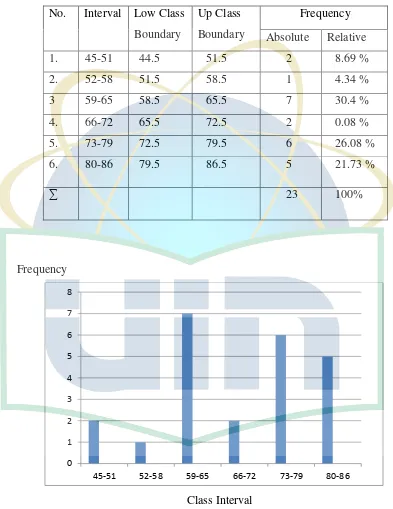
1. 45-51 44.5 51.5 2 8.69 %
2. 52-58 51.5 58.5 1 4.34 %
3 59-65 58.5 65.5 7 30.4 %
4. 66-72 65.5 72.5 2 0.08 %
5. 73-79 72.5 79.5 6 26.08 %
6. 80-86 79.5 86.5 5 21.73 %
∑ 23 100%
Frequency
[image:46.595.118.511.164.673.2]Class Interval
Figure 4.2 Diagram of frequency distribution of the post-test score of the experimental class
0 1 2 3 4 5 6 7 8
The lowest score in class interval was 45 while the highest was 83. By using Sturgess rule, there were 6 classes for class interval with the length of interval 7. From the result which could be seen on the table 4.4, the low class boundary from the first class interval was 44.5 and the low class boundary from last class was 79.5 while the high class boundary on the first class interval was 51.5 and the high class of the last class interval was 86.5. The total absolute frequency was 23. In addition, the total frequency which was formulated in percentage (relative frequency) was 100%. The table showed that the most students’ post-test score appeared in the experimental class was in class interval 59-65 with the absolute frequency 7. However, the lowest absolute frequency was in class interval 52-58, with only 1 student. For the statistical calculation description, see the appendix.
4. The Frequency Distribution of the Controlled Class a. Pre-test score of the controlled class
The Frequency Distribution of the pre-test of Controlled Class No. Interval Low Class
Boundary
Up Class Boundary
Frequency Absolute Relative
1. 20-27 19.5 27.5 1 33.3 %
2. 28-35 27.5 35.5 3 13.0 %
3 36-43 35.5 43.5 6 26.0 %
4. 44-51 43.5 51.5 5 21.7 %
5. 52-59 51.5 59.5 3 13.0 %
6. 60-67 59.5 67.5 5 21.7 %
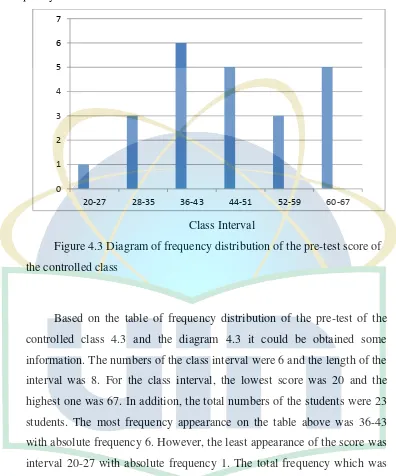
Frequency
[image:48.595.116.512.125.601.2]Class Interval
Figure 4.3 Diagram of frequency distribution of the pre-test score of the controlled class
Based on the table of frequency distribution of the pre-test of the controlled class 4.3 and the diagram 4.3 it could be obtained some information. The numbers of the class interval were 6 and the length of the interval was 8. For the class interval, the lowest score was 20 and the highest one was 67. In addition, the total numbers of the students were 23 students. The most frequency appearance on the table above was 36-43 with absolute frequency 6. However, the least appearance of the score was interval 20-27 with absolute frequency 1. The total frequency which was formulated into relative frequency was 100%. Then, the low boundary class on the first interval was 19.5 and the low boundary class of the last interval was 59.5. While the high boundary class on the first interval was 27.5 and the high boundary class of the last interval was 67.5. For the complete statistical calculation description, see the appendix.
0 1 2 3 4 5 6 7
b. Post-test score of the controlled class
The Frequency Distribution of the post-test of Controlled Class No. Interval Low Class
Boundary
Up Class Boundary
Frequency Absolute Relative
1. 37-42 36.5 42.5 3 13.0 %
2. 43-48 42.5 48.5 2 8.6 %
3 49-54 48.5 54.5 4 17.3 %
4. 55-60 54.5 60.5 11 47.8 %
5. 61-66 60.5 66.5 1 4.3 %
6. 67-82 66.5 82.5 1 4.3 %
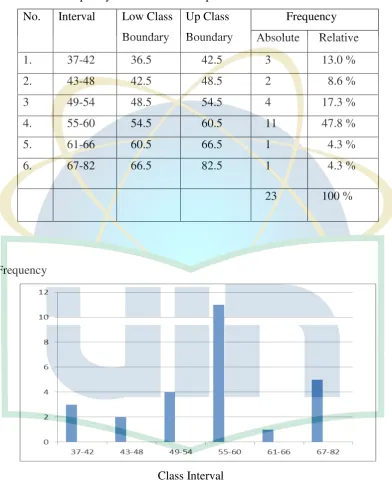
23 100 %
Frequency
[image:49.595.117.510.156.640.2]Class Interval
Figure 4.4 Diagram of frequency distribution of the post-test score of the controlled class
class interval of the low class boundary was 36.5 and the highest one was 66.5. While the highest class interval of the high class boundary on the first interval was 42.5 and the highest one of the last interval was 82.5. In addition, there were 23 numbers of students for the total absolute frequency. Moreover, the lowest absolute frequency was 1 on the two last intervals 61-66 and67-82. On the other hand, the highest absolute frequency was 11 on the interval 55-60 with relative frequency 47.8%. For the calculation description, see the appendix.
B.
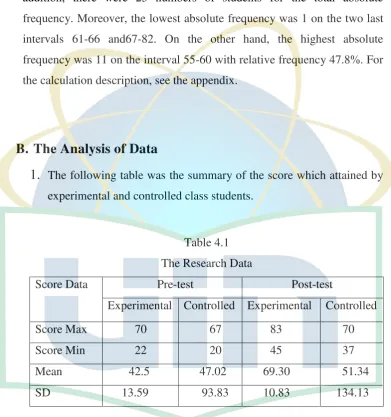
The Analysis of Data
[image:50.595.119.511.185.603.2]1.
The following table was the summary of the score which attained by experimental and controlled class students.Table 4.1 The Research Data
Score Data Pre-test Post-test
Experimental Controlled Experimental Controlled
Score Max 70 67 83 70
Score Min 22 20 45 37
Mean 42.5 47.02 69.30 51.34
SD 13.59 93.83 10.83 134.13
standard deviation of pre-test score of the experimental was 13.59 and 93.83 for the controlled class. Now, the score of post-test of both classes; the highest score of the pre-test of the experimental class was 83 while the score of the controlled was class only 70. Then, the lowest score of post-test of both groups were 45 for the experimental class and 37 for the controlled class. Next, the mean score of post-test of the experimental class was the highest; it was 69.30 while the mean score of post-test of the controlled class was 51.34. However, the standard deviation of the post-test of the controlled class was higher than the experimental class; it was 134.13 while the standard deviation of pre-test score of the experimental class was 10.83. For the calculation description, see the appendix.
2. Data Analysis of Testing Requirements a.Normality Test
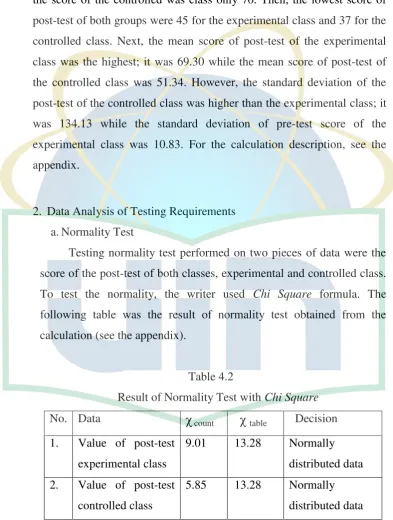
Testing normality test performed on two pieces of data were the score of the post-test of both classes, experimental and controlled class. To test the normality, the writer used Chi Square formula. The following table was the result of normality test obtained from the calculation (see the appendix).
[image:51.595.116.510.183.704.2]Table 4.2
Result of Normality Test with Chi Square No. Data
χ
countχ
table Decision 1. Value of post-testexperimental class
9.01 13.28 Normally distributed data 2. Value of post-test
controlled class
The column of decision was made based on testing the hypothesis of normality that if
χ
count<
χ
tablethen interpreted normally distributed data. On the contrary, ifχ
count>
χ
table,then the data was not normally distributed data. Based on the table 4.4 above, the result of normality calculation showed that theχ
count of post-test of the experimental class was 9.01. On the contrary, theχ
count of post-test of the controlled class was 5.85. Meanwhile,χ
table was 13.28. For theχ
count of the post-test of the experimental class was smaller thanχ
table and theχ
count of post-test of the controlled class was also smaller thanχ
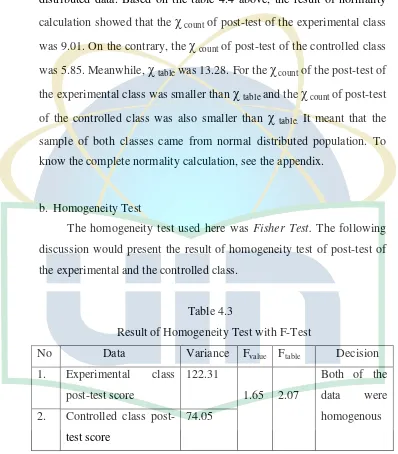
table. It meant that the sample of both classes came from normal distributed population. To know the complete normality calculation, see the appendix.b. Homogeneity Test
[image:52.595.117.515.190.644.2]The homogeneity test used here was Fisher Test. The following discussion would present the result of homogeneity test of post-test of the experimental and the controlled class.
Table 4.3
Result of Homogeneity Test with F-Test
No Data Variance Fvalue Ftable Decision
1. Experimental class post-test score
122.31
1.65 2.07
Both of the data were homogenous 2. Controlled class
post-test score
74.05
variance and the smaller variance while Ftable was 2.07. To get the conclusion whether the population of samples of the experimental and the controlled class was homogeneous or not, hence, the writer determined the criteria of homogeneity hypothesis testing. The criteria hypothesis mentioned; if Fvalue< Ftable, it meant that H0 was accepted (homogenous), however, if Fvalue was greater than Ftable (Fvalue > Ftable), it meant that H0 was rejected. Based on the calculation, the result of homogeneity test in this research showed that Fvalue < Ftable 1.65 < 2.07. Accordingly, it could be concluded that the sample of both the experimental and the controlled class were homogeneous. For more complete statistical calculation, see the appendix.
3. Test Analysis
After calculating the normality and homogeneity tests, the next step was analyzing the hypothesis test by using t-test formula. Based on the calculation, it found that tvalue was 7.54 and ttable was 2.021. It meant that tvalue > ttable. 7.54 > 2.021. In other words, Ho was rejected and Ha was accepted. To conclude, there was a positive effect of using pre-questioning towards students’ reading comprehension of descriptive text. To know the complete statistical calculation, see the appendix.
C.
Discussion
of the text itself. Besides, their background knowledge was incomplete without help questions related to the content of the text. That condition was not good because such a teaching style would successfully get the students bored and less of motivation to read especially to comprehend the text in deeply. To read an unfamiliar text, of course, the students needed a particular way of learning in order to get the meaning of the text rapidly. That is why activating background knowledge of something we have seen, felt, saw, or heard was very important. Automatically, when the students read the text they needed many ideas in their mind to help their comprehension.
On the contrary, there was influence of using pre-questioning technique in the experimental class. It could be seen from the result of the post-test score after the treatment of pre-questioning technique which was higher than the result of the post-test without pre-questioning technique. The mean score of pre-test (before pre-questioning technique) was 42.5 while the score of the post-test (after treatment) was 69.30. The students’ background knowledge had already activated by pre-questions so that they were ready to comprehend the content of the text especially for they who had previous experience related