Identifcation of Gdf9 Gene And its Relationship with The Prolific Traits on
Indonesian Local Goats
Aron Batubara1, R. R. Noor2, A. Frajallah3 and B. Tiesnamurti4
1Indonesian Meat Goat Research Station, Sei Putih, P.O. Box 1 Galang, North Sumatra Province, Indonesia, 2Animal Production Technology Department, Graduated School Faculty,
Bogor Agricultural University, 3Biology Departments, Graduated School Faculty, Bogor Agricultural University, 4Indonesian Central for Animal Research and Development, Bogor,
Indonesia
Corresponding email: [email protected] ABSTRACT
Local goats is very potential for breeding program which suitable to the Indonesia local conditions. The sampling was conducted in four genotypes of the Indonesian local goats (amounts 149 goats) namely: 25 animals Kacang goats, 29 head PE goats, 35 Muara goats and 60 Samosir goats. The goats blood were with absolute Ethanol. DNA extracted analyzed by PCR and RFLP methods for GDF9 gene. The result showed that the identification of GDF 9 gene promoter were polymorphic than and have our relationship with the prolific traits on the twinning does on Kacang and PE genotypes of goats, but were monomorphic on the Samosir and Muara genotypes of goats.
Key Words: GDF9 gene, The Indonesian local goat, Fecundity gene INTRODUCTION
Prolificacy is known as reproductive characteristic of animal that can produce multiple births. This trait is controlled by a single gene. The prolific gene itself was controlled by a well-known as the family genes fertility, a bone morphogenetic protein receptor type 1B (BMPR1B). This gene is also known as Fecundity Boorola (FecB) (Souza et al. 2001; Davis 2005, Davis et al. 2006); growth differentiation factor 9 (GDF9), called FecG (Hanrahan et al. 2004); bone morphogenetic protein 15 (BMP15) is called the FecX (Hanrahan et al. 2004: Galloway et al. 2000). Three genes fecundities above are classified as TGF-β super family who have been identified in mammals.
Kacang goat has an average of litter size between 1.56 - 1.98 kids per birth (Sodiq et al. 2003; Hoda 2008), for PE goats around 1.3-1.7 kids per birth (Sodiq et al. 2003), but for Samosir and Muara goats there were no reports their prolificacy. The purpose of this research is to identify the diversity of GDF9 gene in two groups, namely non-prolific group and prolific group of Kacang, PE, Samosir and Muara goats.
MATERIALS AND METHODS
Blood samples of Kacang and PE goats were from Indonesian Goats Research Station, while blood sample of Samosir and Muara goats were taken from local farmers in Samosir district and the Muara goats from farmers in the North Tapanuli district, North Sumatra Province. Blood sample collected were resulted 149 tubes of DNA of a group of single kid per birth and of a group of twin kids per birth.
Amplification of GDF9 genes in the promoter were using Takara Thermal Cycler primary AF 211 forward CCTCAGTCTTCTCCTCGGTTCC and AF 212 reverse CTGGAA GTGG GAGAAGTGG which refers to Dong et al. (2005). Amplification GDF9 produces the DNA with long-term 1972 pb based sticking in primary minimally futuristic setting DNA- Beatrice Capra hircus with accession number EF446168. Nucleotides edited with the program Bio Edit version 6.0.7. DNA sequence edited aligned Beatrice Capra hircus published in genbank
(http://ncbi.nlm.nih.gov). Aligment Clustal W version 8.1 in the program MEGA-4 (Tamura
et al., 2007). In processing to determine the structure of genes BLASTN v. 2.2.25 program was used and were analyzed using MEGA version 4 program.
RESULT
Gene GDF9 amplification using AF 211 primary and AF 212 produces fragments of DNA with long-term 1296 pb (Figure 1).
Figure 1. Gene mutation nucleotides GDF9 road promoter in the current prolific does (mutants) and
non-prolific parent (wild) in Kacang goat and PE goats.
Mutations in GDF9 gene can increase the high ovulation and litter size. Ruminants with small genotypes heterozygote carrier will increase ovulatetion average 1.5 with average litter size 1.0. While genotypes surviving carrier will increase the ovulation average 3.0 with average of litter size 1.5 (Davis, 2005). If the result of GDF9 gene amplification that has been cut off with enzymes were still in doubt, then it should be verified by sequencing method. The sequence in its genes GDF9 shows that there is a polymorphisms one nucleotide a mutation substitution G - nucleotide position in A to 836 in Kacang goat and PE, and the mutations substitution G - C at Kacang goats at the site of the 1019 AD.
DISCUSSION
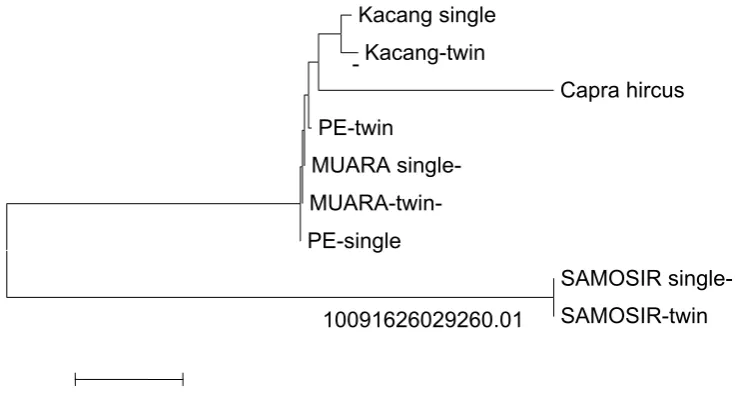
Diversity of GDF9 gene on prolific goats is varied and influenced by genotypes and DNA position. The roads GDF9 exons 1 and 2 in prolific Black Bengal goats is a well-known monomorphic, but in a Jining Gray goats is reportedly polymorphic (Feng et al., 2010). This result is almost the same with the result reported by Polley et al. (2009). The mutation of nucleotides GDF9 allele gene in the promoter in the Kacang and PE goats can add hits the variety gene selection of prospective GDF9 for financing the development of prolific goats. Trace nucleotides GDF9 gene is thought to be related to polymorphic and setting prolificacy nature of White goat (Xu and qin et al. 2009), Jining Gray goat (Feng et al. 2010), while this gene is also monomorphic in Black Bengal goats (Polley et al., 2009), Boer and Huanghuai goats (He 2010). Based on the mutations that are parsimony trace nucleotides gene GDF9 road promoter shows that the Indonesian local goats were in the cluster development and more closely with Jining Gray goat of China.
Figure 2. Dendogram of Indonesian local goats based on the roads trace nucleotides promoter gene GDF9 NJ method, bootstrap 1000x
IMPLICATIONS
Mutation of GDF9 gene road promote polymorphic and there is a relationship of recent global gene GDF9 mutation with the nature prolific of Kacang goats and PE goats. GDF9 gene diversity in of Muara and Samosir goats were monomorphic.
REFERENCES
Bodensteiner KJ, Clay CM, Moeller CL, Sawyer HR. 1999. Molecular cloning of the ovine GDF-9 and expression of GDF-9 in ovine and bovine ovaries. Biol Reprod 60:381-386. Davis GH. 2004. Fecundity in sheep. Anim Reprod Sci 83:247-253.
Davis GH. 2005. Major gene affecting ovulation rate in sheep. Genet Select Evol 37:11-23. Davis GH, Balakrishnan L, Ross IK, Wilson T, Galloway SM, Lumsden BM, Hanrahan
JP,Mullen M, Mao XZ, Wang GL, Zhao ZS, Zeng YQ,Robinson JJ, Mavrogenis P, PapachiristoforouC, Peter C, Baumung R, Cardyn P, Boujenane I, Cockett NE, Eythorsdottir E, Arranz JJ, Notter DR. 2006. Investigation of the Booroola (FecB) and Inverdale (FecX(I)) mutations in 21 prolific breeds and strains of sheep sampled in 13 countries. Anim Reprod Sci 92: 87–96.
Dong CH, Du LX, Li ZZ. 2007. Analysis of fecundity on Jining Grey goat. National centre for molecular genetic and breeding of animal. Institute of animal science (abstract). Feng T, Geng CX, Lang XZ, Chu MX, Cao GL, Di R, Fang L, Chen HQ, Liu XL, Li N.
2010. Polymorphisms of caprine GDF9 gene and their association with litter size in Jining Grey goats. Mol Biol Rep doi 10.1007/s11033-010-0669-y. Princeton Univ Press Galloway SM, McNatty KP, Cambridge LM, Laitinen MPE, Juengel JL, Jokiranta TS,
McLaren RJ, Luiro K, Dodds KG, Montgomery GW, Beattie AE, Davis GH, Ritvos O.
2000. Mutations in an oocyte derived growth factor gene (BMP15) cause increased ovulation rate and infertility in a dosage-sensitive manner. Genetics 25:279–283.
Gilchrist RB, Ritter RJ, Armstrong DT. 2005. Oocyte-somatic cell interaction during follicle development in mammals. Anim Reprod Sci 82:341-377.
Hanrahan JP et al. 2004. Mutation in the genes for oocyte-derived growth factors GDF9 and BMP15 are associated with both Increased ovulation rate and sterility in Cambridge and Belclare sheep (Ovis aries). Biol Reprod 70:900-909.
He YQ, Chu MX, Wang JY, Fang L, Ye SC. 2006. Polymorphism on BMPR15 as candidate gene for prolificacy in six goat breeds. J Anhui Agric Univ 33:61-64.
He YQ. 2010. Candidate genes polymorphism and its association to prolificacy in Chinese goats. J Agric Sci 2:1.
Polley S, Dea S, Batabyalb S, Kaushika R, Yadava P, Aroraa JS, Chattopadhyaayb S, Panc S, Brahmad B, Dattaa TK, Goswami SL. 2009. Polymorphism of fecundity genes (BMPR 1B, BMP15 and GDF9) in the Indian prolific Black Bengal goat. Small Rum Res
85:122-129
Sodiq A, Taufik ES. 2003. The role and breeds, management system, productivity and development strategies of goats in Indonesia: A Review. J Agric Rur Dev Trop 104:71-89.
Souza CJH, MacDougall C, Campbell BK, McNeilly AS, Baird DT. 2001. The Booroola (FecB) phenotype is associated with a mutation in the bone morphogenetic receptor type 1B (BMPR1B) gene. J Endocr 169:1–6.
Tamura K, Dudley J, Nei M, Kumar S. 2007. Molecular evolutionary genetic analysis (MEGA) software version 4. Mol Biol Evol 24:1596-1599.