YU(AZR) , M.Y., (AERY)P S)(OMB)NG , YA(AYA , S.(., SA)D , M.R., UMAR N)RMAL , SA)JOD LAU and P(ONGSAKORN PRAK TOM
1, 2, 3
Faculty of Manufacturing Engineering
4
Faculty of Mechanical Engineering Universiti Teknikal Malaysia Melaka
Hang Tuah Jaya, 76100 Durian Tunggal, Melaka, MALAYSIA
1
2
iphaery@ utem.edu.my
5, 6
Faculty of Engineering and Technology Multimedia University
Jalan Ayer Keroh Lama, 75450, Melaka, MALAYSIA
3
4
7
Nuclear Power Division Malaysia Nuclear Agency Bangi, 43000, Kajang, MALAYSIA
5
1.0 INTRODUCTION
Producing energy from renewable biomass is only one of the various ways of responding to the challenges of the
energy crisis. Since the oil crisis in ’s the use of biomass as a source of energy is a topic of growing interest
and debate as agreed by Gómez-Loscos , Tong and Li , Arias , Vaclav , Fernando
, Kaygusuz and Keles .
Corley and Tinker in their book discuss in detail about oil palm in Malaysia. )n , Malaysia had
about . million hectares of land under oil palm cultivation. Currently, more than percent of the oil palm produced is used for food applications like cooking oil, frying oil and many others. Oil palm is a perennial crop. )t has an economic life span of about years. Traditionally, oil palm is grown for its oil example like palm oil, palm kernel oil, and palm kernel cake as the community products. Besides palm oil and palm kernel, oil palm industry generates large quantity of biomass residue which is side products as stated before like fronds, trunks, EFB, palm oil mill effluent, palm fibre and shell that have not been fully commercially exploited.
Through concerted research and development efforts by many research organizations including Malaysian Oil Palm Board, this co – products from palm oil industry have been found to be good resources for
many application such as palm oil fuel ash a biomass residue Brown et al., , oil palm as a viable concrete
pozzalanic material Foo and (ameed, , Oil palm ash as partial replacement of cement for
solidification/stabilization of nickel hydroxide sludge Chun et al., , oil palm ash in concrete Tangchirapat
et al., .There are many competitive uses of these materials. One of them is to utilize them as a fuel for
energy production but in term of biodiesel fuel. )n fact, Malaysian government has identified biomass as fifth fuel resource to compliment the petroleum, gas, coal, and hydro as energy resources, while palm biomass has been
identified as a single most important energy source as stated by Sumiani . On the other hands, the main
sources of biomass in Malaysia are domestic wastes, agricultural wastes, effluent sludge and wood chips
Yuhazri et al., and Yuhazri et al., .
ABSTRACT
This research discussed on the results obtained for each sample that have been conducted to the solid fuel briquettes made of empty fruit bunch fiber and waste papers from view of physical performance which is water absorption test. This solid fuel prepared by manual compression technique. This analysis important to know the capability of the solid fuel to sustained/maintained the physical shape after immersed in water. Experimental work showed most samples behave same physical behaviors.
Keywords: Empty Fruit Bunch Fiber, Waste Papers, Solid Fuel, Water Immersed.
Biomass energy systems can be based on a wide range of feedstock like food and garden wastes Romeela
and Ackmez, , solid wastes and sewage sludge Despina et al., , cellulosic ethanol Gonzalez, ,
coal and cattle biomass Carlin et al., and many more. They use many different conversion technologies to
produce solid, liquid, and gaseous fuels. These can then be used to provide heat, electricity and fuels to power vehicles; using burners, boilers, generators, internal combustion engines, turbine or fuel cells. Power can be generated by co – firing a small portion of biomass on existing power plant, burning biomass in conventional steam boilers, biomass gasification and anaerobic digestion.
Converting palm biomass into a uniform and solid fuel through briquetting process appears to be an
attractive solution in upgrading its properties and add value as reported by Sławomir, , De et al., ,
Nasrin et al., , Chuen-Shii, . Biomass briquette is the process of converting low bulk density
biomass into high density and energy concentrated fuel briquettes. Biomass briquette plant is of various sizes which converts biomass into a solid fuel. Briquettes are ready substitute of coal or wood in industrial boiler and brick kiln for thermal application. Biomass briquettes are non conventional source of energy, renewable in nature, eco – friendly, non polluting and economical. Process of converting biomass into solid fuel is non polluting process. )t involves drying, cutting, grinding, and pressing with or without the aid of a binder.
Malaysia has involved in palm oil industry over the last four decades and since then it has generated vast quantities of palm biomass, mainly from milling and crushing palm kern`el. Empty fruit bunch is the main solid waste from oil palm obtained from milling process. This biomass can be used as an alternative energy for combustion purposes especially in industry. Unfortunately, due to its poor physical properties EFB is not normally utilized as fuel. (owever, it can be use in optimise by upgrading and treating its properties. The method that can be used is the briquetting technique. Briquetting is the alternative method in upgrading biomass into a useful solid fuel that can be done through various technologies. )n this research, EFB material will be mixed up with the recycled papers and it will be turned into solid briquette through the briquetting process. The used of recycle papers in this research is to utilized the abundant papers into something useful, thus helps in reducing the number of municipal wastes generated every year. Papers are selected as a material to be used compared to the other types of recycled wastes such as glass and plastic because it is known to be a good material for a combustion ignition. As for plastics, it may be compatible to papers to be used as ignition material in combustion, but it will spread a toxic gas while it is burn.
The scope of this research is mainly focusing on the mixing of the empty fruit bunch, EFB and the recycled papers. All these palm oil mills is to be obtained, mixed up and to be develop as a fuel briquette at a certain ratio or percentage with the EFB as the major element. This fuel briquette is to be carried out with the performance
tests and comparison tests in terms of its calorific values Yuhazri et al., a , gas emission Yuhazri et al.,
b , ash content Yuhazri et al., c , compression test at lateral position Yuhazri et al., d , crack test
for transportation and storage purpose Yuhazri et al., e , dimension stability Yuhazri et al., f but in
this paper part only discuss on the water absorption of the solid fuel.
2.0 MATERIALS AND METHODS
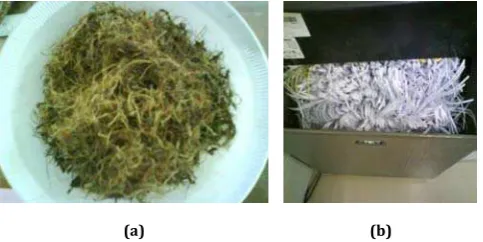
Empty Fruit Bunch EFB supplied by Malaysian Palm Oil Board MPOB from one of plantation in Malaysia was used as reinforced material in this green composites fabrication. The EFB used in the composites was in a chopped strand form. The EFB type used was shown in the Figure a and the Table is the basic properties of
EFB used for the fabrication of the composites based on study done by Nasrin et al., .
(a) (b)
Figure 1: (a) EFB in fibrous form, (b) Shredded paper in shredder machine.
crushing papers have a standard size and dimension after is shredded inside the crushing machine. The standard size and dimension helps to ensure that the blending of papers and EFB is uniform.
Table 1: Properties of EFB as raw materials. Nasrin et al., .
Raw Material Average size of Materials Calorific Value Moisture Content Ash Content kJ/kg % %
Pulverized EFB < µm . . EFB Fibre cm . . EFB Fibre . mm . .
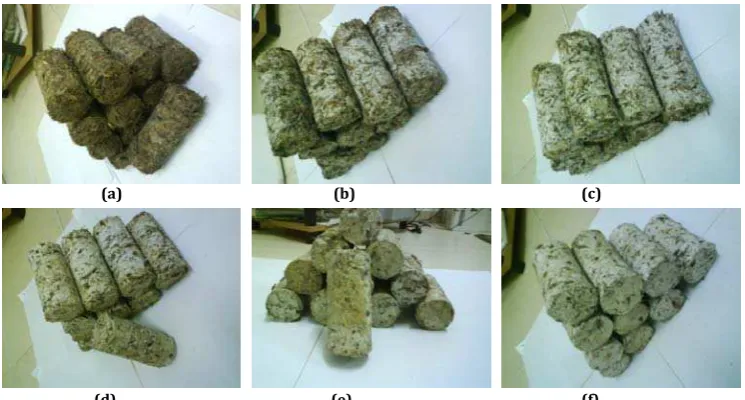
The dimension of sample briquette produced during sample preparation is mm in diameter and mm in length with average weight about . grams. The ratio of briquette produced is presented in Table and Figure is actual specimens.
Table 2: Sample ratio and its serial number.
Ratio of EFB to Paper Serial Number
: S/N : S/N : S/N : S/N : S/N : S/N
There are several steps involved in producing a single briquette according to its ratio. Firstly, the waste papers need to be immersed in water for hours and then it is blended using a blender to mash up the waste papers. Then, the blended papers it weighed again to get the weight of mashed papers with water. After dividing the EFB and shredded papers according to their ratios, the EFB fiber is mixed up with the shredded paper. Then, the compacting step takes place by compacting the mixing of EFB and waste paper into a solid briquette by using
hydraulic press machine and cylinder mold. The size of the mold is mm in length and mm in diameter.
The mixing is compressed into the mold until it gets to the desired length which is mm. The amount of pressure applied during compacting process is bars. Finally, the solid briquette is placed inside a drying oven
at temperature °C for hours to remove the water obtained during the compacting process.
(a) (b) (c)
(d) (e) (f)
Figure 2: Samples of solid briquettes in different ratios; (a) S/N , (b) S/N , (c) S/N (d) S/N , (e) S/N and (f) S/N .
3.0 RESULTS AND DISCUSSION
An immerse test is conducted by immersing the sample briquettes into water for minutes to observe the percentage of water absorption for each sample briquettes. The results shows all briquettes have recorded % water absorption after immersed into water for minutes. EFB and papers on its own is known for high
hours to observe whether the briquettes will disintegrate in water during the period of time. As a result, none of the briquettes disintegrated in the water after they are immersed for hours. The figure of briquettes after hours of water immersed is presented in Figure .
(a) (b)
Figure 3:(a) briquette with ratio S/N , S/N and S/N and (b) briquette with ratio S/N , S/N and S/N .
After hours, there are radial expansions in term of the length of sample briquettes. A result of
dimensional changes of briquettes is recorded in Table .
Table 3: Dimensional changes in briquettes after hours immersed.
Sample ratio Initial Length (mm) Final Length (mm) Percent Expansion (%)
S/N . S/N . S/N . S/N . S/N . S/N .
Table shown dimensional changes in briquettes after immersed for hours in water. From the table, briquettes S/N experienced the highest dimensional changes compared to other samples with percent of expansion in length of %. This is followed by sample of S/N with percentage of expansion %. Sample S/N recorded the least percentage of expansion in length which is . % from its initial length. This shown that the larger percentage of papers in the ratio, the smaller expansion in length the briquette will be. This is because, sample with larger percentage of EFB fiber in it will experience greater expansion in length due to the condition of the fiber which is in fibrous form and easy to absorb water. When they have fully absorbed the water, a debinding process occurred in which starch which added to act as a binder in the mixture will become saturated with water thus causing the binding force of the mixture become loosen. Fibrous element will expand fast thus causing the increased in length of the sample briquettes. Comparing the result with a study on waste paper and
coconut husk mixtures briquette conducted by Olorunnisola , the average percent of length expansion is
relatively smaller which is %. This is because, coconut husk, is known for its relatively high affinity for water. The relatively high resistance of the briquettes to water may therefore be attributed to the waste paper inclusion. Paper is composed mainly of cellulose fiber which at the microscopic level contains waxes water repellents among other noncellulosic substances.
4.0 CONCLUSION
From the experiment carried out, it was generally found out that the characteristics of palm biomass briquettes produced from compaction of EFB and waste paper were satisfactory and compatible with the other researches that involved the palm briquettes. The experimental results conclude that the larger percentage of papers in the ratio, the smaller expansion in length the briquette will be. This is because, sample with larger percentage of EFB fiber in it will experience greater expansion in length due to the condition of the fiber which is in fibrous form and easy to absorb water.
REFERENCES
[ ] Arias, N.C. : Production of Biomass From Short Rotation Coppice for Energy Use: Comparison
[ ] Brown, O.R., Yusof, M.B.B.M., Salim, M.R.B. and Ahmed, K. : Physico-chemical Properties of Palm Oil
Fuel Ash As Composite Sorbent in Kaolin Clay Landfill Liner System. Clean Energy and Technology (CET),
2011 IEEE First Conference June , pp. - , - .
[ ] Carlin N.T., Annamalai, K., Oh, (., Ariza, G.G., Lawrence, B., Arcot V.U., Sweeten, J.M., (eflin, K. and (arman,
W.L. : Co-Combustion and Gasification of Coal And Cattle Biomass: A Review of Research and
Experimentation Green Energy - Progress in Green Energy. Springer London Publisher. Vol. , pp. - .
[ ] Chuen-Shii, C., Sheau-(orng, L., Chun-Chieh, P., Wen-Chung, L. : The Optimum Conditions for
Preparing Solid Fuel Briquette of Rice Straw by a Piston-Mold Process Using the Taguchi Method. Fuel
Processing Technology, Vol. , )ss. – , pp. - .
[ ] Chun, Y.Y., Shabuddin, W.W.A. and Ying, P.L. : Oil Palm Ash as Partial Replacement of Cement for
Solidification/Stabilization of Nickel (ydroxide Sludge. Journal of Hazardous Materials, Vol. , )ss. ,
pp. - .
[ ] Corley, R.(.V. and Tinker, P.B.(. : The Oil Palm: World Agriculture Series. Ed. John Wiley & Sons.
[ ] De, Y.T., Xu, W. and Ai, (.X. : Virtual Design and Simulation for Biomass Plane-die Briquetting
Machine. Advanced Material Research (Renewable and Sustainable Energy). vols. - , pp. - .
[ ] Despina, V., Evaggelia, K., Stelios, S. and Piero, S. :Gasification of Waste Biomass Chars by Carbon
Dioxide via Thermogravimetry : Effect of Catalysts. Combustion Science and Technology. Vol. , )ss. ,
pp. - .
[ ] Fernando, G. : Synergy in Food, Fuels and Materials Production from Biomass. Energy Environ. Sci.,
vol. , iss. , pp. - .
[ ] Foo, K.Y. and (ameed, B.(. : Value-Added Utilization Of Oil Palm Ash: A Superior Recycling Of The
)ndustrial Agricultural Waste. Journal of Hazardous Materials, Vol. , )ss. – , pp. - .
[ ] Gómez-Loscos, A., María, D.G. and Montañés, A. : Economic Growth, )nflation and Oil Shocks: Are the
s Coming Back?. Applied Economics, Vol. , )ss. , pp. - .
[ ] Gonzalez, R.W. : Biomass Supply Chain and Conversion Economics of Cellulosic Ethanol. Ph.D. Thesis
at North Carolina State University. USA.
[ ] Kaygusuz, K. and Keleş, S. : Use of Biomass as a Transitional Strategy to a Sustainable & Clean Energy
System. Energy Sources,Part A: Recovery, Utilization, and Environmental Effects, Vol. , )ss. , pp. - .
[ ] Nasrin, A.B., Choo, Y.M., Lim, W.S., Joseph, L., Michael, S., Rohaya, M.(. and Astimar, A.A. : Briquetting
of Empty Fruit Bunch Fibre and Palm Shell as a Renewable Energy Fuel. Journal of Engineering and Applied
Sciences, Vol. , No. , pp. - .
[ ] Nasrin, A.B., Ma, A.N., Choo, Y.M., Mohamad, S., Rohaya, M.(., Azali, A. and Zainal, Z. : Oil Palm
Biomass as Potential Subtituition Raw Materials for Commercial Biomass Briquettes Production. American
Journal of Applied Sciences.
[ ] Olorunnisola, A. : Production of Fuel Briquettes from Waste Paper and Coconut (usk Admixtures,
Agricultural Engineering International: the CIGR Ejournal, Vol. , pp. - .
[ ] Romeela, M. and Ackmez, M. : Energy from Biomass in Mauritius: Overview of Research and
Applications, Waste to Energy . Springer London Publisher. )SBN: - - - - .
[ ] Sławomir, O. : Analysis of Usability of Potato Pulp as Solid Fuel, Fuel Processing Technology, Vol. ,
)ss. , pp. - .
[ ] Sumiani, Y. : Renewable Energy From Palm Oil – )nnovation on Effective Utilization of Waste. Journal
of Cleaner Production, Vol. , )ss. , pp. - .
[ ] Tangchirapat, W., Saeting, T., Jaturapitakkul, C., Kiattikomol, K. and Siripanichgorn, A. : Use of Waste
Ash From Palm Oil )ndustry )n Concrete. Waste Management, vol. , pp. – .
[ ] Tong, Z. and Feng, T. : A Study On Energy Saving of LEED-NC Green Building Rating System From
Point Analysis. Advanced Materials Research, Vols. - , pp. - .
[ ] Vaclav, S. : Energy Myths and Realities: Bringing Science to the Energy Policy Debate. Government
)nstitutes Publisher.
[ ] Yuhazri, M.Y., Sihombing, (., Jeefferie, A.R., Ahmad Mujahid, A.Z., Balamurugan, A.G., Norazman, M.N. and
Shohaimi, A. : Optimazation of Coconut Fibers Toward (eat )nsulator Applications. Global Engineers
& Technologists Review, Vol. , No. , pp. - .
[ ] Yuhazri, M.Y., Kamarul, A.M., (aeryip Sihombing, Jeefferie, A.R., (aidir, M.M., Toibah, A.R. and Rahimah, A.(. : The Potential of Agriculture Waste Material for Noise )nsulator Application Toward Green Design
and Material, International Journal of Civil & Environmental Engineering, Vol. , No. , pp. - .
[ ] Yuhazri, M.Y., (aeryip Sihombing, Umar, N., Saijod, L. and Phongsakorn, P.T. a : Solid Fuel from Empty
Fruit Bunch Fiber and Waste Papers Part : (eat Released from Combustion Test, Global Engineers and
Technologists Review, Vol. , No. , pp. - .
[ ] Yuhazri, M.Y., (aeryip Sihombing, Yahaya, S.(., Said, M.R., Umar, N., Saijod, L. and Phongsakorn, P.T. b : Solid Fuel from Empty Fruit Bunch Fiber and Waste Papers Part : Gas Emission from Combustion
[ ] Yuhazri, M.Y., (aeryip Sihombing, Yahaya, S.(., Said, M.R., Umar, N., Saijod, L. and Phongsakorn, P.T. c : Solid Fuel from Empty Fruit Bunch Fiber and Waste Papers Part : Ash Content from Combustion
Test, Global Engineers and Technologists Review, Vol. , No. , pp. - .
[ ] Yuhazri, M.Y., (aeryip Sihombing, Yahaya, S.(., Said, M.R., Umar, N., Saijod, L. and Phongsakorn, P.T. d : Solid Fuel from Empty Fruit Bunch Fiber and Waste Papers Part : Compression Test at Lateral
Position, Global Engineers and Technologists Review, Vol. , No. , pp. - .
[ ] Yuhazri, M.Y., (aeryip Sihombing, Yahaya, S.(., Said, M.R., Umar, N., Saijod, L. and Phongsakorn, P.T. e : Solid Fuel from Empty Fruit Bunch Fiber and Waste Papers Part : Crack Test for transportation
and Storage Purpose, Global Engineers and Technologists Review, Vol. , No. , pp. - .
[ ] Yuhazri, M.Y., (aeryip Sihombing, Yahaya, S.(., Said, M.R., Umar, N., Saijod, L. and Phongsakorn, P.T. f :
Solid Fuel from Empty Fruit Bunch Fiber and Waste Papers Part : Dimension Stability Test After Exposed