I74
Djojosugito MedJ
Univ IndonIncidence of Wound
Infection
in
Orthopaedic
Same
Day Surgery and
its
Financial
Implication
M.
Ahmad
Djojosugito*"
Abstrak
Bedah rawat
jalan
dilaksanakan di RS Hasan Sadikin (RSHS)/ Fakultas Kedokteran UNPAD (FKUP) sejak 1987-198E. Kebijakan yang ditnal<sudkan untuk penghe,natan biaya perawatan runah sakit tanpa ntengurangi kualins pelayanannya, kcmudian dilaksanal<an oleh para ahli bedah FKUP/RSHS terhadap pasien pribadi merelw di RSIIS dan dua tRS swcsfa lain di Bandung. Penelitian ini adalah penelitian observasional denganmenggunakanmetode epideniologi deskriptif, yang dilakul<an padakohort pasien-pasien pribadi bedah orthopaedi rawat jalan yang dilaksanal<an oleh penulis di tiga rumah sakit di atas. Tujuan penelitian adalah untuk ntengetahui danpak bedah rawat jalan terhadap kualitas penbedahan (dalan bentuk insidersi kcjadian infeksi luka operasi) dan terhadap biaya perawatan runah sakit (dal.atn bentuk latna hari rawat). Kriteria inklusi ke dalarn kohort adalah : lulu operasi bersih, tidak digunakan drain pasca bedah, lama operasi diperkirakan kurang dari duajan
dan penùerian antibiotika profiktksis. Kohort ini dibandingkan dengan kohort bedah orthopaedi rawat inap yang dilakukan oleh penulis di runnh sakit yang sama dan meuenuhikriteria
inUusi yang sann, yang dilal<sanalcan sebelwn adanya kebijakan bedah rawat jalan. Hasil penelitian ntenunjukkan bahwa kejadian ILO pada tO3 kasus bedah rawatialan
adalah 2.9%, lebih rendah dari kejadian ILO pada 87 kasus bedah rawat nginap yang besarnya 6.9%. Juga penelitian nenunjukkan bahwa didapat penghenatan hari rawat sebesar 2.1 hari pada bedah rawat jal.an, atau 2.5 hari pada bedah rawat jalan pada tulang, atau 3.1 hari pada pembed.ahan petnasangan fil<sasi interna pada tulang. Hasil penelitian yang nenunjulclan bahwa penghenatan dalarn bentuk berkurangnya tnasa rowat pasca bedah tanpa ntenurunkan kualitas perawatan (yaitu berupa turunnya kejadian ILO) ini nenbutuhkan konfinnasi lebihlanjutmelaluipenelitian epideniologisyang tidak nenggunakan netode pentbandingan historiknl.Abstract
"Sanre day surgery" (which ueans, the surgery which is done using outpatient setting and procedures, so that the patients have to be in the hospitalfor
nnxinally
24 hours) was inrplentented in Dr. Hasan Sadikin Hospital (RSHS)/
Faculty of Medicine Padjadjaran University (FKUP) since 1987-1988. The concept which was ained to reduce the cost of hospitalization while naintaitting the quality of care, was then inplemented by surçeons of RSHS/FKUP to their private patients in RSHS and two other private hospitals. This study is an observational study, using a descriptive epidenùologic nethod to identify the itnpact ofsanre day surgery policy onthe quality of operative care (in term of the incidence of postoperative wound infection/
POWI) and on the cost of hospitalization (in tenn of the average length of stuy/
LOS). The study cohort were the sane day orthopaedic surgery done to the private patients in RSHS and two other private hospitals during 1989. The criteriafor inclusion in the cohort were : clean surgical wound, duration of surgical procedure less than two hours, no postoperative drainage tubing were used, prophylactic antibiotic were given. The cohortfor comparison was the inpatient orthopaedic op€ratiorx which were done by the same surgeon in the same hospital before the policy of same day surgery was inplenrented, and which natchedwith the inclusion criteria in the study cohort. The result showed the incidence of POWI antong the lO3 cases of sanre day orthopaedic surgery was 2.9%. The incidence was lower than the incidence of POWI antong 87 casesof
inpatient orthopaedic surgery, which were 6.9%. The LOS which were saved by the sane day orthopaedic surgery were 2.1 days, or 2.5daysfor same day bone surgery, or 3.1 daysfor same day bone internalfitation. The study also showed good saving of LOswithout
lowerirtg the quality of care.
Dffirence
in the study periods have to be considered in uaking uorevalid
conclusions and thereforefurther analytic epidenùologic study should be perfonned.
Keywords : Orthopaedic wound infection, sante-day-surgery
*
Presented at
:
The First International Conference on Sante Day Surgery, Perth, Western Australia, 27 - 30 October 1993**
Vol
i,
No 3, JuIy - September 1994INTRODUCTION
Since the introduction
of
the concept
of
same
daysurgery
in
Indonesia
in 1986, same
day
surgery
wasimplemented
by
Hasan Sadikin Public
Hospital
(RSHS)
/
Faculty
of
Medicine
University
of
Padja-djaran
(FKUP)
in
1987/1988followed
by
surgeonsof
RSHS
in
several
private
hospitals.
In
1985/1986
theconcept
of nosocomial infection control
and
quality
assurancewas also introduced,
and severalprograms
concerning those concepts
were
started.
To
measurethe quality
of
patient care
in
relation
with
quality
assurance program, several
criteria
were used. Toiden.
tify
theimpact
of
same daysurgery
procedures on thequality of
patient
care,the incidence
of
postoperative
wound
infection
was used as oneof
thecriteria of
thequality
of patient
care.To
measure the costof surgical
patient
care, thepostoperative length
of
stay was used as the measurementof
the costof
hospitalization.
This
paper
is a review
on the
same
day
ortho-paedic
operations
doneby
theauthor in
thepublic
and someprivate hospitals in Bandung, which
evaluate the irnpactof
same day surgery on the incidenceof wound
infection and on the reduction
of
the
postoperative
length
of
stay.MATERIALS
AND METHODS
The studied
population
were the same dayorthopaedic
operations done by the author
in
1989 in HasanSadikin
Hospital and two other private hospitals
and
which
were followed
up
by
the author. The study was
adescriptive epidemiologic study,
measuring
the
in-cidence
of
postoperative
wound infection
among
thestudied
cases.The
same
day surgery procedure were
imple-mented in operationswithclean
wound,with
estimatedoperation
time of
lessthan
2
hours,
which didn't
usedrainage
tubing
postoperatively
andto
all
caseswere
given
one
prophylactic antibiotic injection
one hour
before the operation.
Caseswith metal implant
weregiven oral antibiotic postoperatively
for
three
days.The
follow up
was done
in out
patient
office on
day threeup to
day 28postoperatively.
Comparisons were done
by
reviewing the
in-patient orthopaedic operations
doneby
the
samesur-geon during
one year
prior
to
1989
in
the
samehospitals, which
matched
with
the
same
criteria for
doing
same
day surgery procedure namely
:
cleanFinancial Inrplication of Wound
Infection I'15
wound,
duration of
operation
lessthan
two
hours,
no drainagetubing postoperatively
andadministration
of
preoperative
prophylactic
antibiotics.
To identify
the
quality of
patient
carein
term
of
postoperative wound
infection,
the
1988CDC
criteria
for
wound
infection
and theCommittee on Infections
of
the American College
of
Surgeons
wound
clas-sification
were
used.To identify
and
to quantify
thefinancial
impact of postoperative wound infection,
thepostoperative length
of
stay
of
the
in-patient
cases ascompared
with
the length
of
stay
of
the
same-daysurgery
cases(which is
zero), was
used asthe
meas-urement.RESULTS
During
1989, one hundred and three orthopaedic
operations
were performed
as
the
same
day
proce-dures. The age rangedfrom
eight
to 59 yearsold,
with
the medianof
34 years. The cases werepredominantly
male
(62 out
of
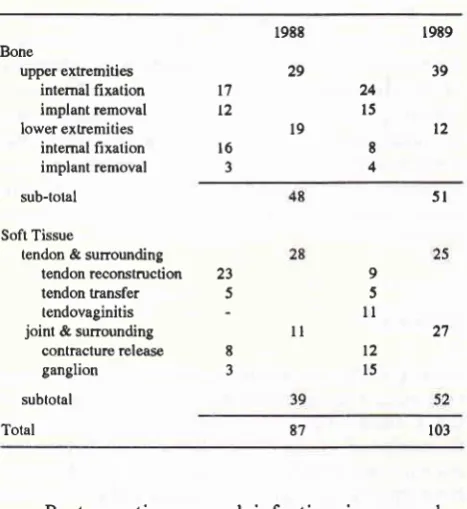
103).The surgery were performed
onbone
(mostly
bone
internal
fixation
and orthopaedic
implant removal) in
5l
cases, andon
soft
tissue (ten-don,joint, skin) in
52 cases.During
1988,eighty
sevenorthopaedic in-patient
operations
which
matchedwith
the samecriteria
as thecriteria
for
same daysurgery procedure
(cleanwound,
no drain,
less
than
2
hours, prophylactic antibiotic)
were done. The age rangedfrom
seven to 61 yearsold,
with
the median
of
31 years. The
caseswere
pre-dominantly
male (53 outof
87). The surgery were done on bonein
48 cases, and onsoft
tissuein
39 cases.The
ageand sex
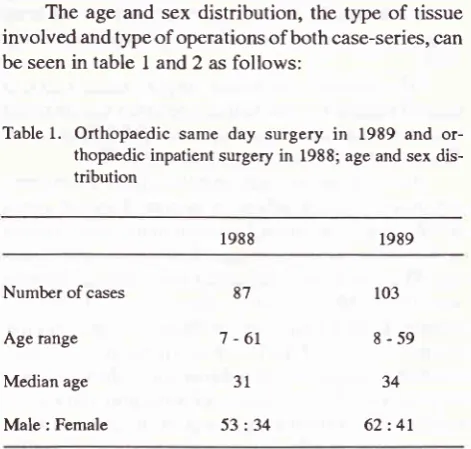
distribution, the type of
tissueinvolved
and type of operations of both case-series, can be seenin table
I
and2
asfollows:
Table
1.
Orthopaedic sameday
surgeryin 1989 and
or-thopaedic inpatient surgeryin
1988; age and sex dis-tribution1988 1989
Number
ofcases
87
103Age range
Median age
Male: Female
7
-61
31
53 :34
8-59
34
[image:2.595.315.551.504.728.2]176
DjojosugitoTable
2.
Orthopaedic sameday
surgeryin
1989 andor-thopaedic inpatient surgery
in
1988; typeof
tissueinvolved and type of operation
Bone
upper extremities
intemal fixation
implant removal lower extremities
intemal fixation
implant removal sub-tolal
Soft Tissue
tendon & surrounding tendon reconstruction tendon transfer tendovaginitis
joint & sunounding
contraclure release
ganglion
subtotal
Total
Postoperative
wound
infection
in same
day
surgery
casesoccurred in
three cases (anincidence
of
2.9
%)namely
two
caseswith intemal fixation of
thelower
leg and one tendon reconstruction.
If we
com-pare the
two
casesof infected internal
fixation with
all
32 internal
fixation
cases, the incidence of wound
infection among
theinternal
fixation
cases was 6.3%.If
we
compare thetwo
casesof infected internal
fixa-tion of
thelower leg with all
casesof internal
fixation
of
the lower leg (which
lweretwo), the incidence
of
infections
among theinternal
fixation of
thelower
leg caseswas
tOO%; and
if
we compare
with
all
bonesurgery
caseswhich weie
48 cases, theincidence
was 3.9%.The infected
soft tissue surgery
caseswas
one caseof
tendon reconstruction operation
out
of
seven tendonreconstruction surgery
cases(14.3%) or out
of
52 cases
of soft
tissuesurgery
cases(1.9%).
In the in-patient orthopaedic surgery
casqs,pos-toperative
wound infection
occurred in
six
cases(6.9%),
five with internal
fixation
to
the bone and onewith
joint
contracture
releasefollowed by skin
graft-ing. The incidence
of
infection after internal fixation
was 15.1%
(five
infected
casesout
of 33
casesof
internal fixation) and the incidence
of
infection
after
internal
fixation
of
thelower leg (three infected
casesout of nine
casesof internal
fixation of
thelower leg)
was 33.3%. The incidence
of infection after
bonesurgery (five infected
casesout
of
48
casesof
bone surgery) w as lO.4% and the incidence ofinfection after
Med
J
Univ Indonsoft
tissuesurgery
(oneinfected
caseafter
39 casesof
soft
tissuesurgery)
was 2.6%.The postoperative length of
stayof
the sameday
surgery was zero (since there was no postoperative
hospitalization) as compared
with
the
postoperative
length
of
stayof
thein-patient operative
surgerywhich
was 2.1 days
(all
cases)
or
2.5 days (bone surgery
cases) and 1.7
days (soft tissue surgery). The
pos-toperative length of
stayof internal
fixation
cases was 3.1 days,while
thepostoperative length of
stayof
theintçrnal
fixation
of
the lower leg was 3.7 days. The
length
of stay after surgery of orthopaedic implant
removal
was one day.The
comparison of
theincidence
ofpostoperative
wound infection
and the postoperative length of
stayof same day orthopaedic surgery and in-patient
or-thopaedic surgery
can be seenin table
3.Table
3.
The incidenceof
POWI(%)
and the postoperative lenght of stay (days) in same day orthopaedic surgery/ SDOS (1989) and in in-patient orthopaedic surgery/
rPos (1988)
Type of surgical cal procedure
(1e88)
SDOS
(le8e)LOS
POWI
LOS1989
39 r988
29
t7
24t2
l519
t2168
34
5t
239
55
-
ll
l1
27812
315
r03 87 IPOS POWIAll internal fixation Intemal
fix
of thelower leg Surgery to the
bone
Surgery to the soft tissue
All
orthopaedic surgery cases15.1 33.3 10.4 2.6 3.1 3.7 2.5 t.7 2.t 6.3 100.0 3.9 1.9 2.9 6.9
DISCUSSION
Same
day surgery
proceduresdeveloped very rapidly
during the last
five
years, due
to
the advent
of
new
minimally
invasive surgical
procedures such asarthro-scopic surgery and laparoarthro-scopic surgery.l Further
more the scarcity
of
resources which
causethe
costcontainment
in
hospital also gave a significant
con-tribution
to such development.
Also the invention
of
new anaesthetic drugs such as
propofol
andflumazenil
enable the patients
to
have
a rapid
and comfortable
[image:3.595.69.303.121.376.2] [image:3.595.327.563.340.584.2]Vol 3, No 3, July - Seprenber 1994
surgical
procedure,3'4'5 andin digestive
surgeryfield
alaparoscopic cholecystectomy also can be done as
a sameday surgical
piocedo.".6't't
Thedevelopment
of
same
day
surgery procedures and
the growth
of
the sameday surgery center
in
theUnited
Stateswere
sorapid that
it
was predicted that
by the end
of
thecentury, 60-66%
of
surgery
will
beperformed
asout-patient or
sameday surgery
procedure.eIn
theUnited
Kingdom
the
sameday surgery procedure resulted
in
the decrease
in
thewaiting list of
patients
for
elective
surgical
procedure.lo'l
IThe
impact of
same day surgery procedure on theincidence
of
postoperative
wound infection
wasreported
by
Southern
SurgeonsClub.6 The
report
anincidence of
O.9%among
l5l8
laparoscopiccholecys-tectomies, 216
of
which
were treated
with
same day surgeryprocedure,
and no case showed increasein
thelength
of
stay
or
was re-hospitalized.
In
the
or-thopaedic
field
the incidence
of
postoperative wound
infection
in
sameday orthopaedic surgery
cases wasvery low. Olderl2
reported
theincidence
of two
casesamong 2838
cases(the incidence
of
O.O7%)of
sameday orthopaedic surgery
cases,one
caseafter
arthro-scopic surgery, one
caseafter
osteotomy.
Seeing theabove
figure, the incidence of
postoperative wound
infection
in this series wasrelatively
higher (2,9%),but
if
we compare
with the incidence
of
postoperative
wound
infection
in
orthopaedic
in-patient
surgery
cases
in
this
series,
which
was 6.9%,
or with
the
in-cidence
of
postoperative wound
infection in
the samehospital but
in
another
period
of study,
done
by
the author(which
were4S%
and 5.57o),t3'la theincidence
of
postoperative wound infection
in
same
day
or-thopaedic
surgery was
relatively
and significantly
lower. However
realizing
thefact
that thecomparison
of
theincidence
between sameday surgery
procedure andin-patient surgical
procedure was doneusing
caseseries
of different periods (the
incidence
of
6.9%
in
1988 wasbefore
thepolicy of
implementing
same daysurgery procedure
andthe incidence
of
2.9%
in
1989 wasthe incidence
in
theperiod after
theimplementa-tion of
thepolicy),
andusing
different
composition
of
cases
(27.9%
and 6.97owere
theincidence
among thepatients
in
three hospitals, one government and
two
private hospitals,
and4.9%
wasthe incidence
among the patientsin
one governmenthospital,
whereas 5.5% was theincidence
among casesof private hospital),
we have to bevery careful
inmaking
theconclusion
ofthis
research.
A
different
research design
for
instance
prospective cohort
designmight
be necessary to makea
more
valid
conclusion, even
this kind
of
designwould
bedifficult
since same day procedure is apolicy
rather than a
exposure
factor
and
previous
researchFinancial Inrplication of Wound
Infection
177which
analysedthe impact
of
sameday
surgery
was alsousing
thehistorical
comparison.
The
fact
that the
incidence
of
postoperative
wound infection
of
the same
day surgery
cases waslower than that of the in-patient surgery
can
be
ex-plained
by
thefact
that thepreoperative length of
stay in same day surgery is zero,while
inin-patient surgery,
the
patients were admitted
afew
daysbefore
surgery,and some previous
study
showed
that the
longer
thepreoperative stay
in
thehospital,
the
higher
the
pos-toperative
infection
rate.''"*
Concerning
theimpact
of same day surgery on thepostoperative length of
stay, this study showed that the averagepostoperative length of
stay was reduceby
2.1 days, rangingfrom
one to six days, after theimplemen-tation
of
same
day surgery policy.
This
means
that there is a saving of 2.1 times the cost of onehospitaliza-tion
day perpatient
peroperation.
Besides thesaving,
the bed can be usedfor elective
surgerywhich
needin-patient surgery procedure so that
thewaiting
time
for
elective surgery
canbe reduced.
In
the
United
King-dom the
waiting time for
hernia operation
is
reducedfrom
three years to three weeks.l5This financial saving
nationally
means thesaving
of
national health
expen-dituresby65%
of
thesaving of
357oto7O7oof private
health
insurance expenditures. I 6CONCLUSION
The study on the
impact
of theimplementation
of sameday surgery
on
the incidence
of
postoperative wound
infection
and on thereduction
of
postoperative length
of stay showed the re
duction of
the incidenceof wound
infection from
6.9% to 2.9%,
and thereduction
of
thepostoperative length
of
stayby 2.1days.
All
thefind-ings
were basedon
thehistorical
comparison
with
thein-patient surgery
casesdone
in
the
samehospital by
the same surgeon,
using
the samecriteria of
inclusion
to
thestudy cohort.
REFERENCES
l.
Davis IE. Ambulatory Surgery, how farcan we go, Med Clin North Am 19931'7712 :365-75.2. Heath PI, Kennedy DJ, Ogg TW, Dunling C,
cilks
WR. Which intravenous induction agent for day surgery ?Anaes-thesia 1988;43 : 365-68.
3. Older
I,
CardosoT.
First year's experienceof
day-casearthroscopy in diagnosis and management of disorder of the knee joint, Lancet 1983; 3O :264-67.
178
Djojosugito5.
Holt
K.
l,ogamentous Reconstructionof
the Knee, paper presented at the Intemational Conference and Exhibition on Same Day Surgery, Perth Australia 1993.6. Southern Surgeons Club.
A
prospective analysisof
1518laparoscopic cholectstectomies, The New Eng
I Med
1991;324 : LO73-8.
7. Fletcher DR. Laparoscopic Cholecystectomy, Techniques, Pitfalls & Cost Implications, paper presented at the
Interna-tional Conference and Exhibition on Same Day Surgery,
Perth Australia 1993.
8. Hailey D. Laparoscopic Cholecystectomy - Potential Impact
and Reality, paper presented at the Intemational Conference
and Exhibition on Same Day Surgery, Perth Australia 1993.
9. Davis JE. The future of Major Ambulatory Surgery, Surg
Clin North Am 1987; 67 : 893-901.
10. Lakhani S, Leach RD, Iarrett PEM. Effect of a surgical day unit on waiting lists,
I
Royal Soc Med 1987; 80 :628-29.MedJ Univ Indan
11. Ogg
TW.
Useof
Anaesthesia, Implicationsof
day<ase surgery and anaesthesia, Brit MedI
1980;lO :2124.
12. Older J. Thefirst
four years experienceof
day caseor-thopaedic surgery in a district general hospital, Ann Roy Coll
Surg England 1988; 70 : 21.
13. Djojosugito
MA.
Infeksi Luka Opcrasi Nosokomial,Pene-litian Klinis, Mikrobiologis, Epidemiologis dan Manajerial, Disertasi FKUI, 1990.
14. Djojosugito MA. Risk Factor in Nosocomial Postoperative Orthopaedic Wound Infection
in hivate
Hospital, paper presented at Westem Pacific Orthopaedic AssociationCon-gress, Singaporc 1989.
15. Baskerville PA, Iarrett PE. Day case inguinal hernia repair under local anaesthetic, Arur Roy Coll Surg England 1983; 65:224-5.
16.
Iarrett P.
The
Economicsof
Day
Surgeryin
UnitedKingdom, paper presented at the International Conference