Subchronic oral toxicity study of Vegeta in Sprague-Dawley rats
Hedi R. Dewoto, Frans D. Suyatna
Abstrak
Tujuan penelitian ini adalah untuk menentukan keamanan dan efek toksik Vegeta yang diberikan secara oral selama 90 hari pada tikus. Delapan puluh tikus strain Sprague-Dawley dibagi secara acak menjadi 4 kelompok. Tiap kelompok terdiri dari 20 tikus, 10 jantan dan 10 betina. Tiap kelompok masing-masing mendapat Vegeta 0,25 g/kg BB; 0,50 g/kg BB; 1,00 g/kg BB (dilarutkan dalam akuades), dan kelompok kontrol mendapat 5,00 ml/ kg BB akuades secara oral memalui sonde lambung selama 90 hari. Berat badan dan tingkah laku tikus tiap hari dievaluasi. Pada hari ke 90 hewan coba didekapitasi, sampel darah diambil untuk dinilai kadar hemoglobin, lekosit, SGPT, SGOT, kreatinin, dan ureum. Organ dalam juga diambil, ditimbang dan diperiksa secara mikroskopis. Hasil menunjukkan bahwa Vegeta dosis 0,25 g/kg BB; 0,50 g/kg BB; dan 1,00 g/kg BB tidak mempengaruhi berat badan, fungsi hati dan fungsi ginjal dibandingkan kelompok kontrol. Dibandingkan dengan kelompok kontrol, tidak didapatkan perbedaan bermakna dalam nilai hemoglobin, tetapi hitung lekositmeningkat pada kelompok yang mendapat 1,00 g/kg BB Vegeta, yang kemungkinan disebabkan oleh infeksi. Berat otak dan limpa tikus jantan, dan berat paru dan jantung tikus betina pada kelompok Vegeta berbeda dibandingkan kelompok kontrol. Tetapi karena perbedaan berat tidak dose related dan tidak didapatkan kelainan mikroskopis yang spesifik dibandingkan kelompok kontrol, ini menunjukkan bukan merupakan efek toksik Vegeta. Nilai No observed effect level (NOEL) Vegeta 90 hari pemberian secara oral pada tikus jantan dan betina strain Sprague-Dawley adalah 1,00 g/kg BB. (Med J Indones 2006; 15:223-8)
Abstract
The objective of this study was to determine the safety and toxic effect of Vegeta giving orally for a period of 90 days in rats. Eighty rats of Sprague-Dawley strain were randomly devided into 4 groups. Each group consists of 20 rats, 10 male and 10 female rats. Each group received 0.25 g/ kgBW; 0.50 g / kgBW; 1.00 g / kgBW Vegeta (in aquadest solution) respectively, and the control group received 5 mL /kgBW aquadest , given orally by gastric tube for 90 days. The rat’s body weight and behavior were daily evaluated. On the 90th
day, the rats were decapitated and the blood samples were withdrawn for evaluation of Hemoglobin, leucocyte, SGPT, SGOT, creatinine, and ureum concentration. Visceral organs were also removed, being weighted and were examined microscopically. The results showed that Vegeta with dose of 0.25 g / kgBW; 0.50 g / kgBW, and 1.00 g / kgBW did not affect body weight, liver and renal function compared to control group. There was no significant difference for hemoglobin value compared to control group, but the number of leucocyte increased in 1.00 g / kgBW Vegeta dose group, which was possibly caused by infection. In Vegeta group, there was different spleen and brain weight in male rats, and different lung and heart weight in female rats compared to the control group. However, since it was not dose-related and there was no specific abnormality in microscopic examination compared to the control group, it was not indicated as Vegeta toxic effect. The No observed effect level (NOEL) value of Vegeta for 90 day oral administration in male and female rats of Sprague-Dawley strain was 1.00 g / kgBW. (Med J Indones 2006; 15:223-8)
Keywords: Vegeta, subchronic toxicity, oral, rats
Vegeta is a food supplement containing soluble and insoluble fiber. It appears to be rquired in providing fiber when people consume less natural fiber in the form of vegetables or fruits in our daily meal. Plantago ovata (Psyllium) and Inulin chicory are major soluble and insoluble fibers in Vegeta. Plantago ovata, a
component of Vegeta may help diet program in reducing weight since it may sigificantly increase feeling of stomach fullness.1,2 Dietary fiber is used for prevention and treatment of constipation.3 It may enhance defecation process because of its hygroscopic nature, and acts as a lubricant.4 Some studies demonstrated that Vegeta may ameliorate the LDL-cholesterol level. Meta analysis of 8 controlled trials found cholesterol-lowering effects of Plantago ovata intake adjunctive to diet therapy in men and women with hypercholesterolemia.5
This study was aimed to investigate the subchronic
Vegeta, a yellow powder packed in sachet form. Vegeta was dissolved in aquadest and the highest Vegeta concentration that could be given to rats through a gastric tube was 1g/10 mL /kgBW.
Experimental animals
Eighty Sprague-Dawley rats from the Directorate General, Drug and Food Regulation (POM), aged range 6-8 weeks, weighed between 110-150 gram were used. These rats were randomly devided into 4 groups. Each group consisted of 20 rats, 10 male and 10 female rats. The 1st, 2nd and 3rd group received three different concentrations of Vegeta and the 4th group was the control group. During the evaluation,
the experimental animals consumed standard rat’s
food and drank ad libitum.
Administration of Vegeta
Vegeta solution was given orally by gastric tube in a volume of less than 1% of body weight, once daily for 90 days. Vegeta was given in 3 dose level. The highest level of dosage was the dosage that was expected to result in toxic effects and fatal death in some experimental animals, while the lowest dosage should not.6 Based on the preliminary experiment, it was determined to administer the following dosage :
1st Group : 0.25 g / kgBW of Vegeta (D1)
2nd Group : 0.50 g / kgBW of Vegeta (D2)
3rd Group : 1.00 g / kgBW of Vegeta (D3)
4th Group : 5 mL/kgBW of aquadest as control, (C)
Observation
1. Body weight was determined daily and evaluated on day 0,30,60,and 90.
2. Behavior and clinical symptoms were daily observed and recorded
3. At the end of study, the rats were decapitated, the blood sample was withdrawn. Of the blood it was examined Hb, leukocyte, SGPT, SGOT, creatinine
and ureum concentration. Visceral organs such as kidney, liver, heart, lung, spleen and brain were removed, cleaned from surrounding tissue, weighted and fixed in 10 % formalin solution. A piece of tissue of each organ was dehydrated in graded concentration of alcohol and embedded in paraffin block according to the routine standard method. Then, it was cut by microtome and stained with hematoxylin eosin for hitological slides.
Statistical Analysis
Data comparison of all groups was conducted by one-way analysis of variance followed by Fisher test for inter-group comparison, with the limit of significance of 0.05.
RESULTS
Body weight
Male rats
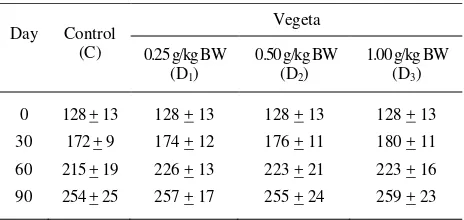
At the beginning of study and in the 30th, 60th, and 90th day , there was no significance difference of body weight in male rats between 4 groups, which received 0.25 g/kgBW, 0.50 g/kg BW, 1.00 g/kgBW of Vegeta respectively and aquadest (the control group). In general, the body weight of male rats increased similarly in all groups (Table 1).
lower body weight compared to the control group, while the body weight in the 0.50 g/kgBW dose group and the control group was not significant different. On the 90th day, body weight in group which received Vegeta of 0.25 g/kg BW was lower than the control group, while the body weight in the higher Vegeta dose groups and the control group was not significant different (Table 2).
p < 0.05 lower than the control group
Mortality, behavior, and clinical symptom
During 90 day observation, there were no mortality,
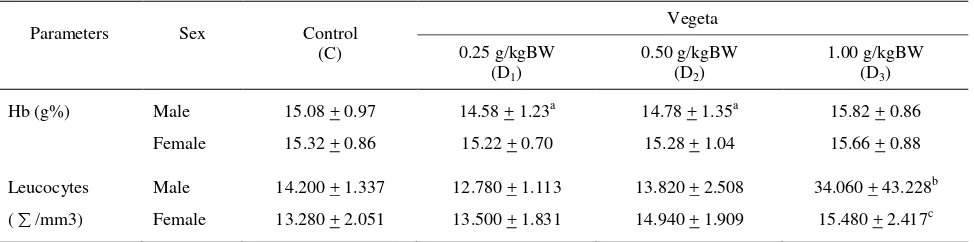
Mean Hb values in male rats which received Vegeta in various dosage were not significant different compared with those of control group, although the group which received 0,25 g/kg BW and 0,50 g/kg BW of Vegeta showed a lower mean Hb values compared to the highest Vegeta dose group. In female rats, the Hb values between all groups were not different (Table 3).
Leucocyte
The number of leucocyte in group receiving Vegeta of 1.00 g/kgBW both in male and female rats was higher than the groups receiving smaller Vegeta dose and the control group.
Blood chemistry
Male Rats
There were no difference of SGOT and SGPT mean values between groups receiving Vegeta and the control group. Mean ureum value in group receiving Vegeta of 0.25 g/kgBW was higher than the other Vegeta groups with greater dose and the control group. Mean creatinine value of group receiving Vegeta of 1 g/kgBW was higher than the group with lower Vegeta dose, but it was not significantly different from the control group (Table 4).
Table 3. Mean hemoglobin and leucocyte values (X + SD) of male and female rats after the administration of various doses of Vegeta
Parameters Sex Control
(C)
p<0,05 lower than D3 group b
p<0,05 higher than D1, D2, and control groups c
Table 4. The effects of various doses of Vegeta (X + SD) on blood chemistry in male rats
p<0.05 higher than D1 and D2 groups
Female Rats
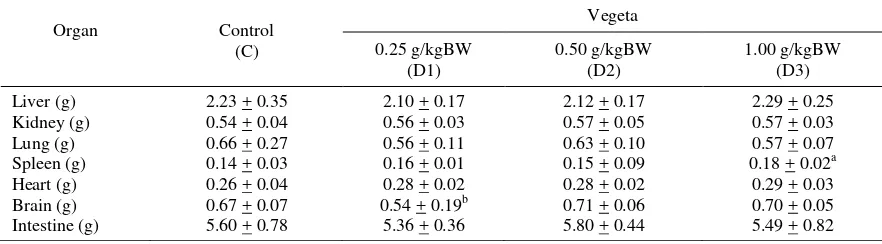
The SGOT, SGPT, and ureum mean values in group receiving Vegeta of 0.50 g/kgBW were significantly higher than the other groups, including the control group, but it was not dose-dependent. Mean creatinine values in groups receiving Vegeta were not not significantly different between groups receiving Vegeta. and that of control group. Spleen weight in rats receiving Vegeta of 1.00 g/kg BW was heavier than those of lower dose of Vegeta and control group. Brain weight of rats receiving Vegeta of 0.25 g/kgBW was lower than those of higher doses of Vegeta and control group (Table 6).
p<0.05 higher than D1,D3,and control group b
p<0.05 higher than D1 and control group
Table 6. The organ weight in male rats receiving Vegeta and control group
Organ Control
p<0.05 higher than D1,D2, and control groups b
Female rats
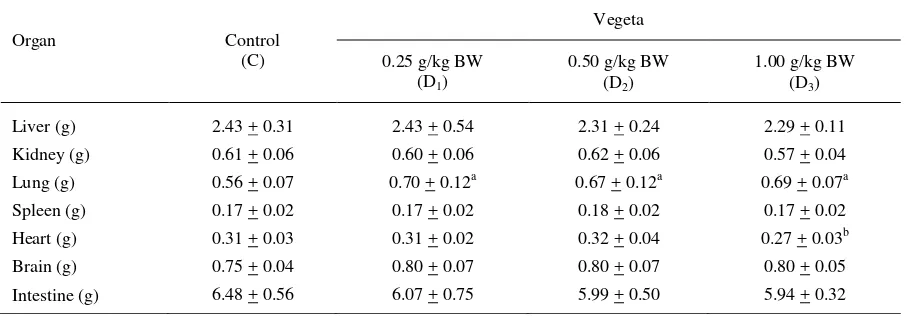
There was no significant difference of liver, kidney, spleen, brain and intestinal weight between groups receiving Vegeta and control group. The lung of groups receiving Vegeta was heavier than that of control group, but there was no significant difference within groups receiving Vegeta. The heart of group receiving Vegeta of 1.00 g/kg BW was slightly lower than those of lower dose of Vegeta and control group (Table 7).
Microscopic examination
Heart. There was no specific abnormality in Vegeta group and control group. In one slide, there was congestion in Vegeta group with dose of 0.25 g/ kg BW.
Lungs. Pneumonia peribronchialis was found in
control group. Pneumonia alveolaris, congestion and hemorrhage were also found in addition to the pneumonia peribronchialis in Vegeta groups, but the severity of pulmonary changes was not dose-related.
Liver. Microscopically, the common changes were
sinusoidal dilatation, hyperplasia of biliary tract and congestion. Those changes occurred both in the Vegeta groups and the control group, and it did not indicate any correlation between the dose of Vegeta and the severity of microscopic changes.
Kidney. The common changes were congestion and
hemorrhage, which were found both in Vegeta and control group.
Spleen. In general, there was no specific abnormality
in spleen. Hemosiderosis, congestion and focal necrosis were found in several spleen both in the Vegeta group and the control group, and there was no correlation between the dose of Vegeta and the severity of microscopic changes.
Intestine.There was no different microscopic appearance between the Vegeta and the control group.
Brain.There was no specific abnormality in the brain.
DISCUSSION
In male rats, oral administration of Vegeta for a period of 90 days did not cause different body weight between treated groups and the control group. In female rats, there was a lower body weight in the group receiving Vegeta of 0.25 g/kgBW and 1 g/kgBW compared to the control group after 60 day administration, and there was also a lower body weight in the group receiving Vegeta of 0.25 g/kgBW after 90 day administration. But the lower body weights in those groups apparently were not caused by Vegeta since it was not dose-related.
Table 7. The organ weight of female rats groups receiving Vegeta and the control group
Organ Control
(C)
Vegeta
0.25 g/kg BW (D1)
0.50 g/kg BW (D2)
1.00 g/kg BW (D3)
Liver (g) 2.43 + 0.31 2.43 + 0.54 2.31 + 0.24 2.29 + 0.11
Kidney (g) 0.61 + 0.06 0.60 + 0.06 0.62 + 0.06 0.57 + 0.04
Lung (g) 0.56 + 0.07 0.70 + 0.12a 0.67 + 0.12a 0.69 + 0.07a
Spleen (g) 0.17 + 0.02 0.17 + 0.02 0.18 + 0.02 0.17 + 0.02
Heart (g) 0.31 + 0.03 0.31 + 0.02 0.32 + 0.04 0.27 + 0.03b
Brain (g) 0.75 + 0.04 0.80 + 0.07 0.80 + 0.07 0.80 + 0.05
Intestine (g) 6.48 + 0.56 6.07 + 0.75 5.99 + 0.50 5.94 + 0.32
a
p<0.05 higher than the control group b
During 90 day Vegeta administration with the dose of 0.25g/kgBW; 0.50 g/kgBW; and 1.00 g/kgBW as well as in the control group, no mortality was found. Increased mean ureum value was noted in low-dose Vegeta group, but at higher dose such an increased value did not occur. In conclusion, the increased mean ureum value did not caused by Vegeta. Slight elevation of SGOT, SGPT, and ureum mean value in middle-dose Vegeta group was found in female rats, but it was not dose dependent. It was concluded that Vegeta administration did not affect liver and renal function both in male and female rats. There was no difference of hemoglobin level between the Vegeta and the control group both in male and in female rats. Greater number of leucocytes was found both in male and female rats receiving Vegeta of 1.00 g/kgBW compared with other Vegeta groups and the control group. It might be caused by infection. In male rats there was slight elevation of spleen weight in group with high Vegeta dose (1.00 g/kgBW), and the brain weight in group with low Vegeta dose is lower than the control group. Apparently it was not caused by Vegeta, since there was no specific abnormality microscopically and or it did not have any dose-dependent characteristic. In female rats, lung weight in Vegeta groups were higher than the control group, and the heart weight in high-dose Vegeta group was lower than the other groups. However, since it was not dose-dependent and there was no specific abnormality, it seems that the changes of such organ weight were not caused by Vegeta. Pneumonia peribronchialis was found microscopically both in the Vegeta groups and the control group; The lung changes are assumed to be occurred naturally because the Sprague-Dawley strain is sensitive to lung infection. Liver did not show serious abnormality microscopically, and mild liver abnormality was found both in the Vegeta group and the control group.
CONCLUSIONS
Oral Vegeta administration with the dose of 0.25 g/kgBW; 0.50 g/kgBW; and 1.00 g/kgBW for 90 days
did not affect the body weight, although slight differences which were not dose related were found in female rats. No mortality was found both in the Vegeta and the control group. Vegeta did not affect hemoglobin value.The high leucocytes number in the Vegeta group with 1.00 g/kgBW dose might be caused by infection. Renal and liver function was not altered by Vegeta, although slight differences which were not dose related were found. In Vegeta group, slight changes of spleen and brain weight in male rats as well as lung and heart weight in female rats apparently were not caused by Vegeta toxic effect, because the weight changes were not dose-related and there were no specific disorders. Microscopic examination indicated that Vegeta did not cause any changes due its toxic effect in visceral organs.
The No Observed Effect Level (NOEL) value of Vegeta for 90 day oral administration in male and female rats of Sprague-Dawley strain was 1.00 g/kgBW.
REFERENCES
1. Turnbull WH, Thomas HG. The effect of Plantago ovata seed containing preparation on appetite variables, nutrient, and energy intake. Int J Obes Relat Metab Disord 1995;19:338-42.
2. Marteau P, Flourie B, Cherbut C,et al. Digestibility and bulking effect of Ispaghula husks in healthy humans. Gut 1994;35:1747-5
3. Voderholzer WA, Schatke W, Muhldorfer BE, et al.
Clinical response to dietary fiber treatment of chronic constipation. Am J Gastroenterol 1997;92:95-8.
4. Marlett JA, Kajs TM, Fischer MH. An unfermented gel component of psyllium seed husk promotes laxation as a lubricant in humans. Am J Clin Nutr 2000;72:784-9.
5. Anderson JW,Allgood LD, Lawrence A, et al.Cholesterol
-lowering effects of psyllium intake adjunctive to diet therapy in men and women with hypercholesterolemia: meta-analysis of 8 controlled trials. Am J Clin Nutr 2000;71:472-9.