BEHAVIOR OF MELON FARMERS IN USING PERSONAL PROTECTIVE EQUIPMENT
AS A PROTECTION EFFORT OF PESTICIDE POISONING
MG. Catur Yuantari1, Eko Hartini1, Eti Rimawati1, Supriyono Asfawi1, Sri Handayani1
Public Health Department, Faculty of Health Science, Dian Nuswantoro University 1
e-mail: [email protected], [email protected], [email protected], [email protected], [email protected]
Abstract
Melon farmer in the village of Curut and Wedoro, with the ability to successfully cultivate farmland has become a center for the production of melon fruit. Melon cultivation relatively high risk, so the use of pesticides can not be avoided. Based on observations in the field, rarely encountered farmers use Personal Protective Equipment (PPE) with a complete, one cause of poisoning by pesticides are farmers pay less attention to the use of PPE.
This study used an explanatory study with a survey method. Retrieval technique based on purposive sampling and sample obtained 43 respondents. The research instrument used was a questionnaire and examination kholinesterase levels in the blood of farmers.
Melon farmer behavior in Curut and Wedoro village, in the use of PPE has a tendency not good, it can be seen that 100% of farmers did not use boots, 69,77% did not use gloves, 53,3% did not use caps, 30,2% did not use a mask, 4.66% did not use trousers. Average of 8,288 farmers cholinesterase at U / L, with a range of levels kholinesterase 4.94 U / L - 11,350 U / L. Subjective complaints perceived by farmers are headache, blurred vision and fatigue.
Keywords: Pesticide, Farmers, Personal Protective Equipment
A. Introduction
Grobogan subdistrict with the planted area of about 500 hectares, capable of producing 12,500 tons of melons and successfully dominating the Central Java market . Beside the quantity, the quality from aroma and taste of the fruit is also favored by the market 1
. This shows that melon is the potential commodities because it has economic value and high competitiveness compared to other fruits.
Melon are very susceptible to pests and diseases, so the use of pesticides in the melon already started when the germination of seeds by soaking in warm water mixed with a systemic fungicide, for 4-6 hours. Seeds soaked in a solution of Agrimycin bactericide (oxytetracycline and streptomycin sulfate) or Agrept (streptomycin sulfate) at a concentration of 1.2 grams / liter and spraying bactericidal at the age of 20 HST. Spraying fungicide Previcur N (propamocarb hydrochloride) at a concentration
of 2-3 ml / liter when the attack has passed the economic threshold. Derasol 500 SC fungicide (carbendazim) at a concentration of 1-2 ml / liter. Attacked stem Base is smeared with fungicide solution Calixin 750 EC (tridemorph) with a concentration of 5 ml / liter 2. Perceived
difficulties at the time of planting melon by farmers include weather changes including changes in rainfall patterns, intensity of sunlight, the amount of evaporation, and humidity varies each year.3
Impact of pesticide use on human health, for example the impact of acute pesticide poisoning have occurred that killed 10 people until mid-July 2007 in Kanigoro Magelang. In Ngawi in 2001 has been carried out examinations of blood cholinesterase 320 melon farmer spraying with heavy exposure to the results of 40%, 52% exposed to moderate, mild exposure to 7% and 1% of normal4
carbamate have effects on insects and mammals including human. There are affects the action of the acetylcholinesterase enzyme on the nervous5
. One cause of accidental poisoning by pesticides are farmers pay less attention to the use of Personal Protective Equipment (PPE) in the process of spraying pesticides. PPE is a set of tools used by worker to protect part or all of the body from the potential hazards / accidents such as pesticide poisoning. The use of PPE when spraying can reduce direct contact with pesticides and inhaled when breathing, in addition to the APD also has the potential to reduce acute and chronic poisoning6
.
Melon farmer in Curut and Wedoro village with their knowledge has been successfully cultivate soil and black clay into a melon production center, where the cultivation of melons classified as high risk, so the use of pesticides can not be avoided. Based on field observations,there are rarely farmers using complete PPE, so it is necessary to do research on the behavior of the melon farmers in the use of PPE as prevention of risks of pesticide poisoning.
B. Methods
This study includes an explanatory study using survey method used to obtain the facts and seek factual information 7. Interviews and
observation methods are used to analyze the behavior of farmers in the use of personal protective equipment when farmers apply pesticides. Sampling technique based on purposive sampling and obtained 43 respondents from the village of Curut and Wedoro, subdistrict of Penawangan, Grobogan District of Central Java. The research instrument was a questionnaire used to interview and measure-ment kholinesterase levels in the blood.
C. Results and Discussion
1. Characteristics of Respondents
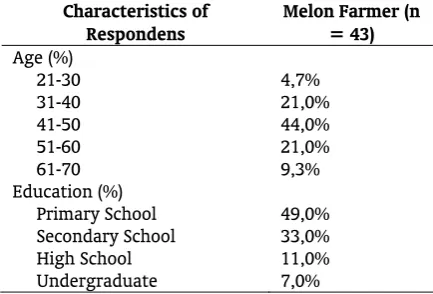
Of the 43 samples of farmers in the village of Curut and Wedoro Penawangan District have age and education level that can be illustrated in Table 1:
Table 1. Characteristics of Respondens
Characteristics of Respondens
Melon Farmer (n = 43)
Age (%) 21-30 31-40 41-50 51-60 61-70
4,7% 21,0% 44,0% 21,0% 9,3% Education (%)
Primary School Secondary School High School Undergraduate
49,0% 33,0% 11,0% 7,0%
The most age of melon farmers with a range of 41-50 by 44% (19 people). As for the education level of farmers, the highest average is primary school graduates was 49% (21 people), Secondary school 33% (14 people), Senior high school 11% (5 people) and undergraduate as much as 7% (3). The higher the level of education of farmers will affect the thinking of farmers in early applied science in agriculture, and the information obtained is more and more farmers, including how to use personal protective equipment to protect themselves from the risk of pesticide poisoning.
2. History of Pesticide Exposure
Melon plants are very susceptible to diseases and pests, so farmers need to use pesticides to control pests and diseases that attack the melon crop. The use of pesticides continue to cause farmer's risk of getting exposure to pesticides. Of the 43 respondents drawn, all farmers use pesticides to control pests and diseases in plants, the average perminggunya farmers spraying 2-4 times depending on how many pests and diseases attack the farm. In one growing season 70% of farmers use pesticides melons as much as 4 types of pesticides, with 18.6% of the farmers use doses above the dose (Table 2).
3. Practice Use of Personal Protective Equipment
PPE when spraying pesticides can be seen in graph 1.
Table 2. History of Pesticide Exposure
Pesticide Exposure Melon Farmer (n = 43)
Spreading Frequencies/week (%) 1 times
2 times 3 times 4 times 7 times
7,0% 27,9% 37,2% 25,6% 2,3% Kind of Pesticides (%)
2 3 4 5 7
2,3% 18,6% 70,0% 2,3% 6,8% Doses of using pesticides (%)
Based on suggestion Under suggestion Upper suggestion
62,8% 18,6% 18,6%
Graph 1. The use of PPE Practices by Farmers in the village of Curut and Wedoro, Subdistrict of
Penawangan
From the graph 1 above can be seen in the use of PPE farmers practice masks as much as 67.5% (29 people) were always used, 2.3% (1) farmers who rarely wears and 30.2% (13 people) of farmers who never wear a mask when spraying pesticides. Practice using gloves there are 9 people who always wears, two people often wear, two people who rarely wears and 69.77% (30 people) farmers never wear gloves
when spraying pesticides. Long sleeves as much as 97.7% (42 people) farmers who have always used and 2.3% (1 person) who does not use long sleeves while spraying. All of the respondents have never used boots on while spraying. Practice using existing trousers while spraying 81.4% (35 people) is always used, 2.3% (1 person) is often used, 4.66% (2 people) rarely use them and 11.64% (5 people) do not use during the spraying process. Farmers as much as 46.5% (20 people) always use the cap / hat and 53.5% (23 people) never use a cap / hat on while spraying.
4. Levels of Kholinesterase in Farmers’ Blood
From the results of cholinesterase examination of the farmer in the village of Curut and Wedoro gained an average results about 8288 U / L, the lowest yield 4.94 U / L and the highest examination results is 11 350 U / L with normal standards for men 4620-11500 U / L, this means that the content of pesticides in the farmers’ blood are approaching threshold consideration. Abnormal Cholinesterase levels in the farmers’ blood can cause health problems. The strength of the enzyme cholinesterase inhibition is determined by the content of the dangers of chemical pesticides present in the blood. When cholinesterase enzyme levels in the blood will increase the decreased levels of red blood or plasma cholinesterase significantly before the appearance of symptoms resulting. The examination of cholinesterase level in the farmers’ blood will help in the prevention of fatal impact8
.
5. Pesticide Poisoning Symptoms and Signs
Graph 2. Pesticide Poisoning in Rural Farmers in Curut and Wedoro Subdistrict Penawangan
Symptoms of toxicity experienced by the farmers are headaches, fatigue, blurred vision, lack of appetite, excessive sweating, muscle feels weak, increased saliva production, excessive water out of the eyes, abdominal pain, chest pain, feelings of anxiety and diarrhea. Headache is a symptom of pesticide poisoning is most felt by the Melon farmers in the village of Curut and Wedoro.
Behavior is what has done by humans, either directly observable or not. Human behavior is essentially an activity of the man himself 9
. Farmers in the District of Curut and Wedoro Penawangan using pesticides in order to protect melon and watermelon crops from pests and plant diseases that will harm their crops. According to David Pimentel, the pesticide has a significant relationship to food production where the estimated use of pesticides will reduce the possibility of crop pests by 10%, but if the farmers do not use pesticides are possibly between 0-100% crop loss due to pests10,11,12
. Based on data from respondents education, the level of education of respondents included in the low category (49% of primary school graduates), this condition will affect the mindset of the people. Traditional farming communities are still often characterized by low levels of education5
. The average farmer to mix more than one pesticide in a single spray, according to the Canadian Federation of healthy meals, mixing pesticides is not an effective way to control crop pests, otherwise it will adversely affect both the environment and human health13,14
.
In fact the melon farmers in the village of Curut and Wedoro are at high risk of exposure to direct contact pesticides, either when mixing, stirring or spraying pesticides. It was reported that chlorpyripos contained in pesticides easily absorbed by the skin15
. Based on the research of Erik Jors, in Bolivia found that almost all the farmers do not get instructions on how to use the right pesticides and prevention so that he is not exposed to hazards posed by pesticides16 the
situation is similar to the situation in Curut and Wedoro village where farmers are mostly less educated do not get instructions on how to cultivate the right pesticide. Lack of knowledge about the processing of pesticides showed a lack of access to information16
. The results of Klith Hanne Jensen (2011) showed that farmers with higher education levels would reduce the risk of pesticide poisoning because he was wearing extra protection. In addition, the cleanliness of personal protective equipment will also affect the incidence of pesticide poisoning17
.
The frequency of spraying pesticides found most farmers spray the melon 3 times in one week, (37.2%). Based on the research results of Eric, found that there is a relationship between perceived symptoms with a frequency of pesticide spraying, this suggests that the more a farmer spraying pesticide then it is likely to show symptoms of poisoning increases16
. From the research, Michael stated that the frequency of the use of pesticides has exhibited significantly towards frequency relationship of farmers visited health service because of illness18
.
Based on the research results, the behavior of farmers in the use of PPE showed a trend is not good, ie 100% of respondents do not use boots, 69.77% did not use gloves, 53.3% did not use a cap / hat, 30.2% did not use mask, 4.66% did not use trousers. These conditions make the risk of exposure to pesticides melon farmers, causing melon farmers were poisoned, although the light levels. If the melon farmers do not use gloves or masks, the pesticide can be attached to the skin of the hands and absorbed into the body through the pores of the skin, it is consistent with studies of Murphy and LaCross4
states that the use of gloves can reduce exposure pesticides to 99%. In addition to the impact of acute poisoning, chronic effects caused by the use of pesticides include cancer. In the United States found cases of cancer caused by pesticides is less than 1%, this is because the cancer is a chronic impact that takes a long time so most of the incidence of cancer was not associated with exposure to pesticides19
. Based on this, it is possible that farmers melons in the village of Curut and Wedoro at risk for developing cancer due to less use of PPE10
. The lack of use of PPE in the farmers showed a lack of availability of tools, lack of money to purchase PPE or due to hot weather so that farmers do not use PPE because of the inconvenience16
.
The results of the study Budiyono, 2005, showed no association between the use of personal protective equipment to the level of toxicity of spraying melon farmer in the village of Jatigembol, subdistrict Kedunggalar, Ngawi. Although the number of respondents who wear personal protective equipment for 31 respondents but the poisoning of 22 respondents, is due to the use of personal protective equipment is not complete, for example, just wear long sleeves and long pants but without wearing a mask and gloves. In addition to the lack of PPE is used, pesticide poisoning is also influenced by the wrong pesticide management, including not using pesticides a good mixer, not washing tools used after spraying and the use of pooled water to wash the atomizer. This resulted in pesticide sprayers attached to it will be easier to enter the body, causing acute poisoning as a result of exposure to pesticides10,20
.
Afriyanto research (2009), showed no association between the use of PPE with organophosphate poisoning incident at the spraying chilli farmer. In general, the behavior of the farmers in this area use PPE incomplete21
. In general, they only use an average of 3 PPE in the form of long-sleeved shirts, long pants and a hat. In addition, Miss Saowanee research (2009) in Thailand showed that farmers there wearing PPE incomplete, including only wearing boots and long-sleeved shirts, even found 4.1% of
respondents drink or smoke while spraying pesticides22
. Florencia Research shows that only a third of farmers who use gloves and masks, most of the farmers do not have the awareness to purchase PPE23
. The belief of farmers that pesticides are not toxic and harmless to health so that farmers do not use PPE when applying pesticides24,6
.
From the results of cholinesterase examination of the farmer in the village of Curut and Wedoro gained an average results 8288 U / L, the lowest yield 4.94 U / L and the highest examination results of 11 350 U / L with normal standards for men 4620-11500 U / L , this means that the content of pesticides in the melon farmers’ blood approaching the highest threshold, so it can be detrimental to health. As for the complaints of the farmers, most are headache, blurred vision and fatigue. Abnormal absorption of cholinesterase at the farmers almost always produces a mixture of anti-cholinesterase25
.
Pesticides can enter the body through the respiratory tract, mouth and skin penetration, it is a good way to prevent poisoning and reduce to the smallest possible hull contact with pesticides is to provide protection on the part - the part with the personal protective equipment. Toxicity and morbidity caused by pesticides is an expensive price to be paid by farmers who use no appropriate PPE10
. The economic pressures felt by many farmers to adopt healthy behaviors and safety in the use of pesticides26
.
Symptoms of poisoning are felt by melon farmers in the village of Curut and Wedoro mostly headaches. But farmers do not realize that the symptoms experienced due to pesticides. Farmers with low education will not associate the symptoms of poisoning are felt with the use of pesticides27
. The use of masks and gloves is very low among farmers. This results in easy contact with the mouth pesticides28,29
children of farmers poisoning also increased as the number of pesticide stored in the house30,31
.
D. Conclusion
Melon farmer behavior in the village of Curut and Wedoro showed a trend in the use of PPE is not good, ie 100% of respondents do not use boots, 69.77% did not use gloves, 53.3% did not use a cap / hat, 30.2% did not using masks, 4.66% did not use trousers. Cholinesterase at the farmers obtained an average of about examination results 8288 U / L, the lowest yield 4.94 U / L and the highest examination results 11 350 U / L with subjective complaints experienced by farmers, most are headache, blurred vision and fatigue.
Melon farmers should wear complete PPE, ie boots, long pants, long sleeves, gloves, masks, goggles and cap so as to prevent and reduce pesticide poisoning.
E. References
1. Anonim (2012). Melon Grobogan Kuasai Pasar Jateng,
http://www.suaramerdeka.com/v1/index.php /read/cetak/2012/06/11/189133/Melon-Grobogan-Kuasai-Pasar-Jateng. Diakses 14 Oktober 2012
2. Kantor Deputi Menegristek Bidang Pendayagunaan dan Pemasyarakatan Ilmu Pengetahuan dan Teknologi (2000). Melon, http://www.warintek.ristek.go.id/pertanian/ melon.pdf. Diakses 14 Oktober 2012
3. Oyediran, WO (2014). Determinants of Melon Production in Iseyin Local Government Area of
Oyo State Nigeria. Scholars Journal of
Agriculture and Veterinanry Sciences.
4. Budiono, Nurjazuli, Heru Prastowo (2005).
Hubungan Faktor Pemaparan Pestisida Dengan Keracunan Pestisida Pada Petani Penyemprot
Melon Di Ngawi, Jurnal Kesehatan
Masyarakat Indonesia. Vol 2 No 2 Tahun 2005.
5. Clarke.E.E.K, Levy LS, Spurgeon A, Calvert IA (1997). The Problems Associated with Pesticide Use by Irrigation Workers in Ghana.
Occupational Medicine 47(5): 301-308
6. Mekonnen Y, Agonafir T (2014). Pesticide Sprayers’ Knowledge, Attitude, and Practice of Pesticide Use on Agricultural Farms on Ethiopia.
Occupational Medicine 52(6): 311-315
7. Arikunto Suharsimi (2006). Prosedur Penelitian Suatu Pendekatan Praktik, PT.Rineka Cipta. Jakarta.
8. Callaway S (1951). Blood Cholinesterase Level and Range of Personal Variation in a Healthy Adult population. British Medical Journal. 9. Notoatmodjo S (1993). Pendidikan Dan
Perilaku Kesehatan, PT Rineka Cipta, Jakarta 10. Pimentel D, Acquay H, Biltonen M, Rice P,
Silva M, Nelson J, Lipner V, Giordano S, Horowitz A, D’Amore M (1990).
Environmental and Economic Costs of Pesticides Use. Bioscience. Proquest 42(10): 750-760 11. Accury TA, Quandt SA, Austin CK, Preisser J,
Cabrera LF (1999). Implementation of EPA’s Worker Protection Standard Training for Agricultural Laborers: An Evaluation Using North Carolina Data. Public Health Report 12. Md. Wasim Aktar (2009). Impact of Pesticide
Use in Agriculture; Their Benefits and Hazards.
Slovak Toxicology Society.
13. Regulatory news (2010). Outlooks in Pest
Management. Research Information.
hhtp://www.pestoutlook.com
14. Jiaming Liang (2011). Agricultural Wastes.
Water Environmental Research
15. Thetkathuek A, Keifer M, Funglada W, Kaewkungwal J, Padungtod C, Wilson B, Mankhetkorn, S (2005). Spectrophotometric determination of Plasma and Red Blood Cell Cholinesterase Activity of 53 Fruit Farm Workers Pre and Post Exposed Chloropyrifos for One Fruit Crop. Pharmaceutical Society of Japan 53(4): 422-424
16. Jors E, Cervantes RM, Condarco GA, Huici O, Lander F, Baelum J, Konradsen F (2006).
Occupational Pesticide Intoxications among Farmers in Bolivia: Cross Sectional Study.
Environmental Health: A Global Access Science Sources 5(10): 1-9
among Aquatic Farmers in Phnom Penh, Cambodia. Journal of Toxicology
18. Alavanja MCR, Sadler DP, McDonnell CJ, Lynch CF, Pennybacker M, Zahm SH, Lubin J, Mage D, Steen WC, Wintersteen W, Blair A (1998). Factors Associated with self-reported, Pesticide Related Visits to Health Care Providers in The Agricultural Study. Environmental Health Perspective 106(7): 415-420
19. Damalas CA, Eleftherohorinos IG (2011).
Pesticide Exposure Safety Issues , and Risk Assessment Indicators. International Journal of Environmental Research and Public Health (8): 1402-1419
20. Tondl RM, Schuzle L (2000). Use of Personal Protection Equipment and Laundry Practice by Nebraska Private Applicators and Launderers.
Journal of Pesticide Safety Education (2): 27-34
21. Afriyanto (2009). Keracunan Pestisida Pada Petani Penyemprot Cabe Di Desa Candi Kecamatan Bandungan Kabupaten Semarang,
Jurnal Kesehatan Lingkungan Indonesia. Vol. 8 No. 1, April 2009.
22. Norkaew MS (2009). Knowledge, Attitude, And Practice (KAP) of Using Personal Protective Equipment (PPE) for Chili Growing Farmers in Huarua Sub-district, Mueang District Ubonrachathani Province, Thailand. College of Public Health Science. Chulalongkorn University
23. Coronado GD, Thompson B, Strong L, Griffith WC, Islas I (2004). Agricultural Task and Exposure to Organophosphate Pesticides among
Farm workers. Environmental Health
Perspective 112(2): 142-147
24. Gomes J, Lloyd O, Revit DM, Norman JN (1997). Erythrocyte Cholinesterase Activity Levels in Desert Farm Workers. Occupational Medicine 47(2): 90-94
25. Mekonnen Y, Ejigu D (2005). Plasma Cholinesterase Level of Ethiopian Farm Workers Exposed to Chemical Pesticide. Occupational Medicine (55): 504-505
26. Murphy DJ, LaCross CM (2002). Personal Protection front Pesticides, Pensylvania State
i. University, USA
27. Xiang H, Wang Z, Stallones R, Keefe TJ, Huang X, Fu X (2000). Agricultural Work-Related Injuries among Farmers in Hubei, People’s Republic of China. American Journal of Public Health 90(8): 1270-1276
28. Lebailly P, Bouchart V, Baldi I, Lecluse Y, Heutte N, Gislard A, Malas JP (2009). Exposure to Pesticides in Open-Field Farming in France.
Oxford University Press 53(1): 69-81
29. Feola G (2010). Why don’t Pesticide Applicators Protect Themselves? Exploring of the Use Personal Protection Equipment among Colombian Smallholder. International Journal of Occupational and Environmental Health 30. Curwin B.D. 2006. Bringing Work Home: Take
Home Pesticide Exposure among Farm Families .Thesis. Utrecht University