Asia Research Institute
Working Paper Series No. 168
Directing Urban Planning From the Top:
Rezoning the Urban Informal Sector in the
Multi-Party System of Yogyakarta City
Achmad Nurmandi
Department of Government Affairs and Administration
Universitas Muhammadiyah Yogyakarta
[email protected]
[email protected]
The ARI Working Paper Series is published electronically by the Asia Research Institute of the National University of Singapore.
© Copyright is held by the author or authors of each Working Paper.
ARI Working Papers cannot be republished, reprinted, or reproduced in any format without the per issio of the paper s author or authors.
Note: The views expressed in each paper are those of the author or authors of the paper. They do not necessarily represent or reflect the views of the Asia Research Institute, its Editorial Committee or of the National University of Singapore.
Citations of this electronic publication should be made in the following manner: Author, Title, A‘I Worki g Paper, No. #, Date, . us.ari.edu.sg/pu / ps.ht . For i sta e, “ ith, Joh , Eth i ‘elatio s i “i gapore, A‘I Worki g Paper, No. , Ju e , .ari. us.edu.sg/pu / ps.ht .
Asia Research Institute Editorial Committee
Michelle Miller - Chair Gregory Clancey Jeremy Kingsley Jonathan Benney Liang Yongjia Peter Marolt Tim Bunnell Valerie Yeo
Asia Research Institute
National University of Singapore 469A Tower Block #10-01, Bukit Timah Road,
Singapore 259770 Tel: (65) 6516 3810 Fax: (65) 6779 1428
Website: www.ari.nus.edu.sg Email: [email protected]
Directing Urban Planning From the Top:
Rezoning the Urban Informal Sector in the
Multi-Party System of Yogyakarta City
INTRODUCTION
Urban management and planning is a political act, most obviously because it involves governmental discretion in the distribution of resources (R. Batley, in Devas and Rakodi, 1993, p. 176). Possessing the function of planning, the urban government should manage the complexity of urban affairs. Urban management and planning become processes not products—that is rather than being focused on the production of intellectual plans and other inaccessible goods (houses, etc), they are concerned with the process of negotiating with and enabling alternative possible providers in the private or public sectors (R. Batley, in Devas and Rakodi, 1993, p. 179).
The political negotiation process has become a complex-network and a demanding process in multi-party systems at a local level. Since the direct election for the head of the city has been based on Law No. 32/2004, the political configuration has changed. Candidates for mayor who want to rule a city have to be nominated by party or parties that have 15% of local council seats. The mayor and vice mayor candidates have to win a minimum of 25% of popular votes. In political reality, however, not all of the candidates nominated by the winning party in a local council can get the popular vote. The winner can basically affect the popular vote by his or her popularity and ability to be selected. As a consequence, this allows most regent or mayor candidates to win the popular vote from minority parties in a local or city council. The research of the Lingkaran Survey Indonesia (LSI) finds that the direct election of a regent or mayor in the Bengkulu Province and the Southeast Timor Province tends to form a local government which is divided rather than a unified government. A divided local government is defined as a local government governed by a head or vice head (it can be regent or mayor) nominated by a minority party, or on the other hand, a local council owned by a majority party. A unified local government is defined as a local or city government governed by the winner of a local government head (regent or mayor) that comes from a majority party in a local council or parliament. Until 2006, LSI found that there was a 56.9% divided local government and only a 43.1% unified local government from direct election results in 296 autonomous areas throughout Indonesia.
Divided local government can be explained from the logic of direct election for candidates who are not from the party. Voters prefer to evaluate candidates rather than support party or parties (split – ticket voting). Here, a voter shares his or her vote for some positions. For legislative institutions, a voter chooses party A, but for a mayor or regent election, he or she votes for candidates from the other parties (party B) (LSI, 2008).
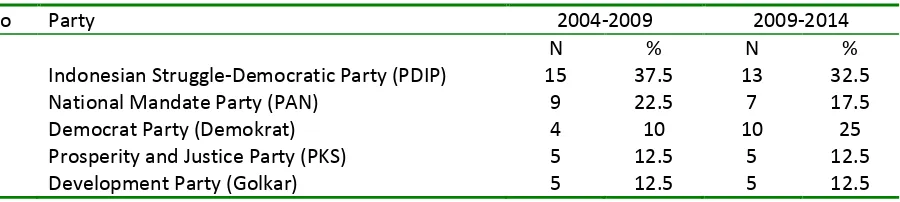
This divided government situation occurred in the municipality circles of Yogyakarta as a consequence of the General Election Results in 2004. At that time, the general election results in Yogyakarta city revealed that parliament seats were won by the Indonesian Democratic Party-Struggle (11 seats), followed by the National Mandate Party (9 seats), the Golkar Party (5 seats), the Prosperous Justice Party (5 seats), the United Development Party (1 seat) and the Democratic Party (4 seats). The result of this election indicated that the flow of political nationalism which is based on segregation; modern and modernist Muslims; was still relevant enough to analyze the political map at a lower level (grassroots). In short, the Indonesian Democratic Party-Struggle was supported by voters coming from the nationalists and the traditional Javanese, while the National Mandate Party and the Social Prosperous Party voters were from modernist Muslims. Therefore, the political competition in winning mayoralty can be assumed to frequently involve Muhammadiyah, one of the biggest Islam organizations in Indonesia, and the traditionalism of Java.
Mayor Herry Zudianto and Deputy Mayor Shukri Fadholi were couples who won the local election ased o La No. of hose legislators. )udia to s a kground was an as entrepreneur with the company flag of "Margaria RIA Group". He grew up and was born in the Malioboro area. Before being active in the National Mandate Party, he became the person in charge of the Muhammadiyah Regional Board especially in the Economic Council. In the first period of his political career in the National Mandate Party Yogyakarta, Shukri Fadholi served as treasurer. However his background was as a politician and activist of the United Development Party when he was nominated as vice mayor---serving as the Branch Executive Board Chairman of the United Development Party (PPP DPC) of Yogyakarta city. The pair disposed mayor candidates who were nominated by the Indonesian Democratic Party-Struggle by winning 22 votes against 17 votes in the second round.
Herry Zudianto nominated himself again in the second period, 2006-2011, with a different partner. In the direct mayoral elections on 27 November 2006, Zudianto partnered with Haryadi Suyuti nominated jointly by the National Mandate Party, the Golkar Party and the Democratic Party (People Coalition of Yogyakarta). Through this strategy, he won the election again with 112,036 votes (61.5%) beating Fadholi Widartho Shukri who only received 38.5% of the vote. The couple won in all of the sub-distri ts. The opi io polls o du ted Ko pas o luded that the figure of Herr s audie t as a ajor fa tor i gai i g otes e ause of his lo g areer a d su ess ser i g as a or. Herr s popularity was widely known by 48% of Kompas poll respondents.
Table 1. Seat Allocation of Yogyakarta City Council
No Party 2004-2009 2009-2014
N % N %
1 Indonesian Struggle-Democratic Party (PDIP) 15 37.5 13 32.5
2 National Mandate Party (PAN) 9 22.5 7 17.5
3 Democrat Party (Demokrat) 4 10 10 25
4 Prosperity and Justice Party (PKS) 5 12.5 5 12.5
5 Development Party (Golkar) 5 12.5 5 12.5
The political consolidation process will be explained further in this paper, especially the process of relocating scrap street vendors from Mangkubumi Street. This paper explains the way the authors combined the relocation planning process with discussions with street vendors who were to be displaced from Mangkubumi Street to the new market location which specializes in selling used goods. The political consolidation or accommodation was managed by the urban government in the current political situation in order to avoid political conflict and enhance cooperation. In terms of managing urban planning, public officials from the urban government had to understand and manage relations among actors and be able to negotiate between them.
The roles of public officials are then more analytic, political, and managerial than technical: they have to understand the motivation of and interrelation between actors, negotiate between them and decide when judicious intervention is required to induce change.In this way, public officials (city managers) are expected to straddle the divide between working with the powers-that-be and bringing about change in favour of the needs of the poor or the majority. They also have to try to coordinate, harmonize or decide between the investment plans and development objectives of public and private actors in different sectors.
The riter s resear h to date has o e trated o the pla i g pro ess i lo al politi s of the ulti -part s ste , ot o l the politi al a tor s role ut also the o u it a d pri ate a tor s role i planning processes that have to pass through negotiation, bargaining, as well as the consolidation process in order to attain mutual understanding and a common goal. Hiller (2000), Mulgan (1997), Burn and Taylor (1997) have done similar network research in the planning process of different ou tries. Hiller s stud results ere a re ie of the Ha er asia o u i ati e approa h to ards decision-making and whether they still rely on rationality. In fact, the planning process is a political process which reveals how social actors are increasingly organizing and mobilizing outside of the formal procedure. The questions that subsequently might arise include how to undertake urban planning and management in the multi party system of Yogyakarta City as well as how to plan the process network in the multi party system within local politics.
THE PLANNING PROCESS OF LOCAL POLITICS IN A DEMOCRATIC REGIME
responses to all possible contingencies cannot be contracted for the simple reason that all possible contingencies cannot be foreseen. The latter, well-known problem of cycling in a multidimensional spa e Co dor et , Dodgso , Mueller further li its the ele tio s a ilit to o e information with anywhere near enough detail to inform specific policy decisions (Verba et al. 1993).
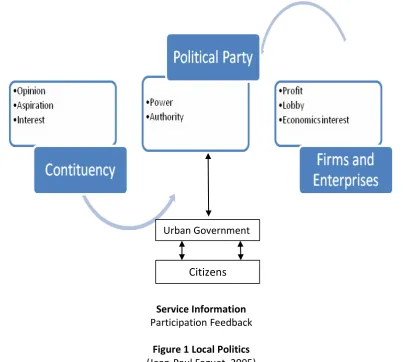
In this setting, local government is a hybrid. Its function is to produce local services and policies at the intersection of two quasi-market relationships and one organizational dynamic (Jean-Paul Faquet, 2005). Thus local government occurs at the confluence of two distinct forms of social interaction (Jean-Paul Faquet, 2005). Political parties and politicians are at the centre of both quasi-markets. The first of these occurs between parties and individual voters. Following Schlesinger (1984), this can be thought of as the primary or retail political market in which parties exchange ideas and declarations of principle for votes; parties compete with promises and ideas to attract voters who vote for the party or candidate that inspires the most confidence. Such exchange is intrinsic to the nature of democracy. The second market connects parties to private firms, producer associations, and other economic and issue-oriented interest groups. Following the pressure group politics work of Bentley (1908), Finer (1997) and Truman (1951), it can be thought of as a secondary or wholesale political market in which specific policies or entire policy bundles, as well as broader influence over legislators and the policy-making process, are sold to interest groups in exchange for money. The rationale for this market is derivative but compelling: despite being volunteer organizations, political parties require resources to fund election campaigns and sustain party operations. In addition, firms are interested in a continuing influence over government decisions and the policy environment in which they operate (Kitschelt 2000). Such wholesale exchanges, combined with gifts from the faithful, are how parties finance themselves. Ben-Zion and Eytan (1974), Poole and Romer (1985) and many others, have tested the relationship between campaign contributions and policy making empirically, with positive results.
Service Information
ParticipationFeedback
Figure 1 Local Politics
(Jean-Paul Faguet, 2005)
Direct election for mayor in Indonesian cities may affect the practice of urban planning and management. Citizens vote for candidates for mayor who have been proposed by the political party or the united political parties. Mayor direct elections do not establish a contract (explicit or implicit) between government and the governed, nor do they set a specific policy agenda. This is due to two problems: political contract and cycle. The former, emerging from the incomplete contracts literature (e.g. Hart 1995, Hart and Moore 1990), refers to the impossibility of writing a o prehe si e platfor that li ks politi ia s a tio s to oters poli prefere es. “pe ifi responses to all possible contingencies cannot be contracted for the simple reason that all possible contingencies cannot be foreseen. The latter, well-known problem of cycling in multidimensional spa e Co dor et , Dodgso , Mueller further li its ele tio s a ilit to o e information with anywhere near enough detail to inform specific policy decisions (Verba et al. 1993).
Local government cabinet in multi-party system causes the urban government has to consolidate and negotiate with different parties whose members were in local parliament. Besides that, urban government has to be facilitated local resident interest represented by local-community organization. Most mainstream studies of urban politics implicitly assume that local governments are important because the services they provide to local residents are important (Wolman and Goldsmith, 1992, p.3). In some cases, the design of policy involves bargaining between public and private sector. The public sector strives to structure incentives or regulations in ways that promote private sector activity consistent with public purposes, and the private organizations seek to shape those incentives or regulations in accordance with their interest (Pindus, et all, 2009, p. 16). Another focal approach was introduced by Marxists tradition said that the ur a state pro oti g pri ate
Urban Government
capital accumulation, and they then proceed to examine the ways in which this occurs (Cockburn, 1977, in Wolman, 1992, p. 4). Wolman referred to Gurr and King said that there were two constraints limit local government ability to act to affect citizen well-being varies from country to country. Type I constraints refer to limit on local autonomy imposed by local economic and social conditions, while Type II constraints refer to limits imposed by higher levels of government ( p.41).
Government is viewed as one intertwined system; a complex network of temporary relationships fashioned to work out problems as they arise and linked by informal channel of communication (Mintberg, 1979, p. 80). In the process of city planning, the network has an important role, especially in the formulation and implementation. The planning process uses a model of collaboration, which prioritizes to strengthen the community as the party using the plan.
Table 1. Typology of Network Structure
Distribution of power Types of Interaction
Conflict Bargaining Cooperation
Concentration Dominance Asymmetric bargaining Hierarchical cooperation
Fragmentation Competition Systematic bargaining Horizontal cooperation
(Adam and Kreisi, 2007: 135, in Park, Hyung-Jun and Min-Jeong Park, 2009)
The interactions among actors can occur in three forms, those are, conflict, bargaining and cooperation. Meanwhile, the power might be scattered or concentrated in one institution.
STREET VENDORS POLICY OF LOCAL GOVERNMENT
As a governmental organization, the city government must act suitable the existing regulations, namely, the local laws. The local regulations are the rules drawn up together with the local council and the foundation for some considerations:
a. Lo al la o: of All street e dors ho ill do usi ess a d use the spa e for selling must have a permission and identity from the mayor or the designated agency. As the absorption of the rule of the space for the street vendors had been decided, then the street vendors being at the outside the absorption area will be ordered and controlled by Yogyakarta City government.
b. Mayor Regulation No. 45 of 2007 which aims to relocate Klitikan street vendors from Mangkubumi, Asemgede, and South Square to a better and neatly-arranged area by providing a new location for street vendors in Kuncen.
c. The order of the Local law no: 26 of 2002 is an important step in coaching the street vendors. However, the law contains a great number of weaknesses because it is too general. 1 Therefore, since 2002 there have been a lot of decrees or municipal regulations which have been issued as the implementation rule in the field.
In the Local law there was not a main pattern of coaching the street vendors, it only set up licensing procedures. After the law had been implemented, there would be a learning to find great patterns for empowering the street vendors. Until now, there have been at least two main patterns of the street vendors coaching in Yogyakarta city, namely management and development.
Basically, there were two forms of street vendors coaching that exist in Yogyakarta city, among others were: (1) Structuring, and (2) Development. Structuring had three variants that were: (a) providing shelter, (b) supplying similar tent and (c) relocation while the development was to provide value-added in order to be more alive, and the steps that should be taken were promotion, improving the quality of merchants and location development. The pattern of structuring and development as described above had been developing since the relocation of Taman Pintar market in 2005. The explicit product knowledge was obtained from the interaction among the old actors. One of the problems that frequently appeared in the structuring and development was the existence of the conflict between the street vendors and the city government.
The structuring policy had three kinds of activities, among others are; (1) providing shelter, (2) supplying similar tent and (3) relocation. Providing shelter was conducted by giving special space to the street vendors and completed with semi-permanent building, afternoon market in Malioboro Street for the example. While supplying similar tent was the standardization activity of street vendors uildi gs ithout ha i g to o e to the other spa es. The last, relo atio as per a e t street vendors moving and being provided by formal traders facilities just like scraps market.
The pattern of development included the promotion, improvement in quality of goods and location activities. The pattern was not implemented seriously by Yogyakarta governmental organizations. Yogyakarta City Government had no clear pattern of regional development for street vendors. In contrast to some officials, it supposed that the presence of pattern vagueness should facilitate the policy adjustments in the field. The patterns were obtained from the process of knowledge management in the city governmental organization, starting from the perception of how to solve the problem beingfaced.
The first document which had to be prepared was a document of environmental Management or the Environmental Monitoring in 2004 by the Office of Environment. Then in 2005, The Local Planning Developmental Office conducted a feasibility study and in 2006 being continued with the Detail Engineering Design (DED) by the Asset Unit Agency.
Negotiation process that took a long time was kept being lead to be what it looked like by Yogyakarta City Government to plan the relocation of the hawkers from the previous location to the new one that was located on Cokroaminoto Street. In this case, the plans being made by the City Government should be matured and accommodated all stakeholder interests. However, on many occasions, the mayor must give a coherent, reasonable, credible (reliable) and acceptable explanation about the relocation to them.
The relocation of the street vendors kept continuing to be conducted by Yogyakarta City Government; though there were still some of the street vendors who were members of the Association of Klitikan Mangkubumi Merchants (Pethikbumi) refused the relocation plan decision. The street vendors that existed on three locations, that were, in Mangkubumi Street, South Square and in Asem Gedhe should had been relocated to Pakuncen started on Friday (9/11).
moving into Pakuncen Markets located on HOS Cokroaminoto street and expected to be well developed.
"We will ensure the marketing activities. We will be responsible for Pakuncen to be a crowded market" he said while saying that the Pakuncen market would be the only one market that sells used goods in Yogyakarta. 2
As a governmental organization, the city government must be acted suitable with the existing regulations, namely, the local laws. The local regulations are the rules drawn up together with the local council and the foundations for the rezoning were:
a.
Lo al la o: of All street e dors ho ill do usi ess a d use the spa e forselling must have a permission and identity from the mayor or the designated agency. As the absorption of the rule of the space for the street vendors had been decided, then the street vendors being at the outside the absorption area will be ordered and controlled by Yogyakarta City government.
b. Mayor Regulation No. 45 of 2007 which aims to relocate Klitikan street vendors from Mangkubumi, Asemgede, and South Square to a better and neatly-arranged area by providing a new location for street vendors in Kuncen.
The order of the Local law no: 26 of 2002 was an important step in coaching the street vendors. However, the law contained a great number of weaknesses because it was too general. 3 Therefore, since 2002 there have been a lot of decrees or municipal regulations which have been issued as the implementation rule in the field.
In the Local law there was not a main pattern of coaching the street vendors, it only set up licensing procedures. After the law had been implemented, there would be a learning to find great patterns for empowering the street vendors. Until now, there have been at least two main patterns of the street vendors coaching in Yogyakarta city, namely management and development.
Basically, there were two forms of street vendors coaching that exist in Yogyakarta city, among others were: (1) Structuring, and (2) Development. Structuring had three variants that were: (a) providing shelter, (b) supplying similar tent and (c) relocation while the development was to provide value-added in order to be more alive, and the steps that should be taken were promotion, improving the quality of merchants and location development. The pattern of structuring and development as described above had been developing since the relocation of Taman Pintar market in 2005. The explicit product knowledge was obtained from the interaction among the old actors. One of the problems that frequently appeared in the structuring and development was the existence of the conflict between the street vendors and the city government.
The structuring policy had three kinds of activities, among others are; (1) providing shelter, (2) supplying similar tent and (3) relocation. Providing shelter was conducted by giving special space to the street vendors and completed with semi-permanent building, afternoon market in Malioboro Street for the example. While supplying similar tent was the standardization activity of street e dors uildi gs ithout ha i g to o e to the other spa es. The last, relo atio as per a e t street vendors moving and being provided by formal traders facilities just like scraps market.
2
Kedaulatan Rakyat, 28 October 2007.
The pattern of development included the promotion, improvement in quality of goods and location activities. The pattern was not implemented seriously by Yogyakarta governmental organizations. Yogyakarta City Government had no clear pattern of regional development for street vendors. In contrast to some officials, it supposed that the presence of pattern vagueness should facilitate the policy adjustments in the field. The patterns were obtained from the process of knowledge management in the city governmental organization, starting from the perception of how to solve the problem beingfaced.
POLITICAL BACKGROUND
The divided government also existed in Yogyakarta City as a result of General Election Result 2004 revealed that parliament seats were won by the Indonesian Democratic Party-Struggle (11 seats), followed by the National Mandate Party (9 seats), the Golkar Party (5 seats), the Prosperous Justice Party (5 seats), United Development Party (1 seat) and the Democratic Party (4 seats). The result of this election indicated that the flow of political nationalism which based on segregation; modern and modernist Muslims were still relevant enough to analyze the political map at the lower level (grassroots). In short, the Indonesian Democratic Party-Struggle was supported by voters coming from the nationalists and the traditionalism of Java, while the National Mandate Party and Social Prosperous Party voters are from modernist Muslims. Therefore, the political competition to win mayoralty can be assumed that frequently involve the Muhammadiyah and the traditionalism of Java.
STREETS VENDORS
The results of the data collection conducted by the Yogyakarta Service Order in December 2006 showed that 5,003 street vendors existed at that time in Yogyakarta City. From 5,003 street vendors, only 3,719 of them (74.34%) had Yog akarta s perso al Ide tit ID . O ership the it perso al ID card had become a policy of municipal government to facilitate the structuring and coaching of the street vendors. The ease offered by having a city personal ID card among others, was the opportunity to obtain financing assistance from the Department of Economic Affairs.
It was true that the number of street vendors would not always match to the current conditions e ause the d a i s of the street e dors additio ha ged e er da a ordi g to the momentum of the business in Yogyakarta city. The numbers of street vendors generally increases on holidays as the number of tourists who visit Yogyakarta also increases. Yogyakarta has also become a city that attracts street vendors from other regions. In 2009, for example, there were 2,183 incidents occurred, 520 of which had to be settled in the courtroom and resulted in a fine. In comparison in 2008, there were only 538 cases. As from 2004 to 2007, the number of stalls violation, as a result of illegal street vendors, consisted 3,007 cases in 2004, 3,421 cases in 2005, 1,544 cases in 2006 and 1,232 cases in 2007, with about 25 percent of these settled through the courts. According to Wahyu Widayat, Head of Yogyakarta Order Agency, illegal street vendors could be fined from Rp.7, 500 to Rp.5, 000,000. However, the decision lies in the hands of judges and only usually only consist of Rp 25,000 in consideration of humanity aspects (Kompas.com, 11 January 2010).
the outer left of the road, measuring 31 cm in height, and 150 cm in width. This 150 cm width is equal to about Five Feet. As time went on, one by one merchant started to sell their goods on this pedestrian walk. So, that is why the merchants at in those places called "Pedagang Kaki Lima" or "Five Feet Merchants".
By 2007, Mangkubumi had become a frequently visited center for street vendors and was therefore always causing traffic jams. Street vendors at this location specialized in selling used-goods. In 2007, the number of street vendors who sold used goods on Jl. Mangkubumi amounted to 515 street vendors, as well as 109 at Asem Gedhe and 85 at South Square.
Table 2 Number of the Street Vendors
No Location The Number of Street vendors
1 Asem Gedhe Market 109 PKL
2 South square 85 PKL
3 Mangkubumi street 515 PKL
Total 709 PKL
Source: (Marketing Division of Yogyakarta City Industry and Trading Office, 2007)
THE RELOCATION POLICY
The developmental planning process of scraps market was initiated in 2004 by holding a zoning change for the Yog akarta s animal market that consisted of relocating it to Cokroaminoto Street (approximately 6,615 meters square). This was with the aim of formalizing the informal sector and increasing the economic growth in the southern Yogyakarta. Besides this, the location that was previously used by street vendors to hawk was a main street and not a trading site. The process of planning that involved Mangkubumi street vendors was a very long and difficult process, provoking controversy among the street vendors themselves.
as a new building, were thought to leave a good impression and hence attract more visitors to come to the market.
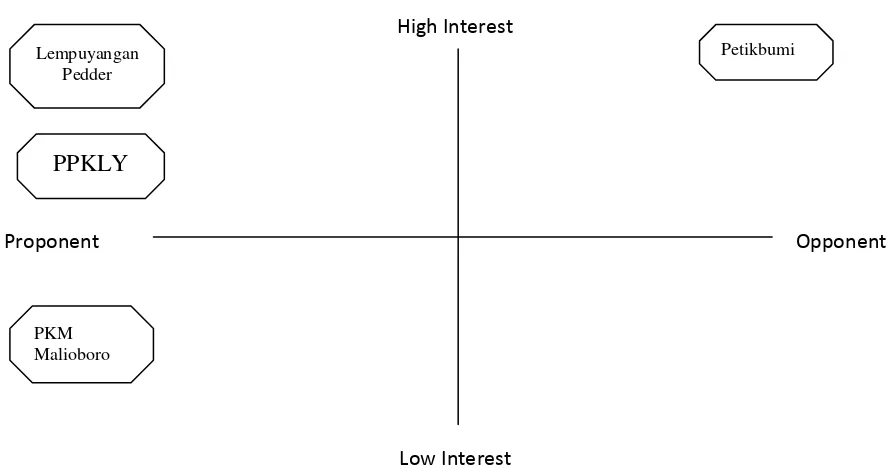
Figure 2 : Positionand Interest of Stakeholders
High Interest
Proponent Opponent
Low Interest
Since there were large numbers of actors involved in the affair of rezoning or relocation of street vendors, it lead the planning process that had commenced since 2002, to run slowly. As a result, it became quite difficult and complicated. One of the planners stated that:
We o du ted o ti uous dialogue at ight ith the street e dors for they sold at night and stated that the plan always adjusted with the input of the street vendors,
oth ho a epted a d reje ted . 4
Market relocation planning had been initiated since the beginning of the leadership of Zudianto and Fadholi in 2002 up to 2006. At that time, intensive dialogue had begun and design of the urban spatial planning concept had started. The concept involved society members working with the Urban Spatial Planning Tegalrejo District (USPT) Tegalrejo, but for three months it produced nothing. Finally, the USPT did not involve the society members anymore and only disseminated the decisions that had been made by them. 5
The dialogue process that was conducted for three months produced the conclusion that most of the scraps hawkers wanted to be relocated. Furthermore, the hawkers wanted to make efforts to ensure that the local council agreed to raise standards as part of the free relocation before the planning could be implemented.
4
Interview with former planner of second- hand goods market on 20 June 2011.
5
I id,. I ter ie the author s thesis ith Endro W. (The leader of development activities in former of Animal Market Kuncen 2006/2007) on August, 26th 2008.
Petikbumi Lempuyangan
Pedder
PKM Malioboro
The policy of relocating the street vendors was the most difficult duty to be accomplished by the Mayor. The Mayor needed to direct the implementation of the existing plan with a clear vision and communicate to the public. The aim of this vision was the formalizing of the scrap street vendors. The issuing of Mayor Regulation No. 45 of 2007 ordered the relocation of the scraps street vendors from Mangkubumi, Asemgede, and South Square to a more comfortable and neater location in Kuncen. During 2007, the Yogyakarta City Government performed the difficult tasks of carrying out the rezoning and relocation displacement of almost 1,000 merchants. This duty was very challenging and full of conflict. The most daring actions in refusing the rezoning plan were:
a. On September 27th 2007, 10,000 signatures were collected from scrap market visitors. The action was conducted as a form of public support to fight the relocation and demand the revocation of Mayor Regulation No 45 of 2007.
b. Pethikbumi street vendors brought a law suit to the Yogyakarta State Administrative Court, which essentially asked for the cancellation of the Mayor Regulation No. 45 of 2007 on street vendors.
c. Merchants came to the Yogyakarta local Ombudsman institution and demanded for its support to deny the policy.
d.
Merchants demonstrated and were supported by student organisations. They debated in parliament in Yogyakarta on June 27th 2007, calling for the parliament to allow scrap merchants in Yogyakarta to keep selling on Mangkubumi Street in the evenings and demanded to revoke Mayor Regulation No. 45 of 2007.O appro i atel t e t three o asio s for al dis ussio s ere held the Offi e of Market Management and the merchants market, beginning on September 28th 2007. The discussions were conducted in Kraton district, as a centre for merchants from South Square; Jetis District for merchants from Mangkubumi Street; and Wirobrajan District in the location of the new market. Finally on November 11th 2007 at 00:00, all scrap merchants were required to move from Mangkubumi Street to the market at Pakuncen. All scrap traders from these three sites approved of moving to Pakuncen Street.
While disseminating the procedure, the city government also underwent an administrative process for merchants who wanted to voluntarily move to Klithikan market. The stages were:
a. Colle ti g data fro ha kers through the street e dors registratio s ste o du ted showing their ID card and a copy, 2 sheets of 3x4 photographs and evidence of being a hawker) carried out between November 5th and 7th November 2007.
b. Zoning (based on the type of goods), along with the distribution of land by the government of Yogyakarta City carried out between 8th and 9th November 2007.
After disseminating the rezoning policy information, there was a large increase in the amount of violent conflict between the Yogyakarta City Government and the traders who refused to move, as well as those who agreed to and rejected the policy.
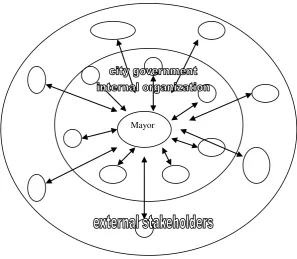
independent. The city government consists of Mayor, Deputy Mayor, the Office of Industry and Trade, the Office of Public Order, the Districts, and the Sub-district as part of the existing network. In the management of the informal sector, the City Government acted as a manager (Park, 2009, p. 210).
Fig. 2. Network in Rezoning Plan of Urban Informal Sector
In the network model above, it appears that the role of mayor is the most powerful in directing a rezoning plan with a clear vision as he or she becomes a referral for the other departments in the municipality circles of Yogyakarta. However, the mayor also plays the role of facilitator to accommodate the interests of stakeholders outside of the organization, especially the street vendors who refuse relocation. One of the important organizational units in the internal circles is the Planning Agency who prepares the master and detailed plan. Within the given process, the initial plans were revised in accordance with input from street vendors. The internal institution that dealt directly with the street vendors was the Small Scale Industry and Traditional Market Agency.
The question that might appear was what was the role of local council in the planning process? From the obtained data, the Urban Planning and the Local Developmental Program Planning Boards had always consulted the Local Council since the beginning of planning. These representative institutions must actually play a role in mediating and negotiating between the City Government and the street vendors. It was recorded that there had been four rallies or demonstrations and a lawsuit to the court from the hawkers who had rejected the plan of the City Government. This information was obtained from the informant who set the plan. He acknowledged that the role of the local council as a i stitutio as er sig ifi a t. Ha kers a d parki g asso iatio s e o e e e ore i porta t stakeholders in the creation of the planning process.
The process of making decisions in the Yogyakarta City Parliament is mostly done by the Commission D, which in this case was chaired by Herman Dodi from National Mandate Party (PAN) fraction --- the party supporter for Mayor. At that time, the PAN fraction succeeded in mobilizing support for the rezoning plan, including holding communications with the Sleman Regency Local Council in relation
to the rezoning of the animal market which was located in Kuncen Market before moving to Gamping District in the Sleman District. There were several reasons why the role of City Local Council became dominant, including: (a) budgetary rights based on Law No. 22 of 1999 were in the hands of the Local Council, before the amendment of Law No. 32 of 2004 on Local Governance and (b) parliament had made changes to the detailed plan several times.
Because there were five fractions in Parliament, the decision-making process took considerable time. The agreement of the Commission D was the result of proposals from each fraction. A multi-party parliament system surely caused the process of decision-making in urban planning, particularly traditional market rezoning, to become more complicated. Each party tried hard to make every effort to gain public sympathy by making popular decisions, especially regarding the interests of the street e dors. “o e of the fra tio s ie s i the House of ‘eprese tati es Yog akarta it hi h supported the traders and rejected the relocation were:
Commission C member in the hearing meeting of opinion (De
c
ember 2005):"It has been consideredwell that the social effects (scraps merchants-red) are going to be satisfying to them if they are relocated to Kuncen market (location of the relocation plan by Yogyakarta City Government), and also to society, but how do we socialize it? We seriously ask about this because the Executive plans to relocate all merchants from various sites to be placed in a relocated location, ... ....
(SU / competency-c / December '05). 6
Meanwhile, the Commission B members stated that they had invited several scrap merchants from different sites, especially merchants that hawked in Mangkubumi street, Asem Gedhe, and South Square, as well as former merchants from Kuncen animal to give their thoughts. There were various opinions related to their willingness to be relocated to a new location in Kuncen. A statement delivered by one of these merchants stated:
"There are merchants who refused to be relocated, primarily from Mangkubimi street..., while some of people around the Kuncen market also refused if the market is to be a scrap market because there is still a bad impression of them, especially since it is not clear where the used good (Klithikan) come from... . But since the information about the relocation plan of Klithikan market to Kuncenhas been widely spread, the merchant in Mangkubumi street now have become more and more "(MNS / competency-c / December '05) ...
The non-governmental actors such as street vendors, mass media, students and non-governmental organizations were the non-state actors involved intensely in the planning process. Nevertheless, the city government was also a strong actor and able to enforce the implementation of the compiled plan by its authority (government-leading network). The two institutions were in direct contact with the street vendors and served them. The policy that had been established by the mayor would not have run without the institutional capacity of these agencies.
CONCLUSION
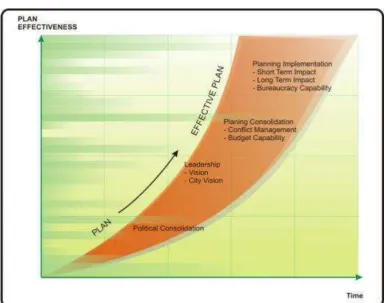
As a result of the analysis above, it can be concluded that the city planning process under a multi-party system causes inefficiency in the process because it takes considerably more time and a fairly large cost in planning. Achieving the process of agreement between stakeholders takes approximately half the period of a political cycle. This consensus can be accomplished when a city has the following requirements: First, the city has visionary leadership especially regarding the re-zoning plan as it is often full of conflicts; Second, it is supported by a direct planning process (directive plan) in accordance with the visions of a city; A mayor must also be supported by capable bureaucrats and able to manage conflicts well; Vice versa, the city government conducts the advocacy role by formalizing street vendors. The rezoning plan can then run as the leadership of mayor is backed by clear visions of street vendors, a powerful bureaucracy, strong political support in local council, and effective communication with mass media, NGOs, and community organizations. However, the lesson learnt from these rezoning cases indicates the inefficiency of the planning process because of the significant length of time from the start of the planning process to its implementation. Contrarily, street vendors --- --- although they do not have the power ---- can articulate their interests in the planning process and tend to follow a more collaborative perspective. In conflict management, the case becomes one of successful examples of a government managing conflict. Communities cannot fully manage the collaboration process since it often imposes its interest in ways that are not democratic. The government, who has clear visions through its political authorities, prepares the pla a d for es the parties that oppose to follo the rezo i g pla hi h has been set.
THEORETICAL IMPLICATION
Figure 3 . Proposed Effectiveness of Urban Plan in Democratic System
REFERENCES
Allmendinger, Philip. (2009), Planning Theory, Palgrave, New York.
Bentley, A. F. (1908). The Process of Government. Chicago: University of Chicago Press.
Ben-Zion, U. and Z. Eytan. (1974). "O Mo ey, Votes, a d Poli y i a De o rati “o iety . Public Choice, 17:1-10.
Brata, A.G. 2008. Vulnerability of Urban Informal Sector: Street Vendors In Yogyakarta, Indonesia. Paper for the International Conference on Social, Development and Environmental Studies: Global Change and Transforming Spaces, November 18-19th
Condorcet, M. de. (1785). Essai sur l’Appli atio de l’A alyse à la Pro a ilité des Dé isio s re dues àla Pluraliste des Voix. Paris:.
Devas, Nick and Carole Rakodi (ed). (1993). Managing Fast Growing Cities. Harlow: Longman Scientific &Technical.
Dodgson, C. L. (1884). The Principles of Parliamentary Representation. London: Harrison.
Downs, A. (1957). An Economic Theory of Democracy. New York: Harper and Row.
Faguet, Jean-Paul. (2005). Governance from Bellow: A Theory of Local Government with Two Empirical Test.: Suntory and Toyota International Centres for Economics and Related Disciplines London School of Economics and Political Science.
Finer, S. E. (1997). The History of Government from the Earliest Times. Oxford: Oxford University Press.
Hardiyanti, Dwi Ariyani. (2008). Ke ijaka Relokasi Pedaga gKlithika Peku e Kota Yogyakarta . Yogyakarta: Thesis of Master ofPublic Administration, UGM.
Hart, O. (1995). Firms, Contracts and Financial Structure. New York: Oxford University Press.
Hart, O. D. and J. H. Moore. 1990. Property rights a d the theory of the fir . Jour al of Politi al Economy, 98: 1119-1158.
Hiller. (2000). Going round the back? Complex network and informal action in local planning processess, Environment and Planning,vol 32.
Kompas.com. 11 January 2010.
Kooiman, Jan and Kjell A Eliassen. (1993), Managing Public Organizations, Sage Publication, London.
Kusakabe, K. 2006. Policy Issues on Street Vending: An Overview of Studies in Thailand, Cambodia
and Mongolia. Bangkok, International Labour Office,
Mueller, D. (1989). Public Choice II. Cambridge: Cambridge University Press.
Mulgan. (1997). Connectivity Chatto and Windus, London.
Park, Hyung-Jun and Min-Jeo g Park. T pes of Net ork Go er a e a d Net ork Perfor a e: Co u it De elop e t Proje t Case , Yo g-Duck Jung, et al (editors), Colloborative Governance in the United Sates and Korea, SNUPRESS, Seoul.
Pindus, Nancy, et al. (20090. Urban and Regional Policy and Its Effects. Washington: Brooking InstitutePress.
Pollit, Christopher and Geert Bouckaert. (20000, Public Management Reform, A Comparative Analysis, Oxford University Press, Oxford.
Poole, K.T. a d T. ‘o er. . Patter of Politi al A tio Co ittee Co tri utio to the s Campaigns for the United StatesHouse of ‘eprese tati e , Pu li Choi e, : -111.
Putnam, R. D. (1993). Making Democracy Work: Civic Traditions in Modern Italy. Princeton: Princeton University Press.
Rhodes. R.A.W. (1997). Understanding governance: policy networks, governance, reflexivity, and accountability, Open University Press.
Smith, B.C. (1985). Decentralization: The Territorial Dimension of the State. London: G. Allen & Unwin.
Stoker, Gerry. (19910. The Politics of Local Government. MacMillan: London.
Truman, D. (19510. The Governmental Process: Political Interests and Public Opinion. New York: Knopf.
Verba, S., K. Lehman, H. Brady and N. H. Nie. (1993). Citize A ti ity: Who Parti ipates? What do
They “ay? A eri a Politi al “ ie e Re ie , 87: 303-18.