UNIVERSITI TEKNIKAL MALAYSIA MELAKA
INVESTIGATION OF FATIGUE CRACK GROWTH ON HEAT
TREATED ALUMINUM 7075 WITH THE EFFECT OF
CORROSION
This report submitted in accordance with partial requirements of the
Universiti Teknikal Malaysia Melaka (UTeM) for the Bachelor Degree of
Manufacturing Engineering (Engineering Material) with Honours.
By
MOHAMMAD KHALID BIN KHAMBALI
FACULTY OF MANUFACTURING ENGINEERING
i
UTeM Library (Pind.1/2007)
UNIVERSITI TEKNIKAL MALAYSIA MELAKA
BORANG PENGESAHAN STATUS LAPORAN PROJEK SARJANA MUDA
JUDUL: INVESTIGATION OF FATIGUE CRACK GROWTH ON HEAT TREATED ALUMINUM 7075 WITH THE EFFECT OF CORROSION
SESI PENGAJIAN : 2009/2010
Saya MOHAMMAD KHALID BIN KHAMBALI
mengaku membenarkan Laporan PSM ini disimpan di Perpustakaan Universiti Teknikal Malaysia Melaka (UTeM) dengan syarat-syarat kegunaan seperti berikut:
1. Laporan PSM adalah hak milik Universiti Teknikal Malaysia Melaka dan penulis. 2. Perpustakaan Universiti Teknikal Malaysia Melaka dibenarkan membuat salinan
untuk tujuan pengajian sahaja dengan izin penulis.
3. Perpustakaan dibenarkan membuat salinan laporan PSM ini sebagai bahan pertukaran antara institusi pengajian tinggi. atau kepentingan Malaysia yang termaktub di dalam AKTA RAHSIA RASMI 1972)
DECLARATION
I hereby, declare this report entitled “Investigation of Fatigue Crack Growth On Heat Treated Aluminum 7075 With The Effect of Corrosion” is the results of my own
research except as cited in references
Signature :
Author‟s Name : Mohammad Khalid bin Khambali
APPROVAL
This report submitted to the Faculty of Manufacturing Engineering of UTeM as a partial fulfillment of the requirements for the degree of Bachelor of Manufacturing Engineering (Engineering Material). The members of the supervisory committee are as follow:
………
Supervisor
ABSTRACT
ABSTRAK
DEDICATION
ACKNOWLEDGEMENT
Alhamdulillah, first and foremost, I would like to thank to Allah for His blessing. Without gods bless I will not be able to complete this research as required and without the help and support from certain groups and individual it will be impossible for me to finish up this research.
Not to forget, my deepest appreciation to Mr. Mohamad Haidir Bin Maslan, my supervisor and other lecturers who had given me endless help, guidance, and support me to make up with the standard as required as a mechanical engineer student during the research.
I also want to thank to UTeM management especially manufacturing faculty management for giving me opportunity to get more experiences and knowledge during the period of the research.
Finally, I am also indebted to all those people who have directly or indirectly helped to make my final year project stint an incredible journey of knowledge and self improvement.
TABLE OF CONTENTS
List of Abbreviations, Symbols, Specialized Nomenclature xi
1. INTRODUCTION 1
2.2.1 The Aluminum Alloy 7075 5
2.3 Purpose of Heat Treatment 6
2.3.1 Heat Treatment on Aluminum Alloy 6
2.3.2 Heat Treatment Processes 7
2.3.2.2 Annealing 8 2.4.2 Stress Concentration and the Stress Intensity Factor, K 14
2.5 Fatigue Crack Growth 16
3.3.1 Heat Treatment Preparations 24
3.3.2 T6 Heat Treatment 24
3.3.3 RRA Heat Treatment 25
3.4 Corrosion 26
3.4.1Exfoliation Corrosion 27
3.4.2. Sample and Experiment Procedure 27
3.5 Fatigue Crack Growth Test Specimens 27
3.6.4 Polishing 33
3.6.5 Etching 33
3.6.6. Microstructure Observation 34
3.6.7 Optical Microscopy 34
3.6.8 Scanning Electron Microscopy 35
3.7 Hardness Testing
5. CONCLUSION AND RECOMMENDATION 56
5.1 Conclusion 56
5.2 Limitations of the Present Work 58
5.3 Recommendation 58
7. REFERENCES 59
8. APPENDIX
A Gantt chart for PSM 1 and 11 B. Fatigue Crack Growth Test result
LIST OF TABLES
2.1 Wrought Alloy Designation System 4
2.2 Typical chemical composition of 7075 Aluminum Alloy 5 2.3 „T‟ Tampers designation. (First digit indicates sequence of treatment) 11 2.4 The mechanical properties of 7075 depend on the temper 12
3.1 Aluminum alloy commonly used etchant 34
3.2 Recommendation table for values,mean and standard deviatiaon for
specimen T6 and RA 38
4.1 Weight specimen before and after corrosion 43
LIST OF FIGURES
3.5 Standard Middle-Tension M(T) Specimen for Fatigue Crack Growth
Rate Testing when W, 25.07 mm (1 in.) 28 3.13 Scanning Electron Microscope (SEM) used to find micrograph of the sample 36
3.14 Vickers Hardness Test 37
3.15 Vickers indenter 37
4.1 Differentiate between corrosion in difference heat treatment 41
4.2 Hardness value 7075 aluminum alloy 45
4.5 Middle tension notch fatigue crack growth data for 7075 as-receive material 48 4.6 Middle tension notch fatigue crack growth data for 7075 - RRA
treated material. 49
4.7 Microstructure properties of various het treatment (a) as-receive
(b) RRA treatments (c) T6 treatment, 50 x magnifications 50 4.8 Microstructure properties of various het treatment (a) As-receive (b) RRA
treatments (c) T6 Treatment, 100 x magnification 51 4.9 Fracture surfaces of failed specimens (a) RRA (b) As-receive (c) T6 54 4.10 Examination of fracture surfaces can provide information about the type
LIST OF ABBREVIATIONS, SYMBOLS, SPECIALIZED
ASTM - American Society for Testing and Materials
CHAPTER 1
INTRODUCTION
1.1. Background
Aluminum alloys are widely used in aerospace engineering. The major problems faced by aluminum alloys in the application are the failure risk attributed by fatigue and corrosion. Corrosion such as pitting often induces crack initiation of corrosion fatigue that shortens the service life of the structural aluminium alloy, and even result in catastrophic accidents (Liu et. al., 2002). Corrosion is defined as the destruction or deterioration of a material because of reaction with its environment. The serious consequences of the corrosion process have become a problem of worldwide significance, where due this problem, more cost had been used in research and development of corrosion engineering as to control corrosion on the material.
Heat treatable aluminum alloys can be strengthened considerably by appropriate heat treatments. Not only does heat treatment increases the strength of the material, heat treatments also give better corrosion resistance to the heat treated material. This attribute is due to the alloying elements of the aluminum alloy that promotes corrosion resistance.
Alloy 7075 has a major shortcoming among other 7xxx series alloys. Its good heat-treated mechanical properties depend on high quench rates to maximize the artificial aging (precipitation hardening) response. High quench rates, however, cause thermal stresses to develop that can exceed the instantaneous local yield strength. Normally, compressive surface stress is desirable in terms of resistance to fatigue and stress corrosion. Unfortunately, the likely subsequent machining operation not only removes
the surface condition, but can result in dimensional stability problems. The effect fatigue properties of heat treatment structures such as crack growth data (da/dN) and fatigue strength curves (S-N data) should be determined accurately so that the fatigue life of the heat treatment structure can be correctly evaluated.
T6 and RRA are heat treatment process done to a material to improve the mechanical properties to the material. The peak aged T6 temper provides maximum mechanical strength but the Cu-containing AA7xxx alloys in the T6 temper are susceptible to various forms of localized corrosion. RRA on the other hand improves the stress corrosion behavior of the material while maintaining the mechanical resistance of the T6 temper.
1.2. Problem Statement
crack growth with T6 and RRA heat treatment processes. A study conducted in order to measure the fatigue crack growth rates of a 7075 aluminum alloy in an exfoliation corrosion solution. The behavior of the crack growth will be compared to each heat treatment and non-heat treated samples.
1.3 Objectives
a. To study the effect of T6 and RRA heat treatments on fatigue crack growth of aluminum alloy 7075 in corrosion environment.
b. To correlate morphology and fatigue crack growth in corrosive environment.
1.4 Scope
The scope of this project is to study the role of Aluminum alloy 7075 with various heat treatments which is T6, and RRA. The corrosion of the material is done by using exfoliation corrosion technique. Structural and microstructure observation of the sample will be conducted using optical microscope and Scanning Electron Microscope (SEM) respectively. Mechanical properties will be conducted in terms of fatigue crack growth, fractography, tensile and hardness properties of the aluminium alloy 7075.
CHAPTER 2
LITERATURE REVIEW
2.1Introduction
The widely used of Aluminum alloy in severe environments requires that the materials have good mechanical properties in these environments. The aim of this study is to investigate of fatigue crack growth on heat treated Aluminum 7075 with effect of corrosion. The relationship between the heat treatment and the effect of corrosion will be studied. Fatigue is one of the principle damage mechanisms for materials operating at cycling loading in long time. Finally the material or structure may fail in different modes, fatigue, rupture, loss and large deformation. For the material under elevated fatigue there is serious influence on the properties and fatigue life of the material.
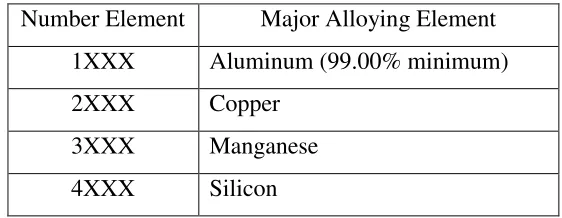
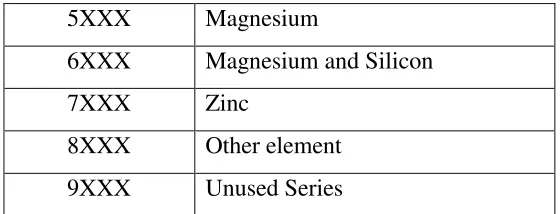
Aluminum alloy are identified by a four-digit number, the first digit of which generally identifies the major alloying element as shown in the table below. For aluminum alloys, the fourth digit is separated from digit by a decimal point and indicates the form.
Table 2.1: Wrought Alloy Designation System (ASM Handbook)
Number Element Major Alloying Element 1XXX Aluminum (99.00% minimum)
2XXX Copper
3XXX Manganese
4XXX Silicon
5XXX Magnesium
Pure aluminum is soft and ductile. Most commercial uses require greater strength than pure aluminum affords. Aluminum is a lightweight structural material that can be strengthened through alloying and, depending upon composition, further strengthened by heat treatment and cold working. This is achieved in aluminum by addition of other elements to produce various strength level alloys. Aluminum and its alloys appear to have increasing applications and to be competitive to ferrous alloys due to their important advantages such as, low density, high specific strength, high corrosion resistance, good formability and weldability. (Hatch, J.E, 1983) The high strength heat treatable aluminum alloys of 7XXX series are highly used in automotive industry, aeronautics and architecture. (S. Pantelakis, 2005).
Table 2.2: Typical chemical composition of 7075 Aluminum Alloy
Element Zn Mg Cu Fe Si Mn Cr Ti Other Aluminum
Wt% 6.10 2.90 2.00 0.50 0.40 0.30 0.28 0.20 0.15 Balance
2.2.1 The Aluminum Alloy 7075
The materials studied here are Aluminum alloys 7075. These alloys are based on aluminum with zinc, copper, magnesium, and chromium as the principal alloying elements. The strength of aluminum 7075 depends primarily on precipitation hardening of the aluminum by zinc and magnesium, which in turn depends on heat treatment. 7075
is an aluminum alloy; it is strong, with high strength and good machinability, weldability and has moderate resistance to corrosion, stress corrosion, and fatigue, plus high fracture toughness. (Hatch, J.E, 1983).
2.3 Purpose of Heat Treatment
The process of heat treating is the method by which metals are heated and cooled in a series of specific operations that never allow the metal to reach the molten state. The purpose of heat treating is to make a metal more useful by changing or restoring its mechanical properties. Through heat treating, we can make a metal harder, stronger, and more resistant to impact. Also, heat treating can make a metal softer and more ductile.
The purpose of the heat treatment is to cause desire changes in the metallurgical structure and thus in the properties of metal parts. Differences in type, volume fraction, size, and distribution of the precipitated particles govern properties as well as the changes observed with time and temperature, and these are all affected by the initial state of the structure. The initial structure may vary in wrought products from unrecrystallized to recrystallized and may exhibit only modest strain from quenching or additional strain from cold working after solution heat treatment. These conditions, as well as the time and temperature of precipitation heat treatment, affect the final structure and the resulting mechanical properties. (Totten, G.E 1997). In this project, the combination of aluminum alloy 7075 is referred to use heat treatment solution.
2.3.1 Heat Treatment on Aluminum Alloy
Heat treating is a critical step in the aluminum manufacturing process to achieve required end-use properties. The heat treatment of aluminum alloys requires precise control of the time-temperature profile, tight temperature uniformity and compliance with industry-wide specifications so as to achieve repeatable results and produce a high-quality, functional product. The most widely used specifications are AMS2770 (Heat
Treatment of Wrought Aluminum Alloy Parts) and AMS2771 (Heat Treatment of Aluminum Alloy Castings) (ASM Handbook), which detail heat-treatment processes such as aging, annealing and solution heat treating in addition to parameters such as times, temperatures and quenching. These specifications also provide information on necessary documentation for lot traceability and the quality-assurance provisions needed to ensure that a dependable product is produced.
Wrought aluminum alloys can be divided into two categories: non-heat treatable and heat treatable. Non-heat-treatable alloys, which include the 1xxx, 3xxx, 4xxx and 5xxx series alloys derive their strength from solid solution and are further strengthened by strain hardening or, in limited cases, aging. Heat-treatable alloys include the 2xxx, 6xxx and 7xxx series alloys and are strengthened by solution heat treatment followed by precipitation hardening (aging). (Peeler, D, 2002)
2.3.2 Heat Treatment Processes
In general, the principles and procedures for heat treating wrought and cast alloys are similar. For cast alloys, however, soak times tend to be longer if the casting is allowed to cool below a process-critical temperature for the particular alloy. Solution soak times for castings can be significantly reduced to durations similar to that for wrought alloys if the castings are placed into the solution furnace while still hot (above the process-critical temperature) immediately following mold filling and solidification. The reduction of stress in complex cast shapes is achieved in large part by the control of quenching temperature. In order to achieve this, the microstructure must recover from an unstable
or “metastable” condition produced by solution treating and quenching or by cold working. (Peeler D, 2002)
The effects of age hardening or precipitation hardening on mechanical properties are greatly accelerated, and usually accentuated, by reheating the quenched material to about
212˚F-424˚F (100˚C-200˚C). A characteristic feature of elevated-temperature aging effects on tensile properties is that the increase in yield strength is more pronounced than the increase in tensile strength. Also ductility – as measured by percentage elongation – may decrease. Thus an alloy in the T6 temper has higher strength but lower ductility than the same alloy in the T4 temper. (Andreatta, F et al 2002)
In certain alloys, precipitation heat treating can occur without prior solution heat treatment since some alloys are relatively insensitive to cooling rate during quenching. Thus they can be either air cooled or water quenched. In either condition, these alloys will respond strongly to precipitation heat treatment (Andreatta, F et al 2002).
In most precipitation-hardenable systems, a complex sequence of time-dependent and temperature-dependent changes is involved. The relative rates at which solution and precipitation reactions occur with different solutes depend upon the respective diffusion rates, in addition to solubility and alloy contents. (Peeler D, 2002)
2.3.2.2 Annealing
Annealing is used for both heat-treatable and non-heat-treatable alloys to increase part ductility with a slight reduction in strength. There are several types of annealing treatments dependent to a large extent on the alloy type, initial and final microstructure and temper condition. In annealing it is important to ensure that the proper temperature is reached in all portions of the load. The maximum annealing temperature needs to be carefully controlled. (Totten G E, 1997)
During annealing, the rate of softening is strongly temperature dependent – the time required can vary from a few hours at low temperature to a few seconds at high
temperature. Full annealing (temper designation “O”) produces the softest, most ductile
and most versatile condition. Other forms of annealing include: stress-relief annealing, used to remove the effects of strain hardening in cold-worked alloys; partial annealing (or recovery annealing) done on non-heat-treatable wrought alloys to obtain intermediate mechanical properties; and recrystallization characterized by the gradual formation and appearance of a microscopically resolvable grain structure. (Totten G E, 1997)
2.3.2.3 Solution Heat Treatment
The purpose of solution heat treatment is the dissolution of the maximum amount of soluble elements from the alloy into solid solution. The process consists of heating and holding the alloy at a temperature sufficiently high and for a long enough period of time to achieve a nearly homogenous solid solution in which all phases have dissolved.
Care must be taken to avoid overheating or under heating. In the case of overheating, eutectic melting can occur with a corresponding degradation of properties such as tensile strength, ductility and fracture toughness. If under heated, solution treatment is incomplete and strength values lower than normal can be expected. In certain cases extreme property loss can occur. The solution soak times for castings can be reduced significantly by placing the casting directly into the solution furnace immediately following solidification. The casting is maintained at a temperature above a process-critical temperature (PCT), and the alloy solute is still in solution. (Andreatta, F et al 2002)
In general, a temperature variation of ±10˚F (±5.5˚C) from control set point is allowable,
but certain alloys require even tighter tolerances. Tighter thermal variation (±5˚F) allows the set point to be controlled closer to the eutectic, thus improving proportion and reducing required soak time. The time at temperature is a function of the solubility of the alloy solute and the temperature at which the aluminum casting or wrought alloy is