THE IMPACT O
AN EMPIRICAL ST
1 TRILLIO
Presented as Partial E Faculty of
UNIVE
OF CAMELS FINANCIAL RATIO TO THE
PERFORMANCE:
STUDY ON THE BANKS WITH CAPITAL B
ION TO 50 TRILLION RUPIAHS IN 2005-200
THESIS
ial Fulfillment of the Requirements for the Degree o Ekonomi (S1) in Management Program
of Economics, Atma Jaya Yogyakarta University
Compiled by:
Yohanes Kristiawan Hartono
NPM: 07 12 16668
FAKULTY OF ECONOMICS
VERSITAS ATMA JAYA YOGYAKARTA
DECEMBER 2010
E BANK
BETWEEN
009
ACKNOWLEDGEMENT
Thanks to the Lord Jesus Christ for blessing, mercy, and grace so that this
thesis can be resolved by the author. Thanks for always brings me an opportunity,
support and victory, so I can finished this writing and finished my study at Atma Jaya
Yogyakarta University.
This thesis is presented as partial fulfillment of the requirements for the
degree of Sarjana Ekonomi (S1) in Management Program, Faculty of Economic Atma
Jaya University Yogyakarta. The title of the thesis is “THE IMPACT OF CAMELS
FINANCIAL RATIO TO THE BANK PERFORMANCE: AN EMPIRICAL
STUDY ON THE BANKS WITH CAPITAL BETWEEN 1 TRILLION TO 50
TRILLION RUPIAHS IN 2005-2009”.
In this Opportunity I want to give thanks to all people that always assist,
support, encourage and teach me, they are:
1.
Lord Jesus Christ, above all blessing, grace and love so that this thesis can be
resolved.
2.
Prof. Dr. J. Sukmawati S., MM. as a supervisor who has spent time to provide
guidance and advice so that this thesis can be resolved.
3.
Mr. Alex Jatmiko Wibowo, SE., SIP., M.SF that lecture finance on
4.
Mr. Felix Wisnu Isdaryadi, Drs., MBA that test writers and provide valuable
input on this essay.
5.
The teaching staff, library staff, and staff of FE Securities Gallery UAJY who
have provided guidance and assistance during the writer studying in UAJY.
6.
Papa and Mama for the support and affection that always given.
7.
Lisa on all the attention, affection, assistance, patience, who always
accompany the author until this thesis is finished. Thank you for always
encourage me to do the thesis.
8.
All of my friends in the International class 2007. Thank you for the wonderful
moment guys.
9.
My friends in KSPM especially David. Thanks for taking your time to
discussing my thesis.
10.
All my friends and those who have give support and prayers for this thesis
quickly resolved.
The writer realizes that there are still a lot of mistake in this thesis, let the
writer apologizes before. Suggestions and comments are very welcome for the
improvements of this thesis. At least but not last the writer hopes that this thesis can
bring advantages and useful to readers.
Yogyakarta, December 2010
TABLE OF CONTENTS
TITLE PAGE
APPROVEMENT PAGE
STATEMENT OF THESIS AUTHETICITY ACKNOWLEDGEMENT
TABLE OF CONTENTS LIST OF TABLES ABSTRACT
Page
CHAPTER I INTRODUCTION
A. Research Background ... 1
1. Problem Statement ... 10
2. Scope of the Problem ... 11
B. Objective and Benefit of the Research... 12
1. Objective of the Research ... 12
2. Benefit of the Research ... 13
C. Research Report Outline ... 13
CHAPTER II THEORETICAL BACKGROUND A. Theoretical Background ... 15
1. Indonesian Banking ... 15
2. Development of the Indonesian Banking ... 15
3. Indonesian Banking Architecture (API) ... 21
4. Banking Performance Analysis ... 22
5. Banking Financial Statement ... 24
6. Financial Statement Analysis ... 28
7. Health Assessment of Banks by CAMELS Method ... 31
C. Hypothesis Development ... 45
CHAPTER III RESEARCH METODOLOGY A. Population and Sample ... 47
B. Data and Data gathering ... 50
1. Data ... 50
2. Data Gathering ... 51
C. Variable and Variable Measurement ... 51
1. Variable ... 51
2. Variable Measurement ... 52
C. Method of Analysis and Hypothesis Testing ... 53
1. Method of Analysis ... 53
2. Hypothesis Testing ... 55
CHAPTER IV DATA ANALYSIS A. Research Description ... 60
B. Pooled Least Square ... 60
1. Common Effect Method ... 61
2. Fixed Effect Method ... 65
3. Random Effect Method ... 69
C. The Selection of Pooled Least Square Estimation Method ... 74
1. Common Effect – Fixed Effect (F-test) ... 74
2. Fixed Effect – Random Effect (Hausman test) ... 75
D. Regression with Fixed Effect Method ... 76
CHAPTER V CONCLUSION A. Conclusion ... 85
B. Limitation ... 86
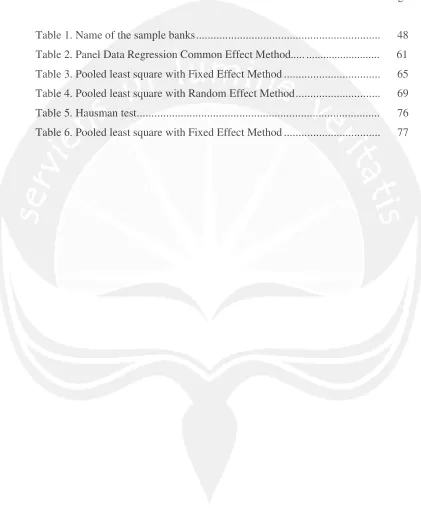
LIST OF THE TABLES
Page
Table 1. Name of the sample banks ... 48
Table 2. Panel Data Regression Common Effect Method... ... 61
Table 3. Pooled least square with Fixed Effect Method ... 65
Table 4. Pooled least square with Random Effect Method ... 69
Table 5. Hausman test ... 76
THE IMPACT OF CAMELS FINANCIAL RATIO TO THE BANK PERFORMANCE:
AN EMPIRICAL STUDY ON THE BANKS WITH CAPITAL BETWEEN 1 TRILLION TO 50 TRILLION RUPIAHS IN 2005-2009
Compiled by:
Yohanes Kristiawan Hartono NPM: 07 12 16668
Supervisor Prof. Dr. J. Sukmawati S., MM
The research is about the analysis of impact of the CAMELS financial ratios to the Bank Performance. In this case the writer use Return on Assets as the proxy for Bank Performance. The objective of This research performed in order to test the influence of the variable, Capital Adequacy Ratio (CAR), Non Performing Loan (NPL), Provision Fulfillment Earning Assets (PPAP) Net Interest Margin (NIM), Return on Equity (ROE), Operational Expenses Operational Income (BOPO), Loan to Deposit Ratio (LDR), and Sensitivity to Market risk (CARS) toward Return on Asset (ROA). Using purposive sampling method, the writer has selected 47 banks with 1 trillion up to 50 trillion rupiahs of assets according to classification stated in Indonesia Banking Architects from Central Bank.
The Research uses Pooled Least Square (PLS) method with Eview3 software. Data analyzed with multi linear regression of Pooled least square and hypotheses test used t-statistic and F-statistic at level of significance 5%.
The research finds out that the model of this study may explain the dependent variable Return on Assets (ROA) of 89.17%. The F-test show that simultaneously the dependent variables effect on ROA, in α level of 95%. Capital
Adequacy Ratio (CAR), Return on Equity (ROE), Net Interest Margin (NIM), Operational Expenses Operational Income (BOPO) proven to significantly influence Return on Assets.