ISTANBUL BILGI UNIVERSITY
CULTURAL STUDIES, MA
ANTHROPOLOGY OF AFFECT
–
CULT591
UMUT YILDIRIM
FALL 2013-14
A Sense Map : Jews in Galata
Knocking on Black Gates
Bur u UZUNÖNER
A community’s sense of place reflects the cultural identity. It is not a static concept, instead, it is an evolving process and reflecting the spectrum of social values of the community. To work on a sense of place requires comprehensive understanding of a
community’s historical, cultural and social context. Therefore, I spent some time walking along the streets and talking to some people in Galata. Galata also known as Karaköy is a neighborhood in the Beyoğlu district, located at the northern part of the Golden Horn. The word Karaköy is the combination of kara and köy. Kara means black and köy means village. Kara originates in the Turkish word Karay, referring to a Turkish speaking Jewish community called the Crimean Karaites. At one time, Karaites were a majority of the people who lived in Karaköy. It is assumed that there are only around 60 Karaites living in
Karaköy today.1
“A most incomparable delight it is so to melancholize, and build castles in the air, to go smiling to themselves, acting an infinite variety of parts, which they suppose and strongly imagine they represent, or that they see acted or done.”2 (BURTON 1883). I read
Hamursuz Fırını is a Jewish bakery located in Galata, number 13. I was climbing the ramp, passed number 11 and reached number 15. The number I was looking for was absent. I asked a guy standing in front of his shop and he replied that it was closed. I found out that it is now a theatre. He also showed me the way. I should have walked through between two buildings. It was a narrow road with a black gate at the end written D22 on it. (Figure 1) I knocked the door slowly and realized the bell. It was too late since an old man opened the door. I introduced myself and kindly asked for permission to get in. Behind the gate, there was a small garden. Walking through the entrance of the building, he mentioned the history of the building. Finding out he was a former worker for the bakery for 20 years, I kept asking questions. The bakery was closed 4 years ago. It used to be open only for a month in a year when it is Pesach (Passover) period. Then comes the reason why it was closed, it costed a lot to run all the special cookers to bake Matzo (flat unleavened bread) for Pesach. Almost 20 people used to work there for a month every year, the man added. He stated that neither him or the workers there were Jewish. After shutting down the bakery, Jewish people started to import Matzo for Pesach.
The cookers were still there yet do not work. Workers are not there, however there are ghosts over there, I assume. Begoña Aretxaga mentions the term “absent
presence” (ARETXAGA, Gangster in guerilla face 2007) Although workers were not baking bread, their presence was felt just near the cookers.
‘Has’ is an Arabic word meaning ‘peculiar, particular and proper’. Hasköy is a historical district in Haliç. It is stated that there were 11 Jewish, 2 Armenian, 1 Greek and 1 Turkish neighbourhood in 1986 (ÖZTUNA 1986). It had various cultures and religions living together. There different religious sects of Jewish such as Karaites, Aşkenaz and Seferad. Karaites Jews are known as Turkish Jews and they settled in Hasköy in Byzantanium
Period. Seferad Jews who lived in Eminönü in the first half of 17th
century in Ottoman Empire
moved to Hasköy. The term Seferad defines the Jews who are from Mediterrian Countries
such as Spain, Italy and Portugal. Aşkenaz Jews also settled in Hasköy and they came from
Germany and Middle Europe. Jewish inheritance was felt more in the past since the street names reflected the culture. However, names have change in time.3(EĞİLMEZER 2013)
Expecting to meet some
Istanbul. Those people came to Istanbul to escape the consequences of the war. In 1915, two women, Rozi and Fremandi bought a house and converted it to an elderly home. The members of the nearby community were bringing food on daily basis to the elderly. It took me 5 minutes to walk from Galata Tower. The building was yellow and there was an iron gate.
Then, I realized the sign writing ‘Barınyurt Huzurevi’ (Barınyurt Elderly Home) on it. It was so simple and plain. There was no other sign. First, I hesitated to ring the bell. I felt the same when I was at the entrance of Hamursuz Fırını. Ignoring the scary affect of all black gate, I rang the bell. In a few seconds, the door was opened. I stepped into the garden. It was not big. I saw the entrance of the building. However, since the security guy stopped me, I couldn’t go further. With all my innocence feelings, I tried to explain my situation. I only wanted to have a few words with the Jewish people living there. The man said no. He explained that I would need a permisin from the Chief Rabbi to go in. He was straight. I couldn’t even kindly ask for
3EĞİLMEZER, “a i Mert. «Tarih Kro ikleri.» Eylül .
the second time. How I felt was : DISSAPOINTED. How would it be if I tried to visit some people in a Turkish Elderly Home? Well, I would be welcomed. I was actually. I did it many times. Only an ID card would help me visit old people in a Turkish Elderly Home. I questioned why it is hard to get in. Is is because what happened throughout history? Not far, in 2003, two trucks carrying bombs slammed into Neve Shalom synagogues and exploded. It explains everything.
Figure 4 : Entrance of Barınyurt Huzurevi
Alliance Israelite School was constructed in 1875 and located in Hasköy. The headquarter is in Paris. Those schools were opened in cities where Jewish people lived to grow children with Jewish culture. The language was French and it was a problem for Turkish Jews to practice their Turkish. After the proclaim of republic, the language switched to Turkish. Allience School in Hasköy converted to Hasköy Jewish School in 1923. Since the number of students were inadequate, the school was closed and began to faciliate as nursing home for the olds.
Galata had a large Sephardic Jewish population during 19th century. Neve Shalom Synagogue designed by Turkish Jewish architects Elyo Ventura and Bernar Morola was built on ruins of a Jewish primary school in 1951. The meaning of the name is Oasis of Peace. However, the synagogue suffered from 3 attacts in its history – a brutal massacre in
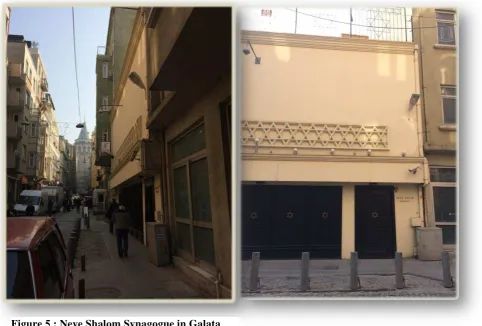
1986, a bomb attack in 1992, and a car bomb attack in 2003. Thinking all these attacks, I had doubts if I would get in. It was Friday noon, I was walking through the synagogue. I was expecting a lucid entrance, at least a separate one from the other building, however, I passed the synagogue while I was looking for it. My navigation on my phone warned that I passed, I realized the black gates. The black gate with Magen Davids (Stars of David) on it reminded me the other two black gates that belong to the bakery and elderly house. That time was the hardest to knock the door since the Stars were staring at me. Fortunately, I saw the bell before I knocked. And the camera right above the bell. Probably, the guy watching me (I was not sure if there was one) would recognize my anxiety and hesitation. Imagining the guy, I tried to seem cute and smiled with a respect, then, rang the bell. Without asking anything, I was told they were closed. Is is beacuse I was smiling to the camera? Is it because I did not demonstrate any sign for the password. I did not ring for the second time, of course. The feeling over there made me keep walking for a while. All the information I had before visiting was passing through my mind. All the attacks, weddings, worships happened there made me
keep walking. I couldn’t feel like stopping. According the Freud’s first thesis, the uncanny
arises due to the return of repressed infantile material.4 (FREUD 1919) When I think of my childhood, there used to be village weddings that we attended. (I used to spend a month in my village in Samsun –Blacksea Region- , as just common as a regular village; consisting of houses, a mosque and a school.) Every house had a big garden and gate. Gates varied
according to the owner’s wealth and choice. I recalled a wedding in a garden of a relative’s house. I was around 8 years old and with my cousins playing in the garden while people were
dancing and chatting. Then I heard of gunshots. I thought it was only one but it didn’t stop.
Then, I saw men with guns shooting in the air. They were laughing and seemed to have fun. It
didn’t feel safe to me and immediately I found my mother and hugged. Afterwards I found out
that it was a part of the weddings in our village. I still don’t understand why, yet men (maybe to prove that they are men) shoot in the air in the weddings. Now, I think of trial; weddings, gates and gunshots in my village. Another trial in the synagogue; weddings, gates and attacks. When I encountered the black gate in the synagogue, I was also felt the atmosphere of the place. I imagined how weddings were there, and how the attacks would happen. It reminded
me of my village and the trial. That’s why I wanted to escape. I felt uncanny. Sara Ahmed
considers affect as sticky.5 (AHMED 2010) Gates in my village have an impact on me. The affect of them touched and sticked to my psyche. Begoña Aretxaga mentions construction through senses.6 (ARETXAGA, Shattering Silence 1997) Knowledge of place consists of senses such as moving, seeing, listening and smell. A sense of place includes spatial images and moods such as nostalgia, bitterness, longing, distance and etc. (NAVARO-YASHIN 2012)
Walking along the streets, my route was to visit Quincentennial Foundation Jewish Museum of Turkey in Galata. It is on a narrow street. It would be impossible to find if it wasn’t for a GPS on my mobile phone. The museum is located in
Perçemli Sokak (Fringe Street). Former name of the street was Zülf-ü Arus which means
Gelin Perçemi (Bride’s lock of hair), commonly known as Zülfaris Street. The synagogue was
recorded as Kal Kadosh Galata in the archive. A middle aged securiy guy welcomed me. I
wrote down my name and ID information on a visitor’s notebook and the he let me in. It was only me inside. There was a small hall, a room downstairs and another one upstairs. There were many objects which are related to Jewish culture. It was in augurated on November 25, 2001. It was Zulfaris Synagogue before that date. Inside the museum, that red curtain attracted me. When I got closer, it was a Parohet that is used to cover synagogue’s most holy place, the
5
AHMED, Sara. The promise of happiness. North Carolina: Duke University Press, 2010.
6ARETXAGA, Begoña. «Ga gster i guerilla fa e.»
Hekhal where the Torah scrolls are kept. Near that, there was a board giving information about republic period of Jews. I learnt first Chief Rabbi was selected in 1953.
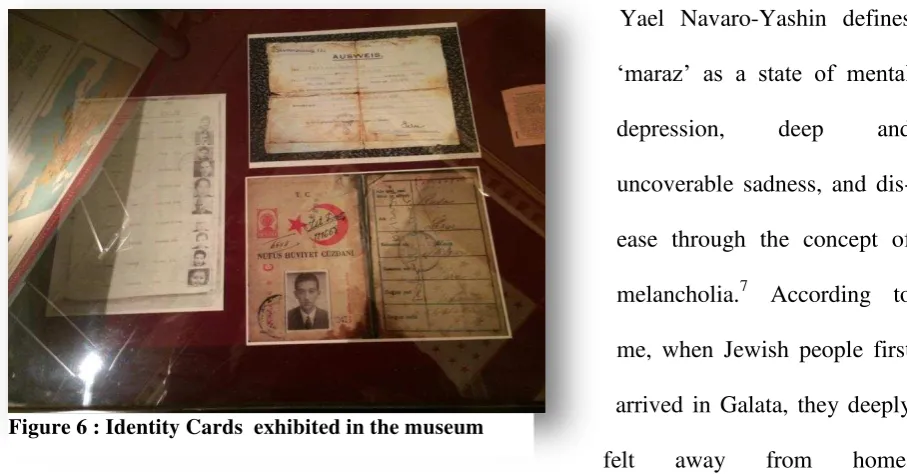
Yael Navaro-Yashin defines Everything was distinct and different from its mainland. That was how I felt when I stepped into the museum. I was unfamiliar to the concept. There were many objects that I have seen for the first time. Jewish sign and symbols such as mezurah, menorah, yarmulke and hamesh hand were all unfamiliar to me. I felt the melancholy there then. While all the sign and symbols are that different, how were they not supposed to feel melancholic? Identity cards attracted me on a table covered with a glass. It was a Turkish identity card and just next to it was there a Ausweis (meaning ID card in German). Did they have to have two? I asked myself without thinking the answer.
As Navaro stated the ghost is a thing and presence of a ghosts is in the shape of material objects and environments. That is how I felt during my visit. I visited Galata a couple of times during my research. Each time, I felt more melancholy in the place. The
7
NAVARO-YASHIN, Yael. The Make-Believe Space: Affective Geography in a Postwar Polity. North Carolina: Duke University Press, 2012.
Kaynakça
AHMED, Sara. The promise of happiness. North Carolina: Duke University Press, 2010.
ARETXAGA, Begoña. «Gangster in guerilla face.» Anthropological Theory, 2007: 37.
—. Shattering Silence. New Jersey: Princeton University Press, 1997.
BURTON, Robert. The Anatomy of Meloncholy. Philadelphia: E. Claxton & company, 1883.
EĞİLMEZER, Sami Mert. «Tarih Kronikleri.» Eylül 2013.
http://smegilmezer.blogspot.com.tr/2013/09/huzunlu-bir-istanbul-semti-haskoy.html
(Şubat 2014 tarihinde erişilmiştir).
FREUD, Sigmund. «The 'Uncanny'.» 1919.
NAVARO-YASHIN, Yael. The Make-Believe Space: Affective Geography in a Postwar Polity. North Carolina: Duke University Press, 2012.
ÖZTUNA, Yılmaz. Osmanlı Devleti Tarihi.İstanbul: Faisal Finans Kurumu Yayını, 1986.
Stephen Worchel, J. Francisco Morales, Dario Paez, Jean-Claude Deschamps. Social Identity.
London: Sage Publications, 1998.