THE INFLUENCE OF USING NARRATIVE STORY TOWARDS STUDENTS’ VOCABULARY MASTERY AT THE FIRST SEMESTER
THE EIGHTH GRADE OF SMPN 19 BANDAR LAMPUNG IN THE ACADEMIC YEAR OF 2016/2017
(A Thesis)
Submitted as a Partial Fulfillment of the Requirements for S1-Degree
By :
MUHAMAD NASRULLOH
NPM : 0911040074Study Program : English Education
Advisor : Iwan Kurniawan, M.Pd
Co-Advisor : Rohmatillah, M.Pd
TARBIYAH AND TEACHER TRAINING FACULTY STATE ISLAMIC UNIVERSITY
ii ABSTRACT
The Influence of Using Narrative Story towards Students’ Vocabulary Mastery at the First Semester of Eighth Grade of SMPN 19 Bandar Lampung
in the Academic year of 2016/2017 By
Muhamad Nasrulloh
Vocabulary is one of the important language elements that should be mastered by the students. Based on the preliminary research at SMPN 19 Banadar Lampung, it was
found that the students’ vocabulary score was still low. The objective of this research was to know whether there is influence of using Narrative Story towards Students’ vocabulary mastery or not.
The method of the research was quasi experimental design with the treatment held in three meetings, 2x45 minutes for each. The population of this research was the eighth grade students of SMPN 19 Bandar Lampung. In taking the sample, the researcher used cluster random sampling. The sample taken was two classes; class VIII D as the experimental class XIII B as the control class. Both of them consisted of 30 students. In collecting the data, the researcher used tests. The tests for pre tests consisted of 20 items and post test consisted of 20 items. For analyzing the data, the researcher used independent sample T-test.
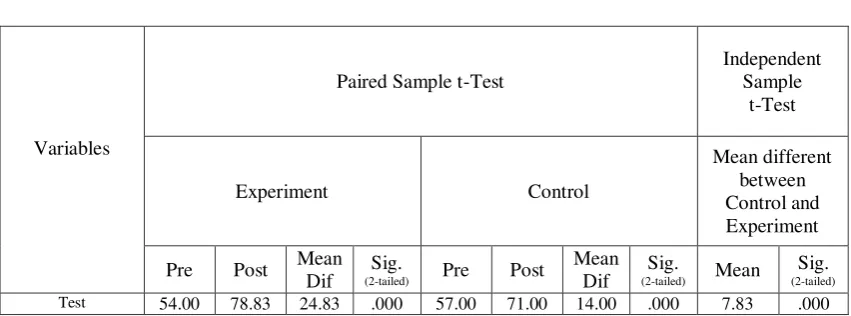
From the data analysis, it was found that the result of T-test was 0.000 this result is consulted to the score of the value significant generated Sig. (pvalue) = 0.000 < α = 0.05. Therefore, Ho is rejected and Ha is accepted. In other words, from this research
it is known that Narrative Story could improve the students’ vocabulary mastery. It could be concluded that there is a significant influence of using Narrative Story
towards students’ vocabulary mastery.
iii
KEMENTERIAN AGAMA
UNIVERSITAS ISLAM NEGERI RADEN INTAN LAMPUNG FAKULTAS TARBIYAH DAN KEGURUAN
Alamat : Jl. Let. Kol.H. Endro Suratmin Sukarame I Bandar Lampung Telp : (0721) 703289
APPROVAL
Title : THE INFLUENCE OF USING NARRATIVE STORY TOWARDS
STUDENTS’ VOCABULARY MASTERY AT THE FIRST
SEMESTER OF EIGHTH GRADE OF SMPN 19 BANDAR LAMPUNG IN THE ACADEMIC YEAR 2016/2017
Student’s Name : Muhamad Nasrulloh
Student’s Number : 0911040074 Study Program : English Education
Faculty : Tarbiyah and Teacher Training
APPROVED
To be tasted and defended in the examination session
at Tarbiyah and Teacher Faculty, The State University of Islamic Studies, Raden Intan Lampung
Advisor Co-Advisor
Iwan Kurniawan, M.Pd Rohmatillah, M.Pd
NIP . 19740520 2003 1002 NIP. 19810508 200710 2 001 The Chairperson of
English Education Study Program
iv
KEMENTERIAN AGAMA RI
UNIVERSITAS ISLAM NEGERI RADEN INTAN LAMPUNG FAKULTAS TARBIYAH DAN KEGURUAN
Alamat : Jl. Let. Kol.H. Endro Suratmin Sukarame I Bandar Lampung Telp : (0721) 703289
ADMISSION
A thesis entitled: “THE INFLUENCE OF USING NARRATIVE STORY
TOWARDS STUDENTS’ VOCABULARY MASTERY AT THE FIRST SEMESTER THE EIGHTH GRADE OF SMPN 19 BANDAR LAMPUNGIN THE ACADEMIC YEAR OF 2016/2017” By: MUHAMAD NASRULLOH, NPM: 0911040074, Study Program: English Educatiaon, was tested and defended in the examination session held on Friday, August 18th, 2017
Board of Examiners:
The chairperson : Bambang Irfani, M.Pd (...) The secretary : Nurul Puspita, M.Pd (...) The primary examiner : Istiqomah Nur R, M.Pd (...) The second examiner : Iwan Kurniawan, M.Pd (...) The advisor : Rohmatillah, M.Pd (...)
The Dean of
Tarbiyah and Teacher Training Faculty
iv
DECLARATION
I declare that this thesis entitled “The Influence of Using Narrative Story towards
Students’ Vocabulary Mastery at the First Semester of the Eighth Grade of SMPN 19
Bandar Lampung in the Academic Year of 2016/2017” is completely my own work.
I am fully aware that I have quoted some statements and theories from several
sources and they are properly acknowledged in the text.
Bandar Lampung , March 2017 Declared by
v MOTTO
Al-Baqarah : 31
The meaning:“And he taught Adam the names of all things, than he placed them before the angels, and said: tell me the names of these if you are right...”1( Al-Baqarah : 31)
1Abdullah yusuf’ Ali, The Holy Qur’an Arabic Text With English Translation
vi
DEDICATION
This thesis dedicated to:
1. My beloved parents, my father Imam Bajuri and my mother Siti Fatimah who
always pray for my success.
2. My beloved brother and sister, Hendri Firmansyah M.Pd and Istiqomah S.Pd
who always support and give me suggestion for my success.
3. My beloved grandmother and all of my big family, who have given me
support and spirit for my study.
vii
CURRICULUM VITAE
The name of the researcher is M.Nasrulloh. He is called Nas. He was born in Gedung
Aji Baru on July 06th, 1988. He is the second of four children of Mr. Imam Bajuri and
Mrs. Siti Fatimah. He has two sisters and one brother whose names are Istiqomah
S.Pd, Mar’atus Soleha (alm) and Ahmad Syaiful Rifai (alm).
The researcher began her study at Elementary Shool of MI Bahrul Ulum Tugu Ratu
Suoh and graduated in 2002. Then He countinued to Junior High School of MTS
Bahrul Ulum Tugu Ratu Suoh and graduated in 2005. In 2008, He was graduated
from at Senior High School of MA Al-Mar’uf Margodadi Tanggamus. He decide to
continue her study in English Education Department, Tarbiyah and Teacher Training
Faculty of State Islamic University Negeri Raden Intan Lampung. While being a
college student, the researcher was a member of UKM Internal: Pramuka, Ibroh,
Bapinda, Pencak Silat (PSHT) and BEM-FT (Dinas Kerohanian). and of UKM
Exsternal: HMI (Himpunan Mahasiswa Islam) and KAMMI (Kesatuan Aksi
Mahasiswa Muslim Indonesia). In the seventh semester, the researcher had her KKN
in Tambah Rejo, Prengsewu. After having KKN, he had her PPL in SMPN 25 Bandar
viii
ACKNOWLEDGEMENT
First of all, praise be to Allah, the Almighty God, the Most Merciful, the Most
Beneficent who always gives His blessing and mercy to the writer during the study to
complete this final project. Then the best salutations be upon the great messenger
Prophet Muhammad PBUH.
For the accomplishment of this thesis, the writer would like to express the gratitude
to:
1. Dr. H. Chairul Anwar, M.Pd, the Dean of Tarbiyah Faculty UIN Raden Intan
Lampung.
2. Meisuri, M.Pd, the chairperson of English Education Study Program at UIN
Raden Intan Lampung.
3. Iwan Kurniawan, M.Pd, the first advisor for here guidance, to complete this
thesis.
4. Rohmatillah, M.Pd, the second advisor, for this time correcting this thesis for its
betterment.
5. Diswatiningsih, S.Pd, and all English teachers at SMPN 19 Bamdar Lampung
who gave guidance and spirit to the writer in conducting the research.
6. Hj. Sri Chairattini E.A, S.Pd, The Headmaster of SMPN 19 Bamdar Lampung all
the members of SMPN 19 Bandar Lampung who gave the writer permission to
ix
7. All the students of eighth grade at SMPN 19 Bandar Lampung 2016/2017
academic year, for giving nice participation during the teaching learning process
in conducting research.
8. All my friends in English Education Department, A class of UIN Raden Intan
Lampung ‘09, All lecturers of English Department in UIN Raden Intan Lampung
who have taught the writer since the first year of study.
He fully realizes that this piece of writing is imperfect. Therefore, he expects
constructive criticism such as corrections or comments for its improvement. Finally,
the writer hopes that this thesis will be useful for the readers, especially for teaching
English.
Bandar Lampung, March 2017 The writer,
xi
TABLE OF CONTENT
Page
COVER ... i
ABSTRACT ... ii
APPROVAL... iii
DECLARATION ... iv
MOTTO ... v
DEDICATION ... vi
CURRICULUM VITAE ... vii
ACKNOWLEDGEMENT ... viii
TABLE OF CONTENTS ... x
LIST OF TABLES ... xiv
LIST OF APPENDICES... xvi
CHAPTER I INTRODUCTION A.Background of the problem ... 1
B. Identification of the problem ... 7
C. Limitation of the problem... 7
D.Formulation of the problem ... 8
E. Objective of the research ... 8
F. Use of the research ... 8
G.Scope of the research ... 8
CHAPTER II REVIEW OF RELEVANT LITERATURE A.Teaching and learning English as a Foreign Language ... 10
B. Concept of Vocabulary ... 11
xii
D.Concept of Media ... 16
E. Concept of Narrative Story ... 19
F. Procedure of Teaching Vocabulary by using Narrative Story ... 22
G.Frame of thinking ... 23
H.Hypothesis ... 24
CHAPTER III RESEARCH METHODOLOGY A.Research design ... 25
B. Research variables ... 27
C. Operational definition of variable ... 27
D.Population, sample and sampling technique ... 28
E. Data collecting technique ... 29
F. Research instrument ... 30
G.Research procedure ... 31
H.Scoring system ... 33
I. Validity of the test ... 33
J. Reliability of the test ... 35
K.Data analysis... 36
CHAPTER IV RESULT AND DISCUSSION A.Research Procedure ... 39
B. Description of Treatment ... 40
1. Description of the First Treatment ... 41
2. Description of the Second Treatment ... 41
3. Description of the Third Treatment ... 42
C. Result of the Research ... 43
1. Result of the Pre-test ... 58
xiii
3. The result of normality and homogeneity test ... 45
4. The result of paired sample t-test and independent
sample t-test ... 46
5. Dicussion ... 48
CHAPTER V CONCLUSION AND SUGGESTION
A.Conclusion ... 51
B. Suggestion ... 51
xiv
LIST OF TABLES
Tables Page
1. Table Achievement of KKM ... 05
2. Table Recapitulation of Students’ Population ... 28
3. Table Analysis of test items ... 30
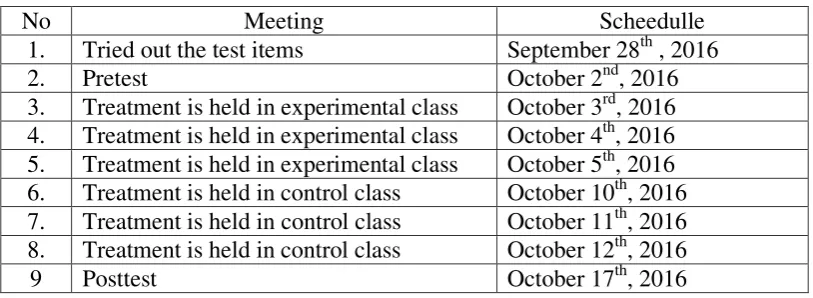
4. Table Schedule Meeting of the Research ... 40
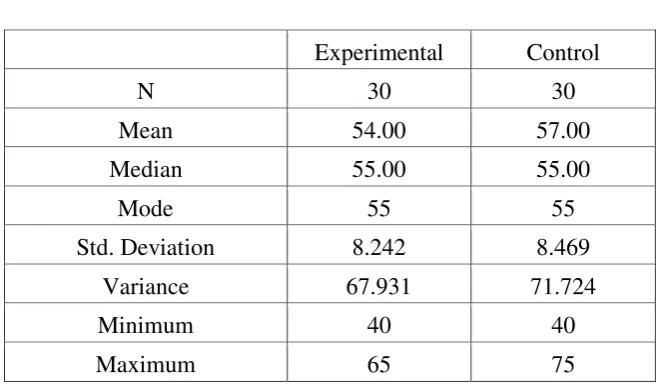
5. Table Statistics Result of the Pretest ... 44
6. Table Statistics Result of the Posttest... 45
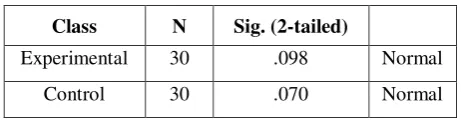
7. Table Result of Kolmogorov-Smirnov Test ... 45
8. Table Result of Homogeneity of Variance ... 46
KEMENTERIAN AGAMA
UNIVERSITAS ISLAM NEGERI RADEN INTAN LAMPUNG FAKULTAS TARBIYAH DAN KEGURUAN
Alamat : Jl. Let. Kol.H. Endro Suratmin Sukarame I Bandar Lampung Telp : (0721) 703289
CONTROL CARD
NAME : M.Nasrulloh
STUDENTS’ NUMBER : 911040074
TITLE : The Influence of Using Narrative Story towards Students’ Vocabulary Mastery at the First Semester of Eighth Grade of SMPN 19 Bandar Lampung in the Academic year of 2016/2017
No Day/ Date Consultation Signature
1
2
3
4
5
Bandar Lampung,………….. 2017
Co- Advisor,
Rohmatillah, M.Pd
KEMENTERIAN AGAMA
UNIVERSITAS ISLAM NEGERI RADEN INTAN LAMPUNG FAKULTAS TARBIYAH DAN KEGURUAN
Alamat : Jl. Let. Kol.H. Endro Suratmin Sukarame I Bandar Lampung Telp : (0721) 703289
CONTROL CARD
NAME : M.Nasrulloh
STUDENTS’ NUMBER : 911040074
TITLE : The Influence of Using Narrative Story towards
Students’ Vocabulary Mastery at the First Semester of Eighth Grade of SMPN 19 Bandar Lampung in the Academic year of 2016/2017
No Day/ Date Consultation Signature
1
2
3
4
5
Bandar Lampung, ………2017
Advisor,
xiv
LIST OF FIGURES
Figures Page
1. Graphs of the result of the Pre-test in Experimental Class... 50
2. Graphs of the result of the of the result of Pre-test Control Class... 51
3. Graphs of the result of the of the result Post-test in Experimental Class ... 53
xv
LIST OF APPENDICES
Appendices Page
Appendix 1. Syllabus ... 56
Appendix 2. Lesson Plan for Experimental Class ... 63
Appendix 3. students’ Vocabulary Score ... 83
Appendix 4. The Result of Interview Teacher in the Preliminary Research ... 87
Appendix 5. The Result of Interview Students’ in the Preliminary Research ... 89
Appendix 6. The Pre-Test Item for Try Out ... 91
Appendix 7. The Post-Test Item for Try Out ... 96
Appendix 8. Key Answer Trayout for Pre-Test and Post-Test ... 101
Appendix 9. Result of The Pre-Test in the Experimental Class ... 103
Appendix 10. Result of The Pre-Test in the Control Class ... 104
Appendix 11. Result of The Post-Test in the Experimental Class ... 105
Appendix 12. Result of The Post-Test in the Control Class ... 106
Appendix 13. The Score of Students’ in Experimental Class ... 107
Appendix 14. The Score of Students’ in Control Class ... 108
Appendix 15. The Result of Normality Test ... 109
Appendix 16. The Result of Homogenity Test ... 110
Appendix 17. Independent Sample Test ... 111
Appendix 18. The Test Item Pre-Test ... 114
Appendix 19. The Test Item Post-Test ... 117
xvi
CHAPTER I INTRODUCTION
A. Background of the Problems
English is an international language which is used all over the world. In
Indonesia, we learn English as a foreign language1. The most important thing in
learning English as a foreign language is learning vocabulary. Alqahtani 2 stated that
vocabulary learning is an essential part in foreign language learning as the meanings
of new words are very often emphasized, whether in books or in classrooms. In
addition, Cameron3 stated that vocabulary as one of the knowledge areas in language,
plays a great role for learners in acquiring a language. Mastering vocabulary is a basic
matter in learning a foreign language4. It means that the aquisition of vocabulary is
essential for successful foreign language use and plays an important role in the
formation of comple spoken and written text.
In Indonesia, the government realized that vocabulary learning is the essential
part for students in learning English as a foreign language. Therefore, at the end of
the first year students of SLTP/MTs, the students are hoped to have at least 500
1 Dewa Komang Tantra. "Teaching English as a Foreign Language in Indonesia: A Literature Review." Lingual: Journal of Language and Culture 4.1 (2015).
2 Mofareh Alqahtani. "The importance of vocabulary in language learning and how to be taught." International Journal of Teaching and Education 3.3 (2015): 21-34.
3 Lynne Cameron. Teaching languages to young learners. Cambridge: Cambridge University Press. 2001.
4 Scott Thornbury.
2
words to support their reading, listening, writing, and speaking.5 There are four
competences in KTSP curriculum that should be mastered by Junior High School
such as listening, speaking, reading, and writing. But, in this study, the writer will
focus on vocabulary mastery. To master vocabulary is not easy because vocabulary is
one major problem for learning English as a foreign language. Mastering vocabulary
is the basic unit of language form. Without a sufficient vocabulary, one cannot
communicate effectively or express idea. Having a limited vocabulary is also a barrier
that prevents students from learning foreign language. If the students do not know
how to expand their vocabulary, their gradually lose interest in learning. Based on
preliminary research, many students consider learning vocabulary is a tedious job.
They try studying list of words with their spelling, pronunciation, meaning,
synonyms, etc only to realize a few hours later that their result are hardly satisfactory.
They start blaming their poor memories. They say they are discouraged by the
number of words in English and their complex usage. They still have difficulties to
recall or remember the vocabularies that have been learned. They come to rely on
incidental learning, finding intentional studying boring and inefficient.
According to Margono, Istianah, and Rofiq, generally students have difficulty
in learning English especially in vocabulary because they are lack of vocabulary and
5
Departemen Pendidikan Nasional. Penyempurnaan/Penyesuaian Kurikulum 1994 SLTP
3
grammar.6Therefore, the English teacher is expected to be able to cover the students’
problems in vocabulary mastery. In addition Firmansyah, there were some problems
in teaching and mastering vocabulary.7 The first problem is forgotten and loses the
words rapidly. It is because the difficulties in pronunciation, spelling, idiomatic, and
overlap meaning make the students uninterested to memorize the vocabularies well.
The Second is the appropriateness of teaching materials to the students’ level of
proficiency. Teaching material is very important in learning process. The appropriate
materials make the students interested in studying and the bad material will make the
students bored. The third problem is teaching media. We have known that media is a
resource to motivate the students' spirit to study. Media also helps the teacher in
transferring the material to the students. The fourth problem is teaching technique.
Teaching technique is also important in teaching vocabulary. A teacher should have
various techniques instead of using single technique in order to avoid boredom to the
students. An important in teaching technique is how to motivate the students studying
vocabulary, practical the effective technique to make the class livelier, make learning
vocabulary easier and more pleasant.
6
Sapto Margono, Wiwiek Istianah, Annur Rofiq. A Descriptive Study On The Class X-2 Students’ Vocabulary Mastery Through Narrative Texts Taken From The Internet At SMAN 11 Surabaya. ©Pancaran, Vol. 2, No. 2, hal 65-74, Mei 2013
7
Hendri Firmansyah, Increasing students’ vocabulary mastery by using song technique (A
4
Related to my research, the students difficulties in learning English are caused
by lack of vocabulary, teaching material is inappropriate to the students, unattractive
media, and monotonous teaching technique.
The students of SMPN 19 Bandar Lampung were also have difficulties in
learning English. Based on the results of interview between the writer and the teacher
at SMPN 19 Bandar Lampung, she said that students’ English ability still low since
they are difficult to comprehend the text when they did the English assignments. It is
because the lack of vocabulary. The students difficult to understand and memorize
new vocabulary words and tend to forget the new words rapidly that have been
learned. So, they are difficult for increasing their vocabulary. In teaching and learning
process, most of the students cannot communicate with English well since they get
difficulties in vocabularies. Then, some students said that the monotonous technique
make the learning process as the boredom activities and make them lose their
interests and motivations in learning. Besides that, she said that score of KKM
(criteria of minimum mastery) in SMPN 19 Bandar Lampung is 75.8 The students’
vocabulary score can be seen in the table below:
5
Table 1
The achievement of KKM at Seven Grader of SMPN 19 Bandar Lampung 2016/2017
No KKM (75) The Number of students Percentage
1 <75 45 75%
2 >75 15 25%
Total 60 100%
Score: English teacher at SMPN 19 Bandar Lampung
From the table above, the students who achieve the KKM are 75%. It means
that there are many students uder the standard of KKM at the school. By knowing the
students’ problem in vocabulary, it is necessary for the writer to do a research. In this
case, the writer needs to organize a way to find an appropriate technique which can
help the students to master their vocabulary.
Based on the information above, it is necessary for the teacher to find out and
apply the efficient and effective teaching technique, appropriate materials, and good
media which can make the students easily and rapidly understand the English word
that they have heard, read, or known. So, to make the students are interested to study
English, the writer will use narrative story to increase students’ English vocabulary.
Narrative is one type of texts or story that must be learned by the Indonesian
students of junior high school when they are studying English. It is a kind of text
(story) that has purpose to entertain or amuse the reader or listener. According to
6
doing so and entertains or informs the students or listener.9 In addition, Sejnost and
Thiese mention the purpose of narrative is to entertain, to gain and hold a reader's
interest.10 however, writers of memoirs and novels often relate complex stories that
examine universal ideas, events, and issues. The kinds of story that are included in
narrative are legend, myth, tales, fable, and etc. If the students are interested to read
the story, fun, enjoy, and entertained by content of the story, they will be easy to
memorize the vocabularies and their vocabulary mastery increased. Theoretically,
Wardiman, Jahur, and Djusma, stated that narrative story is an imaginative story to
entertain people.11 It means that narrative story is the genre of the text that tells a
story to the readers in order to entertain them. The materials of narrative texts in this
research refer to reading materials that have simple language, not too long, easy to
understand by the students and the text did not make them bored.
Karolina says in his thesis that Based on the result of the research in the
previous can conclude that. It is described that the students have more knowledge
about narrative story are, among others are generic structure and many types of
narrative story. They seem to know the steps to make a good writing and it is very
9 Mark Anderson & Kathy Anderson. Text types in English 2. South Yarra: MacMillan.
(2003). 10
Roberta L. Sejnost & Sharoon M. Thiese. Building content literacy: Strategies for the adolescent learner. Thousand Oaks, CA: Corwin Press. Retrieved from http://www.adlit.org/article/39884/ (2010).
11
7
useful for them when they write something. Therefore they can make a narrative story
better than before.12
Based on the problems above, the writer conducted the study to find out
whether narrative story is effective or not in students' vocabulary mastery with the
research title “The Influence of Using Narrative Story towards Students’
Vocabulary Mastery for Eight grade in the first Semester of SMPN 19 Bandar
Lampung in the Academic Year of 2016/2017”.
B. Identification of the Problems
Based on the backgroud of the problem above, the writer identified the
problem as follows:
1. The students of SMPN 19 Bandar Lampung have difficulties in vocabulary
mastery.
2. The students should use narrative story to get vocabulary rapidly.
C. Limitation of the Problems
Based on the identification of problem above, the writer was focus on using
Narrative Story to increase students’ vocabulary mastery. Text used in the story is a
Narrative Story type Fables.
8
D. Formulation of Problem
Based on the identification and the limitation of the problem above, the writer
formulated the problem: Is there any significant influence of using Narrative Story
towards students’ vocabulary mastery?
E. Objective of the Research
The objective of the research is to know whether there is significance
influence of using Narrative Story towards students’ vocabulary mastery.
F. Use of he Research
The use of this research are:
1. Theoretically, to give information to the English teacher about the influence
of using Narrative Story toward vocabulary mastery, and also to give
information for futher research with similar interest.
2. Practically, to motivate the students to increase their vocabulary mastery.
G. Scopes of the Research
1. Research Subject
The subject of the research was the students at the first Semester of the Eight
9
2. Objective of the Research
Objective of the research was to know whether there is significance influence
of using Narrative Story towards students’ vocabulary mastery.
3. Place of the Reseaarch
The writer conducted the research at SMPN 19 Bandar Lampung in the
Academic Year of 2016/2017.
4. Time of the Reseach
The writer conducted the research on first Semester at SMPN 19 Bandar
Lampung in the Academic Year of 2016/2017”.
CHAPTER II
REVIEW OF RELEVANT LITERATURE
A.Teaching and Learning English as a Foreign Language
English is an international language in the world. It has a big influence in human life
in the world. English has very important position almost in every aspect of our life,
like: in technological, scientific, social, cultural and economic sector. In Indonesia
English is the foreign language that is learned at the formal school from elementary
school up to university. It is expected that the students should have the ability or
knowledge of English with can be used for communication.
According to Murcia, the goal of teaching English a second language or foreign
language would be for the learning to gain ability to communication in the target
language.1 Based on the statement above it can be said that language learners in this
case the students are expected to use or to communication the language that he or she
learns. Brown also states that teaching is facilitating learning, enabling the learner to
learns, setting the conditions for learning and showing or helping someone to learn
how to do something. Teaching also means giving instruction guiding in study of
something, providing with knowledge, and causing to know or understands.2 It means
that teaching is a process that should be done be teacher based on the experiences,
1
Mariannne Calce Murcia, Teaching English as a Second of Foreign Language, University of California, Los Angles: California Publisher, 2001.p.3
2
H. Douglas Brown, The Principles of Language Learning and Teaching. New York:
11
knowledge and material preparation the aim of teaching can be reached. In addition it
is also hoped that at the end of teaching English as a foreign language activities
he/she was understand the subject that is taught.
Considering this fact, remembering the importance of English, teaching English as a
foreign language should be put as one of the first priority. This way will be
introduced not only something new about culture. Skillful, creative and innovative
teacher to achieve the goal of English teaching need media and other facilities which
can support in achieving goal. In addition, the teaching techniques should be also
interesting, appropriate for students.
Base on the explanation above, it means that the students who learn English as a
foreign language have a little exposure or opportunities to leaern and to practice
English. Because of that, teachers should have an interesting and an effective media
or technique so that the students will learn English effectively although they do not
have much time to learn it.
B.Concept of Vocabulary
Vocabulary is one important part in learning a language. If the students’ English
vocabulary mastery is limited, they will find some difficulties in using English for the
aim of communication. According to Hiebert and Kamil “vocabulary is the set of
12
words also that an individual can use when writing”.3
In order to be to be able to
communicate in English, the students should master adequate personal English
vocabulary that covers their need for communication in real life situation. Nunan
quoted by rivers also states. “Vocabulary is essential for successful second language
use because, without an extensive vocabulary, we will be unable to use the structures
and function we may have learned for comprehensible communication”.4
According to Webster dictionary “vocabulary is a bank of number of words in
language or list of words with their meaning”.5
The statement above explained that
vocabulary is total number of words whose meaning of those words must be
understood and to organize the words of a language is by using of rules. So, it is clear
that vocabulary must exist in a language. One cannot express her/his ideas, nor can
receive information without vocabulary. This is supported by Thornbury, he states,
”without vocabulary nothing can be conveyed.”6
Mastering vocabularies means mastering the meaning and the ways to use them in
context. According to Cameron “vocabulary is central to learning of a foreign
language”.7
By mastering a great number of vocabularies, the students can learn
3
Elfrieda H. Hiebert and Michael L. Kamil, Teaching And Learning Vocabulary Bringing
Research to Practice. Lawrence Erlbaum Associate, Publisher Mahwah, New Jersey London, 2005,p.3 4
David Nunan, Language Teaching Methodology: A Textbook for Teacher, New York:
Longman, 2000,p.177
5
Webster, The New Wabster Dictionary of Current English, Oxford University Press, New
York, 1988,p.101 6
Scott Thornbury, How To Teach Vocabulary, Longman, England, 2002,p.13 7
Lyne Cameron, Teaching Language to Young Learners, Cambrige University
13
foreign language easier. Based on the statements above, the writer assumes that
students’ vocabulary mastery means as the students’ ability to use or to understand
the properties of words in English language.
Vocabulary is basic to learn a language and make communication to each other
fluently, it is impossible to learn language without vocabulary. The explanation above
is supported by Cameron’s statement,” vocabulary is fundamental to using the foreign
language as discourse”.8
In communication, vocabulary plays an important role,
without the mastery of vocabulary it is impossible to make communication through
language.
According to Hiebert and Kamil, vocabulary is “the knowledge of meaning of
words”.9
It refers that by mastering a great number of vocabularies students will learn
foreign language easily. According to Hornby, ”vocabulary is total number of words
in a language”.10
It means that before someone is able to use language he or she
should have a certain amount of vocabulary. It means that vocabulary is an essential
element of the language which we use in communication.
From these definitions it can be said that vocabulary is used to build a language. It is
a basic element in communication. Thus, learning vocabulary plays an important role
in understanding the language whether it is in written of spoken. In short, from the
8
Ibid,p.95 9
Elfrieda H.Hiebert And Micheal L.Kamil, Op.Cit,p.3 10
Hornby, Oxford Advanced Learner’s of Current English, (Oxford University Press, Oxford,
14
explanation above the research concludes that vocabulary is a list of words with their
meaning used for communication in a certain language, in this case, English.
C.Concept of Teaching Vocabulary
a wide range of vocabulary is one of the most important tools of learning. A list of
words that teachers prepare for their learners to memorize and learn by heart.
Memorizing may be good and useful as a temporary technique for tests, but not for
learning a foreign language. Language students need to learn vocabulary of the target
language in another way. If we are really to teach students what words mean and how
they are used, we need to show them being used together in context, words do not just
exist on their own; they live together and they depend upon each other. Therefore,
teaching vocabulary correctly is a very important element in language learning.
Correct vocabulary instruction involves vocabulary selection, word knowledge and
techniques. Nowadays methodologists and linguists suggest that teachers can decide
and select the words to be taught on the basis of how frequently they are used by
speakers of the language. 11 Vocabulary is basic element of language to understand
the language; the learner should know the complexity of words. Them, the teacher
should decide how to teach vocabulary on the class, According to Thornbury, there
are five factors related to the teaching of vocabulary should be considered by the
teacher:
1. The level of the learner
11
15
2. The learner likely familiarity with words
3, The difficulty of items
4. Their teaching ability
5. Whether items are being learned for production (in speaking and writing) or for
recognition only (in listening and reading)”.12
From the statement above that students have different level and teacher encourage
their students to gain success in learning the language. The method or technique
might be one motivating them on teaching language. There are many ways on
teaching vocabulary mostly English teacher used. such as game and picture. Teacher
knows that in presenting the new vocabulary the English teacher cannot give the
students list of words, but they should be creative to manage and introduce the words
with a good and appropriate way.
Brown says, “teaching is guiding and facilitating the learners to learn, setting the
condition for learning”.13 It means that the teacher is monitoring progress, where the
teacher can assess progress identify gaps and errors, many pace to fill in activity. In
teaching vocabulary the teacher does not merely give the students a list of words to be
memorized separately, but the words are put and practice in sentence. The basic aims
of teaching vocabulary, according to Brown is to develop the students vocabulary
12
Scott Thombury. Op. Cit. p. 75-76 13
16
perhaps by extending his vocabulary or perhaps by giving him practice in using what
he afready knows receptively, and so on.14
Some people claim that vocabulary should be taught in its own way, not in
conjunction with the language skills. They argue that such a way will provide learners
with more time to focus on certain lexicons that needed to be activate. However it
does not seem true for it is not enough for learners just to memorize a number of
words. Teaching learning vocabulary needs the right techniques to be used in order to
make it successful. Implementing the right techniques help teaching learning process
run well.
In teaching learning English, the writer focused on the using of narrative story in
presenting new vocabulary. It is hoped that the narrative story can improve the
students' vocabulary, make students have fun in teaching learning process, and make
the vocabulary stay longer in students' mind.
D.Concept of Media
Media comes from the Latin medius which literary means the middle. According to
AECT (Assosiation of education and communication technolo in Arsyad’s book
limited that media is every means and connection that is used to send message or
information.15 Teaching learning process in reality is a communication process, this is
14
Ibid.p.104 15
17
a process to deliver message from the sender through any media to the receiver.16
From this statement, we can say that a media is needed by the sender to convey the
message in order the message accepted by the receiver.
Learning is a complex process that happens to all people in their life. This process
happens because there is an interaction between people with the environment.17 This
means, learning is also part of communication in human life. The process of learning
is a process among learner, teacher and the materials. Then the communication
process will not happen if there is no media.
Hamalik in Azhar states that the main function of media in teaching learning process
is to arouse students’ desire and interest, build students’ motivation and stimulate
learning activity; even the media can bring psychology influence to the students.18
Moreover, Kemp and Dayton in Arsyad state that there were three functions of media,
can be used for individual, group, or larger group.19 They are:
1. It can motivate interest or action
2. Giving Information
3. Giving Instruction
16
Arief S. Sadiman, Rahardjo, Anung Haryono, Rahardjito, Media Pendidikan, PT
Rajagrafindo Persada, Jakarta, 2011, p. 11 17
Azhar Arsyad, M.A, Lo.Cit. 18
Ibid, p.15 19
18
Media is aimed to share instructional information where the information in a media
should involve students in a form of activity in order to make a process of teaching
and learning. From description, it is clear that media has essential part of teaching
learning process.
In general, there are many uses of media in teaching learning process, as follows:
I. To make a clear message in order to make the message not all as a verbal (in
written form or oral form)
2. To cope with the limited of place, time, and sense, for example:
a. The object is too big, it can be changed with realia, picture, slide, or model.
b. The object is small, it can be use with micro projector, slede, film or picture.
c. The motion that too slow and too fast can be assisted with time lapse or high-
speed photography.
d. Event that happened in the past can be displayed more through film
transcription, video, slide, or photo.
e. The complex object can be displayed with model or diagram.
f. The concept that too large (volcano, earthquake, climate, etc) can be visualized
in a form of film, or picture.
3. by using appropriate and various media, in order to overcome the passive act from
19
4. Each student has their own behavior and also students have different surroundings
and different experiences, in this situation media is the way to compare the any
differences of students’ experiences.20
Based on the description above, we can see that there are many kinds of media that
the teacher can use in teaching. Media is anything that can be used to convey message
from sender to the receiver in order to stimulate mind, feeling, attention, interest, of
the learner to create teaching learning process.
E.Narrative Story
1. Concept of Narrative Story
According to Harmer, as an English teacher we have to use variety of teaching aids to
explain language meaning and conduction, engage students in a topic, or as the basis
of whole activity.21 it can be said that the teacher needs teaching aid to teach the
students. There some teaching media that can be used by the teacher. One of these
teaching aids is narrative story. As the research states in the background of the
problem, to make students interested in learning English, the students should be
conditioned to be interested in learning English by providing them with a teaching
technique and material which are able to arouse their interest in learning English.
20
Arief S. Sadiman, Rahardjo, Anung Haryono, Rahardjito, Op.Cit, p.95 21
Jeremy Harmer, The Practice of English Language Teaching 3rd Edition, England,
20
Narrative Story is one kind of monolog texts in teaching reading to the students. This
kind of text is used to entertain the students as well as to attract their interest to read
with actual and various experience in different ways.22
According to Brewer, Narrative Story is a set of events that occurs through time and
in thematic chain. It means that Narrative Story is a kind of text which tell the story in
chronological way in order to amuse the readers.23 Narrative Story has its own
generic structure which can be easily found inside the story as Anderson and
Anderson, describes, the construction of Narrative Story as follows:24
a. Orientation/Exposition
Introducing the main characters and possibly some minor characters as well as
informing the time and the place of the story.
b. Complication/Rising Action
Describing the rising crises which are the characters have to do with in a serious of
events.
c. Sequence of Event/Climax
Telling how the characters react to the complication which includes their feeling
and what they do.
22
Beverly Derewianka. Exploring how text works. Sydney, NSW: Primary English Teaching
Association Australia. P. 40.(1990).
23
William. F Brewer. Literary theory, rhetoric, and stylistics: Implications for psychology. In R. J. Shapiro, B. C. Bruce, & W. F. Brewer (Eds.) Theoretical issues in reading comprehension (pp.
221–239). Hillsdale, NJ: Erlbaum. (1980).
24
21
d. Resolution/Falling Action
Showing the way of participant to solve the crises, better or worse .
e. Reorientation
Closing the story.
Furthermore, this type of text is also consists of some elements which is also known
as literary elements. These elements are useful in helping the students comprehend
and construct the meaning of the story25. There are five basic of literary elements.
First is setting which refers to where and when the story takes place. Second is a
character which refers to people or animal that carry out the action. Third is plot
which refers to the storyline. Fourth is theme which refers to the whole idea of the
story and the moral lesson inside the story. Fifth is vocabulary which refers to the
words inside the story.
2. Types of Narrative Story
There can be a combination of narratives within each of this different types.
Sometimes, the term genre is used for the type of narrative. A genre is some kind of a
category. The notion of genre is to help you generate story ideas. Here are examples
of the type (or genre) of narrative showing typical features:
25
22
a) Humor
Humor A humorous narrative is one of that aims to make audience laugh as a part of
telling story. Here is typical structure: a. Orientation: the narrator tells the funny
characters names in unusual setting. b. Complication: in this part, something crazy
happen. c. Sequence of event: there are many imaginative ideas here funny things
said by characters and extraordinary things happening to ordinary people. d.
Resolution : All’s well that end well, Example : Belling the Cat.
F.Procedure of Teaching Vocabulary and by Using Narrative Story
Using narrative story helps the students to make English lessons memorable by
creating a link between the objects and the word represented. By bringing narrative
story in to the classroom, the researcher hopes, it can make students more interested
in learning English especially in teaching vocabulary.
Here are some procedures of using narrative story in the classroom:
1. Teacher explains about the use of media in learning vocabulary.
2. Teacher gave the material.
3. The teacher presented a traditional narrative story.
4. Teacher shows some real things related to the material.
5. Students finds new words related to the material.
6. Students understand explanation of vocabulary mastery using narrative story.
7. Answering questions about the story.26
26
Gay Miller, Haw to Teaching Narrrative Story, available at. http://www.school.com/how to
23
G. Frame of Thinking
In teaching vocabulary, an English teacher should be able to help students to
memorize the words. Therefore the teacher should have such kind of technique to
make the students interested and have motivation in learning English. The teacher
must prepare the materials as well, using suitable technique and media in teaching
and learning vocabulary. In this case, the teacher can help the students by using
narrative story in teaching vocabulary. By using narrative story in teaching
vocabulary, the writer hopes that the students can learn more and more creatively in
the progress.
Based on the previous explanation, the writer believes that teaching vocabulary
through narrative story can increase students’ vocabulary mastery and another
component in language skill. Narrative story can produce many words that make it
keep in students’ mind for a long time. Narrative story can be used in teaching
vocabulary, because there are so many words appear and it can improve the students’
vocabulary mastery.
24
H. Hypothesis
Based on the theories and explanation above, the researcher made the hypotheses as
follows:
Ho : There is no significant influence of using narrative story towards students’
vocabulary mastery at the first Semester of Eighth Grade of SMPN 19 Bandar
Lampung in the Academic Year of 2016/2017
Ha : There is significant influence of using narrative story towards students’
vocabulary mastery at the first Semester of Eighth Grade of SMPN 19 Bandar
CHAPTER III
RESEARCH METHODOLOGY
A.Research Design
In conducting the research, the writer used experimental research design.
According to Ary, Jacobs, and Sorensen, experimental research is the general
plans for carrying out a study with and active independent variable. The design is
important because it determines the study’s internal validity, which is the ability
to reach valid conclusions about the effect of the experimental treatment on the
dependent variable. 1 the purpose of experimental research it to investigate causal
correlation or influence between free variable with variable tied by comparing
result of between experiment group.
In this research the writer used quasi experimental research design. Quasi
experimental design are similar to randomlized experimental design in that they
involve manipulation of an independent variable but differ in that subjects are not
randomly assigned to the treatment groups.2 That is appropriate to this research’s
subject because this research’s subject is in groups. So if the writer randomly
assigns the students into the two groups, it would disrupt the classroom learning.3
It means that in quasi experimental research the writer does not randomly assign
the students
1
Donald Ary, Lucy Cheser Jacobs, & Chris Sorensen. 8th Edition. Introduction to Research in Education. Canada: Wadsworth. Cengage Learning, 2002. p.301
2
Ibid, p.316 3
26
The writer assigned the sample by taking randomly the class of the students, so it
would not disrupt the classroom learning.
The variety of quasi experimental design can be divided into two main categories,
they are post-test only control group, and pre-test post-test group design. In this
research, the writer applied quasi-experimental pre-test post-test group design.
The writer flip a coin to determine which of the two intact groups will be the
experimental group and which will be the control group. The would would give a
vocabulary pretest to both classes, administer a program designed to improve
vocabulary to the experimental group only, and then give a vocabulary posttest to
assess the differences between the both groups.The research design4 is presented
as follows:
Group Pretest Independent variable Posttest
E Y1 X Y2
C Y1 - Y2
Note: E = experimental class
C= control class
Y1 = Pre- test
Y2= Post-test
X = Treatments by using Narrative Story
- = No treatments
4
27
B.Research Variables
A variable is a characteristic or attribute of an individual or an organization that a
writer can measure or observe and varies among individuals or organization study.
There are two variables in this research namely: independent variable and
dependent variable. An Independent variable is variable selected by the writer to
determine their effect on the relationship with the dependent variable. The
dependent variable is observed to determine what effect, if any the other types of
variable may have on it.5
C.Operational Definition of Variable 1. Independent Variable (X)
Independent variable is the variable in a study that is made in the cause or
function affects the bound variable.6 Independent variable in this research is
Narrative Story. Narrative Story is using for teaching English in order to give the
direct experience to the learner in doing activity during teaching learning
proccess.
2. Dependent Variable (Y)
Dependent variable is the main variable in a reseach.7 The dependent variable in
this research is students’ vocabulary mastery. Vocabulary mastery is the students’
ability to use or to understand the properties of words in English including noun,
verb, adjective and adverb.
5
Jack R. Fraenkel, Norman E. Wallen, How to Design and Evaluate Research in
Education, (New York: Mc Graw-Hill, 2009), p.42 6
lbid, p. 107 7
28
D.Population, Sample and Sampling Technique 1. Population
According to Creswell, a population is a group of individuals who have the same
characteristics, then a target population is a group of individuals or a group of
organization with the same common defining characteristics.8 The population of
this research was the students of the first semester students of the eighth grade of
SMPN 19 Bandar Lampung in Academic Year of 2016/2017
Table 2
Population of Eighth Grade of SMPN 19 Bandar Lampung in Academic Year of 2016/2017
No Class Male Female Total
1. VIII A 11 18 29
2. VIII B 16 14 30
3. VIII C 13 16 29
4. VIII D 11 19 30
5. VIII E 14 15 29
6. VIII F 15 11 26
7. VIII G 17 13 30
8. VIII H 12 18 30
9. VIII I 9 21 31
10. VIII J 10 19 29
11. VIII K 16 19 35
12. VIII L 15 20 35
Total of
Students
159 203 362
Source: The Data of SMPN 19 Bandar Lampung
8
29
Based on the table above we can see that the population of the eighth grade of
SMPN 19 Bandar Lampung is 362 students.
2. Sample
A sample is a subgroup of the target population that the writer plans to study for
generalizing about the target population.9 The sample of this research was take
two classes of the first semester of the Eighth Grade of SMPN 19 Bandar
Lampung.
3. Sampling Technique
In taking sample, the writer used cluster random sampling technique. The
selection of groups or clusters of subjects rather then individuals is known as
cluster random sampling.10 The writertook two classes of the eighth grade, one
was an experimental and one class as a control class. The writer flip a coin to
determine which of the two intact groups will be the experimental group and
which will be the control group.
E.Data Collecting Technique
In collecting the data, the writergives the test, they are pretest and posttest
a. Pretest conducted before the treatment.
b. Posttest conducted after the samples of the research were trained to assess the
differences between the both groups.
9
Ibid. 10
30
F.Research Instrument
An instrument is a tool for measuring, observing, or documenting data. It contains
specific questions and response possibilities that you establish or develop in
advance of the study.11
The instrument was used in collecting the data is a test. The test consists of 40 test
items for pre-test and post-test, the writer was used multiple choices test with 4
options a,b,c and d. In order to make sure that all items of the test were valid in
term of content, level of difficulty and appropriateness, the instrument test were
tried out. The judgment was used as a consideration for developing a test. The
following table shows the summary of the judgment.
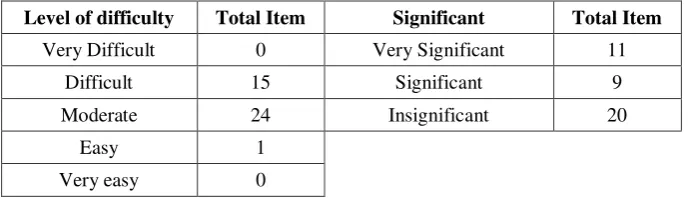
Table 3
Analysis of test items about the Level of Difficulty and Significance of Test Items
Level of difficulty Total Item Significant Total Item
Very Difficult 0 Very Significant 11
Difficult 15 Significant 9
Moderate 24 Insignificant 20
Easy 1
Very easy 0
As shown in Table 3, for the level of difficulty there was no item in
very difficult and very easy level; while for level of siginificant there was 11
test items in very significant, 9 test items in significant, and 20 test items
were insignificant. Based on the summary of the judgment above, the items of
the test were considered significant and very significant as the instrument test
11
31
in this research. It means that there were 20 test items is used for pre-test and
post-test. See appendix 19 for the detail of test items analysis.
G.Research Procedure
There are three steps that were applied in this research procedure, they were:
1. Planning
Before the writerapplied the research procedure, the writermade some plans to run
the application well. There were some steps that should be planned by researcher.
The procedure of making planning of the research can be seen as follows:
a. Determining the Subject
The writerdetermined the subject; in this phase the writerchose the first
semester of the eighth grade of SMPN 19 Bandar Lampung as the subject of
the research, one class was as the experimental class and the other one was as
the control class.
b. Preparing the pre-test
The writerprepared two kinds the test that were given to the students of
experimental and control class. The writer prepared try out test items and the
total number of the test items was 20 test items.
c. Determining the material to be teach.
The writerdetermined the material that be taught to the students, the material
32
d. Preparing the post-test
The writerprepared a kind of test (called post-test) that was given to the
students. By giving the post-test, the writer may know whether the students
increase their vocabulary mastery or not.
2. Application
After making the planning, the writer tried to apply the research procedure that
has been planned. There were some steps in doing this research:
a. In the first meeting, the writer gave the try out for students. This test was
multiple choices that consist of 40 items with 4 options; a, b, c, and d.
b. The second meeting, the writer gave pre-test
The test is multiple choices with 4 options; a, b, c, and d.
c. After giving the pre-test to the students, the writer gave the treatment in control
class and experimental class. In control class the writer gave the treatment
through picture. While in the experimental class, the writer gave the treatment
through narrative story.
d. In the last meeting, the writer gave the post-test.
The test was multiple choices with 4 options; a, b, c, and d.
3. Reporting
The last point that have been done in this research procedure was reporting. There
were three steps which applied in reporting. They were:
a. Analyzing the data received from try out
b. Analyzing the data received from pre-test and post-test
33
H. Scoring System
Before getting the score, the writer determined the procedure to be used in scoring
the students’ work. In order to do that, the writer used Arikunto’s fonnula12”. The
ideal highest score is 100. The scores of pre-test and post test were calculated by
using the following formula:
S
=
𝐫𝐧
𝟏𝟎𝟎
Where:
S : The score of the test
r : The total of the right answer n : The total items.
I. Validity of the Test
According to Arikunto, validity is a measurement which shows the level of
validity or the real of the instrument. A valid instrument has a high validity. On
the other hand, the instrument which is lack of goodness has a low validity.13
1. Content Validity
Content validity concerns whether the test was be good reflection of the materials
that need to be test. Content validity refers to instruments that were parallel with
the matter that measure. In this research the test intend to measure students’
vocabulary mastery of the eighth grade students of junior high school, the test was
12
Ibid,p.271 13
Suharsimi Arikunto, Dasar-Dasar Evaluasi Pendidikan, Bumi Aksara, Jakarta, 2010,
34
given to the students that can measure students’ mastery about vocabulary which
be base on what they have learn before based on the curriculum.
To get the content validity of the vocabulary test, the writer tried to arrange the
material based on the objective of teaching in the school based on the curriculum
for the eighth grades of SMPN 19 Bandar Lampung then the writer consulted the
instrument to the English teacher of SMPN 19 Bandar Lampung to make sure that
the instrument was valid. The teacher decided that the instrument was valid since
it was suitable with the curriculum for the eighth grade in that school.
2. Construct Validity
An instrument can be called valid when it can measure what is wanted. To
measure the validity of instrument, the writer used construct validity. According
to the expert, construct validity is use to measure perception, language behavior,
motivation, even the language ability.14 In this session, the writer consulted to the
English teacher to measure the validity of the instruments.
3. Internal Validity
In order to make sure that all items of vocabulary test were valid in term of
content, the writer asked for the English teacher to check the level of difficulty
and appropriateness of 40 test items before trying them out. The writer asked
English teachers in order to get their view and opinion about the level of difficulty
and appropriateness of each item. The judgment was used as a consideration for
developing reading comprehension test.
14
35
This research used ANATES Version 4 program to know validity of test which
consist of 40 items multiple choice. After tried out the test items, there were 20
items considered invalid. They were the items number 3, 8, 10, 11, 13, 14, 15, 16,
19, 20, 21, 24, 27, 30, 31, 32, 33, 35, 36 and 38. After that, valid items in posttest
try out were 20 items. They were the items number 1, 2, 4, 5, 6, 7, 9, 12, 17, 18,
22, 23, 25, 26, 28, 29, 34, 37, 39 and 40. It can be seen in Appendix 19.
Therefore, 20 valid test items were applied as the instrument test in this research.
J. Reliability of Test
According to Creswell, reliability means that scores from an instrument are stable
and consistent.15 Reliability refers to consistency of the test. The writer used
ANATES Version 4 program. ANATES can help analysis of item quickly, easy
and accurately. ANATES is necessary in the research to assess the good
instrument or not.
The criteria of reliability test are :
0.800-1.000 = Very high reliability
0.600-0.800 = High reliability
0.400-0.600 = Medium reliability
0.200-0.400 = Low reliability
0.00-0.200 = Very low reliability 16
From the criteria of reliability above, it can be drawn a conclusion that the result
obtained in the ANATES of reliability that reliability test in Narrative Story for
pre test has a high reliability because the result of the reliability is 0.67 and the
15
Ibid, 159 16
36
result of post test was 0.80. The writer concluded that the degree of the level of
reliability of the students was high reliability. It can be seen in Appendix 19.
K. Data Analysis
After collecting the data, the writer analyzed the data by using independent
sample t-test. There were two tests that must be done before analyzing the data by
usingindependent sample t-test. They are normality test and homogeneity test.
1. Prerequisite Tests
Parametric statistical significance tests, such as analysis of variance and least
squares regression, are widely used by writers in many disciplines, including,
statistics parametric tests to produce accurate results, the assumptions underlying
them such as normality and homogeneity test must be satisfied.17 It means that to
get the accurate result, the writer had to do some tests such as normality test and
homogeneity test.
a. Normality test
The normality test is used to know whether the data in the experimental class and
control classes are normally distributed or not. In this research, the writerused
statistical computation by using SPSS (Statistical Package for Social Science)
fornormality. The tests of normality employed are Kolmogorov – Smirnov and
Shapiro Wilk. The hypothesizes for the normality test are formulated as follows:
H0 : The data have normal distribution.
Ha : The data do not have normal distribution
17
37
While the criteria of acceptance or rejection of normality test are:
Hois accepted if sig > α = 0.05
Hais accepted if sig < α = 0.05
b. Homogeneity Test
Homogeneity test is used to determine whether the data obtained from the sample
homogeneous or not. In this research, the writer use statistical computation by
using SPSS (Statistical Package for the Social Sciences).
The hypotheses for the homogeneity test are:
Ha = The variance of the data is not homogeneous
Ho = The variance of the data is homogeneous
While the criteria of acceptance or rejection of hypothesis test are:
Ho is accepted if sig > α = 0.05
Hais accepted if sig < α = 0.05
2. Hypothetical Test
After the writer knows that the data is normal and homogeneous, the data was be
analyzed by using sample T-test, to know the significance of the treatment effect.
The writerwill use SPSS (S