D
ATA AND
C
OMPUTER
C
OMMUNICATIONS
Eighth Edition
William Stallings
Library of Congress Cataloging-in-Publication Data on File
Vice President and Editorial Director, ECS:
Marcia J. Horton
Executive Editor:Tracy Dunkelberger
Assistant Editor:Carole Snyder
Editorial Assistant:Christianna Lee
Executive Managing Editor:Vince O’Brien
Managing Editor:Camille Trentacoste
Production Editor:Rose Kernan
Director of Creative Services:Paul Belfanti
Creative Director:Juan Lopez
Cover Designer:Bruce Kenselaar
Managing Editor, AV Management and Production:
Patricia Burns
Art Editor:Gregory Dulles
Director, Image Resource Center:Melinda Reo
Manager, Rights and Permissions:Zina Arabia
Manager,Visual Research:Beth Brenzel
Manager, Cover Visual Research and Permissions:
Karen Sanatar
Manufacturing Manager, ESM:Alexis Heydt-Long
Manufacturing Buyer:Lisa McDowell
Executive Marketing Manager:Robin O’Brien
Marketing Assistant:Mack Patterson
©2007 Pearson Education, Inc. Pearson Prentice Hall
Pearson Education, Inc. Upper Saddle River, NJ 07458
All rights reserved. No part of this book may be reproduced in any form or by any means, without permission in writing from the publisher.
Pearson Prentice Hall™ is a trademark of Pearson Education, Inc.
All other tradmarks or product names are the property of their respective owners.
The author and publisher of this book have used their best efforts in preparing this book.These efforts include the development, research, and testing of the theories and programs to determine their effectiveness.The author and publisher make no warranty of any kind, expressed or implied, with regard to these programs or the documentation contained in this book.The author and publisher shall not be liable in any event for incidental or consequential damages in connection with, or arising out of, the furnishing, performance, or use of these programs.
Printed in the United States of America 10 9 8 7 6 5 4 3 2 1
ISBN: 0-13-243310-9
Pearson Education Ltd.,London
Pearson Education Australia Pty. Ltd.,Sydney
Pearson Education Singapore, Pte. Ltd. Pearson Education North Asia Ltd.,Hong Kong
Pearson Education Canada, Inc.,Toronto
Pearson Educaci n de Mexico, S.A. de C.V. Pearson Education Japan,Tokyo
Pearson Education Malaysia, Pte. Ltd.
W
EB
S
ITE FOR
DATA AND
COMPUTER
COMMUNICATIONS, EIGHTH
EDITION
The Web site at WilliamStallings.com/DCC/DCC8e.html provides support for instructors and students using the book. It includes the following elements.
Course Support Materials
The course support materials include
• Copies of figures from the book in PDF format
• A detailed set of course notes in PDF format suitable for student handout or for use as viewgraphs
• A set of PowerPoint slides for use as lecture aids
• Computer Science Student Support Site: contains a number of links and documents that the student may find useful in his/her ongoing computer science education. The site includes a review of basic, relevant mathematics; advice on research, writing, and doing homework problems; links to
computer science research resources, such as report repositories and bibliographies; and other useful links.
• An errata sheet for the book, updated at most monthly
DCC Courses
The DCC8e Web site includes links to Web sites for courses taught using the book. These sites can provide useful ideas about scheduling and topic ordering, as well as a number of useful handouts and other materials.
Useful Web Sites
The DCC8e Web site includes links to relevant Web sites, organized by chapter. The links cover a broad spectrum of topics and will enable students to explore timely issues in greater depth.
T
WEB SITE FOR DATA AND COMPUTER COMMUNICATIONS, EIGHTH EDITION
v
Supplemental Documents
The DCC8e Web site includes a number of documents that expand on the treatment in the book. Topics include standards organizations, Sockets, TCP/IP checksum, ASCII, and the sampling theorem.
Internet Mailing List
An Internet mailing list is maintained so that instructors using this book can exchange infor-mation, suggestions, and questions with each other and the author. Subscription information is provided at the book’s Web site.
Simulation and Modeling Tools
C
ONTENTS
Web Site for Data and Computer Communications iv
Preface xv
Chapter 0 Reader’s and Instructor’s Guide 1
0.1 Outline of the Book 2
0.2 Roadmap 3
0.3 Internet and Web Resources 5
0.4 Standards 6
PART ONE OVERVIEW 9
Chapter 1 Data Communications, Data Networking, and the Internet 10
1.1 Data Communications and Networking for Today’s Enterprise 12
1.2 A Communications Model 16
1.3 Data Communications 19
1.4 Networks 22
1.5 The Internet 25
1.6 An Example Configuration 29
Chapter 2 Protocol Architecture, TCP/IP, and Internet-Based Applications 32
2.1 The Need for a Protocol Architecture 33 2.2 The TCP/IP Protocol Architecture 34
2.3 The OSI Model 42
2.4 Standardization within a Protocol Architecture 44 2.5 Traditional Internet-Based Applications 48
2.6 Multimedia 48
2.7 Recommended Reading and Web Sites 53 2.8 Key Terms, Review Questions, and Problems 54 Appendix 2A The Trivial File Transfer Protocol 57
PART TWO DATA COMMUNICATIONS 62
Chapter 3 Data Transmission 65
3.1 Concepts and Terminology 67
3.2 Analog and Digital Data Transmission 78 3.3 Transmission Impairments 86
3.4 Channel Capacity 91
3.5 Recommended Reading and Web Site 96 3.6 Key Terms, Review Questions, and Problems 96 Appendix 3A Decibels and Signal Strength 99
Chapter 4 Transmission Media 102
4.1 Guided Transmission Media 104 4.2 Wireless Transmission 117 4.3 Wireless Propagation 125
viii
CONTENTS4.4 Line-of-Sight Transmission 129
4.5 Recommended Reading and Web Sites 133 4.6 Key Terms, Review Questions, and Problems 134
Chapter 5 Signal Encoding Techniques 138
5.1 Digital Data, Digital Signals 141 5.2 Digital Data, Analog Signals 151 5.3 Analog Data, Digital Signals 162 5.4 Analog Data, Analog Signals 168
5.5 Recommended Reading 175
5.6 Key Terms, Review Questions, and Problems 175
Chapter 6 Digital Data Communication Techniques 180
6.1 Asynchronous and Synchronous Transmission 182 6.2 Types of Errors 186
6.3 Error Detection 186 6.4 Error Correction 196 6.5 Line Configurations 201
6.6 Recommended Reading 203
6.7 Key Terms, Review Questions, and Problems 204
Chapter 7 Data Link Control Protocols 207
7.1 Flow Control 209
7.2 Error Control 216
7.3 High-Level Data Link Control (HDLC) 222
7.4 Recommended Reading 228
7.5 Key Terms, Review Questions, and Problems 229 Appendix 7A Performance Issues 232
Chapter 8 Multiplexing 239
8.1 Frequency-Division Multiplexing 242 8.2 Synchronous Time-Division Multiplexing 248 8.3 Statistical Time-Division Multiplexing 258 8.4 Asymmetric Digital Subscriber Line 265 8.5 xDSL 268
8.6 Recommended Reading and Web Sites 269 8.7 Key Terms, Review Questions, and Problems 270
Chapter 9 Spread Spectrum 274
CONTENTS
ix
PART THREE WIDE AREA NETWORKS 295Chapter 10 Circuit Switching and Packet Switching 297
10.1 Switched Communications Networks 299 10.2 Circuit Switching Networks 301
10.3 Circuit Switching Concepts 304 10.4 Softswitch Architecture 307 10.5 Packet-Switching Principles 309 10.6 X.25 317
10.7 Frame Relay 319
10.8 Recommended Reading and Web Sites 324 10.9 Key Terms, Review Questions, and Problems 325
Chapter 11 Asynchronous Transfer Mode 328
11.1 Protocol Architecture 329 11.2 ATM Logical Connections 331
11.3 ATM Cells 335
11.4 Transmission of ATM Cells 340 11.5 ATM Service Categories 345
11.6 Recommended Reading and Web Sites 348 11.7 Key Terms, Review Questions, and Problems 349
Chapter 12 Routing in Switched Networks 351
12.1 Routing in Packet-Switching Networks 352 12.2 Examples: Routing in ARPANET 362 12.3 Least-Cost Algorithms 367
12.4 Recommended Reading 372
12.5 Key Terms, Review Questions, and Problems 373
Chapter 13 Congestion Control in Data Networks 377
13.1 Effects of Congestion 379 13.2 Congestion Control 383 13.3 Traffic Management 386
13.4 Congestion Control in Packet-Switching Networks 387 13.5 Frame Relay Congestion Control 388
13.6 ATM Traffic Management 394 13.7 ATM-GFR Traffic Management 406
13.8 Recommended Reading 409
13.9 Key Terms, Review Questions, and Problems 410 Chapter 14 Cellular Wireless Networks 413
14.1 Principles of Cellular Networks 415 14.2 First Generation Analog 427
14.3 Second Generation CDMA 429
14.4 Third Generation Systems 437
x
CONTENTSPART FOUR LOCAL AREA NETWORKS 444
Chapter 15 Local Area Network Overview 446
15.1 Background 448
15.2 Topologies and Transmission Media 451 15.3 LAN Protocol Architecture 457
15.4 Bridges 465
15.5 Layer 2 and Layer 3 Switches 473
15.6 Recommended Reading and Web Site 478 15.7 Key Terms, Review Questions, and Problems 479
Chapter 16 High-Speed LANs 482
16.1 The Emergence of High-Speed LANs 483
16.2 Ethernet 485
16.3 Fibre Channel 500
16.4 Recommended Reading and Web Sites 504 16.5 Key Terms, Review Questions, and Problems 506
Appendix 16A Digital Signal Encoding for LANs 508 Appendix 16B Performance Issues 514
Appendix 16C Scrambling 518
Chapter 17 Wireless LANs 522
17.1 Overview 523
17.2 Wireless LAN Technology 528
17.3 IEEE 802.11 Architecture and Services 531 17.4 IEEE 802.11 Medium Access Control 535 17.5 IEEE 802.11Physical Layer 543
17.6 IEEE 802.11 Security Considerations 549 17.7 Recommended Reading and Web Sites 550 17.8 Key Terms, Review Questions, and Problems 551
PART FIVE INTERNET AND TRANSPORT PROTOCOLS 554
Chapter 18 Internetwork Protocols 556
18.1 Basic Protocol Functions 558 18.2 Principles of Internetworking 566 18.3 Internet Protocol Operation 569 18.4 Internet Protocol 576
18.5 IPv6 586
18.6 Virtual Private Networks and IP Security 596 18.7 Recommended Reading and Web Sites 599 18.8 Key Terms, Review Questions, and Problems 600 Chapter 19 Internetwork Operation 603
19.1 Multicasting 605 19.2 Routing Protocols 614
CONTENTS
xi
19.5 Service Level Agreements 64519.6 IP Performance Metrics 646
19.7 Recommended Reading and Web Sites 649 19.8 Key Terms, Review Questions, and Problems 651
Chapter 20 Transport Protocols 655
20.1 Connection-Oriented Transport Protocol Mechanisms 657 20.2 TCP 674
20.3 TCP Congestion Control 683 20.4 UDP 693
20.5 Recommended Reading and Web Sites 695 20.6 Key Terms, Review Questions, and Problems 695
PART SIX INTERNET APPLICATIONS 699
Chapter 21 Network Security 701
21.1 Security Requirements and Attacks 703
21.2 Confidentiality with Conventional Encryption 705 21.3 Message Authentication and Hash Functions 713 21.4 Public-Key Encryption and Digital Signatures 720 21.5 Secure Socket Layer and Transport Layer Security 727 21.6 IPv4 and IPv6 Security 732
21.7 Wi-Fi Protected Access 737
21.8 Recommended Reading and Web Sites 739 21.9 Key Terms, Review Questions, and Problems 740
Chapter 22 Internet Applications—Electronic Mail and Network Management 743
22.1 Electronic Mail: SMTP and MIME 745
22.2 Network Management: SNMP 760
22.3 Recommended Reading and Web Sites 770 22.4 Key Terms, Review Questions, and Problems 771
Chapter 23 Internet Applications—Internet Directory Service and World Wide Web 773
23.1 Internet Directory Service: DNS 774
23.2 Web Access: HTTP 784
23.3 Recommended Reading and Web Sites 795 23.4 Key Terms, Review Questions, and Problems 796
Chapter 24 Internet Applications—Multimedia 799
24.1 Audio and Video Compression 800 24.2 Real-Time Traffic 808
xii
CONTENTS APPENDICES 835Appendix A Fourier Analysis 835
A.1 Fourier Series Representation of Periodic Signals 836 A.2 Fourier Transform Representation of Aperiodic Signals 837
A.3 Recommended Reading 840
Appendix B Projects for Teaching Data and Computer Communications 841
B.1 Practical Exercises 842 B.2 Sockets Projects 843 B.3 Ethereal Projects 843
B.4 Simulation and Modeling Projects 844 B.5 Performance Modeling 844
B.6 Research Projects 845
B.7 Reading/Report Assignments 845 B.8 Writing Assignments 845
B.9 Discussion Topics 846
References 847
Index 858
ONLINE APPENDICES
WilliamStallings.com/DCC
Appendix C Sockets: A Programmer’s Introduction
C.1 Versions of Sockets
C.2 Sockets, Socket Descriptors, Ports, and Connections C.3 The Client/Server Model of Communication C.4 Sockets Elements
C.5 Stream and Datagram Sockets C.6 Run-Time Program Control
C.7 Remote Execution of a Windows Console Application Appendix D Standards Organizations
D.1 The Importance of Standards D.2 Standards and Regulation D.3 Standards-Setting Organizations
Appendix E The International Reference Alphabet
Appendix F Proof of the Sampling Theorem
Appendix G Physical-Layer Interfacing
G.1 V.24/EIA-232-F
G.2 ISDN Physical Interface
Appendix H The OSI Model
H.1 The Model
CONTENTS
xiii
Appendix I Queuing Effects
I.1 Queuing Models
I.2 Queuing Results
Appendix J Orthogonality, Correlation, and Autocorrelation
J.1 Correlation and Autocorrelation J.2 Orthogonal Codes
Appendix K The TCP/IP Checksum
K.1 Ones-Complement Addition K.2 Use in TCP and IP
Appendix L TCP/IP Example
Appendix M Uniform Resource Locators (URLs) and Uniform Resource Identifiers (URIs)
M.1 Uniform Resource Locator M.2 Uniform Resource Identifier
M.3 To Learn More
Appendix N Augmented Backus-Naur Form
P
REFACE
Begin at the beginning and go on till you come to the end; then stop.
—Alice in Wonderland,Lewis Carroll
OBJECTIVES
This book attempts to provide a unified overview of the broad field of data and computer com-munications. The organization of the book reflects an attempt to break this massive subject into comprehensible parts and to build, piece by piece, a survey of the state of the art.The book emphasizes basic principles and topics of fundamental importance concerning the technology and architecture of this field and provides a detailed discussion of leading-edge topics.
The following basic themes serve to unify the discussion:
•Principles:Although the scope of this book is broad, there are a number of basic principles that appear repeatedly as themes and that unify this field. Examples are multiplexing, flow control, and error control. The book highlights these principles and contrasts their application in specific areas of technology. •Design approaches:The book examines alternative approaches to meeting
specific communication requirements.
•Standards:Standards have come to assume an increasingly important, indeed dominant, role in this field. An understanding of the current status and future direction of technology requires a comprehensive discussion of the related standards.
INTENDED AUDIENCE
The book is intended for both an academic and a professional audience. For the professional interested in this field, the book serves as a basic reference volume and is suitable for self-study. As a textbook, it can be used for a one-semester or two-semester course. It covers the material in Networking (NET), a core area in the Information Technology body of knowledge, which is part of the Draft ACM/IEEE/AIS Computing Curricula 2005. The book also covers the material in Computer Networks (CE-NWK), a core area in Computer Engineering 2004 Curriculum Guidelines from the ACM/IEEE Joint Task Force on Computing Curricula.
PLAN OF THE TEXT
The book is divided into six parts (see Chapter 0): • Overview
• Data Communications • Wide Area Networks
xvi
PREFACE• Local Area Networks
• Internet and Transport Protocols • Internet Applications
In addition, the book includes an extensive glossary, a list of frequently used acronyms, and a bibliography. Each chapter includes problems and suggestions for further reading.
The chapters and parts of the book are sufficiently modular to provide a great deal of flex-ibility in the design of courses. See Chapter 0 for a number of detailed suggestions for both top-down and bottom-up course strategies.
INSTRUCTIONAL SUPPORT MATERIALS
To support instructors, the following materials are provided:
•Solutions Manual:Solutions to all end-of-chapter Review Questions and Problems.
•PowerPoint Slides:A set of slides covering all chapters, suitable for use in lecturing.
•PDF files:Reproductions of all figures and tables from the book.
•Projects Manual:Suggested project assignments for all of the project cate-gories listed below.
Instructors may contact their Pearson Education or Prentice Hall representative for access to these materials.
In addition, the book’s Web site supports instructors with:
• Links to Webs sites for other courses being taught using this book • Sign up information for an Internet mailing list for instructors
INTERNET SERVICES FOR INSTRUCTORS AND STUDENTS
There is a Web site for this book that provides support for students and instructors. The site includes links to other relevant sites, transparency masters of figures in the book, and sign-up information for the book’s Internet mailing list. The Web page is at WilliamStallings.com/DCC/DCC8e.html; see the section,Web Site for Data and Computer Communications, preceding the Table of Contents, for more information. An Internet mail-ing list has been set up so that instructors usmail-ing this book can exchange information, sug-gestions, and questions with each other and with the author. As soon as typos or other errors are discovered, an errata list for this book will be available at WilliamStallings.com.
PROJECTS AND OTHER STUDENT EXERCISES
PREFACE
xvii
Manuals for various project types plus specific assignments, all written especially for this book. Instructors can assign work in the following areas:
•Practical exercises:Using network commands, the student gains experience in network connectivity.
•Sockets programming projects:The book is supported by a detailed descrip-tion of Sockets available at the book’s Web site. The Instructors supplement includes a set of programming projects. Sockets programming is an “easy” topic and one that can result in very satisfying hands-on projects for students. •Ethereal projects:Ethereal is a protocol analyzer that enables students to
study the behavior of protocols.
•Simulation projects:The student can use the simulation package cnetto analyze network behavior.
•Performance modeling projects:Two performance modeling techniques are provided a toolspackage and OPNET.
•Research projects:The instructor’s supplement includes a list of suggested research projects that would involve Web and literature searches.
•Reading/report assignments:The instructor’s supplement includes a list of papers that can be assigned for reading and writing a report, plus suggested assignment wording.
•Writing assignments:The instructor’s supplement includes a list of writing assignments to facilitate learning the material.
•Discussion topics:These topics can be used in a classroom, chat room, or message board environment to explore certain areas in greater depth and to foster student collaboration.
This diverse set of projects and other student exercises enables the instructor to use the book as one component in a rich and varied learning experience and to tailor a course plan to meet the specific needs of the instructor and students. See Appendix B for details.
WHAT’S NEW IN THE EIGHTH EDITION
This eighth edition is seeing the light of day less than four years after the publication of the seventh edition. During that time, the pace of change in this field continues unabated. In this new edition, I try to capture these changes while maintaining a broad and comprehensive coverage of the entire field. To begin the process of revision, the seventh edition of this book was extensively reviewed by a number of professors who teach the subject. The result is that, in many places, the narrative has been clarified and tightened, and illustrations have been improved. Also, a number of new “field-tested” problems have been added.
Beyond these refinements to improve pedagogy and user friendliness, there have been major substantive changes throughout the book. Every chapter has been revised, new chapters have been added, and the overall organization of the book has changed. Highlights include:
•Updated coverage of Gigabit Ethernet and 10-Gbps Ethernet:New details of these standards are provided.
xviii
PREFACE•New coverage of IP performance metrics and service level agreements (SLAs):These aspects of Quality of Service (QoS) and performance monitor-ing are increasmonitor-ingly important.
•Address Resolution Protocol (ARP):This important protocol is now covered. •New coverage of TCP Tahoe, Reno, and NewReno:These congestion control
algorithms are now common in most commercial implementations.
•Expanded coverage of security:Chapter 21 is more detailed; other chapters provide overview of security for the relevant topic. Among the new topics are Wi-Fi Protected Access (WPA) and the secure hash algorithm SHA-512. •Domain Name System (DNS):This important scheme is now covered. •New coverage of multimedia:Introductory section in Chapter 2; detailed
cov-erage in Chapter 24. Topics covered include video compression, SIP, and RTP. •Online appendices:Fourteen online appendices provide additional detail on
important topics in the text, including Sockets programming, queuing models, the Internet checksum, a detailed example of TCP/IP operation, and the BNF grammar.
In addition, throughout the book, virtually every topic has been updated to reflect the developments in standards and technology that have occurred since the publication of the seventh edition.
ACKNOWLEDGMENTS
This new edition has benefited from review by a number of people, who gave generously of their time and expertise. The following people reviewed all or a large part of the manuscript: Xin Liu- (UC, Davis), Jorge Cobb, Andras Farago, Dr. Prasant Mohapatra (UC Davis), Dr. Jingxian Wu (Sonoma State University), G. R. Dattareya (UT Dallas), Guanling Chen (Umass, Lowell), Bob Roohaprvar (Cal State East Bay), Ahmed Banafa (Cal State East Bay), Ching-Chen Lee (CSU Hayward), and Daji Qaio (Iowa State).
Thanks also to the many people who provided detailed technical reviews of a single chap-ter: Dave Tweed, Bruce Lane, Denis McMahon, Charles Freund, Paul Hoadley, Stephen Ma, Sandeep Subramaniam, Dragan Cvetkovic, Fernando Gont, Neil Giles, Rajesh Thundil, and Rick Jones. In addition, Larry Owens of California State University and Katia Obraczka of the University of Southern California provided some homework problems.
Thanks also to the following contributors. Zornitza Prodanoff of the University of North Florida prepared the appendix on Sockets programming. Michael Harris of the University of South Florida is responsible for the Ethereal exercises and user’s guide. Lawrie Brown of the Australian Defence Force Academy of the University of New South Wales produced the PPT lecture slides.
CHAPTER
R
EADER
’
S AND
I
NSTRUCTOR
’
S
G
UIDE
0.1 Outline of the Book
0.2 Roadmap
0.3 Internet and Web Resources
0.4 Standards
1
2
CHAPTER 0 / READER’S AND INSTRUCTOR’S GUIDE“In the meanwhile, then,” demanded Li-loe, “relate to me the story to which reference has been made, thereby proving the truth of your assertion, and at the same time
affording an entertainment of a somewhat exceptional kind.” “The shadows lengthen,” replied Kai Lung, “but as the narrative in question is of an inconspicuous span I will raise no barrier against your flattering
request, especially as it indicates an awakening taste hitherto unexpected.” —Kai Lung’s Golden Hours, Earnest Bramah This book, with its accompanying Web site, covers a lot of material. Here we give the reader some basic background information.
0.1 OUTLINE OF THE BOOK
The book is organized into five parts:
Part One. Overview: Provides an introduction to the range of topics covered in the book. This part includes a general overview of data communications and net-working and a discussion of protocols, OSI, and the TCP/IP protocol suite.
Part Two. Data Communications: Concerned primarily with the exchange of data between two directly connected devices.Within this restricted scope, the key aspects of transmission, interfacing, link control, and multiplexing are examined.
Part Three. Wide Area Networks: Examines the internal mechanisms and user-network interfaces that have been developed to support voice, data, and multimedia communications over long-distance networks. The traditional tech-nologies of packet switching and circuit switching are examined, as well as the more recent ATM and wireless WANs. Separate chapters are devoted to routing and congestion control issues that are relevant both to switched data networks and to the Internet.
Part Four. Local Area Networks: Explores the technologies and architectures that have been developed for networking over shorter distances. The transmis-sion media, topologies, and medium access control protocols that are the key ingredients of a LAN design are explored and specific standardized LAN sys-tems examined.
Part Five. Networking Protocols: Explores both the architectural principles and the mechanisms required for the exchange of data among computers, worksta-tions, servers, and other data processing devices. Much of the material in this part relates to the TCP/IP protocol suite.
Part Six. Internet Applications: Looks at a range of applications that operate over the Internet.
0.2 / ROADMAP
3
0.2 ROADMAP
Course Emphasis
The material in this book is organized into four broad categories: data transmission and communication; communications networks; network protocols; and applica-tions and security. The chapters and parts of the book are sufficiently modular to provide a great deal of flexibility in the design of courses. The following are suggestions for three different course designs:
• Fundamentals of Data Communications: Parts One (overview) and Two (data communications) and Chapters 10 and 11 (circuit switching, packet switching, and ATM).
• Communications Networks: If the student has a basic background in data communications, then this course could cover Parts One (overview), Three (WAN), and Four (LAN).
• Computer Networks: If the student has a basic background in data communi-cations, then this course could cover Part One (overview), Chapters 6 and 7 (data communication techniques and data link control), Part Five (protocols), and part or all of Part Six (applications).
In addition, a more streamlined course that covers the entire book is possible by eliminating certain chapters that are not essential on a first reading. Chapters that could be optional are Chapters 3 (data transmission) and 4 (transmission media), if the student has a basic understanding of these topics; Chapter 8 (multi-plexing); Chapter 9 (spread spectrum); Chapters 12 through 14 (routing, congestion control, cellular networks); Chapter 18 (internetworking); and Chapter 21 (network security).
Bottom-Up versus Top-Down
The book is organized in a modular fashion. After reading Part One, the other parts can be read in a number of possible sequences. Figure 0.1a shows the bottom-up approach provided by reading the book from front to back. With this approach, each part builds on the material in the previous part, so that it is always clear how a given layer of functionality is supported from below. There is more material than can be comfortably covered in a single semester, but the book’s organization makes it easy to eliminate some chapters and maintain the bottom-up sequence. Figure 0.1b suggests one approach to a survey course.
4
CHAPTER 0 / READER’S AND INSTRUCTOR’S GUIDEFinally, it is possible to select chapters to reflect specific teaching objectives by not sticking to a strict chapter ordering. We give two examples used in courses taught with the seventh edition. One course used the sequence Part One (Overview); Chapter 3 (Data Transmission); Chapter 6 (Digital Data Communica-tions Techniques); Chapter 7 (Data Link Control); Chapter 15 (LAN Overview); Chapter 16 (High-Speed LANs); Chapter 10 (Circuit and Packet Switching); Chapter 12 (Routing); Chapter 18 (Internet Protocols); and Chapter 19 (Internet Operation). The other course used the sequence Part One (Overview); Chapter 3 (Data Transmission); Chapter 4 (Guided and Wireless Transmission); Chapter 5 (Signal Encoding Techniques); Chapter 8 (Multiplexing); Chapter 15 (LAN
Figure 0.1 Suggested Reading Orders Part One
0.3 / INTERNET AND WEB RESOURCES
5
Overview); Chapter 16 (High-Speed LANs); Chapter 10 (Circuit and Packet Switching); Chapter 20 (Transport Protocols); Chapter 18 (Internet Protocols); and Chapter 19 (Internet Operation).
0.3 INTERNET AND WEB RESOURCES
There are a number of resources available on the Internet and the Web to support this book and to help one keep up with developments in this field.
Web Sites for This Book
A special Web page has been set up for this book at WilliamStallings.com/DCC/
DCC8e.html. See the two-page layout at the beginning of this book for a detailed
description of that site.
As soon as any typos or other errors are discovered, an errata list for this book will be available at the Web site. Please report any errors that you spot. Errata sheets for my other books are at WilliamStallings.com.
I also maintain the Computer Science Student Resource Site, at WilliamStallings.com/StudentSupport.html. The purpose of this site is to provide docu-ments, information, and links for computer science students and professionals. Links and documents are organized into four categories:
• Math: Includes a basic math refresher, a queuing analysis primer, a number system primer, and links to numerous math sites
• How-to: Advice and guidance for solving homework problems, writing techni-cal reports, and preparing technitechni-cal presentations
• Research resources: Links to important collections of papers, technical reports, and bibliographies
• Miscellaneous: A variety of useful documents and links
Other Web Sites
There are numerous Web sites that provide information related to the topics of this book. In subsequent chapters, pointers to specific Web sites can be found in the Recommended Reading and Web Sitessection. Because the addresses for Web sites tend to change frequently, I have not included URLs in the book. For all of the Web sites listed in the book, the appropriate link can be found at this book’s Web site. Other links not mentioned in this book will be added to the Web site over time.
The following are Web sites of general interest related to data and computer communications:
• Network World: Information and links to resources about data communica-tions and networking.
6
CHAPTER 0 / READER’S AND INSTRUCTOR’S GUIDE• Vendors: Links to thousands of hardware and software vendors who currently have Web sites, as well as a list of thousands of computer and networking com-panies in a phone directory.
• IEEE Communications Society: Good way to keep up on conferences, publi-cations, and so on.
• ACM Special Interest Group on Communications (SIGCOMM): Good way to keep up on conferences, publications, and so on.
• International Telecommunications Union: Contains a listing of ITU-T recom-mendations, plus information on obtaining ITU-T documents in hard copy or on DVD.
• International Organization for Standardization: Contains a listing of ISO standards, plus information on obtaining ISO documents in hard copy or on CD-ROM.
• CommWeb: Links to vendors, tutorials, and other useful information.
• CommsDesign: Lot of useful articles, tutorials, and product information. A bit hard to navigate, but worthwhile.
USENET Newsgroups
A number of USENET newsgroups are devoted to some aspect of data communi-cations, networks, and protocols. As with virtually all USENET groups, there is a high noise-to-signal ratio, but it is worth experimenting to see if any meet your needs. The most relevant are as follows:
• comp.dcom.lans, comp.dcom.lans.misc:General discussions of LANs
• comp.dcom.lans.ethernet:Covers Ethernet, Ethernet-like systems, and the IEEE
802.3 CSMA/CD standards
• comp.std.wireless: General discussion of wireless networks, including wireless
LANs
• comp.security.misc:Computer security and encryption
• comp.dcom.cell-relay:Covers ATM and ATM LANs
• comp.dcom.frame-relay:Covers frame relay networks
• comp.dcom.net-management: Discussion of network management applications,
protocols, and standards
• comp.protocols.tcp-ip:The TCP/IP protocol suite
0.4 STANDARDS
0.4 / STANDARDS
7
equipment will generally interface to and communicate with other vendors’ equip-ment, computer vendors have traditionally attempted to monopolize their cus-tomers. The proliferation of computers and distributed processing has made that an untenable position. Computers from different vendors must communicate with each other and, with the ongoing evolution of protocol standards, customers will no longer accept special-purpose protocol conversion software development. The result is that standards now permeate all of the areas of technology discussed in this book.
There are a number of advantages and disadvantages to the standards-making process. We list here the most striking ones. The principal advantages of standards are as follows:
• A standard assures that there will be a large market for a particular piece of equipment or software. This encourages mass production and, in some cases, the use of large-scale-integration (LSI) or very-large-scale-integration (VLSI) techniques, resulting in lower costs.
• A standard allows products from multiple vendors to communicate, giving the purchaser more flexibility in equipment selection and use.
The principal disadvantages are as follows:
• A standard tends to freeze the technology. By the time a standard is devel-oped, subjected to review and compromise, and promulgated, more efficient techniques are possible.
• There are multiple standards for the same thing. This is not a disadvantage of standards per se, but of the current way things are done. Fortunately, in recent years the various standards-making organizations have begun to cooperate more closely. Nevertheless, there are still areas where multiple conflicting standards exist.
Throughout this book, we describe the most important standards in use or being developed for various aspects of data and computer communications. Various organizations have been involved in the development or promotion of these stan-dards. The following are the most important (in the current context) of these orga-nizations:
• Internet Society: The Internet SOCiety (ISOC) is a professional member-ship society with more than 150 organizational and 6000 individual mem-bers in over 100 countries. It provides leadership in addressing issues that confront the future of the Internet and is the organization home for the groups responsible for Internet infrastructure standards, including the Internet Engineering Task Force (IETF) and the Internet Architecture Board (IAB). All of the RFCs and Internet standards are developed through these organizations.
8
CHAPTER 0 / READER’S AND INSTRUCTOR’S GUIDE1ISO is not an acronym (in which case it would be IOS), but a word, derived from the Greek, meaning
equal.
• ITU-T: The International Telecommunication Union (ITU) is an interna-tional organization within the United Nations System where governments and the private sector coordinate global telecom networks and services. The ITU Telecommunication Standardization Sector (ITU-T) is one of the three sec-tors of the ITU. ITU-T’s mission is the production of standards covering all fields of telecommunications.
• ATM Forum: The ATM Forum is an international nonprofit organization formed with the objective of accelerating the use of ATM (asynchronous transfer mode) products and services through a rapid convergence of interop-erability specifications. In addition, the Forum promotes industry cooperation and awareness.
• ISO: The International Organization for Standardization (ISO)1is a world-wide federation of national standards bodies from more than 140 countries, one from each country. ISO is a nongovernmental organization that promotes the development of standardization and related activities with a view to facili-tating the international exchange of goods and services, and to developing cooperation in the spheres of intellectual, scientific, technological, and eco-nomic activity. ISO’s work results in international agreements that are pub-lished as International Standards.
P
ART
O
NE
The purpose of Part One is to provide a background and context for the remainder of this book. The broad range of topics that are encompassed in the field of data and computer communications is introduced, and the fundamental concepts of protocols and protocol architectures are examined.
9
Overview
ROAD MAP FOR PART ONE
Chapter 1 Data Communications, Data Networks, and
The Internet
Chapter 1 provides an overview of Parts Two through Four of the book, giving the “big picture.” In essence, the book deals with four topics: data communications over a transmission link; wide area networks; local area networks; and protocols and the TCP/IP protocol architecture. Chapter 1 provides a preview of the first three of these topics.
Chapter 2 Protocol Architecture, TCP/IP, and
Internet-Based Applications
CHAPTER
D
ATA
C
OMMUNICATIONS
, D
ATA
N
ETWORKS
,
AND THE
I
NTERNET
1.1 Data Communications and Networking for Today’s Enterprise
1.2 A Communications Model
1.3 Data Communications
1.4 Networks
1.5 The Internet
1.6 An Example Configuration
10
The 1970s and 1980s saw a merger of the fields of computer science and data communications that profoundly changed the technology, products, and compa-nies of the now combined communications industry. The computer-communications revolution has produced several remarkable facts:
• There is no fundamental difference between data processing (computers) and data communications (transmission and switching equipment). • There are no fundamental differences among data, voice, and video
com-munications.
• The distinction among single-processor computer, multiprocessor computer, local network, metropolitan network, and long-haul network has blurred.
One effect of these trends has been a growing overlap of the computer and communications industries, from component fabrication to system integration. Another result is the development of integrated systems that transmit and process all types of data and information. Both the technology and the technical standards organizations are driving toward integrated public systems that make virtually all data and information sources around the world easily and uniformly accessible. This book aims to provide a unified view of the broad field of data and computer communications. The organization of the book reflects an attempt to break this massive subject into comprehensible parts and to build, piece by piece, a survey of the state of the art. This introductory chapter begins with a general model of communications. Then a brief discussion introduces each of the Parts Two through Four of this book. Chapter 2 provides an overview to Parts Five and Six
KEY POINTS
• The scope of this book is broad, covering three general areas: data communications, networking, and protocols; the first two are intro-duced in this chapter.
• Data communications deals with the transmission of signals in a reli-able and efficient manner. Topics covered include signal transmission, transmission media, signal encoding, interfacing, data link control, and multiplexing.
• Networking deals with the technology and architecture of the com-munications networks used to interconnect communicating devices. This field is generally divided into the topics of local area networks (LANs) and wide area networks (WANs).
11
The fundamental problem of communication is that of reproducing at one12
CHAPTER 1 / DATA COMMUNICATIONS, DATA NETWORKS, AND THE INTERNET1.1 DATA COMMUNICATIONS AND NETWORKING FOR
TODAY’S ENTERPRISE
Effective and efficient data communication and networking facilities are vital to any enterprise. In this section, we first look at trends that are increasing the challenge for the business manager in planning and managing such facilities. Then we look specif-ically at the requirement for ever-greater transmission speeds and network capacity.
Trends
Three different forces have consistently driven the architecture and evolution of data communications and networking facilities: traffic growth, development of new services, and advances in technology.
Communicationtraffic, both local (within a building or building complex) and long distance, both voice and data, has been growing at a high and steady rate for decades. The increasing emphasis on office automation, remote access, online transactions, and other productivity measures means that this trend is likely to con-tinue. Thus, managers are constantly struggling to maximize capacity and minimize transmission costs.
As businesses rely more and more on information technology, the range of
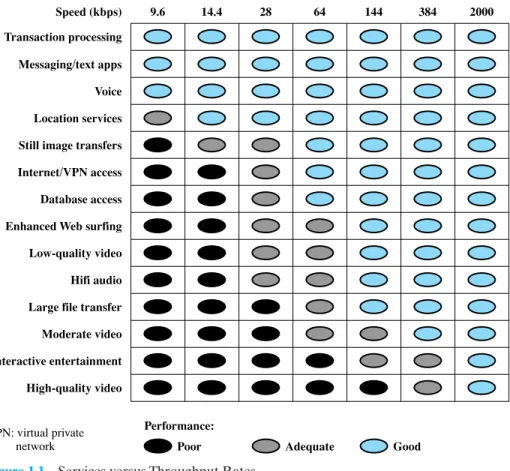
servicesexpands. This increases the demand for high-capacity networking and trans-mission facilities. In turn, the continuing growth in high-speed network offerings with the continuing drop in prices encourages the expansion of services. Thus, growth in services and growth in traffic capacity go hand in hand. Figure 1.1 gives some examples of information-based services and the data rates needed to support them [ELSA02].
Finally, trends in technology enable the provision of increasing traffic capacity and the support of a wide range of services. Four technology trends are particularly notable:
1. The trend toward faster and cheaper, both in computing and communications, continues. In terms of computing, this means more powerful computers and clusters of computers capable of supporting more demanding applications, such as multimedia applications. In terms of communications, the increasing use of optical fiber has brought transmission prices down and greatly increased capacity. For example, for long-distance telecommunication and data network links, recent offerings of dense wavelength division multiplexing (DWDM) enable capacities of many terabits per second. For local area works (LANs) many enterprises now have Gigabit Ethernet backbone net-works and some are beginning to deploy 10-Gbps Ethernet.
1.1 / DATA COMMUNICATIONS AND NETWORKING FOR TODAY’S ENTERPRISE
13
9.6 Speed (kbps) Transaction processing Messaging/text apps Voice Location services Still image transfers Internet/VPN access Database access Enhanced Web surfing Low-quality video Hifi audio Large file transfer Moderate video Interactive entertainment High-quality video
Performance:
VPN: virtual private
network Poor Adequate Good
14.4 28 64 144 384 2000
Figure 1.1 Services versus Throughput Rates
1Briefly, an intranet uses Internet and Web technology in an isolated facility internal to an enterprise; an extranet extends a company’s intranet out onto the Internet to allow selected customers, suppliers, and mobile workers to access the company’s private data and applications.
3. The Internet, the Web, and associated applications have emerged as dominant features of both the business and personal world, opening up many opportunities and challenges for managers. In addition to exploiting the Internet and the Web to reach customers, suppliers, and partners, enterprises have formed intranets and extranets1to isolate their proprietary information free from unwanted access. 4. There has been a trend toward ever-increasing mobility for decades, liberating
14
CHAPTER 1 / DATA COMMUNICATIONS, DATA NETWORKS, AND THE INTERNETData Transmission and Network Capacity Requirements
Momentous changes in the way organizations do business and process information have been driven by changes in networking technology and at the same time have driven those changes. It is hard to separate chicken and egg in this field. Similarly, the use of the Internet by both businesses and individuals reflects this cyclic depen-dency: the availability of new image-based services on the Internet (i.e., the Web) has resulted in an increase in the total number of users and the traffic volume gen-erated by each user. This, in turn, has resulted in a need to increase the speed and efficiency of the Internet. On the other hand, it is only such increased speed that makes the use of Web-based applications palatable to the end user.
In this section, we survey some of the end-user factors that fit into this equa-tion. We begin with the need for high-speed LANs in the business environment, because this need has appeared first and has forced the pace of networking develop-ment. Then we look at business WAN requirements. Finally we offer a few words about the effect of changes in commercial electronics on network requirements.
The Emergence of High-Speed LANs
Personal computers and microcom-puter workstations began to achieve widespread acceptance in business computing in the early 1980s and have now achieved virtually the status of the telephone: an essential tool for office workers. Until relatively recently, office LANs provided basic connectivity services—connecting personal computers and terminals to main-frames and midrange systems that ran corporate applications, and providing work-group connectivity at the departmental or divisional level. In both cases, traffic patterns were relatively light, with an emphasis on file transfer and electronic mail. The LANs that were available for this type of workload, primarily Ethernet and token ring, are well suited to this environment.In the 1990s, two significant trends altered the role of the personal computer and therefore the requirements on the LAN:
1. The speed and computing power of personal computers continued to enjoy explo-sive growth. These more powerful platforms support graphics-intenexplo-sive applica-tions and ever more elaborate graphical user interfaces to the operating system. 2. MIS (management information systems) organizations have recognized the LAN as a viable and essential computing platform, resulting in the focus on network computing. This trend began with client/server computing, which has become a dominant architecture in the business environment and the more recent Web-focused intranet trend. Both of these approaches involve the frequent transfer of potentially large volumes of data in a transaction-oriented environment.
1.1 / DATA COMMUNICATIONS AND NETWORKING FOR TODAY’S ENTERPRISE
15
which servers typically contain tens of gigabytes of image data that must be downloaded to imaging workstations. As the performance of the servers them-selves has increased, the bottleneck has shifted to the network.
• Power workgroups: These groups typically consist of a small number of cooper-ating users who need to draw massive data files across the network. Examples are a software development group that runs tests on a new software version, or a computer-aided design (CAD) company that regularly runs simulations of new designs. In such cases, large amounts of data are distributed to several workstations, processed, and updated at very high speed for multiple iterations. • High-speed local backbone: As processing demand grows, LANs proliferate at
a site, and high-speed interconnection is necessary.
Corporate Wide Area Networking Needs
As recently as the early 1990s, there was an emphasis in many organizations on a centralized data processing model. In a typical environment, there might be significant computing facilities at a few regional offices, consisting of mainframes or well-equipped midrange systems. These centralized facilities could handle most corporate applications, including basic finance, accounting, and personnel programs, as well as many of the business-specific applications. Smaller, outlying offices (e.g., a bank branch) could be equipped with terminals or basic personal computers linked to one of the regional centers in a transaction-oriented environment. This model began to change in the early 1990s, and the change accelerated through the mid-1990s. Many organizations have dispersed their employees into multi-ple smaller offices. There is a growing use of telecommuting. Most significant, the nature of the application structure has changed. First client/server computing and, more recently, intranet computing have fundamentally restructured the organizational data processing environment.There is now much more reliance on personal computers, workstations, and servers and much less use of centralized mainframe and midrange systems. Furthermore, the virtually universal deployment of graphical user interfaces to the desktop enables the end user to exploit graphic applications, multimedia, and other data-intensive applications. In addition, most organizations require access to the Inter-net. When a few clicks of the mouse can trigger huge volumes of data, traffic patterns have become more unpredictable while the average load has risen.All of these trends means that more data must be transported off premises and into the wide area. It has long been accepted that in the typical business environ-ment, about 80% of the traffic remains local and about 20% traverses wide area links. But this rule no longer applies to most companies, with a greater percentage of the traffic going into the WAN environment [COHE96]. This traffic flow shift places a greater burden on LAN backbones and, of course, on the WAN facilities used by a corporation. Thus, just as in the local area, changes in corporate data traffic patterns are driving the creation of high-speed WANs.
Digital Electronics
The rapid conversion of consumer electronics to digital technology is having an impact on both the Internet and corporate intranets. As these new gadgets come into view and proliferate, they dramatically increase the amount of image and video traffic carried by networks.16
CHAPTER 1 / DATA COMMUNICATIONS, DATA NETWORKS, AND THE INTERNETfound an acceptable replacement for the analog VHS videotape. The DVD has replaced the videotape used in videocassette recorders (VCRs) and replaced the CD-ROM in personal computers and servers. The DVD takes video into the digital age. It delivers movies with picture quality that outshines laser disks, and it can be randomly accessed like audio CDs, which DVD machines can also play. Vast vol-umes of data can be crammed onto the disk, currently seven times as much as a CD-ROM. With DVD’s huge storage capacity and vivid quality, PC games have become more realistic and educational software incorporates more video. Following in the wake of these developments is a new crest of traffic over the Internet and corporate intranets, as this material is incorporated into Web sites.
A related product development is the digital camcorder. This product has made it easier for individuals and companies to make digital video files to be placed on corporate and Internet Web sites, again adding to the traffic burden.
1.2 A COMMUNICATIONS MODEL
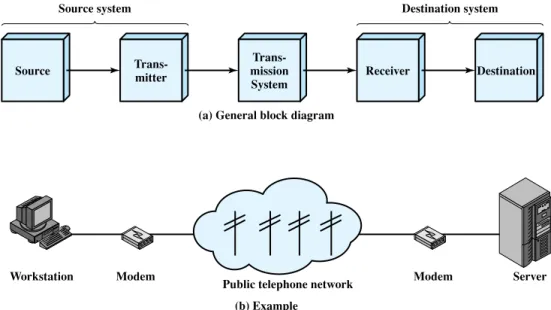
This section introduces a simple model of communications, illustrated by the block diagram in Figure 1.2a.
The fundamental purpose of a communications system is the exchange of data between two parties. Figure 1.2b presents one particular example, which is commu-nication between a workstation and a server over a public telephone network. Another example is the exchange of voice signals between two telephones over the same network. The key elements of the model are as follows:
• Source. This device generates the data to be transmitted; examples are tele-phones and personal computers.
Server Modem
Modem
Public telephone network Workstation
Source
Trans-mitter
Trans-mission System
Receiver Destination
Source system Destination system
(a) General block diagram
1.2 / A COMMUNICATIONS MODEL
17
• Transmitter: Usually, the data generated by a source system are not transmit-ted directly in the form in which they were generatransmit-ted. Rather, a transmitter transforms and encodes the information in such a way as to produce electro-magnetic signals that can be transmitted across some sort of transmission sys-tem. For example, a modem takes a digital bit stream from an attached device such as a personal computer and transforms that bit stream into an analog sig-nal that can be handled by the telephone network.• Transmission system: This can be a single transmission line or a complex net-work connecting source and destination.
• Receiver: The receiver accepts the signal from the transmission system and converts it into a form that can be handled by the destination device. For example, a modem will accept an analog signal coming from a network or transmission line and convert it into a digital bit stream.
• Destination: Takes the incoming data from the receiver.
This simple narrative conceals a wealth of technical complexity. To get some idea of the scope of this complexity, Table 1.1 lists some of the key tasks that must be performed in a data communications system. The list is somewhat arbitrary: Ele-ments could be added; items on the list could be merged; and some items represent several tasks that are performed at different “levels” of the system. However, the list as it stands is suggestive of the scope of this book.
The first item, transmission system utilization, refers to the need to make efficient use of transmission facilities that are typically shared among a number of communicating devices. Various techniques (referred to as multiplexing) are used to allocate the total capacity of a transmission medium among a number of users. Congestion control techniques may be required to assure that the system is not overwhelmed by excessive demand for transmission services.
To communicate, a device must interfacewith the transmission system. All the forms of communication discussed in this book depend on the use of electromagnetic signals propagated over a transmission medium. Thus, once an interface is estab-lished,signal generationis required for communication. The properties of the signal, such as form and intensity, must be such that the signal is (1) capable of being propa-gated through the transmission system, and (2) interpretable as data at the receiver. Not only must the signals be generated to conform to the requirements of the transmission system and receiver, but also there must be some form of synchronization
Table 1.1 Communications Tasks
Transmission system utilization Addressing
Interfacing Routing
Signal generation Recovery
Synchronization Message formatting Exchange management Security
18
CHAPTER 1 / DATA COMMUNICATIONS, DATA NETWORKS, AND THE INTERNETbetween transmitter and receiver.The receiver must be able to determine when a signal begins to arrive and when it ends. It must also know the duration of each signal element. Beyond the basic matter of deciding on the nature and timing of signals, there is a variety of requirements for communication between two parties that might be col-lected under the term exchange management. If data are to be exchanged in both directions over a period of time, the two parties must cooperate. For example, for two parties to engage in a telephone conversation, one party must dial the number of the other, causing signals to be generated that result in the ringing of the called phone.The called party completes a connection by lifting the receiver. For data processing devices, more will be needed than simply establishing a connection; certain conven-tions must be decided on. These convenconven-tions may include whether both devices may transmit simultaneously or must take turns, the amount of data to be sent at one time, the format of the data, and what to do if certain contingencies such as an error arise. The next two items might have been included under exchange management, but they seem important enough to list separately. In all communications systems, there is a potential for error; transmitted signals are distorted to some extent before reaching their destination.Error detection and correctionare required in circum-stances where errors cannot be tolerated. This is usually the case with data process-ing systems. For example, in transferrprocess-ing a file from one computer to another, it is simply not acceptable for the contents of the file to be accidentally altered.Flow controlis required to assure that the source does not overwhelm the destination by sending data faster than they can be processed and absorbed.
Next are the related but distinct concepts of addressing and routing. When more than two devices share a transmission facility, a source system must indicate the identity of the intended destination. The transmission system must assure that the destination system, and only that system, receives the data. Further, the trans-mission system may itself be a network through which various paths may be taken. A specific route through this network must be chosen.
Recoveryis a concept distinct from that of error correction. Recovery techniques are needed in situations in which an information exchange, such as a database transac-tion or file transfer, is interrupted due to a fault somewhere in the system.The objective is either to be able to resume activity at the point of interruption or at least to restore the state of the systems involved to the condition prior to the beginning of the exchange.
Message formattinghas to do with an agreement between two parties as to the form of the data to be exchanged or transmitted, such as the binary code for characters. Frequently, it is important to provide some measure of securityin a data com-munications system. The sender of data may wish to be assured that only the intended receiver actually receives the data. And the receiver of data may wish to be assured that the received data have not been altered in transit and that the data actually come from the purported sender.
1.3 / DATA COMMUNICATIONS
19
1.3 DATA COMMUNICATIONS
Following Part One, this book is organized into five parts. Part Two deals with the most fundamental aspects of the communications function, focusing on the trans-mission of signals in a reliable and efficient manner. For want of a better name, we have given Part Two the title “Data Communications,” although that term arguably encompasses some or even all of the topics of Parts Three through Six.
A Data Communications Model
To get some flavor for the focus of Part Two, Figure 1.3 provides a new perspective on the communications model of Figure 1.2a. We trace the details of this figure using electronic mail as an example.
Suppose that the input device and transmitter are components of a personal computer. The user of the PC wishes to send a message mto another user. The user activates the electronic mail package on the PC and enters the message via the key-board (input device). The character string is briefly buffered in main memory. We can view it as a sequence of bits (g) in memory. The personal computer is connected to some transmission medium, such as a local network or a telephone line, by an I/O device (transmitter), such as a local network transceiver or a modem. The input data are transferred to the transmitter as a sequence of voltage shifts [g(t)] representing bits on some communications bus or cable. The transmitter is connected directly to the medium and converts the incoming stream [g(t)] into a signal [s(t)] suitable for transmission; specific alternatives will be described in Chapter 5.
The transmitted signal s(t) presented to the medium is subject to a number of impairments, discussed in Chapter 3, before it reaches the receiver. Thus, the received signal r(t) may differ from s(t). The receiver will attempt to estimate the original s(t), based on r(t) and its knowledge of the medium, producing a sequence of bits These bits are sent to the output personal computer, where they are briefly buffered in memory as a block of bits In many cases, the destination system will attempt to determine if an error has occurred and, if so, cooperate with the source system to eventually obtain a complete, error-free block of data. These data are then presented to the user via an output device, such as a
1g¿2.
20
CHAPTER 1 / DATA COMMUNICATIONS, DATA NETWORKS, AND THE INTERNETprinter or screen. The message as viewed by the user will usually be an exact copy of the original message (m).
Now consider a telephone conversation. In this case the input to the telephone is a message (m) in the form of sound waves. The sound waves are converted by the telephone into electrical signals of the same frequency. These signals are transmitted without modification over the telephone line. Hence the input signal g(t) and the transmitted signal s(t) are identical. The signals (t) will suffer some distortion over the medium, so that r(t) will not be identical to s(t). Nevertheless, the signal r(t) is converted back into a sound wave with no attempt at correction or improvement of signal quality. Thus, is not an exact replica of m. However, the received sound message is generally comprehensible to the listener.
The discussion so far does not touch on other key aspects of data communica-tions, including data link control techniques for controlling the flow of data and detect-ing and correctdetect-ing errors, and multiplexdetect-ing techniques for transmission efficiency.
The Transmission of Information
The basic building block of any communications facility is the transmission line. Much of the technical detail of how information is encoded and transmitted across a line is of no real interest to the business manager. The manager is concerned with whether the particular facility provides the required capacity, with acceptable relia-bility, at minimum cost. However, there are certain aspects of transmission technol-ogy that a manager must understand to be able to ask the right questions and make informed decisions.
One of the basic choices facing a business user is the transmission medium. For use within the business premises, this choice is generally completely up to the busi-ness. For long-distance communications, the choice is generally but not always made by the long-distance carrier. In either case, changes in technology are rapidly chang-ing the mix of media used. Of particular note are fiber optic transmission and wirelesstransmission (e.g., satellite and radio). These two media are now driving the evolution of data communications transmission.
The ever-increasing capacity of fiber optic channels is making channel capac-ity a virtually free resource. The growth of the market for optical fiber transmission systems since the beginning of the 1980s is without precedent. During the past 10 years, the cost of fiber optic transmission has dropped by more than an order of magnitude, and the capacity of such systems has grown at almost as rapid a rate. Long-distance telephone communications trunks within the United States will soon consist almost completely of fiber optic cable. Because of its high capacity and because of its security characteristics—fiber is almost impossible to tap—it is becoming increasingly used within office buildings to carry the growing load of busi-ness information. However, switching is now becoming the bottleneck. This problem is causing radical changes in communications architecture, including asynchronous transfer mode (ATM) switching, highly parallel processing in switches, and inte-grated network management schemes.
The second medium—wireless transmission—is a result of the trend toward universal personal telecommunications and universal access to communications. The first concept refers to the ability of a person to identify himself or herself easily
m¿